BHARATHIAR UNIVERSITY
BIOMOLECULAR METABOLISM
TOPIC : GLUCONEOGENESIS
PRESENTED BY :
SUMESH.M
21MBTB24
1st. M. Sc., Microbiology
Bharathiar University
CONTENTS
1. Introduction
2. Gluconeogenesis pathway
3. Location of pathway
4. Substrates of gluconeogenesis
5. Regulation
6. Summary and conclusion
7. References
INTRODUCTION
● Gluconeogenesis (GNG) is a metabolic pathway that results in the generation of
glucose from certain non-carbohydrate carbon substrates. It is a ubiquitous process,
present in plants, animals, fungi, bacteria, and other microorganisms.
● In vertebrates, gluconeogenesis occurs mainly in the liver and, to a lesser extent, in
the cortex of the kidneys. It is one of two primary mechanisms – the other being
degradation of glycogen (glycogenolysis).
● The primary carbon sources used for gluconeogenesis are derived from pyruvate,
lactate, glycerol, and the amino acids alanine and glutamine.
GLUCONEOGENESIS PATHWAY
Gluconeogenesis is a pathway of eleven enzyme-catalyzed reactions. The pathway will
begin in either the liver or kidney, in the mitochondria or cytoplasm of those cells, this being
dependent on the substrate being used. Many of the reactions are the reverse of steps found
in glycolysis.
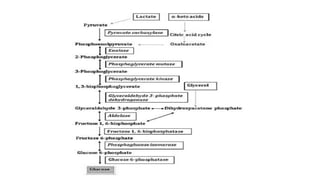
● Gluconeogenesis begins in the mitochondria with the formation of oxaloacetate by the
carboxylation of pyruvate.
● This reaction requires one molecule of ATP, and it is catalyzed by pyruvate
carboxylase. This enzyme is stimulated by acetyl-CoA which is produced in
β-oxidation in the liver, and inhibited by high levels of adenosine diphosphate (ADP)
and glucose.
● Oxaloacetate is reduced to malate using NADH, This step required for its
transportation out of the mitochondria.
● Malate is oxidized to oxaloacetate using NAD+
in the cytosol, where the remaining
steps of gluconeogenesis take place.
● Oxaloacetate is decarboxylated and then phosphorylated to form
phosphoenolpyruvate using the enzyme PEPCK. (Phosphoenolpyruvate kinase)
● A molecule of GTP is hydrolyzed to GDP during this reaction.
● The next steps in the reaction are the same as reversed glycolysis.
● Phosphoenolpyruvate converts to 2 Phosphoglycerate using the enzyme enolase.
● 2 Phosphoglycerate converts or Phosphorylated to 3 Phosphoglycerate using the
enzyme Phosphoglycerate Mutase.
● 3 Phosphoglycerate converts to 1 3 Bisphosphoglycerate by using the enzyme
Phosphoglycerate kinase
● 1 3 Bisphosphoglycerate converts to Glyceraldehyde 3 Phosphate by using the
enzyme Glyceraldehyde 3 phosphate dehydrogenase.
● Glyceraldehyde 3 Phosphate converts to Dihydroxyacetone phosphate using the
enzyme Triose phosphate isomerase. Dihydroxyacetone phosphate converts to
Fructose 1 6 bisphosphate using the enzyme Aldolase
● In gluconeogenesis, fructose 1,6-bisphosphatase converts fructose
1,6-bisphosphate to fructose 6-phosphate, using one water molecule and releasing
one phosphate (in glycolysis, phosphofructokinase converts fructose
1,6-bisphosphate to fructose 6-phosphate and ATP to ADP).
● Glucose-6-phosphate is formed from fructose 6-phosphate by
phosphoglucoisomerase. Glucose-6-phosphate can be used in other metabolic
pathways or dephosphorylated to free glucose.
● The final gluconeogenesis, the formation of glucose, occurs in the lumen of the
endoplasmic reticulum, where glucose-6-phosphate is hydrolyzed by
glucose-6-phosphatase to produce glucose and release an inorganic phosphate.
Like two steps prior, this step is not a simple reversal of glycolysis, in which
hexokinase catalyzes the conversion of glucose and ATP ADP. Glucose is shuttled
into the cytoplasm by glucose transporters located in the endoplasmic reticulum's
membrane.
LOCATION
● In mammals, gluconeogenesis has been believed to be restricted to the liver, the kidney,
the intestine, and muscle, but recent evidence indicates gluconeogenesis occurring in
astrocytes of the brain.
● These organs use somewhat different gluconeogenic precursors.
● The liver preferentially uses lactate, glycerol, and glucogenic amino acids (especially
alanine) while the kidney preferentially uses lactate, glutamine and glycerol.
● Lactate from the Cori cycle is quantitatively the largest source of substrate for
gluconeogenesis, especially for the kidney.
● The liver uses both glycogenolysis and gluconeogenesis to produce glucose, whereas
the kidney only uses gluconeogenesis.
SUBSTRATES FOR GLUCONEOGENESIS
The major substrates of gluconeogenesis are lactate, glycerol, and glucogenic amino
acids.
LACTATE
● Lactate is a product of anaerobic glycolysis. When oxygen is limited (such as
during vigorous exercise or in low perfusion states) cells must perform anaerobic
glycolysis to produce ATP. Cells that lack mitochondria (e.g., erythrocytes) cannot
perform oxidative phosphorylation, and as a result rely strictly on anaerobic
glycolysis to meet energy demands.
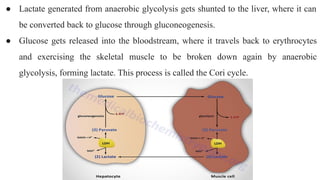
● Lactate generated from anaerobic glycolysis gets shunted to the liver, where it can
be converted back to glucose through gluconeogenesis.
● Glucose gets released into the bloodstream, where it travels back to erythrocytes
and exercising the skeletal muscle to be broken down again by anaerobic
glycolysis, forming lactate. This process is called the Cori cycle.
GLYCEROL
● Glycerol comes from adipose tissue.
● The breakdown of triacylglycerols in adipose tissue yields free fatty acids and
glycerol molecules, the latter of which can circulate freely in the bloodstream until
it reaches the liver.
● Glycerol is then phosphorylated by the hepatic enzyme glycerol kinase to yield
glycerol 3 phosphate. Next, the enzyme glycerol phosphate dehydrogenase oxidizes
glycerol phosphate to yield dihydroxyacetone phosphate, a glycolytic intermediate.
GLUCOGENIC AMINO ACIDS
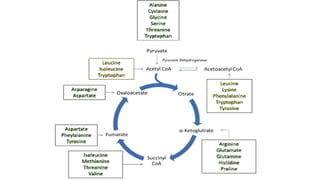
● Glucogenic amino acids enter gluconeogenesis via the citric acid cycle.
● Glucogenic amino acids are catabolized into citric acid cycle metabolites such as
alpha-ketoglutarate, succinyl CoA, and fumarate.
● Through the citric acid cycle, these alpha-keto acids converts to oxaloacetate,
which is the substrate for the gluconeogenic enzyme PEP kinase
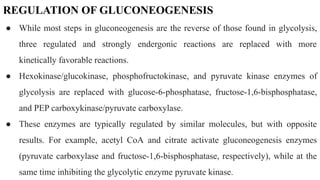
REGULATION OF GLUCONEOGENESIS
● While most steps in gluconeogenesis are the reverse of those found in glycolysis,
three regulated and strongly endergonic reactions are replaced with more
kinetically favorable reactions.
● Hexokinase/glucokinase, phosphofructokinase, and pyruvate kinase enzymes of
glycolysis are replaced with glucose-6-phosphatase, fructose-1,6-bisphosphatase,
and PEP carboxykinase/pyruvate carboxylase.
● These enzymes are typically regulated by similar molecules, but with opposite
results. For example, acetyl CoA and citrate activate gluconeogenesis enzymes
(pyruvate carboxylase and fructose-1,6-bisphosphatase, respectively), while at the
same time inhibiting the glycolytic enzyme pyruvate kinase.
● This system of reciprocal control allows glycolysis and gluconeogenesis to inhibit each
other and prevents a futile cycle of synthesizing glucose to only break it down. Pyruvate
kinase can be also bypassed by 86 pathways not related to gluconeogenesis, for the
purpose of forming pyruvate and subsequently lactate; some of these pathways use
carbon atoms originating from glucose.
● The majority of the enzymes responsible for gluconeogenesis are found in the cytosol;
the exceptions are mitochondrial pyruvate carboxylase and, in animals,
phosphoenolpyruvate carboxykinase. The latter exists as an isozyme located in both the
mitochondria and the cytosol.
● The rate of gluconeogenesis is ultimately controlled by the action of a key enzyme,
fructose-1,6-bisphosphatase, which is also regulated through signal transduction by
cAMP and its phosphorylation
SUMMARY AND CONCLUSION
● Gluconeogenesis is essentially the reversal of glycolysis. However, to bypass the
three highly exergonic (and essentially irreversible) steps of glycolysis,
gluconeogenesis utilizes four unique enzymes. The enzymes unique to
gluconeogenesis are pyruvate carboxylase, PEP carboxykinase, fructose
1,6-bisphosphatase, and glucose 6-phosphatase. Because these enzymes are not
present in all cell types, gluconeogenesis can only occur in specific tissues. In
humans, gluconeogenesis takes place primarily in the liver and, to a lesser extent,
the renal cortex.
● The major substrates of gluconeogenesis are lactate, glycerol, and glucogenic
amino acids.
REFERENCES
Nelson DL, Cox MM (2000). Lehninger Principles of Biochemistry. USA: Worth
Publishers. p. 724. ISBN 978-1-57259-153-0.
https://en.wikipedia.org/wiki/Gluconeogenesis
http://themedicalbiochemistrypage.org/gluconeogenesis-endogenous-glucose-synthesis/
Glucogenic or ketogenic_amino_acids/khanacademy
Erica A et al Physiology, Gluconeogenesis
THANK
YOU

Biomolecular metabolism- Gluconeogenesis

  • 1.
    BHARATHIAR UNIVERSITY BIOMOLECULAR METABOLISM TOPIC: GLUCONEOGENESIS PRESENTED BY : SUMESH.M 21MBTB24 1st. M. Sc., Microbiology Bharathiar University
  • 2.
    CONTENTS 1. Introduction 2. Gluconeogenesispathway 3. Location of pathway 4. Substrates of gluconeogenesis 5. Regulation 6. Summary and conclusion 7. References
  • 3.
    INTRODUCTION ● Gluconeogenesis (GNG)is a metabolic pathway that results in the generation of glucose from certain non-carbohydrate carbon substrates. It is a ubiquitous process, present in plants, animals, fungi, bacteria, and other microorganisms. ● In vertebrates, gluconeogenesis occurs mainly in the liver and, to a lesser extent, in the cortex of the kidneys. It is one of two primary mechanisms – the other being degradation of glycogen (glycogenolysis). ● The primary carbon sources used for gluconeogenesis are derived from pyruvate, lactate, glycerol, and the amino acids alanine and glutamine.
  • 4.
    GLUCONEOGENESIS PATHWAY Gluconeogenesis isa pathway of eleven enzyme-catalyzed reactions. The pathway will begin in either the liver or kidney, in the mitochondria or cytoplasm of those cells, this being dependent on the substrate being used. Many of the reactions are the reverse of steps found in glycolysis. ● Gluconeogenesis begins in the mitochondria with the formation of oxaloacetate by the carboxylation of pyruvate. ● This reaction requires one molecule of ATP, and it is catalyzed by pyruvate carboxylase. This enzyme is stimulated by acetyl-CoA which is produced in β-oxidation in the liver, and inhibited by high levels of adenosine diphosphate (ADP) and glucose.
  • 5.
    ● Oxaloacetate isreduced to malate using NADH, This step required for its transportation out of the mitochondria. ● Malate is oxidized to oxaloacetate using NAD+ in the cytosol, where the remaining steps of gluconeogenesis take place. ● Oxaloacetate is decarboxylated and then phosphorylated to form phosphoenolpyruvate using the enzyme PEPCK. (Phosphoenolpyruvate kinase) ● A molecule of GTP is hydrolyzed to GDP during this reaction. ● The next steps in the reaction are the same as reversed glycolysis. ● Phosphoenolpyruvate converts to 2 Phosphoglycerate using the enzyme enolase. ● 2 Phosphoglycerate converts or Phosphorylated to 3 Phosphoglycerate using the enzyme Phosphoglycerate Mutase.
  • 6.
    ● 3 Phosphoglycerateconverts to 1 3 Bisphosphoglycerate by using the enzyme Phosphoglycerate kinase ● 1 3 Bisphosphoglycerate converts to Glyceraldehyde 3 Phosphate by using the enzyme Glyceraldehyde 3 phosphate dehydrogenase. ● Glyceraldehyde 3 Phosphate converts to Dihydroxyacetone phosphate using the enzyme Triose phosphate isomerase. Dihydroxyacetone phosphate converts to Fructose 1 6 bisphosphate using the enzyme Aldolase ● In gluconeogenesis, fructose 1,6-bisphosphatase converts fructose 1,6-bisphosphate to fructose 6-phosphate, using one water molecule and releasing one phosphate (in glycolysis, phosphofructokinase converts fructose 1,6-bisphosphate to fructose 6-phosphate and ATP to ADP).
  • 7.
    ● Glucose-6-phosphate isformed from fructose 6-phosphate by phosphoglucoisomerase. Glucose-6-phosphate can be used in other metabolic pathways or dephosphorylated to free glucose. ● The final gluconeogenesis, the formation of glucose, occurs in the lumen of the endoplasmic reticulum, where glucose-6-phosphate is hydrolyzed by glucose-6-phosphatase to produce glucose and release an inorganic phosphate. Like two steps prior, this step is not a simple reversal of glycolysis, in which hexokinase catalyzes the conversion of glucose and ATP ADP. Glucose is shuttled into the cytoplasm by glucose transporters located in the endoplasmic reticulum's membrane.
  • 10.
    LOCATION ● In mammals,gluconeogenesis has been believed to be restricted to the liver, the kidney, the intestine, and muscle, but recent evidence indicates gluconeogenesis occurring in astrocytes of the brain. ● These organs use somewhat different gluconeogenic precursors. ● The liver preferentially uses lactate, glycerol, and glucogenic amino acids (especially alanine) while the kidney preferentially uses lactate, glutamine and glycerol. ● Lactate from the Cori cycle is quantitatively the largest source of substrate for gluconeogenesis, especially for the kidney. ● The liver uses both glycogenolysis and gluconeogenesis to produce glucose, whereas the kidney only uses gluconeogenesis.
  • 11.
    SUBSTRATES FOR GLUCONEOGENESIS Themajor substrates of gluconeogenesis are lactate, glycerol, and glucogenic amino acids. LACTATE ● Lactate is a product of anaerobic glycolysis. When oxygen is limited (such as during vigorous exercise or in low perfusion states) cells must perform anaerobic glycolysis to produce ATP. Cells that lack mitochondria (e.g., erythrocytes) cannot perform oxidative phosphorylation, and as a result rely strictly on anaerobic glycolysis to meet energy demands.
  • 12.
    ● Lactate generatedfrom anaerobic glycolysis gets shunted to the liver, where it can be converted back to glucose through gluconeogenesis. ● Glucose gets released into the bloodstream, where it travels back to erythrocytes and exercising the skeletal muscle to be broken down again by anaerobic glycolysis, forming lactate. This process is called the Cori cycle.
  • 13.
    GLYCEROL ● Glycerol comesfrom adipose tissue. ● The breakdown of triacylglycerols in adipose tissue yields free fatty acids and glycerol molecules, the latter of which can circulate freely in the bloodstream until it reaches the liver. ● Glycerol is then phosphorylated by the hepatic enzyme glycerol kinase to yield glycerol 3 phosphate. Next, the enzyme glycerol phosphate dehydrogenase oxidizes glycerol phosphate to yield dihydroxyacetone phosphate, a glycolytic intermediate.
  • 15.
    GLUCOGENIC AMINO ACIDS ●Glucogenic amino acids enter gluconeogenesis via the citric acid cycle. ● Glucogenic amino acids are catabolized into citric acid cycle metabolites such as alpha-ketoglutarate, succinyl CoA, and fumarate. ● Through the citric acid cycle, these alpha-keto acids converts to oxaloacetate, which is the substrate for the gluconeogenic enzyme PEP kinase
  • 17.
    REGULATION OF GLUCONEOGENESIS ●While most steps in gluconeogenesis are the reverse of those found in glycolysis, three regulated and strongly endergonic reactions are replaced with more kinetically favorable reactions. ● Hexokinase/glucokinase, phosphofructokinase, and pyruvate kinase enzymes of glycolysis are replaced with glucose-6-phosphatase, fructose-1,6-bisphosphatase, and PEP carboxykinase/pyruvate carboxylase. ● These enzymes are typically regulated by similar molecules, but with opposite results. For example, acetyl CoA and citrate activate gluconeogenesis enzymes (pyruvate carboxylase and fructose-1,6-bisphosphatase, respectively), while at the same time inhibiting the glycolytic enzyme pyruvate kinase.
  • 18.
    ● This systemof reciprocal control allows glycolysis and gluconeogenesis to inhibit each other and prevents a futile cycle of synthesizing glucose to only break it down. Pyruvate kinase can be also bypassed by 86 pathways not related to gluconeogenesis, for the purpose of forming pyruvate and subsequently lactate; some of these pathways use carbon atoms originating from glucose. ● The majority of the enzymes responsible for gluconeogenesis are found in the cytosol; the exceptions are mitochondrial pyruvate carboxylase and, in animals, phosphoenolpyruvate carboxykinase. The latter exists as an isozyme located in both the mitochondria and the cytosol. ● The rate of gluconeogenesis is ultimately controlled by the action of a key enzyme, fructose-1,6-bisphosphatase, which is also regulated through signal transduction by cAMP and its phosphorylation
  • 19.
    SUMMARY AND CONCLUSION ●Gluconeogenesis is essentially the reversal of glycolysis. However, to bypass the three highly exergonic (and essentially irreversible) steps of glycolysis, gluconeogenesis utilizes four unique enzymes. The enzymes unique to gluconeogenesis are pyruvate carboxylase, PEP carboxykinase, fructose 1,6-bisphosphatase, and glucose 6-phosphatase. Because these enzymes are not present in all cell types, gluconeogenesis can only occur in specific tissues. In humans, gluconeogenesis takes place primarily in the liver and, to a lesser extent, the renal cortex. ● The major substrates of gluconeogenesis are lactate, glycerol, and glucogenic amino acids.
  • 20.
    REFERENCES Nelson DL, CoxMM (2000). Lehninger Principles of Biochemistry. USA: Worth Publishers. p. 724. ISBN 978-1-57259-153-0. https://en.wikipedia.org/wiki/Gluconeogenesis http://themedicalbiochemistrypage.org/gluconeogenesis-endogenous-glucose-synthesis/ Glucogenic or ketogenic_amino_acids/khanacademy Erica A et al Physiology, Gluconeogenesis
  • 21.