GLYCOLYSIS
Kamal Singh Khadka
GLYCOLYSIS
It is defined as a sequence of reactions converting
glucose to pyruvate or lactate, with the
production of ATP.
Greek: glykys = sweet; lysis = splitting
SALIENT FEATURES OF GLYCOLYSIS
• takes place in all cells of the body
• the enzymes of this pathway are present in cytosol of cells
• in absence of oxygen -anaerobic glycolysis takes place ,
lactate is the end product.
• in presence of oxygen -aerobic glycolysis, pyruvate is the
end product.
•it is also known as Embden-Meyerhof (e.m.) pathway. (
Gustav Embden; Otto Meyerhof; German Biochemists -
elucided the whole pathway in muscle. )
• glycolysis is the major pathway for ATP synthesis in
tissues lacking mitochondria.
• glycolysis is very essential for brain.
• the intermediates of glycolysis is used in formation
of non-essential amino acids and glycerol.
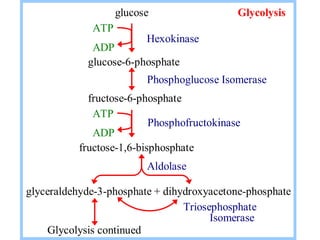
Hexokinase
Phosphofructokinase
glucose Glycolysis
ATP
ADP
glucose-6-phosphate
Phosphoglucose Isomerase
fructose-6-phosphate
ATP
ADP
fructose-1,6-bisphosphate
Aldolase
glyceraldehyde-3-phosphate + dihydroxyacetone-phosphate
Triosephosphate
Isomerase
Glycolysis continued
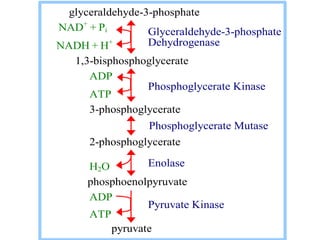
Glyceraldehyde-3-phosphate
Dehydrogenase
Phosphoglycerate Kinase
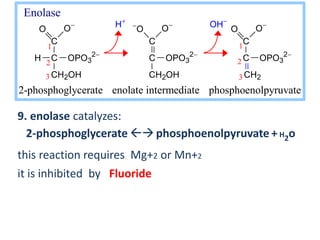
Enolase
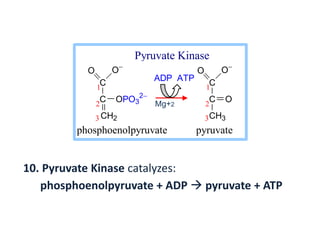
Pyruvate Kinase
glyceraldehyde-3-phosphate
NAD+
+ Pi
NADH + H+
1,3-bisphosphoglycerate
ADP
ATP
3-phosphoglycerate
Phosphoglycerate Mutase
2-phosphoglycerate
H2O
phosphoenolpyruvate
ADP
ATP
pyruvate
H O
OH
H
OHH
OH
CH2OH
H
OH
H H O
OH
H
OHH
OH
CH2OPO3
2
H
OH
H
23
4
5
6
1 1
6
5
4
3 2
ATP ADP
Mg2+
glucose glucose-6-phosphate
Hexokinase
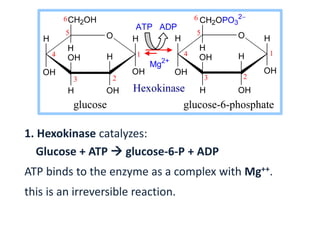
1. Hexokinase catalyzes:
Glucose + ATP  glucose-6-P + ADP
ATP binds to the enzyme as a complex with Mg++.
this is an irreversible reaction.
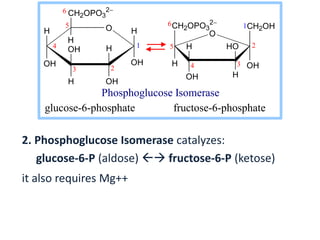
2. Phosphoglucose Isomerase catalyzes:
glucose-6-P (aldose)  fructose-6-P (ketose)
it also requires Mg++
H O
OH
H
OHH
OH
CH2OPO3
2
H
OH
H
1
6
5
4
3 2
CH2OPO3
2
OH
CH2OH
H
OH H
H HO
O
6
5
4 3
2
1
glucose-6-phosphate fructose-6-phosphate
Phosphoglucose Isomerase
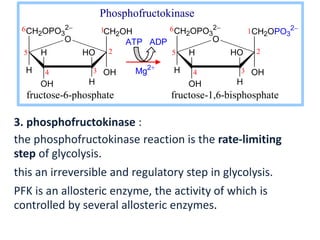
3. phosphofructokinase :
the phosphofructokinase reaction is the rate-limiting
step of glycolysis.
this an irreversible and regulatory step in glycolysis.
PFK is an allosteric enzyme, the activity of which is
controlled by several allosteric enzymes.
CH2OPO3
2
OH
CH2OH
H
OH H
H HO
O
6
5
4 3
2
1 CH2OPO3
2
OH
CH2OPO3
2
H
OH H
H HO
O
6
5
4 3
2
1
ATP ADP
Mg2+
fructose-6-phosphate fructose-1,6-bisphosphate
Phosphofructokinase
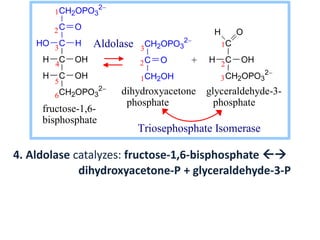
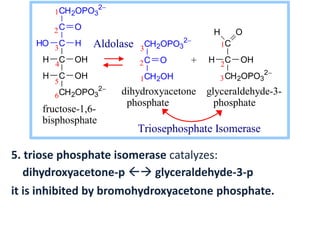
4. Aldolase catalyzes: fructose-1,6-bisphosphate 
dihydroxyacetone-P + glyceraldehyde-3-P
6
5
4
3
2
1CH2OPO3
2
C
C
C
C
CH2OPO3
2
O
HO H
H OH
H OH
3
2
1
CH2OPO3
2
C
CH2OH
O
C
C
CH2OPO3
2
H O
H OH+
1
2
3
fructose-1,6-
bisphosphate
Aldolase
dihydroxyacetone glyceraldehyde-3-
phosphate phosphate
Triosephosphate Isomerase
5. triose phosphate isomerase catalyzes:
dihydroxyacetone-p  glyceraldehyde-3-p
it is inhibited by bromohydroxyacetone phosphate.
6
5
4
3
2
1CH2OPO3
2
C
C
C
C
CH2OPO3
2
O
HO H
H OH
H OH
3
2
1
CH2OPO3
2
C
CH2OH
O
C
C
CH2OPO3
2
H O
H OH+
1
2
3
fructose-1,6-
bisphosphate
Aldolase
dihydroxyacetone glyceraldehyde-3-
phosphate phosphate
Triosephosphate Isomerase
C
C
CH2OPO3
2
H O
H OH
C
C
CH2OPO3
2
O OPO3
2
H OH
+ Pi
+ H+
NAD+
NADH 1
2
3
2
3
1
glyceraldehyde- 1,3-bisphospho-
3-phosphate glycerate
Glyceraldehyde-3-phosphate
Dehydrogenase
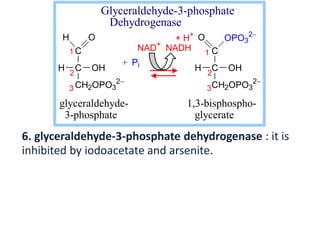
6. glyceraldehyde-3-phosphate dehydrogenase : it is
inhibited by iodoacetate and arsenite.
C
C
CH2OPO3
2
O OPO3
2
H OH
C
C
CH2OPO3
2
O O
H OH
ADP ATP
1
22
3 3
1
Mg2+
1,3-bisphospho- 3-phosphoglycerate
glycerate
Phosphoglycerate Kinase
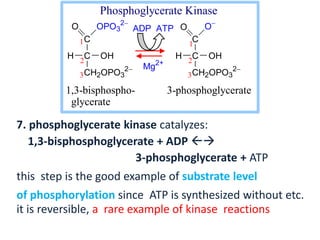
7. phosphoglycerate kinase catalyzes:
1,3-bisphosphoglycerate + ADP 
3-phosphoglycerate + ATP
this step is the good example of substrate level
of phosphorylation since ATP is synthesized without etc.
it is reversible, a rare example of kinase reactions
C
C
CH2OH
O O
H OPO3
2
2
3
1
C
C
CH2OPO3
2
O O
H OH2
3
1
3-phosphoglycerate 2-phosphoglycerate
Phosphoglycerate Mutase
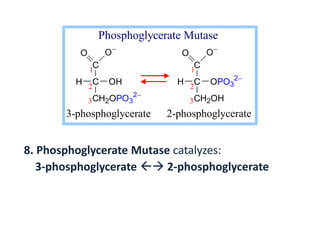
8. Phosphoglycerate Mutase catalyzes:
3-phosphoglycerate  2-phosphoglycerate
9. enolase catalyzes:
2-phosphoglycerate phosphoenolpyruvate + H2o
this reaction requires Mg+2 or Mn+2
it is inhibited by Fluoride
C
C
CH2OH
O O
H OPO3
2
C
C
CH2OH

O O
OPO3
2
C
C
CH2
O O
OPO3
2
OH
2
3
1
2
3
1
H
2-phosphoglycerate enolate intermediate phosphoenolpyruvate
Enolase
10. Pyruvate Kinase catalyzes:
phosphoenolpyruvate + ADP  pyruvate + ATP
C
C
CH3
O O
O2
3
1
ADP ATP
C
C
CH2
O O
OPO3
2
2
3
1
phosphoenolpyruvate pyruvate
Pyruvate Kinase
Mg+2
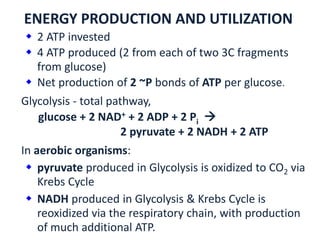
ENERGY PRODUCTION AND UTILIZATION
 2 ATP invested
 4 ATP produced (2 from each of two 3C fragments
from glucose)
 Net production of 2 ~P bonds of ATP per glucose.
Glycolysis - total pathway,
glucose + 2 NAD+ + 2 ADP + 2 Pi 
2 pyruvate + 2 NADH + 2 ATP
In aerobic organisms:
 pyruvate produced in Glycolysis is oxidized to CO2 via
Krebs Cycle
 NADH produced in Glycolysis & Krebs Cycle is
reoxidized via the respiratory chain, with production
of much additional ATP.
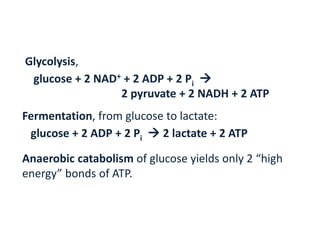
Glycolysis,
glucose + 2 NAD+ + 2 ADP + 2 Pi 
2 pyruvate + 2 NADH + 2 ATP
Fermentation, from glucose to lactate:
glucose + 2 ADP + 2 Pi  2 lactate + 2 ATP
Anaerobic catabolism of glucose yields only 2 “high
energy” bonds of ATP.
C
C
CH3
O
O
O
C
HC
CH3
O
OH
O
NADH + H+
NAD+
Lactate Dehydrogenase
pyruvate lactate
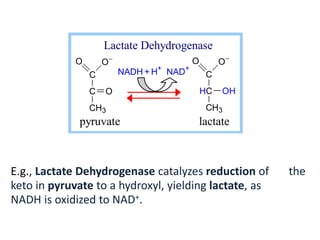
E.g., Lactate Dehydrogenase catalyzes reduction of the
keto in pyruvate to a hydroxyl, yielding lactate, as
NADH is oxidized to NAD+.
REGULATION OF GLYCOLYSIS
Glycolysis pathway is regulated by control of 3
enzymes :
1) Hexokinase
2) Phosphofructokinase
3) Pyruvate Kinase.
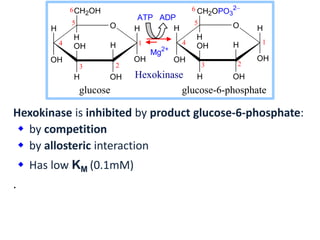
Hexokinase is inhibited by product glucose-6-phosphate:
 by competition
 by allosteric interaction
 Has low KM (0.1mM)
.
H O
OH
H
OHH
OH
CH2OH
H
OH
H H O
OH
H
OHH
OH
CH2OPO3
2
H
OH
H
23
4
5
6
1 1
6
5
4
3 2
ATP ADP
Mg2+
glucose glucose-6-phosphate
Hexokinase
 Glucokinase has a high KM (10mM) for glucose.
It is active only at high [glucose].
H O
OH
H
OHH
OH
CH2OH
H
OH
H H O
OH
H
OHH
OH
CH2OPO3
2
H
OH
H
23
4
5
6
1 1
6
5
4
3 2
ATP ADP
Mg2+
glucose glucose-6-phosphate
Hexokinase
Glucokinase (
a variant of
Hexokinase) is
found in liver.
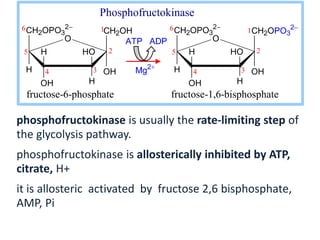
phosphofructokinase is usually the rate-limiting step of
the glycolysis pathway.
phosphofructokinase is allosterically inhibited by ATP,
citrate, H+
it is allosteric activated by fructose 2,6 bisphosphate,
AMP, Pi
CH2OPO3
2
OH
CH2OH
H
OH H
H HO
O
6
5
4 3
2
1 CH2OPO3
2
OH
CH2OPO3
2
H
OH H
H HO
O
6
5
4 3
2
1
ATP ADP
Mg2+
fructose-6-phosphate fructose-1,6-bisphosphate
Phosphofructokinase
C
C
CH3
O O
O2
3
1
ADP ATP
C
C
CH2
O O
OPO3
2
2
3
1
phosphoenolpyruvate pyruvate
Pyruvate Kinase
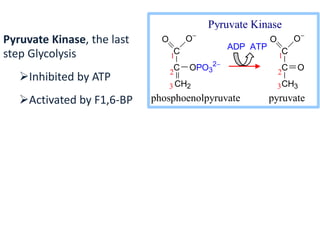
Pyruvate Kinase, the last
step Glycolysis
Inhibited by ATP
Activated by F1,6-BP
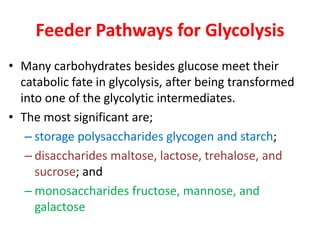
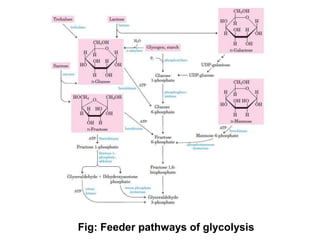
Feeder Pathways for Glycolysis
• Many carbohydrates besides glucose meet their
catabolic fate in glycolysis, after being transformed
into one of the glycolytic intermediates.
• The most significant are;
– storage polysaccharides glycogen and starch;
– disaccharides maltose, lactose, trehalose, and
sucrose; and
– monosaccharides fructose, mannose, and
galactose
Fig: Feeder pathways of glycolysis
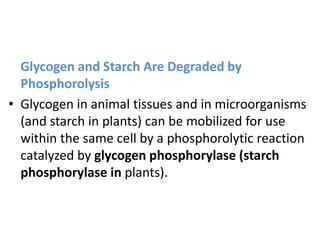
Glycogen and Starch Are Degraded by
Phosphorolysis
• Glycogen in animal tissues and in microorganisms
(and starch in plants) can be mobilized for use
within the same cell by a phosphorolytic reaction
catalyzed by glycogen phosphorylase (starch
phosphorylase in plants).
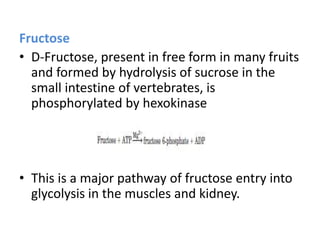
Fructose
• D-Fructose, present in free form in many fruits
and formed by hydrolysis of sucrose in the
small intestine of vertebrates, is
phosphorylated by hexokinase
• This is a major pathway of fructose entry into
glycolysis in the muscles and kidney.
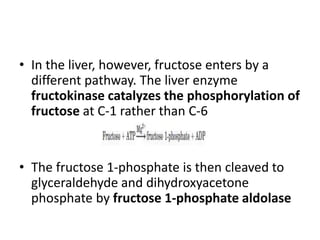
• In the liver, however, fructose enters by a
different pathway. The liver enzyme
fructokinase catalyzes the phosphorylation of
fructose at C-1 rather than C-6
• The fructose 1-phosphate is then cleaved to
glyceraldehyde and dihydroxyacetone
phosphate by fructose 1-phosphate aldolase
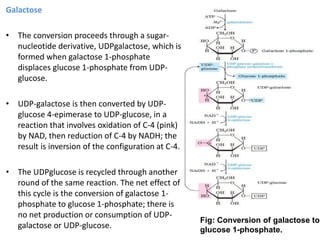
Galactose
• The conversion proceeds through a sugar-
nucleotide derivative, UDPgalactose, which is
formed when galactose 1-phosphate
displaces glucose 1-phosphate from UDP-
glucose.
• UDP-galactose is then converted by UDP-
glucose 4-epimerase to UDP-glucose, in a
reaction that involves oxidation of C-4 (pink)
by NAD, then reduction of C-4 by NADH; the
result is inversion of the configuration at C-4.
• The UDPglucose is recycled through another
round of the same reaction. The net effect of
this cycle is the conversion of galactose 1-
phosphate to glucose 1-phosphate; there is
no net production or consumption of UDP-
galactose or UDP-glucose.
Fig: Conversion of galactose to
glucose 1-phosphate.
Pasteur effect
• The inhibition of glycolysis by oxygen (aerobic condition)
is known as Pasteur effect.
• Discovered by Louis Pasteur while studying fermentation
in yeast.
• He observed that when anaerobic yeast cultures were
exposed to air, the utilization of glucose decreased by 7 fold.
• The levels of glycolytic intermediates from fructose 1,6
bisphosphate onward decrease while the earlier
intermediates accumulate
• This is due to inhibition of Phosphofructokinase
• The inhibitory effect of citrate and ATP on
phosphofructokinase explains the Pasteur effect
Crabtree effect
• The phenomenon of inhibition of oxygen consumption
by the addition of glucose to tissues having high
aerobic glycolysis is known as Crabtree effect.
• It is due to increased competition of glycolysis for
inorganic phosphate (Pi) and NAD+ which limits their
availability for phosphorylation and oxidation
Glycolysis

Glycolysis

  • 1.
  • 2.
    GLYCOLYSIS It is definedas a sequence of reactions converting glucose to pyruvate or lactate, with the production of ATP. Greek: glykys = sweet; lysis = splitting
  • 3.
    SALIENT FEATURES OFGLYCOLYSIS • takes place in all cells of the body • the enzymes of this pathway are present in cytosol of cells • in absence of oxygen -anaerobic glycolysis takes place , lactate is the end product. • in presence of oxygen -aerobic glycolysis, pyruvate is the end product. •it is also known as Embden-Meyerhof (e.m.) pathway. ( Gustav Embden; Otto Meyerhof; German Biochemists - elucided the whole pathway in muscle. )
  • 4.
    • glycolysis isthe major pathway for ATP synthesis in tissues lacking mitochondria. • glycolysis is very essential for brain. • the intermediates of glycolysis is used in formation of non-essential amino acids and glycerol.
  • 5.
  • 6.
    Glyceraldehyde-3-phosphate Dehydrogenase Phosphoglycerate Kinase Enolase Pyruvate Kinase glyceraldehyde-3-phosphate NAD+ +Pi NADH + H+ 1,3-bisphosphoglycerate ADP ATP 3-phosphoglycerate Phosphoglycerate Mutase 2-phosphoglycerate H2O phosphoenolpyruvate ADP ATP pyruvate
  • 7.
    H O OH H OHH OH CH2OH H OH H HO OH H OHH OH CH2OPO3 2 H OH H 23 4 5 6 1 1 6 5 4 3 2 ATP ADP Mg2+ glucose glucose-6-phosphate Hexokinase 1. Hexokinase catalyzes: Glucose + ATP  glucose-6-P + ADP ATP binds to the enzyme as a complex with Mg++. this is an irreversible reaction.
  • 8.
    2. Phosphoglucose Isomerasecatalyzes: glucose-6-P (aldose)  fructose-6-P (ketose) it also requires Mg++ H O OH H OHH OH CH2OPO3 2 H OH H 1 6 5 4 3 2 CH2OPO3 2 OH CH2OH H OH H H HO O 6 5 4 3 2 1 glucose-6-phosphate fructose-6-phosphate Phosphoglucose Isomerase
  • 9.
    3. phosphofructokinase : thephosphofructokinase reaction is the rate-limiting step of glycolysis. this an irreversible and regulatory step in glycolysis. PFK is an allosteric enzyme, the activity of which is controlled by several allosteric enzymes. CH2OPO3 2 OH CH2OH H OH H H HO O 6 5 4 3 2 1 CH2OPO3 2 OH CH2OPO3 2 H OH H H HO O 6 5 4 3 2 1 ATP ADP Mg2+ fructose-6-phosphate fructose-1,6-bisphosphate Phosphofructokinase
  • 10.
    4. Aldolase catalyzes:fructose-1,6-bisphosphate  dihydroxyacetone-P + glyceraldehyde-3-P 6 5 4 3 2 1CH2OPO3 2 C C C C CH2OPO3 2 O HO H H OH H OH 3 2 1 CH2OPO3 2 C CH2OH O C C CH2OPO3 2 H O H OH+ 1 2 3 fructose-1,6- bisphosphate Aldolase dihydroxyacetone glyceraldehyde-3- phosphate phosphate Triosephosphate Isomerase
  • 11.
    5. triose phosphateisomerase catalyzes: dihydroxyacetone-p  glyceraldehyde-3-p it is inhibited by bromohydroxyacetone phosphate. 6 5 4 3 2 1CH2OPO3 2 C C C C CH2OPO3 2 O HO H H OH H OH 3 2 1 CH2OPO3 2 C CH2OH O C C CH2OPO3 2 H O H OH+ 1 2 3 fructose-1,6- bisphosphate Aldolase dihydroxyacetone glyceraldehyde-3- phosphate phosphate Triosephosphate Isomerase
  • 12.
    C C CH2OPO3 2 H O H OH C C CH2OPO3 2 OOPO3 2 H OH + Pi + H+ NAD+ NADH 1 2 3 2 3 1 glyceraldehyde- 1,3-bisphospho- 3-phosphate glycerate Glyceraldehyde-3-phosphate Dehydrogenase 6. glyceraldehyde-3-phosphate dehydrogenase : it is inhibited by iodoacetate and arsenite.
  • 13.
    C C CH2OPO3 2 O OPO3 2 H OH C C CH2OPO3 2 OO H OH ADP ATP 1 22 3 3 1 Mg2+ 1,3-bisphospho- 3-phosphoglycerate glycerate Phosphoglycerate Kinase 7. phosphoglycerate kinase catalyzes: 1,3-bisphosphoglycerate + ADP  3-phosphoglycerate + ATP this step is the good example of substrate level of phosphorylation since ATP is synthesized without etc. it is reversible, a rare example of kinase reactions
  • 14.
    C C CH2OH O O H OPO3 2 2 3 1 C C CH2OPO3 2 OO H OH2 3 1 3-phosphoglycerate 2-phosphoglycerate Phosphoglycerate Mutase 8. Phosphoglycerate Mutase catalyzes: 3-phosphoglycerate  2-phosphoglycerate
  • 15.
    9. enolase catalyzes: 2-phosphoglyceratephosphoenolpyruvate + H2o this reaction requires Mg+2 or Mn+2 it is inhibited by Fluoride C C CH2OH O O H OPO3 2 C C CH2OH  O O OPO3 2 C C CH2 O O OPO3 2 OH 2 3 1 2 3 1 H 2-phosphoglycerate enolate intermediate phosphoenolpyruvate Enolase
  • 16.
    10. Pyruvate Kinasecatalyzes: phosphoenolpyruvate + ADP  pyruvate + ATP C C CH3 O O O2 3 1 ADP ATP C C CH2 O O OPO3 2 2 3 1 phosphoenolpyruvate pyruvate Pyruvate Kinase Mg+2
  • 17.
    ENERGY PRODUCTION ANDUTILIZATION  2 ATP invested  4 ATP produced (2 from each of two 3C fragments from glucose)  Net production of 2 ~P bonds of ATP per glucose. Glycolysis - total pathway, glucose + 2 NAD+ + 2 ADP + 2 Pi  2 pyruvate + 2 NADH + 2 ATP In aerobic organisms:  pyruvate produced in Glycolysis is oxidized to CO2 via Krebs Cycle  NADH produced in Glycolysis & Krebs Cycle is reoxidized via the respiratory chain, with production of much additional ATP.
  • 18.
    Glycolysis, glucose + 2NAD+ + 2 ADP + 2 Pi  2 pyruvate + 2 NADH + 2 ATP Fermentation, from glucose to lactate: glucose + 2 ADP + 2 Pi  2 lactate + 2 ATP Anaerobic catabolism of glucose yields only 2 “high energy” bonds of ATP.
  • 19.
    C C CH3 O O O C HC CH3 O OH O NADH + H+ NAD+ LactateDehydrogenase pyruvate lactate E.g., Lactate Dehydrogenase catalyzes reduction of the keto in pyruvate to a hydroxyl, yielding lactate, as NADH is oxidized to NAD+.
  • 20.
    REGULATION OF GLYCOLYSIS Glycolysispathway is regulated by control of 3 enzymes : 1) Hexokinase 2) Phosphofructokinase 3) Pyruvate Kinase.
  • 21.
    Hexokinase is inhibitedby product glucose-6-phosphate:  by competition  by allosteric interaction  Has low KM (0.1mM) . H O OH H OHH OH CH2OH H OH H H O OH H OHH OH CH2OPO3 2 H OH H 23 4 5 6 1 1 6 5 4 3 2 ATP ADP Mg2+ glucose glucose-6-phosphate Hexokinase
  • 22.
     Glucokinase hasa high KM (10mM) for glucose. It is active only at high [glucose]. H O OH H OHH OH CH2OH H OH H H O OH H OHH OH CH2OPO3 2 H OH H 23 4 5 6 1 1 6 5 4 3 2 ATP ADP Mg2+ glucose glucose-6-phosphate Hexokinase Glucokinase ( a variant of Hexokinase) is found in liver.
  • 23.
    phosphofructokinase is usuallythe rate-limiting step of the glycolysis pathway. phosphofructokinase is allosterically inhibited by ATP, citrate, H+ it is allosteric activated by fructose 2,6 bisphosphate, AMP, Pi CH2OPO3 2 OH CH2OH H OH H H HO O 6 5 4 3 2 1 CH2OPO3 2 OH CH2OPO3 2 H OH H H HO O 6 5 4 3 2 1 ATP ADP Mg2+ fructose-6-phosphate fructose-1,6-bisphosphate Phosphofructokinase
  • 24.
    C C CH3 O O O2 3 1 ADP ATP C C CH2 OO OPO3 2 2 3 1 phosphoenolpyruvate pyruvate Pyruvate Kinase Pyruvate Kinase, the last step Glycolysis Inhibited by ATP Activated by F1,6-BP
  • 25.
    Feeder Pathways forGlycolysis • Many carbohydrates besides glucose meet their catabolic fate in glycolysis, after being transformed into one of the glycolytic intermediates. • The most significant are; – storage polysaccharides glycogen and starch; – disaccharides maltose, lactose, trehalose, and sucrose; and – monosaccharides fructose, mannose, and galactose
  • 26.
    Fig: Feeder pathwaysof glycolysis
  • 27.
    Glycogen and StarchAre Degraded by Phosphorolysis • Glycogen in animal tissues and in microorganisms (and starch in plants) can be mobilized for use within the same cell by a phosphorolytic reaction catalyzed by glycogen phosphorylase (starch phosphorylase in plants).
  • 28.
    Fructose • D-Fructose, presentin free form in many fruits and formed by hydrolysis of sucrose in the small intestine of vertebrates, is phosphorylated by hexokinase • This is a major pathway of fructose entry into glycolysis in the muscles and kidney.
  • 29.
    • In theliver, however, fructose enters by a different pathway. The liver enzyme fructokinase catalyzes the phosphorylation of fructose at C-1 rather than C-6 • The fructose 1-phosphate is then cleaved to glyceraldehyde and dihydroxyacetone phosphate by fructose 1-phosphate aldolase
  • 30.
    Galactose • The conversionproceeds through a sugar- nucleotide derivative, UDPgalactose, which is formed when galactose 1-phosphate displaces glucose 1-phosphate from UDP- glucose. • UDP-galactose is then converted by UDP- glucose 4-epimerase to UDP-glucose, in a reaction that involves oxidation of C-4 (pink) by NAD, then reduction of C-4 by NADH; the result is inversion of the configuration at C-4. • The UDPglucose is recycled through another round of the same reaction. The net effect of this cycle is the conversion of galactose 1- phosphate to glucose 1-phosphate; there is no net production or consumption of UDP- galactose or UDP-glucose. Fig: Conversion of galactose to glucose 1-phosphate.
  • 31.
    Pasteur effect • Theinhibition of glycolysis by oxygen (aerobic condition) is known as Pasteur effect. • Discovered by Louis Pasteur while studying fermentation in yeast. • He observed that when anaerobic yeast cultures were exposed to air, the utilization of glucose decreased by 7 fold. • The levels of glycolytic intermediates from fructose 1,6 bisphosphate onward decrease while the earlier intermediates accumulate • This is due to inhibition of Phosphofructokinase • The inhibitory effect of citrate and ATP on phosphofructokinase explains the Pasteur effect
  • 32.
    Crabtree effect • Thephenomenon of inhibition of oxygen consumption by the addition of glucose to tissues having high aerobic glycolysis is known as Crabtree effect. • It is due to increased competition of glycolysis for inorganic phosphate (Pi) and NAD+ which limits their availability for phosphorylation and oxidation

Editor's Notes

  • #15 this enzyme requires Mg+2