GLUCONEOGENESIS
3/12/2020
GLUCONEOGENESIS
Definition
It is the process by which glucose molecules are
produced from non-carbohydrate precursors.
These include lactate, glucogenic amino acids,
glycerol part of fat and propionyl CoA derived from
odd chain fatty acids .
3/12/2020
3/12/2020
3/12/2020
3/12/2020
3/12/2020
3/12/2020
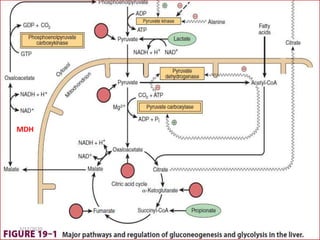
MDH
3/12/2020
3/12/2020
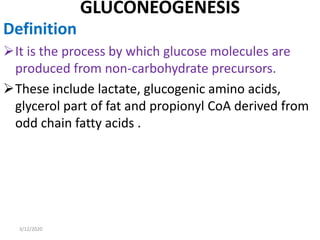
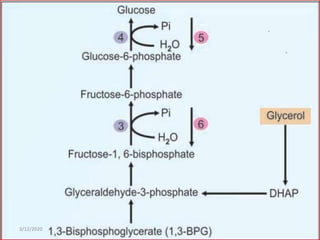
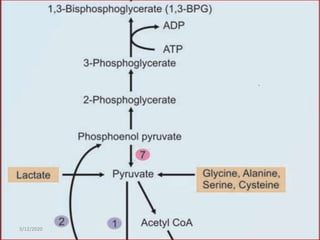
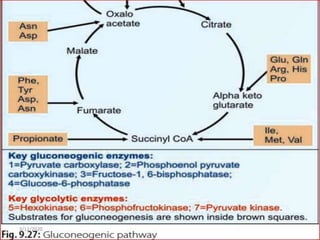
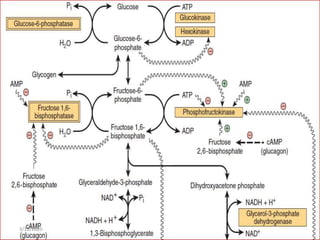
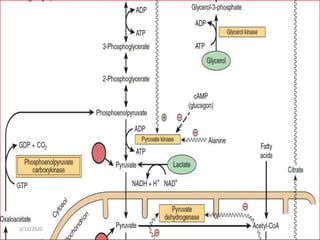
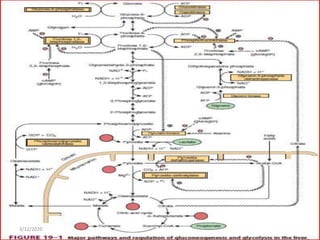
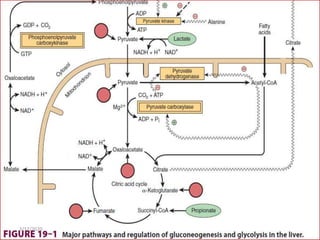
Fig. Major pathways and regulation of gluconeogenesis and
glycolysis in the liver.
 Entry points of glucogenic amino acids after transamination
are indicated by arrows extended from circles
 The key gluconeogenic enzymes are enclosed in double-
bordered boxes.
 The ATP required for gluconeogenesis is supplied by the
oxidation of fatty acids.
 Propionate is of quantitative importance only in ruminants.
 Arrows with wavy shafts signify allosteric effects.
 Dash-shafted arrows, covalent modification by reversible
phosphorylation.
 High concentrations of alanine act as a “gluconeogenic
signal” by inhibiting glycolysis at the pyruvate kinase step.
3/12/2020
GLUCONEOGENESIS : SITE
The liver, and to a lesser extent in the renal cortex.
The pathway is partly mitochondrial and partly
cytoplasmic.
3/12/2020
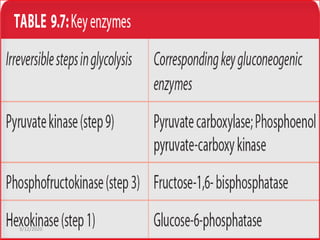
Key Gluconeogenic Enzymes
1. Pyruvate carboxylase
2. Phosphoenol pyruvate carboxy kinase
3. Fructose-1-6-bisphosphatase
4. Glucose-6-phosphatase
Gluconeogenesis involves several enzymes of
glycolysis, but it is not a reversal of glycolysis.
The irreversible steps in glycolysis are circumvented
by four enzymes which are designated as the key
enzymes of gluconeogenesis .
3/12/2020
3/12/2020
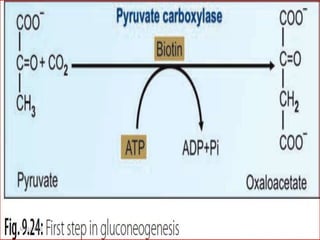
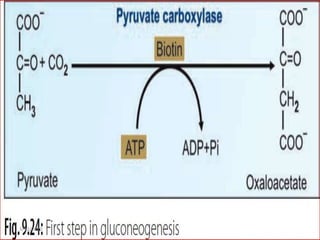
Step 1:Pyruvate Carboxylase Reaction
Pyruvate in the cytoplasm enters the mitochondria.
Then,
carboxylation of pyruvate to oxaloacetate is
catalyzed by a mitochondrial enzyme, pyruvate
carboxylase which needs the co-enzyme biotin and
energy by ATP hydrolysis.
3/12/2020
3/12/2020
Step 2:Malate Aspartate Shuttle
 Oxaloacetate is generated inside the mitochondria.
 oxaloacetate has to be transported from mitochondria to cytosol,
because further reactions of gluconeogenesis are taking place in
cytosol.
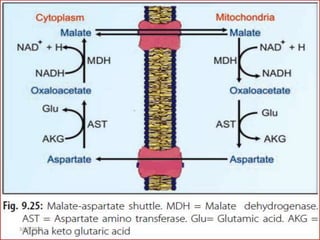
 This is achieved by the malate aspartate shuttle.
 Oxaloacetate is first converted to malate, which traverses the
membrane and reaches cytoplasm.
 Malate is then re-converted to oxaloacetate.
 Malate dehydrogenase is present in both mitochondria and
cytoplasm.
 When alanine is the substrate for gluconeogenesis, the malate
shuttle predominantly operates, because NADH is also required in
the cytoplasm for the gluconeogenesis to continue.
 When lactate is the substrate for gluconeogenesis, the aspartate
shuttle operates, because sufficient NADH is available in the
cytoplasm by the LDH reaction.
3/12/2020
3/12/2020
Step 3 Phosphoenolpyruvate Carboxykinase
(PEPCK)
 In the cytoplasm, PEPCK enzyme then converts
oxaloacetate to phosphoenol pyruvate by removing a
molecule of CO2.
 GTP or ITP donates the phosphate .
 The net effect of these two reactions is the conversion of
pyruvate to phosphoenol pyruvate.
 This circumvents the irreversible step in glycolysis catalyzed
by pyruvate kinase (step 9 of glycolysis).
 In humans a mitochondrial PEPCK is also found to be active
and PEP formed in the mitochondria is transported by a
carrier to the cytoplasm for further metabolism.
3/12/2020
Step 4,5,6,7,8 :partial reversal of Glycolysis
The phosphoenol pyruvate undergoes further
reactions catalyzed by the glycolytic enzymes to
form fructose-1,6- bisphosphate (see glycolysis
steps 8,7,6,5 and 4).
All these reactions are freely reversible.
3/12/2020
Step 9:Fructose-1,6-bisphosphatase
Fructose 1,6-bisphosphate is then acted upon by
fructose 1,6-bisphosphatase to form fructose-6-
phosphate.
This will bypass the step of PFK reaction (see step 3 of
glycolysis).
Fru-1,6-bishosphatase
Fru-1,6-bis Fructose-6 phosphate + Pi
Then fructose-6-phosphate is isomerised to glucose-6
phosphate by the freely reversible reaction catalyzed by
Hexose phosphate isomerase (second step in
glycolysis).
3/12/2020
Step:Glucose-6-phosphatase Reaction
The glucose 6-phosphate is hydrolyzed to free
glucose by
Glu-6-phosphatase.
Glucose-6-phosphate + H2O Glucose + Pi
Glucose-6-phosphatase is active in liver.
 It is present in kidney and intestinal mucosa to a
lesser extent, but is absent in muscle.
3/12/2020
Significance of Gluconeogenesis
1. Only liver can replenish blood sugar through
gluconeogenesis, because glucose-6-phosphatase
is present mainly in liver.
 So liver plays the major role in maintaining the
blood glucose level.
2. During starvation gluconeogenesis maintains the
blood glucose level.
 The stored glycogen is depleted
3/12/2020
Significance of Gluconeogenesis
within the first 12–18 hours of fasting. On
prolonged
starvation, the gluconeogenesis is speeded up and
protein catabolism provides the substrates, namely
glucogenic amino acids.
3/12/2020
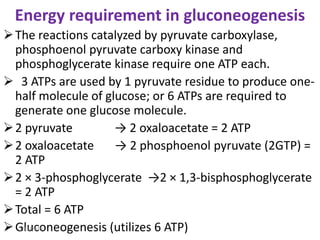
Energy requirement in gluconeogenesis
The reactions catalyzed by pyruvate carboxylase,
phosphoenol pyruvate carboxy kinase and
phosphoglycerate kinase require one ATP each.
 3 ATPs are used by 1 pyruvate residue to produce one-
half molecule of glucose; or 6 ATPs are required to
generate one glucose molecule.
2 pyruvate → 2 oxaloacetate = 2 ATP
2 oxaloacetate → 2 phosphoenol pyruvate (2GTP) =
2 ATP
2 × 3-phosphoglycerate →2 × 1,3-bisphosphoglycerate
= 2 ATP
Total = 6 ATP
Gluconeogenesis (utilizes 6 ATP)3/12/2020
3/12/2020
Substrates for Gluconeogenesis
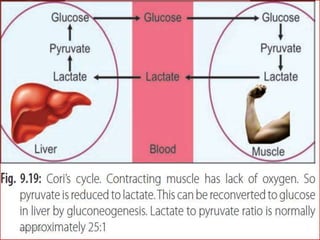
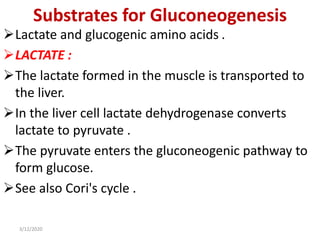
Lactate and glucogenic amino acids .
LACTATE :
The lactate formed in the muscle is transported to
the liver.
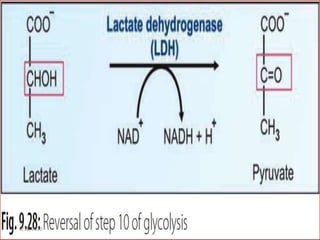
In the liver cell lactate dehydrogenase converts
lactate to pyruvate .
The pyruvate enters the gluconeogenic pathway to
form glucose.
See also Cori's cycle .
3/12/2020
3/12/2020
3/12/2020
Substrates for Gluconeogenesis
Glucogenic amino acids
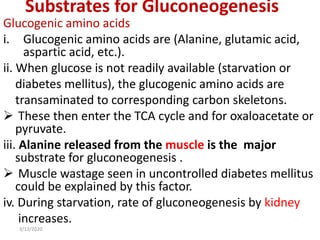
i. Glucogenic amino acids are (Alanine, glutamic acid,
aspartic acid, etc.).
ii. When glucose is not readily available (starvation or
diabetes mellitus), the glucogenic amino acids are
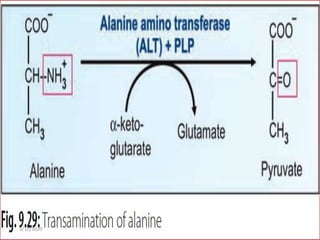
transaminated to corresponding carbon skeletons.
 These then enter the TCA cycle and for oxaloacetate or
pyruvate.
iii. Alanine released from the muscle is the major
substrate for gluconeogenesis .
 Muscle wastage seen in uncontrolled diabetes mellitus
could be explained by this factor.
iv. During starvation, rate of gluconeogenesis by kidney
increases.
3/12/2020
3/12/2020
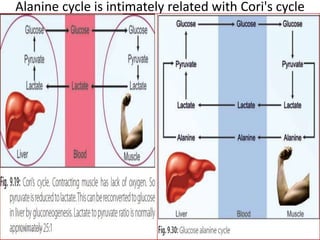
Glucose-Alanine Cycle (Cahill Cycle)
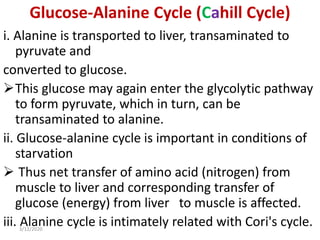
i. Alanine is transported to liver, transaminated to
pyruvate and
converted to glucose.
This glucose may again enter the glycolytic pathway
to form pyruvate, which in turn, can be
transaminated to alanine.
ii. Glucose-alanine cycle is important in conditions of
starvation
 Thus net transfer of amino acid (nitrogen) from
muscle to liver and corresponding transfer of
glucose (energy) from liver to muscle is affected.
iii. Alanine cycle is intimately related with Cori's cycle.3/12/2020
Alanine cycle is intimately related with Cori's cycle
3/12/2020
Substrates for Gluconeogenesis
Glycerol :
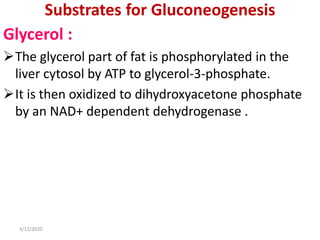
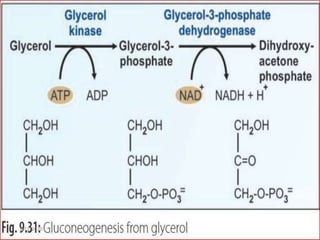
The glycerol part of fat is phosphorylated in the
liver cytosol by ATP to glycerol-3-phosphate.
It is then oxidized to dihydroxyacetone phosphate
by an NAD+ dependent dehydrogenase .
3/12/2020
3/12/2020
Substrates for Gluconeogenesis
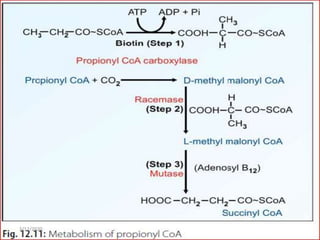
Propionyl CoA :
Propionyl CoA is formed from odd chain fatty acids
and carbon skeleton of some amino acids.
 It is converted to succinyl CoA and is a minor
source for glucose.
Important: Even chain fatty acids cannot be
converted to glucose; they are not substrates for
gluconeogenesis.
3/12/2020
3/12/2020
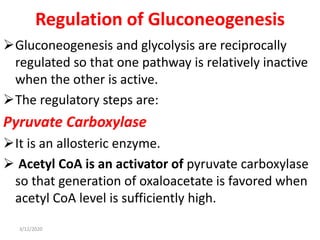
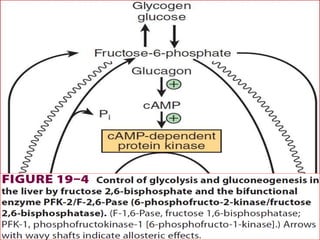
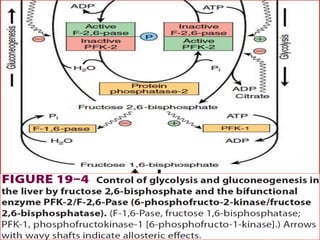
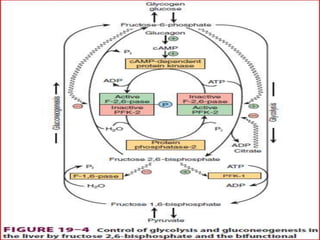
Regulation of Gluconeogenesis
Gluconeogenesis and glycolysis are reciprocally
regulated so that one pathway is relatively inactive
when the other is active.
The regulatory steps are:
Pyruvate Carboxylase
It is an allosteric enzyme.
 Acetyl CoA is an activator of pyruvate carboxylase
so that generation of oxaloacetate is favored when
acetyl CoA level is sufficiently high.
3/12/2020
3/12/2020
3/12/2020
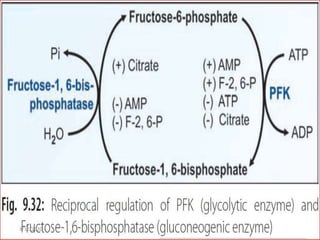
Fructose-1,6-bisphosphatase
Citrate is an activator while fructose-2,6-bis-
phosphate and AMP are inhibitors.
All these three effectors have an exactly opposite
effect on the phosphofructokinase (PFK).
3/12/2020
3/12/2020
Gluconeogenesis
Gluconeogenesis
Gluconeogenesis

Gluconeogenesis

  • 1.
  • 2.
    GLUCONEOGENESIS Definition It is theprocess by which glucose molecules are produced from non-carbohydrate precursors. These include lactate, glucogenic amino acids, glycerol part of fat and propionyl CoA derived from odd chain fatty acids . 3/12/2020
  • 3.
  • 4.
  • 5.
  • 6.
  • 7.
  • 8.
  • 9.
  • 10.
    Fig. Major pathwaysand regulation of gluconeogenesis and glycolysis in the liver.  Entry points of glucogenic amino acids after transamination are indicated by arrows extended from circles  The key gluconeogenic enzymes are enclosed in double- bordered boxes.  The ATP required for gluconeogenesis is supplied by the oxidation of fatty acids.  Propionate is of quantitative importance only in ruminants.  Arrows with wavy shafts signify allosteric effects.  Dash-shafted arrows, covalent modification by reversible phosphorylation.  High concentrations of alanine act as a “gluconeogenic signal” by inhibiting glycolysis at the pyruvate kinase step. 3/12/2020
  • 11.
    GLUCONEOGENESIS : SITE Theliver, and to a lesser extent in the renal cortex. The pathway is partly mitochondrial and partly cytoplasmic. 3/12/2020
  • 12.
    Key Gluconeogenic Enzymes 1.Pyruvate carboxylase 2. Phosphoenol pyruvate carboxy kinase 3. Fructose-1-6-bisphosphatase 4. Glucose-6-phosphatase Gluconeogenesis involves several enzymes of glycolysis, but it is not a reversal of glycolysis. The irreversible steps in glycolysis are circumvented by four enzymes which are designated as the key enzymes of gluconeogenesis . 3/12/2020
  • 13.
  • 14.
    Step 1:Pyruvate CarboxylaseReaction Pyruvate in the cytoplasm enters the mitochondria. Then, carboxylation of pyruvate to oxaloacetate is catalyzed by a mitochondrial enzyme, pyruvate carboxylase which needs the co-enzyme biotin and energy by ATP hydrolysis. 3/12/2020
  • 15.
  • 16.
    Step 2:Malate AspartateShuttle  Oxaloacetate is generated inside the mitochondria.  oxaloacetate has to be transported from mitochondria to cytosol, because further reactions of gluconeogenesis are taking place in cytosol.  This is achieved by the malate aspartate shuttle.  Oxaloacetate is first converted to malate, which traverses the membrane and reaches cytoplasm.  Malate is then re-converted to oxaloacetate.  Malate dehydrogenase is present in both mitochondria and cytoplasm.  When alanine is the substrate for gluconeogenesis, the malate shuttle predominantly operates, because NADH is also required in the cytoplasm for the gluconeogenesis to continue.  When lactate is the substrate for gluconeogenesis, the aspartate shuttle operates, because sufficient NADH is available in the cytoplasm by the LDH reaction. 3/12/2020
  • 17.
  • 18.
    Step 3 PhosphoenolpyruvateCarboxykinase (PEPCK)  In the cytoplasm, PEPCK enzyme then converts oxaloacetate to phosphoenol pyruvate by removing a molecule of CO2.  GTP or ITP donates the phosphate .  The net effect of these two reactions is the conversion of pyruvate to phosphoenol pyruvate.  This circumvents the irreversible step in glycolysis catalyzed by pyruvate kinase (step 9 of glycolysis).  In humans a mitochondrial PEPCK is also found to be active and PEP formed in the mitochondria is transported by a carrier to the cytoplasm for further metabolism. 3/12/2020
  • 19.
    Step 4,5,6,7,8 :partialreversal of Glycolysis The phosphoenol pyruvate undergoes further reactions catalyzed by the glycolytic enzymes to form fructose-1,6- bisphosphate (see glycolysis steps 8,7,6,5 and 4). All these reactions are freely reversible. 3/12/2020
  • 20.
    Step 9:Fructose-1,6-bisphosphatase Fructose 1,6-bisphosphateis then acted upon by fructose 1,6-bisphosphatase to form fructose-6- phosphate. This will bypass the step of PFK reaction (see step 3 of glycolysis). Fru-1,6-bishosphatase Fru-1,6-bis Fructose-6 phosphate + Pi Then fructose-6-phosphate is isomerised to glucose-6 phosphate by the freely reversible reaction catalyzed by Hexose phosphate isomerase (second step in glycolysis). 3/12/2020
  • 21.
    Step:Glucose-6-phosphatase Reaction The glucose6-phosphate is hydrolyzed to free glucose by Glu-6-phosphatase. Glucose-6-phosphate + H2O Glucose + Pi Glucose-6-phosphatase is active in liver.  It is present in kidney and intestinal mucosa to a lesser extent, but is absent in muscle. 3/12/2020
  • 22.
    Significance of Gluconeogenesis 1.Only liver can replenish blood sugar through gluconeogenesis, because glucose-6-phosphatase is present mainly in liver.  So liver plays the major role in maintaining the blood glucose level. 2. During starvation gluconeogenesis maintains the blood glucose level.  The stored glycogen is depleted 3/12/2020
  • 23.
    Significance of Gluconeogenesis withinthe first 12–18 hours of fasting. On prolonged starvation, the gluconeogenesis is speeded up and protein catabolism provides the substrates, namely glucogenic amino acids. 3/12/2020
  • 24.
    Energy requirement ingluconeogenesis The reactions catalyzed by pyruvate carboxylase, phosphoenol pyruvate carboxy kinase and phosphoglycerate kinase require one ATP each.  3 ATPs are used by 1 pyruvate residue to produce one- half molecule of glucose; or 6 ATPs are required to generate one glucose molecule. 2 pyruvate → 2 oxaloacetate = 2 ATP 2 oxaloacetate → 2 phosphoenol pyruvate (2GTP) = 2 ATP 2 × 3-phosphoglycerate →2 × 1,3-bisphosphoglycerate = 2 ATP Total = 6 ATP Gluconeogenesis (utilizes 6 ATP)3/12/2020
  • 25.
  • 26.
    Substrates for Gluconeogenesis Lactateand glucogenic amino acids . LACTATE : The lactate formed in the muscle is transported to the liver. In the liver cell lactate dehydrogenase converts lactate to pyruvate . The pyruvate enters the gluconeogenic pathway to form glucose. See also Cori's cycle . 3/12/2020
  • 27.
  • 28.
  • 29.
    Substrates for Gluconeogenesis Glucogenicamino acids i. Glucogenic amino acids are (Alanine, glutamic acid, aspartic acid, etc.). ii. When glucose is not readily available (starvation or diabetes mellitus), the glucogenic amino acids are transaminated to corresponding carbon skeletons.  These then enter the TCA cycle and for oxaloacetate or pyruvate. iii. Alanine released from the muscle is the major substrate for gluconeogenesis .  Muscle wastage seen in uncontrolled diabetes mellitus could be explained by this factor. iv. During starvation, rate of gluconeogenesis by kidney increases. 3/12/2020
  • 30.
  • 31.
    Glucose-Alanine Cycle (CahillCycle) i. Alanine is transported to liver, transaminated to pyruvate and converted to glucose. This glucose may again enter the glycolytic pathway to form pyruvate, which in turn, can be transaminated to alanine. ii. Glucose-alanine cycle is important in conditions of starvation  Thus net transfer of amino acid (nitrogen) from muscle to liver and corresponding transfer of glucose (energy) from liver to muscle is affected. iii. Alanine cycle is intimately related with Cori's cycle.3/12/2020
  • 32.
    Alanine cycle isintimately related with Cori's cycle 3/12/2020
  • 33.
    Substrates for Gluconeogenesis Glycerol: The glycerol part of fat is phosphorylated in the liver cytosol by ATP to glycerol-3-phosphate. It is then oxidized to dihydroxyacetone phosphate by an NAD+ dependent dehydrogenase . 3/12/2020
  • 34.
  • 35.
    Substrates for Gluconeogenesis PropionylCoA : Propionyl CoA is formed from odd chain fatty acids and carbon skeleton of some amino acids.  It is converted to succinyl CoA and is a minor source for glucose. Important: Even chain fatty acids cannot be converted to glucose; they are not substrates for gluconeogenesis. 3/12/2020
  • 36.
  • 37.
    Regulation of Gluconeogenesis Gluconeogenesisand glycolysis are reciprocally regulated so that one pathway is relatively inactive when the other is active. The regulatory steps are: Pyruvate Carboxylase It is an allosteric enzyme.  Acetyl CoA is an activator of pyruvate carboxylase so that generation of oxaloacetate is favored when acetyl CoA level is sufficiently high. 3/12/2020
  • 38.
  • 39.
  • 40.
    Fructose-1,6-bisphosphatase Citrate is anactivator while fructose-2,6-bis- phosphate and AMP are inhibitors. All these three effectors have an exactly opposite effect on the phosphofructokinase (PFK). 3/12/2020
  • 41.