The Female Reproductive 
System 
DR RITESH SHIWAKOTI 
MScD PERIODONTICS 
SN SNO: 20130204556
Female Reproduction 
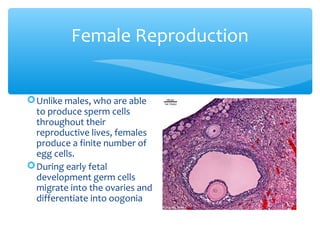
Unlike males, who are able 
to produce sperm cells 
throughout their 
reproductive lives, females 
produce a finite number of 
egg cells. 
During early fetal 
development germ cells 
migrate into the ovaries and 
differentiate into oogonia
Oogonia 
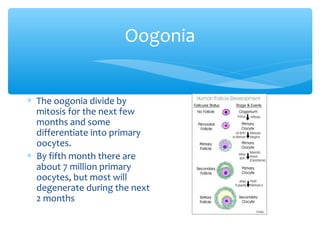
* The oogonia divide by 
mitosis for the next few 
months and some 
differentiate into primary 
oocytes. 
* By fifth month there are 
about 7 million primary 
oocytes, but most will 
degenerate during the next 
2 months
Oogonia 
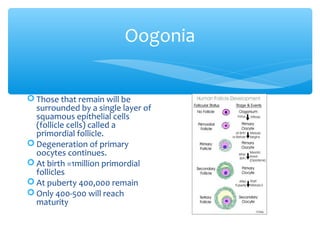
Those that remain will be 
surrounded by a single layer of 
squamous epithelial cells 
(follicle cells) called a 
primordial follicle. 
Degeneration of primary 
oocytes continues. 
At birth =1million primordial 
follicles 
At puberty 400,000 remain 
Only 400-500 will reach 
maturity
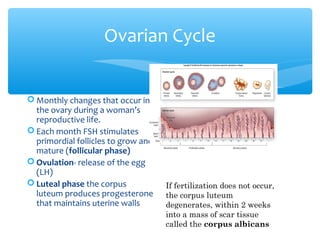
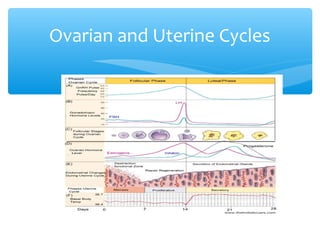
Ovarian Cycle 
Monthly changes that occur in 
the ovary during a woman’s 
reproductive life. 
Each month FSH stimulates 
primordial follicles to grow and 
mature (follicular phase) 
Ovulation- release of the egg 
(LH) 
Luteal phase the corpus 
luteum produces progesterone 
that maintains uterine walls 
If fertilization does not occur, 
the corpus luteum 
degenerates, within 2 weeks 
into a mass of scar tissue 
called the corpus albicans
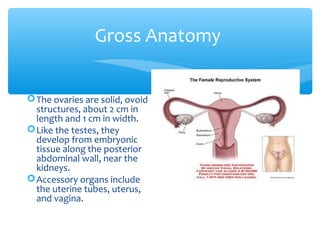
Gross Anatomy 
The ovaries are solid, ovoid 
structures, about 2 cm in 
length and 1 cm in width. 
Like the testes, they 
develop from embryonic 
tissue along the posterior 
abdominal wall, near the 
kidneys. 
Accessory organs include 
the uterine tubes, uterus, 
and vagina.
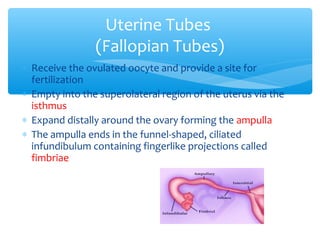
* Receive the ovulated oocyte and provide a site for 
fertilization 
* Empty into the superolateral region of the uterus via the 
isthmus 
* Expand distally around the ovary forming the ampulla 
* The ampulla ends in the funnel-shaped, ciliated 
infundibulum containing fingerlike projections called 
fimbriae 
7 
Uterine Tubes 
(Fallopian Tubes)
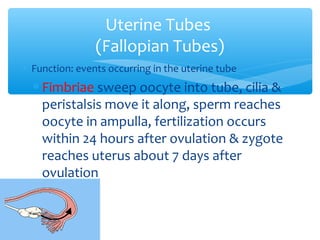
* Function: events occurring in the uterine tube 
* Fimbriae sweep oocyte into tube, cilia & 
peristalsis move it along, sperm reaches 
oocyte in ampulla, fertilization occurs 
within 24 hours after ovulation & zygote 
reaches uterus about 7 days after 
ovulation 
8 
Uterine Tubes 
(Fallopian Tubes)
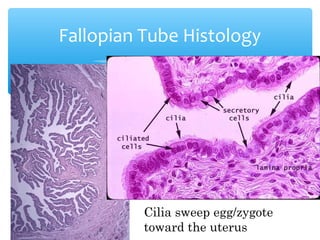
Fallopian Tube Histology 
9 
Cilia sweep egg/zygote 
toward the uterus
* Hollow, thick-walled organ located in the pelvis anterior 
to the rectum and posterosuperior to the bladder 
* Body: Major portion of the uterus 
* Fundus: Rounded region superior to the entrance of the 
uterine tubes 
* Isthmus: Narrowed region between the body and cervix 
10 
Uterus
Uterus 
11
* Endometrium 
* Simple columnar epithelium 
* Stroma of connective tissue and endometrial glands 
* Stratum functionalis: Shed during menstruation 
* Stratum basalis: Replaces stratum functionalis each 
month 
* Myometrium 
* 3 layers of smooth muscle 
* Perimetrium 
* Visceral peritoneum 
12 
Uterine Histology
13 
Uterine 
Histology
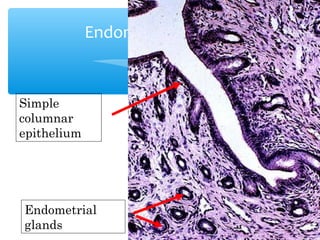
Endometrium 
14 
Simple 
columnar 
epithelium 
Endometrial 
glands
Endometrium 
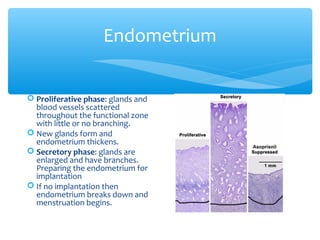
 Proliferative phase: glands and 
blood vessels scattered 
throughout the functional zone 
with little or no branching. 
 New glands form and 
endometrium thickens. 
 Secretory phase: glands are 
enlarged and have branches. 
Preparing the endometrium for 
implantation 
 If no implantation then 
endometrium breaks down and 
menstruation begins.
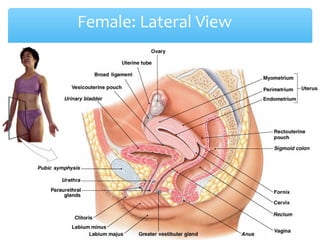
Female: Lateral View 
16
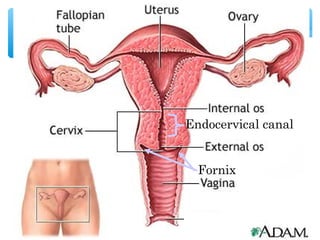
* Narrow lower neck of the uterus which projects into the 
vagina inferiorly 
* Cervical canal – cavity of the cervix that communicates 
with: 
* The vagina via the external os 
* The uterine body via the internal os 
* Cervical glands secrete mucus that covers the external 
os and blocks sperm entry except during midcycle 
17 
Cervix
18 
Endocervical canal 
Fornix
* Thin-walled tube lying between the bladder and the 
rectum, extending from the cervix to the exterior of the 
body 
* Wall consists of three coats: fibroelastic adventitia, 
smooth muscle muscularis, and a stratified squamous 
mucosa 
* Mucosa near the vaginal orifice forms an incomplete 
partition called the hymen 
* Vaginal fornix: upper end of the vagina surrounding the 
cervix 
19 
Vagina
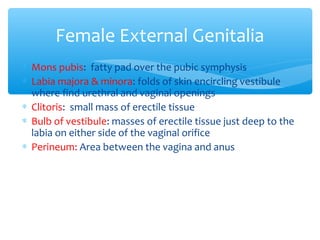
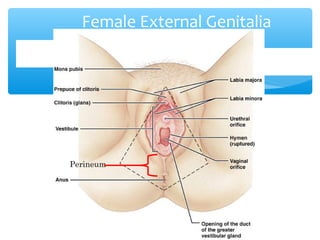
Female External Genitalia 
* Mons pubis: fatty pad over the pubic symphysis 
* Labia majora & minora: folds of skin encircling vestibule 
where find urethral and vaginal openings 
* Clitoris: small mass of erectile tissue 
* Bulb of vestibule: masses of erectile tissue just deep to the 
labia on either side of the vaginal orifice 
* Perineum: Area between the vagina and anus 
20
Female External Genitalia 
21 
Perineum
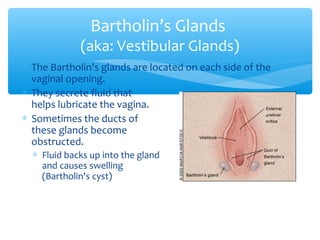
* The Bartholin's glands are located on each side of the 
vaginal opening. 
* They secrete fluid that 
helps lubricate the vagina. 
* Sometimes the ducts of 
these glands become 
obstructed. 
* Fluid backs up into the gland 
and causes swelling 
(Bartholin's cyst) 
22 
Bartholin’s Glands 
(aka: Vestibular Glands)
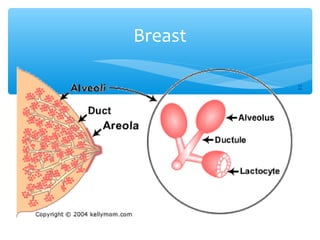
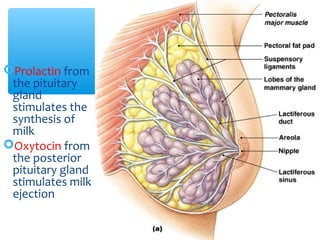
* Modified sweat glands that produce milk (lactation) 
* Amount of adipose determines size of breast 
* Milk-secreting glands open by lactiferous ducts at the 
nipple 
* Areola is pigmented area around nipple 
* Suspensory ligaments suspend breast from deep fascia of 
pectoral muscles (aging & Cooper’s droop) 
* Mammary line is a thickened ridge of embryonic tiwwue 
that extends from the axilla to the groin. 
23 
Mammary Glands
Breast 
24
Prolactin from 
the pituitary 
gland 
stimulates the 
synthesis of 
milk 
Oxytocin from 
the posterior 
pituitary gland 
stimulates milk 
ejection 
25 
Breast
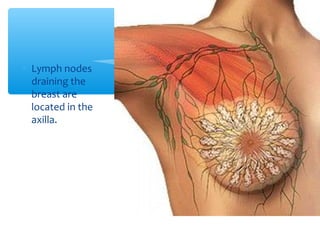
* Lymph nodes 
draining the 
breast are 
located in the 
axilla. 
26 
Lymphatic 
Drainage
Oogenesis: Before birth 
27 
During fetal development, 
oogonia (stem cells) divide 
by mitosis to make primary 
oocytes 
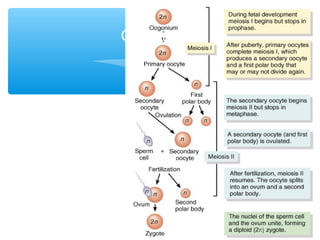
Primary oocytes begin 
meiosis and stop in 
prophase I until puberty 
Primordial follicles: Support 
cells that surround the 
oocyte in the ovary 
2 million present at birth 
400,000 remain at puberty
Oogenesis: After Puberty 
* Each month, hormones cause several follicles to 
develop, which triggers the primary oocyte to 
resume meiosis I 
* Polar bodies: When the cell divides, all the cytoplasm 
and organelles stay with one of the new cells, the 
other cell is just DNA, and is called a polar body and is 
discarded 
* Secondary oocyte: The stage at which ovulation 
occurs. 
28
Oogenesis: After Puberty 
* The secondary oocyte begins meiosis II, but stops in 
metaphase II 
* The secondary oocyte is ovulated 
* Meiosis II is completed only if it is fertilized. 
29
30 
Oogenesis
As a fetus, oogonia divide to produce millions by 
mitosis but most degenerate (atresia) 
Some develop into primary oocytes & stop in 
prophase stage of meiosis I 
200,000 to 2 million present at birth 
40,000 remain at puberty but only 400 mature during a 
woman’s life 
Each month, hormones cause meiosis I to resume in 
several follicles so that meiosis II is reached by 
ovulation 
Penetration by the sperm causes the final stages of 
meiosis to occur 
31 
Life History of Oogonia
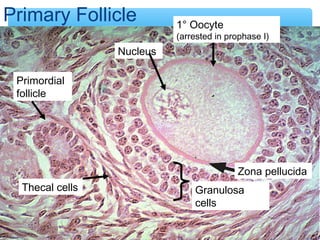
* Each follicle consists of an immature egg called an 
oocyte 
* Cells around the oocyte are called: 
* Follicle cells (one cell layer thick) 
* Stimulated to mature by FSH from the pituitary gland 
* Granulosa cells (when more than one layer is present) 
* Thecal cells: Cells in the ovarian stroma 
* Thecal & granulosa cells work together to produce 
estrogen 
* A protective layer of glycoprotein forms around the egg 
called the zona pellucida 
32 
Ovaries
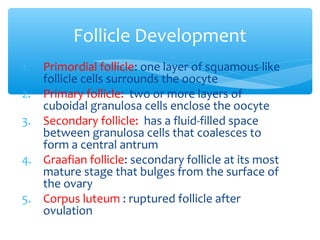
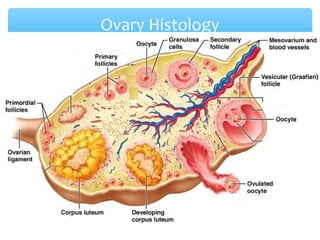
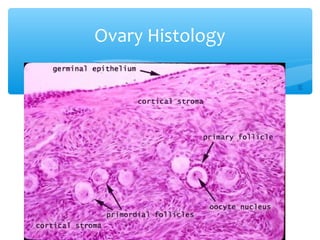
1. Primordial follicle: one layer of squamous-like 
follicle cells surrounds the oocyte 
2. Primary follicle: two or more layers of 
cuboidal granulosa cells enclose the oocyte 
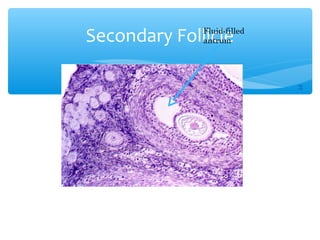
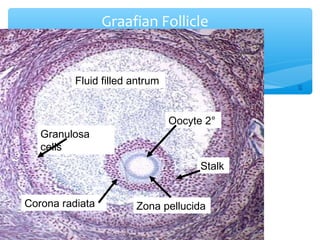
3. Secondary follicle: has a fluid-filled space 
between granulosa cells that coalesces to 
form a central antrum 
4. Graafian follicle: secondary follicle at its most 
mature stage that bulges from the surface of 
the ovary 
5. Corpus luteum : ruptured follicle after 
ovulation 
33 
Follicle Development
Ovary Histology 
34
Ovary Histology 
35
36 
1° Oocyte 
(arrested in prophase I) 
Zona pellucida 
Granulosa 
cells 
Primary Follicle 
Thecal cells 
Nucleus 
Primordial 
follicle
Secondary Follicle 
37 
Fluid-filled 
antrum
Graafian Follicle 
38 
Fluid filled antrum 
Granulosa 
cells 
Oocyte 2° 
Corona radiata 
Stalk 
Zona pellucida
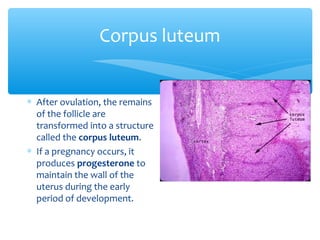
Corpus luteum 
* After ovulation, the remains 
of the follicle are 
transformed into a structure 
called the corpus luteum. 
* If a pregnancy occurs, it 
produces progesterone to 
maintain the wall of the 
uterus during the early 
period of development.
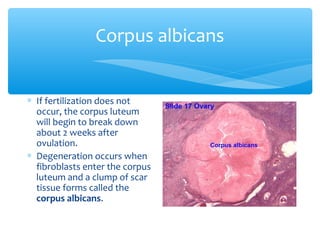
Corpus albicans 
* If fertilization does not 
occur, the corpus luteum 
will begin to break down 
about 2 weeks after 
ovulation. 
* Degeneration occurs when 
fibroblasts enter the corpus 
luteum and a clump of scar 
tissue forms called the 
corpus albicans.
Ovarian and Uterine Cycles

Female reproductive system

  • 1.
    The Female Reproductive System DR RITESH SHIWAKOTI MScD PERIODONTICS SN SNO: 20130204556
  • 2.
    Female Reproduction Unlikemales, who are able to produce sperm cells throughout their reproductive lives, females produce a finite number of egg cells. During early fetal development germ cells migrate into the ovaries and differentiate into oogonia
  • 3.
    Oogonia * Theoogonia divide by mitosis for the next few months and some differentiate into primary oocytes. * By fifth month there are about 7 million primary oocytes, but most will degenerate during the next 2 months
  • 4.
    Oogonia Those thatremain will be surrounded by a single layer of squamous epithelial cells (follicle cells) called a primordial follicle. Degeneration of primary oocytes continues. At birth =1million primordial follicles At puberty 400,000 remain Only 400-500 will reach maturity
  • 5.
    Ovarian Cycle Monthlychanges that occur in the ovary during a woman’s reproductive life. Each month FSH stimulates primordial follicles to grow and mature (follicular phase) Ovulation- release of the egg (LH) Luteal phase the corpus luteum produces progesterone that maintains uterine walls If fertilization does not occur, the corpus luteum degenerates, within 2 weeks into a mass of scar tissue called the corpus albicans
  • 6.
    Gross Anatomy Theovaries are solid, ovoid structures, about 2 cm in length and 1 cm in width. Like the testes, they develop from embryonic tissue along the posterior abdominal wall, near the kidneys. Accessory organs include the uterine tubes, uterus, and vagina.
  • 7.
    * Receive theovulated oocyte and provide a site for fertilization * Empty into the superolateral region of the uterus via the isthmus * Expand distally around the ovary forming the ampulla * The ampulla ends in the funnel-shaped, ciliated infundibulum containing fingerlike projections called fimbriae 7 Uterine Tubes (Fallopian Tubes)
  • 8.
    * Function: eventsoccurring in the uterine tube * Fimbriae sweep oocyte into tube, cilia & peristalsis move it along, sperm reaches oocyte in ampulla, fertilization occurs within 24 hours after ovulation & zygote reaches uterus about 7 days after ovulation 8 Uterine Tubes (Fallopian Tubes)
  • 9.
    Fallopian Tube Histology 9 Cilia sweep egg/zygote toward the uterus
  • 10.
    * Hollow, thick-walledorgan located in the pelvis anterior to the rectum and posterosuperior to the bladder * Body: Major portion of the uterus * Fundus: Rounded region superior to the entrance of the uterine tubes * Isthmus: Narrowed region between the body and cervix 10 Uterus
  • 11.
  • 12.
    * Endometrium *Simple columnar epithelium * Stroma of connective tissue and endometrial glands * Stratum functionalis: Shed during menstruation * Stratum basalis: Replaces stratum functionalis each month * Myometrium * 3 layers of smooth muscle * Perimetrium * Visceral peritoneum 12 Uterine Histology
  • 13.
  • 14.
    Endometrium 14 Simple columnar epithelium Endometrial glands
  • 15.
    Endometrium  Proliferativephase: glands and blood vessels scattered throughout the functional zone with little or no branching.  New glands form and endometrium thickens.  Secretory phase: glands are enlarged and have branches. Preparing the endometrium for implantation  If no implantation then endometrium breaks down and menstruation begins.
  • 16.
  • 17.
    * Narrow lowerneck of the uterus which projects into the vagina inferiorly * Cervical canal – cavity of the cervix that communicates with: * The vagina via the external os * The uterine body via the internal os * Cervical glands secrete mucus that covers the external os and blocks sperm entry except during midcycle 17 Cervix
  • 18.
  • 19.
    * Thin-walled tubelying between the bladder and the rectum, extending from the cervix to the exterior of the body * Wall consists of three coats: fibroelastic adventitia, smooth muscle muscularis, and a stratified squamous mucosa * Mucosa near the vaginal orifice forms an incomplete partition called the hymen * Vaginal fornix: upper end of the vagina surrounding the cervix 19 Vagina
  • 20.
    Female External Genitalia * Mons pubis: fatty pad over the pubic symphysis * Labia majora & minora: folds of skin encircling vestibule where find urethral and vaginal openings * Clitoris: small mass of erectile tissue * Bulb of vestibule: masses of erectile tissue just deep to the labia on either side of the vaginal orifice * Perineum: Area between the vagina and anus 20
  • 21.
  • 22.
    * The Bartholin'sglands are located on each side of the vaginal opening. * They secrete fluid that helps lubricate the vagina. * Sometimes the ducts of these glands become obstructed. * Fluid backs up into the gland and causes swelling (Bartholin's cyst) 22 Bartholin’s Glands (aka: Vestibular Glands)
  • 23.
    * Modified sweatglands that produce milk (lactation) * Amount of adipose determines size of breast * Milk-secreting glands open by lactiferous ducts at the nipple * Areola is pigmented area around nipple * Suspensory ligaments suspend breast from deep fascia of pectoral muscles (aging & Cooper’s droop) * Mammary line is a thickened ridge of embryonic tiwwue that extends from the axilla to the groin. 23 Mammary Glands
  • 24.
  • 25.
    Prolactin from thepituitary gland stimulates the synthesis of milk Oxytocin from the posterior pituitary gland stimulates milk ejection 25 Breast
  • 26.
    * Lymph nodes draining the breast are located in the axilla. 26 Lymphatic Drainage
  • 27.
    Oogenesis: Before birth 27 During fetal development, oogonia (stem cells) divide by mitosis to make primary oocytes Primary oocytes begin meiosis and stop in prophase I until puberty Primordial follicles: Support cells that surround the oocyte in the ovary 2 million present at birth 400,000 remain at puberty
  • 28.
    Oogenesis: After Puberty * Each month, hormones cause several follicles to develop, which triggers the primary oocyte to resume meiosis I * Polar bodies: When the cell divides, all the cytoplasm and organelles stay with one of the new cells, the other cell is just DNA, and is called a polar body and is discarded * Secondary oocyte: The stage at which ovulation occurs. 28
  • 29.
    Oogenesis: After Puberty * The secondary oocyte begins meiosis II, but stops in metaphase II * The secondary oocyte is ovulated * Meiosis II is completed only if it is fertilized. 29
  • 30.
  • 31.
    As a fetus,oogonia divide to produce millions by mitosis but most degenerate (atresia) Some develop into primary oocytes & stop in prophase stage of meiosis I 200,000 to 2 million present at birth 40,000 remain at puberty but only 400 mature during a woman’s life Each month, hormones cause meiosis I to resume in several follicles so that meiosis II is reached by ovulation Penetration by the sperm causes the final stages of meiosis to occur 31 Life History of Oogonia
  • 32.
    * Each follicleconsists of an immature egg called an oocyte * Cells around the oocyte are called: * Follicle cells (one cell layer thick) * Stimulated to mature by FSH from the pituitary gland * Granulosa cells (when more than one layer is present) * Thecal cells: Cells in the ovarian stroma * Thecal & granulosa cells work together to produce estrogen * A protective layer of glycoprotein forms around the egg called the zona pellucida 32 Ovaries
  • 33.
    1. Primordial follicle:one layer of squamous-like follicle cells surrounds the oocyte 2. Primary follicle: two or more layers of cuboidal granulosa cells enclose the oocyte 3. Secondary follicle: has a fluid-filled space between granulosa cells that coalesces to form a central antrum 4. Graafian follicle: secondary follicle at its most mature stage that bulges from the surface of the ovary 5. Corpus luteum : ruptured follicle after ovulation 33 Follicle Development
  • 34.
  • 35.
  • 36.
    36 1° Oocyte (arrested in prophase I) Zona pellucida Granulosa cells Primary Follicle Thecal cells Nucleus Primordial follicle
  • 37.
    Secondary Follicle 37 Fluid-filled antrum
  • 38.
    Graafian Follicle 38 Fluid filled antrum Granulosa cells Oocyte 2° Corona radiata Stalk Zona pellucida
  • 39.
    Corpus luteum *After ovulation, the remains of the follicle are transformed into a structure called the corpus luteum. * If a pregnancy occurs, it produces progesterone to maintain the wall of the uterus during the early period of development.
  • 40.
    Corpus albicans *If fertilization does not occur, the corpus luteum will begin to break down about 2 weeks after ovulation. * Degeneration occurs when fibroblasts enter the corpus luteum and a clump of scar tissue forms called the corpus albicans.
  • 41.