B A S A L I N G A P P A B G
D M L T . , B M L T . , B S B T . ,
M . S C . M E D I C A L B I O C H E M I S T R Y
D E P ' T O F B I O C H E M I S T R Y
J S S M E D I C A L C O L L E G E
One Carbon Metabolism
FOLIC ACID
 Folic acid (or folate), which plays a key role in one-
carbon metabolism, is essential for the
biosynthesis of several compounds.
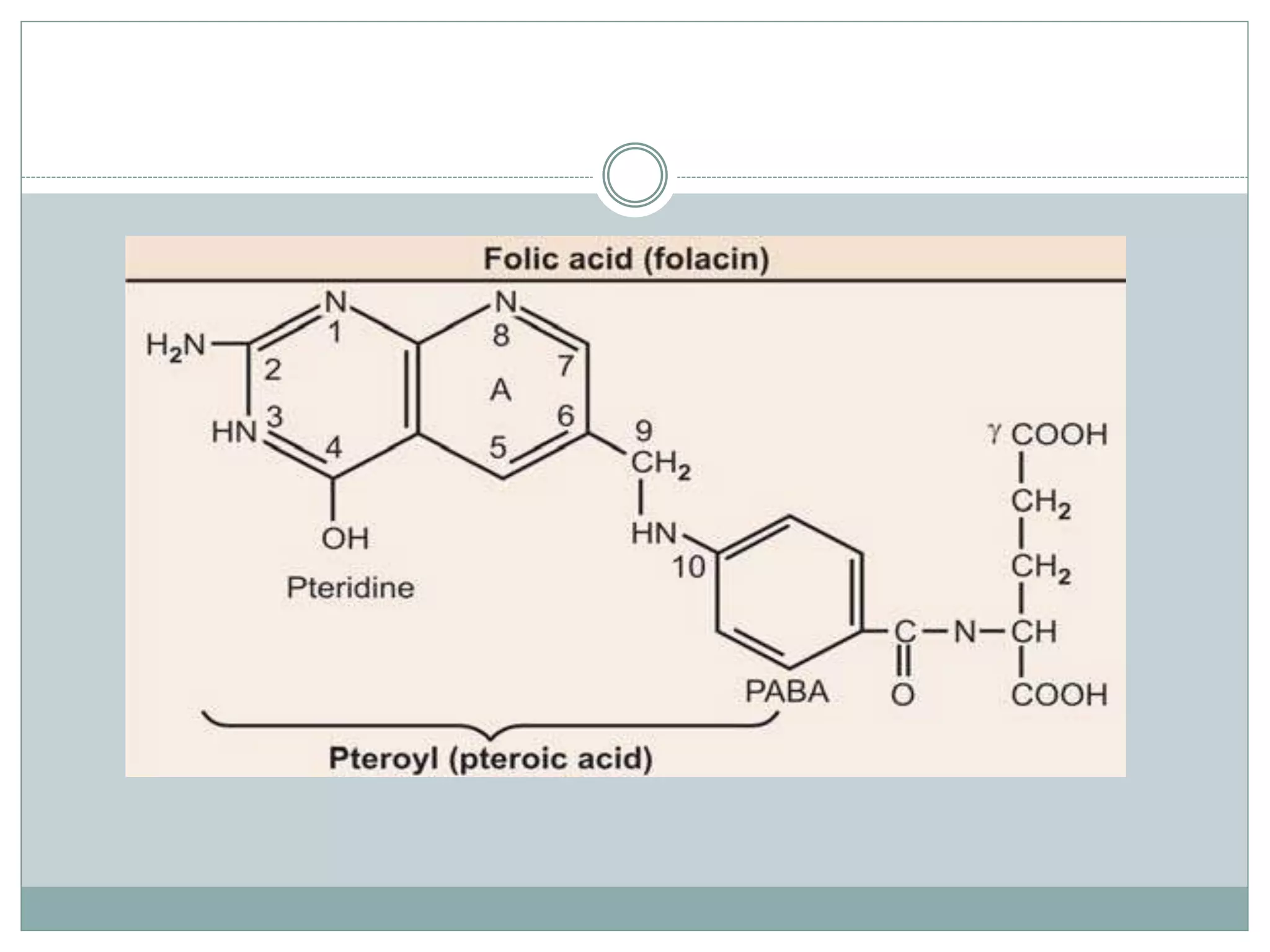
 Chemically folic acid is pteroyl-glutamic acid made
up of pteridne nucleus- amino benzoic acid
(PABA)and glutamic acid.
 The role of folic acid is that it acts as a carrier of
one carbon groups or moities required in
metabolism.
 Structure of folic acid is shown below. Chemically
called pteroyl glutamic acid (PGA).
 There are at least three chemically related
compounds of nutritional importance which occur in
natural products, all may be termed pteroyl
glutamates.
These three compounds differ only in the number of
glutamic acid residues attached to pteridine PABA
complex (pteroic acid).
Monoglutamate: Having one glutamic acid. It is
synonymous
with vitamin Bc.
• Triglutamate: Having three glutamic acid residues.
This substance once designated as “fermentation factor”.
• Heptaglutamate: Having seven glutamate
residues,synonymous with vitamin Bc conjugate of
yeast.Pteroyl glutamic acid is liberated from these
conjugates by enzymes called conjugases.
Biological “Active” Forms
 Active “coenzyme” form of the vitamin is the reduced
tetra hydrderivative,Tetrahydrofolate reductase
FH4, obtained by addition of four hydrogen's to the
pteridne moiety at 5, 6, 7 and 8 position.
 Structure of tetrahydrofolate is shown below.
Structure of tetrahydrofolate
 Folic acid is reduced by dihydrofolate reductase in
two steps:
 First to dihydrofolic acid (DHFA),also called
dihydrofolate and then converted to tetra
hydrofolate (THFA).
 The double bonds at N-atom 5 and 8 as shown in
above figure are reduced .
The one carbon groups are as
 Methyl (-CH3)
 Methylene (=CH2)
 Methenyl (=CH-)
 Formyl (-HCO)
 Formimino(-CH=NH-)
 Hydroxy methyl (-CH2 –OH).
 All these one carbon groups which are carried by
folic acid .
Sources of One Carbon
 Serine
 Glycine
 Histidine
 Tryptophan
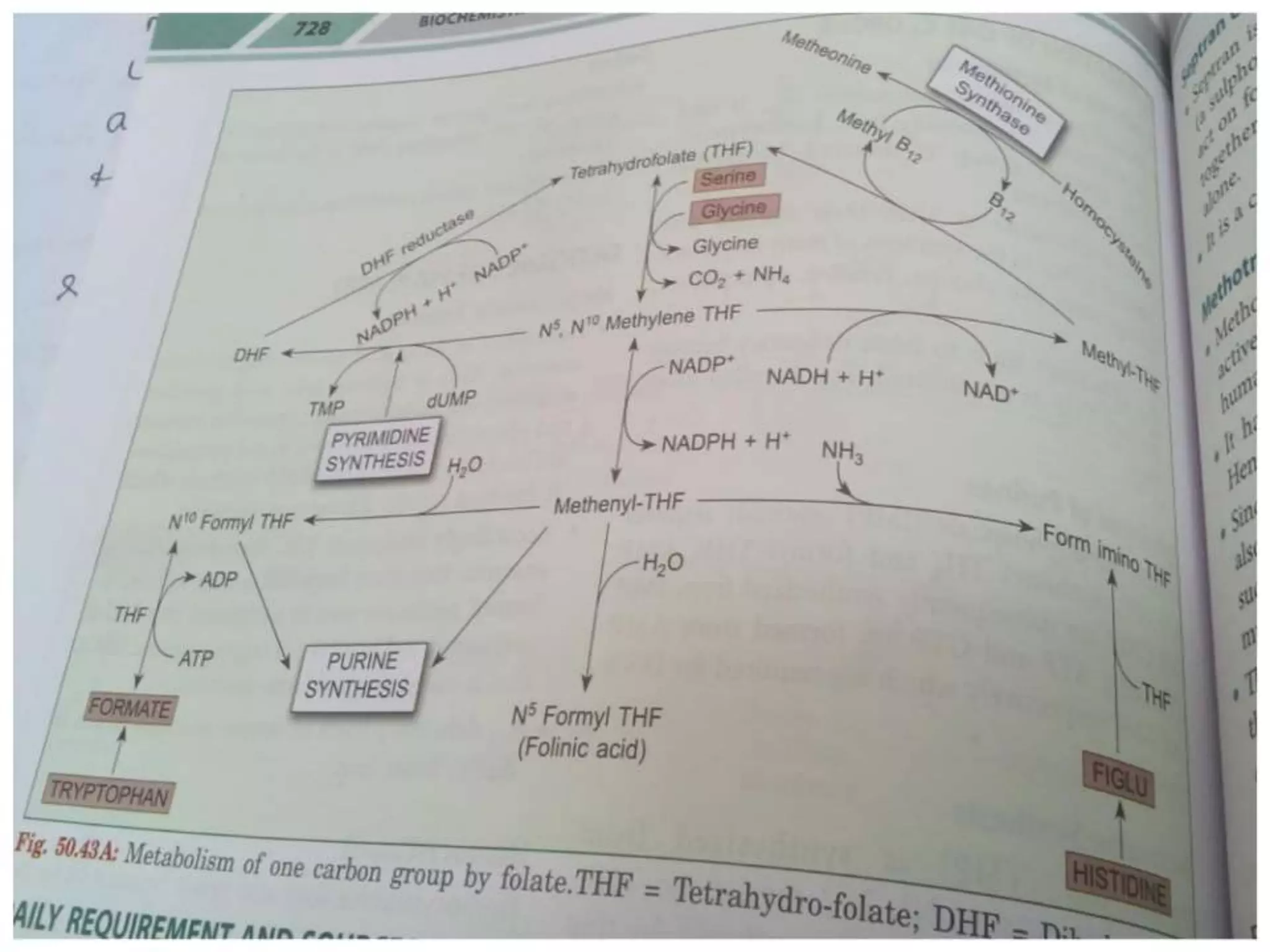
Metabolism of one carbon metabolism
 One carbon metabolism is basically indicates that
there will be a donation of carbon atom in variety of
metabolic reaction.
 Some of metabolic reactions which will need to carry
out function in our body,so we need a C-atom ,and
that has to be donated ,so it is going to do that so
that will be done at tetrahydro folate(THF)
 Basically THF it carries a one carbon derivative and
that will be donated in some other metabolic
reactions.
 Here so the THF is also referred as vitB9, so there
are THF derivatives which are Participating in one
carbon metabolismon they have
 N10 –formyl THF (-CHO)
 N5 ,N10 Methyl THF (-CH=)
 N5 ,N10 Methylene THF (-CH2-)
 N5 –Methyl THF (-CH3)
 Now to THF in order to make all these have different
types of folate derivatives ,so we need again a
vitB6,vitB2 ,VitB12, So these are the other water
Soluble vitamins but they are necessary for the
THF,to get into all their derivatives.
 So now let us one carbon metabolism is go on in our
body ,what are reactions shunts or participating in
one carbon metabolism,
 So we get folate (from green leafy vegetables)usually
folate we get as polyglutamate from of folate and the
intestine and glutamates are removed and
monoglutamate are just fold is absorbed and once
its,in our body.
 It will be converted to dihydrofolate (DHF)by an
enzyme dihydrofolate reductase (DHFR).
 So now we are going to convert folate into
dihydrofolate by an enzyme DHFR.
Folate Dihydro folate reductase Dihydrofolate
Now the DHF is converted THF By the same enzyme
DHFR applies aspects for this methotrexate(Basically
it is a anticancer drug which is going to DHFR enzyme
there by converting folate into THF is decrease that s
all ,so anyway
 Now what happens to THF ,will interact by a seine
,SHMT(serine hydroxyl methoxy transferase)this
SHMT it needs PLP(pyridoxal phosphate ) as a
coenzyme(VitB6)this is needed to make THF
derivative.
 So SHMT while transferase is going to take a methyl
form serine and side chain methyl group ie attached
to hydroxyl group there,ie in the side chain,CH2 is
taken from serine .
 So this serine will be attached to the THF and the
compund that will get
 N5 ,N10 Methylene THF (-CH2-)and it will get
glycine .This is a reversible reaction.
THF serine
N5,N10 methylene THF Glycine
Once it get a N5 ,N10 methylene THF ,So it has three
fates here,
1. It will be used as a coenzyme by thymidilate
synthase enzyme,This TS Which is going to convert
dUMP (deoxy uridine monophosphate) into
TMP(Thymidilate monophosphate).
dUMP TMP
 HISTIDINE: It is a source of formimino group
during its catabolism and transfers this formimino
group to THFA resulting in N5 form imino THFA .
 N5 N10 methenyl THFA can also give raise to
formimino THFA as well as N5 formyl THFA.
 Tryptophan: Formate can directly form N5 formyl
THFA.
 It is a source of formate
UTILISATION OF ONE CARBON
Synthesis of methionine :
 Methyl group of methyl cobalmine (VitB12) is used
to synthesize methionine from homocysteine .The
methyl group which is donated by methyl tetra
hydro folate(MTHF).
 The methionine as SAM then donates this methyl
group in the synthesis of many important compunds
like
 Choline
 Creatine
 Epinephrine etc .
IS Cobalmine which leads to folate deficiency ?
Why because the methyl tetrahydrofolate is not
utilized so this called folate trap or methyl trap.
PURINE SYNTHESIS
 Ionisine monophosphate (IMP) synthesis mainly it
requires N5,N10 Methenyl tetrahydrofolate and
formyl tetrahydrofolate.
 AMP and GMP both are significantly symthesized
from IMP.
 Ultimately ATP and GTP These are formed from
AMP And GMP respectively which are required for
the DNA synthesis.
PYRIMIDINE SYNTHESIS
 Thymidilate (TMP)is synthesized from deoxy
uridilate using N5,N10 methylene THF.
 It is used in DNA synthesis.
 In this Process tetrahydrofolate is simultaneously
oxidised to dihydrofolate which must be reconverted
to THF for reuse
Formyl tRNA
 Formyl THF is required for the formation of formyl
methionine tRNA needed in Protein Synthesis in
Prokaryotes and Mitochondria.
Deficiency of folic acid
 Megaloblastic anaemia
 Homocystinuria
 Birth defect.
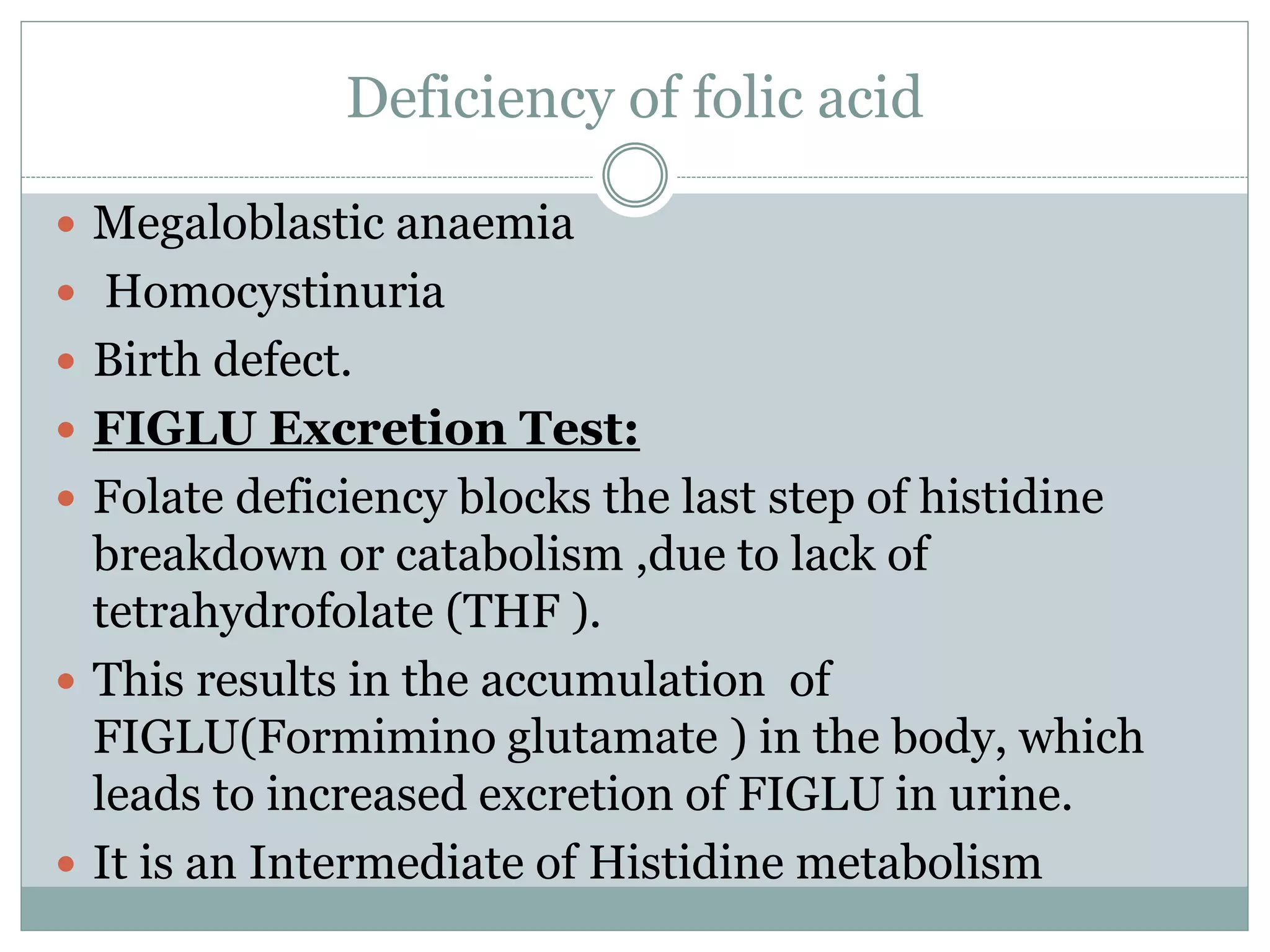
 FIGLU Excretion Test:
 Folate deficiency blocks the last step of histidine
breakdown or catabolism ,due to lack of
tetrahydrofolate (THF ).
 This results in the accumulation of
FIGLU(Formimino glutamate ) in the body, which
leads to increased excretion of FIGLU in urine.
 It is an Intermediate of Histidine metabolism
Inhibitors of Folic acid
 Sulphonamides.
 Trimethoprim
 Septran
 Methotrexate
 Pyrimethamine
References
 Text book of biochemistry – D M vasudevan,
 Text book of biochemistry- S K Guptha
 Illustrated biochemistry – Lippincott's
 Text book of biochemistry – Pankaja naik

One carbon metabolism

  • 1.
    B A SA L I N G A P P A B G D M L T . , B M L T . , B S B T . , M . S C . M E D I C A L B I O C H E M I S T R Y D E P ' T O F B I O C H E M I S T R Y J S S M E D I C A L C O L L E G E One Carbon Metabolism
  • 2.
    FOLIC ACID  Folicacid (or folate), which plays a key role in one- carbon metabolism, is essential for the biosynthesis of several compounds.  Chemically folic acid is pteroyl-glutamic acid made up of pteridne nucleus- amino benzoic acid (PABA)and glutamic acid.  The role of folic acid is that it acts as a carrier of one carbon groups or moities required in metabolism.
  • 3.
     Structure offolic acid is shown below. Chemically called pteroyl glutamic acid (PGA).  There are at least three chemically related compounds of nutritional importance which occur in natural products, all may be termed pteroyl glutamates.
  • 5.
    These three compoundsdiffer only in the number of glutamic acid residues attached to pteridine PABA complex (pteroic acid). Monoglutamate: Having one glutamic acid. It is synonymous with vitamin Bc. • Triglutamate: Having three glutamic acid residues. This substance once designated as “fermentation factor”. • Heptaglutamate: Having seven glutamate residues,synonymous with vitamin Bc conjugate of yeast.Pteroyl glutamic acid is liberated from these conjugates by enzymes called conjugases.
  • 6.
    Biological “Active” Forms Active “coenzyme” form of the vitamin is the reduced tetra hydrderivative,Tetrahydrofolate reductase FH4, obtained by addition of four hydrogen's to the pteridne moiety at 5, 6, 7 and 8 position.  Structure of tetrahydrofolate is shown below.
  • 7.
  • 8.
     Folic acidis reduced by dihydrofolate reductase in two steps:  First to dihydrofolic acid (DHFA),also called dihydrofolate and then converted to tetra hydrofolate (THFA).  The double bonds at N-atom 5 and 8 as shown in above figure are reduced .
  • 9.
    The one carbongroups are as  Methyl (-CH3)  Methylene (=CH2)  Methenyl (=CH-)  Formyl (-HCO)  Formimino(-CH=NH-)  Hydroxy methyl (-CH2 –OH).  All these one carbon groups which are carried by folic acid .
  • 10.
    Sources of OneCarbon  Serine  Glycine  Histidine  Tryptophan
  • 13.
    Metabolism of onecarbon metabolism  One carbon metabolism is basically indicates that there will be a donation of carbon atom in variety of metabolic reaction.  Some of metabolic reactions which will need to carry out function in our body,so we need a C-atom ,and that has to be donated ,so it is going to do that so that will be done at tetrahydro folate(THF)
  • 15.
     Basically THFit carries a one carbon derivative and that will be donated in some other metabolic reactions.  Here so the THF is also referred as vitB9, so there are THF derivatives which are Participating in one carbon metabolismon they have
  • 16.
     N10 –formylTHF (-CHO)  N5 ,N10 Methyl THF (-CH=)  N5 ,N10 Methylene THF (-CH2-)  N5 –Methyl THF (-CH3)  Now to THF in order to make all these have different types of folate derivatives ,so we need again a vitB6,vitB2 ,VitB12, So these are the other water Soluble vitamins but they are necessary for the THF,to get into all their derivatives.
  • 17.
     So nowlet us one carbon metabolism is go on in our body ,what are reactions shunts or participating in one carbon metabolism,  So we get folate (from green leafy vegetables)usually folate we get as polyglutamate from of folate and the intestine and glutamates are removed and monoglutamate are just fold is absorbed and once its,in our body.  It will be converted to dihydrofolate (DHF)by an enzyme dihydrofolate reductase (DHFR).
  • 18.
     So nowwe are going to convert folate into dihydrofolate by an enzyme DHFR. Folate Dihydro folate reductase Dihydrofolate Now the DHF is converted THF By the same enzyme DHFR applies aspects for this methotrexate(Basically it is a anticancer drug which is going to DHFR enzyme there by converting folate into THF is decrease that s all ,so anyway
  • 19.
     Now whathappens to THF ,will interact by a seine ,SHMT(serine hydroxyl methoxy transferase)this SHMT it needs PLP(pyridoxal phosphate ) as a coenzyme(VitB6)this is needed to make THF derivative.  So SHMT while transferase is going to take a methyl form serine and side chain methyl group ie attached to hydroxyl group there,ie in the side chain,CH2 is taken from serine .
  • 20.
     So thisserine will be attached to the THF and the compund that will get  N5 ,N10 Methylene THF (-CH2-)and it will get glycine .This is a reversible reaction. THF serine N5,N10 methylene THF Glycine
  • 21.
    Once it geta N5 ,N10 methylene THF ,So it has three fates here, 1. It will be used as a coenzyme by thymidilate synthase enzyme,This TS Which is going to convert dUMP (deoxy uridine monophosphate) into TMP(Thymidilate monophosphate). dUMP TMP
  • 22.
     HISTIDINE: Itis a source of formimino group during its catabolism and transfers this formimino group to THFA resulting in N5 form imino THFA .  N5 N10 methenyl THFA can also give raise to formimino THFA as well as N5 formyl THFA.
  • 24.
     Tryptophan: Formatecan directly form N5 formyl THFA.  It is a source of formate
  • 25.
    UTILISATION OF ONECARBON Synthesis of methionine :  Methyl group of methyl cobalmine (VitB12) is used to synthesize methionine from homocysteine .The methyl group which is donated by methyl tetra hydro folate(MTHF).  The methionine as SAM then donates this methyl group in the synthesis of many important compunds like  Choline  Creatine  Epinephrine etc .
  • 26.
    IS Cobalmine whichleads to folate deficiency ? Why because the methyl tetrahydrofolate is not utilized so this called folate trap or methyl trap.
  • 27.
    PURINE SYNTHESIS  Ionisinemonophosphate (IMP) synthesis mainly it requires N5,N10 Methenyl tetrahydrofolate and formyl tetrahydrofolate.  AMP and GMP both are significantly symthesized from IMP.  Ultimately ATP and GTP These are formed from AMP And GMP respectively which are required for the DNA synthesis.
  • 28.
    PYRIMIDINE SYNTHESIS  Thymidilate(TMP)is synthesized from deoxy uridilate using N5,N10 methylene THF.  It is used in DNA synthesis.  In this Process tetrahydrofolate is simultaneously oxidised to dihydrofolate which must be reconverted to THF for reuse
  • 29.
    Formyl tRNA  FormylTHF is required for the formation of formyl methionine tRNA needed in Protein Synthesis in Prokaryotes and Mitochondria.
  • 31.
    Deficiency of folicacid  Megaloblastic anaemia  Homocystinuria  Birth defect.  FIGLU Excretion Test:  Folate deficiency blocks the last step of histidine breakdown or catabolism ,due to lack of tetrahydrofolate (THF ).  This results in the accumulation of FIGLU(Formimino glutamate ) in the body, which leads to increased excretion of FIGLU in urine.  It is an Intermediate of Histidine metabolism
  • 32.
    Inhibitors of Folicacid  Sulphonamides.  Trimethoprim  Septran  Methotrexate  Pyrimethamine
  • 33.
    References  Text bookof biochemistry – D M vasudevan,  Text book of biochemistry- S K Guptha  Illustrated biochemistry – Lippincott's  Text book of biochemistry – Pankaja naik