DNA replication
in Eukaryotes.
Animal/Humans
DNA replication is the most fundamental
action.
It is a biological process and occurs in all
living beings.
It is basis of biological heritance.
Process : producing two identical replicas
from one original DNA strand.
The process takes place in semi-
conservative method.
DNA replication like all
other biological process
proceed in 3 co-ordinated
process:
• Initiation
• Elongation
• Termination
1.INITIATION
DNA replication initiate from specific sequences
Origin of replication (ORI) called Replisomes.
Eukaryotic cells have multiple replication sites.
Multiple replicative proteins must assemble on
these replication sites.
It leads to formation of Pre-replication complex
(pre-RC).
Pre-replication complex has steps
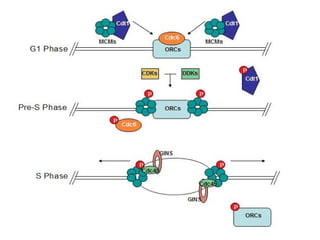
First - association of Origin Recognizing Complex (ORC) with
replication origin.
Second - binding of Cdc6 [cell division cycle 6] protein to
ORC
Third - binding of Cdt1 [Chromatin licensing and DNA replication factor
1] and minichromosome maintenance protein (MCM).
This replicative complex assembly occurs during G1 phase prior
to S phase.
During the transition between G1 phase to S phase, CDK [Cyclin-dependent
kinases] proteins and DDK [Dbf4-dependent kinase] proteins get attached
to the Pre-replication complex.
It transforms the Pre-replication complex into active
replication fork.
SYNTHETIC LETHALITY WITH DPB11
Once the complex forms and cell pass into S phase, then
unwinding of DNA strand takes place.
Unwinding takes place by enzyme Helicases, and it leads
of exposure of 2 DNA templates.
After unwinding, polymerization of the daughter strands
takes place.
It occurs with help of DNA polymerase enzymes.
They are :
• DNA polymerase alpha [α]
• DNA polymerase epsilon [ε]
• DNA polymerase delta [δ]
2. ELONATION
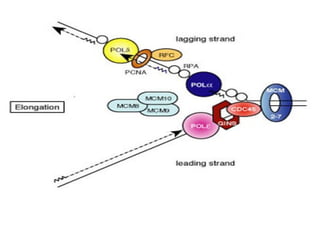
DNA polymerase α
DNA polymerase α associated with enzyme Primase,
forms RNA primer which are 8-10 nucleotide long.
Later DNA polymerase α elongates this RNA primer by
more 20 nucleotides and then leaves the place.
DNA polymerase ε :
DNA polymerase ε synthesis nucleotides on the leading
strand.
It will continuously add nucleotides leading to
continuous process of replication.
Thus it will require only one RNA primer at the
beginning.
DNA polymerase δ
DNA polymerase δ helps the synthesis of DNA on
lagging strand.
On the lagging strand multiple RNA primers are
required.
On the lagging strand, DNA polymerase δ synthesize small
fragments of DNA called Okazaki fragments.
At the end of each Okazaki fragment, DNAPD runs to previous Okazaki
fragment and replaces the RNA primer nucleotides with Dna
nucleotides.
this leads to flap formation which is removed and the nick
between is replaced by enzyme DNA ligases .
This process is known as Okazaki fragments
maturation.
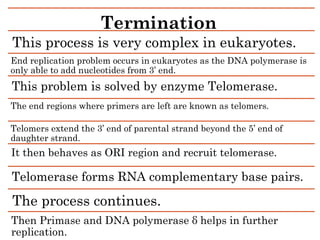
Termination
This process is very complex in eukaryotes.
End replication problem occurs in eukaryotes as the DNA polymerase is
only able to add nucleotides from 3’ end.
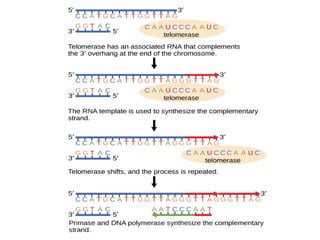
This problem is solved by enzyme Telomerase.
The end regions where primers are left are known as telomers.
Telomers extend the 3’ end of parental strand beyond the 5’ end of
daughter strand.
It then behaves as ORI region and recruit telomerase.
Telomerase forms RNA complementary base pairs.
The process continues.
Then Primase and DNA polymerase δ helps in further
replication.
EUKARYOTIC DNA REPLICATION.pptx pharmacology

EUKARYOTIC DNA REPLICATION.pptx pharmacology

  • 1.
  • 2.
    DNA replication isthe most fundamental action. It is a biological process and occurs in all living beings. It is basis of biological heritance. Process : producing two identical replicas from one original DNA strand. The process takes place in semi- conservative method.
  • 3.
    DNA replication likeall other biological process proceed in 3 co-ordinated process: • Initiation • Elongation • Termination
  • 4.
    1.INITIATION DNA replication initiatefrom specific sequences Origin of replication (ORI) called Replisomes. Eukaryotic cells have multiple replication sites. Multiple replicative proteins must assemble on these replication sites. It leads to formation of Pre-replication complex (pre-RC).
  • 5.
    Pre-replication complex hassteps First - association of Origin Recognizing Complex (ORC) with replication origin. Second - binding of Cdc6 [cell division cycle 6] protein to ORC Third - binding of Cdt1 [Chromatin licensing and DNA replication factor 1] and minichromosome maintenance protein (MCM). This replicative complex assembly occurs during G1 phase prior to S phase. During the transition between G1 phase to S phase, CDK [Cyclin-dependent kinases] proteins and DDK [Dbf4-dependent kinase] proteins get attached to the Pre-replication complex. It transforms the Pre-replication complex into active replication fork.
  • 7.
  • 8.
    Once the complexforms and cell pass into S phase, then unwinding of DNA strand takes place. Unwinding takes place by enzyme Helicases, and it leads of exposure of 2 DNA templates. After unwinding, polymerization of the daughter strands takes place. It occurs with help of DNA polymerase enzymes. They are : • DNA polymerase alpha [α] • DNA polymerase epsilon [ε] • DNA polymerase delta [δ] 2. ELONATION
  • 9.
    DNA polymerase α DNApolymerase α associated with enzyme Primase, forms RNA primer which are 8-10 nucleotide long. Later DNA polymerase α elongates this RNA primer by more 20 nucleotides and then leaves the place. DNA polymerase ε : DNA polymerase ε synthesis nucleotides on the leading strand. It will continuously add nucleotides leading to continuous process of replication. Thus it will require only one RNA primer at the beginning.
  • 10.
    DNA polymerase δ DNApolymerase δ helps the synthesis of DNA on lagging strand. On the lagging strand multiple RNA primers are required. On the lagging strand, DNA polymerase δ synthesize small fragments of DNA called Okazaki fragments. At the end of each Okazaki fragment, DNAPD runs to previous Okazaki fragment and replaces the RNA primer nucleotides with Dna nucleotides. this leads to flap formation which is removed and the nick between is replaced by enzyme DNA ligases . This process is known as Okazaki fragments maturation.
  • 12.
    Termination This process isvery complex in eukaryotes. End replication problem occurs in eukaryotes as the DNA polymerase is only able to add nucleotides from 3’ end. This problem is solved by enzyme Telomerase. The end regions where primers are left are known as telomers. Telomers extend the 3’ end of parental strand beyond the 5’ end of daughter strand. It then behaves as ORI region and recruit telomerase. Telomerase forms RNA complementary base pairs. The process continues. Then Primase and DNA polymerase δ helps in further replication.