BHARATHIDASAN UNIVERSITY
MECHANISM OF REPLICATION
Presented by:
Bhanu Kiran. P
3rd Year Life Sciences
CONTENT
 Introduction
 DNA Polymerase
 Leading and lagging strand
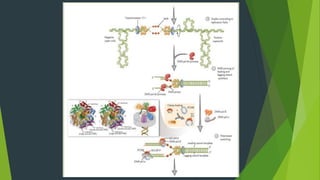
 Origin recognition complex
 Overall mechanism in 12steps
 DNA Helicase and action of topoisomerase
 Primase
 Enzyme trading
 Proof reading
 Maturation of nascent DNA strand
 Histone deposition
 Abbreviations
 Reference
INTRODUCTION
 DNA replication is the process by which a double-stranded DNA molecule is
copied to produce two identical DNA molecules.
 Replication is an essential process because, whenever a cell divides, the two new
daughter cells must contain the same genetic information, or DNA, as the parent
cell.
 The replication process relies on the fact that each strand of DNA can serve as a
template for duplication. DNA replication initiates at specific points, called
origins, where the DNA double helix is unwound.
 A short segment of RNA, called a primer, is then synthesized and acts as a
starting point for new DNA synthesis. An enzyme called DNA polymerase next
begins replicating the DNA by matching bases to the original strand.
 Once synthesis is complete, the RNA primers are replaced with DNA, and any
gaps between newly synthesized DNA segments are sealed together with
enzymes.
DNA Polymerase
 Enzymes that polymerize nucleotides into a growing strand of DNA are called
DNA polymerases.
 Three different DNA polymerases are involved in chromosomal DNA
replication:
DNA polymerase α
DNA polymerase δ
DNA polymerase ε.
 DNA polymerase γ is used strictly for mitochondrial DNA (mtDNA) replication.
 A DNA polymerase can catalyze the formation of a phosphodiester bond
between the first 5′-phosphate group of a new dNTP and the 3′-hydroxyl group
of the last nucleotide in the newly synthesized strand
Leading and lagging strand
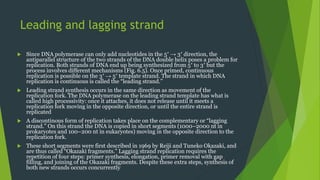
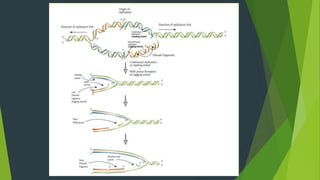
 Since DNA polymerase can only add nucleotides in the 5′ → 3′ direction, the
antiparallel structure of the two strands of the DNA double helix poses a problem for
replication. Both strands of DNA end up being synthesized from 5′ to 3′ but the
process involves different mechanisms (Fig. 6.5). Once primed, continuous
replication is possible on the 3′ → 5′ template strand. The strand in which DNA
replication is continuous is called the “leading strand.”
 Leading strand synthesis occurs in the same direction as movement of the
replication fork. The DNA polymerase on the leading strand template has what is
called high processivity: once it attaches, it does not release until it meets a
replication fork moving in the opposite direction, or until the entire strand is
replicated
 A discontinous form of replication takes place on the complementary or “lagging
strand.” On this strand the DNA is copied in short segments (1000–2000 nt in
prokaryotes and 100–200 nt in eukaryotes) moving in the opposite direction to the
replication fork.
 These short segments were first described in 1969 by Reiji and Tuneko Okazaki, and
are thus called “Okazaki fragments.” Lagging strand replication requires the
repetition of four steps: primer synthesis, elongation, primer removal with gap
filling, and joining of the Okazaki fragments. Despite these extra steps, synthesis of
both new strands occurs concurrently
Origin recognition complex
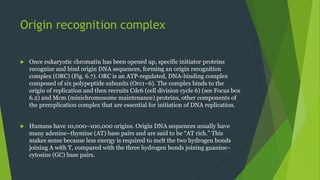
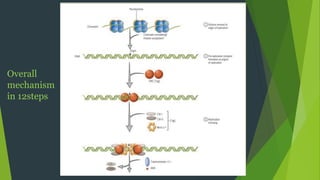
 Once eukaryotic chromatin has been opened up, specific initiator proteins
recognize and bind origin DNA sequences, forming an origin recognition
complex (ORC) (Fig. 6.7). ORC is an ATP-regulated, DNA-binding complex
composed of six polypeptide subunits (Orc1–6). The complex binds to the
origin of replication and then recruits Cdc6 (cell division cycle 6) (see Focus box
6.2) and Mcm (minichromosome maintenance) proteins, other components of
the prereplication complex that are essential for initiation of DNA replication.
 Humans have 10,000–100,000 origins. Origin DNA sequences usually have
many adenine–thymine (AT) base pairs and are said to be “AT rich.” This
makes sense because less energy is required to melt the two hydrogen bonds
joining A with T, compared with the three hydrogen bonds joining guanine–
cytosine (GC) base pairs.
Overall
mechanism
in 12steps
DNA Helicase and action of
topoisomerase
 DNA helicases are enzymes that use the energy of ATP to melt (separate the two
strands of the double helix) the DNA duplex. They progressively catalyze the
transition from double-stranded to single-stranded DNA in the direction of the
moving replication fork.
 Movement of the replication fork machinery along the DNA molecule results in
the generation of positive supercoiling ahead of the fork, while the already
replicated parental strands in its wake become negatively supercoiled (see Fig.
6.7).
 The resulting accumulation of torsional strain could lead to inhibition of fork
movement if not relieved by a DNA topoisomerase. Either type I or type II
topoisomerases are capable of removing (relaxing) the positive supercoils ahead
of the fork. However, the progeny DNA molecules that are formed remain
multiply intertwined because of failure to remove all of the links between the
parental strands during DNA synthesis.
 Topoisomerase II is required to resolve this tangled structure into two separate
progeny genomes.
Primase
 Synthesis of an RNA primer is required to start leading strand synthesis and for
each Okazaki fragment to be synthesized on the lagging strand.
 The RNA primer is created de novo.
 It is an RNA polymerase that is only used for this specific purpose. In
eukaryotes, the RNA primer is synthesized by DNA polymerase α and its
associated primase activity .
 The eukaryotic enzyme exists as a complex consisting of a subunit with DNA
polymerase activity, a subunit necessary for assembly, and two small proteins
that together provide the primase activity. The complex is usually referred to as
pol α/primase.
 The pol α/primase enzyme binds to the initiation complex at the origin and
synthesizes a short strand consisting of approximately 10 bases of RNA,
followed by 20–30 bases of DNA (called iDNA, for initiator DNA).
Enzyme Trading
 Multiple dynamic protein interactions are involved in DNA replication. A key
feature of the replication process is the ordered hand-off or “trading places” of
DNA from one protein to another, or from complex to complex.
 A striking example of such “trading places” occurs after primer synthesis is
complete – the pol α/primase complex is replaced by the DNA polymerase that
will extend the chain. This hand-off of the DNA template from one DNA
polymerase to another is called polymerase switching. On the leading strand,
the switch is to DNA polymerase δ.
 Recent data suggest that DNA polymerase ε elongates the lagging strand.
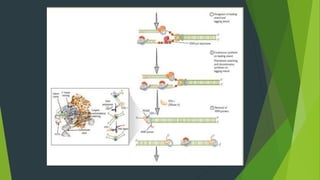
Proofreading
 Despite being classified as high-fidelity enzymes, the replicative polymerases
are not perfect. They generate errors spontaneously when copying DNA, with
mutation rates ranging from 10−4 to 10−5 per base pair.
 Many replicative polymerases have an associated proofreading exonuclease
that excises 90–99% of misincorporated nucleotides, reducing the spontaneous
polymerase error rates to within the range of 10−7 to 10−8.
 For example, DNA polymerase δ has a subunit with 3′ → 5′ exonuclease
activity (Fig. 6.13). The structure of DNA polymerase, determined by X-ray
crystallography, has been likened to a hand holding the DNA.
 The polymerase activity is within the fingers and thumb, and the exonuclease
domain is at the base of the palm. Incorporation of an incorrect base at the 3′
end causes a melting of the end of the duplex.
 As a result, the polymerase pauses and excises the mispaired base, then
elongation resumes. DNA polymerase α (involved in primer synthesis) does not
have 3′ → 5′ exonuclease activity.
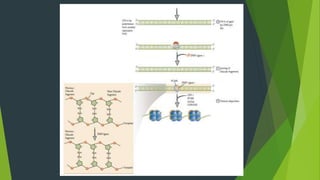
Maturation of nascent DNA strands
 Maturation of newly synthesized DNA involves several different steps: RNA
primer removal, gap fill-in, and joining of Okazaki fragments on the lagging
strand.
Gap fill-in and joining of the Okazaki fragments
 The remaining gap left by primer removal on the lagging strand is filled in by
DNA polymerase ε, resulting in a nicked double-stranded DNA. Ligation then
occurs by the action of DNA ligase I, which joins the Okazaki fragments by
catalyzing the formation of new phosphodiester bonds.
Termination
 Replication probably continues until one fork meets a fork proceeding towards
it from the adjacent replicon. Some sequences have been identified at specific
sites that can arrest the progress of DNA replication forks in the genomes of
eukaryotic cells
Histone deposition
 Nucleosomes re-form within approximately 250 bp behind the replication fork.
Thus, histone deposition occurs almost as soon as enough DNA is available to
form nucleosomes (approximately 180 bp). Chromatin assembly factor 1 (CAF-
1) brings histones to the DNA replication fork via direct interaction with PCNA.
Abbreviations
 Proliferating cell nuclear antigen (PCNA)
 Replication factor C (RFC)
Reference
 Fundamental Molecular Biology-Lizabeth A. Allison
 www.nature.com/scitable/definition/replication-33
 www.ncbi.nlm.nih.gov/books/NBK26850/
 www.khanacademy.org/science/biology/dna-as-the-genetic-material/dna-
replication/a/molecular-mechanism-of-dna-replication

Mechanism of replication

  • 1.
    BHARATHIDASAN UNIVERSITY MECHANISM OFREPLICATION Presented by: Bhanu Kiran. P 3rd Year Life Sciences
  • 2.
    CONTENT  Introduction  DNAPolymerase  Leading and lagging strand  Origin recognition complex  Overall mechanism in 12steps  DNA Helicase and action of topoisomerase  Primase  Enzyme trading  Proof reading  Maturation of nascent DNA strand  Histone deposition  Abbreviations  Reference
  • 3.
    INTRODUCTION  DNA replicationis the process by which a double-stranded DNA molecule is copied to produce two identical DNA molecules.  Replication is an essential process because, whenever a cell divides, the two new daughter cells must contain the same genetic information, or DNA, as the parent cell.  The replication process relies on the fact that each strand of DNA can serve as a template for duplication. DNA replication initiates at specific points, called origins, where the DNA double helix is unwound.  A short segment of RNA, called a primer, is then synthesized and acts as a starting point for new DNA synthesis. An enzyme called DNA polymerase next begins replicating the DNA by matching bases to the original strand.  Once synthesis is complete, the RNA primers are replaced with DNA, and any gaps between newly synthesized DNA segments are sealed together with enzymes.
  • 4.
    DNA Polymerase  Enzymesthat polymerize nucleotides into a growing strand of DNA are called DNA polymerases.  Three different DNA polymerases are involved in chromosomal DNA replication: DNA polymerase α DNA polymerase δ DNA polymerase ε.  DNA polymerase γ is used strictly for mitochondrial DNA (mtDNA) replication.  A DNA polymerase can catalyze the formation of a phosphodiester bond between the first 5′-phosphate group of a new dNTP and the 3′-hydroxyl group of the last nucleotide in the newly synthesized strand
  • 5.
    Leading and laggingstrand  Since DNA polymerase can only add nucleotides in the 5′ → 3′ direction, the antiparallel structure of the two strands of the DNA double helix poses a problem for replication. Both strands of DNA end up being synthesized from 5′ to 3′ but the process involves different mechanisms (Fig. 6.5). Once primed, continuous replication is possible on the 3′ → 5′ template strand. The strand in which DNA replication is continuous is called the “leading strand.”  Leading strand synthesis occurs in the same direction as movement of the replication fork. The DNA polymerase on the leading strand template has what is called high processivity: once it attaches, it does not release until it meets a replication fork moving in the opposite direction, or until the entire strand is replicated  A discontinous form of replication takes place on the complementary or “lagging strand.” On this strand the DNA is copied in short segments (1000–2000 nt in prokaryotes and 100–200 nt in eukaryotes) moving in the opposite direction to the replication fork.  These short segments were first described in 1969 by Reiji and Tuneko Okazaki, and are thus called “Okazaki fragments.” Lagging strand replication requires the repetition of four steps: primer synthesis, elongation, primer removal with gap filling, and joining of the Okazaki fragments. Despite these extra steps, synthesis of both new strands occurs concurrently
  • 7.
    Origin recognition complex Once eukaryotic chromatin has been opened up, specific initiator proteins recognize and bind origin DNA sequences, forming an origin recognition complex (ORC) (Fig. 6.7). ORC is an ATP-regulated, DNA-binding complex composed of six polypeptide subunits (Orc1–6). The complex binds to the origin of replication and then recruits Cdc6 (cell division cycle 6) (see Focus box 6.2) and Mcm (minichromosome maintenance) proteins, other components of the prereplication complex that are essential for initiation of DNA replication.  Humans have 10,000–100,000 origins. Origin DNA sequences usually have many adenine–thymine (AT) base pairs and are said to be “AT rich.” This makes sense because less energy is required to melt the two hydrogen bonds joining A with T, compared with the three hydrogen bonds joining guanine– cytosine (GC) base pairs.
  • 8.
  • 12.
    DNA Helicase andaction of topoisomerase  DNA helicases are enzymes that use the energy of ATP to melt (separate the two strands of the double helix) the DNA duplex. They progressively catalyze the transition from double-stranded to single-stranded DNA in the direction of the moving replication fork.  Movement of the replication fork machinery along the DNA molecule results in the generation of positive supercoiling ahead of the fork, while the already replicated parental strands in its wake become negatively supercoiled (see Fig. 6.7).  The resulting accumulation of torsional strain could lead to inhibition of fork movement if not relieved by a DNA topoisomerase. Either type I or type II topoisomerases are capable of removing (relaxing) the positive supercoils ahead of the fork. However, the progeny DNA molecules that are formed remain multiply intertwined because of failure to remove all of the links between the parental strands during DNA synthesis.  Topoisomerase II is required to resolve this tangled structure into two separate progeny genomes.
  • 13.
    Primase  Synthesis ofan RNA primer is required to start leading strand synthesis and for each Okazaki fragment to be synthesized on the lagging strand.  The RNA primer is created de novo.  It is an RNA polymerase that is only used for this specific purpose. In eukaryotes, the RNA primer is synthesized by DNA polymerase α and its associated primase activity .  The eukaryotic enzyme exists as a complex consisting of a subunit with DNA polymerase activity, a subunit necessary for assembly, and two small proteins that together provide the primase activity. The complex is usually referred to as pol α/primase.  The pol α/primase enzyme binds to the initiation complex at the origin and synthesizes a short strand consisting of approximately 10 bases of RNA, followed by 20–30 bases of DNA (called iDNA, for initiator DNA).
  • 14.
    Enzyme Trading  Multipledynamic protein interactions are involved in DNA replication. A key feature of the replication process is the ordered hand-off or “trading places” of DNA from one protein to another, or from complex to complex.  A striking example of such “trading places” occurs after primer synthesis is complete – the pol α/primase complex is replaced by the DNA polymerase that will extend the chain. This hand-off of the DNA template from one DNA polymerase to another is called polymerase switching. On the leading strand, the switch is to DNA polymerase δ.  Recent data suggest that DNA polymerase ε elongates the lagging strand.
  • 15.
    Proofreading  Despite beingclassified as high-fidelity enzymes, the replicative polymerases are not perfect. They generate errors spontaneously when copying DNA, with mutation rates ranging from 10−4 to 10−5 per base pair.  Many replicative polymerases have an associated proofreading exonuclease that excises 90–99% of misincorporated nucleotides, reducing the spontaneous polymerase error rates to within the range of 10−7 to 10−8.  For example, DNA polymerase δ has a subunit with 3′ → 5′ exonuclease activity (Fig. 6.13). The structure of DNA polymerase, determined by X-ray crystallography, has been likened to a hand holding the DNA.  The polymerase activity is within the fingers and thumb, and the exonuclease domain is at the base of the palm. Incorporation of an incorrect base at the 3′ end causes a melting of the end of the duplex.  As a result, the polymerase pauses and excises the mispaired base, then elongation resumes. DNA polymerase α (involved in primer synthesis) does not have 3′ → 5′ exonuclease activity.
  • 16.
    Maturation of nascentDNA strands  Maturation of newly synthesized DNA involves several different steps: RNA primer removal, gap fill-in, and joining of Okazaki fragments on the lagging strand. Gap fill-in and joining of the Okazaki fragments  The remaining gap left by primer removal on the lagging strand is filled in by DNA polymerase ε, resulting in a nicked double-stranded DNA. Ligation then occurs by the action of DNA ligase I, which joins the Okazaki fragments by catalyzing the formation of new phosphodiester bonds. Termination  Replication probably continues until one fork meets a fork proceeding towards it from the adjacent replicon. Some sequences have been identified at specific sites that can arrest the progress of DNA replication forks in the genomes of eukaryotic cells
  • 17.
    Histone deposition  Nucleosomesre-form within approximately 250 bp behind the replication fork. Thus, histone deposition occurs almost as soon as enough DNA is available to form nucleosomes (approximately 180 bp). Chromatin assembly factor 1 (CAF- 1) brings histones to the DNA replication fork via direct interaction with PCNA.
  • 18.
    Abbreviations  Proliferating cellnuclear antigen (PCNA)  Replication factor C (RFC)
  • 19.
    Reference  Fundamental MolecularBiology-Lizabeth A. Allison  www.nature.com/scitable/definition/replication-33  www.ncbi.nlm.nih.gov/books/NBK26850/  www.khanacademy.org/science/biology/dna-as-the-genetic-material/dna- replication/a/molecular-mechanism-of-dna-replication