

ABG -402
INTRODUCTORY MOLECULAR GENETICS
GROUP 2
M BAQIR
LAIBA ARIF
KANWAL AKBAR
ESHA IQBAL
NAVEED NAZAR
Submitted to :
Mam Warda Sarwar
DNA Replication in Eukaryotes
 Replication in E. coli begins at only one site along the single, circular
chromosome.
 Eukaryotes have thousand times bigger DNA yet their polymerases
incorporate nucleotides into DNA at much slower rates.
 Eukaryotic cells replicate their genome in small portions, termed replicons.
 Each replicon has its own origin from which replication forks proceed
outward in both directions.
 In a human cell, replication begins at about 10,000 to 100,000 different
replication origins.
 Approximately 10 to 15 percent of replicons are actively engaged in
replication at any given time during the S phase of the cell cycle
Replication in Eukaryotic Cell
DNA polymerase
 Five “classic” DNA polymerase designated as DNA polymerase α, β, γ, δ, and ε.
Polymerase γ replicates mitochondrial DNA
 Polymerase β functions in DNA repair
DNA polymerase α and δ are involved in replication (nuclear)
 DNA polymerase α is typically a multi-subunit enzyme
 One subunit has a primase activity
 The largest subunit contains the polymerization activity
DNA unwinding and DNA synthesis are assembled in multistep process.
There are three major steps that are involved in DNA replication.
➤ Initiation
➤ Elongation
➤ Termination
Mechanism of DNA Replication
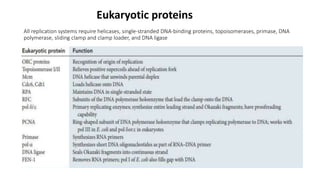
All replication systems require helicases, single‐stranded DNA‐binding proteins, topoisomerases, primase, DNA
polymerase, sliding clamp and clamp loader, and DNA ligase
Eukaryotic proteins
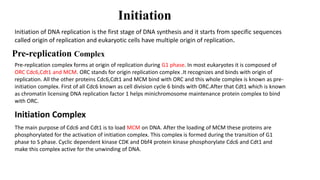
Initiation
Initiation of DNA replication is the first stage of DNA synthesis and it starts from specific sequences
called origin of replication and eukaryotic cells have multiple origin of replication.
Pre-replication Complex
Pre-replication complex forms at origin of replication during G1 phase. In most eukaryotes it is composed of
ORC Cdc6,Cdt1 and MCM. ORC stands for origin replication complex .It recognizes and binds with origin of
replication. All the other proteins Cdc6,Cdt1 and MCM bind with ORC and this whole complex is known as pre-
initiation complex. First of all Cdc6 known as cell division cycle 6 binds with ORC.After that Cdt1 which is known
as chromatin licensing DNA replication factor 1 helps minichromosome maintenance protein complex to bind
with ORC.
Initiation Complex
The main purpose of Cdc6 and Cdt1 is to load MCM on DNA. After the loading of MCM these proteins are
phosphorylated for the activation of initiation complex. This complex is formed during the transition of G1
phase to S phase. Cyclic dependent kinase CDK and Dbf4 protein kinase phosphorylate Cdc6 and Cdt1 and
make this complex active for the unwinding of DNA.
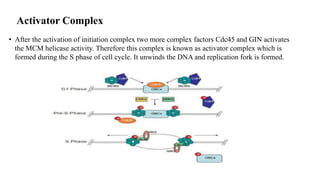
Activator Complex
• After the activation of initiation complex two more complex factors Cdc45 and GIN activates
the MCM helicase activity. Therefore this complex is known as activator complex which is
formed during the S phase of cell cycle. It unwinds the DNA and replication fork is formed.
Elongation
• Replication Fork
in humans, synthesis of new DNA occurs at the rate of 300 nucleotides per minute. Once initiation complex is
formed the cell is passed into S Phase and replication fork is formed. This complex then becomes a replisome.
The eukaryotic replisome complex is responsible for coordinating of DNA replication. It consists of polymerase
enzymes ,clamp loader proteins, Topoisomerase and all other important factors that help in replication of DNA
strands.
• Replication Protein A (RPA)
RPA is major protein that binds to single stranded DNA in eukaryotic cells.RPA prevents DNA from winding
back on itself or forming secondary structures. It keeps the DNA unwound for polymerase to replicate it.
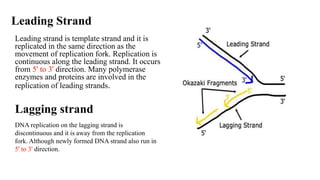
Leading Strand
Leading strand is template strand and it is
replicated in the same direction as the
movement of replication fork. Replication is
continuous along the leading strand. It occurs
from 5' to 3' direction. Many polymerase
enzymes and proteins are involved in the
replication of leading strands.
Lagging strand
DNA replication on the lagging strand is
discontinuous and it is away from the replication
fork. Although newly formed DNA strand also run in
5' to 3' direction.
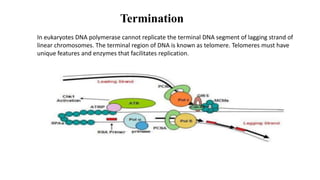
Termination
In eukaryotes DNA polymerase cannot replicate the terminal DNA segment of lagging strand of
linear chromosomes. The terminal region of DNA is known as telomere. Telomeres must have
unique features and enzymes that facilitates replication.
Thank you

DNA Replication in Eukaryotes (initiation-elongation-termination)

  • 1.
  • 2.
    GROUP 2 M BAQIR LAIBAARIF KANWAL AKBAR ESHA IQBAL NAVEED NAZAR Submitted to : Mam Warda Sarwar
  • 3.
  • 4.
     Replication inE. coli begins at only one site along the single, circular chromosome.  Eukaryotes have thousand times bigger DNA yet their polymerases incorporate nucleotides into DNA at much slower rates.  Eukaryotic cells replicate their genome in small portions, termed replicons.  Each replicon has its own origin from which replication forks proceed outward in both directions.  In a human cell, replication begins at about 10,000 to 100,000 different replication origins.  Approximately 10 to 15 percent of replicons are actively engaged in replication at any given time during the S phase of the cell cycle Replication in Eukaryotic Cell
  • 5.
    DNA polymerase  Five“classic” DNA polymerase designated as DNA polymerase α, β, γ, δ, and ε. Polymerase γ replicates mitochondrial DNA  Polymerase β functions in DNA repair DNA polymerase α and δ are involved in replication (nuclear)  DNA polymerase α is typically a multi-subunit enzyme  One subunit has a primase activity  The largest subunit contains the polymerization activity
  • 6.
    DNA unwinding andDNA synthesis are assembled in multistep process. There are three major steps that are involved in DNA replication. ➤ Initiation ➤ Elongation ➤ Termination Mechanism of DNA Replication
  • 7.
    All replication systemsrequire helicases, single‐stranded DNA‐binding proteins, topoisomerases, primase, DNA polymerase, sliding clamp and clamp loader, and DNA ligase Eukaryotic proteins
  • 8.
    Initiation Initiation of DNAreplication is the first stage of DNA synthesis and it starts from specific sequences called origin of replication and eukaryotic cells have multiple origin of replication. Pre-replication Complex Pre-replication complex forms at origin of replication during G1 phase. In most eukaryotes it is composed of ORC Cdc6,Cdt1 and MCM. ORC stands for origin replication complex .It recognizes and binds with origin of replication. All the other proteins Cdc6,Cdt1 and MCM bind with ORC and this whole complex is known as pre- initiation complex. First of all Cdc6 known as cell division cycle 6 binds with ORC.After that Cdt1 which is known as chromatin licensing DNA replication factor 1 helps minichromosome maintenance protein complex to bind with ORC. Initiation Complex The main purpose of Cdc6 and Cdt1 is to load MCM on DNA. After the loading of MCM these proteins are phosphorylated for the activation of initiation complex. This complex is formed during the transition of G1 phase to S phase. Cyclic dependent kinase CDK and Dbf4 protein kinase phosphorylate Cdc6 and Cdt1 and make this complex active for the unwinding of DNA.
  • 9.
    Activator Complex • Afterthe activation of initiation complex two more complex factors Cdc45 and GIN activates the MCM helicase activity. Therefore this complex is known as activator complex which is formed during the S phase of cell cycle. It unwinds the DNA and replication fork is formed.
  • 10.
    Elongation • Replication Fork inhumans, synthesis of new DNA occurs at the rate of 300 nucleotides per minute. Once initiation complex is formed the cell is passed into S Phase and replication fork is formed. This complex then becomes a replisome. The eukaryotic replisome complex is responsible for coordinating of DNA replication. It consists of polymerase enzymes ,clamp loader proteins, Topoisomerase and all other important factors that help in replication of DNA strands. • Replication Protein A (RPA) RPA is major protein that binds to single stranded DNA in eukaryotic cells.RPA prevents DNA from winding back on itself or forming secondary structures. It keeps the DNA unwound for polymerase to replicate it.
  • 11.
    Leading Strand Leading strandis template strand and it is replicated in the same direction as the movement of replication fork. Replication is continuous along the leading strand. It occurs from 5' to 3' direction. Many polymerase enzymes and proteins are involved in the replication of leading strands. Lagging strand DNA replication on the lagging strand is discontinuous and it is away from the replication fork. Although newly formed DNA strand also run in 5' to 3' direction.
  • 12.
    Termination In eukaryotes DNApolymerase cannot replicate the terminal DNA segment of lagging strand of linear chromosomes. The terminal region of DNA is known as telomere. Telomeres must have unique features and enzymes that facilitates replication.
  • 13.