Lecture 11:
DNA replication in Eukaryotes and
phage
Readings (chapter 3)
Course 281
Lessons for life
AIMS
• Understand the replication in bacteriophage and
the benefits of such replication method for the
virus.
• Understand the DNA replication in eukaryotes
and how it differs from that of prokaryotes.
• Learn the names of the enzymes in the
replication of eukaryotic genome and their
equivalent in prokaryotes.
• Understand how the differences in the replication
of eukaryotic DNA is fixed.
Replication in phages
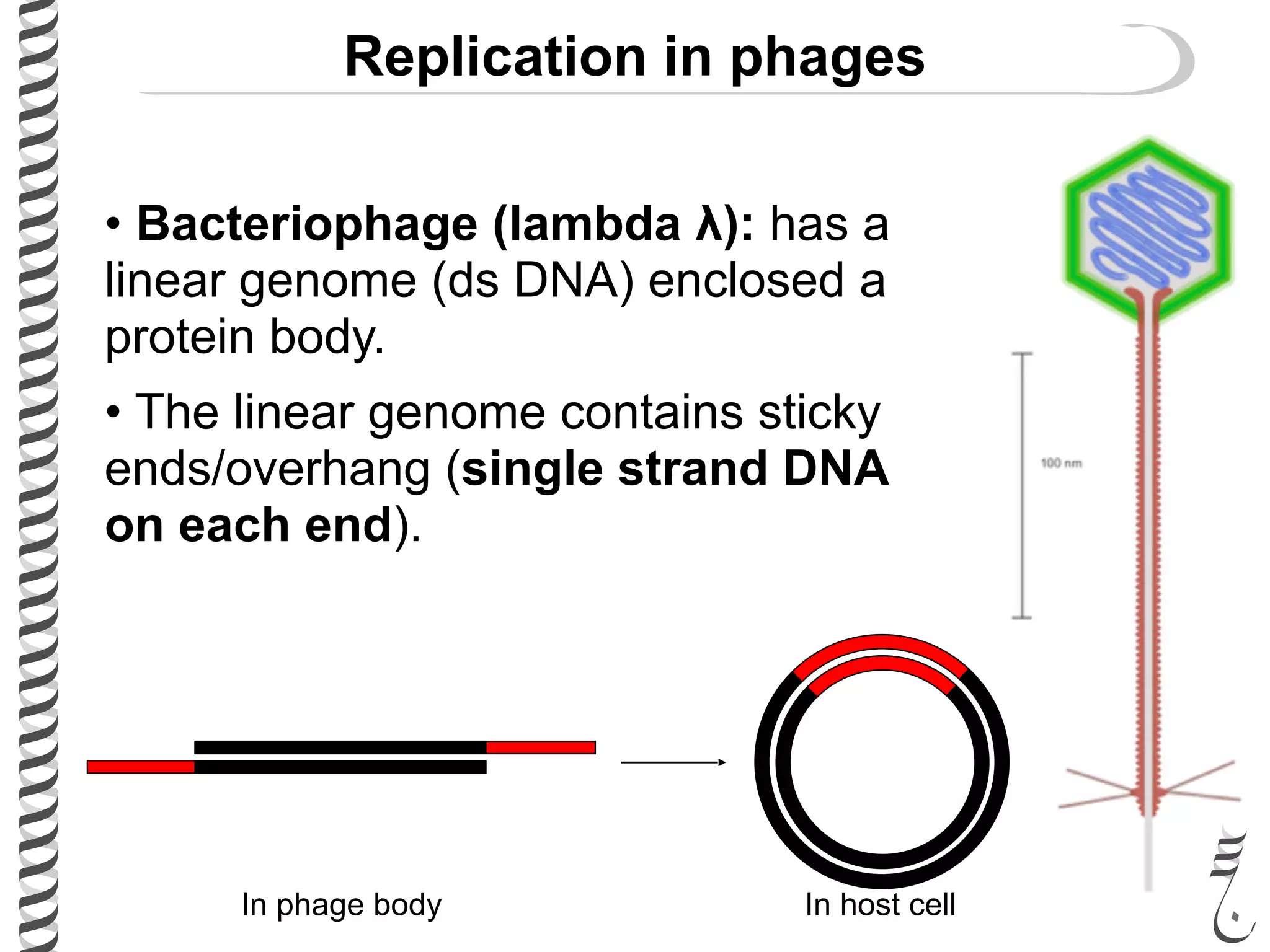
• Bacteriophage (lambda λ): has a
linear genome (ds DNA) enclosed a
protein body.
• The linear genome contains sticky
ends/overhang (single strand DNA
on each end).
In phage body In host cell
Replication in phages
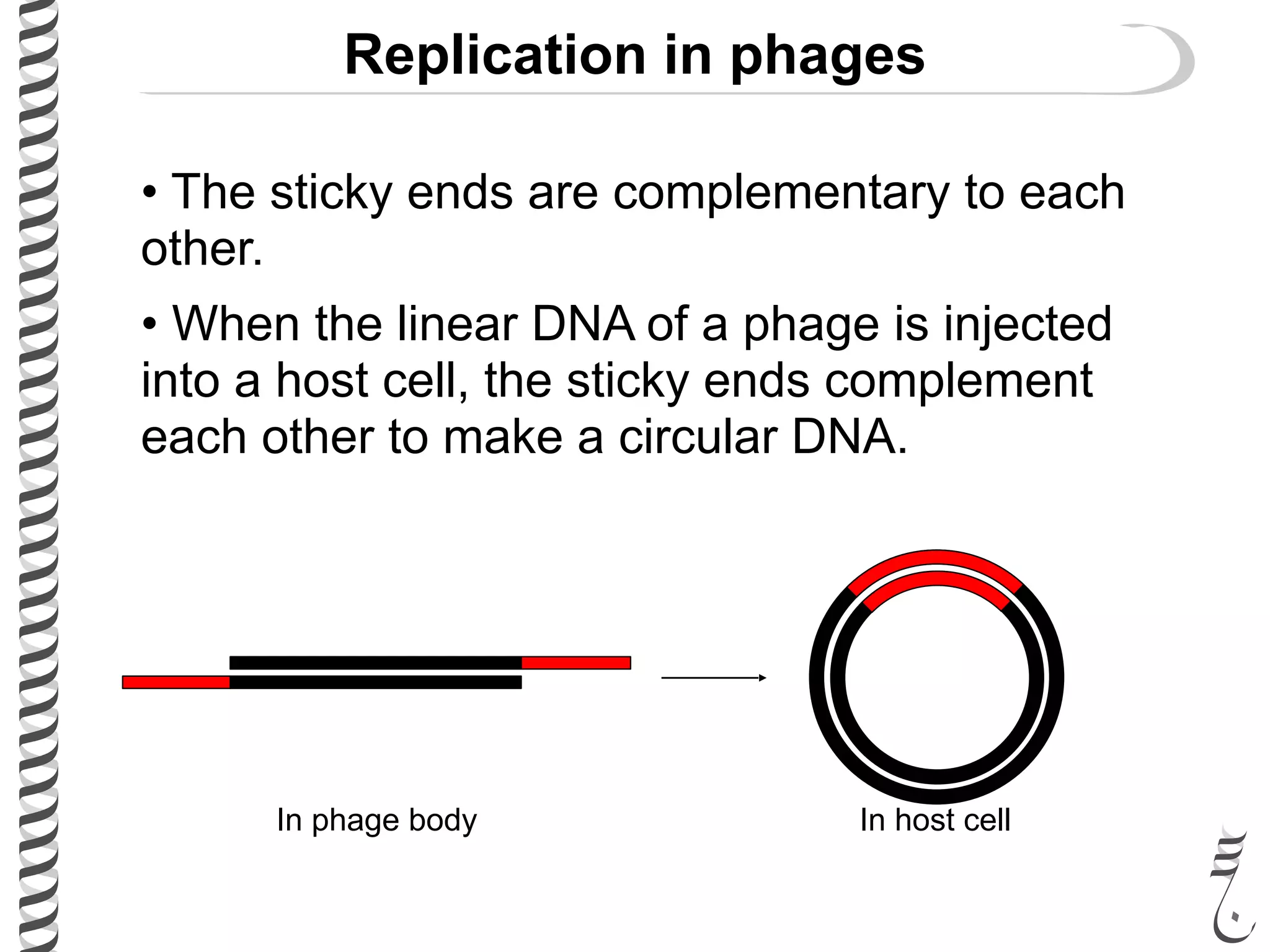
• The sticky ends are complementary to each
other.
• When the linear DNA of a phage is injected
into a host cell, the sticky ends complement
each other to make a circular DNA.
In phage body In host cell
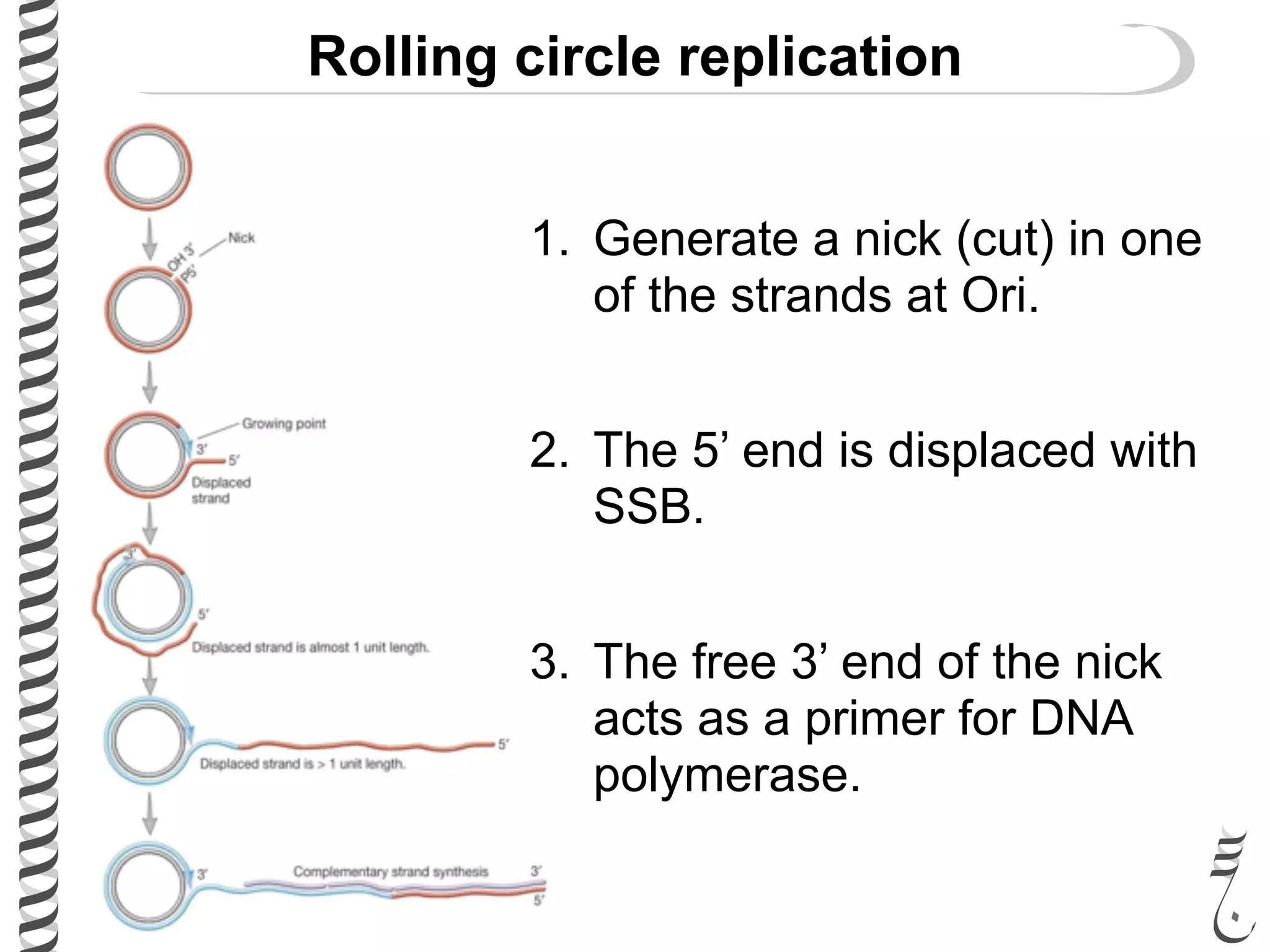
Rolling circle replication
1. Generate a nick (cut) in one
of the strands at Ori.
2. The 5’ end is displaced with
SSB.
3. The free 3’ end of the nick
acts as a primer for DNA
polymerase.
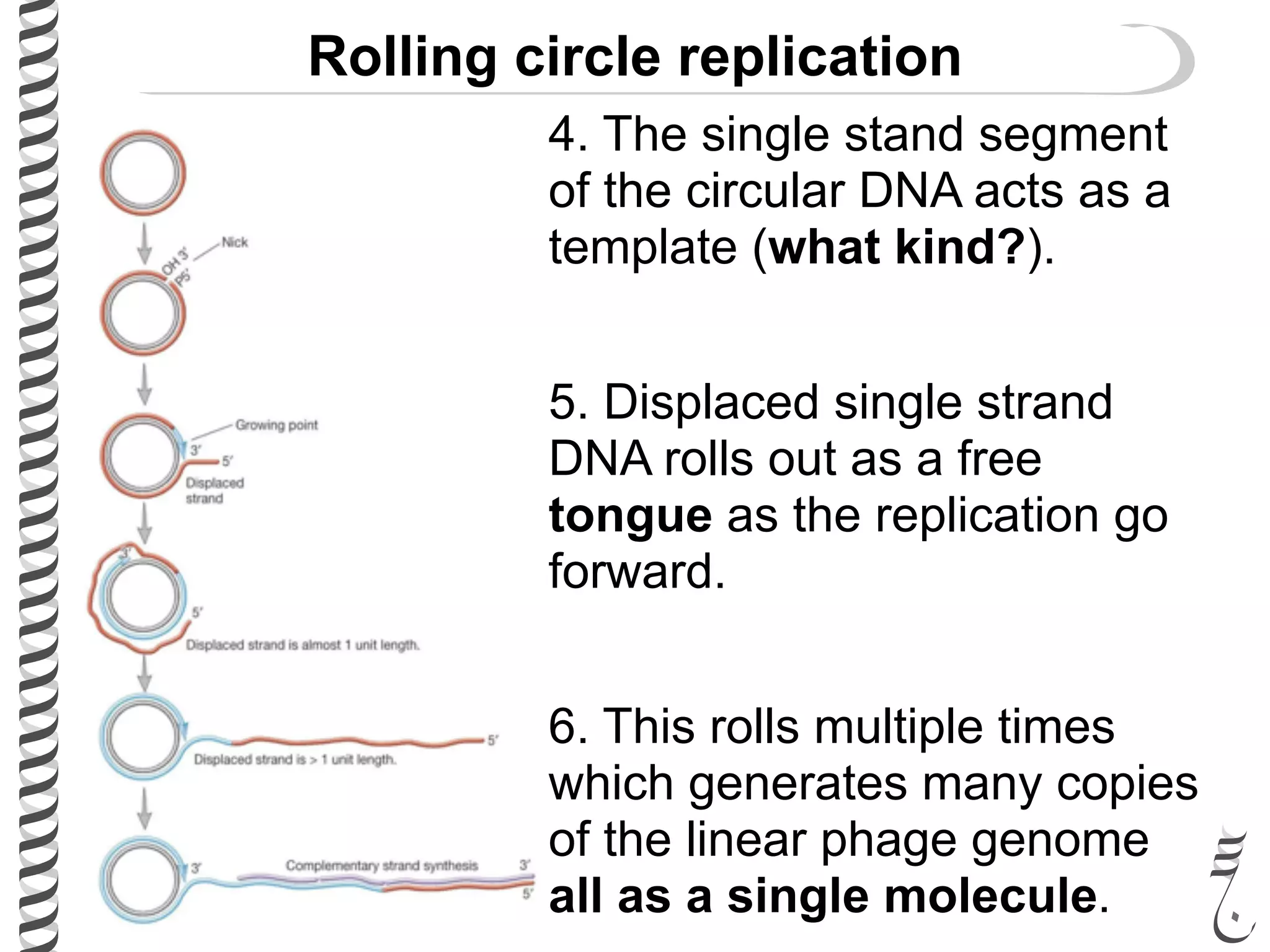
Rolling circle replication
4. The single stand segment
of the circular DNA acts as a
template (what kind?).
5. Displaced single strand
DNA rolls out as a free
tongue as the replication go
forward.
6. This rolls multiple times
which generates many copies
of the linear phage genome
all as a single molecule.
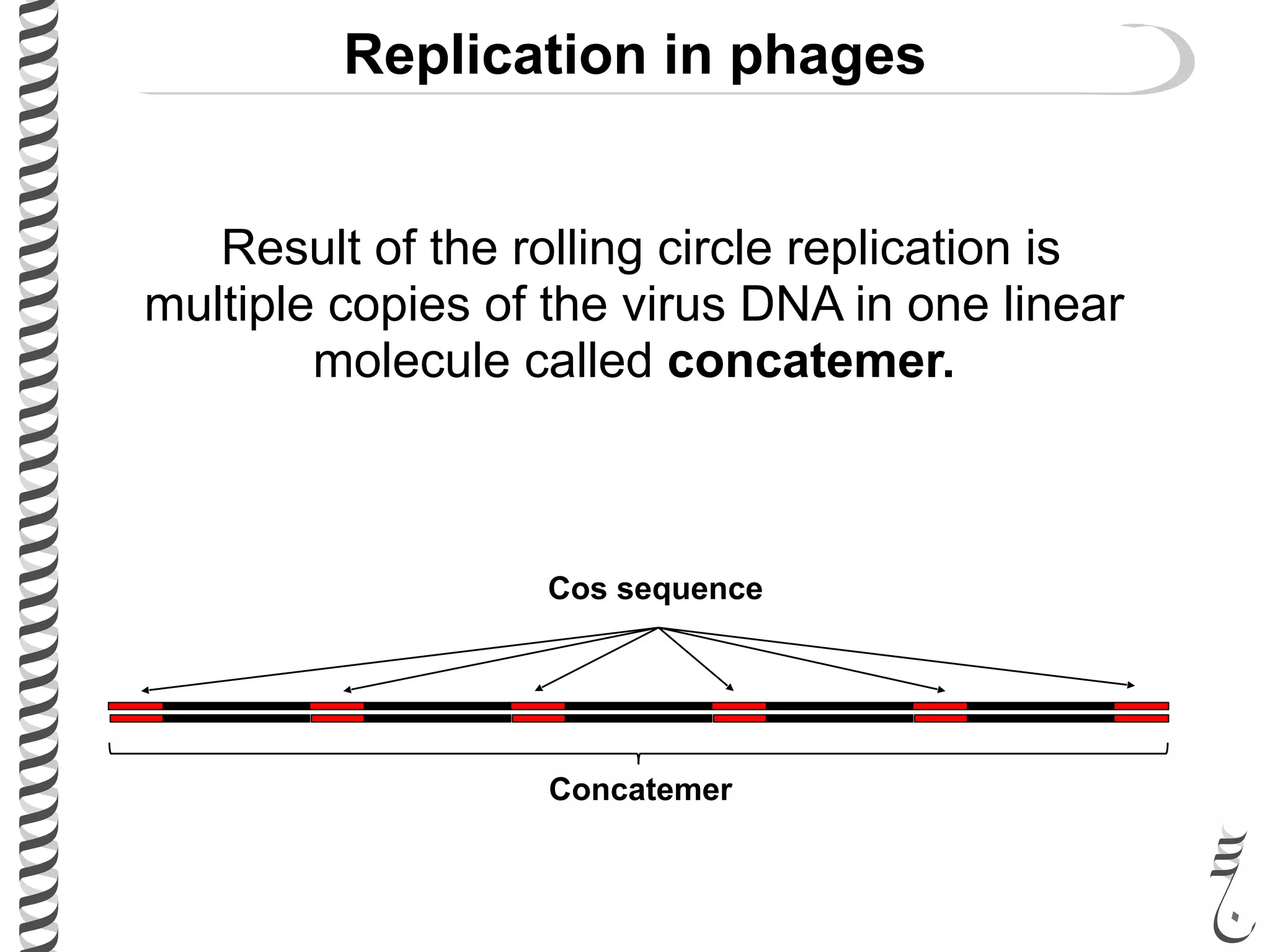
Replication in phages
Result of the rolling circle replication is
multiple copies of the virus DNA in one linear
molecule called concatemer.
Concatemer
Cos sequence
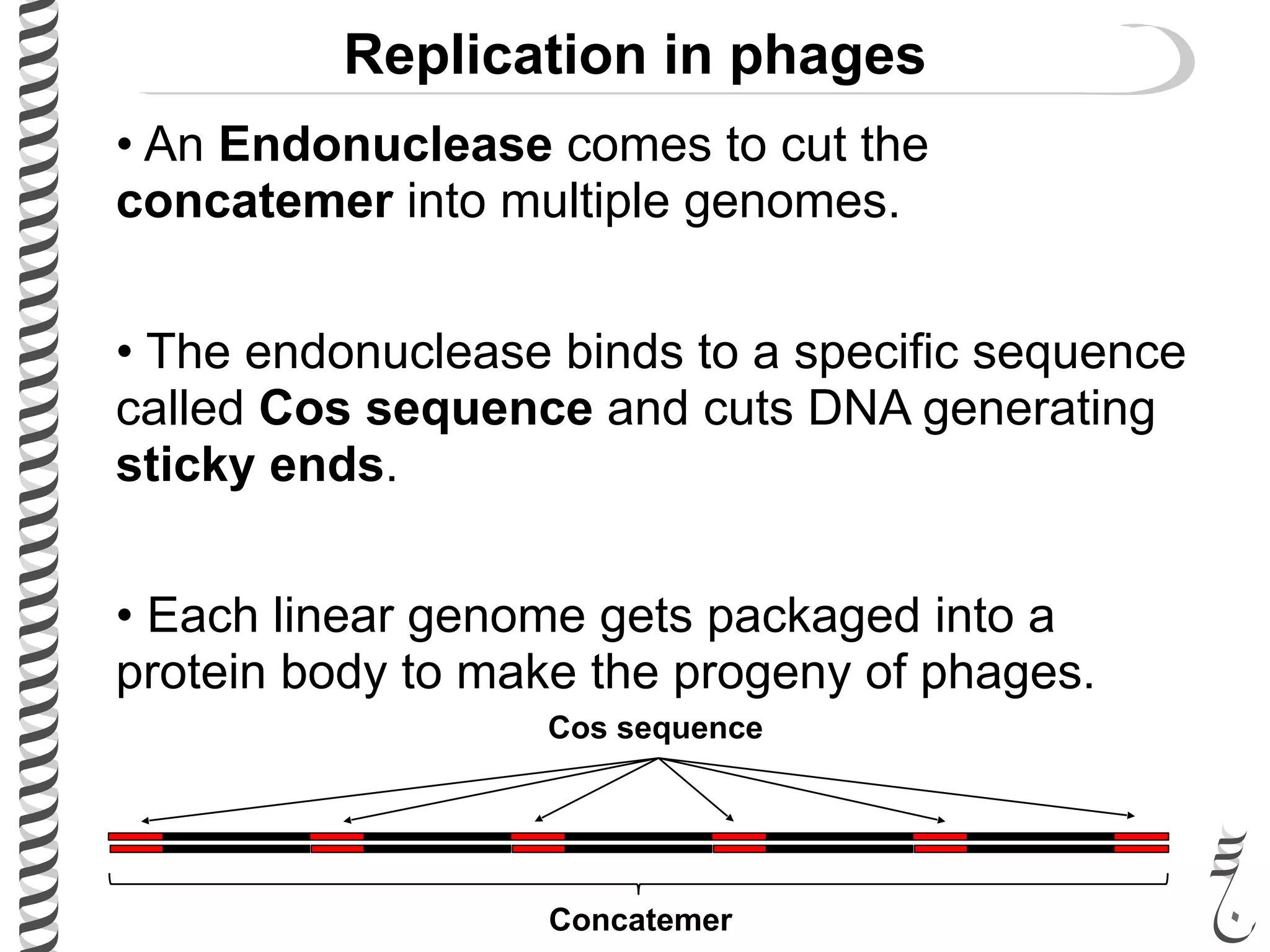
Replication in phages
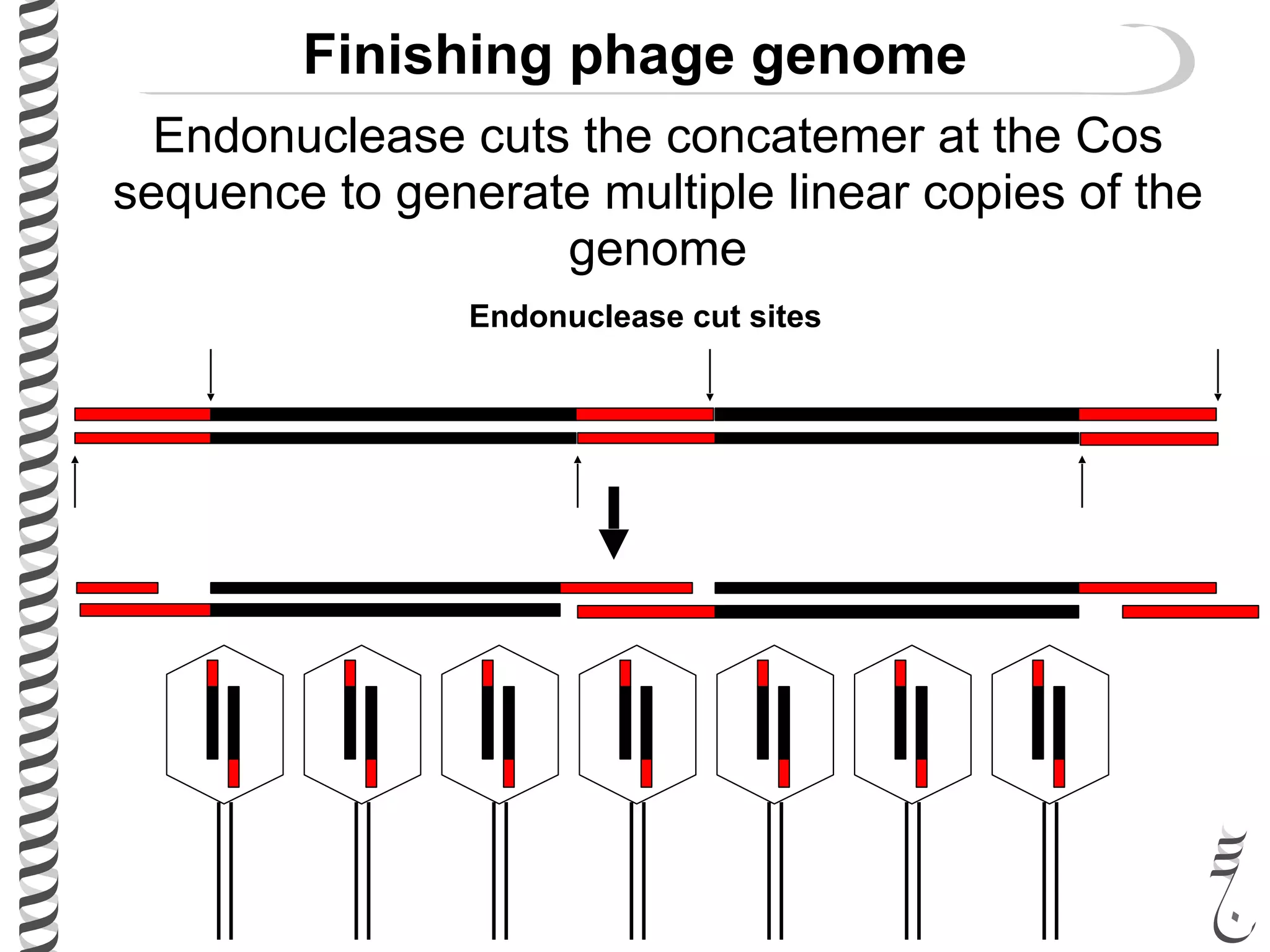
• An Endonuclease comes to cut the
concatemer into multiple genomes.
• The endonuclease binds to a specific sequence
called Cos sequence and cuts DNA generating
sticky ends.
• Each linear genome gets packaged into a
protein body to make the progeny of phages.
Concatemer
Cos sequence
Finishing phage genome
Endonuclease cuts the concatemer at the Cos
sequence to generate multiple linear copies of the
genome
Endonuclease cut sites
Replication in Eukaryotes
Replication in eukaryotes is, generally similar to
prokaryotes with some differences.
What are differences?
Replication in Eukaryotes
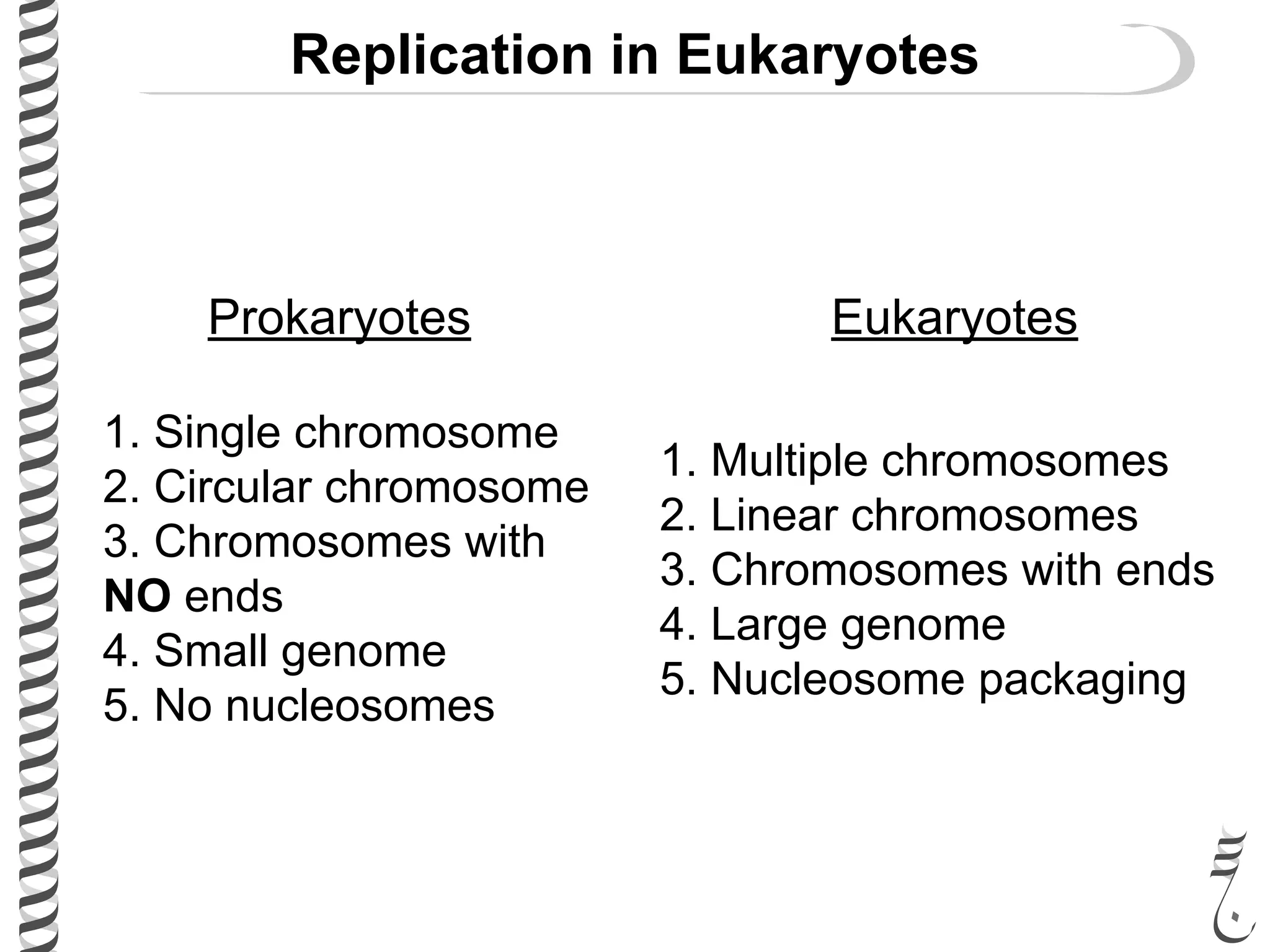
Prokaryotes Eukaryotes
1. Single chromosome
2. Circular chromosome
3. Chromosomes with
NO ends
4. Small genome
5. No nucleosomes
1. Multiple chromosomes
2. Linear chromosomes
3. Chromosomes with ends
4. Large genome
5. Nucleosome packaging
Replication in Eukaryotes
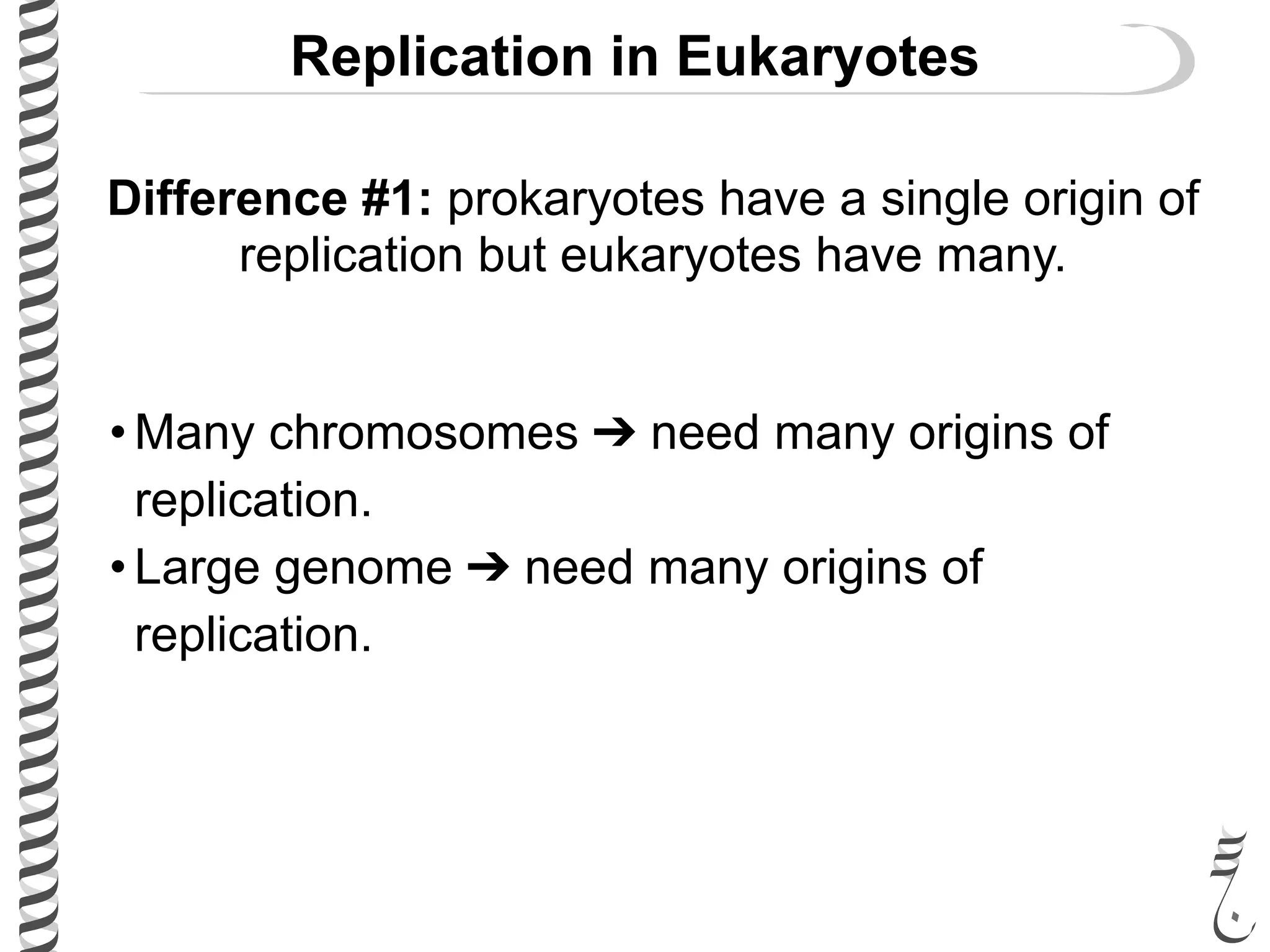
Difference #1: prokaryotes have a single origin of
replication but eukaryotes have many.
• Many chromosomes ➔ need many origins of
replication.
• Large genome ➔ need many origins of
replication.
Replication in Eukaryotes
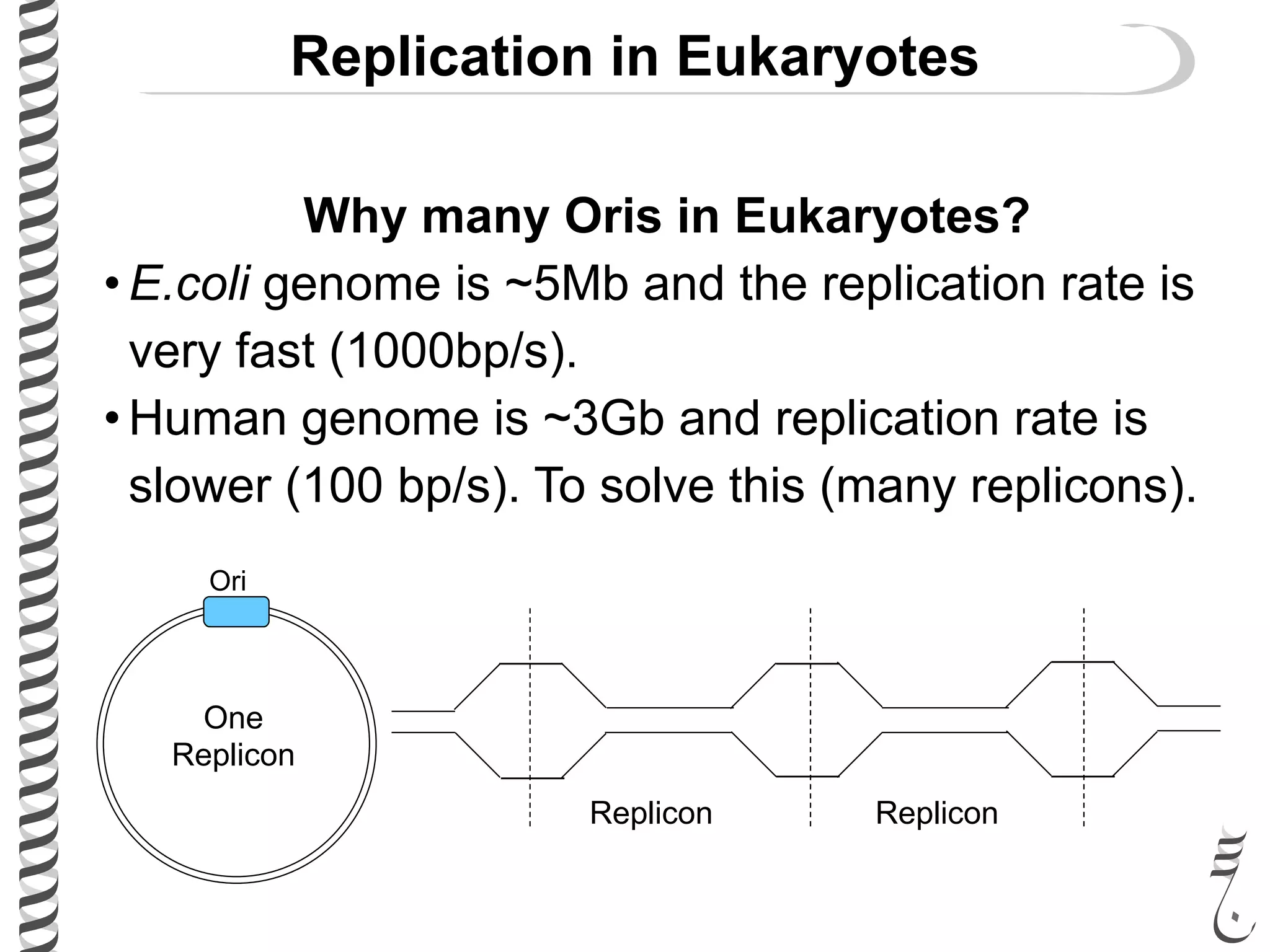
Why many Oris in Eukaryotes?
• E.coli genome is ~5Mb and the replication rate is
very fast (1000bp/s).
• Human genome is ~3Gb and replication rate is
slower (100 bp/s). To solve this (many replicons).
Ori
Replicon Replicon
One
Replicon
Initiation of replication
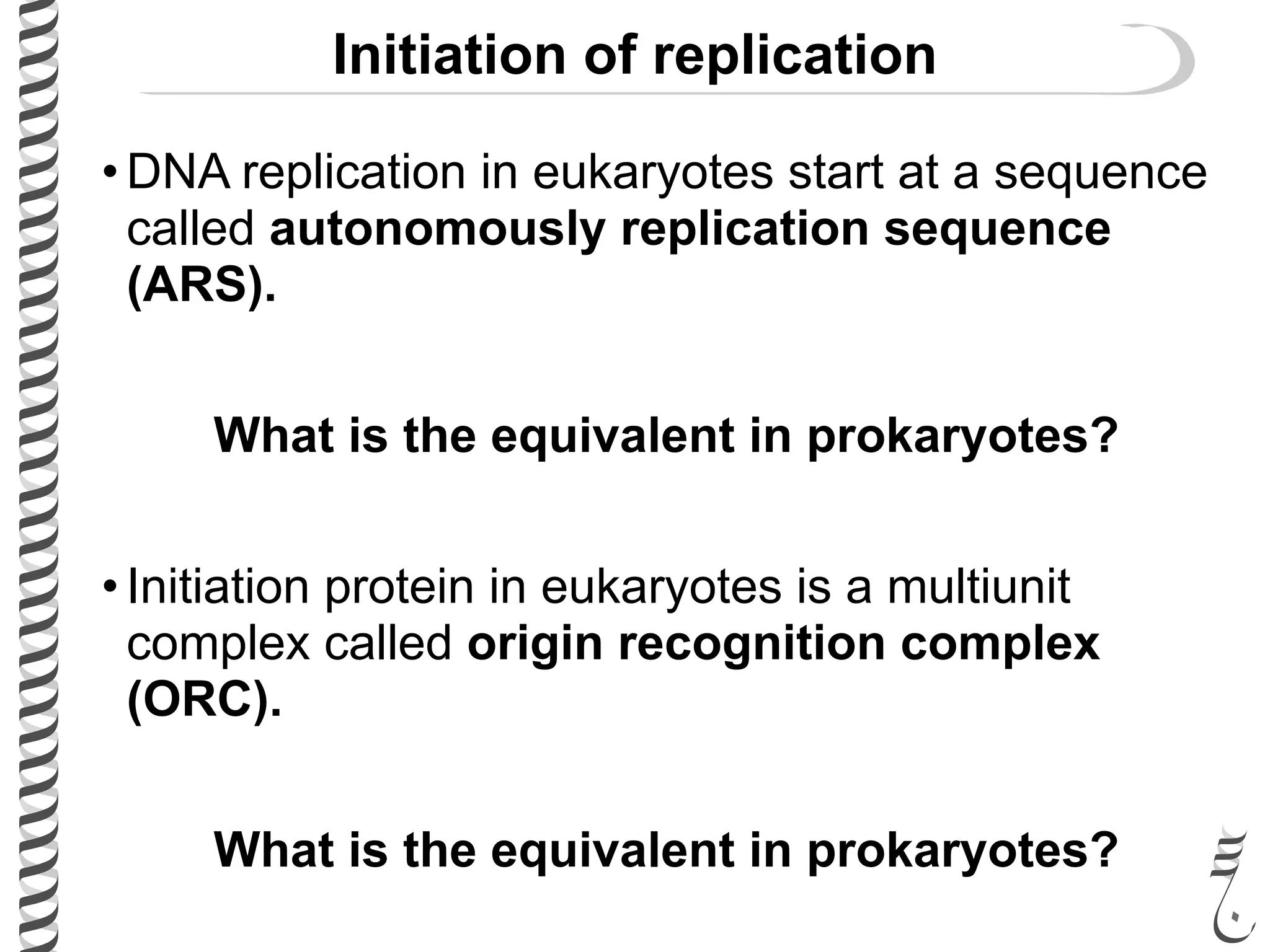
• DNA replication in eukaryotes start at a sequence
called autonomously replication sequence
(ARS).
What is the equivalent in prokaryotes?
• Initiation protein in eukaryotes is a multiunit
complex called origin recognition complex
(ORC).
What is the equivalent in prokaryotes?
Initiation of replication
Each origin of replication in eukaryotes is used
once. Why?
Replication in Eukaryotes
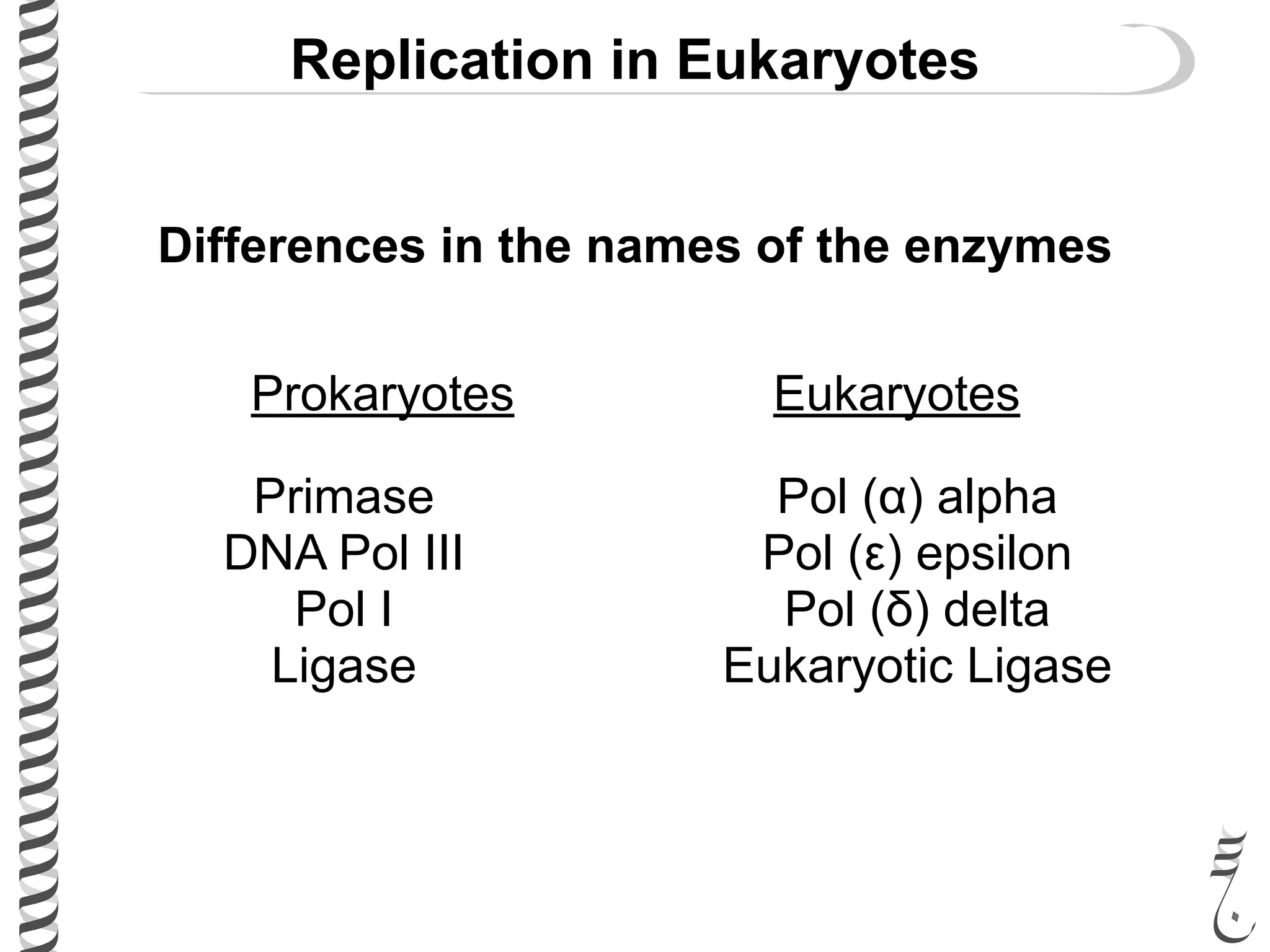
Differences in the names of the enzymes
Prokaryotes Eukaryotes
Primase
DNA Pol III
Pol I
Ligase
Pol (α) alpha
Pol (ε) epsilon
Pol (δ) delta
Eukaryotic Ligase
Replication in Eukaryotes
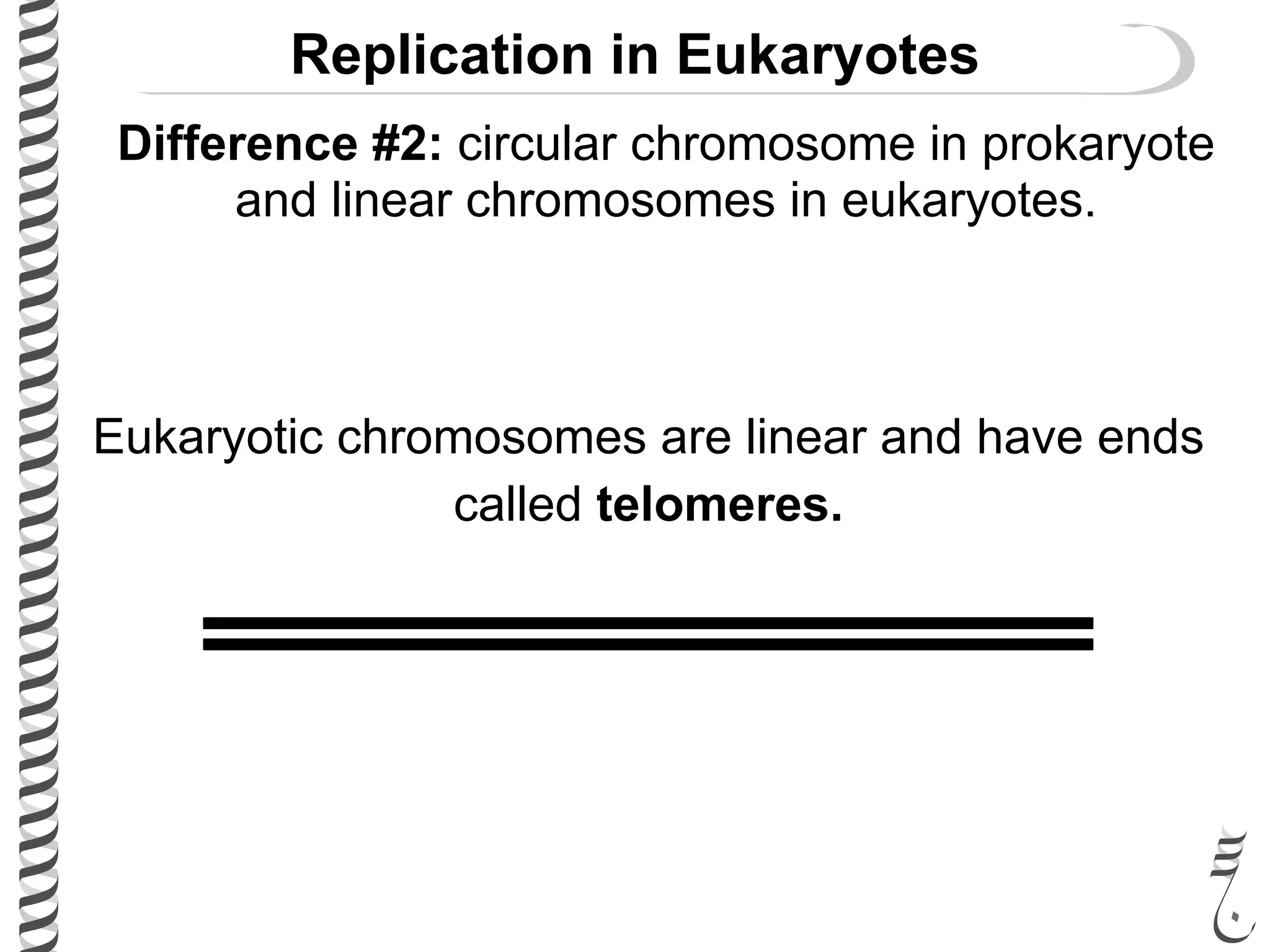
Difference #2: circular chromosome in prokaryote
and linear chromosomes in eukaryotes.
Eukaryotic chromosomes are linear and have ends
called telomeres.
Replication in Eukaryotes
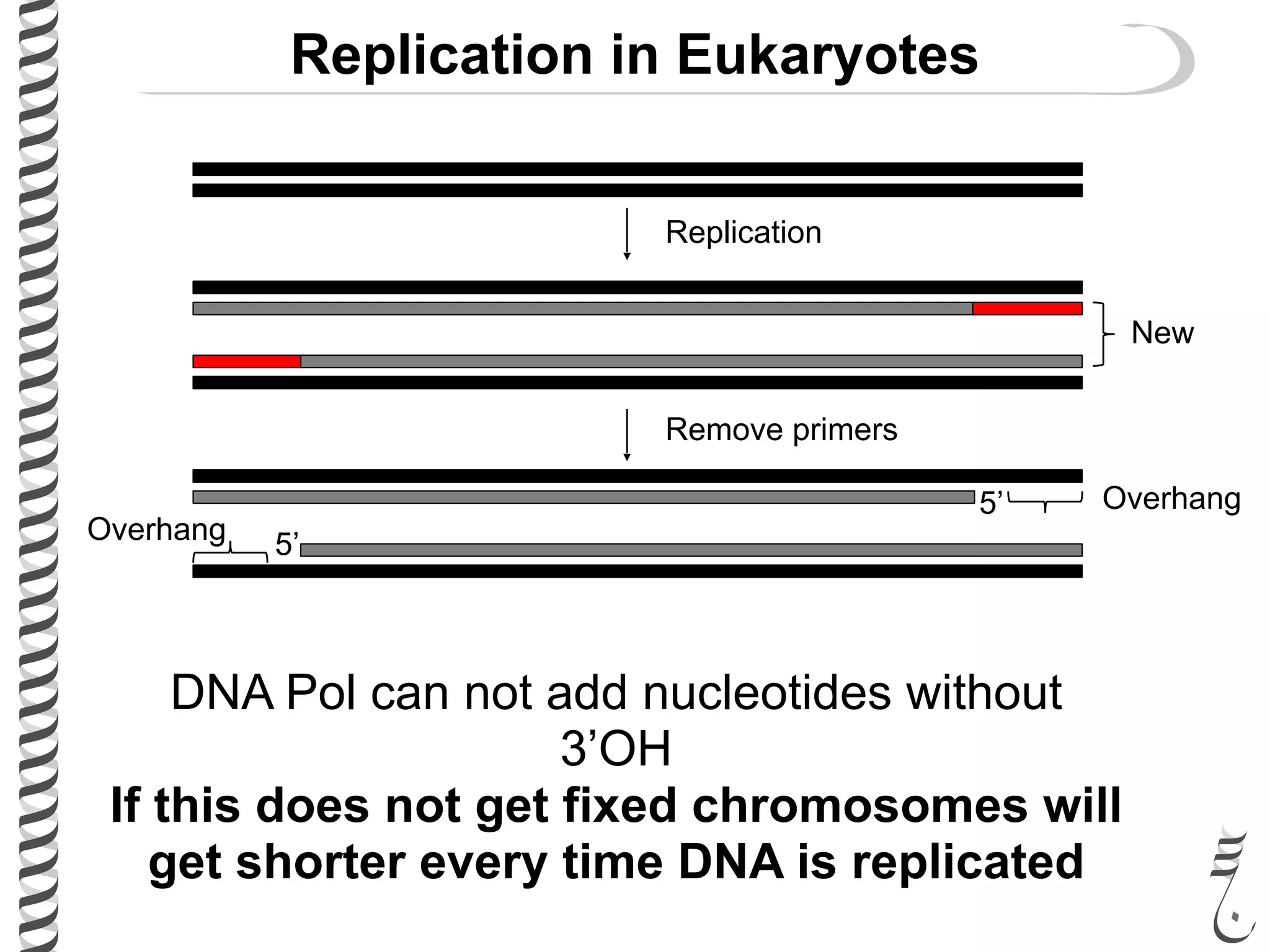
New
Replication
Remove primers
5’
5’
Overhang
Overhang
DNA Pol can not add nucleotides without
3’OH
If this does not get fixed chromosomes will
get shorter every time DNA is replicated
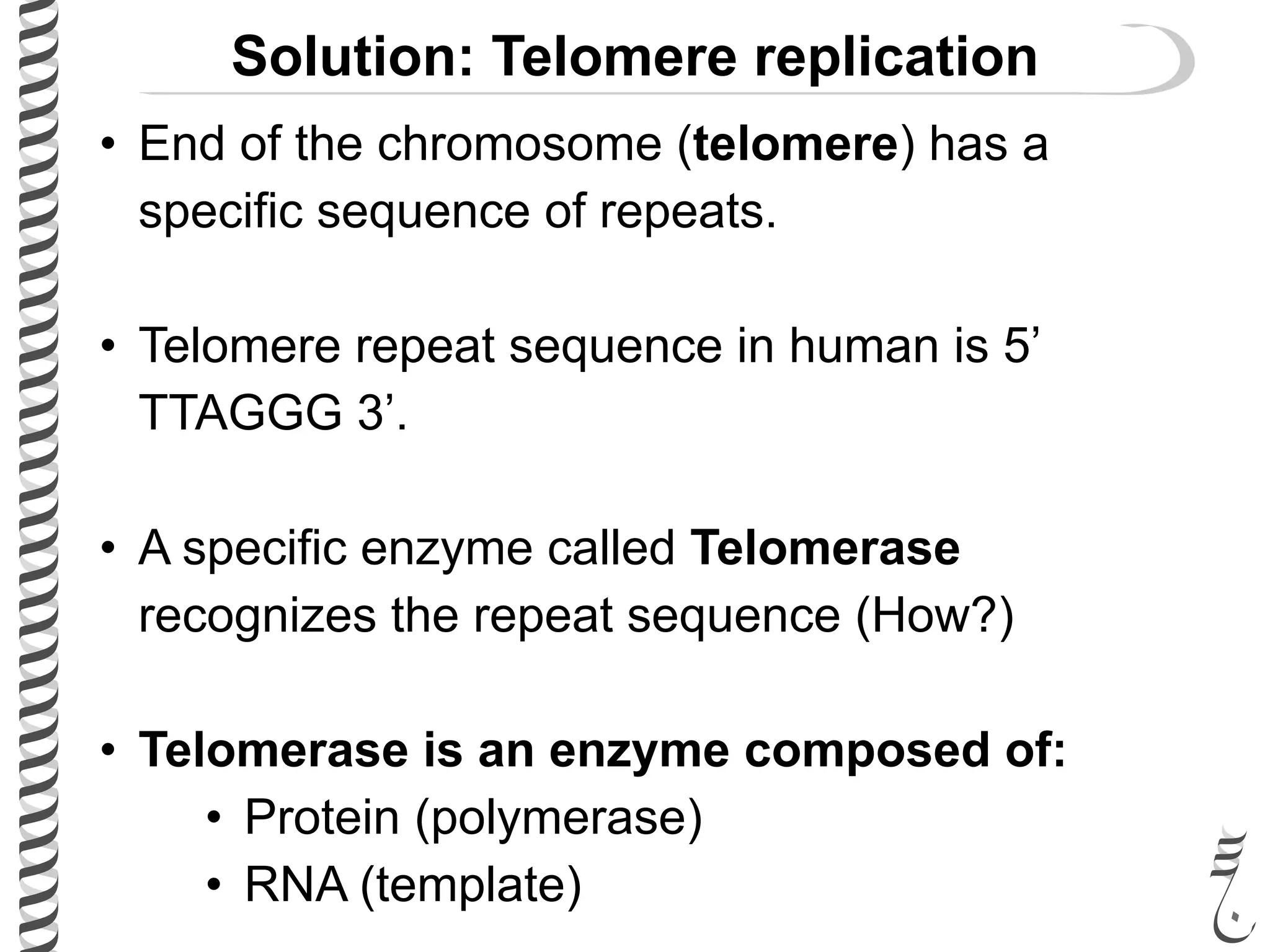
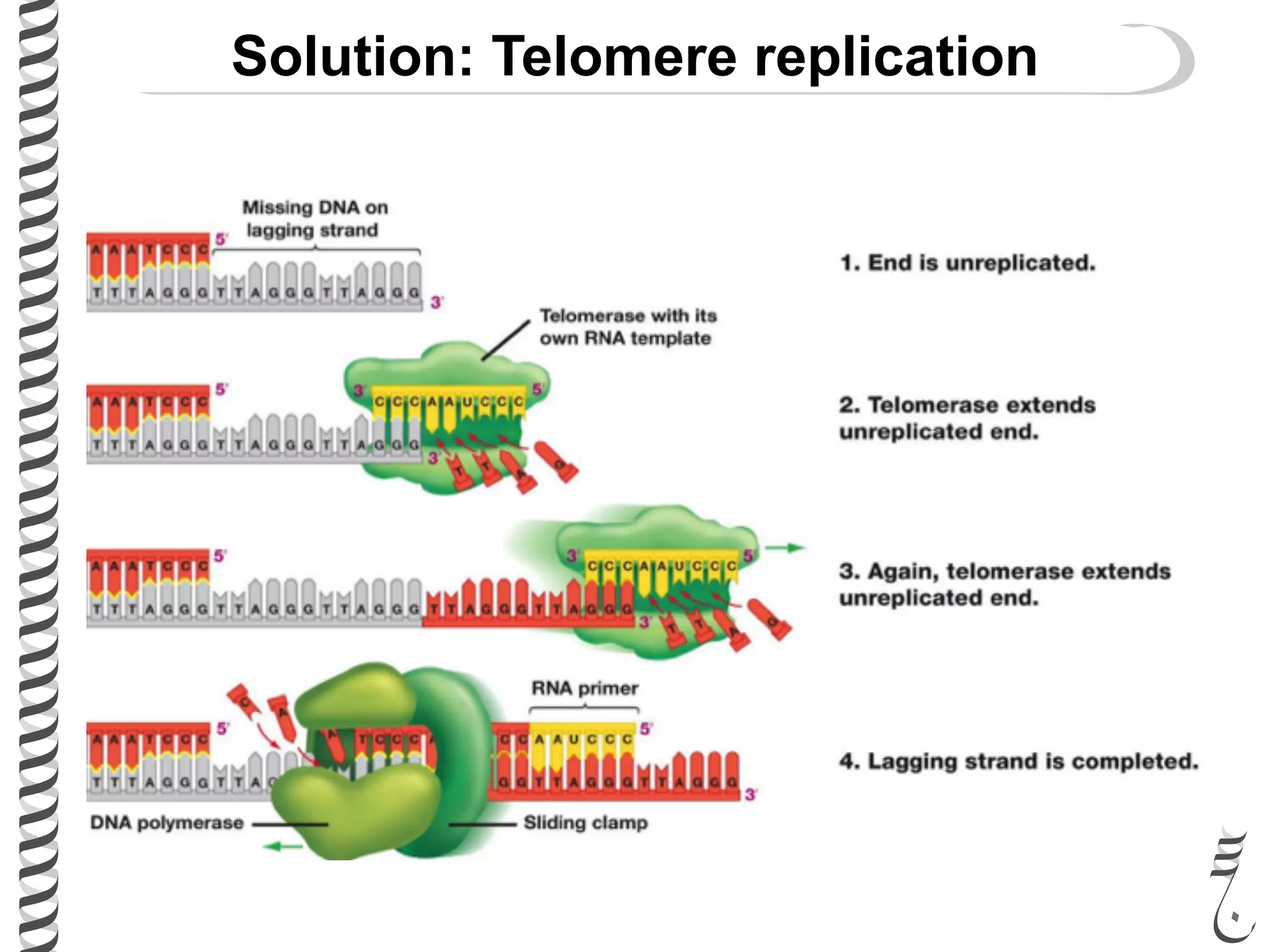
Solution: Telomere replication
• End of the chromosome (telomere) has a
specific sequence of repeats.
• Telomere repeat sequence in human is 5’
TTAGGG 3’.
• A specific enzyme called Telomerase
recognizes the repeat sequence (How?)
• Telomerase is an enzyme composed of:
• Protein (polymerase)
• RNA (template)
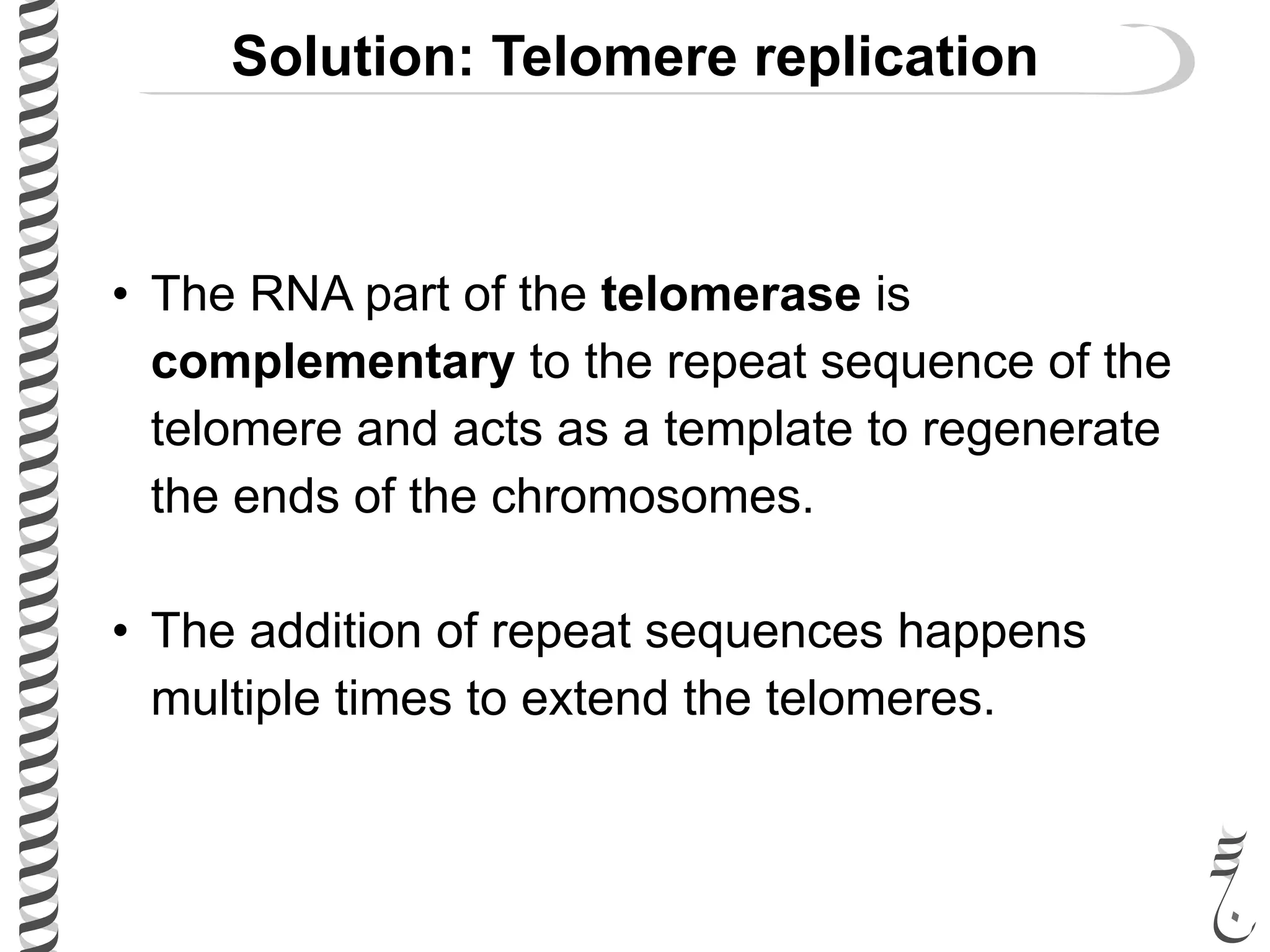
Solution: Telomere replication
• The RNA part of the telomerase is
complementary to the repeat sequence of the
telomere and acts as a template to regenerate
the ends of the chromosomes.
• The addition of repeat sequences happens
multiple times to extend the telomeres.
Solution: Telomere replication
Some Terms
• The process of making DNA from DNA template
is called Replication.
• The process of making RNA from DNA template
is called Transcription.
• The process of making DNA from RNA template
is called Reverse Transcription.
So what is the process in which telomerase
acts?
Nucleosome replication
• Nucleosomes are parts of DNA condensation in
eukaryotes.
• 8 histone (octamer) proteins make a one
nucleosome.
• H2A/H2B make one dimer while H3/H4 make the
second dimer.
How many dimers in a single nucleosome?
Difference #3: eukaryotic DNA is wrapped around
nucleosomes.
Nucleosome replication
• When replicating DNA the histones are removed
to allow for the replication of DNA.
• When replication is done double the amount of
nucleosomes needs to added to the old and
newly replicated DNA.
So we need more histones, what do we do?
Nucleosome replication
• More histone proteins are made to
accommodate the organization of two
genomes.
• Nucleosomes are made of new and old dimers.
• On each genome different combination of
dimers are generated:
New/new New/old Old/old
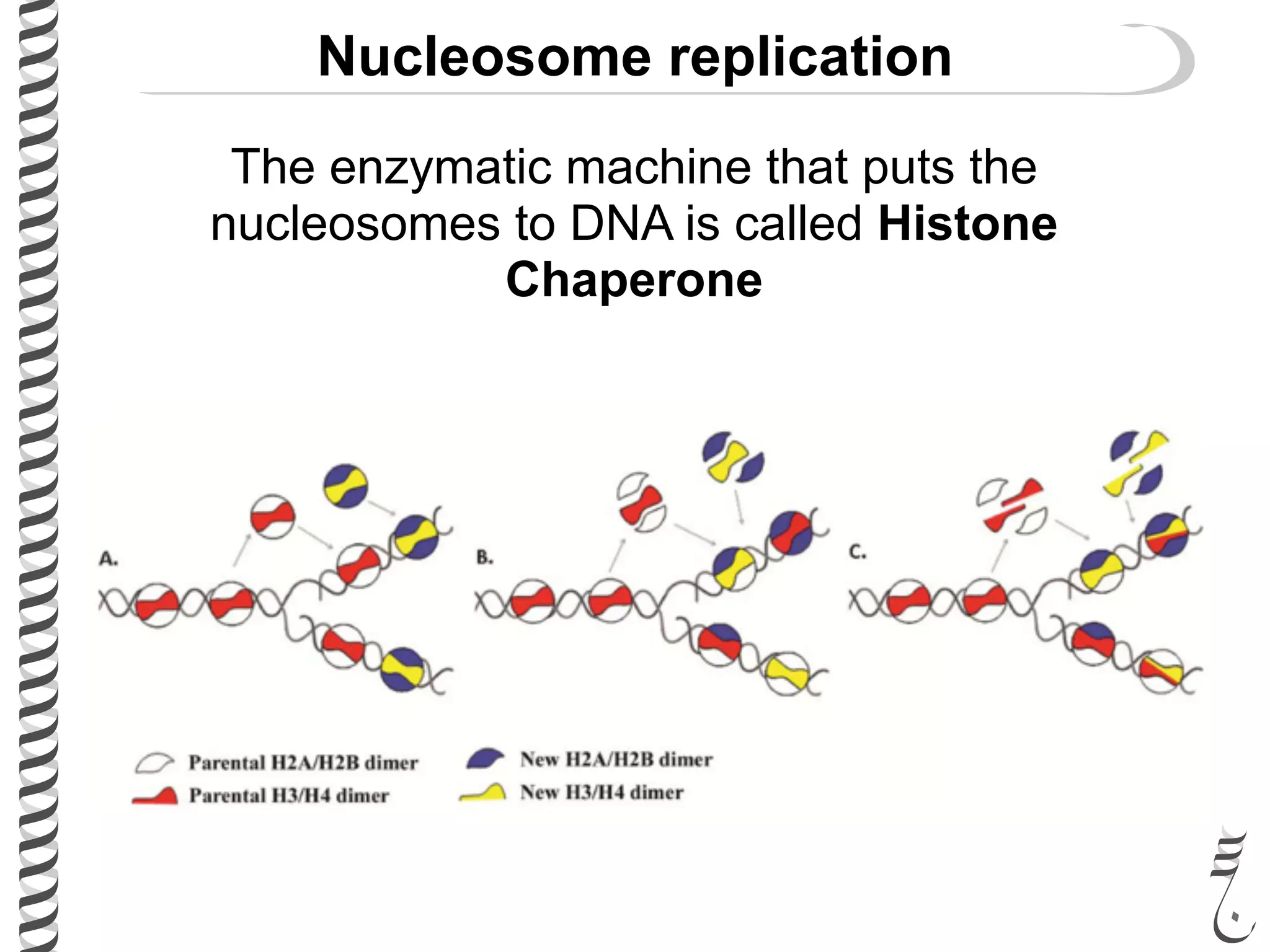
Nucleosome replication
The enzymatic machine that puts the
nucleosomes to DNA is called Histone
Chaperone
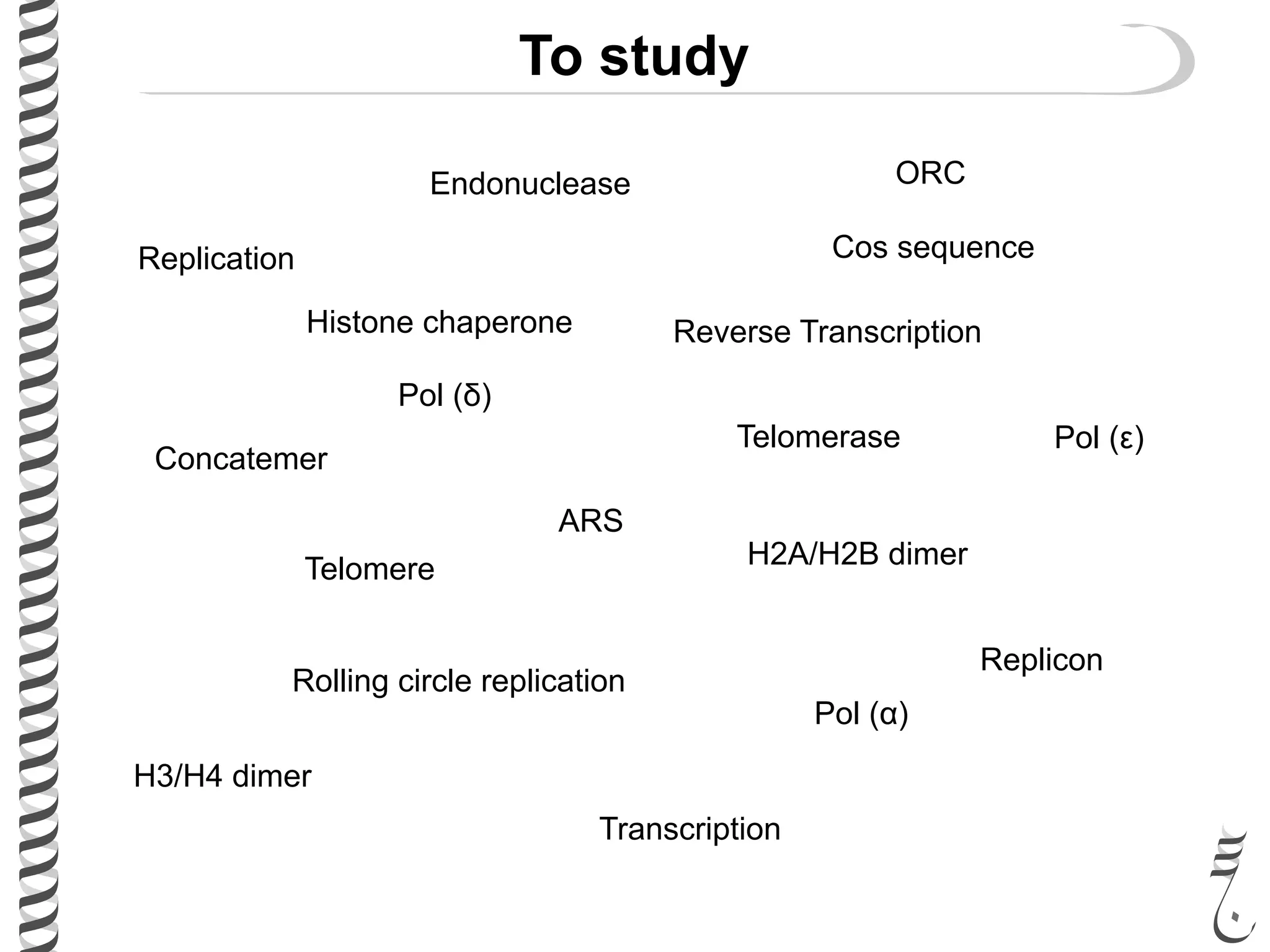
To study
Histone chaperone
Telomere
Telomerase
Pol (α)
Pol (ε)
Pol (δ)
Rolling circle replication
Cos sequence
Endonuclease
Concatemer
H2A/H2B dimer
H3/H4 dimer
Replication
Transcription
Reverse Transcription
Replicon
ARS
ORC
Expectations
• You know the replication process in bacteriophage.
• You know that replication process in prokaryotes is
similar to that of eukaryotes with some differences.
• You know the differences between eukaryotic and
prokaryotic replication process and link this to the
differenced in genome characteristics.
• You know the differences in enzyme names.
• You know how the ends of chromosomes are
replicated.
• You know how nucleosomes are replicated.
For a smile

281 lec11 euk_phage replication

  • 1.
    Lecture 11: DNA replicationin Eukaryotes and phage Readings (chapter 3) Course 281
  • 2.
  • 3.
    AIMS • Understand thereplication in bacteriophage and the benefits of such replication method for the virus. • Understand the DNA replication in eukaryotes and how it differs from that of prokaryotes. • Learn the names of the enzymes in the replication of eukaryotic genome and their equivalent in prokaryotes. • Understand how the differences in the replication of eukaryotic DNA is fixed.
  • 4.
    Replication in phages •Bacteriophage (lambda λ): has a linear genome (ds DNA) enclosed a protein body. • The linear genome contains sticky ends/overhang (single strand DNA on each end). In phage body In host cell
  • 5.
    Replication in phages •The sticky ends are complementary to each other. • When the linear DNA of a phage is injected into a host cell, the sticky ends complement each other to make a circular DNA. In phage body In host cell
  • 6.
    Rolling circle replication 1.Generate a nick (cut) in one of the strands at Ori. 2. The 5’ end is displaced with SSB. 3. The free 3’ end of the nick acts as a primer for DNA polymerase.
  • 7.
    Rolling circle replication 4.The single stand segment of the circular DNA acts as a template (what kind?). 5. Displaced single strand DNA rolls out as a free tongue as the replication go forward. 6. This rolls multiple times which generates many copies of the linear phage genome all as a single molecule.
  • 8.
    Replication in phages Resultof the rolling circle replication is multiple copies of the virus DNA in one linear molecule called concatemer. Concatemer Cos sequence
  • 9.
    Replication in phages •An Endonuclease comes to cut the concatemer into multiple genomes. • The endonuclease binds to a specific sequence called Cos sequence and cuts DNA generating sticky ends. • Each linear genome gets packaged into a protein body to make the progeny of phages. Concatemer Cos sequence
  • 10.
    Finishing phage genome Endonucleasecuts the concatemer at the Cos sequence to generate multiple linear copies of the genome Endonuclease cut sites
  • 11.
    Replication in Eukaryotes Replicationin eukaryotes is, generally similar to prokaryotes with some differences. What are differences?
  • 12.
    Replication in Eukaryotes ProkaryotesEukaryotes 1. Single chromosome 2. Circular chromosome 3. Chromosomes with NO ends 4. Small genome 5. No nucleosomes 1. Multiple chromosomes 2. Linear chromosomes 3. Chromosomes with ends 4. Large genome 5. Nucleosome packaging
  • 13.
    Replication in Eukaryotes Difference#1: prokaryotes have a single origin of replication but eukaryotes have many. • Many chromosomes ➔ need many origins of replication. • Large genome ➔ need many origins of replication.
  • 14.
    Replication in Eukaryotes Whymany Oris in Eukaryotes? • E.coli genome is ~5Mb and the replication rate is very fast (1000bp/s). • Human genome is ~3Gb and replication rate is slower (100 bp/s). To solve this (many replicons). Ori Replicon Replicon One Replicon
  • 15.
    Initiation of replication •DNA replication in eukaryotes start at a sequence called autonomously replication sequence (ARS). What is the equivalent in prokaryotes? • Initiation protein in eukaryotes is a multiunit complex called origin recognition complex (ORC). What is the equivalent in prokaryotes?
  • 16.
    Initiation of replication Eachorigin of replication in eukaryotes is used once. Why?
  • 17.
    Replication in Eukaryotes Differencesin the names of the enzymes Prokaryotes Eukaryotes Primase DNA Pol III Pol I Ligase Pol (α) alpha Pol (ε) epsilon Pol (δ) delta Eukaryotic Ligase
  • 18.
    Replication in Eukaryotes Difference#2: circular chromosome in prokaryote and linear chromosomes in eukaryotes. Eukaryotic chromosomes are linear and have ends called telomeres.
  • 19.
    Replication in Eukaryotes New Replication Removeprimers 5’ 5’ Overhang Overhang DNA Pol can not add nucleotides without 3’OH If this does not get fixed chromosomes will get shorter every time DNA is replicated
  • 20.
    Solution: Telomere replication •End of the chromosome (telomere) has a specific sequence of repeats. • Telomere repeat sequence in human is 5’ TTAGGG 3’. • A specific enzyme called Telomerase recognizes the repeat sequence (How?) • Telomerase is an enzyme composed of: • Protein (polymerase) • RNA (template)
  • 21.
    Solution: Telomere replication •The RNA part of the telomerase is complementary to the repeat sequence of the telomere and acts as a template to regenerate the ends of the chromosomes. • The addition of repeat sequences happens multiple times to extend the telomeres.
  • 22.
  • 23.
    Some Terms • Theprocess of making DNA from DNA template is called Replication. • The process of making RNA from DNA template is called Transcription. • The process of making DNA from RNA template is called Reverse Transcription. So what is the process in which telomerase acts?
  • 24.
    Nucleosome replication • Nucleosomesare parts of DNA condensation in eukaryotes. • 8 histone (octamer) proteins make a one nucleosome. • H2A/H2B make one dimer while H3/H4 make the second dimer. How many dimers in a single nucleosome? Difference #3: eukaryotic DNA is wrapped around nucleosomes.
  • 25.
    Nucleosome replication • Whenreplicating DNA the histones are removed to allow for the replication of DNA. • When replication is done double the amount of nucleosomes needs to added to the old and newly replicated DNA. So we need more histones, what do we do?
  • 26.
    Nucleosome replication • Morehistone proteins are made to accommodate the organization of two genomes. • Nucleosomes are made of new and old dimers. • On each genome different combination of dimers are generated: New/new New/old Old/old
  • 27.
    Nucleosome replication The enzymaticmachine that puts the nucleosomes to DNA is called Histone Chaperone
  • 28.
    To study Histone chaperone Telomere Telomerase Pol(α) Pol (ε) Pol (δ) Rolling circle replication Cos sequence Endonuclease Concatemer H2A/H2B dimer H3/H4 dimer Replication Transcription Reverse Transcription Replicon ARS ORC
  • 29.
    Expectations • You knowthe replication process in bacteriophage. • You know that replication process in prokaryotes is similar to that of eukaryotes with some differences. • You know the differences between eukaryotic and prokaryotic replication process and link this to the differenced in genome characteristics. • You know the differences in enzyme names. • You know how the ends of chromosomes are replicated. • You know how nucleosomes are replicated.
  • 30.