DNA Replication in
Prokaryotes
SUBMITTED TO : MISS MUNEZA
Contents
•Introduction to Replication
•Initiation
•Elongation
•Termination
Introduction to
Replication
BY: MARZIA
Introduction
• DNA replication is a biological process which produces
two identical daughter DNA strands from a double
stranded parental DNA.
• A basis for biological inheritance in all living organisms.
Prokaryotic DNA Replication
• DNA replication is semi conservative, each strand is used as
template for the synthesis of new complementary strand.
• It is bidirectional, the y shaped formation of replication fork
running in opposite directions.
• It is semi discontinuous, the leading strand copies
continuously and the lagging strand copies in
segments(Okazaki fragments).
Replicon
• Replicon is a DNA segment that undergoes
replication.
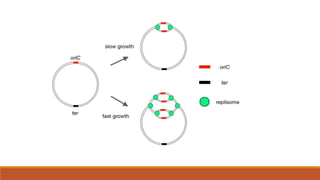
• It consists of an origin where replication begins and a
terminus where replication stops.
• E. coli has a single replicon on its chromosome, as do
most prokaryotes.
Origin of Replication
• Replication is initiated at the origin of replication called
Ori C which is 245 base pairs long and rich in AT
sequences.
• This sequence of bps is recognized by a protein that binds
to this cite and opens up the DNA.
• An enzyme, helicase unwinds the DNA by breaking the
hydrogen bonds between nitrogenous bps.
• ATP hydrolysis is required for this process, the energy
released by it is used for the break down of hydrogen
bonds.
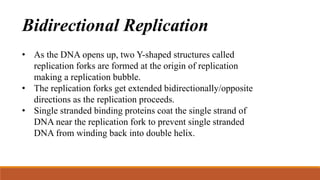
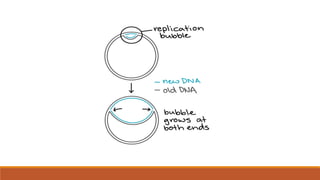
Bidirectional Replication
• As the DNA opens up, two Y-shaped structures called
replication forks are formed at the origin of replication
making a replication bubble.
• The replication forks get extended bidirectionally/opposite
directions as the replication proceeds.
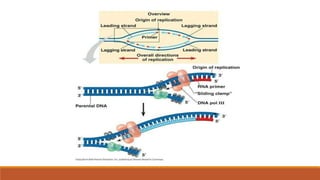
• Single stranded binding proteins coat the single strand of
DNA near the replication fork to prevent single stranded
DNA from winding back into double helix.
DNA Polymerases
• DNA polymerases refers to a group of enzymes that is
responsible for DNA synthesis.
• The DNA polymerases have an additional activity that
is nuclease activity, the ability to break phosphodiester
bonds between nucleotides.
• All the DNA polymerases synthesize polynucleotides in
5’ to 3’ direction and requires a primer.
Prokaryotic DNA Polymerases
• In prokaryotes, three main types of Polymerases are
known as DNA pol I, DNA pol II, and DNA pol III.
• DNA pol I has a exonuclease activity, which serves as
proofreading function to remove a mispaired base and
removes primarase after nucleotides addition.
• DNA pol II, doesn’t play role in replication, is involved in
DNA repair Processes.
• DNA pol III is the main replication enzyme responsible for
the bulk DNA synthesis; it adds nucleotides one by one to
the growing DNA chain.
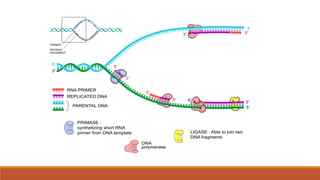
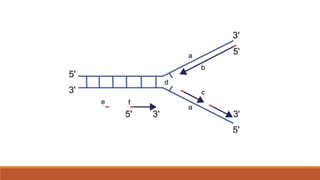
Replication Fork-Leading Strand
• As we know DNA is antiparallel, that means one strand runs in
the 3’ to 5’ direction and its complementary strand runs in 5’ to
3’ direction.
• While the polymerases can only extend in 5’ to 3’ direction
which poses a slight problem at replication fork.
• One strand( 5’ to 3’) which is complementary to 3’ to 5’ parental
DNA strand is synthesized continuously towards the replication
fork because the polymerase can add nucleotides in this
direction.
• This continuously strand is known as leading strand.
Lagging Strand
• The other strand complementary to 5’ to 3’ parental
DNA is extended away from the replication fork in
small segments known as Okazaki Fragments, each
requiring a primer to start synthesis.
• The strand with Okazaki fragments( named after the
scientist who discovered it) is known as lagging strand.
Enzymes and proteins involved in
Replication
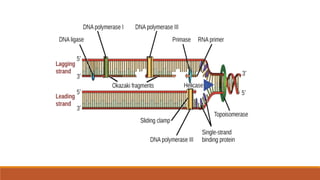
• Helicase opens up the DNA at the replication fork.
• Single-strand binding proteins coat the DNA around the
replication fork to prevent rewinding of the DNA.
• Topoisomerase works at the region ahead of the replication
fork to prevent supercoiling.
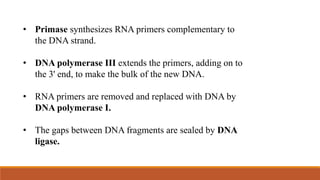
• Primase synthesizes RNA primers complementary to
the DNA strand.
• DNA polymerase III extends the primers, adding on to
the 3' end, to make the bulk of the new DNA.
• RNA primers are removed and replaced with DNA by
DNA polymerase I.
• The gaps between DNA fragments are sealed by DNA
ligase.
Initiation
BY: RAMAIETA
• Initiation means to start or to initiate something.
• During prokaryotic DNA replication the protein
DnaA (chromosomal replication initiator protein)
bind to the origin of replication while DnaB
helicase unwinds the DNA helix and two
replication forks are formed at the origin of
replication.
• It is the bidirectional replication.
The main events involved in
replication initiation
• Recognition of origin.
• DNA melting.
• Stabilization of single strand.
• Assembly of Primosome at the two forks produced.
• Start synthesis of two daughter strands.
Proteins for initiation
• Replication initiation in E.coli requires 6 proteins.
• DnaA or chromosomal replication initiator protein
• DnaB or replicative DNA helicase
• DnaC (DNA replication protein)
• SSBp (single stranded DNA-binding protein)
• DNA gyrase
• DnaG primase
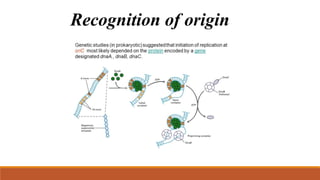
Recognition of origin
DNA Denaturation
• 2 to 4 DnaA protein binds to the 9 mer sequences called R boxes to
DAR(DnaA Assembly region).DNA coils around the protein which
induces the topological stress cause Denaturation of AT rich that is DUE
(DNA un winding)region at 13 mer site to the left.
• An aggregate having 6 molecules each of DnaB and DnaC are formed.
• The DnaC (helicase loader) loads the DnaB to the DUE site then itself get
detach. The process is called helicase loading.
• Then DnaB move and break hydrogen bond of AT rich region.
• DnaB functions as helicase and begins to unwind the DNA.
• Gyrase facilitates unwinding by helicase as it provides a swivel.
Stabilization of
single strand
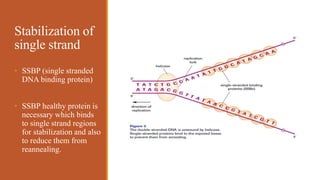
• SSBP (single stranded
DNA binding protein)
• SSBP healthy protein is
necessary which binds
to single strand regions
for stabilization and also
to reduce them from
reannealing.
• Initiation of replication generally requires ~ 60
bp of unwound DNA and the process consumes
ATP.
• One DnaB hexamer binds to each of the two forks
produced by unwinding at the origin.
Assembly of primosome at the two forks
• Once a replication fork is generated ,primosome assembles at the
origin ,and initiates primer synthesis this is called priming.
• Priming occurs only once and at the origin for the replication of the
leading strand.
• But for replication of the lagging strand , priming occurs repeatedly at
intervals of 1000 to 2000 bases.
• Priming reaction at oric is rather simple the primosome
consists of a single protein, DnaG.
• DnaG needs to be activated by DnaB. DnaB also serves as
helicase , while DnaG carries out primer synthesis , primers of
15-50 bases are normally synthesized.
• The replication fork proceeds in the 5 to 3 direction in relation
to the lagging strand
• The replication fork advances and generates a single
stranded region of the lagging strand bound to SSBP
ahead of the primosomes. The primosomes moves
along this single stranded region.
• When the primosome reaches a site at which priming
can occur , it synthesis an RNA primer . This primer
sponsors synthesis of a new okazaki fragment.
Energy from ATP is required
during
• Melting of DNA by DnaA,
• Release of DnaB at the Forks by DnaC
• Helicase action of DnaB,
• Swivel action of DNA gyrase ,
• Activation of primase DnaG by DnaB , and
• Activation of DNA polymerase 3 to begin replication.
Elongation
BY: NADIA
• In elongation step, the synthesis of two new daughter
strands takes place complementary to the template
strands.
• DNA polymerases are the enzymes that synthesize the
new daughter DNA molecules.
• DNA polymerases in prokaryotes are three types:
• DNA polymerase I
• DNA polymerase II
• DNA polymerase III
• DNA polymerases can synthesize in one direction
only which means they can add DNA nucleotides in
5ʹ to 3ʹ direction.
• DNA polymerases require primer to initiate the
synthesis.
• Primer is 5-10 RNA nucleotide sequences that is
essential for the synthesis of new strand of DNA.
• DNA polymerase can now extend this RNA primer,
adding nucleotide one by one that are complementary
strand
• The addition of new nucleotides require energy
(ATP). This energy is obtained from the nucleotides
that have three phosphate attached to them.
Leading and lagging strands
Leading strand:
• Strand which runs from 5ʹ to 3ʹ towards the replication
fork.
• A single primer is required and then the strand can be
extended by the action of DNA pol III.
Lagging strand:
• Strand that runs from 5ʹto 3ʹ away from replication fork.
• Create fragments known as Okazaki fragments.
• This strand requires more than one primer.
• The polymerization is discontinuous.
DNA polymerase I
• Enzyme that has exonuclease activity in which it
removes RNA primer
• Replace it DNA sequences.
DNA polymerase II
• Enzymes that catalyzes the repair of nucleotide bas
pairs.
DNA polymerase III
• Enzyme that synthesizes the daughter strands and also
adds nucleotides one by one to the growing DNA chain.
• Main enzyme that adds in the 5ʹ to 3ʹ direction.
• DNA polymerase III uses 3ʹ-hydroxyl group of the RNA
primer as an acceptor of the first DNA sequence.
Β subunit enzyme
• It is made up of two identical protein chain to come
together to form a circle. The circle can be loaded onto the
template like a clamp to hold the DNA pol III enzyme to
the DNA.
• Is referred to as sliding clamp.
• Helps to hold the DNA polymerase in place when
nucleotides are being added.
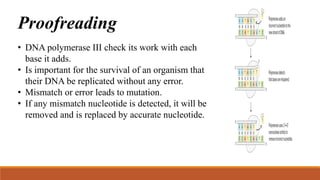
Proofreading
• DNA polymerase III check its work with each
base it adds.
• Is important for the survival of an organism that
their DNA be replicated without any error.
• Mismatch or error leads to mutation.
• If any mismatch nucleotide is detected, it will be
removed and is replaced by accurate nucleotide.
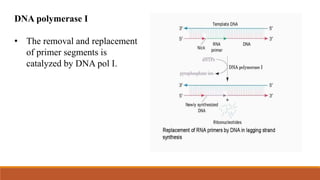
DNA polymerase I
• The removal and replacement
of primer segments is
catalyzed by DNA pol I.
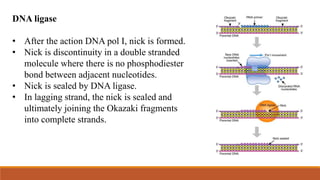
DNA ligase
• After the action DNA pol I, nick is formed.
• Nick is discontinuity in a double stranded
molecule where there is no phosphodiester
bond between adjacent nucleotides.
• Nick is sealed by DNA ligase.
• In lagging strand, the nick is sealed and
ultimately joining the Okazaki fragments
into complete strands.
Termination
BY: USAMA
TERMINATION
• Replication of bacterial genome proceeds bidirectional which
terminates at a position diametrically opposite to the origin of
replication.
• Replication terminates at the terminus region containing multiple
copies of a 20bp sequence called Ter (terminus) sequences.
• Ter is a binding site for TUS (terminus utilization substance)
protein.
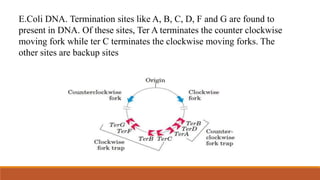
E.Coli DNA. Termination sites like A, B, C, D, F and G are found to
present in DNA. Of these sites, Ter A terminates the counter clockwise
moving fork while ter C terminates the clockwise moving forks. The
other sites are backup sites
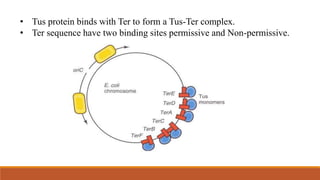
• Tus protein binds with Ter to form a Tus-Ter complex.
• Ter sequence have two binding sites permissive and Non-permissive.
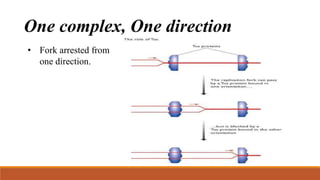
One complex, One direction
• Fork arrested from
one direction.
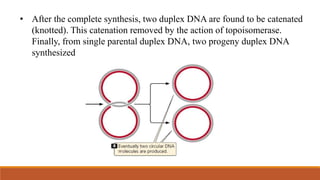
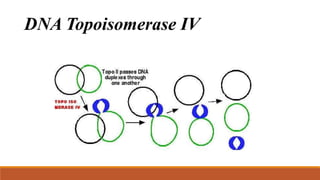
• After the complete synthesis, two duplex DNA are found to be catenated
(knotted). This catenation removed by the action of topoisomerase.
Finally, from single parental duplex DNA, two progeny duplex DNA
synthesized
DNA Topoisomerase IV
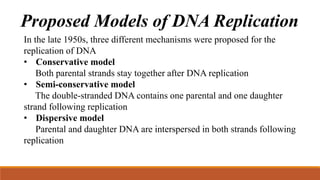
Proposed Models of DNA Replication
In the late 1950s, three different mechanisms were proposed for the
replication of DNA
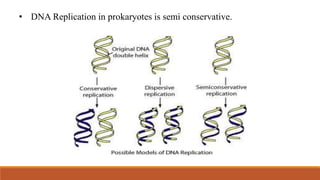
• Conservative model
Both parental strands stay together after DNA replication
• Semi-conservative model
The double-stranded DNA contains one parental and one daughter
strand following replication
• Dispersive model
Parental and daughter DNA are interspersed in both strands following
replication
• DNA Replication in prokaryotes is semi conservative.
Conclusion
• DNA is very important for life.
• DNA replicates semi-conservatively.
• During replication, the strands separate, replication occurs and the
two daughter DNAs are formed.
• Each strands contains one parental strand and one new strand.
References
• Hussain, (November 12 ,2018)DNA Replication in prokaryotes
initiation[hussain biology]
https://www.youtube.com/watch?v=sGyZ2s3FOWg
• Manisha ,G. Phases of DNA Replication (With
Diagram)Prokaryoteshttp://www.biologydiscussion.com/cell/prokaryotes
/phases-of-dna-replication-with-diagram-prokaryotes/55420
• Bussiere DE, Bastia D (March 1999). "Termination of DNA replication
of bacterial and plasmid chromosomes". Molecular Microbiology. 31 (6):
1611–8. doi:10.1046/j.1365-2958.1999.01287.x. PMID 10209736
Prokaryotic Replication presentation

Prokaryotic Replication presentation

  • 1.
  • 2.
  • 3.
  • 4.
    Introduction • DNA replicationis a biological process which produces two identical daughter DNA strands from a double stranded parental DNA. • A basis for biological inheritance in all living organisms.
  • 5.
    Prokaryotic DNA Replication •DNA replication is semi conservative, each strand is used as template for the synthesis of new complementary strand. • It is bidirectional, the y shaped formation of replication fork running in opposite directions. • It is semi discontinuous, the leading strand copies continuously and the lagging strand copies in segments(Okazaki fragments).
  • 6.
    Replicon • Replicon isa DNA segment that undergoes replication. • It consists of an origin where replication begins and a terminus where replication stops. • E. coli has a single replicon on its chromosome, as do most prokaryotes.
  • 8.
    Origin of Replication •Replication is initiated at the origin of replication called Ori C which is 245 base pairs long and rich in AT sequences. • This sequence of bps is recognized by a protein that binds to this cite and opens up the DNA. • An enzyme, helicase unwinds the DNA by breaking the hydrogen bonds between nitrogenous bps. • ATP hydrolysis is required for this process, the energy released by it is used for the break down of hydrogen bonds.
  • 9.
    Bidirectional Replication • Asthe DNA opens up, two Y-shaped structures called replication forks are formed at the origin of replication making a replication bubble. • The replication forks get extended bidirectionally/opposite directions as the replication proceeds. • Single stranded binding proteins coat the single strand of DNA near the replication fork to prevent single stranded DNA from winding back into double helix.
  • 11.
    DNA Polymerases • DNApolymerases refers to a group of enzymes that is responsible for DNA synthesis. • The DNA polymerases have an additional activity that is nuclease activity, the ability to break phosphodiester bonds between nucleotides. • All the DNA polymerases synthesize polynucleotides in 5’ to 3’ direction and requires a primer.
  • 12.
    Prokaryotic DNA Polymerases •In prokaryotes, three main types of Polymerases are known as DNA pol I, DNA pol II, and DNA pol III. • DNA pol I has a exonuclease activity, which serves as proofreading function to remove a mispaired base and removes primarase after nucleotides addition. • DNA pol II, doesn’t play role in replication, is involved in DNA repair Processes. • DNA pol III is the main replication enzyme responsible for the bulk DNA synthesis; it adds nucleotides one by one to the growing DNA chain.
  • 13.
    Replication Fork-Leading Strand •As we know DNA is antiparallel, that means one strand runs in the 3’ to 5’ direction and its complementary strand runs in 5’ to 3’ direction. • While the polymerases can only extend in 5’ to 3’ direction which poses a slight problem at replication fork. • One strand( 5’ to 3’) which is complementary to 3’ to 5’ parental DNA strand is synthesized continuously towards the replication fork because the polymerase can add nucleotides in this direction. • This continuously strand is known as leading strand.
  • 14.
    Lagging Strand • Theother strand complementary to 5’ to 3’ parental DNA is extended away from the replication fork in small segments known as Okazaki Fragments, each requiring a primer to start synthesis. • The strand with Okazaki fragments( named after the scientist who discovered it) is known as lagging strand.
  • 16.
    Enzymes and proteinsinvolved in Replication • Helicase opens up the DNA at the replication fork. • Single-strand binding proteins coat the DNA around the replication fork to prevent rewinding of the DNA. • Topoisomerase works at the region ahead of the replication fork to prevent supercoiling.
  • 17.
    • Primase synthesizesRNA primers complementary to the DNA strand. • DNA polymerase III extends the primers, adding on to the 3' end, to make the bulk of the new DNA. • RNA primers are removed and replaced with DNA by DNA polymerase I. • The gaps between DNA fragments are sealed by DNA ligase.
  • 19.
  • 20.
    • Initiation meansto start or to initiate something. • During prokaryotic DNA replication the protein DnaA (chromosomal replication initiator protein) bind to the origin of replication while DnaB helicase unwinds the DNA helix and two replication forks are formed at the origin of replication. • It is the bidirectional replication.
  • 21.
    The main eventsinvolved in replication initiation • Recognition of origin. • DNA melting. • Stabilization of single strand. • Assembly of Primosome at the two forks produced. • Start synthesis of two daughter strands.
  • 22.
    Proteins for initiation •Replication initiation in E.coli requires 6 proteins. • DnaA or chromosomal replication initiator protein • DnaB or replicative DNA helicase • DnaC (DNA replication protein) • SSBp (single stranded DNA-binding protein) • DNA gyrase • DnaG primase
  • 23.
  • 24.
    DNA Denaturation • 2to 4 DnaA protein binds to the 9 mer sequences called R boxes to DAR(DnaA Assembly region).DNA coils around the protein which induces the topological stress cause Denaturation of AT rich that is DUE (DNA un winding)region at 13 mer site to the left. • An aggregate having 6 molecules each of DnaB and DnaC are formed. • The DnaC (helicase loader) loads the DnaB to the DUE site then itself get detach. The process is called helicase loading. • Then DnaB move and break hydrogen bond of AT rich region. • DnaB functions as helicase and begins to unwind the DNA. • Gyrase facilitates unwinding by helicase as it provides a swivel.
  • 25.
    Stabilization of single strand •SSBP (single stranded DNA binding protein) • SSBP healthy protein is necessary which binds to single strand regions for stabilization and also to reduce them from reannealing.
  • 26.
    • Initiation ofreplication generally requires ~ 60 bp of unwound DNA and the process consumes ATP. • One DnaB hexamer binds to each of the two forks produced by unwinding at the origin.
  • 27.
    Assembly of primosomeat the two forks • Once a replication fork is generated ,primosome assembles at the origin ,and initiates primer synthesis this is called priming. • Priming occurs only once and at the origin for the replication of the leading strand. • But for replication of the lagging strand , priming occurs repeatedly at intervals of 1000 to 2000 bases.
  • 28.
    • Priming reactionat oric is rather simple the primosome consists of a single protein, DnaG. • DnaG needs to be activated by DnaB. DnaB also serves as helicase , while DnaG carries out primer synthesis , primers of 15-50 bases are normally synthesized. • The replication fork proceeds in the 5 to 3 direction in relation to the lagging strand
  • 29.
    • The replicationfork advances and generates a single stranded region of the lagging strand bound to SSBP ahead of the primosomes. The primosomes moves along this single stranded region. • When the primosome reaches a site at which priming can occur , it synthesis an RNA primer . This primer sponsors synthesis of a new okazaki fragment.
  • 30.
    Energy from ATPis required during • Melting of DNA by DnaA, • Release of DnaB at the Forks by DnaC • Helicase action of DnaB, • Swivel action of DNA gyrase , • Activation of primase DnaG by DnaB , and • Activation of DNA polymerase 3 to begin replication.
  • 31.
  • 32.
    • In elongationstep, the synthesis of two new daughter strands takes place complementary to the template strands. • DNA polymerases are the enzymes that synthesize the new daughter DNA molecules. • DNA polymerases in prokaryotes are three types: • DNA polymerase I • DNA polymerase II • DNA polymerase III
  • 33.
    • DNA polymerasescan synthesize in one direction only which means they can add DNA nucleotides in 5ʹ to 3ʹ direction. • DNA polymerases require primer to initiate the synthesis. • Primer is 5-10 RNA nucleotide sequences that is essential for the synthesis of new strand of DNA. • DNA polymerase can now extend this RNA primer, adding nucleotide one by one that are complementary strand • The addition of new nucleotides require energy (ATP). This energy is obtained from the nucleotides that have three phosphate attached to them.
  • 34.
    Leading and laggingstrands Leading strand: • Strand which runs from 5ʹ to 3ʹ towards the replication fork. • A single primer is required and then the strand can be extended by the action of DNA pol III.
  • 35.
    Lagging strand: • Strandthat runs from 5ʹto 3ʹ away from replication fork. • Create fragments known as Okazaki fragments. • This strand requires more than one primer. • The polymerization is discontinuous.
  • 37.
    DNA polymerase I •Enzyme that has exonuclease activity in which it removes RNA primer • Replace it DNA sequences. DNA polymerase II • Enzymes that catalyzes the repair of nucleotide bas pairs.
  • 38.
    DNA polymerase III •Enzyme that synthesizes the daughter strands and also adds nucleotides one by one to the growing DNA chain. • Main enzyme that adds in the 5ʹ to 3ʹ direction. • DNA polymerase III uses 3ʹ-hydroxyl group of the RNA primer as an acceptor of the first DNA sequence.
  • 40.
    Β subunit enzyme •It is made up of two identical protein chain to come together to form a circle. The circle can be loaded onto the template like a clamp to hold the DNA pol III enzyme to the DNA. • Is referred to as sliding clamp. • Helps to hold the DNA polymerase in place when nucleotides are being added.
  • 41.
    Proofreading • DNA polymeraseIII check its work with each base it adds. • Is important for the survival of an organism that their DNA be replicated without any error. • Mismatch or error leads to mutation. • If any mismatch nucleotide is detected, it will be removed and is replaced by accurate nucleotide.
  • 42.
    DNA polymerase I •The removal and replacement of primer segments is catalyzed by DNA pol I.
  • 43.
    DNA ligase • Afterthe action DNA pol I, nick is formed. • Nick is discontinuity in a double stranded molecule where there is no phosphodiester bond between adjacent nucleotides. • Nick is sealed by DNA ligase. • In lagging strand, the nick is sealed and ultimately joining the Okazaki fragments into complete strands.
  • 44.
  • 45.
    TERMINATION • Replication ofbacterial genome proceeds bidirectional which terminates at a position diametrically opposite to the origin of replication. • Replication terminates at the terminus region containing multiple copies of a 20bp sequence called Ter (terminus) sequences. • Ter is a binding site for TUS (terminus utilization substance) protein.
  • 46.
    E.Coli DNA. Terminationsites like A, B, C, D, F and G are found to present in DNA. Of these sites, Ter A terminates the counter clockwise moving fork while ter C terminates the clockwise moving forks. The other sites are backup sites
  • 47.
    • Tus proteinbinds with Ter to form a Tus-Ter complex. • Ter sequence have two binding sites permissive and Non-permissive.
  • 48.
    One complex, Onedirection • Fork arrested from one direction.
  • 49.
    • After thecomplete synthesis, two duplex DNA are found to be catenated (knotted). This catenation removed by the action of topoisomerase. Finally, from single parental duplex DNA, two progeny duplex DNA synthesized
  • 50.
  • 51.
    Proposed Models ofDNA Replication In the late 1950s, three different mechanisms were proposed for the replication of DNA • Conservative model Both parental strands stay together after DNA replication • Semi-conservative model The double-stranded DNA contains one parental and one daughter strand following replication • Dispersive model Parental and daughter DNA are interspersed in both strands following replication
  • 52.
    • DNA Replicationin prokaryotes is semi conservative.
  • 53.
    Conclusion • DNA isvery important for life. • DNA replicates semi-conservatively. • During replication, the strands separate, replication occurs and the two daughter DNAs are formed. • Each strands contains one parental strand and one new strand.
  • 54.
    References • Hussain, (November12 ,2018)DNA Replication in prokaryotes initiation[hussain biology] https://www.youtube.com/watch?v=sGyZ2s3FOWg • Manisha ,G. Phases of DNA Replication (With Diagram)Prokaryoteshttp://www.biologydiscussion.com/cell/prokaryotes /phases-of-dna-replication-with-diagram-prokaryotes/55420 • Bussiere DE, Bastia D (March 1999). "Termination of DNA replication of bacterial and plasmid chromosomes". Molecular Microbiology. 31 (6): 1611–8. doi:10.1046/j.1365-2958.1999.01287.x. PMID 10209736