MITOCHONDRIAL
GENOME
GANESH KUMAR
KOLI
ID- 2019A45D
Introduction
Mitochondria (singular: Mitochondrion) are membrane
bound organelles found in the cytoplasm of almost all
eukaryotic cells .
It’s primary function is to generate large quantities of
energy in the form of adenosine triphosphate (ATP).
Mitochondria are typically round to oval in shape and
range in size from 0.5 to 10 μm.
In addition to producing energy, mitochondria store
calcium for cell signaling activities, generate heat and
mediates cell growth and death.
Mitochondria are unlike other cellular organelles in that
Discovery
• Mitochondrial DNA was discovered in the 1960s by Margit
M. K. Nass and Sylvan Nass by electron microscopy and
by Ellen Haslbrunner, Hans Tuppy and Gottfried
Schatz by biochemical assays on highly purified
mitochondrial fractions.
MITOCHONDRIAL GENOME
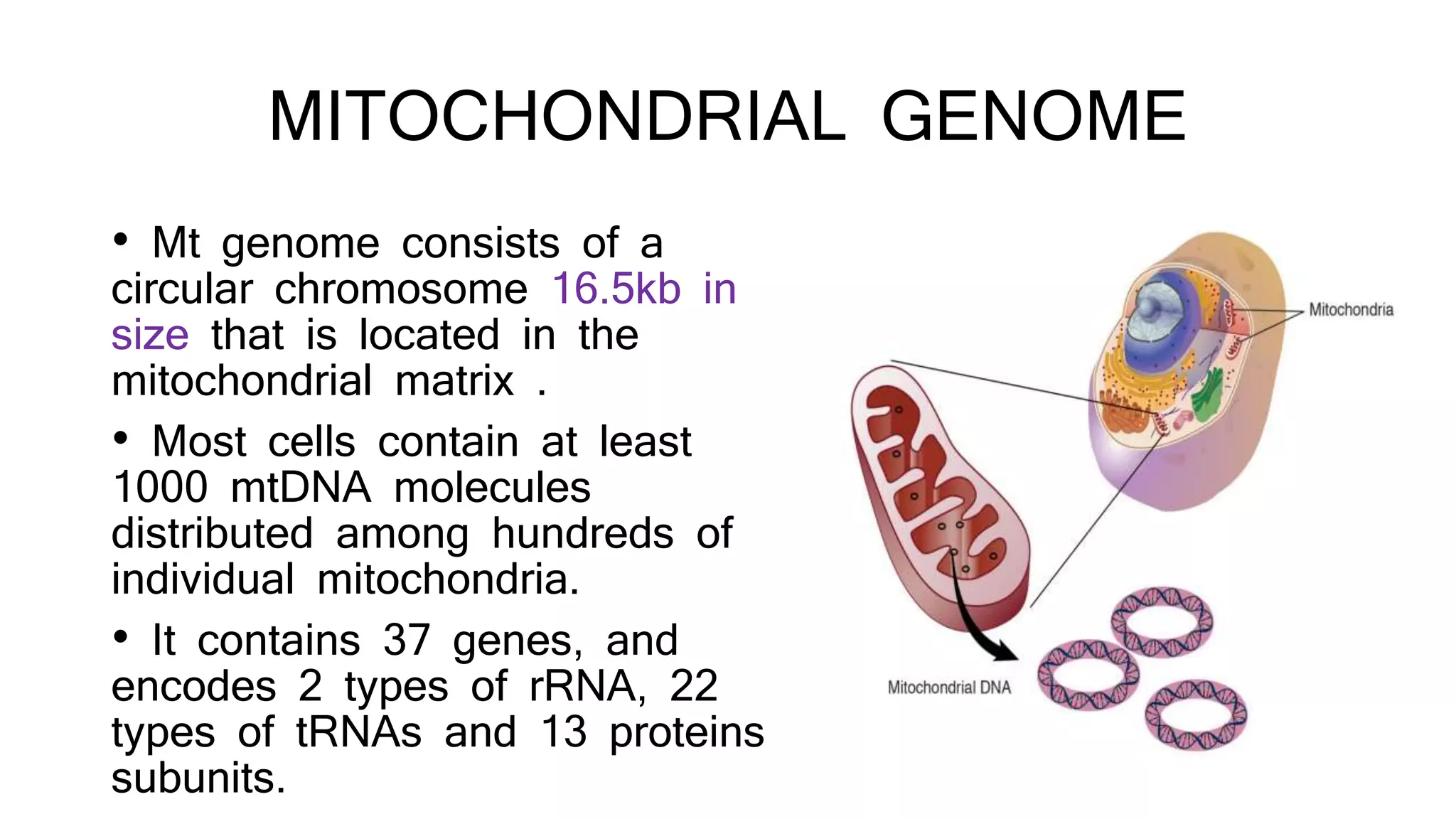
• Mt genome consists of a
circular chromosome 16.5kb in
size that is located in the
mitochondrial matrix .
• Most cells contain at least
1000 mtDNA molecules
distributed among hundreds of
individual mitochondria.
• It contains 37 genes, and
encodes 2 types of rRNA, 22
types of tRNAs and 13 proteins
subunits.
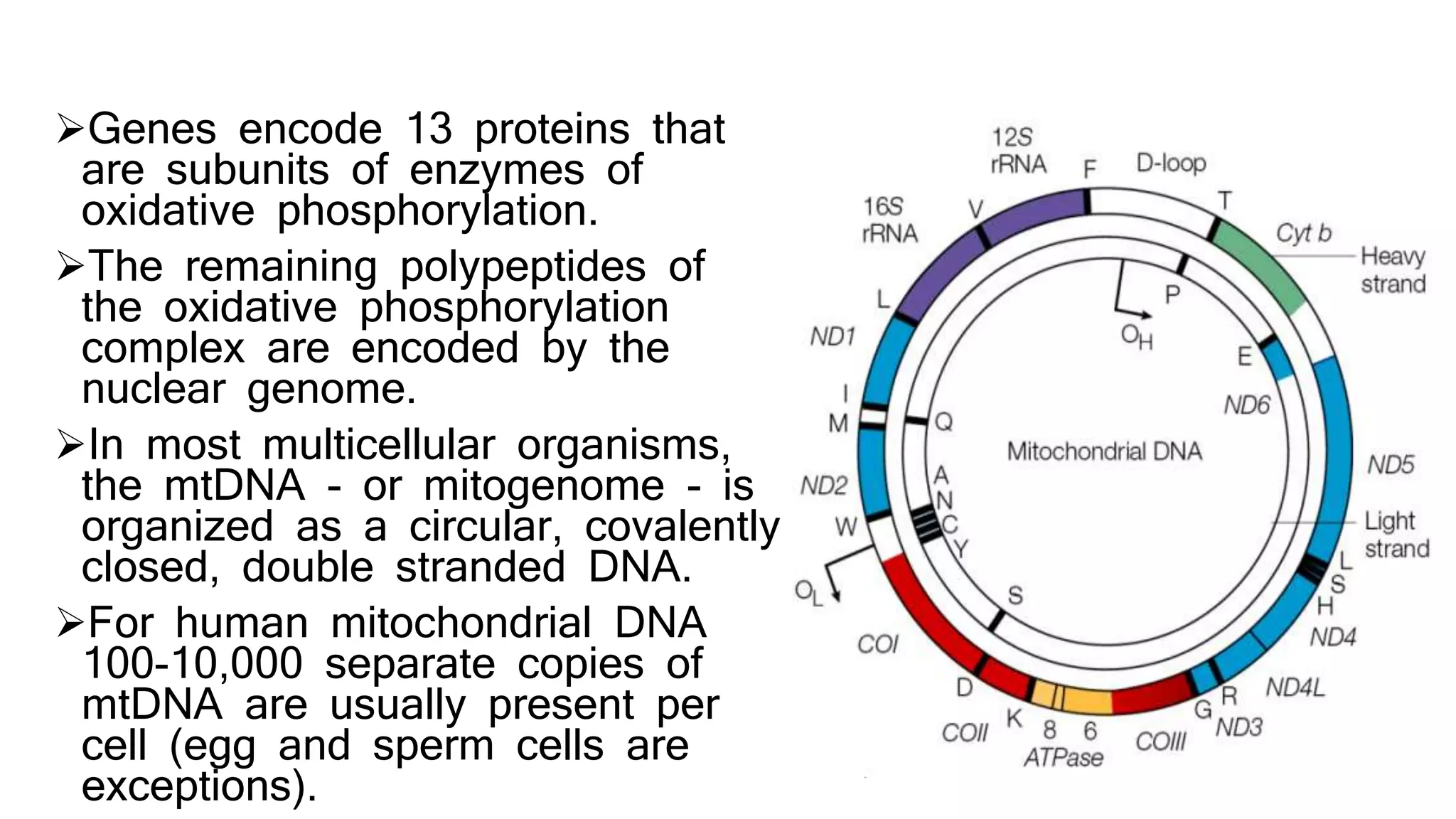
Genes encode 13 proteins that
are subunits of enzymes of
oxidative phosphorylation.
The remaining polypeptides of
the oxidative phosphorylation
complex are encoded by the
nuclear genome.
In most multicellular organisms,
the mtDNA - or mitogenome - is
organized as a circular, covalently
closed, double stranded DNA.
For human mitochondrial DNA
100-10,000 separate copies of
mtDNA are usually present per
cell (egg and sperm cells are
exceptions).
The two strands of mtDNA are differentiated by their
nucleotide content, with a guanine rich strand referred to
as the heavy strand (or H-strand) and a cytosine-rich
strand referred to as the light strand (or L-strand).
The heavy strand encodes 28 genes, and the light strand
encodes 9 genes for a total of 37 genes.
Of the 37 genes, 13 are for proteins (polypeptides), 22
are for transfer RNA (tRNA) and two are for the small
and large subunits of ribosomal RNA (rRNA).
Control Region
Control Region
• The control region contains
the signals to control RNA
and DNA synthesis in the
mitochondria.
• It is also our fastest evolving
DNA sequence.
• This region of noncoding
DNA, also known as the
hypervariable region,
accumulates mutations at
approximately 10 times the
rate of nuclear dna,
• This region also called as D-
loop, relating to a structure
formed when the mtDNA
replicates.
Complex I Genes
• These seven genes (ND-1, ND-
2, ND-3, ND-4, ND-4L, ND-5,
ND-6)encode subunits of a
protein complex in the
mitochondrial membrane.
• The complex, NADH
dehydrogenase, is an electron
transporter that is involved in the
production and storage of
energy. Although the genes to
make the complex lie within the
mtDNA, the process of producing
energy requires molecules that
are produced outside the
mitochondria.
Complex III Genes
• This complex is part of the
electron transport chain of
mitochondria, involved in
generation and storage of
energy. This mitochondrial
gene encodes the
cytochrome b protein, which
is part of a complex in the
inner membrane of a
mitochondrion, known as
ubiquinol, or cytochrome c
oxidoreductase.
Complex IV Genes
• These three genes (MT-
CO 1, MT-CO 2, MT-CO
3) encode protein subunits
that are part of a complex
known as cytochrome c
oxidase.
• This complex acts as an
electron transporter during
the process of producing
and storing energy in the
mitochondria.
Complex V Genes
• These two genes (MT-ATP 6
and MT-ATP-8) encode
proteins contained within a
complex known as ATP
synthase.
• This protein complex,
located in the inner
membrane of the
mitochondrion, acts an
electron transporter in the
pathway that produces and
stores energy.
Ribosomal RNA Genes
• These genes, known as
16s and 12s rRNA,
encode ribosomal RNAs
(rRNA) used to build
ribosomes.
• During protein synthesis,
ribosomes assemble to
translate the messenger
RNA sequence into an
assembled protein. The
RNA produced by these
genes build the “molecular
machinery” to synthesize
Transfer RNA Genes
• These 22 genes encode transfer
RNA molecules. Each transfer
RNA is associated with a
specific amino acid ( protein
building block). Transfer RNAs
play a vital role in protein
synthesis, delivering their
associated amino acids to the
ribosome for incorporation into
new protein.
Mitochondrial DNA in several human
diseases
Size of Mitochondrial Genomes
Species Size (kb)
Human 16
Drosophila 18
Yeast 75
Turnip 218
Corn 570
Muskmelon 2000
Mitochondrial genome

Mitochondrial genome

  • 1.
  • 2.
    Introduction Mitochondria (singular: Mitochondrion)are membrane bound organelles found in the cytoplasm of almost all eukaryotic cells . It’s primary function is to generate large quantities of energy in the form of adenosine triphosphate (ATP). Mitochondria are typically round to oval in shape and range in size from 0.5 to 10 μm. In addition to producing energy, mitochondria store calcium for cell signaling activities, generate heat and mediates cell growth and death. Mitochondria are unlike other cellular organelles in that
  • 3.
    Discovery • Mitochondrial DNAwas discovered in the 1960s by Margit M. K. Nass and Sylvan Nass by electron microscopy and by Ellen Haslbrunner, Hans Tuppy and Gottfried Schatz by biochemical assays on highly purified mitochondrial fractions.
  • 5.
    MITOCHONDRIAL GENOME • Mtgenome consists of a circular chromosome 16.5kb in size that is located in the mitochondrial matrix . • Most cells contain at least 1000 mtDNA molecules distributed among hundreds of individual mitochondria. • It contains 37 genes, and encodes 2 types of rRNA, 22 types of tRNAs and 13 proteins subunits.
  • 6.
    Genes encode 13proteins that are subunits of enzymes of oxidative phosphorylation. The remaining polypeptides of the oxidative phosphorylation complex are encoded by the nuclear genome. In most multicellular organisms, the mtDNA - or mitogenome - is organized as a circular, covalently closed, double stranded DNA. For human mitochondrial DNA 100-10,000 separate copies of mtDNA are usually present per cell (egg and sperm cells are exceptions).
  • 7.
    The two strandsof mtDNA are differentiated by their nucleotide content, with a guanine rich strand referred to as the heavy strand (or H-strand) and a cytosine-rich strand referred to as the light strand (or L-strand). The heavy strand encodes 28 genes, and the light strand encodes 9 genes for a total of 37 genes. Of the 37 genes, 13 are for proteins (polypeptides), 22 are for transfer RNA (tRNA) and two are for the small and large subunits of ribosomal RNA (rRNA).
  • 8.
  • 10.
    Control Region • Thecontrol region contains the signals to control RNA and DNA synthesis in the mitochondria. • It is also our fastest evolving DNA sequence. • This region of noncoding DNA, also known as the hypervariable region, accumulates mutations at approximately 10 times the rate of nuclear dna, • This region also called as D- loop, relating to a structure formed when the mtDNA replicates.
  • 11.
    Complex I Genes •These seven genes (ND-1, ND- 2, ND-3, ND-4, ND-4L, ND-5, ND-6)encode subunits of a protein complex in the mitochondrial membrane. • The complex, NADH dehydrogenase, is an electron transporter that is involved in the production and storage of energy. Although the genes to make the complex lie within the mtDNA, the process of producing energy requires molecules that are produced outside the mitochondria.
  • 12.
    Complex III Genes •This complex is part of the electron transport chain of mitochondria, involved in generation and storage of energy. This mitochondrial gene encodes the cytochrome b protein, which is part of a complex in the inner membrane of a mitochondrion, known as ubiquinol, or cytochrome c oxidoreductase.
  • 13.
    Complex IV Genes •These three genes (MT- CO 1, MT-CO 2, MT-CO 3) encode protein subunits that are part of a complex known as cytochrome c oxidase. • This complex acts as an electron transporter during the process of producing and storing energy in the mitochondria.
  • 14.
    Complex V Genes •These two genes (MT-ATP 6 and MT-ATP-8) encode proteins contained within a complex known as ATP synthase. • This protein complex, located in the inner membrane of the mitochondrion, acts an electron transporter in the pathway that produces and stores energy.
  • 15.
    Ribosomal RNA Genes •These genes, known as 16s and 12s rRNA, encode ribosomal RNAs (rRNA) used to build ribosomes. • During protein synthesis, ribosomes assemble to translate the messenger RNA sequence into an assembled protein. The RNA produced by these genes build the “molecular machinery” to synthesize
  • 16.
    Transfer RNA Genes •These 22 genes encode transfer RNA molecules. Each transfer RNA is associated with a specific amino acid ( protein building block). Transfer RNAs play a vital role in protein synthesis, delivering their associated amino acids to the ribosome for incorporation into new protein.
  • 17.
    Mitochondrial DNA inseveral human diseases
  • 18.
    Size of MitochondrialGenomes Species Size (kb) Human 16 Drosophila 18 Yeast 75 Turnip 218 Corn 570 Muskmelon 2000