Also known as: Tricarboxylic acid cycle TCA cycle Kreb’s Cycle
 
 
The  Krebs Cycle  is the  Third Stage  of Aerobic Respiration
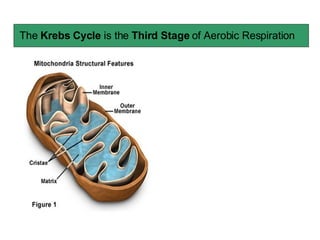
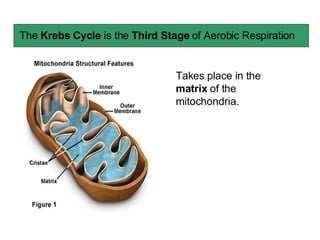
The  Krebs Cycle  is the  Third Stage  of Aerobic Respiration Takes place in the  matrix  of the mitochondria.
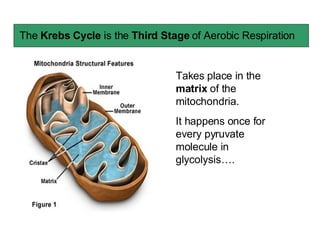
The  Krebs Cycle  is the  Third Stage  of Aerobic Respiration Takes place in the  matrix  of the mitochondria. It happens once for every pyruvate molecule in glycolysis….
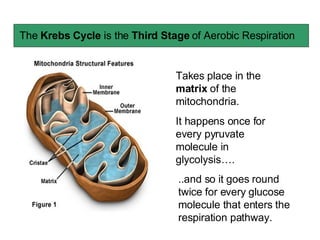
The  Krebs Cycle  is the  Third Stage  of Aerobic Respiration Takes place in the  matrix  of the mitochondria. It happens once for every pyruvate molecule in glycolysis…. ..and so it goes round twice for every glucose molecule that enters the respiration pathway.
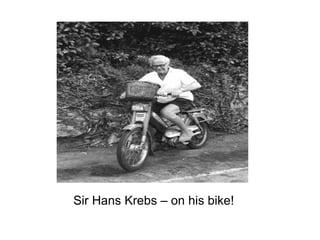
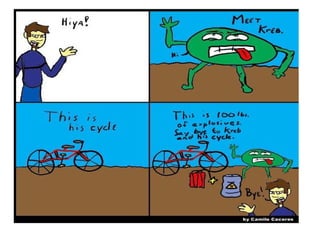
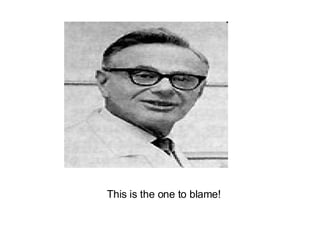
Sir Hans Krebs – on his bike!
 
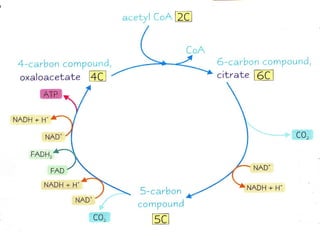
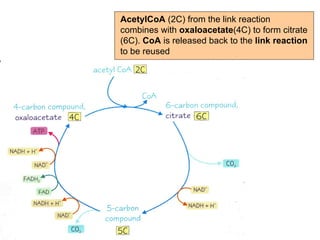
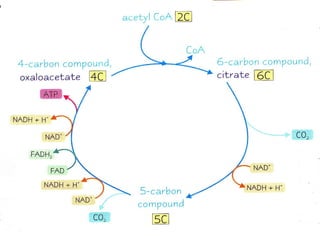
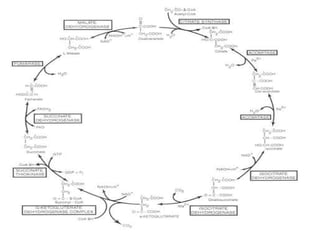
AcetylCoA  (2C) from the link reaction combines with  oxaloacetate (4C) to form citrate (6C).  CoA  is released back to the  link reaction  to be reused
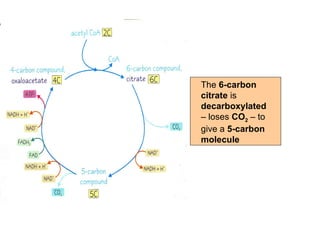
The  6-carbon citrate  is  decarboxylated  – loses  CO 2  – to give a  5-carbon molecule
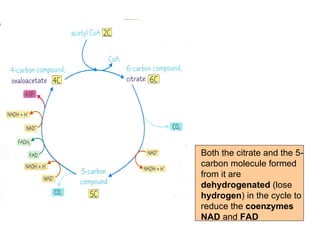
Both the citrate and the 5-carbon molecule formed from it are  dehydrogenated  (lose  hydrogen ) in the cycle to reduce the  coenzymes NAD  and  FAD
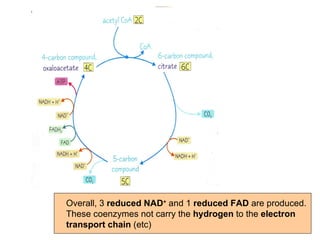
Overall, 3  reduced NAD +   and 1  reduced FAD  are produced. These coenzymes not carry the  hydrogen  to the  electron transport chain  (etc)
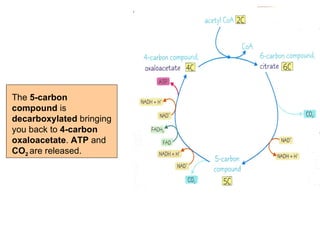
The  5-carbon compound  is  decarboxylated  bringing you back to  4-carbon oxaloacetate .  ATP  and  CO 2  are released.
 
 
Products  of the  Krebs Cycle  enter the  Final Stage  of  Aerobic Respiration
Products  of the  Krebs Cycle  enter the  Final Stage  of  Aerobic Respiration Some products are  reused,
Products  of the  Krebs Cycle  enter the  Final Stage  of  Aerobic Respiration Some products are  reused,  some are  released
Products  of the  Krebs Cycle  enter the  Final Stage  of  Aerobic Respiration Some products are  reused,  some are  released  and others are used   in the  final  stage,  oxidative phosphorylation
This is the one to blame!
One  CoA  is reused in the next  link reaction.
One  CoA  is reused in the next  link reaction. Oxaloacetate  is  regenerated  so it can be  reused  in the next  Krebs cycle .
One  CoA  is reused in the next  link reaction. Oxaloacetate  is  regenerated  so it can be  reused  in the next  Krebs cycle .   Two  carbon dioxide  molecules are released as a  waste product  of respiration.
One  CoA  is reused in the next  link reaction. Oxaloacetate  is  regenerated  so it can be  reused  in the next  Krebs cycle .   Two  carbon dioxide  molecules are released as a  waste product  of respiration. One molecule of  ATP  is made per turn of the cycle – by  substrate level phosphorlyation.
One  CoA  is reused in the next  link reaction. Oxaloacetate  is  regenerated  so it can be  reused  in the next  Krebs cycle .   Two  carbon dioxide  molecules are released as a  waste product  of respiration. One molecule of  ATP  is made per turn of the cycle – by  substrate level phosphorlyation. Three reduced NAD  and  one reduced FAD  coenzymes are made and enter the  e.t.c.
Oxidative Phosphorylation  happens via the  Electron Transport Chain.
 

Krebs Cycle

  • 1.
    Also known as:Tricarboxylic acid cycle TCA cycle Kreb’s Cycle
  • 2.
  • 3.
  • 4.
    The KrebsCycle is the Third Stage of Aerobic Respiration
  • 5.
    The KrebsCycle is the Third Stage of Aerobic Respiration
  • 6.
    The KrebsCycle is the Third Stage of Aerobic Respiration Takes place in the matrix of the mitochondria.
  • 7.
    The KrebsCycle is the Third Stage of Aerobic Respiration Takes place in the matrix of the mitochondria. It happens once for every pyruvate molecule in glycolysis….
  • 8.
    The KrebsCycle is the Third Stage of Aerobic Respiration Takes place in the matrix of the mitochondria. It happens once for every pyruvate molecule in glycolysis…. ..and so it goes round twice for every glucose molecule that enters the respiration pathway.
  • 9.
    Sir Hans Krebs– on his bike!
  • 10.
  • 11.
    AcetylCoA (2C)from the link reaction combines with oxaloacetate (4C) to form citrate (6C). CoA is released back to the link reaction to be reused
  • 12.
    The 6-carboncitrate is decarboxylated – loses CO 2 – to give a 5-carbon molecule
  • 13.
    Both the citrateand the 5-carbon molecule formed from it are dehydrogenated (lose hydrogen ) in the cycle to reduce the coenzymes NAD and FAD
  • 14.
    Overall, 3 reduced NAD + and 1 reduced FAD are produced. These coenzymes not carry the hydrogen to the electron transport chain (etc)
  • 15.
    The 5-carboncompound is decarboxylated bringing you back to 4-carbon oxaloacetate . ATP and CO 2 are released.
  • 16.
  • 17.
  • 18.
    Products ofthe Krebs Cycle enter the Final Stage of Aerobic Respiration
  • 19.
    Products ofthe Krebs Cycle enter the Final Stage of Aerobic Respiration Some products are reused,
  • 20.
    Products ofthe Krebs Cycle enter the Final Stage of Aerobic Respiration Some products are reused, some are released
  • 21.
    Products ofthe Krebs Cycle enter the Final Stage of Aerobic Respiration Some products are reused, some are released and others are used in the final stage, oxidative phosphorylation
  • 22.
    This is theone to blame!
  • 23.
    One CoA is reused in the next link reaction.
  • 24.
    One CoA is reused in the next link reaction. Oxaloacetate is regenerated so it can be reused in the next Krebs cycle .
  • 25.
    One CoA is reused in the next link reaction. Oxaloacetate is regenerated so it can be reused in the next Krebs cycle . Two carbon dioxide molecules are released as a waste product of respiration.
  • 26.
    One CoA is reused in the next link reaction. Oxaloacetate is regenerated so it can be reused in the next Krebs cycle . Two carbon dioxide molecules are released as a waste product of respiration. One molecule of ATP is made per turn of the cycle – by substrate level phosphorlyation.
  • 27.
    One CoA is reused in the next link reaction. Oxaloacetate is regenerated so it can be reused in the next Krebs cycle . Two carbon dioxide molecules are released as a waste product of respiration. One molecule of ATP is made per turn of the cycle – by substrate level phosphorlyation. Three reduced NAD and one reduced FAD coenzymes are made and enter the e.t.c.
  • 28.
    Oxidative Phosphorylation happens via the Electron Transport Chain.
  • 29.