CITRIC ACID CYCLE
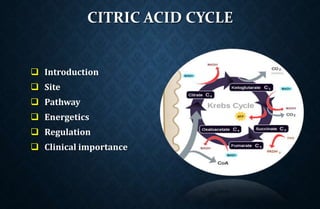
 Introduction
 Site
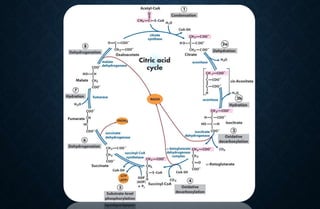
 Pathway
 Energetics
 Regulation
 Clinical importance
INTRODUCTION
 Citric acid cycle
 Krebs cycle (1937; NP-1953)
 Tricarboxylic acid cycle
 Reduced co-enzymes are produced – act as substrate for for ETC
 Most important ATP producing pathway
 About 65-70% ATP synthesized
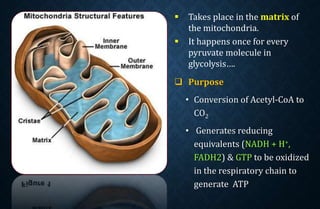
 Takes place in the matrix of
the mitochondria.
 It happens once for every
pyruvate molecule in
glycolysis….
 Purpose
• Conversion of Acetyl-CoA to
CO2
• Generates reducing
equivalents (NADH + H+,
FADH2) & GTP to be oxidized
in the respiratory chain to
generate ATP
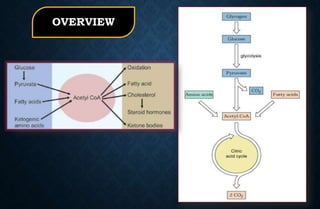
OVERVIEW
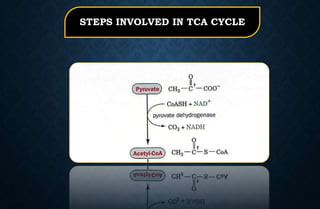
STEPS INVOLVED IN TCA CYCLE
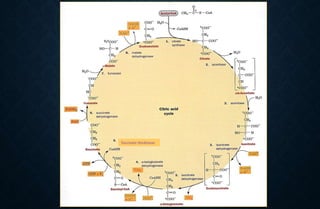
Succinate thiokinase
TIPS TO LEARN BIOCHEMISTRY
• Do not rely on passive reading and highlighting/underlining
of the textbook.
• Do not sit and stare at the handouts
• Do not try to read 50 review books. (Make your own review
book instead!)
• Do focus on identifying key concepts
• Do actively draw and redraw pathways and connections
• Do learn to identify relevant information
Do prioritize:
• What is the purpose of a pathway?
• What are the starting and ending molecules?
• Where is the pathway (in the cell, in a tissue, in an organ system)?
• How does the pathway connect to other pathways?
• What metabolic conditions turn the pathway on and off?
• What are the control points for regulating the pathway?
• reactants, products and enzyme name of each regulatory step
• additional regulatory molecules involved (vitamins, cofactors)
• make sure you know every step that makes or uses ATP
• What specific drugs or diseases associated with the pathway?
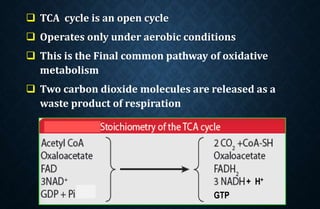
 TCA cycle is an open cycle
 Operates only under aerobic conditions
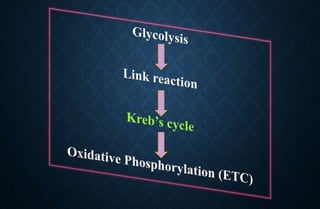
 This is the Final common pathway of oxidative
metabolism
 Two carbon dioxide molecules are released as a
waste product of respiration
GTP
+ H+
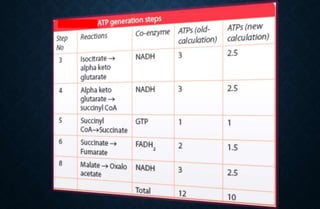
Energetics : 2 Acetyl CoA from 2 Pyruvate
 1NADH+H+ = 3/2.5 ATP
 1FADH2 = 2/1.5 ATP
 1GTP = 1 ATP
Acetyl-CoA + 3 NAD+ + [FAD] + GDP + Pi + 2 H2O CoASH +
3 NADH+3 H+ +[FADH2] + GTP + 2 CO2
×2=24
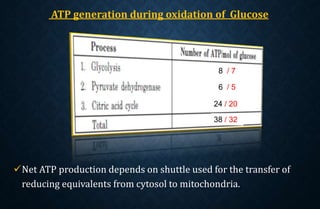
ATP generation during oxidation of Glucose
Net ATP production depends on shuttle used for the transfer of
reducing equivalents from cytosol to mitochondria.
8 / 7
6 / 5
24 / 20
38 / 32
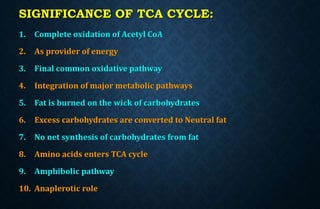
SIGNIFICANCE OF TCA CYCLE:
1. Complete oxidation of Acetyl CoA
2. As provider of energy
3. Final common oxidative pathway
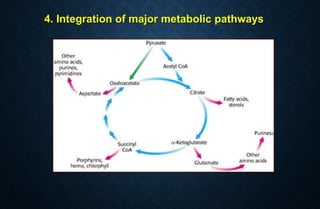
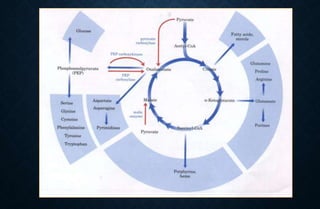
4. Integration of major metabolic pathways
5. Fat is burned on the wick of carbohydrates
6. Excess carbohydrates are converted to Neutral fat
7. No net synthesis of carbohydrates from fat
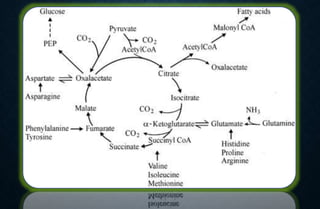
8. Amino acids enters TCA cycle
9. Amphibolic pathway
10. Anaplerotic role
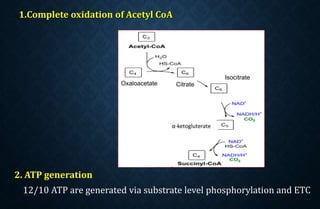
1.Complete oxidation of Acetyl CoA
2. ATP generation
12/10 ATP are generated via substrate level phosphorylation and ETC
Oxaloacetate Citrate
Isocitrate
α-ketogluterate
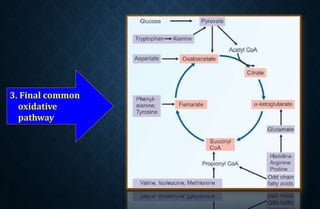
3. Final common
oxidative
pathway
4. Integration of major metabolic pathways
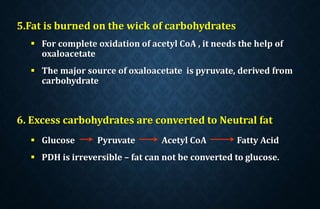
5.Fat is burned on the wick of carbohydrates
 For complete oxidation of acetyl CoA , it needs the help of
oxaloacetate
 The major source of oxaloacetate is pyruvate, derived from
carbohydrate
6. Excess carbohydrates are converted to Neutral fat
 Glucose Pyruvate Acetyl CoA Fatty Acid
 PDH is irreversible – fat can not be converted to glucose.
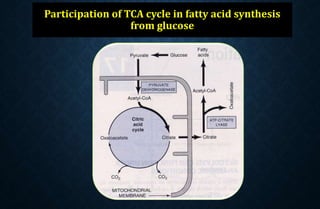
Participation of TCA cycle in fatty acid synthesis
from glucose
7.No net synthesis of carbohydrates from fat
• Acetyl CoA entering in the cycle is completely oxidized to
CO2 by the time the cycle reaches Succinyl CoA.
• So acetyl CoA can not be used for the synthesis of
carbohydrates.
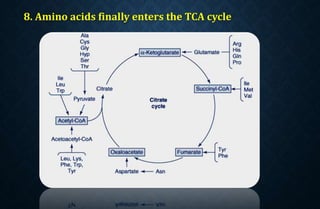
8. Amino acids finally enters the TCA cycle
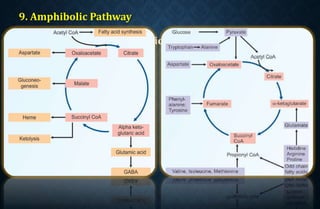
9. Amphibolic Pathway
• Both anabolic and catabolic
• Metabolic traffic cycle
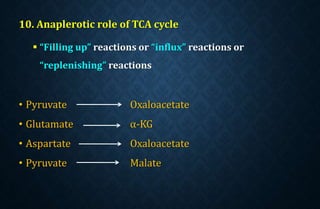
10. Anaplerotic role of TCA cycle
 “Filling up” reactions or “influx” reactions or
“replenishing” reactions
• Pyruvate Oxaloacetate
• Glutamate α-KG
• Aspartate Oxaloacetate
• Pyruvate Malate
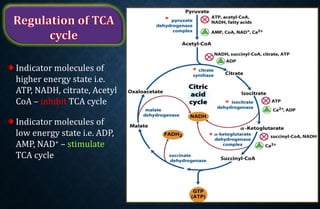
Indicator molecules of
higher energy state i.e.
ATP, NADH, citrate, Acetyl
CoA – inhibit TCA cycle
Indicator molecules of
low energy state i.e. ADP,
AMP, NAD+ – stimulate
TCA cycle
*
*
*
*
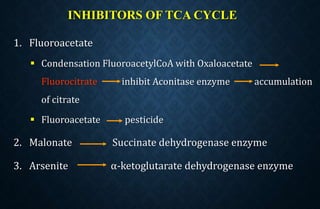
INHIBITORS OF TCA CYCLE
1. Fluoroacetate
 Condensation FluoroacetylCoA with Oxaloacetate
Fluorocitrate inhibit Aconitase enzyme accumulation
of citrate
 Fluoroacetate pesticide
2. Malonate Succinate dehydrogenase enzyme
3. Arsenite α-ketoglutarate dehydrogenase enzyme
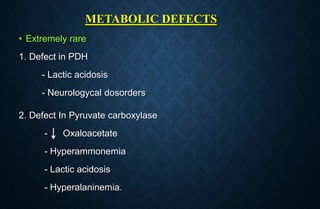
METABOLIC DEFECTS
• Extremely rare
1. Defect in PDH
- Lactic acidosis
- Neurologycal dosorders
2. Defect In Pyruvate carboxylase
- Oxaloacetate
- Hyperammonemia
- Lactic acidosis
- Hyperalaninemia.
SUMMARY
• Pyruvate is converted to acetyl-CoA by the action of p yruvate
dehydrogenase complex, a huge enzyme complex.
• Acetyl-CoA is converted to 2 CO2 via the eight-step citric acid
cycle, generating three NADH, one FADH2, and one ATP (by
substrate-level phophorylation).
• Intermediates of citric acid cycle are also used as
biosynthetic precursors for many other biomolecules,
including fatty acids, steroids, amino acids, heme,
pyrimidines, and glucose.
• Oxaloacetate can get replenished from pyruvate, via a
carboxylation reaction catalyzed by the biotin-containing
pyruvate carboxylase.
QUESTIONS?
• TCA cycle is the final common metabolic pathway for
the oxidation of food stuffs. – Justify
• Conversion of Pyruvate to Acetyl CoA
• Energetics of citric acid cycle
THANK YOU

TCA Cycle

  • 1.
    CITRIC ACID CYCLE Introduction  Site  Pathway  Energetics  Regulation  Clinical importance
  • 3.
    INTRODUCTION  Citric acidcycle  Krebs cycle (1937; NP-1953)  Tricarboxylic acid cycle  Reduced co-enzymes are produced – act as substrate for for ETC  Most important ATP producing pathway  About 65-70% ATP synthesized
  • 4.
     Takes placein the matrix of the mitochondria.  It happens once for every pyruvate molecule in glycolysis….  Purpose • Conversion of Acetyl-CoA to CO2 • Generates reducing equivalents (NADH + H+, FADH2) & GTP to be oxidized in the respiratory chain to generate ATP
  • 5.
  • 6.
  • 7.
  • 10.
    TIPS TO LEARNBIOCHEMISTRY • Do not rely on passive reading and highlighting/underlining of the textbook. • Do not sit and stare at the handouts • Do not try to read 50 review books. (Make your own review book instead!) • Do focus on identifying key concepts • Do actively draw and redraw pathways and connections • Do learn to identify relevant information
  • 11.
    Do prioritize: • Whatis the purpose of a pathway? • What are the starting and ending molecules? • Where is the pathway (in the cell, in a tissue, in an organ system)? • How does the pathway connect to other pathways? • What metabolic conditions turn the pathway on and off? • What are the control points for regulating the pathway? • reactants, products and enzyme name of each regulatory step • additional regulatory molecules involved (vitamins, cofactors) • make sure you know every step that makes or uses ATP • What specific drugs or diseases associated with the pathway?
  • 13.
     TCA cycleis an open cycle  Operates only under aerobic conditions  This is the Final common pathway of oxidative metabolism  Two carbon dioxide molecules are released as a waste product of respiration GTP + H+
  • 14.
    Energetics : 2Acetyl CoA from 2 Pyruvate  1NADH+H+ = 3/2.5 ATP  1FADH2 = 2/1.5 ATP  1GTP = 1 ATP Acetyl-CoA + 3 NAD+ + [FAD] + GDP + Pi + 2 H2O CoASH + 3 NADH+3 H+ +[FADH2] + GTP + 2 CO2 ×2=24
  • 16.
    ATP generation duringoxidation of Glucose Net ATP production depends on shuttle used for the transfer of reducing equivalents from cytosol to mitochondria. 8 / 7 6 / 5 24 / 20 38 / 32
  • 17.
    SIGNIFICANCE OF TCACYCLE: 1. Complete oxidation of Acetyl CoA 2. As provider of energy 3. Final common oxidative pathway 4. Integration of major metabolic pathways 5. Fat is burned on the wick of carbohydrates 6. Excess carbohydrates are converted to Neutral fat 7. No net synthesis of carbohydrates from fat 8. Amino acids enters TCA cycle 9. Amphibolic pathway 10. Anaplerotic role
  • 18.
    1.Complete oxidation ofAcetyl CoA 2. ATP generation 12/10 ATP are generated via substrate level phosphorylation and ETC Oxaloacetate Citrate Isocitrate α-ketogluterate
  • 19.
  • 20.
    4. Integration ofmajor metabolic pathways
  • 22.
    5.Fat is burnedon the wick of carbohydrates  For complete oxidation of acetyl CoA , it needs the help of oxaloacetate  The major source of oxaloacetate is pyruvate, derived from carbohydrate 6. Excess carbohydrates are converted to Neutral fat  Glucose Pyruvate Acetyl CoA Fatty Acid  PDH is irreversible – fat can not be converted to glucose.
  • 23.
    Participation of TCAcycle in fatty acid synthesis from glucose
  • 24.
    7.No net synthesisof carbohydrates from fat • Acetyl CoA entering in the cycle is completely oxidized to CO2 by the time the cycle reaches Succinyl CoA. • So acetyl CoA can not be used for the synthesis of carbohydrates.
  • 25.
    8. Amino acidsfinally enters the TCA cycle
  • 26.
    9. Amphibolic Pathway •Both anabolic and catabolic • Metabolic traffic cycle
  • 27.
    10. Anaplerotic roleof TCA cycle  “Filling up” reactions or “influx” reactions or “replenishing” reactions • Pyruvate Oxaloacetate • Glutamate α-KG • Aspartate Oxaloacetate • Pyruvate Malate
  • 29.
    Indicator molecules of higherenergy state i.e. ATP, NADH, citrate, Acetyl CoA – inhibit TCA cycle Indicator molecules of low energy state i.e. ADP, AMP, NAD+ – stimulate TCA cycle * * * *
  • 30.
    INHIBITORS OF TCACYCLE 1. Fluoroacetate  Condensation FluoroacetylCoA with Oxaloacetate Fluorocitrate inhibit Aconitase enzyme accumulation of citrate  Fluoroacetate pesticide 2. Malonate Succinate dehydrogenase enzyme 3. Arsenite α-ketoglutarate dehydrogenase enzyme
  • 31.
    METABOLIC DEFECTS • Extremelyrare 1. Defect in PDH - Lactic acidosis - Neurologycal dosorders 2. Defect In Pyruvate carboxylase - Oxaloacetate - Hyperammonemia - Lactic acidosis - Hyperalaninemia.
  • 32.
    SUMMARY • Pyruvate isconverted to acetyl-CoA by the action of p yruvate dehydrogenase complex, a huge enzyme complex. • Acetyl-CoA is converted to 2 CO2 via the eight-step citric acid cycle, generating three NADH, one FADH2, and one ATP (by substrate-level phophorylation).
  • 33.
    • Intermediates ofcitric acid cycle are also used as biosynthetic precursors for many other biomolecules, including fatty acids, steroids, amino acids, heme, pyrimidines, and glucose. • Oxaloacetate can get replenished from pyruvate, via a carboxylation reaction catalyzed by the biotin-containing pyruvate carboxylase.
  • 34.
    QUESTIONS? • TCA cycleis the final common metabolic pathway for the oxidation of food stuffs. – Justify • Conversion of Pyruvate to Acetyl CoA • Energetics of citric acid cycle
  • 35.