Regulation of Enzyme Activity
Namrata Chhabra
M.D.Biochemistry
• Purpose- Regulation of enzyme activity is needed to maintain
homeostasis
• Dysregulation triggered by pathogenic agents or genetic mutations
leads to diseases.
• Cancer, diabetes, cystic fibrosis, and Alzheimer's disease, are
characterized by regulatory dysfunctions.
Regulation of Enzyme activity
15-May-20 Regulation of enzyme activity 2
Rate limiting enzyme
• The flux of metabolites through metabolic pathways involves
catalysis by numerous enzymes.
• Active control of homeostasis is achieved by regulation of only a
small number of enzymes.
15-May-20 Regulation of enzyme activity 3
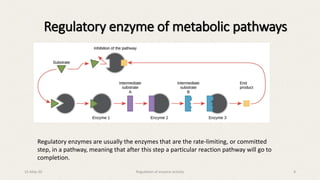
Regulatory enzyme of metabolic pathways
15-May-20 Regulation of enzyme activity 4
Regulatory enzymes are usually the enzymes that are the rate-limiting, or committed
step, in a pathway, meaning that after this step a particular reaction pathway will go to
completion.
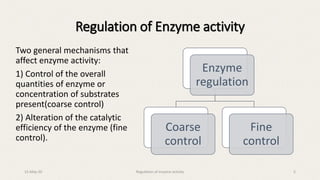
Two general mechanisms that
affect enzyme activity:
1) Control of the overall
quantities of enzyme or
concentration of substrates
present(coarse control)
2) Alteration of the catalytic
efficiency of the enzyme (fine
control).
Regulation of Enzyme activity
Enzyme
regulation
Coarse
control
Fine
control
15-May-20 Regulation of enzyme activity 5
Regulation of enzyme activity
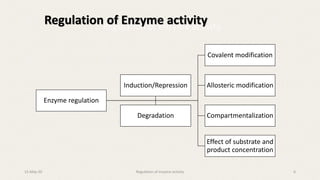
15-May-20 Regulation of enzyme activity 6
Enzyme regulation
Covalent modification
Allosteric modification
Compartmentalization
Effect of substrate and
product concentration
Induction/Repression
Degradation
Regulation of Enzyme activity
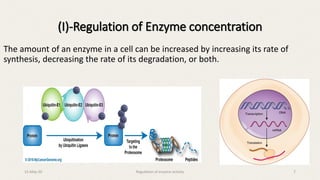
The amount of an enzyme in a cell can be increased by increasing its rate of
synthesis, decreasing the rate of its degradation, or both.
(I)-Regulation of Enzyme concentration
15-May-20 Regulation of enzyme activity 7
• Induction -an increase caused by
an effector molecule
• The actions of many hormones
and/or growth factors on cells
leads to an increase in the
expression and translation of
"new" enzymes not present prior
to the signal.
(I)-Regulation of enzyme concentration:
Induction
15-May-20 Regulation of enzyme activity 8
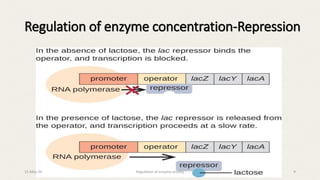
Regulation of enzyme concentration-Repression
15-May-20 Regulation of enzyme activity 9
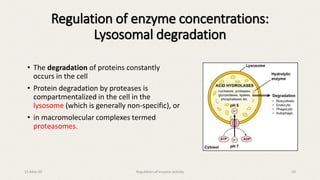
• The degradation of proteins constantly
occurs in the cell
• Protein degradation by proteases is
compartmentalized in the cell in the
lysosome (which is generally non-specific), or
• in macromolecular complexes termed
proteasomes.
Regulation of enzyme concentrations:
Lysosomal degradation
15-May-20 Regulation of enzyme activity 10
Enzyme degradation by ubiquitination
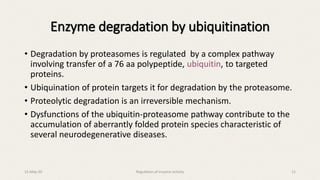
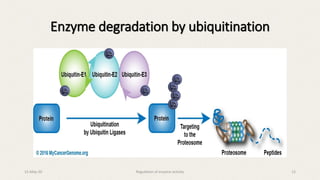
• Degradation by proteasomes is regulated by a complex pathway
involving transfer of a 76 aa polypeptide, ubiquitin, to targeted
proteins.
• Ubiquination of protein targets it for degradation by the proteasome.
• Proteolytic degradation is an irreversible mechanism.
• Dysfunctions of the ubiquitin-proteasome pathway contribute to the
accumulation of aberrantly folded protein species characteristic of
several neurodegenerative diseases.
15-May-20 Regulation of enzyme activity 11
Enzyme degradation by ubiquitination
15-May-20 Regulation of enzyme activity 12
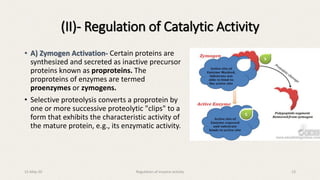
• A) Zymogen Activation- Certain proteins are
synthesized and secreted as inactive precursor
proteins known as proproteins. The
proproteins of enzymes are termed
proenzymes or zymogens.
• Selective proteolysis converts a proprotein by
one or more successive proteolytic "clips" to a
form that exhibits the characteristic activity of
the mature protein, e.g., its enzymatic activity.
(II)- Regulation of Catalytic Activity
15-May-20 Regulation of enzyme activity 13
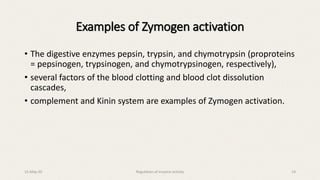
Examples of Zymogen activation
• The digestive enzymes pepsin, trypsin, and chymotrypsin (proproteins
= pepsinogen, trypsinogen, and chymotrypsinogen, respectively),
• several factors of the blood clotting and blood clot dissolution
cascades,
• complement and Kinin system are examples of Zymogen activation.
15-May-20 Regulation of enzyme activity 14
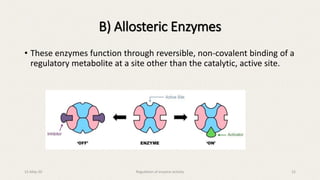
• These enzymes function through reversible, non-covalent binding of a
regulatory metabolite at a site other than the catalytic, active site.
B) Allosteric Enzymes
15-May-20 Regulation of enzyme activity 15
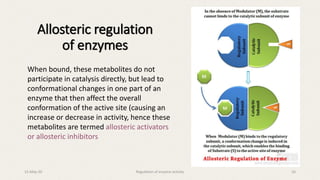
Allosteric regulation
of enzymes
15-May-20 Regulation of enzyme activity 16
When bound, these metabolites do not
participate in catalysis directly, but lead to
conformational changes in one part of an
enzyme that then affect the overall
conformation of the active site (causing an
increase or decrease in activity, hence these
metabolites are termed allosteric activators
or allosteric inhibitors
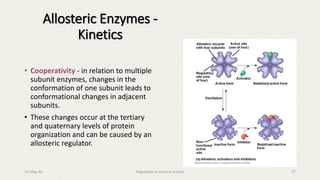
• Cooperativity - in relation to multiple
subunit enzymes, changes in the
conformation of one subunit leads to
conformational changes in adjacent
subunits.
• These changes occur at the tertiary
and quaternary levels of protein
organization and can be caused by an
allosteric regulator.
Allosteric Enzymes -
Kinetics
15-May-20 Regulation of enzyme activity 17
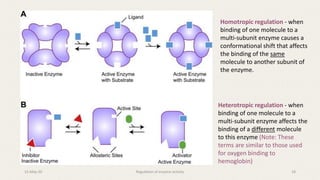
Heterotropic regulation - when
binding of one molecule to a
multi-subunit enzyme affects the
binding of a different molecule
to this enzyme (Note: These
terms are similar to those used
for oxygen binding to
hemoglobin)
Homotropic regulation - when
binding of one molecule to a
multi-subunit enzyme causes a
conformational shift that affects
the binding of the same
molecule to another subunit of
the enzyme.
15-May-20 Regulation of enzyme activity 18
• Allosteric enzymes do exhibit saturation kinetics
at high [S], but they have a characteristic
sigmoidal saturation curve rather than
hyperbolic curve when vo is plotted versus [S]
(analogous to the oxygen saturation curves of
myoglobin vs. hemoglobin).
• The sigmoidicity is thought to result from the
cooperativity of structural changes between
enzyme subunits (again similar to oxygen binding
to hemoglobin).
Allosteric Enzymes - Kinetics
15-May-20 Regulation of enzyme activity 19
Vo v/s [S] for Allosteric Enzymes
Addition of an allosteric activator (+)
tends to shift the curve to a more
hyperbolic profile (more like
Michaelis-Menten curves), while an
allosteric inhibitor (-) will result in
more pronounced sigmoidal curves.
15-May-20 Regulation of enzyme activity 20
C)Regulation of Enzyme Activity by Covalent
Modifications
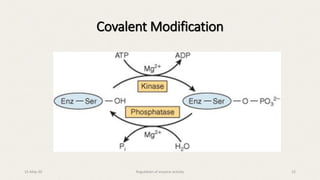
• Another common regulatory mechanism is the reversible covalent
modification of an enzyme.
• Phosphorylation, whereby a phosphate is transferred from an
activated donor (usually ATP) to an amino acid on the regulatory
enzyme, is the most common example of this type of regulation.
• Frequently this phosphorylation occurs in response to some stimulus
(like a hormone or growth factor) that will either activate or inactivate
target enzymes
15-May-20 Regulation of enzyme activity 21
Covalent Modification
15-May-20 Regulation of enzyme activity 22
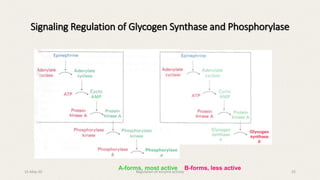
• Phosphorylation of one enzyme can lead to phosphorylation of a
different enzyme which in turn acts on another enzyme, and so on.
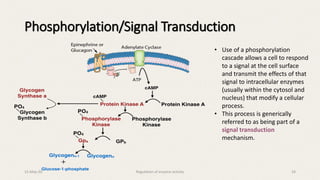
• An example of this type of phosphorylation cascade is the response
of a cell to cyclic AMP and its effect on glycogen metabolism.
Phosphorylation/Signal Transduction
15-May-20 Regulation of enzyme activity 23
Phosphorylation/Signal Transduction
• Use of a phosphorylation
cascade allows a cell to respond
to a signal at the cell surface
and transmit the effects of that
signal to intracellular enzymes
(usually within the cytosol and
nucleus) that modify a cellular
process.
• This process is generically
referred to as being part of a
signal transduction
mechanism.
15-May-20 Regulation of enzyme activity 24
Signaling Regulation of Glycogen Synthase and Phosphorylase
A-forms, most active B-forms, less active
15-May-20 Regulation of enzyme activity 25
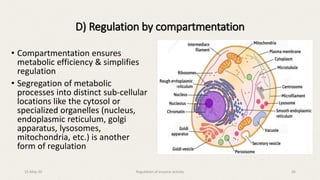
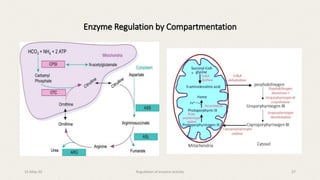
• Compartmentation ensures
metabolic efficiency & simplifies
regulation
• Segregation of metabolic
processes into distinct sub-cellular
locations like the cytosol or
specialized organelles (nucleus,
endoplasmic reticulum, golgi
apparatus, lysosomes,
mitochondria, etc.) is another
form of regulation
D) Regulation by compartmentation
15-May-20 Regulation of enzyme activity 26
Enzyme Regulation by Compartmentation
15-May-20 Regulation of enzyme activity 27
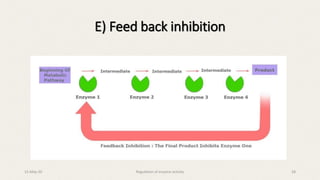
E) Feed back inhibition
15-May-20 Regulation of enzyme activity 28
Thank you
15-May-20 Regulation of enzyme activity 29

Enzyme regulation

  • 1.
    Regulation of EnzymeActivity Namrata Chhabra M.D.Biochemistry
  • 2.
    • Purpose- Regulationof enzyme activity is needed to maintain homeostasis • Dysregulation triggered by pathogenic agents or genetic mutations leads to diseases. • Cancer, diabetes, cystic fibrosis, and Alzheimer's disease, are characterized by regulatory dysfunctions. Regulation of Enzyme activity 15-May-20 Regulation of enzyme activity 2
  • 3.
    Rate limiting enzyme •The flux of metabolites through metabolic pathways involves catalysis by numerous enzymes. • Active control of homeostasis is achieved by regulation of only a small number of enzymes. 15-May-20 Regulation of enzyme activity 3
  • 4.
    Regulatory enzyme ofmetabolic pathways 15-May-20 Regulation of enzyme activity 4 Regulatory enzymes are usually the enzymes that are the rate-limiting, or committed step, in a pathway, meaning that after this step a particular reaction pathway will go to completion.
  • 5.
    Two general mechanismsthat affect enzyme activity: 1) Control of the overall quantities of enzyme or concentration of substrates present(coarse control) 2) Alteration of the catalytic efficiency of the enzyme (fine control). Regulation of Enzyme activity Enzyme regulation Coarse control Fine control 15-May-20 Regulation of enzyme activity 5
  • 6.
    Regulation of enzymeactivity 15-May-20 Regulation of enzyme activity 6 Enzyme regulation Covalent modification Allosteric modification Compartmentalization Effect of substrate and product concentration Induction/Repression Degradation Regulation of Enzyme activity
  • 7.
    The amount ofan enzyme in a cell can be increased by increasing its rate of synthesis, decreasing the rate of its degradation, or both. (I)-Regulation of Enzyme concentration 15-May-20 Regulation of enzyme activity 7
  • 8.
    • Induction -anincrease caused by an effector molecule • The actions of many hormones and/or growth factors on cells leads to an increase in the expression and translation of "new" enzymes not present prior to the signal. (I)-Regulation of enzyme concentration: Induction 15-May-20 Regulation of enzyme activity 8
  • 9.
    Regulation of enzymeconcentration-Repression 15-May-20 Regulation of enzyme activity 9
  • 10.
    • The degradationof proteins constantly occurs in the cell • Protein degradation by proteases is compartmentalized in the cell in the lysosome (which is generally non-specific), or • in macromolecular complexes termed proteasomes. Regulation of enzyme concentrations: Lysosomal degradation 15-May-20 Regulation of enzyme activity 10
  • 11.
    Enzyme degradation byubiquitination • Degradation by proteasomes is regulated by a complex pathway involving transfer of a 76 aa polypeptide, ubiquitin, to targeted proteins. • Ubiquination of protein targets it for degradation by the proteasome. • Proteolytic degradation is an irreversible mechanism. • Dysfunctions of the ubiquitin-proteasome pathway contribute to the accumulation of aberrantly folded protein species characteristic of several neurodegenerative diseases. 15-May-20 Regulation of enzyme activity 11
  • 12.
    Enzyme degradation byubiquitination 15-May-20 Regulation of enzyme activity 12
  • 13.
    • A) ZymogenActivation- Certain proteins are synthesized and secreted as inactive precursor proteins known as proproteins. The proproteins of enzymes are termed proenzymes or zymogens. • Selective proteolysis converts a proprotein by one or more successive proteolytic "clips" to a form that exhibits the characteristic activity of the mature protein, e.g., its enzymatic activity. (II)- Regulation of Catalytic Activity 15-May-20 Regulation of enzyme activity 13
  • 14.
    Examples of Zymogenactivation • The digestive enzymes pepsin, trypsin, and chymotrypsin (proproteins = pepsinogen, trypsinogen, and chymotrypsinogen, respectively), • several factors of the blood clotting and blood clot dissolution cascades, • complement and Kinin system are examples of Zymogen activation. 15-May-20 Regulation of enzyme activity 14
  • 15.
    • These enzymesfunction through reversible, non-covalent binding of a regulatory metabolite at a site other than the catalytic, active site. B) Allosteric Enzymes 15-May-20 Regulation of enzyme activity 15
  • 16.
    Allosteric regulation of enzymes 15-May-20Regulation of enzyme activity 16 When bound, these metabolites do not participate in catalysis directly, but lead to conformational changes in one part of an enzyme that then affect the overall conformation of the active site (causing an increase or decrease in activity, hence these metabolites are termed allosteric activators or allosteric inhibitors
  • 17.
    • Cooperativity -in relation to multiple subunit enzymes, changes in the conformation of one subunit leads to conformational changes in adjacent subunits. • These changes occur at the tertiary and quaternary levels of protein organization and can be caused by an allosteric regulator. Allosteric Enzymes - Kinetics 15-May-20 Regulation of enzyme activity 17
  • 18.
    Heterotropic regulation -when binding of one molecule to a multi-subunit enzyme affects the binding of a different molecule to this enzyme (Note: These terms are similar to those used for oxygen binding to hemoglobin) Homotropic regulation - when binding of one molecule to a multi-subunit enzyme causes a conformational shift that affects the binding of the same molecule to another subunit of the enzyme. 15-May-20 Regulation of enzyme activity 18
  • 19.
    • Allosteric enzymesdo exhibit saturation kinetics at high [S], but they have a characteristic sigmoidal saturation curve rather than hyperbolic curve when vo is plotted versus [S] (analogous to the oxygen saturation curves of myoglobin vs. hemoglobin). • The sigmoidicity is thought to result from the cooperativity of structural changes between enzyme subunits (again similar to oxygen binding to hemoglobin). Allosteric Enzymes - Kinetics 15-May-20 Regulation of enzyme activity 19
  • 20.
    Vo v/s [S]for Allosteric Enzymes Addition of an allosteric activator (+) tends to shift the curve to a more hyperbolic profile (more like Michaelis-Menten curves), while an allosteric inhibitor (-) will result in more pronounced sigmoidal curves. 15-May-20 Regulation of enzyme activity 20
  • 21.
    C)Regulation of EnzymeActivity by Covalent Modifications • Another common regulatory mechanism is the reversible covalent modification of an enzyme. • Phosphorylation, whereby a phosphate is transferred from an activated donor (usually ATP) to an amino acid on the regulatory enzyme, is the most common example of this type of regulation. • Frequently this phosphorylation occurs in response to some stimulus (like a hormone or growth factor) that will either activate or inactivate target enzymes 15-May-20 Regulation of enzyme activity 21
  • 22.
  • 23.
    • Phosphorylation ofone enzyme can lead to phosphorylation of a different enzyme which in turn acts on another enzyme, and so on. • An example of this type of phosphorylation cascade is the response of a cell to cyclic AMP and its effect on glycogen metabolism. Phosphorylation/Signal Transduction 15-May-20 Regulation of enzyme activity 23
  • 24.
    Phosphorylation/Signal Transduction • Useof a phosphorylation cascade allows a cell to respond to a signal at the cell surface and transmit the effects of that signal to intracellular enzymes (usually within the cytosol and nucleus) that modify a cellular process. • This process is generically referred to as being part of a signal transduction mechanism. 15-May-20 Regulation of enzyme activity 24
  • 25.
    Signaling Regulation ofGlycogen Synthase and Phosphorylase A-forms, most active B-forms, less active 15-May-20 Regulation of enzyme activity 25
  • 26.
    • Compartmentation ensures metabolicefficiency & simplifies regulation • Segregation of metabolic processes into distinct sub-cellular locations like the cytosol or specialized organelles (nucleus, endoplasmic reticulum, golgi apparatus, lysosomes, mitochondria, etc.) is another form of regulation D) Regulation by compartmentation 15-May-20 Regulation of enzyme activity 26
  • 27.
    Enzyme Regulation byCompartmentation 15-May-20 Regulation of enzyme activity 27
  • 28.
    E) Feed backinhibition 15-May-20 Regulation of enzyme activity 28
  • 29.
    Thank you 15-May-20 Regulationof enzyme activity 29