Electron Transport and Oxidative Phosphorylation It all reduces down to water. www.freelivedoctor.com
Mitochondria outer membrane relatively permeable inner membrane permeable only to those things with specific transporters Impermeable to NADH and FADH 2 Permeable to pyruvate Compartmentalization Kreb's and β-oxidation in matrix Glycolysis in cytosol www.freelivedoctor.com
Most energy from Redox electrons during metabolic reactions sent to NAD and FAD Glycolysis In cytosol produces 2 NADH Pyruvate dehydrogenase reaction In mitochondrial matrix 2 NADH / glucose Krebs In mitochondrial matrix 6 NADH and 2 FADH 2  / glucose www.freelivedoctor.com
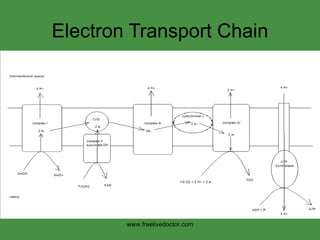
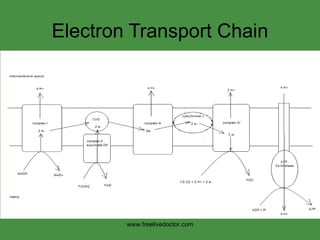
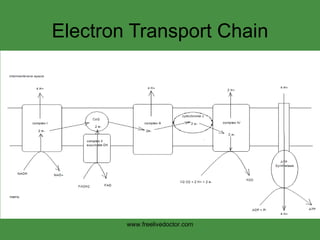
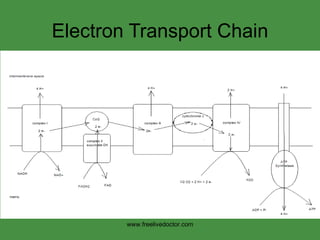
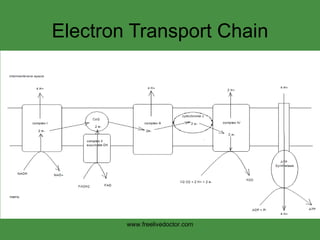
Electron Transport Chain Groups of redox proteins On inner mitochondrial membrane Binding sites for NADH and FADH 2 On matrix side of membrane Electrons transferred to redox proteins NADH reoxidized to NAD + FADH 2  reoxidized to FAD www.freelivedoctor.com
4 Complexes proteins in specific order Transfers 2 electrons in specific order Proteins localized in complexes Embedded in membrane Ease of electron transfer Electrons ultimately reduce oxygen to water 2 H +  + 2 e -  + ½ O 2  --    H 2 O www.freelivedoctor.com
Electron Transport Chain www.freelivedoctor.com
Complex 1 Has NADH binding site NADH reductase activity NADH -   NAD + NADH ---> FMN--->FeS---> ubiquinone ubiquinone ---> ubiquinone H 2 4 H +  pumped/NADH www.freelivedoctor.com
Electron Transport Chain www.freelivedoctor.com
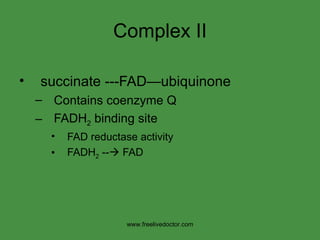
Complex II succinate ---FAD—ubiquinone Contains coenzyme Q FADH 2  binding site FAD reductase activity FADH 2  --   FAD www.freelivedoctor.com
Electron Transport Chain www.freelivedoctor.com
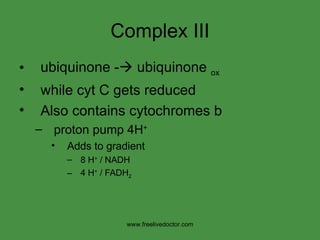
Complex III ubiquinone -   ubiquinone  ox   while cyt C gets reduced Also contains cytochromes b proton pump 4H + Adds to gradient 8 H +  / NADH  4 H +  / FADH 2 www.freelivedoctor.com
Electron Transport Chain www.freelivedoctor.com
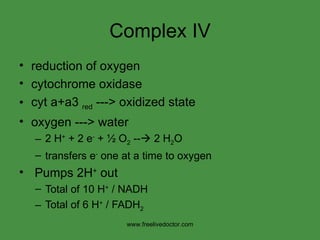
Complex IV reduction of oxygen cytochrome oxidase cyt a+a3  red  ---> oxidized state oxygen ---> water 2 H +  + 2 e -  + ½ O 2  --   2 H 2 O transfers e -  one at a time to oxygen Pumps 2H +  out Total of 10 H +  / NADH Total of 6 H +  / FADH 2 www.freelivedoctor.com
Totals Proton gradient created as electrons transferred to oxygen forming water 10 H +  / NADH 6 H +  / FADH 2 www.freelivedoctor.com
Electron Transport Chain www.freelivedoctor.com
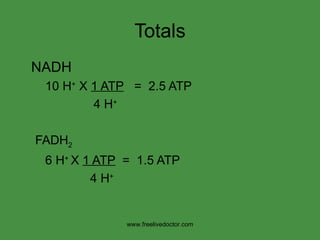
Generation of ATP Proton dependant ATP synthetase Uses proton gradient to make ATP Protons pumped through channel on enzyme From intermembrane space into matrix ~4 H +  / ATP Called chemiosmotic theory www.freelivedoctor.com
Totals NADH 10 H +  X  1 ATP   =  2.5 ATP   4 H + FADH 2 6 H +  X  1 ATP   =  1.5 ATP   4 H + www.freelivedoctor.com
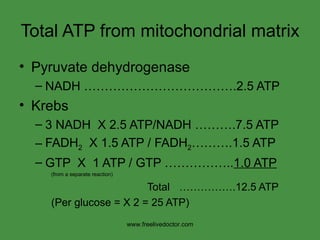
Total ATP from mitochondrial matrix  Pyruvate dehydrogenase  NADH ……………………………….2.5 ATP Krebs 3 NADH  X 2.5 ATP/NADH ……….7.5 ATP FADH 2   X 1.5 ATP / FADH 2 ……….1.5 ATP GTP  X  1 ATP / GTP …………….. 1.0 ATP (from a separate reaction) Total …………….12.5 ATP (Per glucose = X 2 = 25 ATP) www.freelivedoctor.com
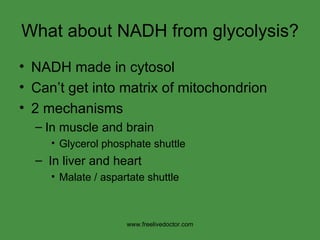
What about NADH from glycolysis? NADH made in cytosol Can’t get into matrix of mitochondrion 2 mechanisms In muscle and brain Glycerol phosphate shuttle In liver and heart Malate / aspartate shuttle www.freelivedoctor.com
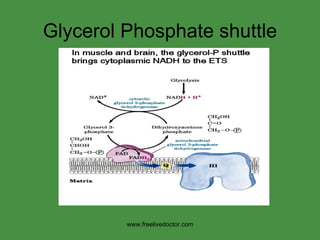
Glycerol Phosphate shuttle www.freelivedoctor.com
Glycerol phosphate shuttle In muscle and brain Each NADH converted to FADH 2  inside mitochondrion FADH 2  enters later in the electron transport chain Produces 1.5 ATP www.freelivedoctor.com
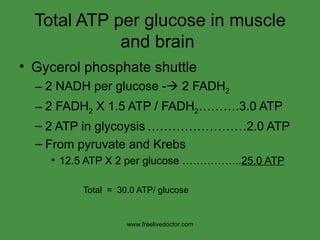
Total ATP per glucose in muscle and brain  Gycerol phosphate shuttle 2 NADH per glucose -   2 FADH 2 2 FADH 2  X 1.5 ATP / FADH 2 ……….3.0 ATP 2 ATP in glycoysis ……………………2.0 ATP From pyruvate and Krebs 12.5 ATP X 2 per glucose …………….. 25.0 ATP Total  =  30.0 ATP/ glucose www.freelivedoctor.com
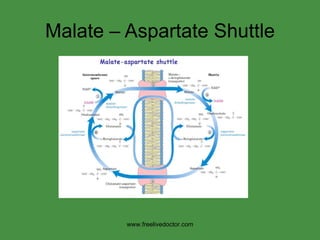
Malate – Aspartate Shuttle www.freelivedoctor.com
Malate – Aspartate Shuttle in cytosol In liver and heart NADH oxidized while reducing oxaloacetate to malate Malated dehydrogenase Malate crosses membrane www.freelivedoctor.com
Malate – Aspartate Shuttle in matrix Malate reoxidized to oxaloacetate Malate dehydrogenase NAD +  reduced to NADH NADH via electron transport yields 2.5 ATP Mlate – Aspartate Shuttle in cytosol www.freelivedoctor.com
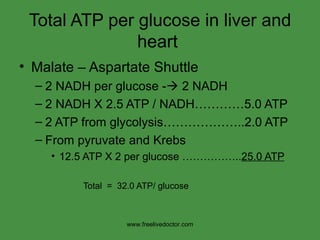
Total ATP per glucose in liver and heart  Malate – Aspartate Shuttle 2 NADH per glucose -   2 NADH 2 NADH X 2.5 ATP / NADH…………5.0 ATP 2 ATP from glycolysis………………..2.0 ATP From pyruvate and Krebs 12.5 ATP X 2 per glucose …………….. 25.0 ATP Total  =  32.0 ATP/ glucose www.freelivedoctor.com
Summary Total ATP / glucose Muscle and brain 30.0 ATP Uses glycerol phosphate shuttle Heart and liver 32.0 ATP Uses malate aspartate shuttle www.freelivedoctor.com

Electron Transport Chain

  • 1.
    Electron Transport andOxidative Phosphorylation It all reduces down to water. www.freelivedoctor.com
  • 2.
    Mitochondria outer membranerelatively permeable inner membrane permeable only to those things with specific transporters Impermeable to NADH and FADH 2 Permeable to pyruvate Compartmentalization Kreb's and β-oxidation in matrix Glycolysis in cytosol www.freelivedoctor.com
  • 3.
    Most energy fromRedox electrons during metabolic reactions sent to NAD and FAD Glycolysis In cytosol produces 2 NADH Pyruvate dehydrogenase reaction In mitochondrial matrix 2 NADH / glucose Krebs In mitochondrial matrix 6 NADH and 2 FADH 2 / glucose www.freelivedoctor.com
  • 4.
    Electron Transport ChainGroups of redox proteins On inner mitochondrial membrane Binding sites for NADH and FADH 2 On matrix side of membrane Electrons transferred to redox proteins NADH reoxidized to NAD + FADH 2 reoxidized to FAD www.freelivedoctor.com
  • 5.
    4 Complexes proteinsin specific order Transfers 2 electrons in specific order Proteins localized in complexes Embedded in membrane Ease of electron transfer Electrons ultimately reduce oxygen to water 2 H + + 2 e - + ½ O 2 --  H 2 O www.freelivedoctor.com
  • 6.
    Electron Transport Chainwww.freelivedoctor.com
  • 7.
    Complex 1 HasNADH binding site NADH reductase activity NADH -  NAD + NADH ---> FMN--->FeS---> ubiquinone ubiquinone ---> ubiquinone H 2 4 H + pumped/NADH www.freelivedoctor.com
  • 8.
    Electron Transport Chainwww.freelivedoctor.com
  • 9.
    Complex II succinate---FAD—ubiquinone Contains coenzyme Q FADH 2 binding site FAD reductase activity FADH 2 --  FAD www.freelivedoctor.com
  • 10.
    Electron Transport Chainwww.freelivedoctor.com
  • 11.
    Complex III ubiquinone-  ubiquinone ox while cyt C gets reduced Also contains cytochromes b proton pump 4H + Adds to gradient 8 H + / NADH 4 H + / FADH 2 www.freelivedoctor.com
  • 12.
    Electron Transport Chainwww.freelivedoctor.com
  • 13.
    Complex IV reductionof oxygen cytochrome oxidase cyt a+a3 red ---> oxidized state oxygen ---> water 2 H + + 2 e - + ½ O 2 --  2 H 2 O transfers e - one at a time to oxygen Pumps 2H + out Total of 10 H + / NADH Total of 6 H + / FADH 2 www.freelivedoctor.com
  • 14.
    Totals Proton gradientcreated as electrons transferred to oxygen forming water 10 H + / NADH 6 H + / FADH 2 www.freelivedoctor.com
  • 15.
    Electron Transport Chainwww.freelivedoctor.com
  • 16.
    Generation of ATPProton dependant ATP synthetase Uses proton gradient to make ATP Protons pumped through channel on enzyme From intermembrane space into matrix ~4 H + / ATP Called chemiosmotic theory www.freelivedoctor.com
  • 17.
    Totals NADH 10H + X 1 ATP = 2.5 ATP 4 H + FADH 2 6 H + X 1 ATP = 1.5 ATP 4 H + www.freelivedoctor.com
  • 18.
    Total ATP frommitochondrial matrix Pyruvate dehydrogenase NADH ……………………………….2.5 ATP Krebs 3 NADH X 2.5 ATP/NADH ……….7.5 ATP FADH 2 X 1.5 ATP / FADH 2 ……….1.5 ATP GTP X 1 ATP / GTP …………….. 1.0 ATP (from a separate reaction) Total …………….12.5 ATP (Per glucose = X 2 = 25 ATP) www.freelivedoctor.com
  • 19.
    What about NADHfrom glycolysis? NADH made in cytosol Can’t get into matrix of mitochondrion 2 mechanisms In muscle and brain Glycerol phosphate shuttle In liver and heart Malate / aspartate shuttle www.freelivedoctor.com
  • 20.
    Glycerol Phosphate shuttlewww.freelivedoctor.com
  • 21.
    Glycerol phosphate shuttleIn muscle and brain Each NADH converted to FADH 2 inside mitochondrion FADH 2 enters later in the electron transport chain Produces 1.5 ATP www.freelivedoctor.com
  • 22.
    Total ATP perglucose in muscle and brain Gycerol phosphate shuttle 2 NADH per glucose -  2 FADH 2 2 FADH 2 X 1.5 ATP / FADH 2 ……….3.0 ATP 2 ATP in glycoysis ……………………2.0 ATP From pyruvate and Krebs 12.5 ATP X 2 per glucose …………….. 25.0 ATP Total = 30.0 ATP/ glucose www.freelivedoctor.com
  • 23.
    Malate – AspartateShuttle www.freelivedoctor.com
  • 24.
    Malate – AspartateShuttle in cytosol In liver and heart NADH oxidized while reducing oxaloacetate to malate Malated dehydrogenase Malate crosses membrane www.freelivedoctor.com
  • 25.
    Malate – AspartateShuttle in matrix Malate reoxidized to oxaloacetate Malate dehydrogenase NAD + reduced to NADH NADH via electron transport yields 2.5 ATP Mlate – Aspartate Shuttle in cytosol www.freelivedoctor.com
  • 26.
    Total ATP perglucose in liver and heart Malate – Aspartate Shuttle 2 NADH per glucose -  2 NADH 2 NADH X 2.5 ATP / NADH…………5.0 ATP 2 ATP from glycolysis………………..2.0 ATP From pyruvate and Krebs 12.5 ATP X 2 per glucose …………….. 25.0 ATP Total = 32.0 ATP/ glucose www.freelivedoctor.com
  • 27.
    Summary Total ATP/ glucose Muscle and brain 30.0 ATP Uses glycerol phosphate shuttle Heart and liver 32.0 ATP Uses malate aspartate shuttle www.freelivedoctor.com