Electron transport chain
It is the final common pathway in aerobic cells by which
electrons derived from (CHO, amino acids and fatty acids)
can use respiratory chain as a final pathway as they give
electrons to oxidized co enzymes NAD+ and FAD+ to form
the energy rich reduced coenzymes NADH+ , FADH2
Then NADH+ , FADH2 give hydrogen and a pair of
electrons to electron transport chain to form water
Electron transport is coupled with formation of
proton gradient → used for ATP synthesis
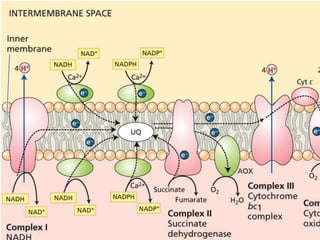
• ETC Consists of 5 complexes:
– Complex I (NADH dehydrogenase)
– Complex II (Succinate dehydrogenase)
– Complex III (Cytochrome bc1 complex)
– Complex IV (Cytochrome a+a3 oxidase)
– Complex V (ATP synthase)
Organization of mitochondrial
electron transport chain
Complex I NADH Dehydrogenase
- oxidizes NADH
- transfers e- to Ubiquinone (UQ)
- pumps 1H+ per of electrons
It oxidizes NADH+H into NAD.at the same time
converts its coenzyme FMN into FMNH2
Complex II : Succinate Dehydroganase
- oxidation of succinate (from citric acid cycle)
- Electrons - are transferred via FADH2
- does not pump protons
Complex III Cytochrome bc1 complex
- oxidizes reduced UQ
- - pumps 1H+ per e
- Complex IV Cytochrome a+a3
- reduces O2 to H2O
- pumps 1H+ per e-
Complex V ATP synthase
- uses electrochemical proton gradient
to synthesize ATP
Coenzyme Q:
It is quinine derivative ,it is a relatively mobile
electron carrier.
Coenzyme Q can accept hydrogen atoms both from
FMNH2 produced by NADH dehydrogenase
(complex I) and from FADH2 which is produced by
succinate dehydrogenase and other similar
enzymes (complex II)
Cytochromes
There are 4 types of cytochromes (b, c, a and a3)
All cytochromes are conjugated proteins formed of
protein conjugated with heme ring. the heme ring
contains iron (fe) this iron oscillates between ferric
(fe+3) when it loses an electron, and ferrous (fe+2)
when it accepts electron.
Inhibitors of respiratory chain
Are compounds prevent the passage of electrons by
binding to a components of the chain,blocking the
oxidation , reduction reaction.
There are specific sites for binding inhibitors:
Site 1: binding with complex 1 preventing passage
of electrons from FMN to coenzyme Q.
e.g (Barbiturates and piericidin A)
Site II: preventing passage of electrons from
cytochrome b to cytochrome c.
e.g.(Antimycin A & dimercaprol)
Site III: preventing passage of electrons from
cytochrome a+a3 to o2.
e.g.(H2S, cyanide (CN-), carbon monoxide and
sodium a zide).
Inhibition of the respiratory chain also inhibits
ATP synthesis because ETC and oxidative
phosphorylation are tightly coupled
Release of free energy during ETC
Free energy is released as electrons are transferred
along the ETC from electron donor(reducing agent)
to an electron acceptor (oxidizing agent). The
electrons can be transferred in different forms e.g.
1. As hydride ion (H) to NAD+
2. As hydrogen atoms (H) to FAD
3. As electrons (e) to cytochromes
At three sites, the free energy released is sufficient
to support the phosphorylation of ADP to ATP,
which required about 7 kcal/mol.
Electrons that inter the respiratory chain through
the NAD-Q support the synthesis of 3mol of ATP. By
contrast ,electrons join the chain directly at the
level of coenzyme Q (as in case of FADH2 of
succinate dehydrogenase) will only support the
synthesis of 2mol of ATP.
Oxidative phosphorylation
Electrons are transported down the respiratory
chain from donor (NADH &FADH) to acceptor
oxygen.
The flow of electron from donor to acceptor
(oxidation) results in ATP synthesis by
phosphorylation of ADP by inorganic phosphate Pi
(phosphorylation). Therefor ,there is a coupling
between oxidation and phosphorylation.
Chemiosmotic hypothesis
1. Proton pump
The transport of electrons down the respiratory chain
give energy.
This energy is used to transport H+ from the
mitochondrial matrix across inner mitochondrial
membrane to inter membrane space(because outside
of the membrane (lower PH & more positive charges).
This done by complexes I,III and IV.
The energy generated by this proton gradient is
sufficient for ATP synthesis.
ATP synthase (complex V)
In the inner mitochondrial, there is a
phosphorylating enzyme complex: ATP snthase
It is formed of 2 subunits:
1. F1 subunit which protrude into matrix.
2. Fο subunit which present in the membrane.
The protons outside the inner mitochondrial
membrane can reenter mitochondrial matrix by
passing through channel (F1- Fο) to pass by ATP
synthase enzyme which is present in F1 subunit.
This results in synthesis of ATP from ADP + Pi.
Uncouplers
These are substances that allow oxidation to
proceed but prevent phosphorylation, so energy
released by electron transport will be lost in the
form of heat. This explains the cause of hotness
after intake of these substances. Examples:
Oligomycin,2.4 Dinitrophenol, Ca,high doses of
aspirin.

Electron Transport Chain.ppt

  • 1.
    Electron transport chain Itis the final common pathway in aerobic cells by which electrons derived from (CHO, amino acids and fatty acids) can use respiratory chain as a final pathway as they give electrons to oxidized co enzymes NAD+ and FAD+ to form the energy rich reduced coenzymes NADH+ , FADH2
  • 2.
    Then NADH+ ,FADH2 give hydrogen and a pair of electrons to electron transport chain to form water
  • 3.
    Electron transport iscoupled with formation of proton gradient → used for ATP synthesis • ETC Consists of 5 complexes: – Complex I (NADH dehydrogenase) – Complex II (Succinate dehydrogenase) – Complex III (Cytochrome bc1 complex) – Complex IV (Cytochrome a+a3 oxidase) – Complex V (ATP synthase)
  • 4.
    Organization of mitochondrial electrontransport chain Complex I NADH Dehydrogenase - oxidizes NADH - transfers e- to Ubiquinone (UQ) - pumps 1H+ per of electrons It oxidizes NADH+H into NAD.at the same time converts its coenzyme FMN into FMNH2
  • 5.
    Complex II :Succinate Dehydroganase - oxidation of succinate (from citric acid cycle) - Electrons - are transferred via FADH2 - does not pump protons
  • 6.
    Complex III Cytochromebc1 complex - oxidizes reduced UQ - - pumps 1H+ per e - Complex IV Cytochrome a+a3 - reduces O2 to H2O - pumps 1H+ per e- Complex V ATP synthase - uses electrochemical proton gradient to synthesize ATP
  • 7.
    Coenzyme Q: It isquinine derivative ,it is a relatively mobile electron carrier. Coenzyme Q can accept hydrogen atoms both from FMNH2 produced by NADH dehydrogenase (complex I) and from FADH2 which is produced by succinate dehydrogenase and other similar enzymes (complex II)
  • 8.
    Cytochromes There are 4types of cytochromes (b, c, a and a3) All cytochromes are conjugated proteins formed of protein conjugated with heme ring. the heme ring contains iron (fe) this iron oscillates between ferric (fe+3) when it loses an electron, and ferrous (fe+2) when it accepts electron.
  • 9.
    Inhibitors of respiratorychain Are compounds prevent the passage of electrons by binding to a components of the chain,blocking the oxidation , reduction reaction. There are specific sites for binding inhibitors: Site 1: binding with complex 1 preventing passage of electrons from FMN to coenzyme Q. e.g (Barbiturates and piericidin A)
  • 10.
    Site II: preventingpassage of electrons from cytochrome b to cytochrome c. e.g.(Antimycin A & dimercaprol) Site III: preventing passage of electrons from cytochrome a+a3 to o2. e.g.(H2S, cyanide (CN-), carbon monoxide and sodium a zide).
  • 11.
    Inhibition of therespiratory chain also inhibits ATP synthesis because ETC and oxidative phosphorylation are tightly coupled
  • 13.
    Release of freeenergy during ETC Free energy is released as electrons are transferred along the ETC from electron donor(reducing agent) to an electron acceptor (oxidizing agent). The electrons can be transferred in different forms e.g. 1. As hydride ion (H) to NAD+ 2. As hydrogen atoms (H) to FAD 3. As electrons (e) to cytochromes
  • 14.
    At three sites,the free energy released is sufficient to support the phosphorylation of ADP to ATP, which required about 7 kcal/mol. Electrons that inter the respiratory chain through the NAD-Q support the synthesis of 3mol of ATP. By contrast ,electrons join the chain directly at the level of coenzyme Q (as in case of FADH2 of succinate dehydrogenase) will only support the synthesis of 2mol of ATP.
  • 15.
    Oxidative phosphorylation Electrons aretransported down the respiratory chain from donor (NADH &FADH) to acceptor oxygen. The flow of electron from donor to acceptor (oxidation) results in ATP synthesis by phosphorylation of ADP by inorganic phosphate Pi (phosphorylation). Therefor ,there is a coupling between oxidation and phosphorylation.
  • 16.
    Chemiosmotic hypothesis 1. Protonpump The transport of electrons down the respiratory chain give energy. This energy is used to transport H+ from the mitochondrial matrix across inner mitochondrial membrane to inter membrane space(because outside of the membrane (lower PH & more positive charges). This done by complexes I,III and IV. The energy generated by this proton gradient is sufficient for ATP synthesis.
  • 17.
    ATP synthase (complexV) In the inner mitochondrial, there is a phosphorylating enzyme complex: ATP snthase It is formed of 2 subunits: 1. F1 subunit which protrude into matrix. 2. Fο subunit which present in the membrane. The protons outside the inner mitochondrial membrane can reenter mitochondrial matrix by passing through channel (F1- Fο) to pass by ATP synthase enzyme which is present in F1 subunit. This results in synthesis of ATP from ADP + Pi.
  • 18.
    Uncouplers These are substancesthat allow oxidation to proceed but prevent phosphorylation, so energy released by electron transport will be lost in the form of heat. This explains the cause of hotness after intake of these substances. Examples: Oligomycin,2.4 Dinitrophenol, Ca,high doses of aspirin.