DEVIPRIYA P V
M PHARM
 Electron transport chain (ETC) and its mechanism.
 Oxidative phosphorylation & its mechanism
 Substrate level phosphorylation
 Inhibitors ETC and oxidative phosphorylation
/Uncouplers
 Oxidation is the loss of electrons and reduction is the gain of
electrons.
 oxidation-reduction is applicable to biological systems also.
 The transfer of electrons from the reduced coenzymes through
the respiratory chain to oxygen is known as biological
oxidation.
 The enzymes involved in biological oxidation are:
1. Oxidases
2. Dehydrogenases
3. Hydroperoxidases
4. Oxygenases.
 Energy-rich molecules, such as glucose, are metabolized by a
series of oxidation reactions and yield CO2 and water.
 The metabolic intermediates of these reactions donate
electrons to specific coenzymes, nicotinamide adenine
dinucleotide (NAD+) and flavin adenine dinucleotide (FAD), to
form the energy-rich reduced forms, NADH and FADH2.
 These reduced coenzymes donate a pair of electrons to a
specialized set of electron carriers, collectively called the
electron transport chain
 The ETC is located in the inner mitochondrial membrane.
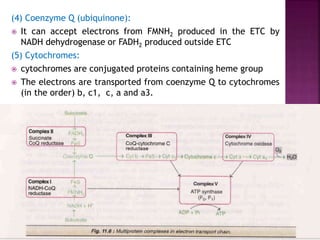
 The inner mitochondrial membrane have 5 enzyme complexes-
complex I, II, II , IV and V.
 The complexes I- IV are carriers of electrons while complex V
is responsible for ATP synthesis.
 There are five distinct carriers that participate in the ETC.
(1)Nicotinamide nucleotides:
 NAD+ is reduced to NADH + H+ by dehydrogenases with the removal
of 2 hydrogen atoms from the substrates (glyceraldehyde-
3phosphate, pyruvate,isocitrate,α-ketoglutarate and malate).
(2) Flavoproteins:
 NADH dehydrogenase reductase is a flavoprotein with FMN as the
prosthetic group.
 The coenzyme FMN accepts 2 electrons and a proton to form
FMNH2.
 Succinate dehydrogenase is also a flavoprotein with FAD as the
coenzyme. This accept 2 hydrogen atoms from succinate
(3) Iron- sulfur proteins:
 The iron-sulfur (FeS) proteins exist in the oxidized (Fe3+) or
reduced (Fe2+) state and they participates in the transfer of
electron
(4) Coenzyme Q (ubiquinone):
 It can accept electrons from FMNH2 produced in the ETC by
NADH dehydrogenase or FADH2 produced outside ETC
(5) Cytochromes:
 cytochromes are conjugated proteins containing heme group
 The electrons are transported from coenzyme Q to cytochromes
(in the order) b, c1, c, a and a3.
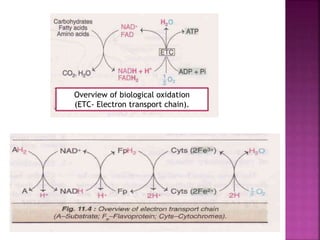
Overview of biological oxidation
(ETC- Electron transport chain).
 The transport of electrons through the ETC is linked with the
release of free energy.
 The process of synthesizing ATP from ADP and Pi coupled with
the ETC is known as oxidative phosphorylation.
 The complex V of the inner mitochondrial membrane is the
site of oxidative phosphorylation.
 There are three reactions in the ETC that are exergonic to
result in the synthesis of 3 ATP molecules.
1. Oxidation of FMNH2 by coenzyme Q.
2. Oxidation of cytochrome b by cytochrome c1 .
3. Cytochrome oxidase reaction.
 MECHANISM OF OXIDATIVE PHOSPHORYLATION.
Chemical coupling hypothesis :
 According to chemical coupling hypothesis, during the course of
electron transfer in respiratory chain, a series of phosphorylated
high-energy intermediates are first produced which are utilized
for the synthesis of ATP.
Chemiosmotic hypothesis :
 Proton gradient : The inner mitochondrial membrane is
impermeable to protons (H+) and hydroxyl ions (OH-).
 The transport of electrons through ETC is coupled with the
translocation of protons (H+) across the inner mitochondrial
membrane (coupling membrane) from the matrix to the
intermembrane space.
 The pumping of protons results in a proton gradient which results
in the synthesis of ATP from ADP and Pi.
 ATP synthase, present in the complex V, utilizes the proton
gradient for the synthesis of ATP.
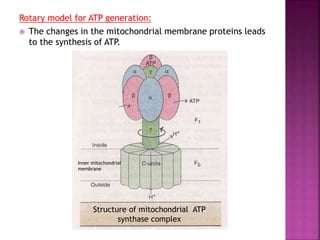
Rotary model for ATP generation:
 The changes in the mitochondrial membrane proteins leads
to the synthesis of ATP.
Structure of mitochondrial ATP
synthase complex
Inner mitochondrial
membrane
 ATP may be directly synthesized during substrate oxidation
in the metabolism.
 The high-energy compounds such as phosphoenolpyruvate
and 1,3-bisphosphoglycerate (intermediates of glycolysis)
and succinyl CoA (of citric acid cycle) can transfer high-
energy phosphate to ultimately produce ATP.
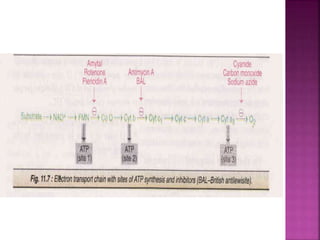
(1)NADH and coenzyme Q :
 Fish poison rotenone, barbituate drug Amytal and antibiotic
piercidin A inhibit this site.
(2)Between cytochrome b and c1 :
 Antimycin A -an antibiotic, British antilewisite (BAL)-an
antidote.
(3)Inhibitors of cytochrome oxidase:
 Carbon monoxide, cyanide, hydrogen sulphide and azide
effectively inhibit cytochrome oxidase.
 Carbon monoxide reacts with reduced form of the cytochrome
while cyanide and azide react with oxidized form.
 Cyanide is a potent inhibitor of ETC. It binds to Fe3+ of
cytochrome oxidase blocking mitochondrial respiration leading
to cell death.
 Uncouplers are compounds that can uncouple (or delink) the
electron transport from oxidative phosphorylation
 They increase the permeability of inner mitochondrial
membrane to protons (H+), so that ATP synthesis does not
occur.
 The uncouplers allow oxidation of substrates without ATP
formation.
 Eg: 2,4-dinitrophenol (DNP), dinitrocresol, pentachlorophenol,
trifluorocarbonylcyanide phenylhydrazone( FCCP).
 Physiological substances like thermogenin, thyroxine and long
chain free fatty acids
 The antibiotic Oligomycin prevents the mitochondrial oxidation
as well as phosphorylation.
 Plant toxin Atractyloside is an uncoupler

Biological oxidation

  • 1.
  • 2.
     Electron transportchain (ETC) and its mechanism.  Oxidative phosphorylation & its mechanism  Substrate level phosphorylation  Inhibitors ETC and oxidative phosphorylation /Uncouplers
  • 3.
     Oxidation isthe loss of electrons and reduction is the gain of electrons.  oxidation-reduction is applicable to biological systems also.  The transfer of electrons from the reduced coenzymes through the respiratory chain to oxygen is known as biological oxidation.  The enzymes involved in biological oxidation are: 1. Oxidases 2. Dehydrogenases 3. Hydroperoxidases 4. Oxygenases.
  • 4.
     Energy-rich molecules,such as glucose, are metabolized by a series of oxidation reactions and yield CO2 and water.  The metabolic intermediates of these reactions donate electrons to specific coenzymes, nicotinamide adenine dinucleotide (NAD+) and flavin adenine dinucleotide (FAD), to form the energy-rich reduced forms, NADH and FADH2.  These reduced coenzymes donate a pair of electrons to a specialized set of electron carriers, collectively called the electron transport chain  The ETC is located in the inner mitochondrial membrane.  The inner mitochondrial membrane have 5 enzyme complexes- complex I, II, II , IV and V.  The complexes I- IV are carriers of electrons while complex V is responsible for ATP synthesis.
  • 5.
     There arefive distinct carriers that participate in the ETC. (1)Nicotinamide nucleotides:  NAD+ is reduced to NADH + H+ by dehydrogenases with the removal of 2 hydrogen atoms from the substrates (glyceraldehyde- 3phosphate, pyruvate,isocitrate,α-ketoglutarate and malate). (2) Flavoproteins:  NADH dehydrogenase reductase is a flavoprotein with FMN as the prosthetic group.  The coenzyme FMN accepts 2 electrons and a proton to form FMNH2.  Succinate dehydrogenase is also a flavoprotein with FAD as the coenzyme. This accept 2 hydrogen atoms from succinate (3) Iron- sulfur proteins:  The iron-sulfur (FeS) proteins exist in the oxidized (Fe3+) or reduced (Fe2+) state and they participates in the transfer of electron
  • 6.
    (4) Coenzyme Q(ubiquinone):  It can accept electrons from FMNH2 produced in the ETC by NADH dehydrogenase or FADH2 produced outside ETC (5) Cytochromes:  cytochromes are conjugated proteins containing heme group  The electrons are transported from coenzyme Q to cytochromes (in the order) b, c1, c, a and a3.
  • 7.
    Overview of biologicaloxidation (ETC- Electron transport chain).
  • 8.
     The transportof electrons through the ETC is linked with the release of free energy.  The process of synthesizing ATP from ADP and Pi coupled with the ETC is known as oxidative phosphorylation.  The complex V of the inner mitochondrial membrane is the site of oxidative phosphorylation.  There are three reactions in the ETC that are exergonic to result in the synthesis of 3 ATP molecules. 1. Oxidation of FMNH2 by coenzyme Q. 2. Oxidation of cytochrome b by cytochrome c1 . 3. Cytochrome oxidase reaction.
  • 9.
     MECHANISM OFOXIDATIVE PHOSPHORYLATION. Chemical coupling hypothesis :  According to chemical coupling hypothesis, during the course of electron transfer in respiratory chain, a series of phosphorylated high-energy intermediates are first produced which are utilized for the synthesis of ATP. Chemiosmotic hypothesis :  Proton gradient : The inner mitochondrial membrane is impermeable to protons (H+) and hydroxyl ions (OH-).  The transport of electrons through ETC is coupled with the translocation of protons (H+) across the inner mitochondrial membrane (coupling membrane) from the matrix to the intermembrane space.  The pumping of protons results in a proton gradient which results in the synthesis of ATP from ADP and Pi.  ATP synthase, present in the complex V, utilizes the proton gradient for the synthesis of ATP.
  • 10.
    Rotary model forATP generation:  The changes in the mitochondrial membrane proteins leads to the synthesis of ATP. Structure of mitochondrial ATP synthase complex Inner mitochondrial membrane
  • 11.
     ATP maybe directly synthesized during substrate oxidation in the metabolism.  The high-energy compounds such as phosphoenolpyruvate and 1,3-bisphosphoglycerate (intermediates of glycolysis) and succinyl CoA (of citric acid cycle) can transfer high- energy phosphate to ultimately produce ATP.
  • 12.
    (1)NADH and coenzymeQ :  Fish poison rotenone, barbituate drug Amytal and antibiotic piercidin A inhibit this site. (2)Between cytochrome b and c1 :  Antimycin A -an antibiotic, British antilewisite (BAL)-an antidote. (3)Inhibitors of cytochrome oxidase:  Carbon monoxide, cyanide, hydrogen sulphide and azide effectively inhibit cytochrome oxidase.  Carbon monoxide reacts with reduced form of the cytochrome while cyanide and azide react with oxidized form.  Cyanide is a potent inhibitor of ETC. It binds to Fe3+ of cytochrome oxidase blocking mitochondrial respiration leading to cell death.
  • 14.
     Uncouplers arecompounds that can uncouple (or delink) the electron transport from oxidative phosphorylation  They increase the permeability of inner mitochondrial membrane to protons (H+), so that ATP synthesis does not occur.  The uncouplers allow oxidation of substrates without ATP formation.  Eg: 2,4-dinitrophenol (DNP), dinitrocresol, pentachlorophenol, trifluorocarbonylcyanide phenylhydrazone( FCCP).  Physiological substances like thermogenin, thyroxine and long chain free fatty acids  The antibiotic Oligomycin prevents the mitochondrial oxidation as well as phosphorylation.  Plant toxin Atractyloside is an uncoupler