Berg • Tymoczko • Stryer


  Biochemistry
      Sixth Edition


      Chapter 18:
Oxidative Phosphorylation


            Copyright © 2007 by W. H. Freeman and Company
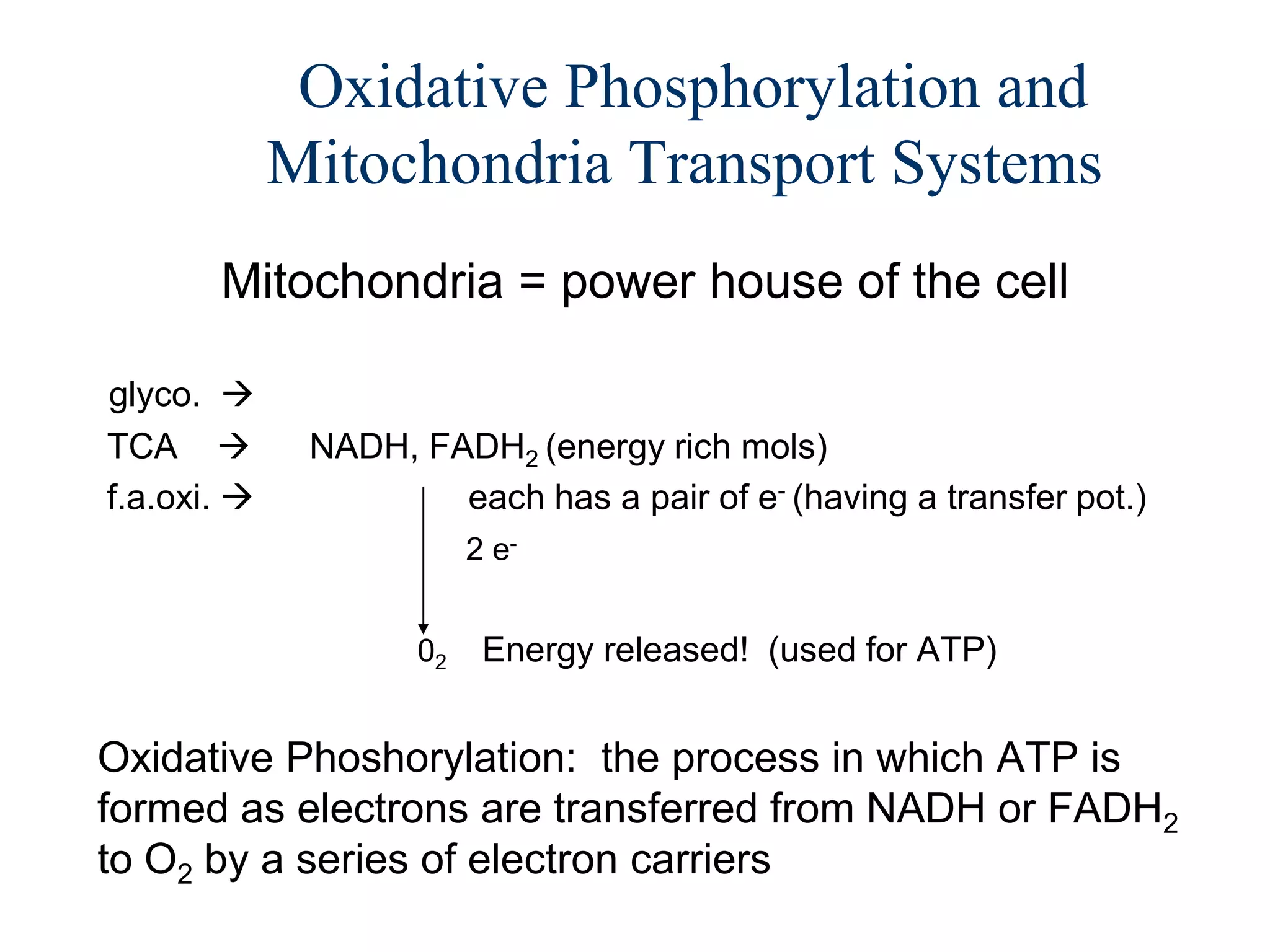
Oxidative Phosphorylation and
             Mitochondria Transport Systems
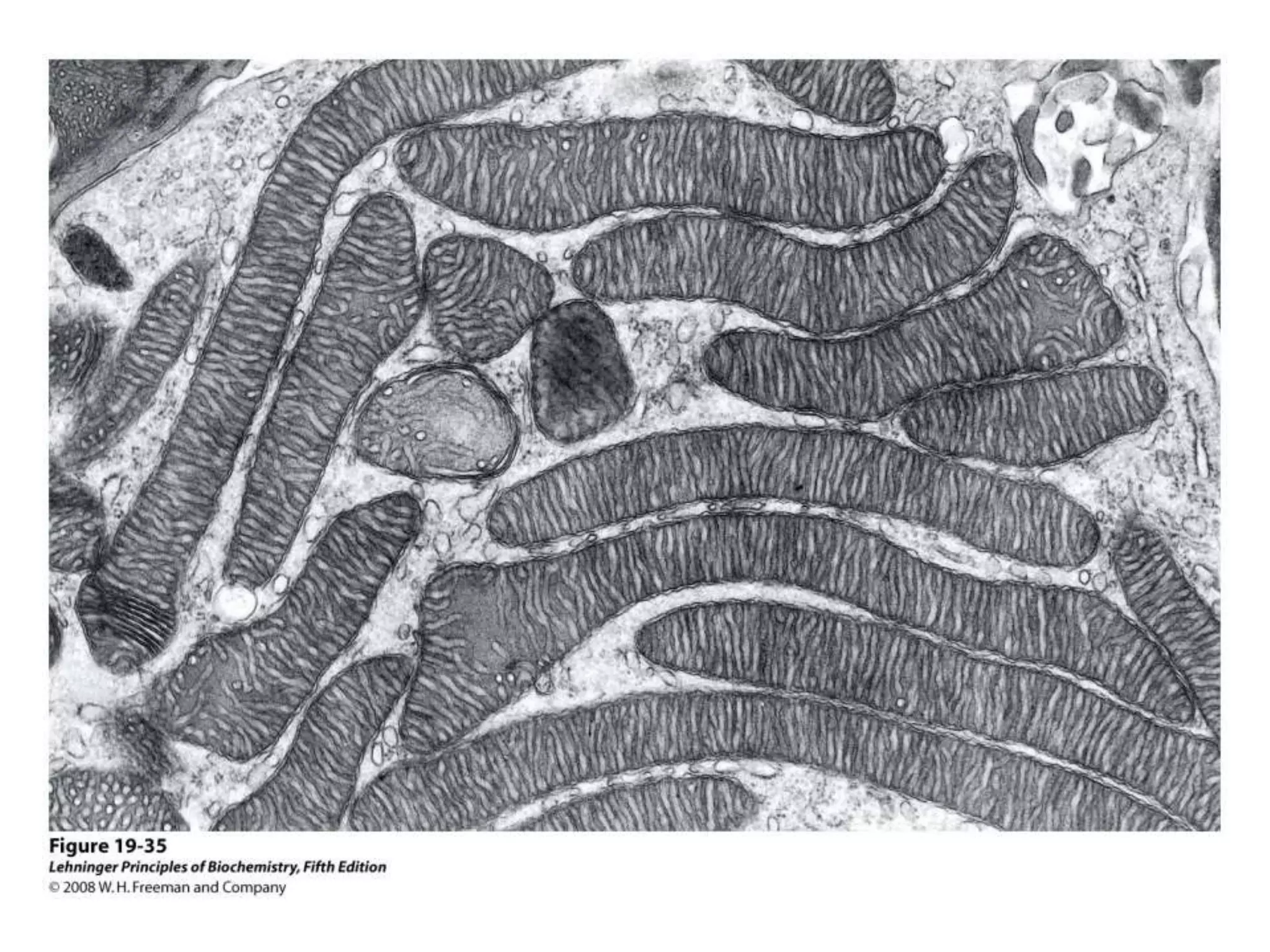
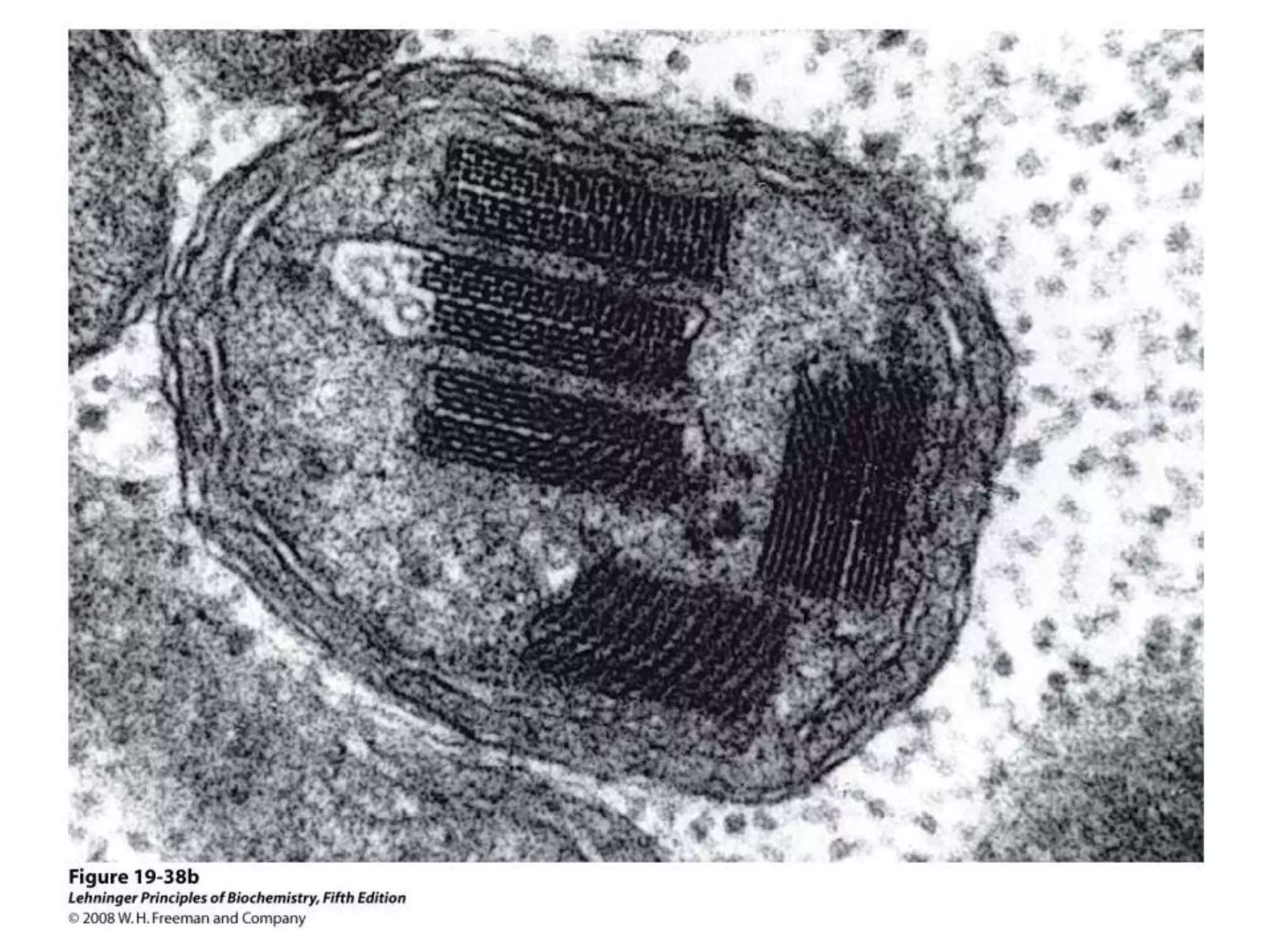
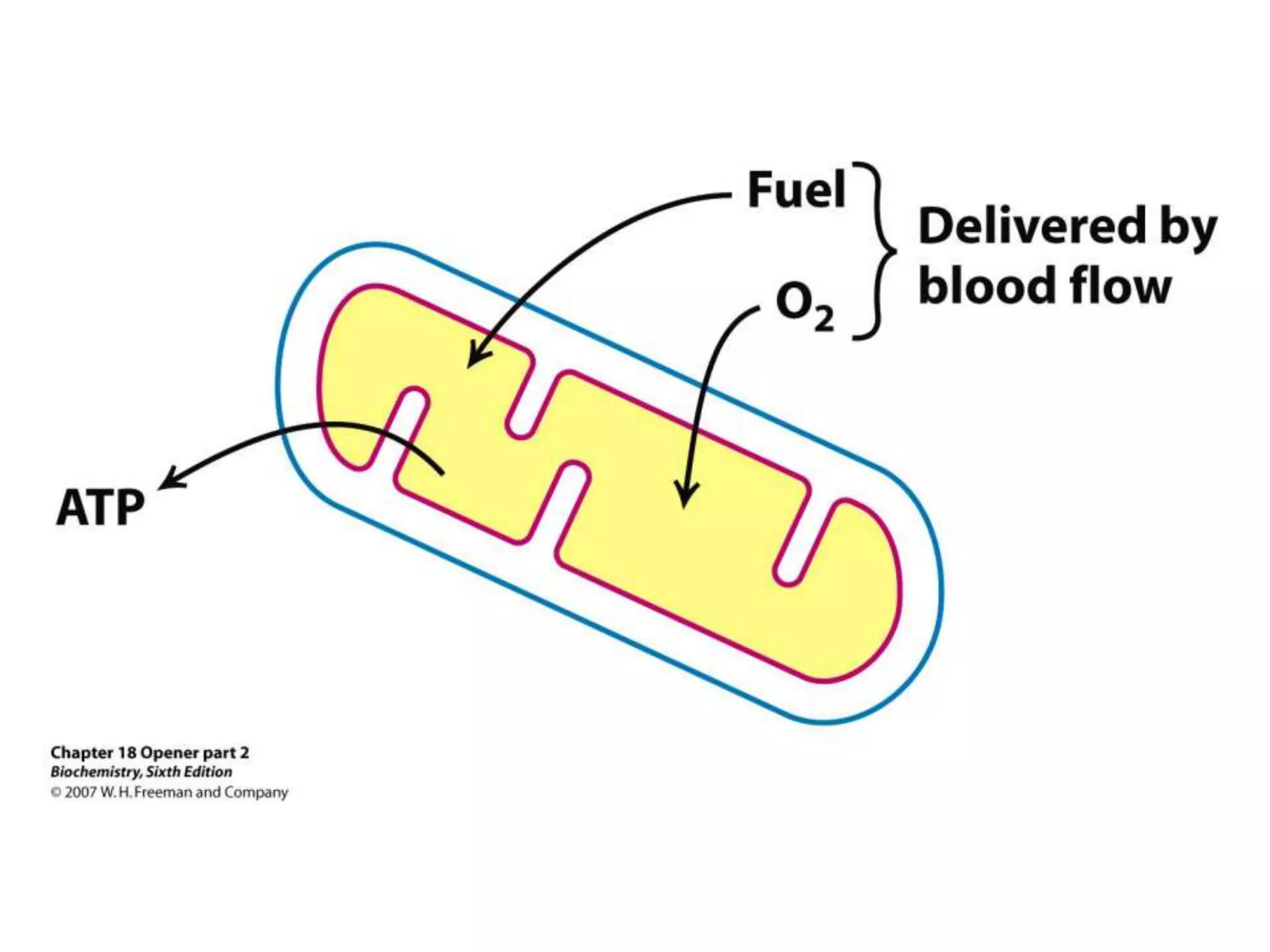
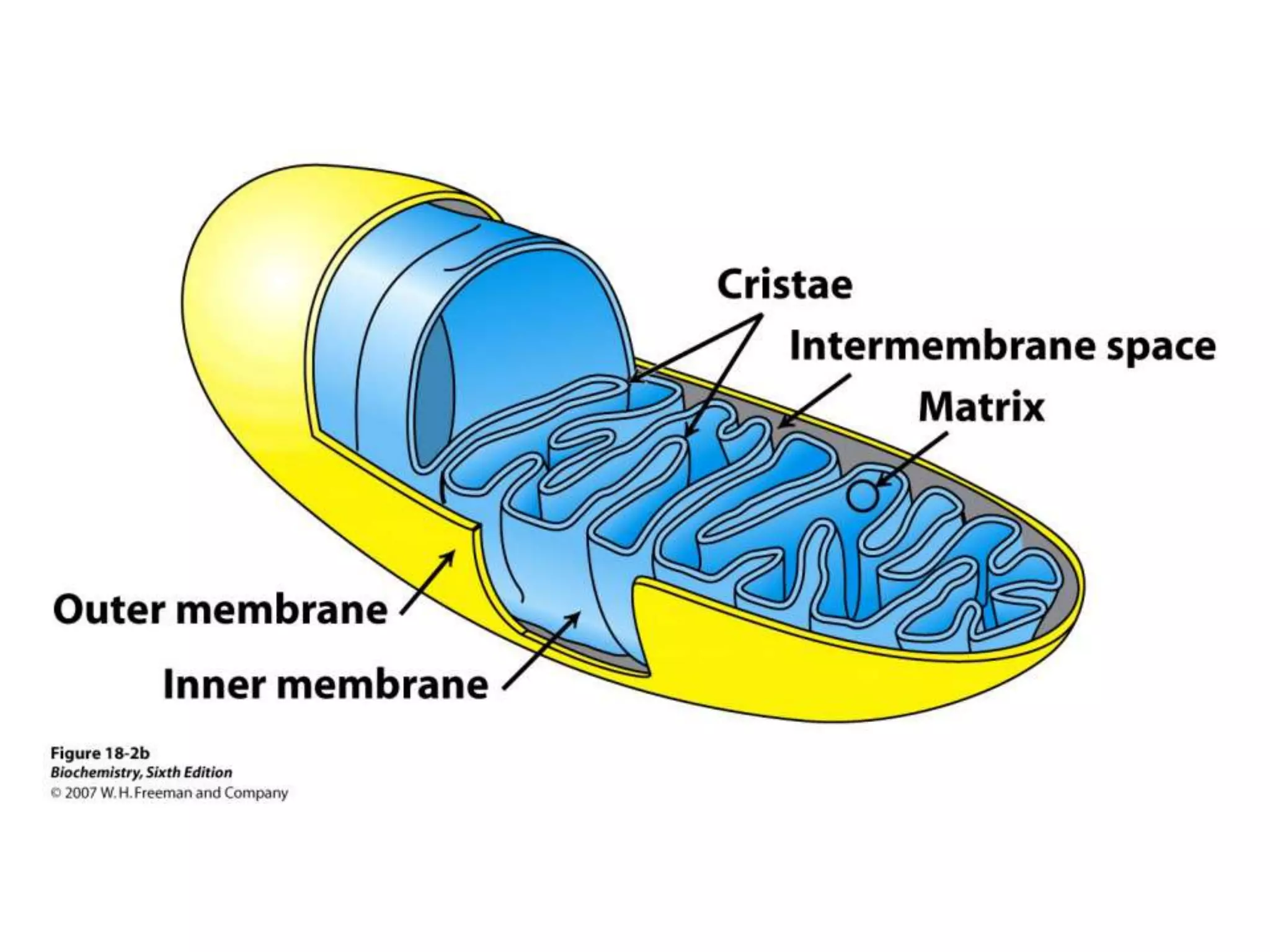
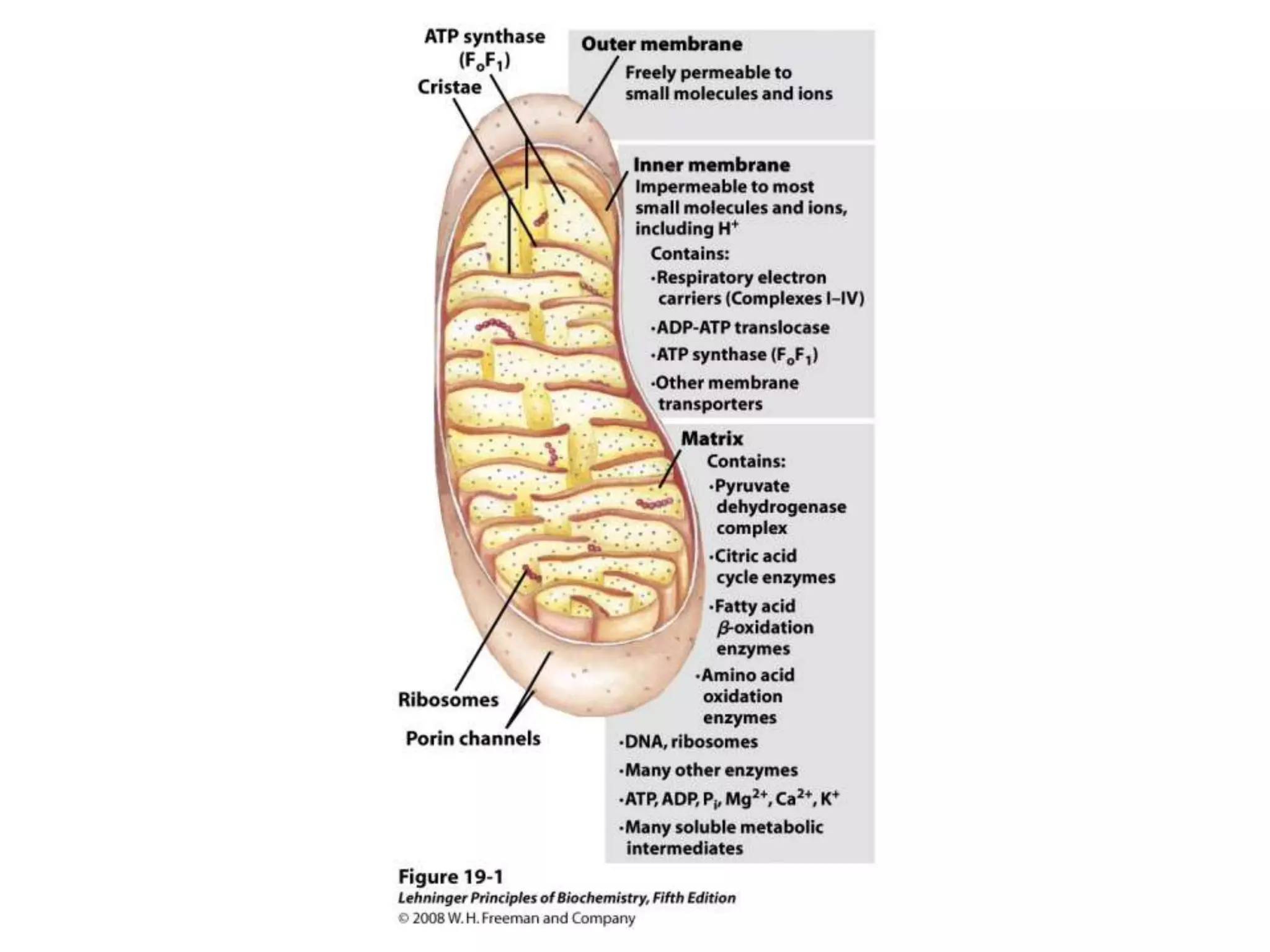
       Mitochondria = power house of the cell

glyco. 
TCA          NADH, FADH2 (energy rich mols)
f.a.oxi.             each has a pair of e- (having a transfer pot.)
                         2 e-


                    02    Energy released! (used for ATP)


Oxidative Phoshorylation: the process in which ATP is
formed as electrons are transferred from NADH or FADH2
to O2 by a series of electron carriers
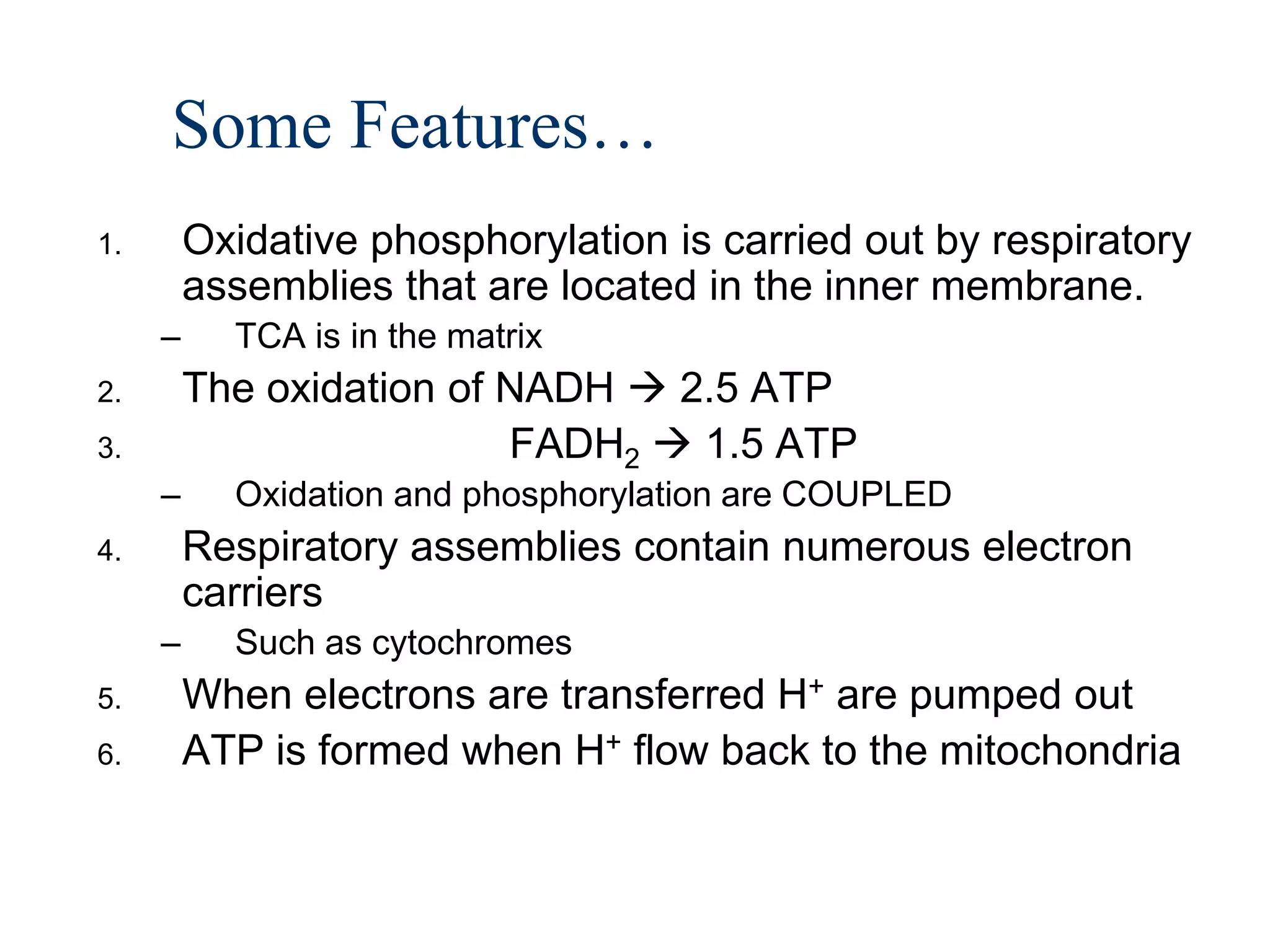
Some Features…
1.       Oxidative phosphorylation is carried out by respiratory
         assemblies that are located in the inner membrane.
     –     TCA is in the matrix
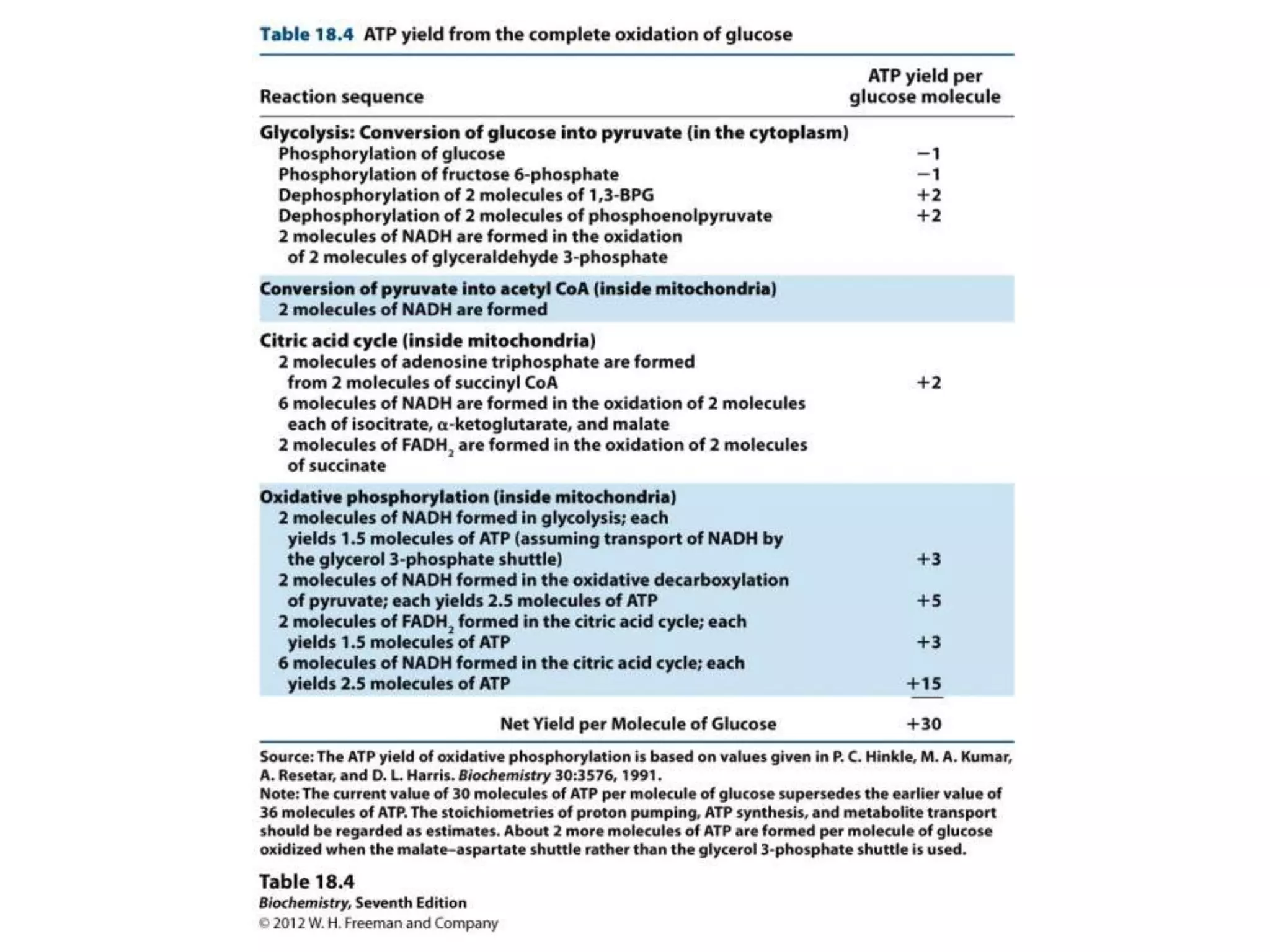
2.       The oxidation of NADH  2.5 ATP
3.                        FADH2  1.5 ATP
     –     Oxidation and phosphorylation are COUPLED
4.       Respiratory assemblies contain numerous electron
         carriers
     –     Such as cytochromes
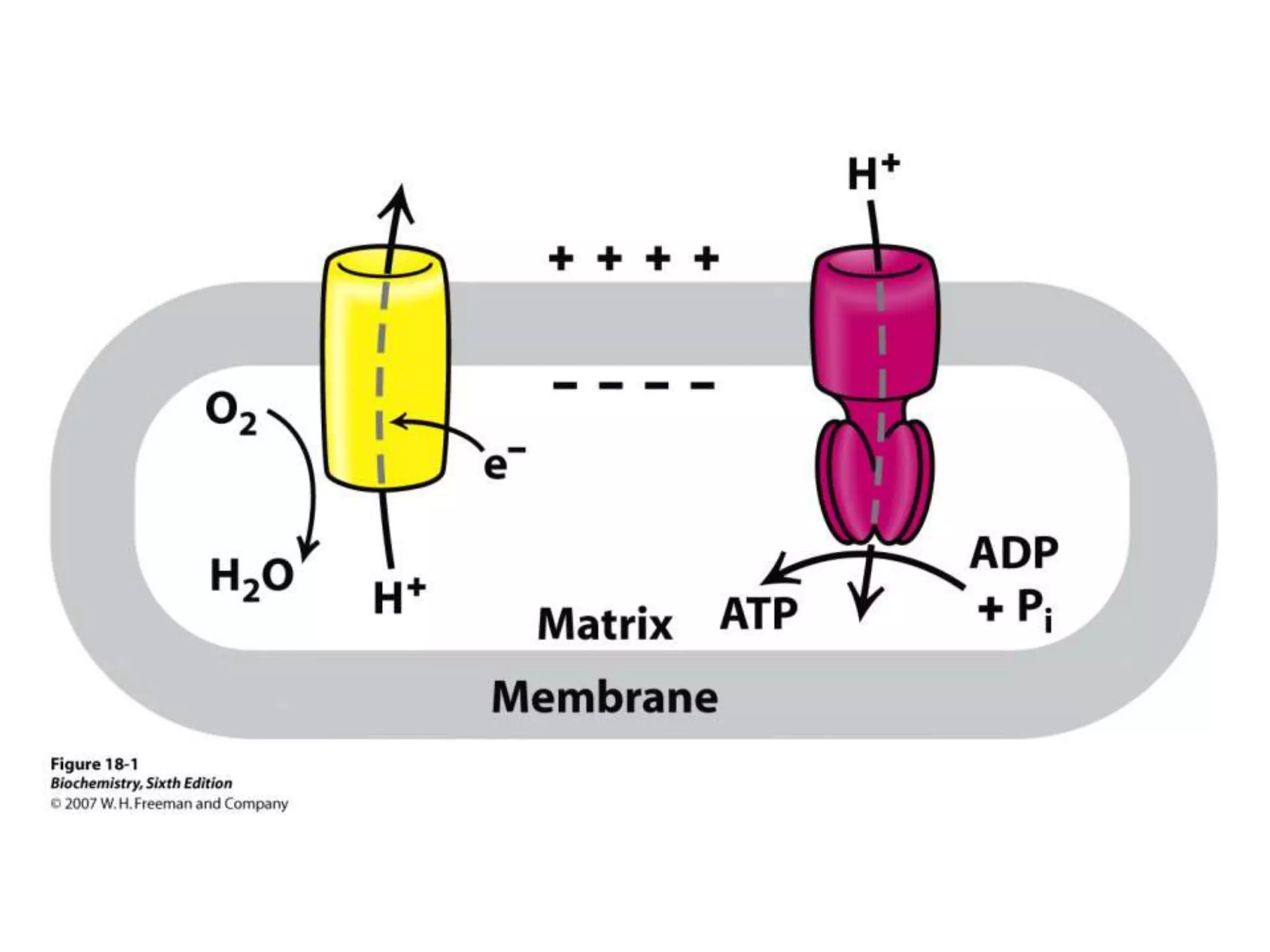
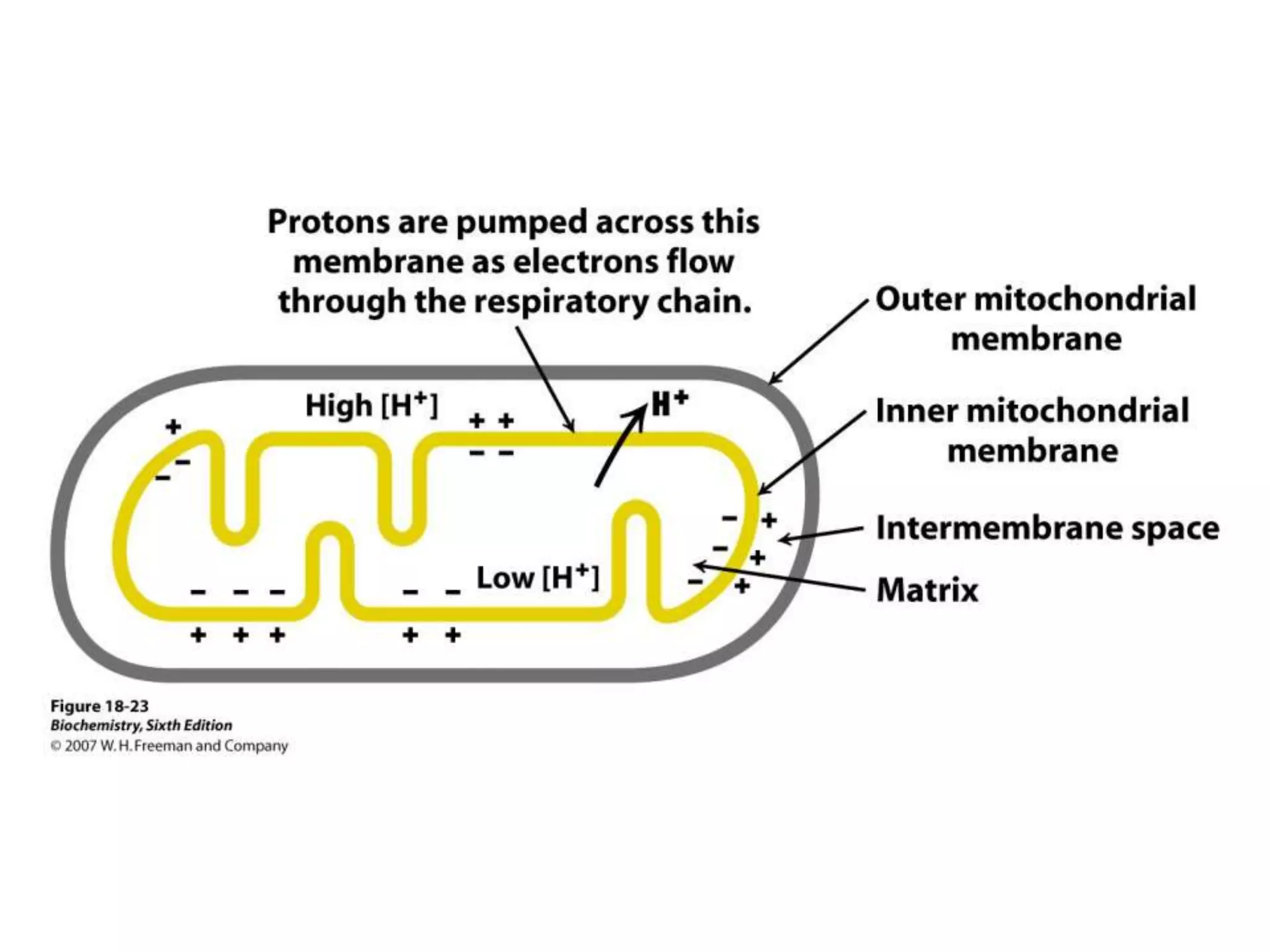
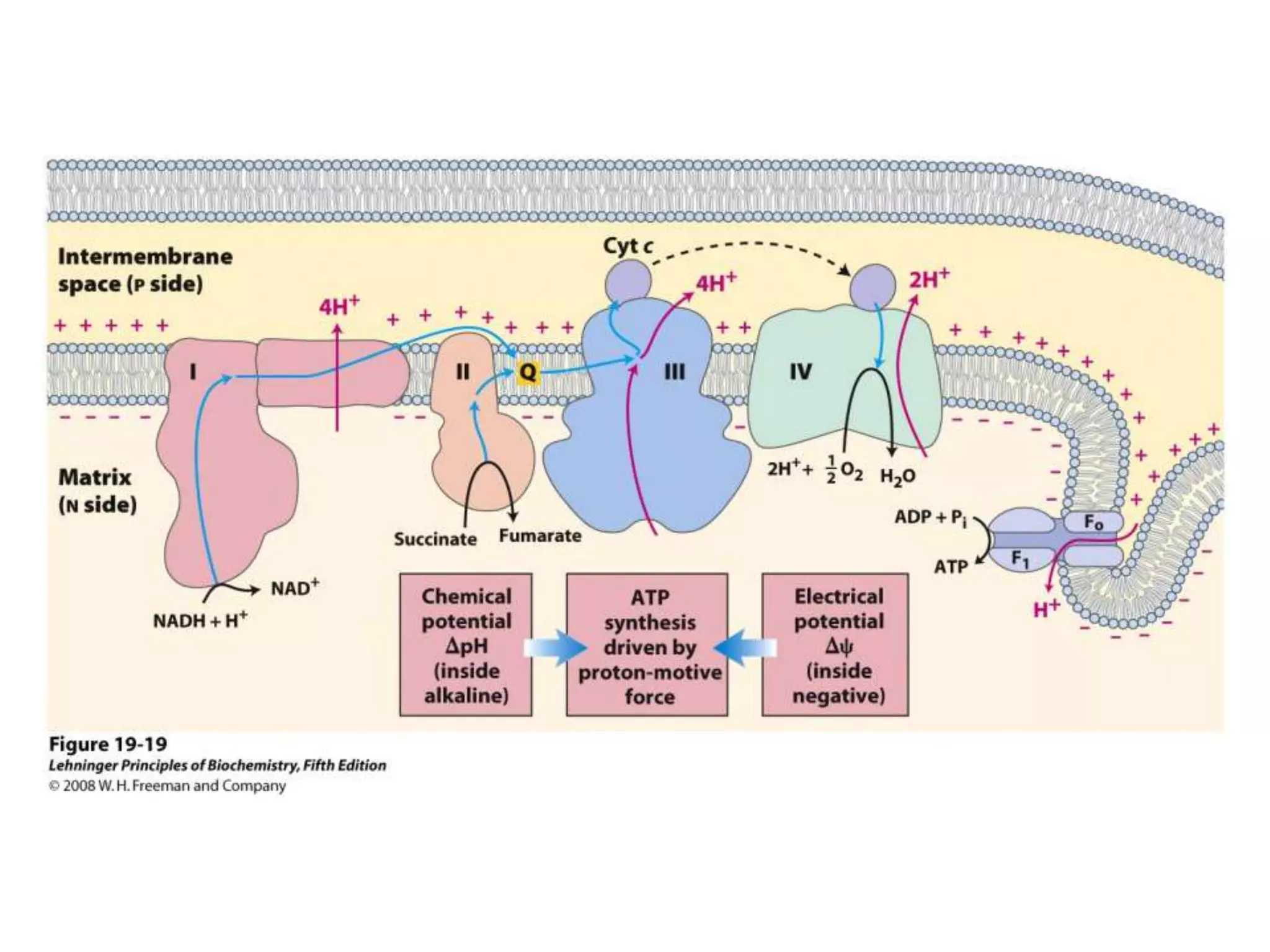
5.       When electrons are transferred H+ are pumped out
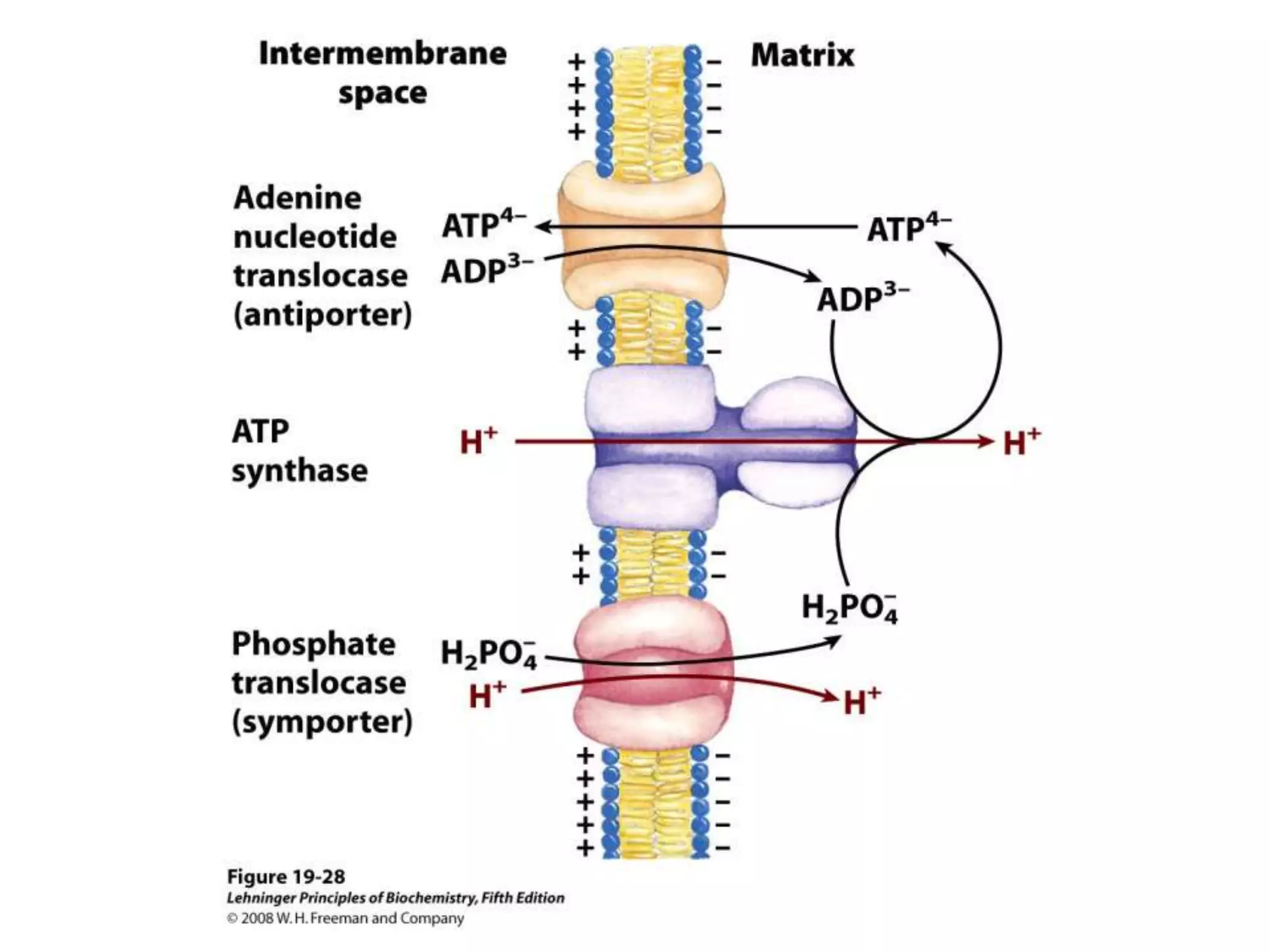
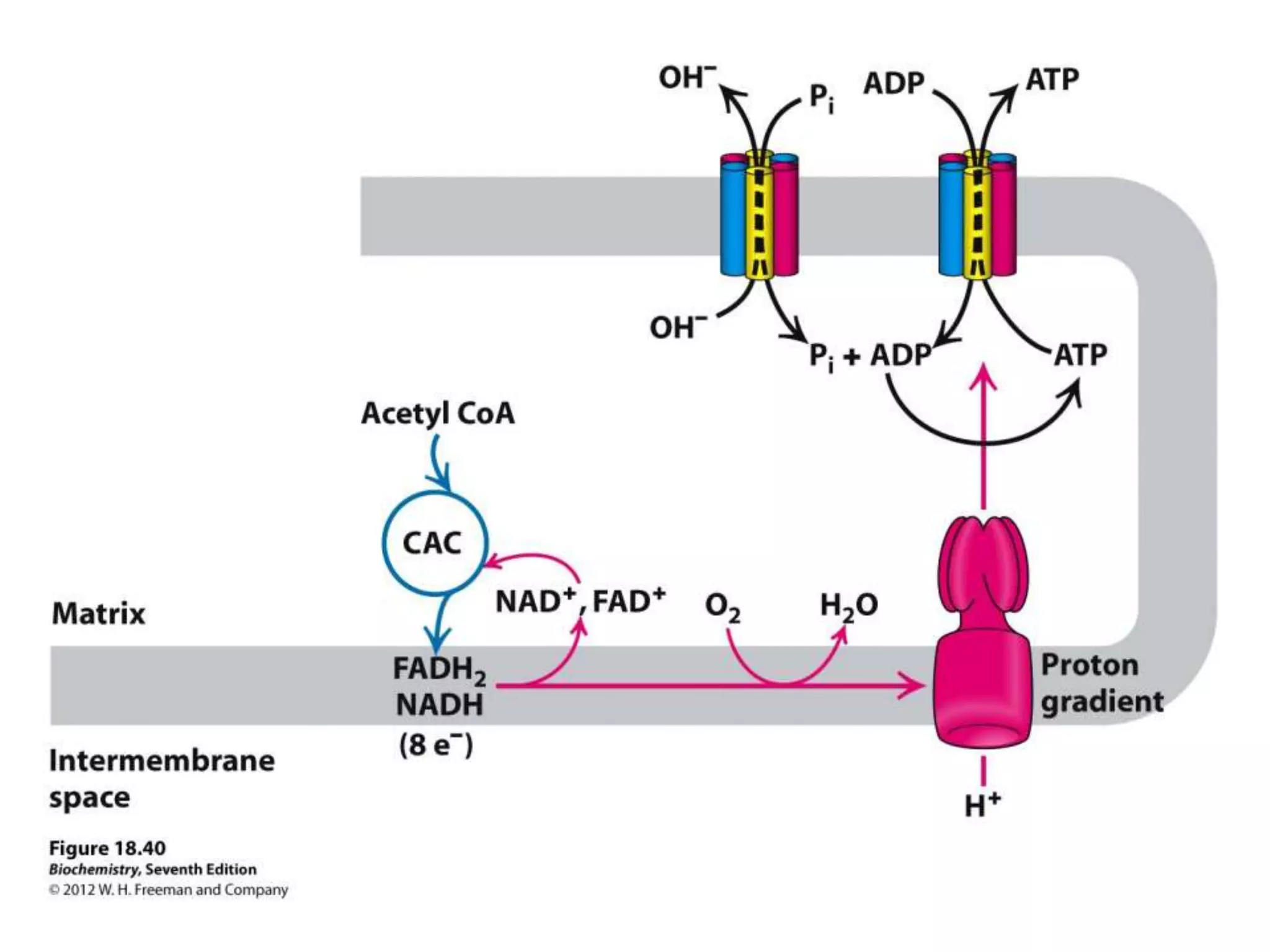
6.       ATP is formed when H+ flow back to the mitochondria
Some Features Continued…

   Thus oxidation and phosphorylation are coupled by
    a proton gradient across the inner mitochondria
    membrane
    – So, we produce ATP through this
    – Glycolysis and TCA cycle can continue only if NADH and
      FADH2 are somehow reoxidized to NAD+ and FAD
Release of Free Energy During Electron
              Transport
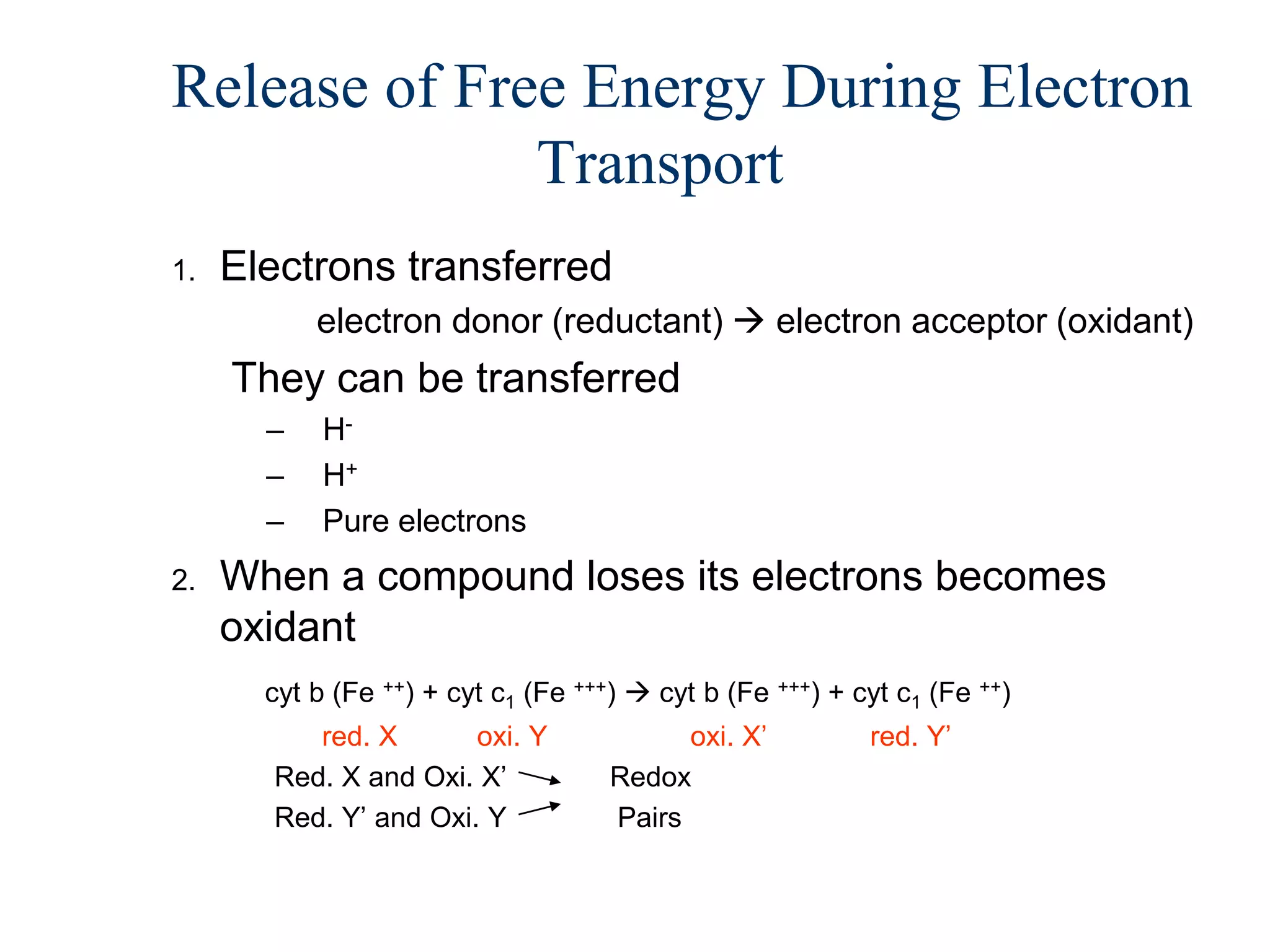
1.   Electrons transferred
           electron donor (reductant)  electron acceptor (oxidant)
     They can be transferred
       –    H-
       –    H+
       –    Pure electrons
2.   When a compound loses its electrons becomes
     oxidant
       cyt b (Fe ++) + cyt c1 (Fe +++)  cyt b (Fe +++) + cyt c1 (Fe ++)
          red. X       oxi. Y              oxi. X’         red. Y’
       Red. X and Oxi. X’            Redox
       Red. Y’ and Oxi. Y            Pairs
Release of Free Energy Continued…
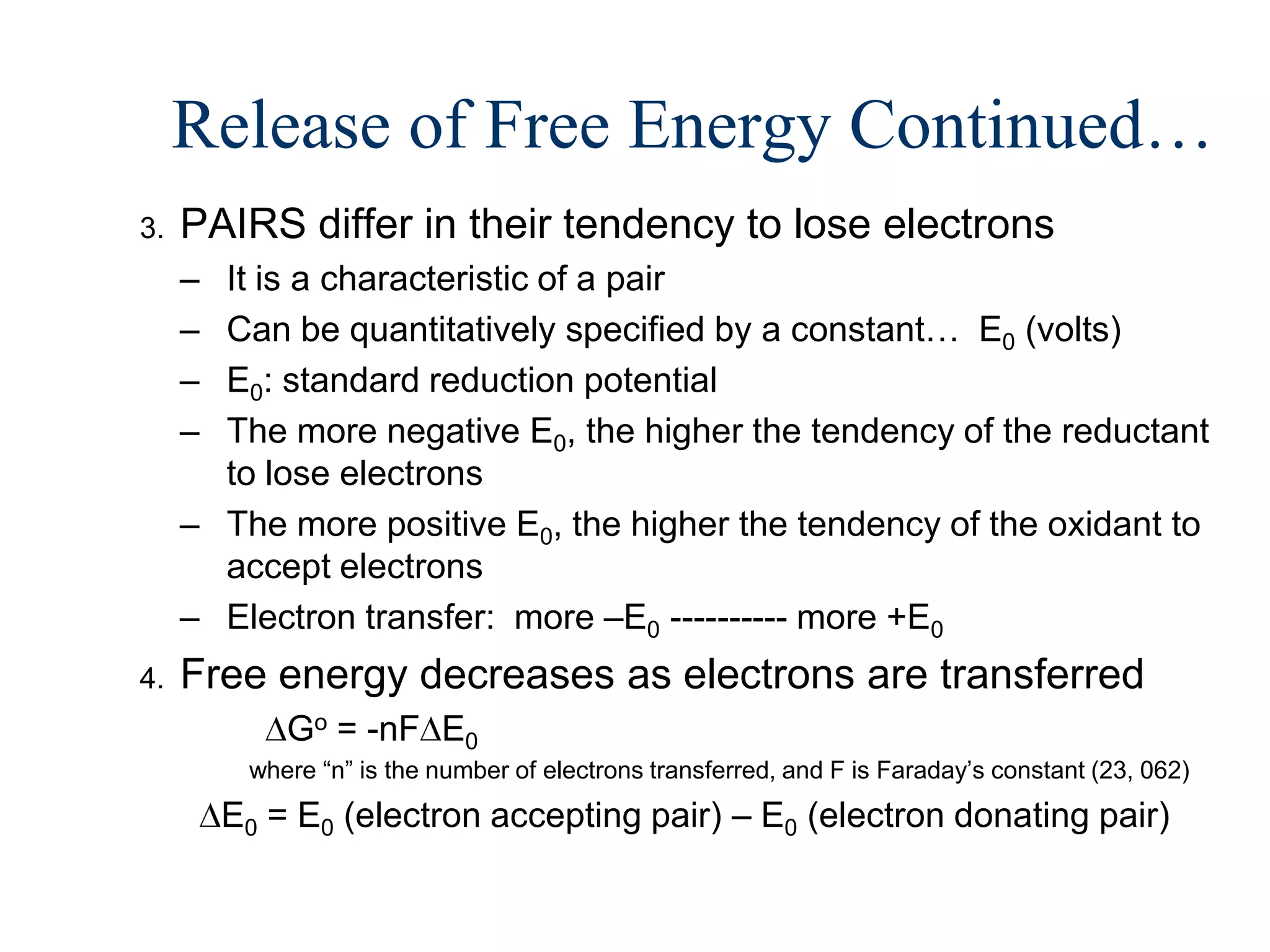
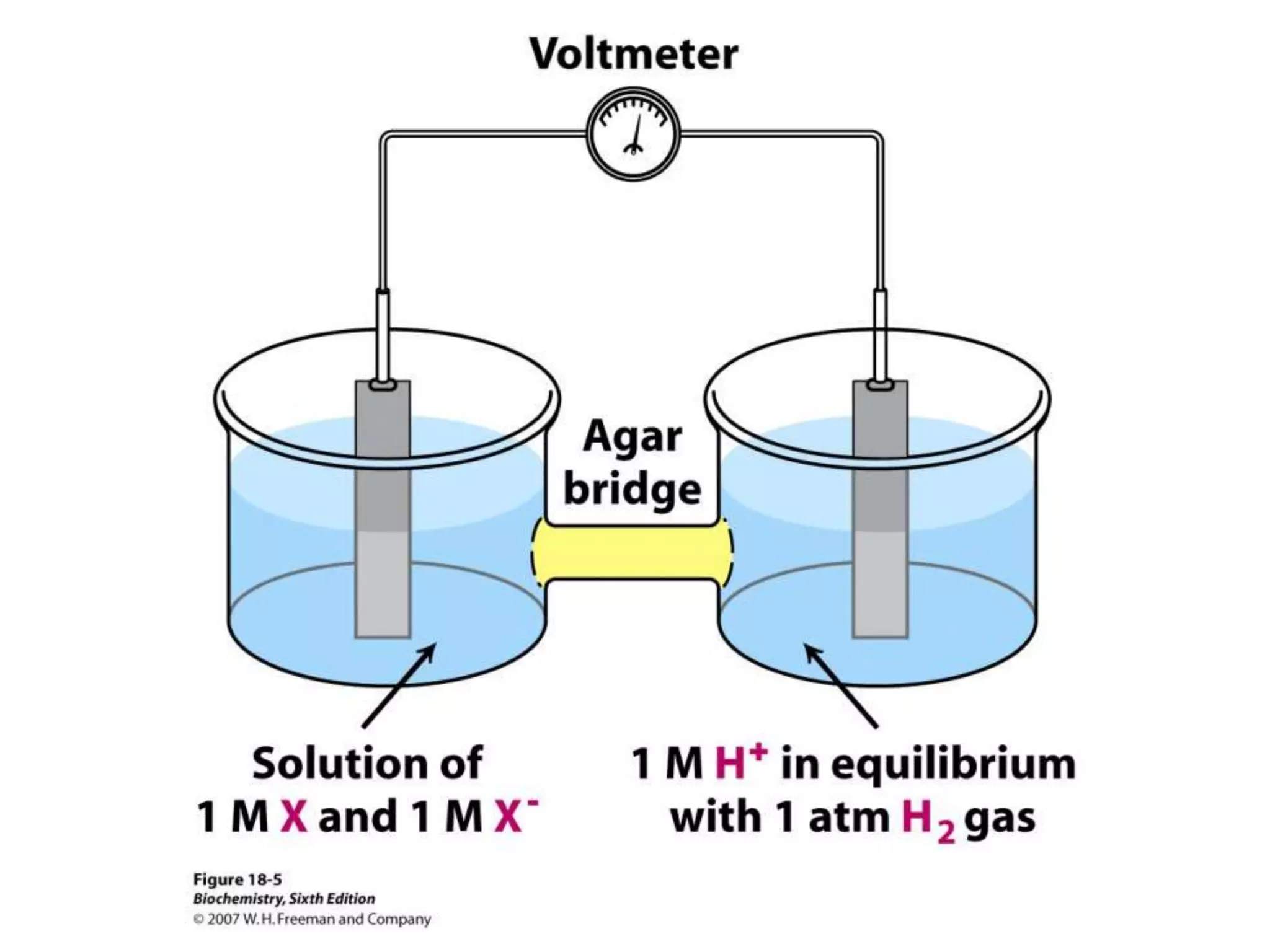
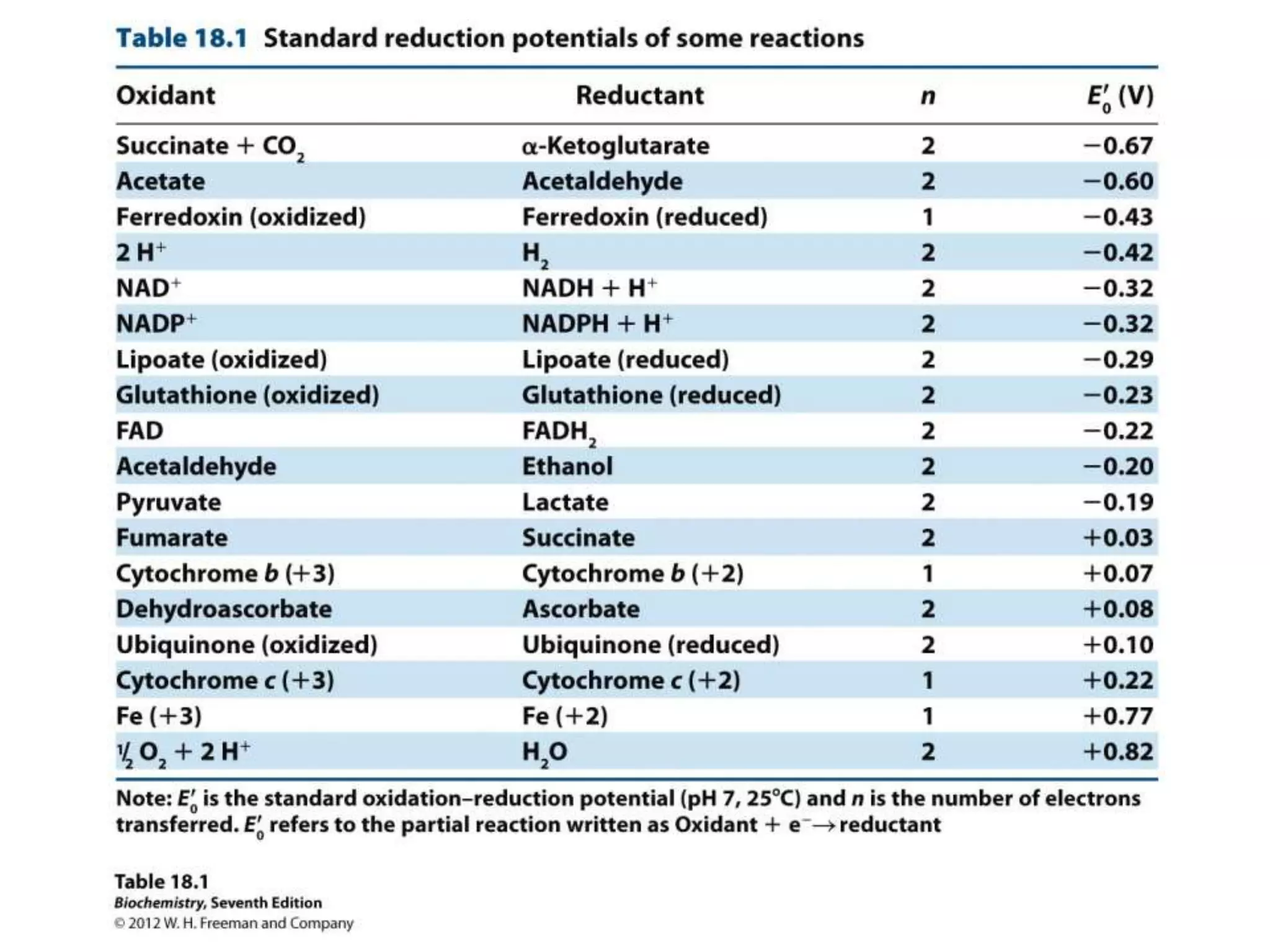
3.   PAIRS differ in their tendency to lose electrons
     – It is a characteristic of a pair
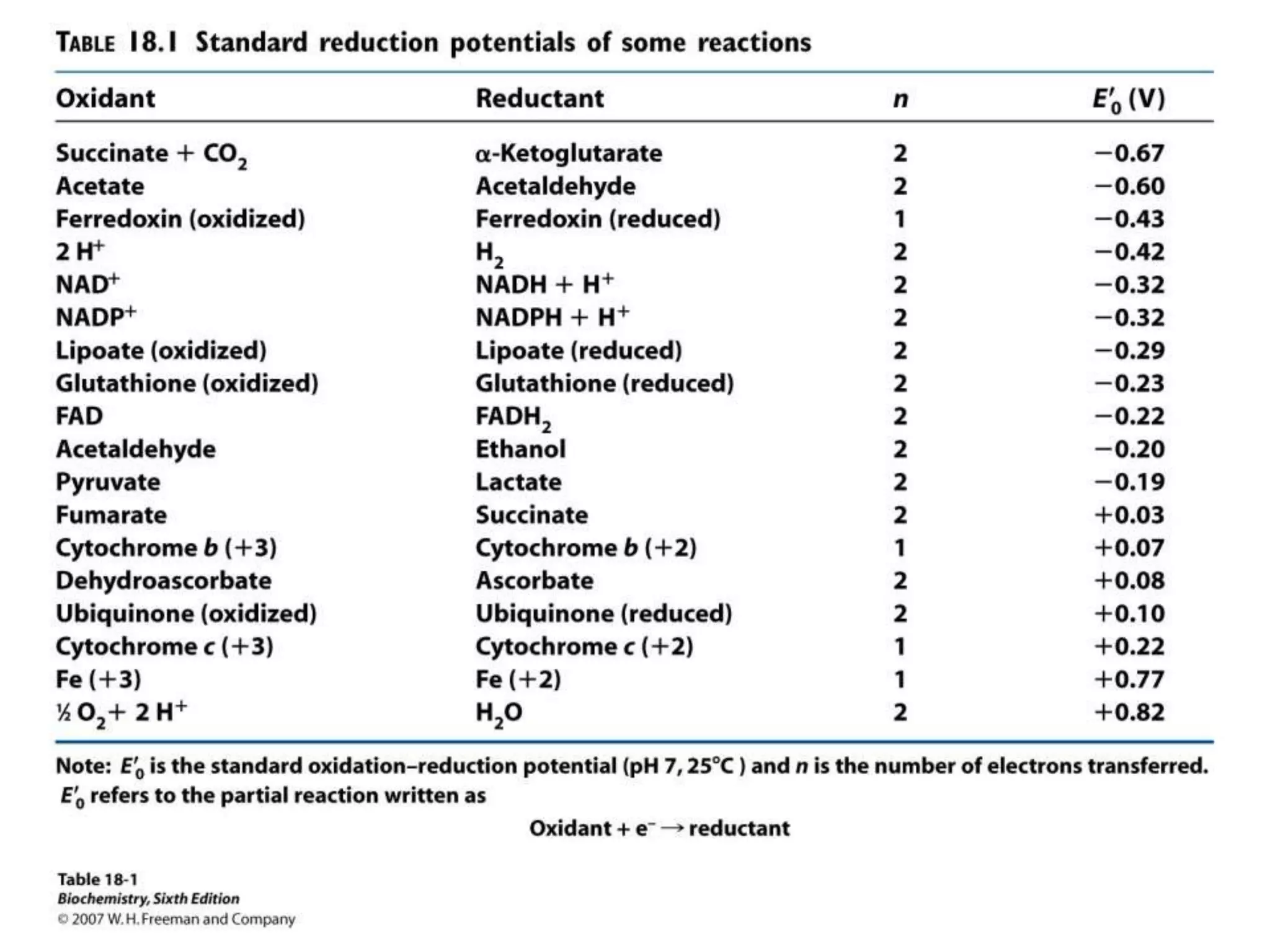
     – Can be quantitatively specified by a constant… E0 (volts)
     – E0: standard reduction potential
     – The more negative E0, the higher the tendency of the reductant
       to lose electrons
     – The more positive E0, the higher the tendency of the oxidant to
       accept electrons
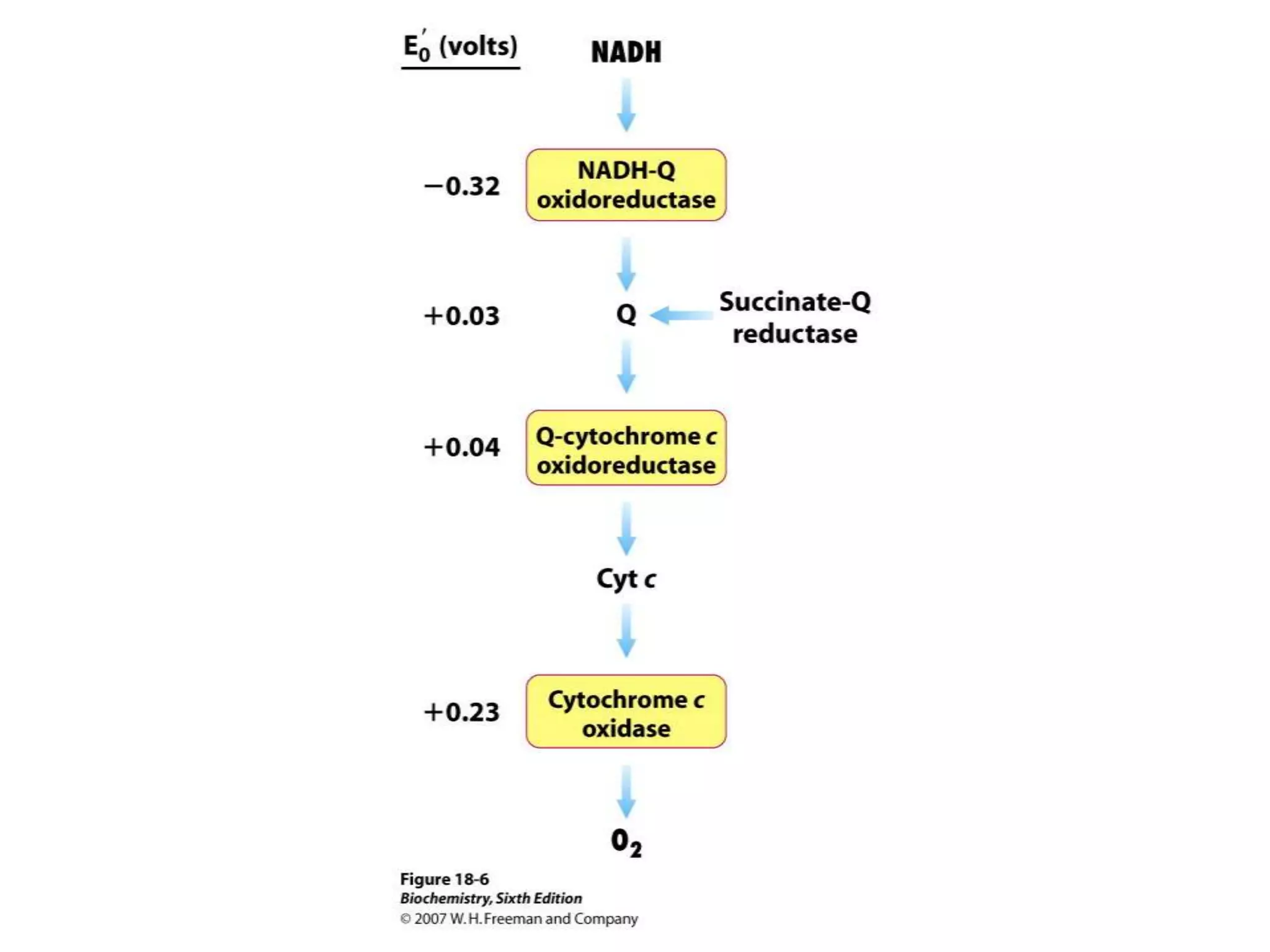
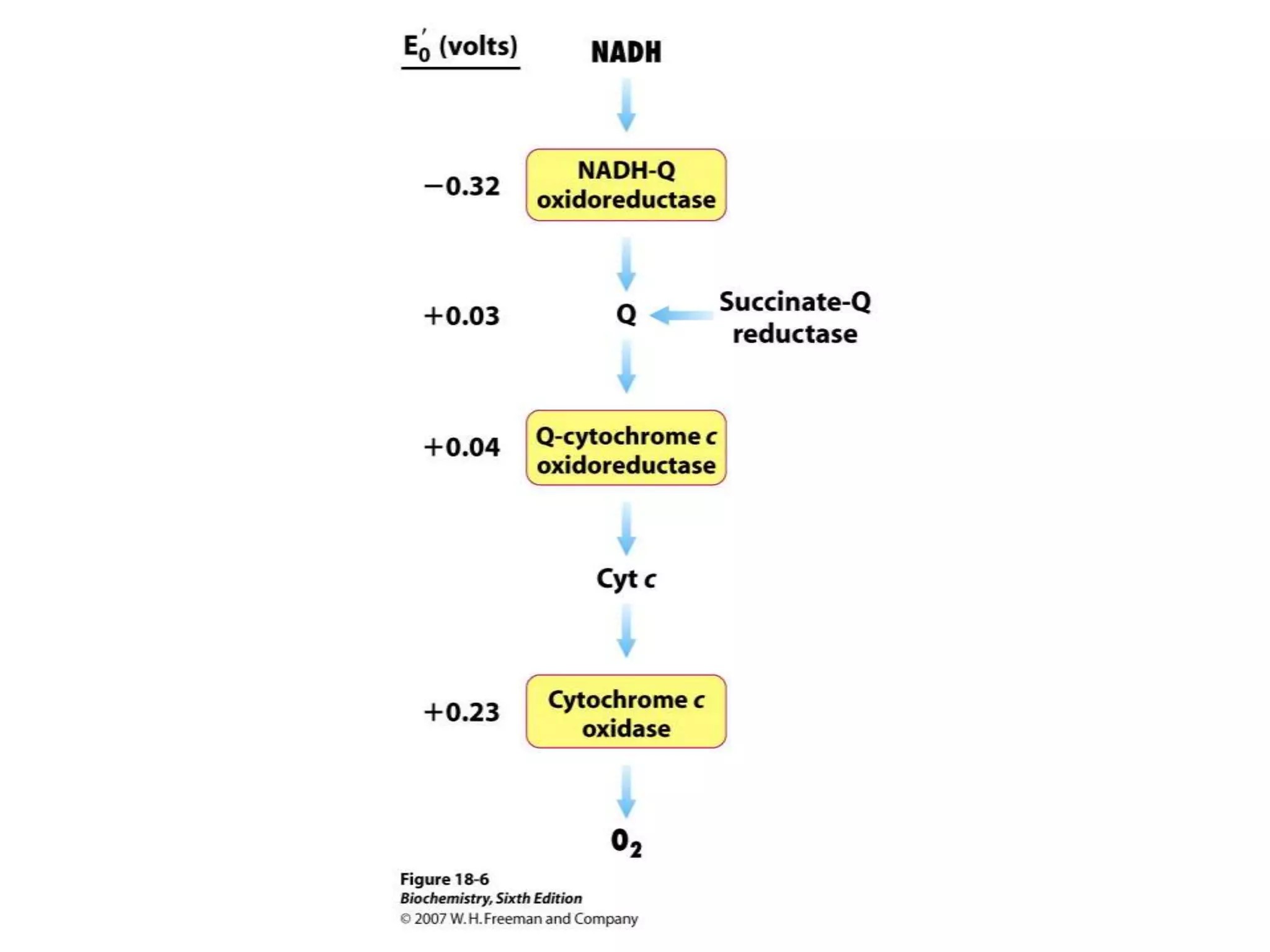
     – Electron transfer: more –E0 ---------- more +E0
4.   Free energy decreases as electrons are transferred
             Go = -nF E0
          where “n” is the number of electrons transferred, and F is Faraday’s constant (23, 062)
         E0 = E0 (electron accepting pair) – E0 (electron donating pair)
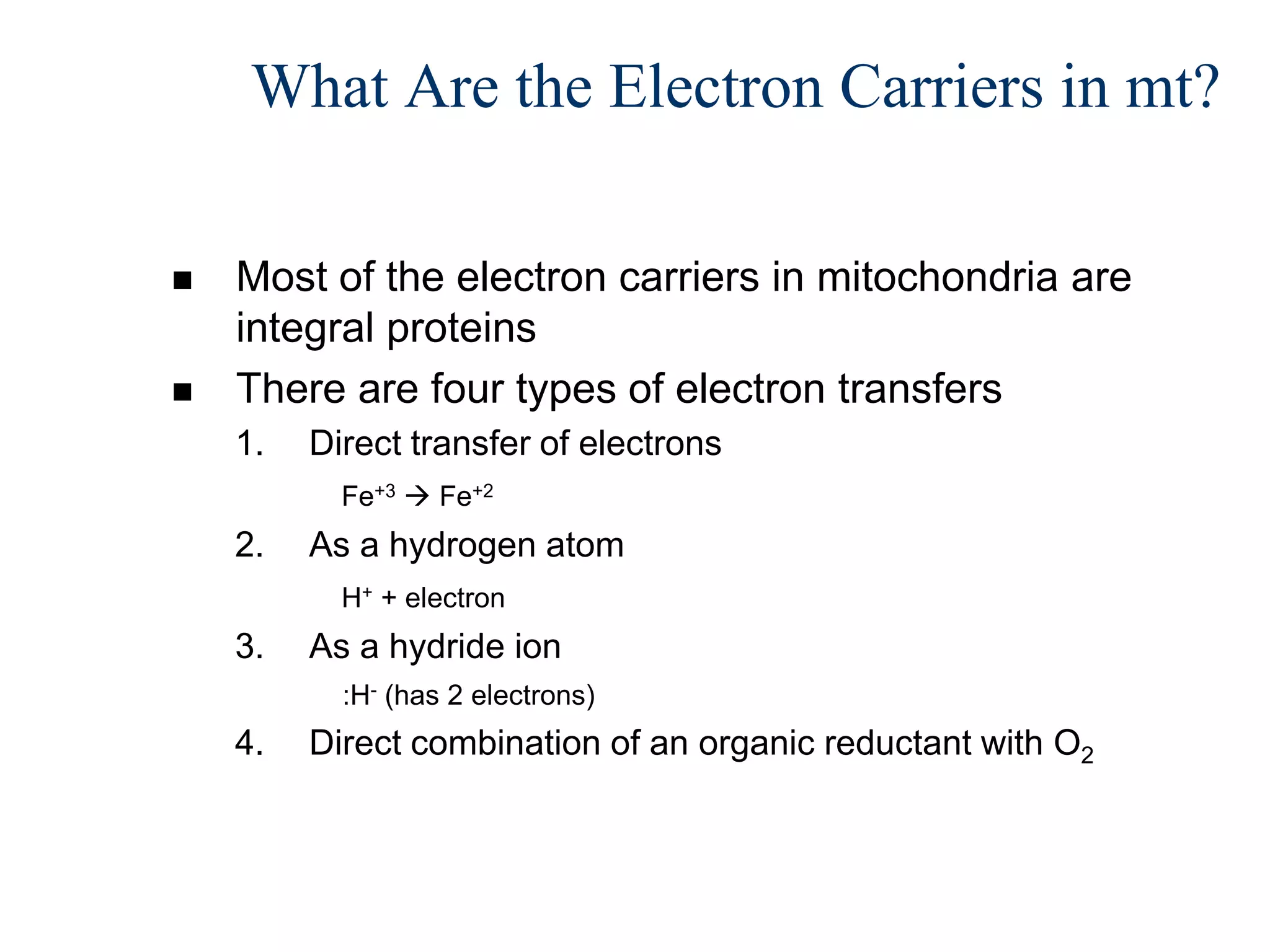
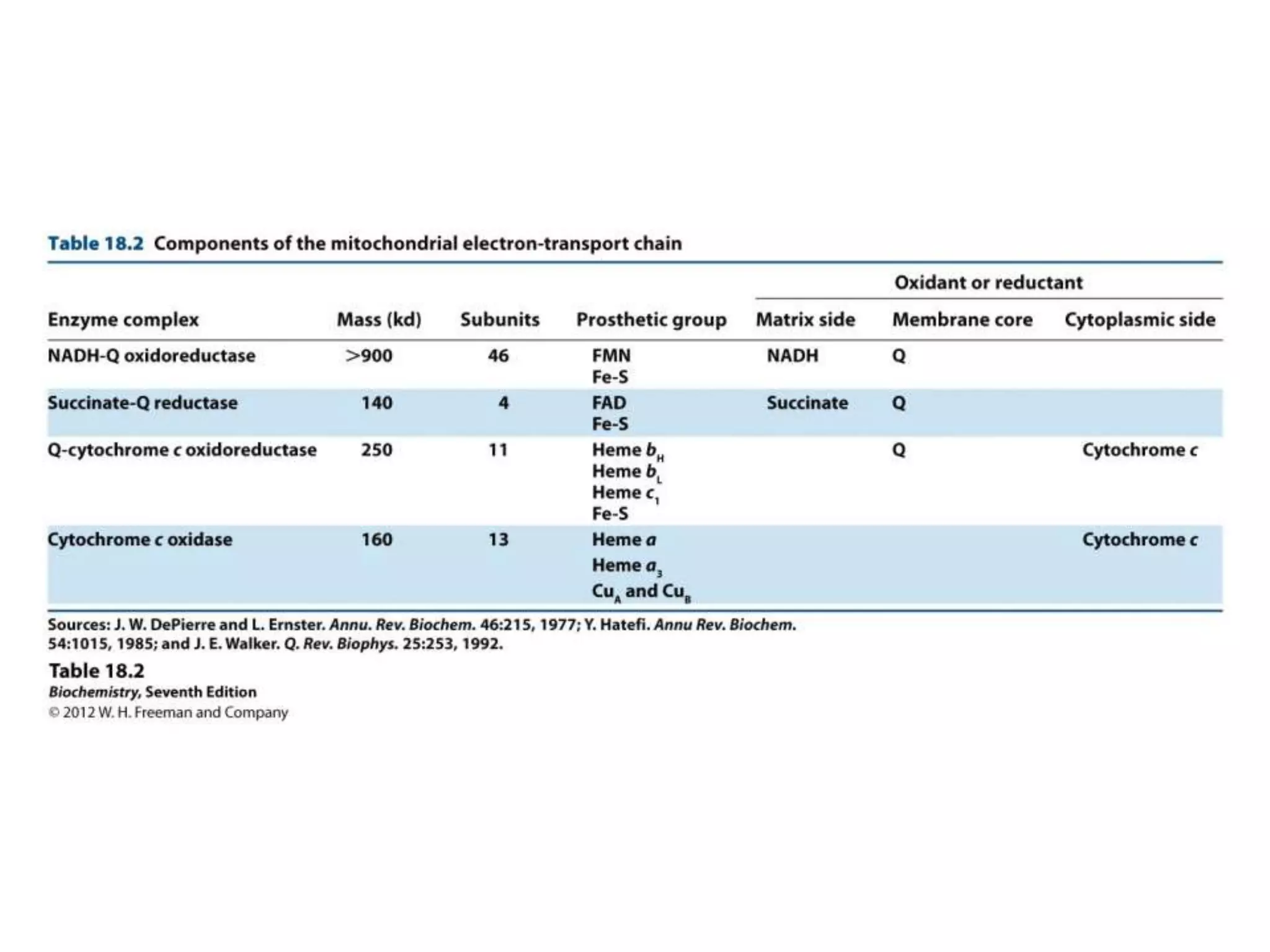
What Are the Electron Carriers in mt?

   Most of the electron carriers in mitochondria are
    integral proteins
   There are four types of electron transfers
    1.   Direct transfer of electrons
           Fe+3  Fe+2
    2.   As a hydrogen atom
           H+ + electron
    3.   As a hydride ion
           :H- (has 2 electrons)
    4.   Direct combination of an organic reductant with O2
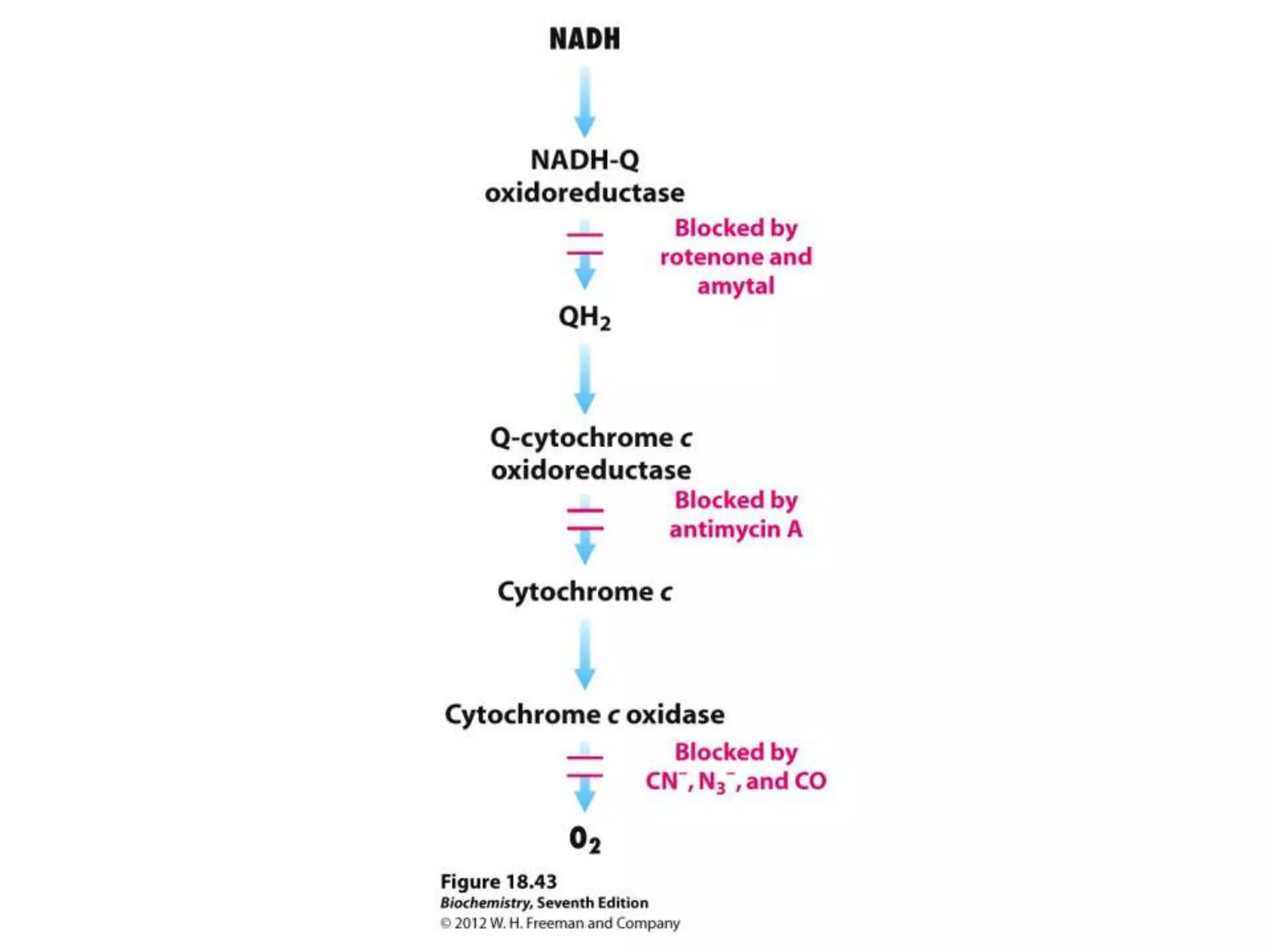
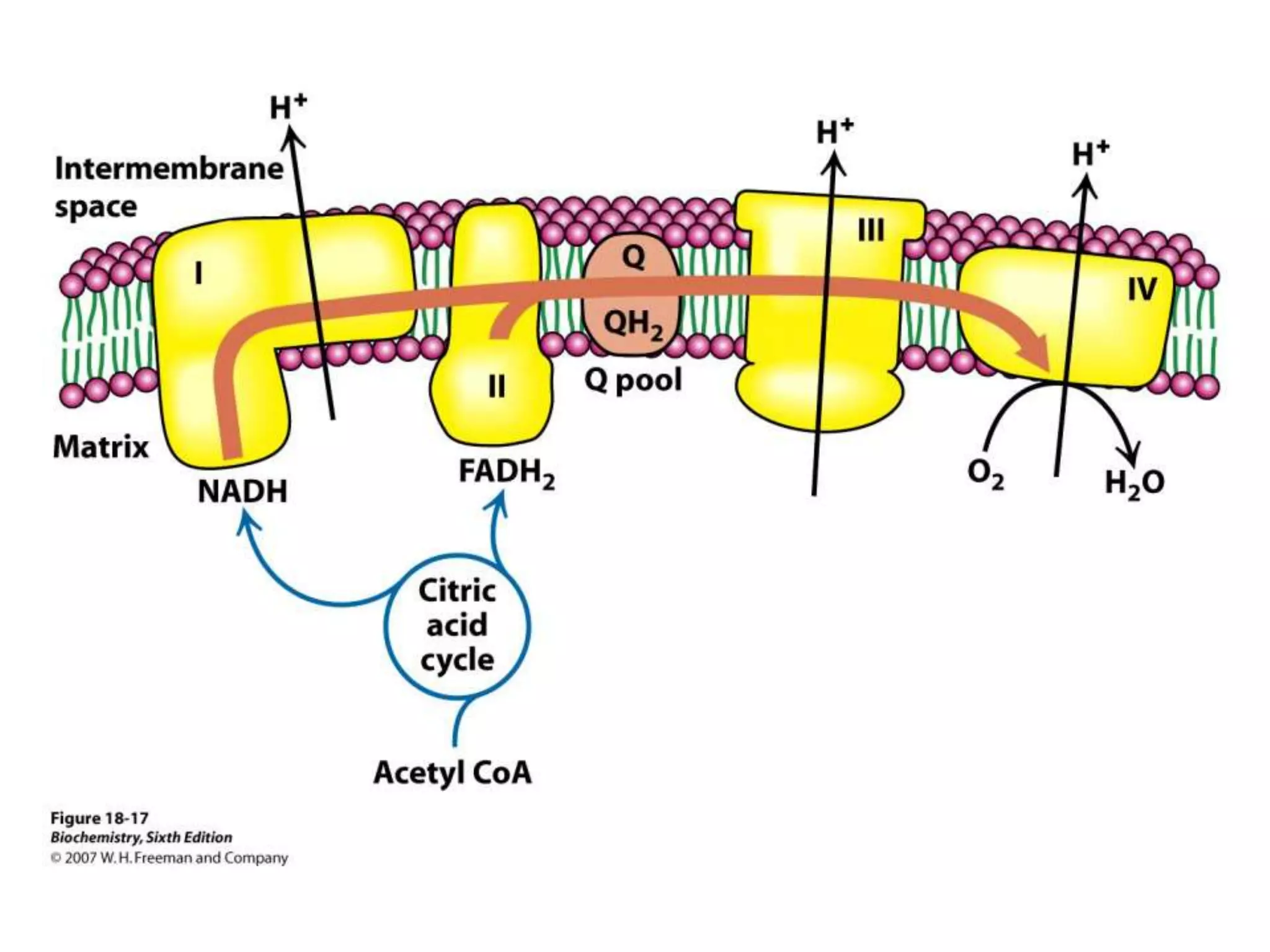
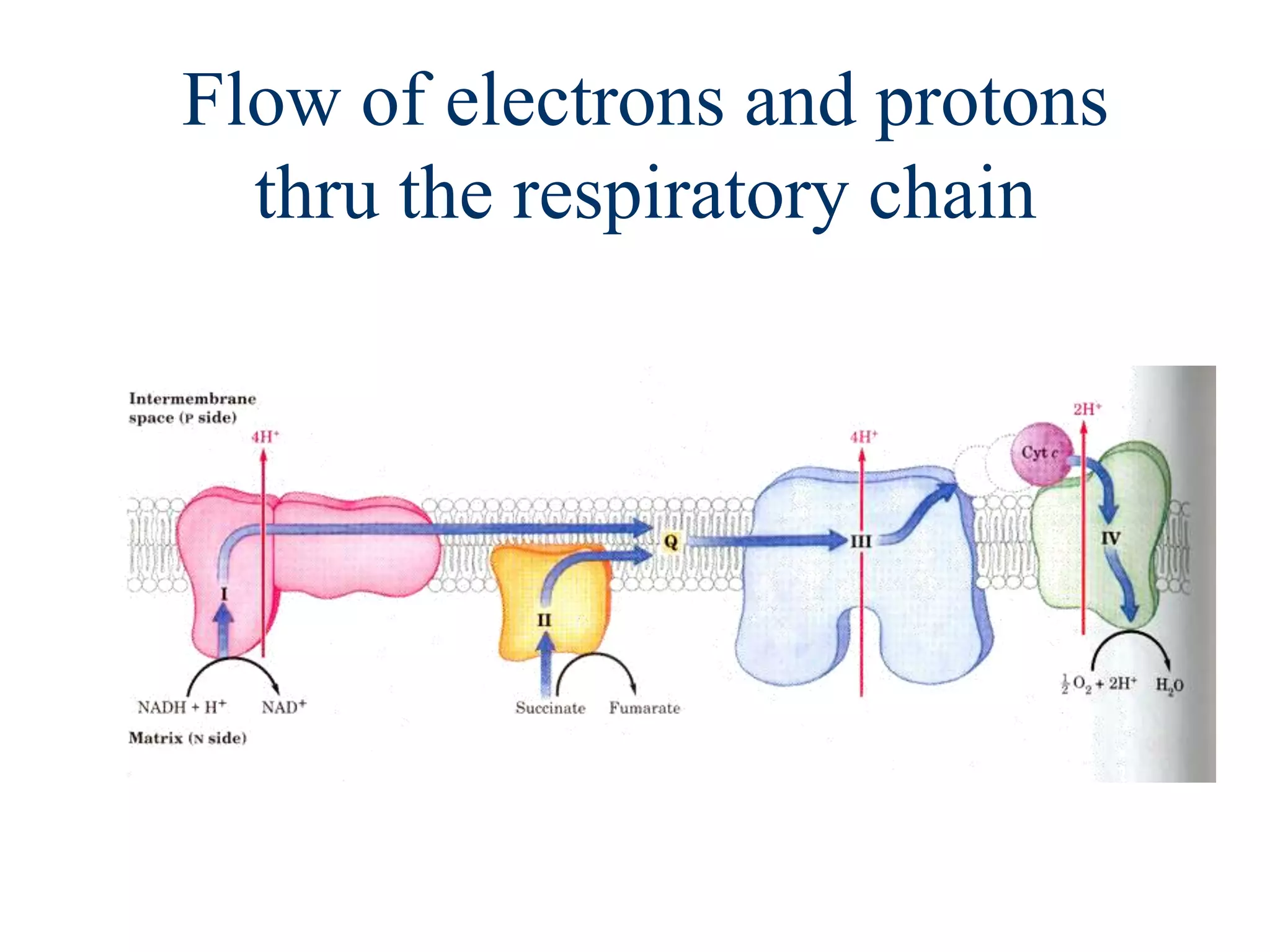
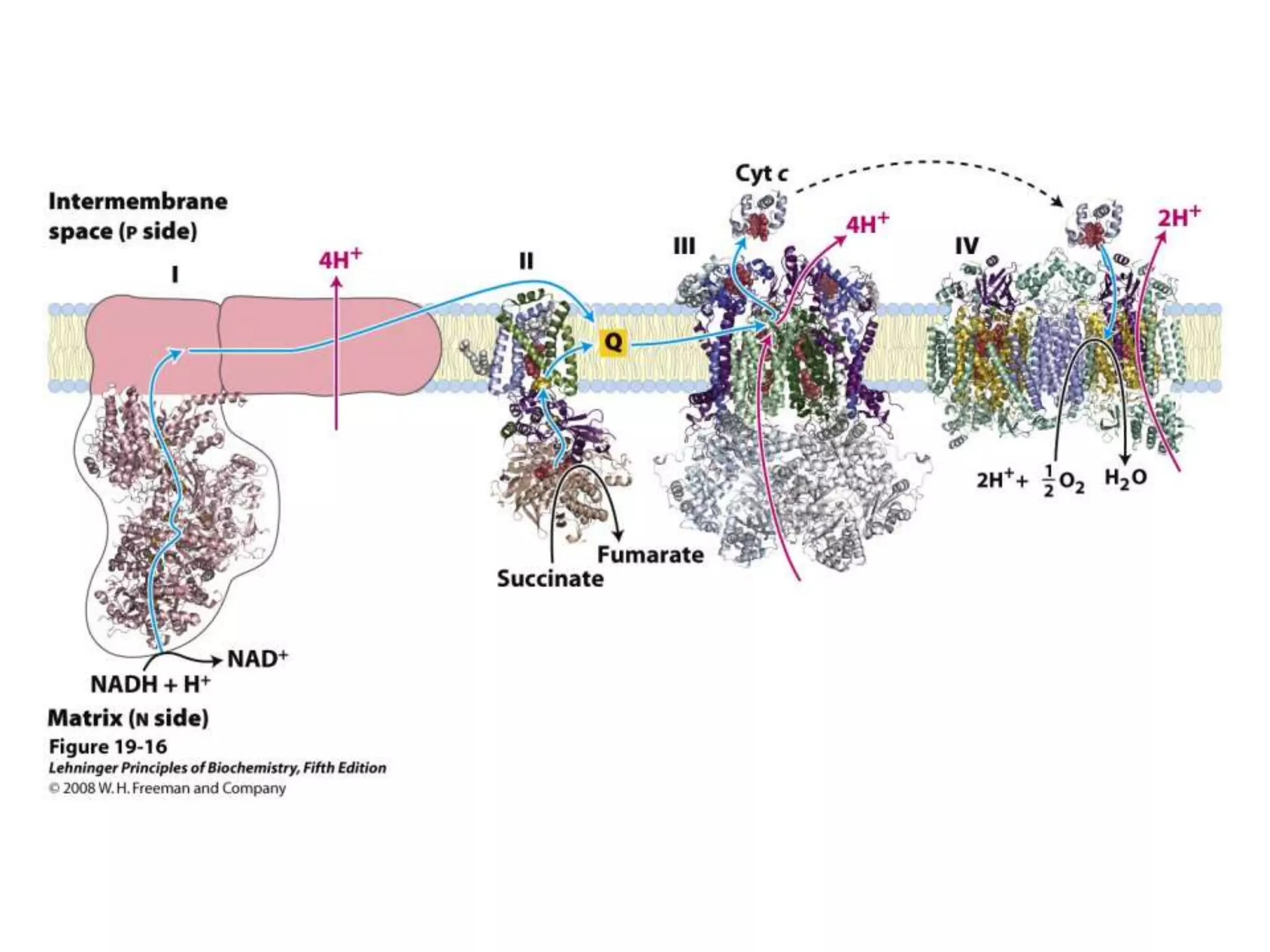
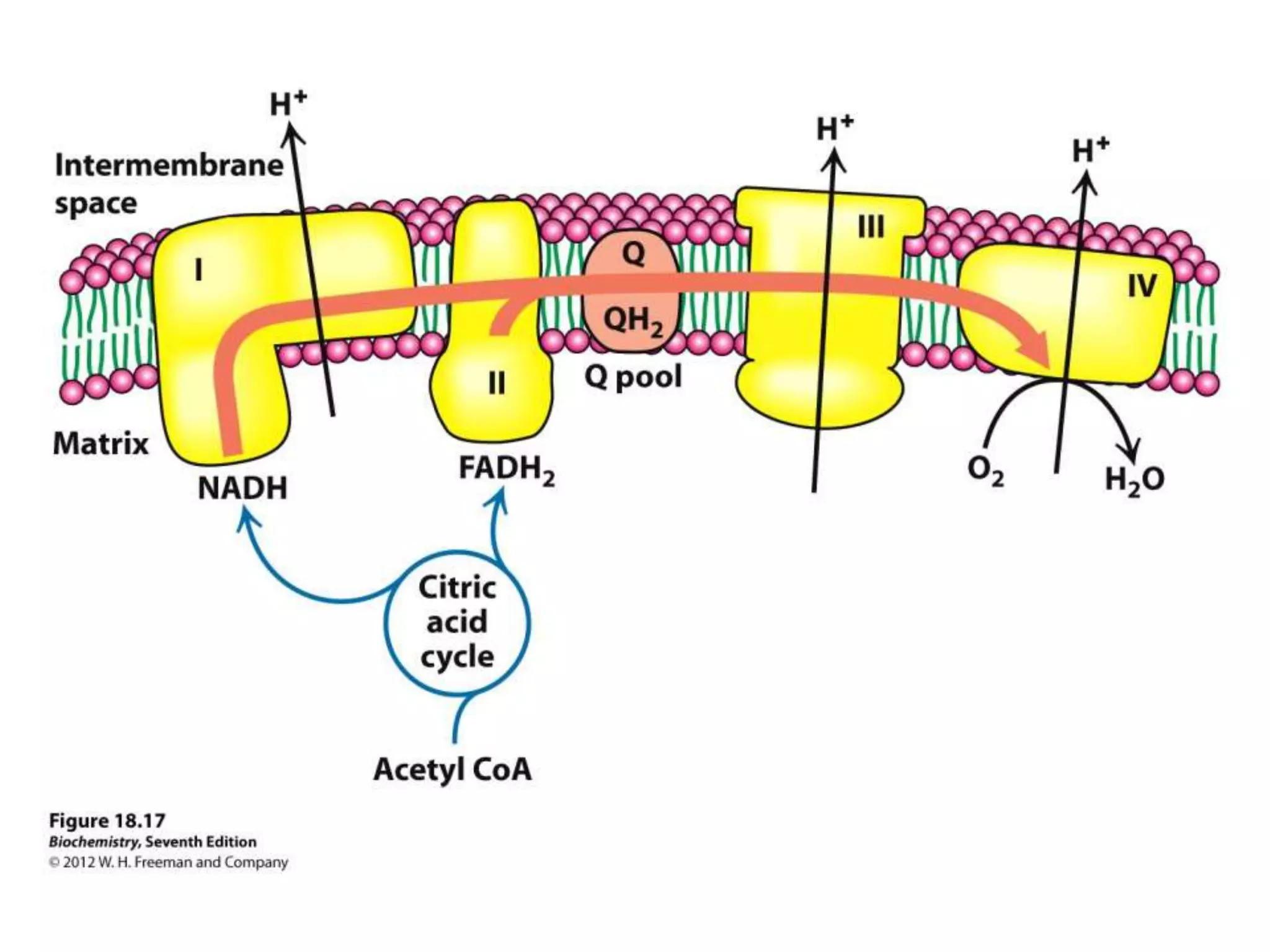
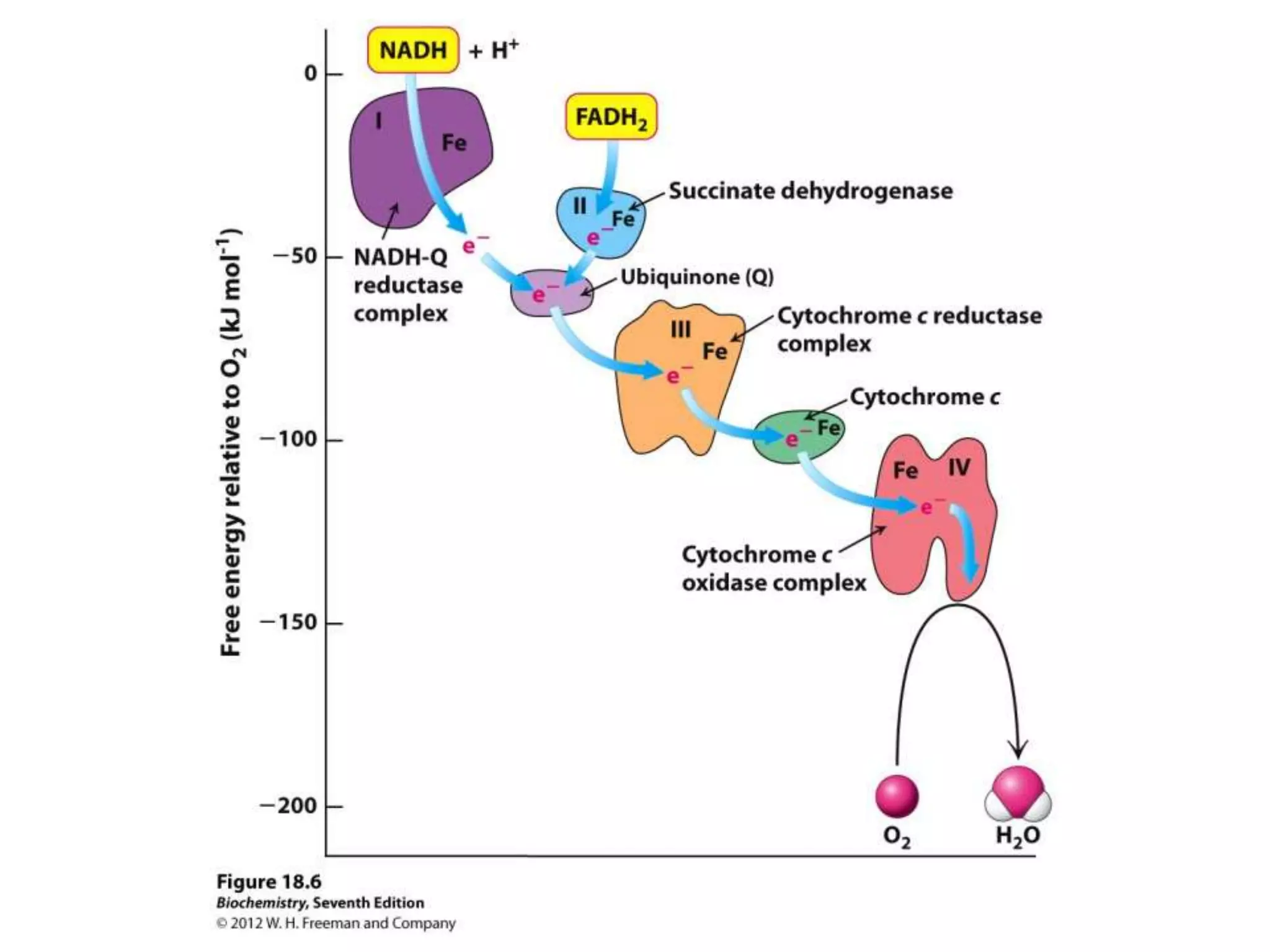
Flow of electrons and protons
  thru the respiratory chain
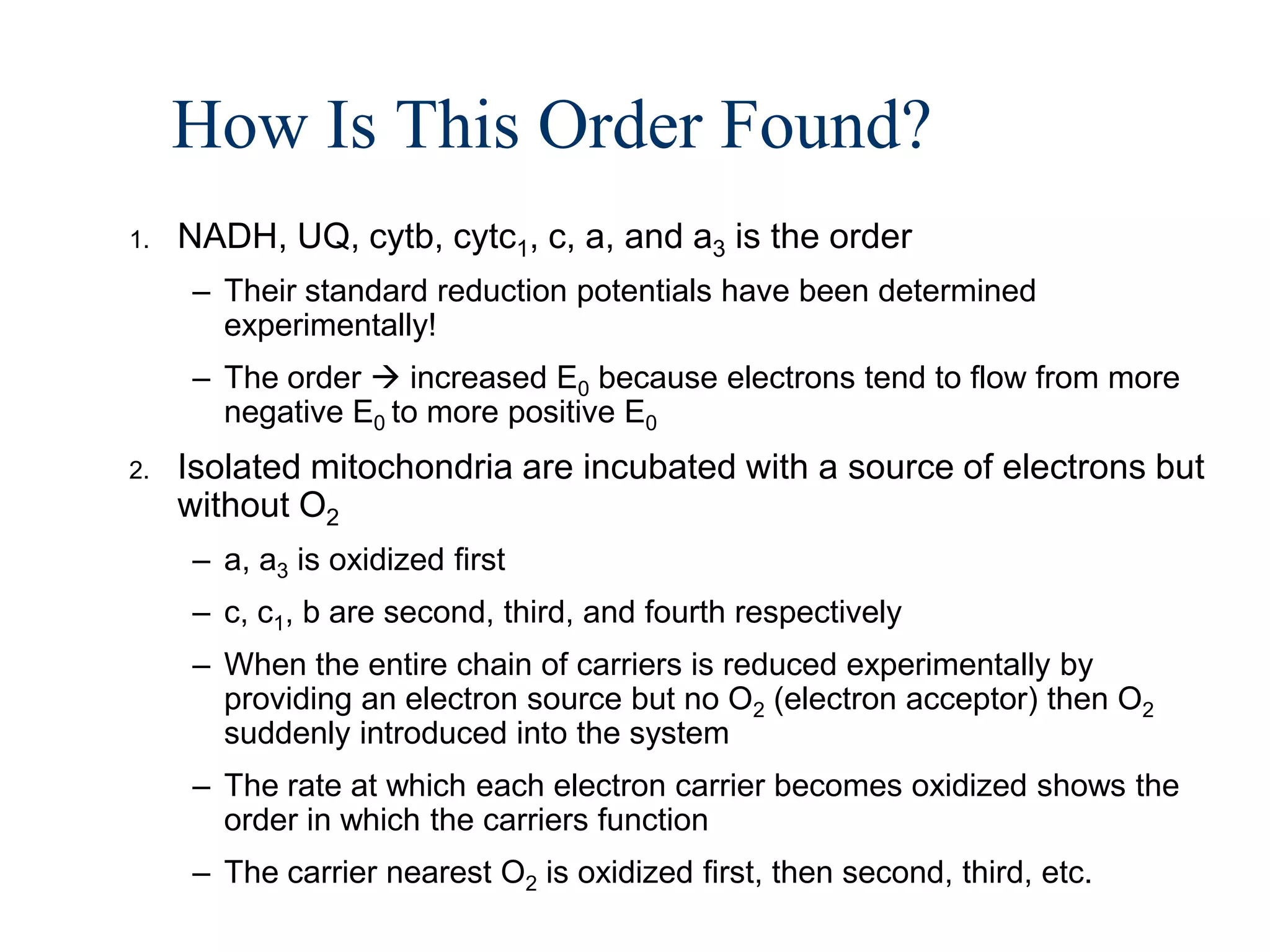
How Is This Order Found?
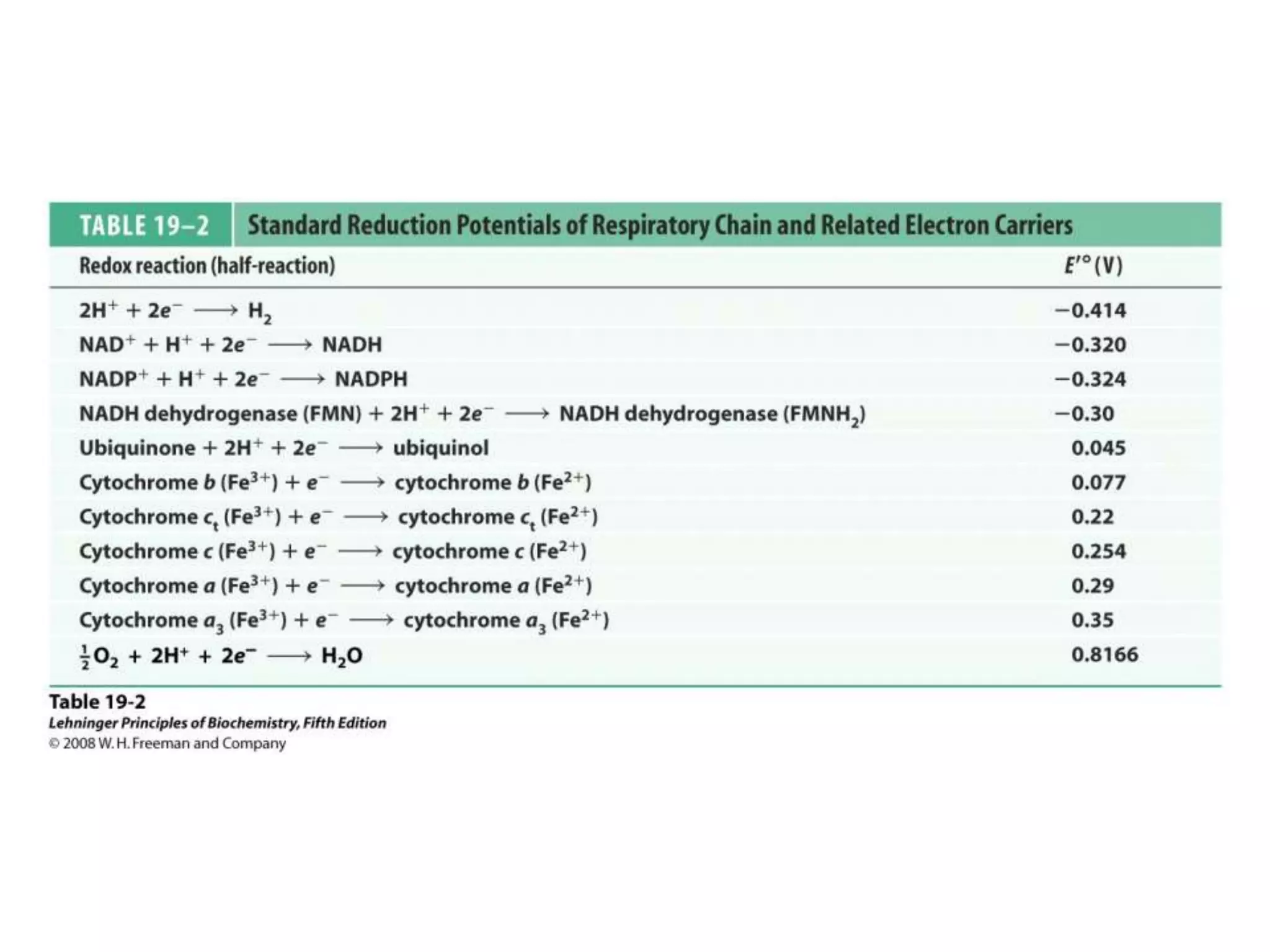
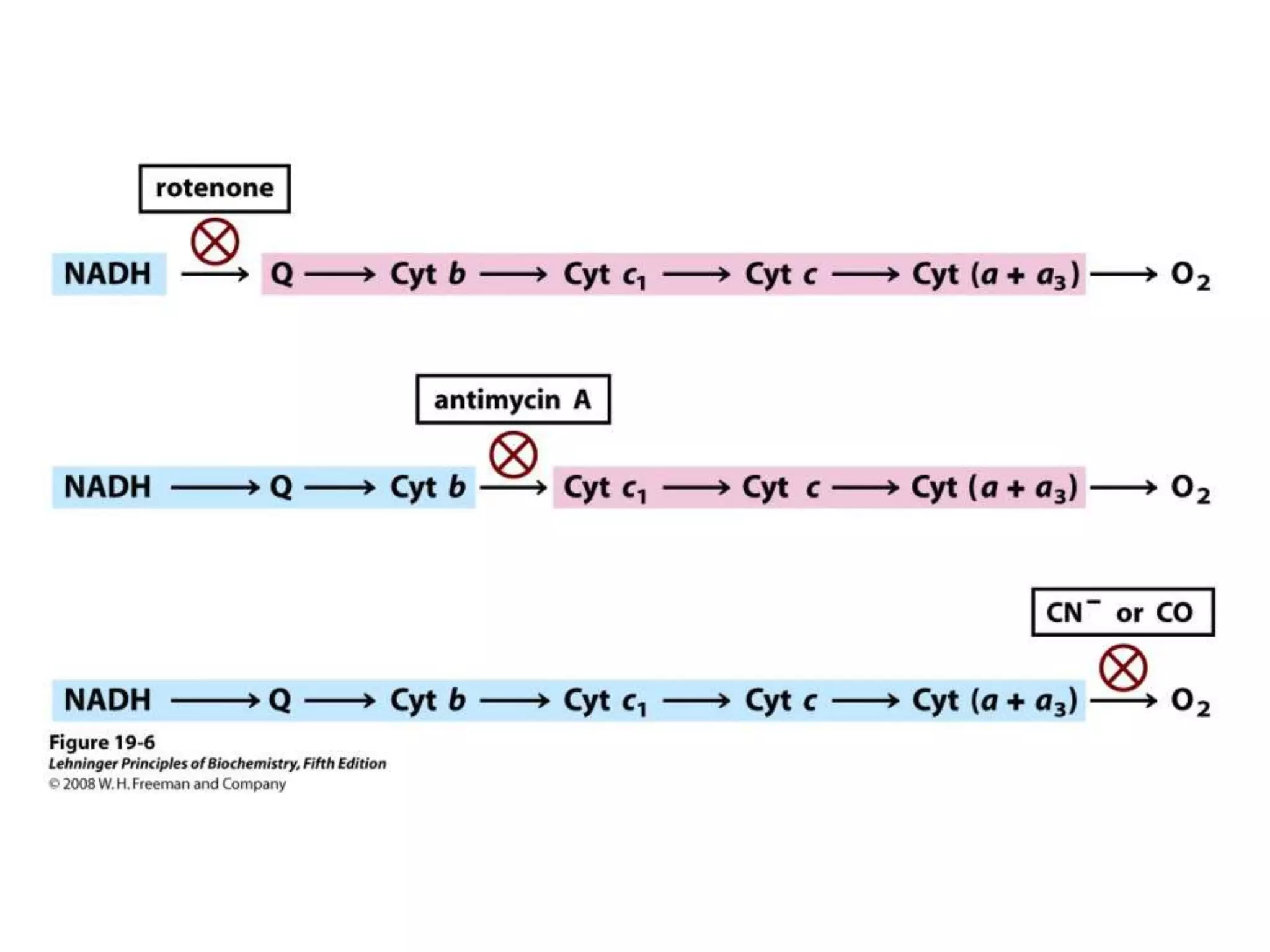
1.   NADH, UQ, cytb, cytc1, c, a, and a3 is the order
     – Their standard reduction potentials have been determined
       experimentally!
     – The order  increased E0 because electrons tend to flow from more
       negative E0 to more positive E0
2.   Isolated mitochondria are incubated with a source of electrons but
     without O2
     – a, a3 is oxidized first
     – c, c1, b are second, third, and fourth respectively
     – When the entire chain of carriers is reduced experimentally by
       providing an electron source but no O2 (electron acceptor) then O2
       suddenly introduced into the system
     – The rate at which each electron carrier becomes oxidized shows the
       order in which the carriers function
     – The carrier nearest O2 is oxidized first, then second, third, etc.
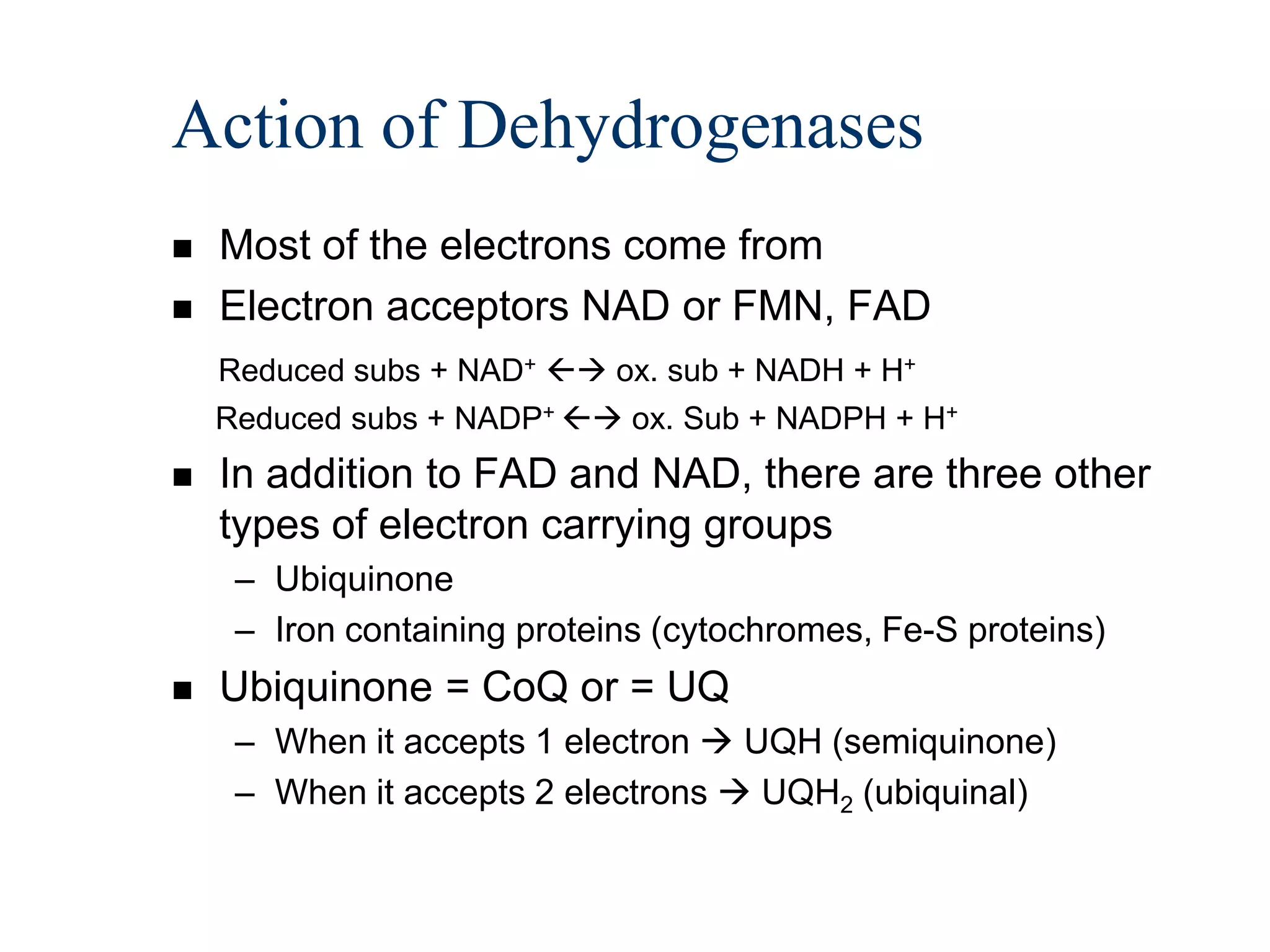
Action of Dehydrogenases
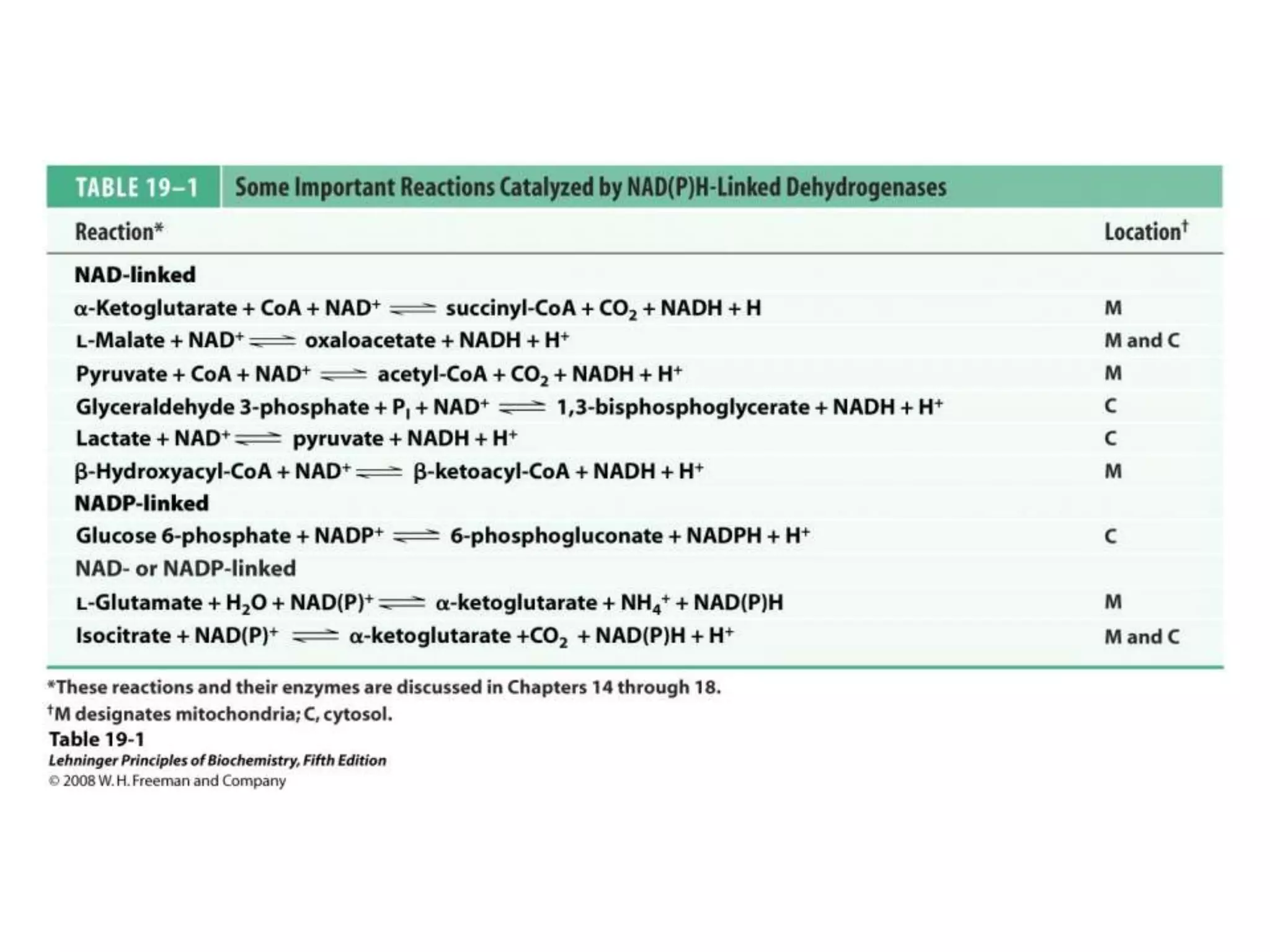
   Most of the electrons come from
   Electron acceptors NAD or FMN, FAD
    Reduced subs + NAD+  ox. sub + NADH + H+
    Reduced subs + NADP+  ox. Sub + NADPH + H+
   In addition to FAD and NAD, there are three other
    types of electron carrying groups
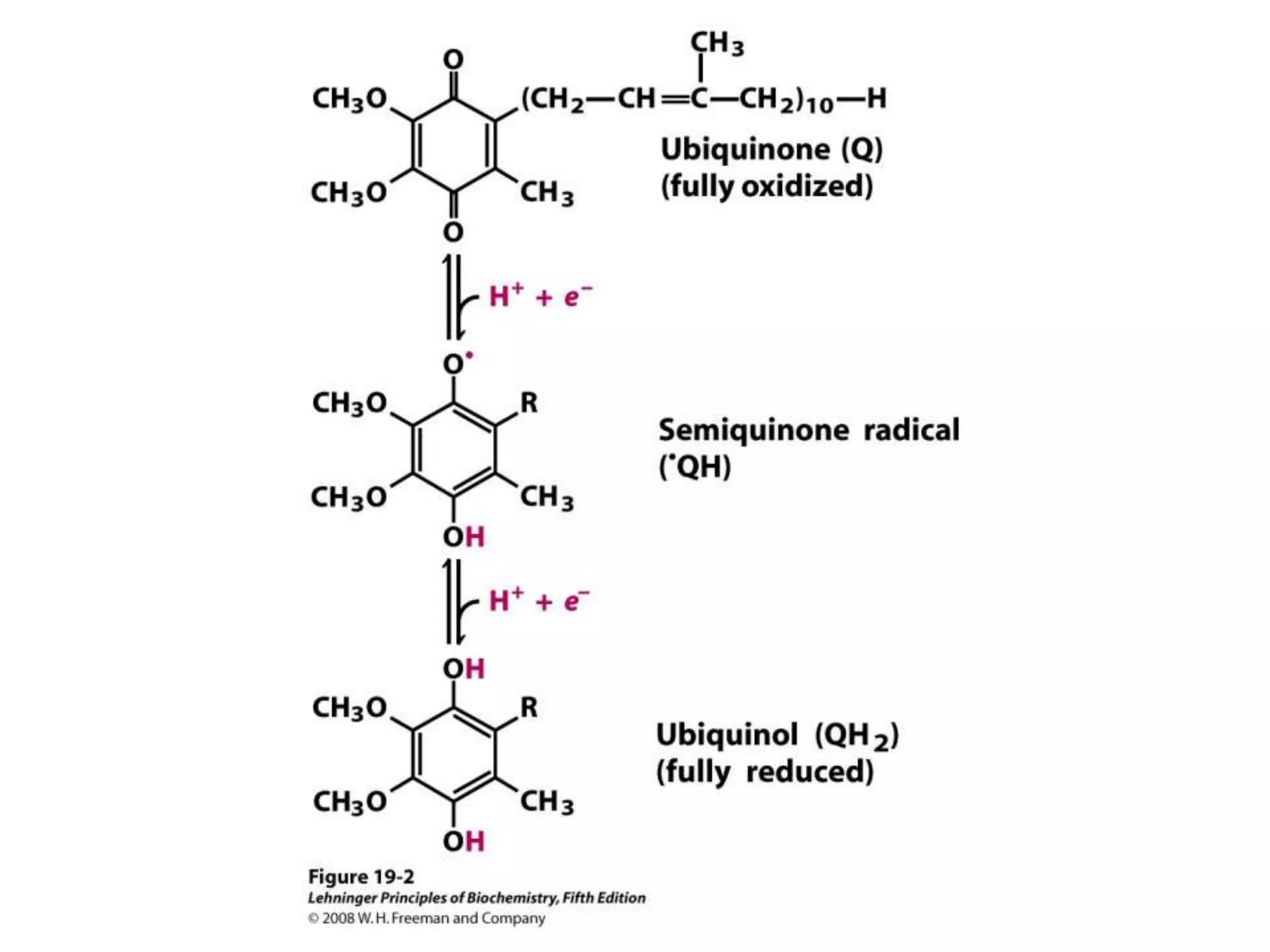
     – Ubiquinone
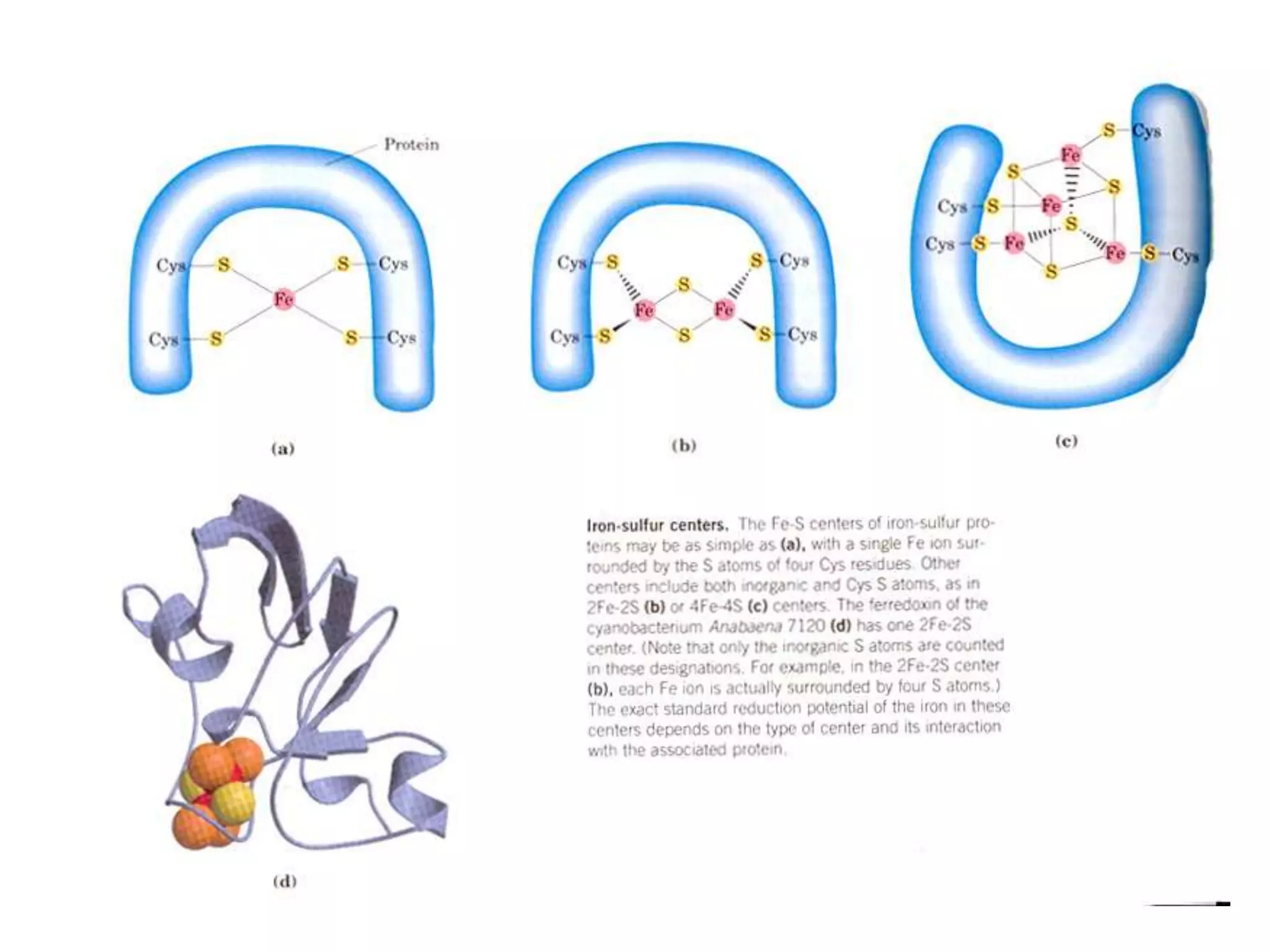
     – Iron containing proteins (cytochromes, Fe-S proteins)
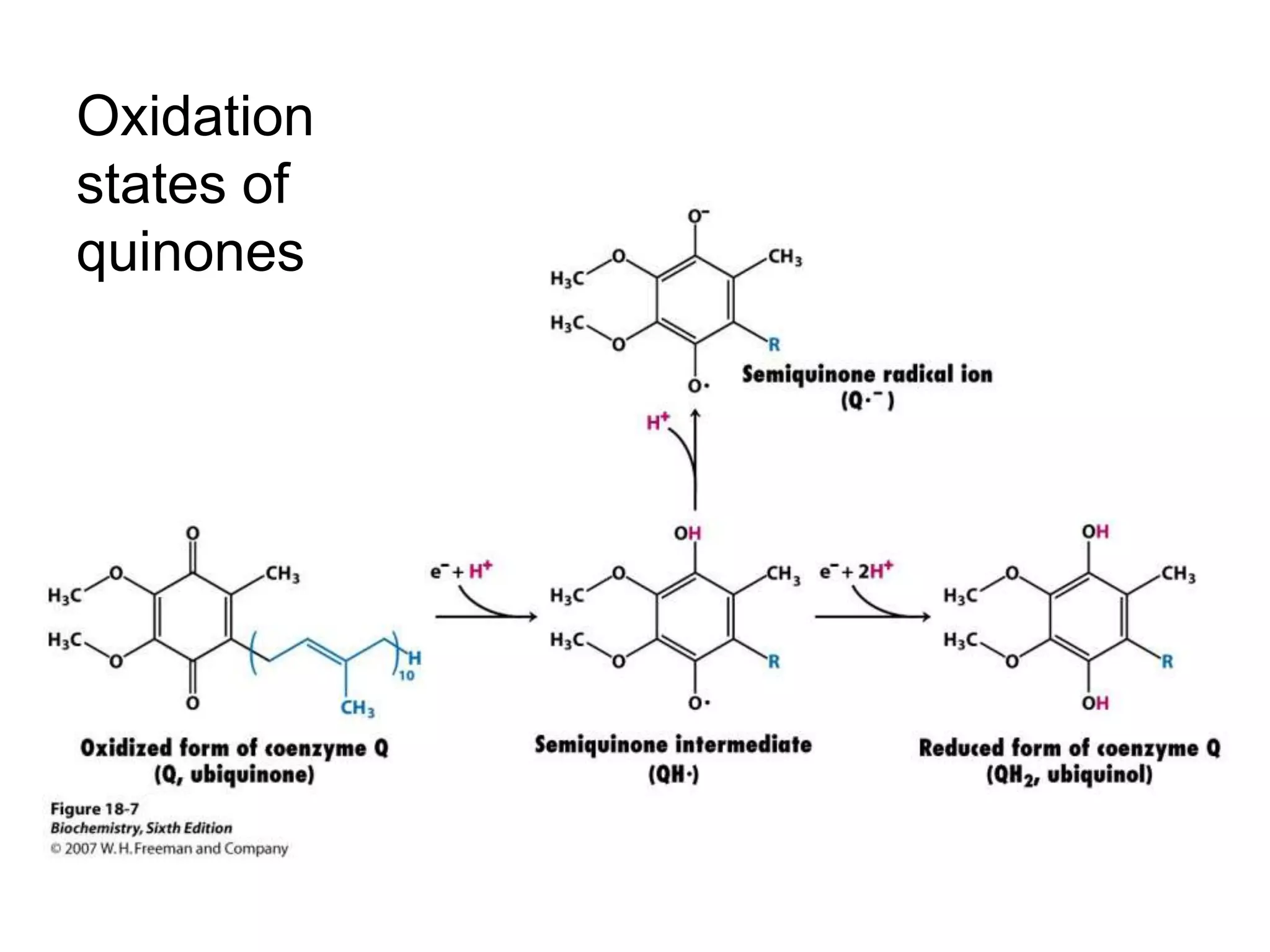
   Ubiquinone = CoQ or = UQ
     – When it accepts 1 electron  UQH (semiquinone)
     – When it accepts 2 electrons  UQH2 (ubiquinal)
Oxidation
states of
quinones
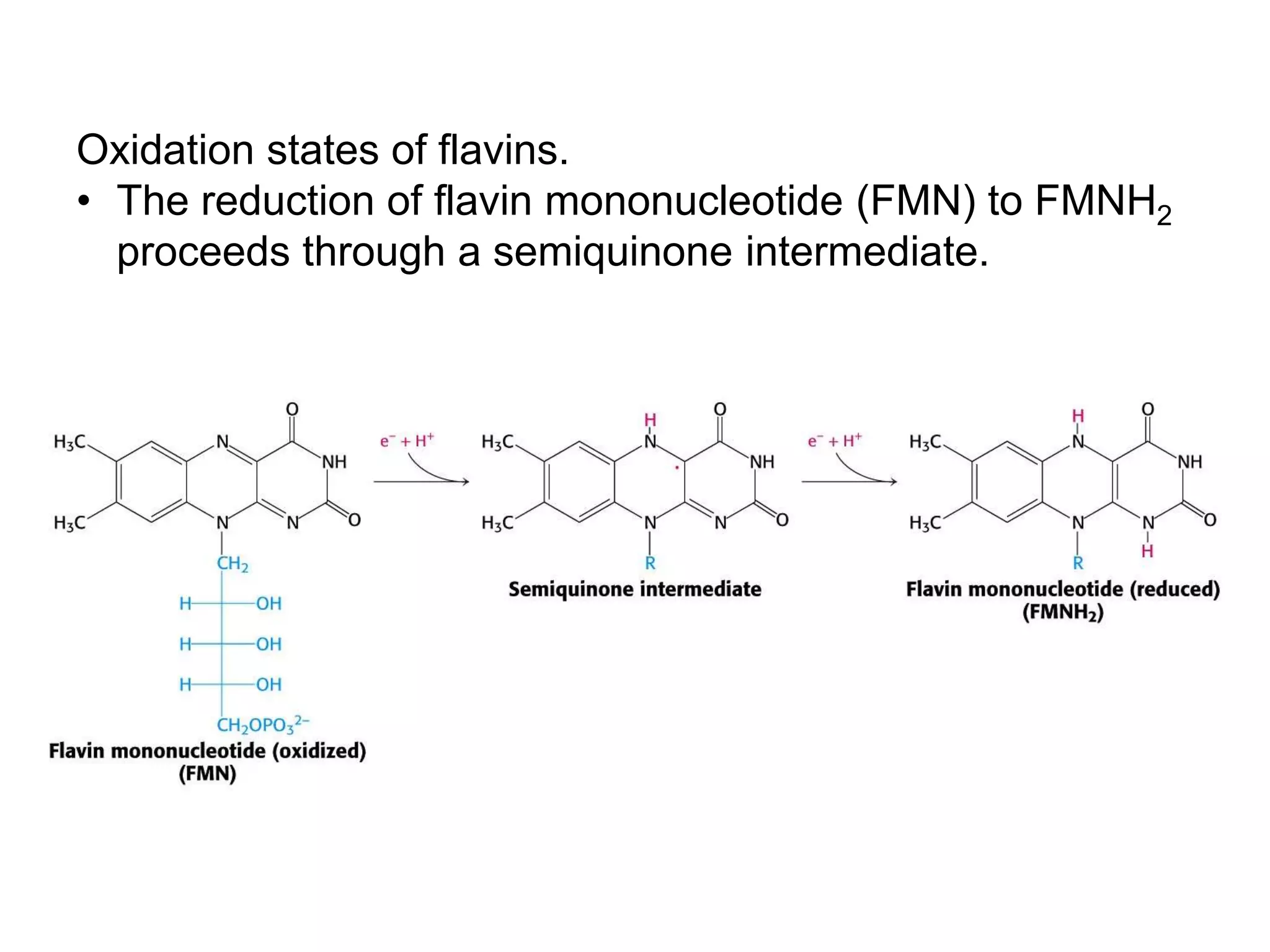
Oxidation states of flavins.
• The reduction of flavin mononucleotide (FMN) to FMNH2
  proceeds through a semiquinone intermediate.
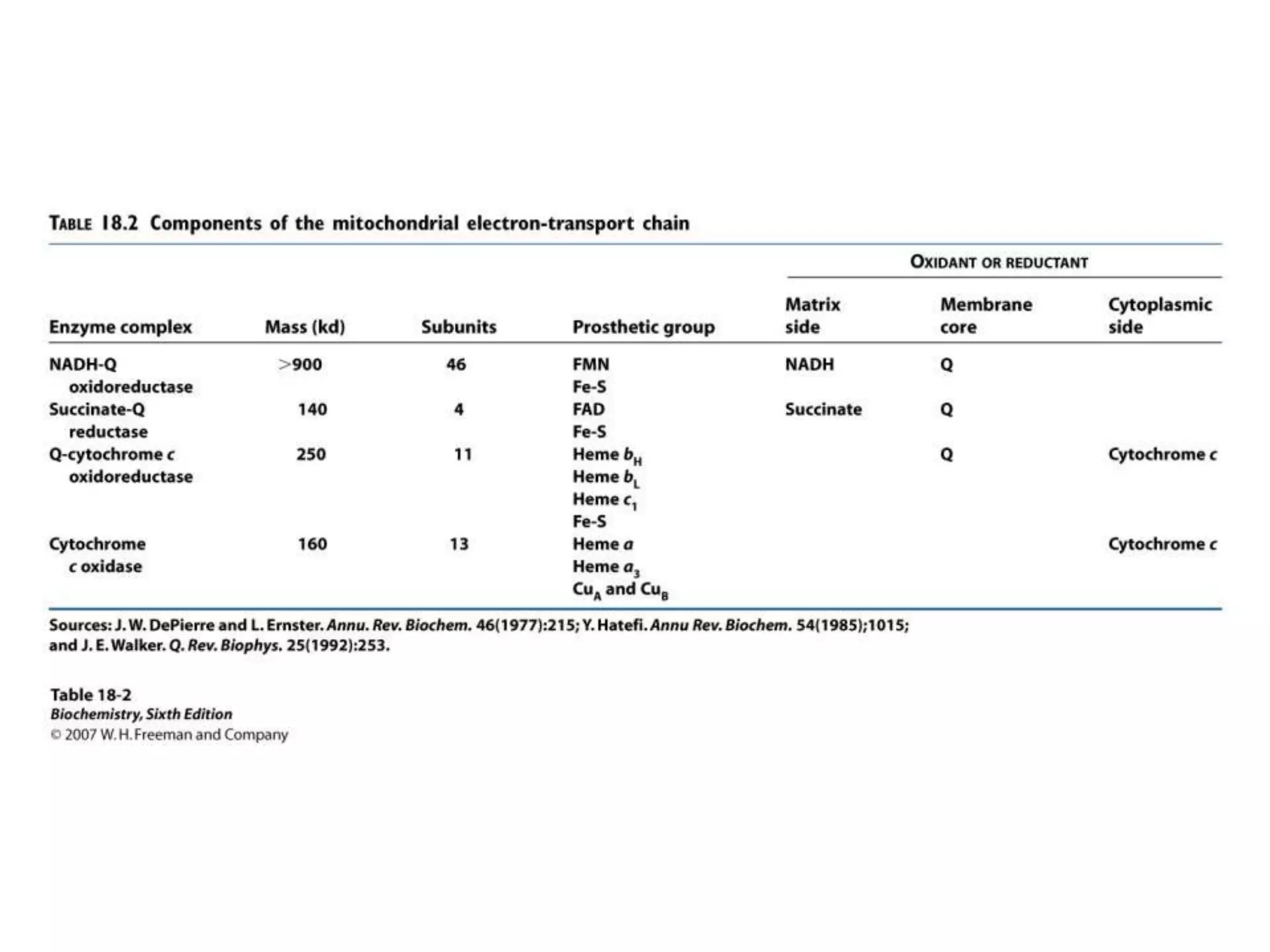
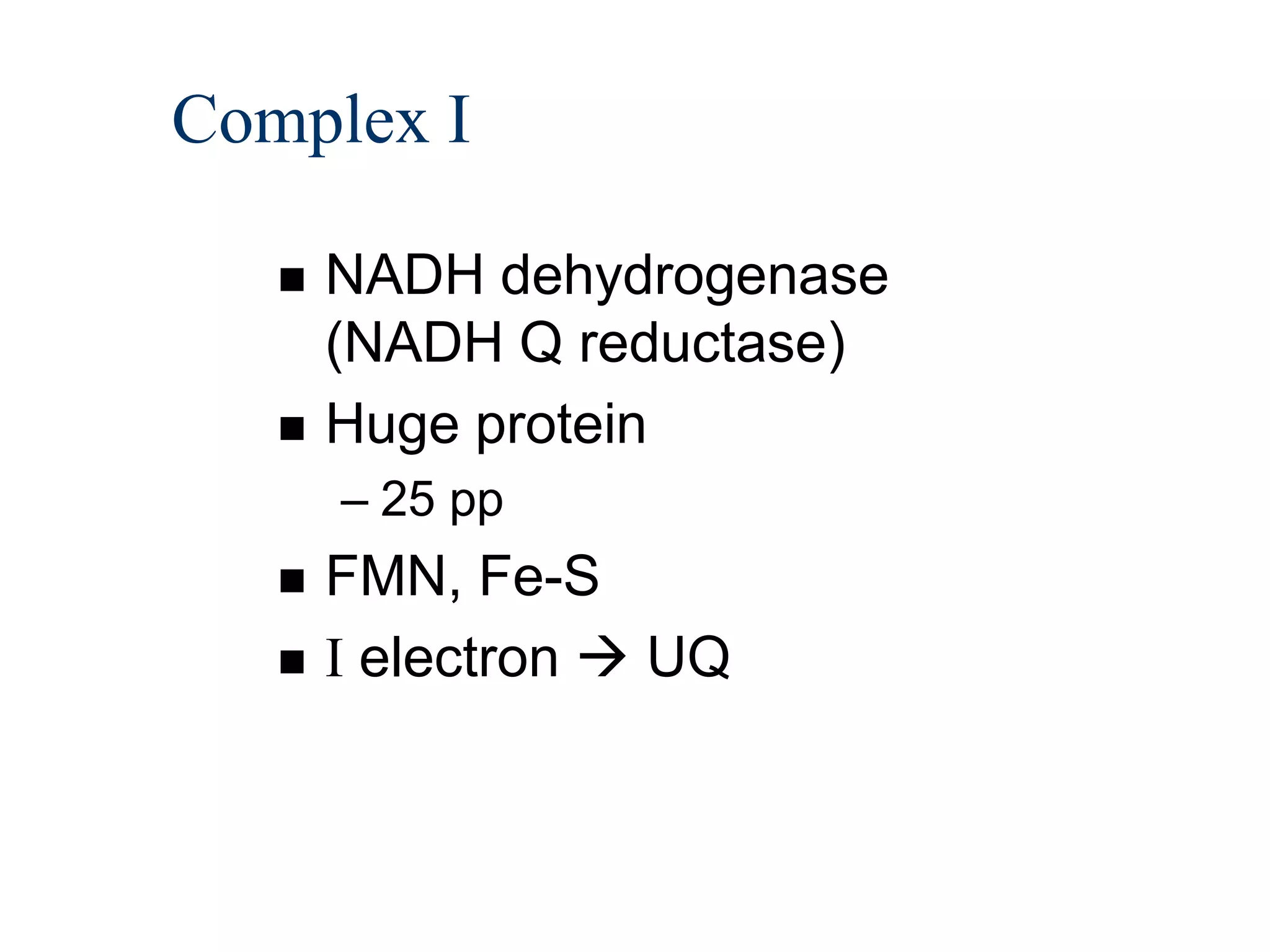
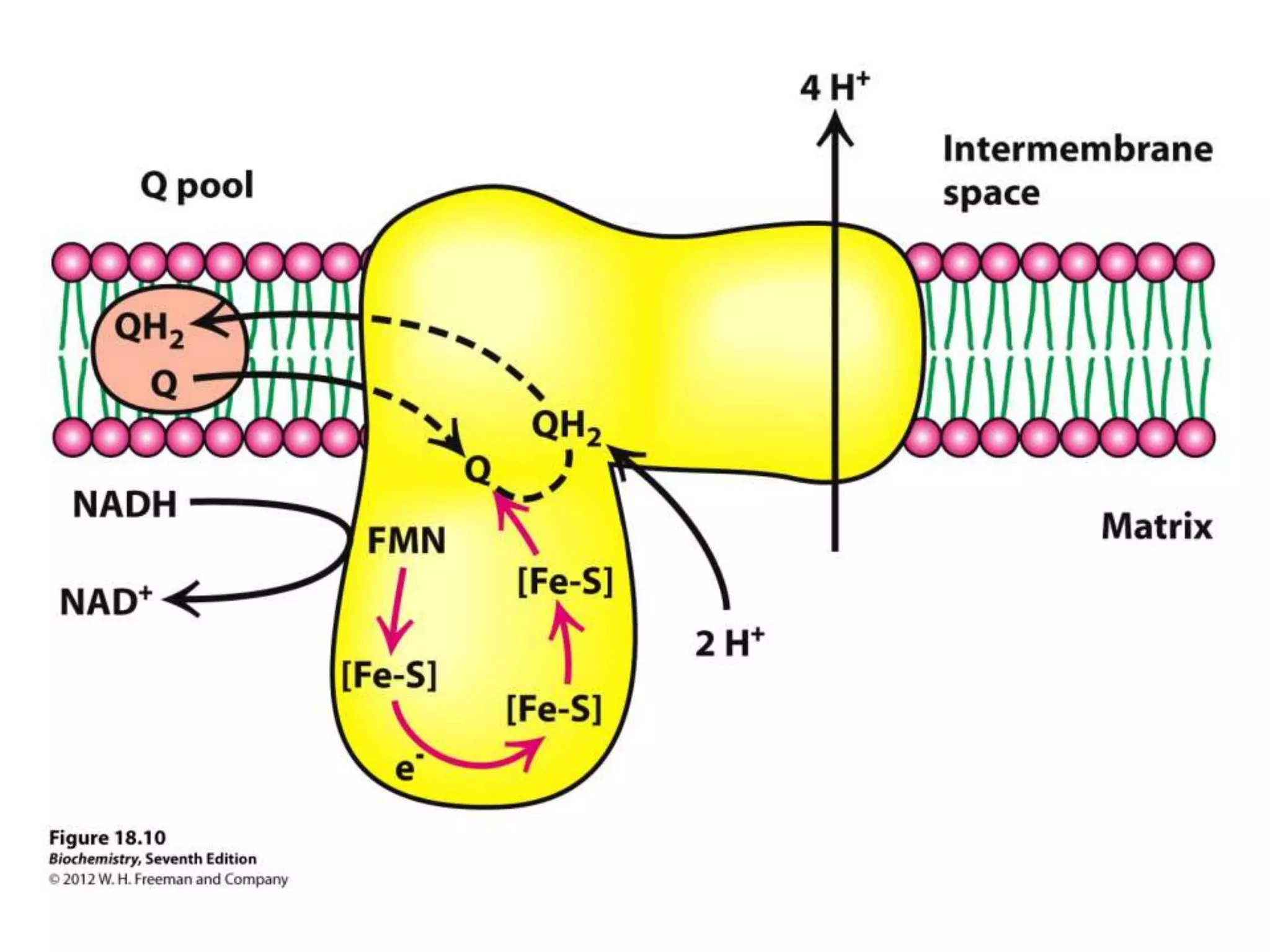
Complex I

      NADH dehydrogenase
       (NADH Q reductase)
      Huge protein
       – 25 pp
      FMN, Fe-S
      I electron  UQ
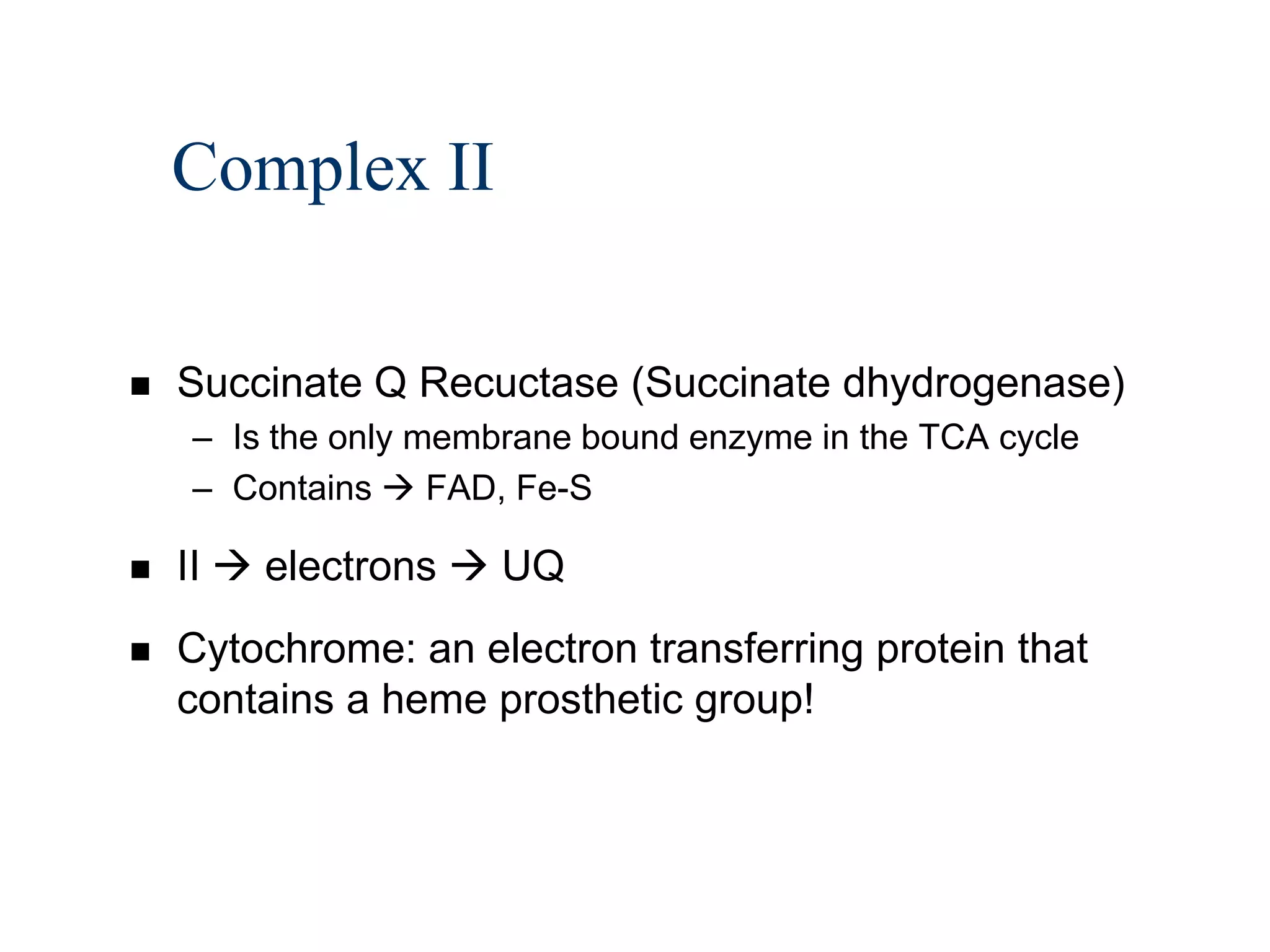
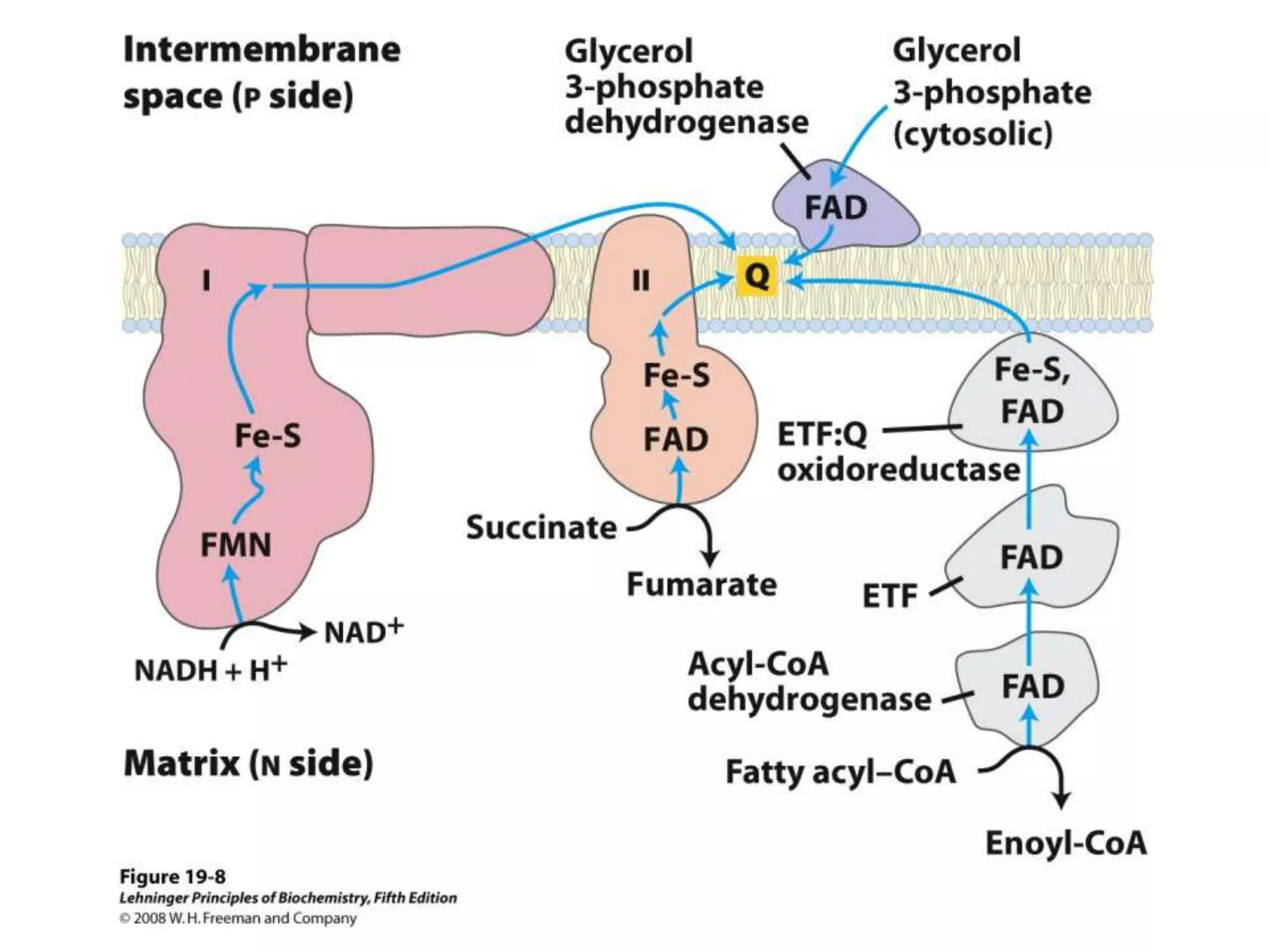
Complex II

   Succinate Q Recuctase (Succinate dhydrogenase)
    – Is the only membrane bound enzyme in the TCA cycle
    – Contains  FAD, Fe-S

   II  electrons  UQ
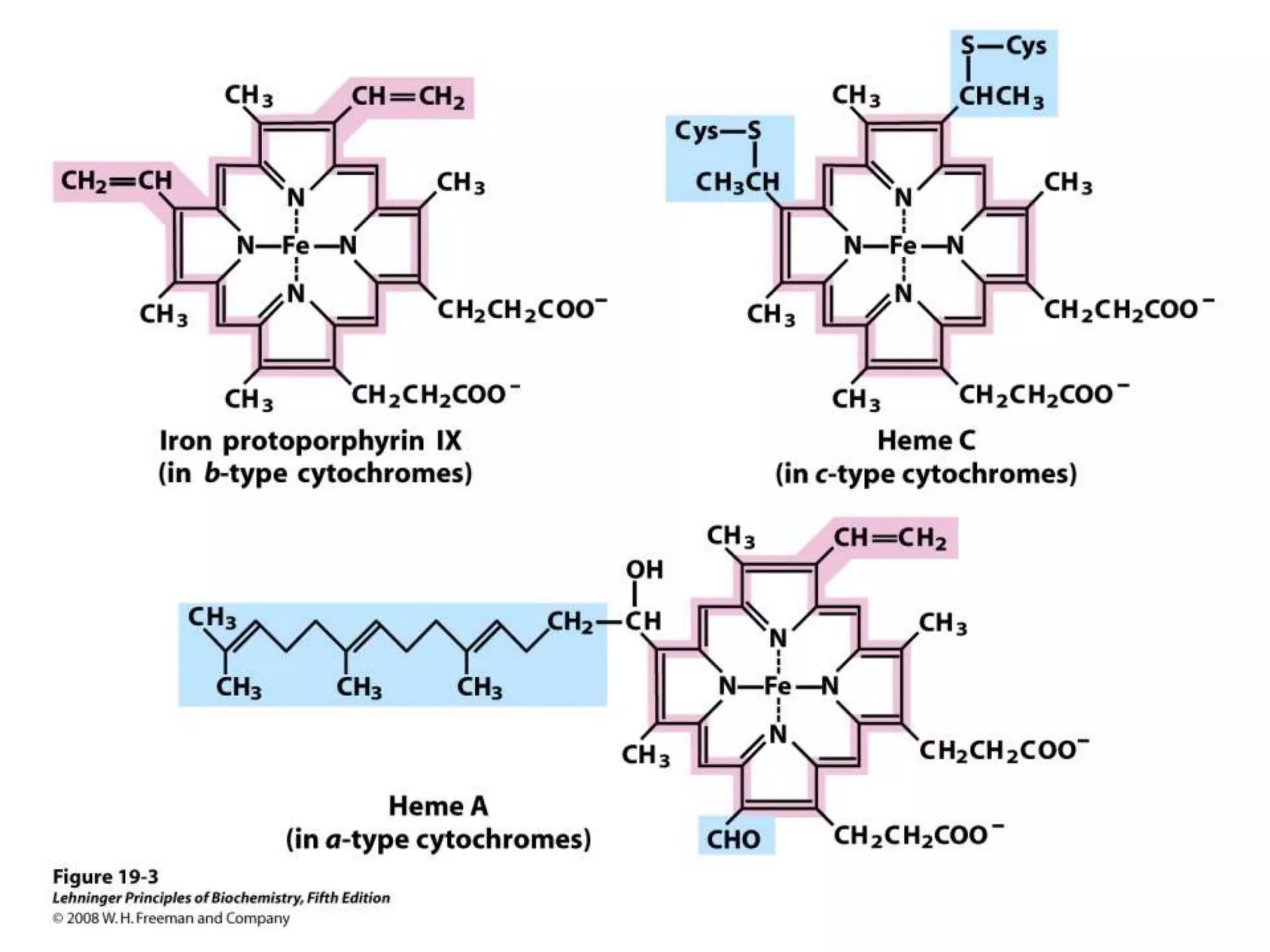
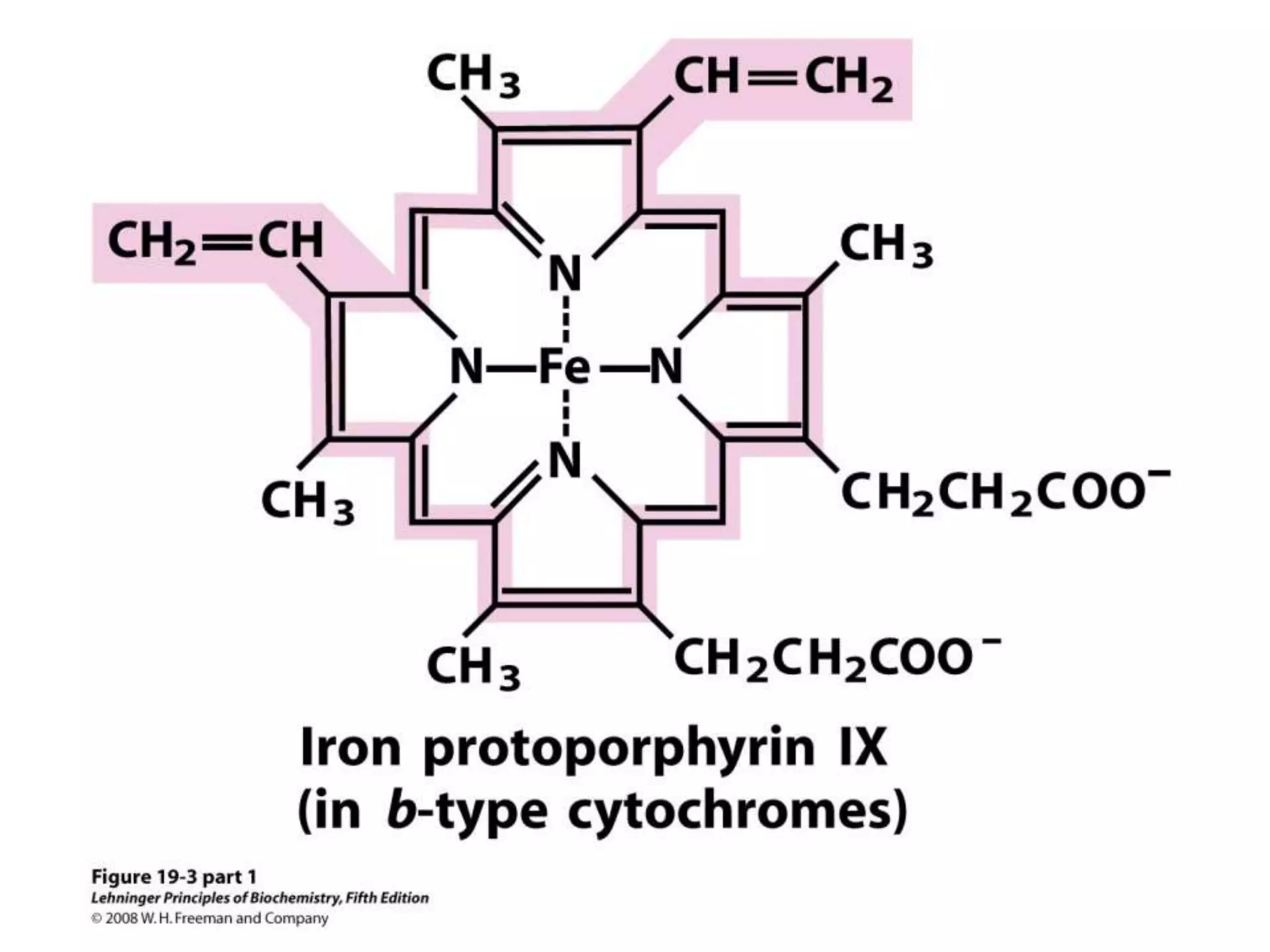
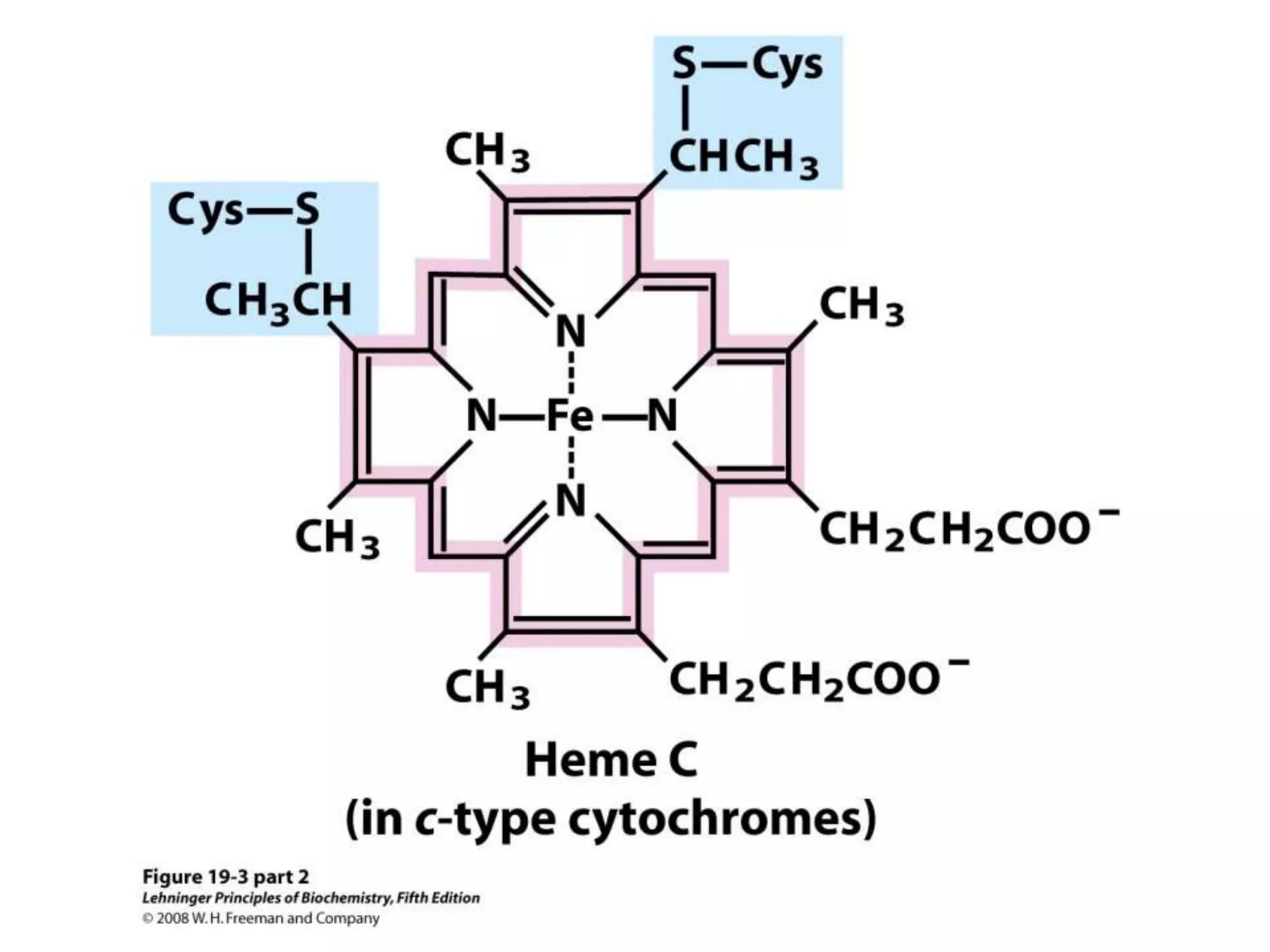
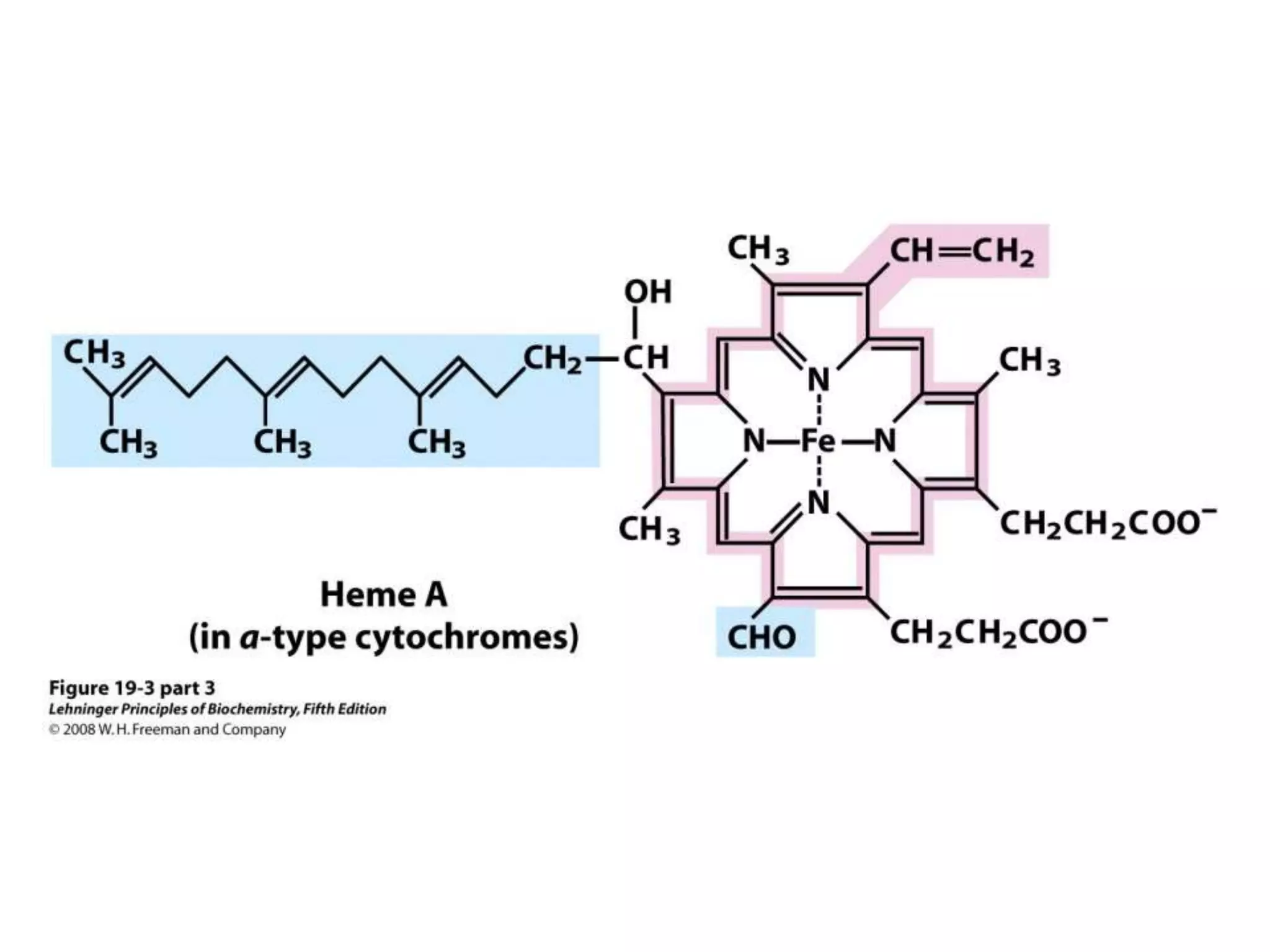
   Cytochrome: an electron transferring protein that
    contains a heme prosthetic group!
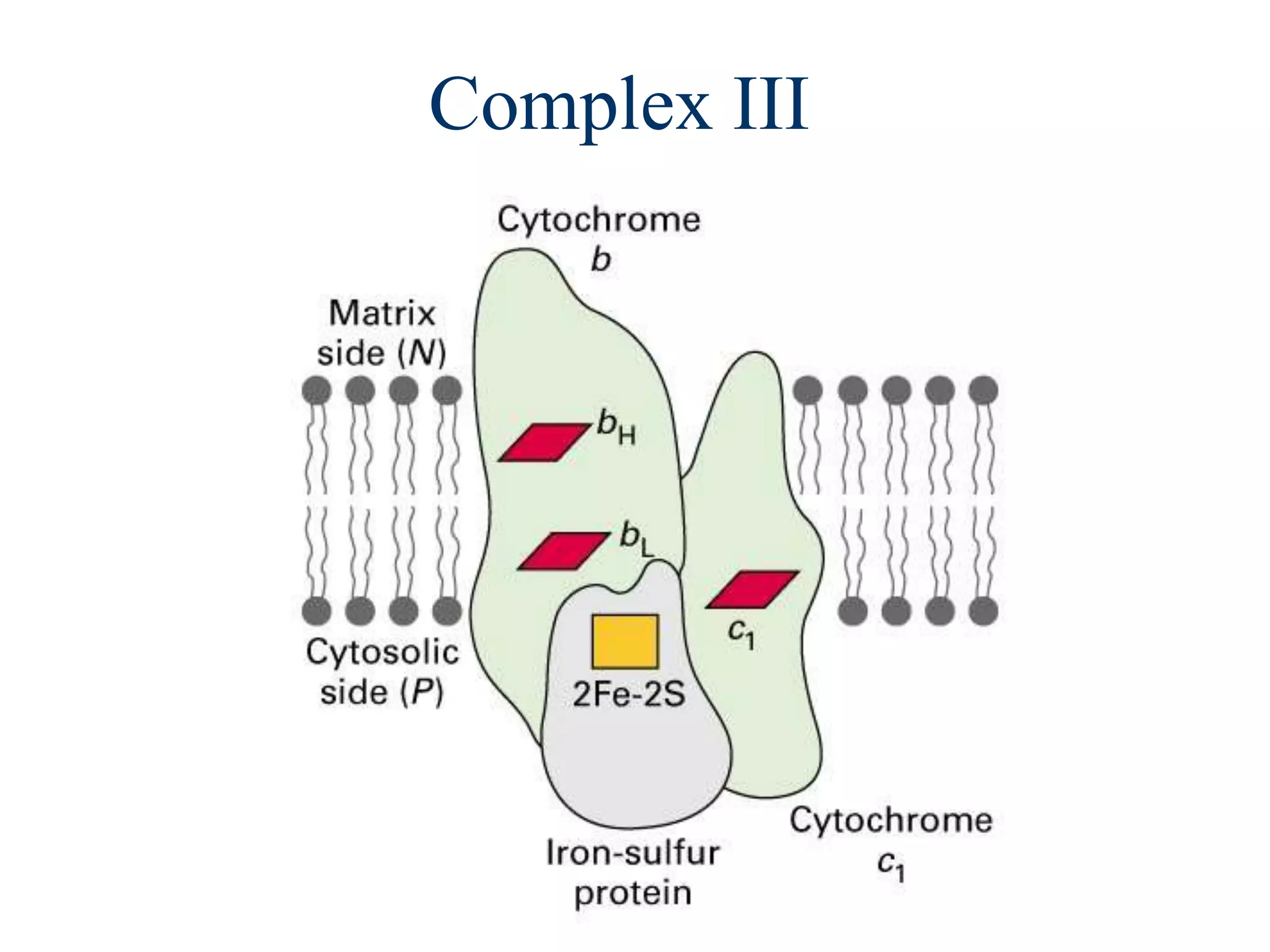
Complex III
Complex III
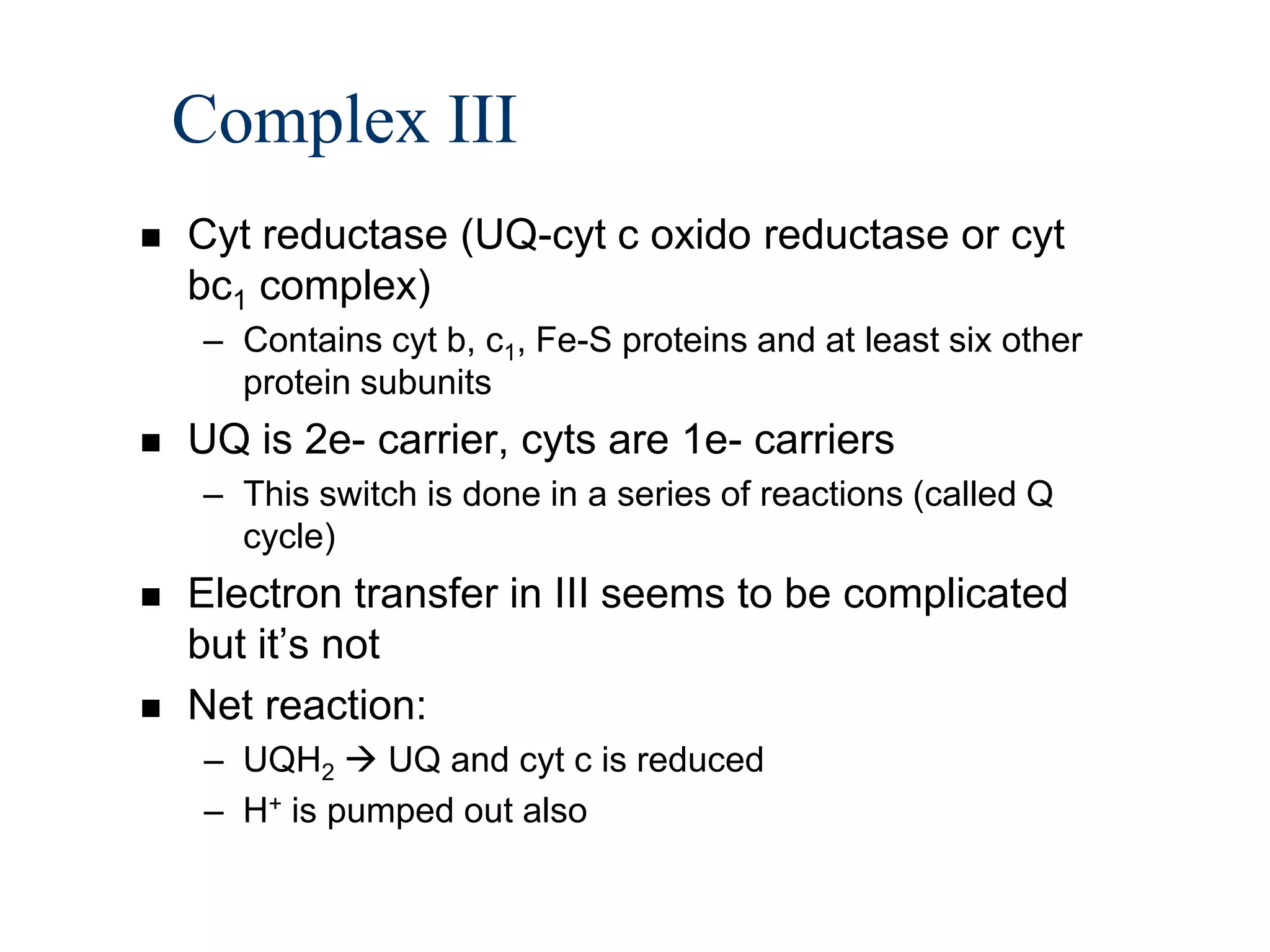
   Cyt reductase (UQ-cyt c oxido reductase or cyt
    bc1 complex)
     – Contains cyt b, c1, Fe-S proteins and at least six other
       protein subunits
   UQ is 2e- carrier, cyts are 1e- carriers
     – This switch is done in a series of reactions (called Q
       cycle)
   Electron transfer in III seems to be complicated
    but it’s not
   Net reaction:
     – UQH2  UQ and cyt c is reduced
     – H+ is pumped out also
Complex IV

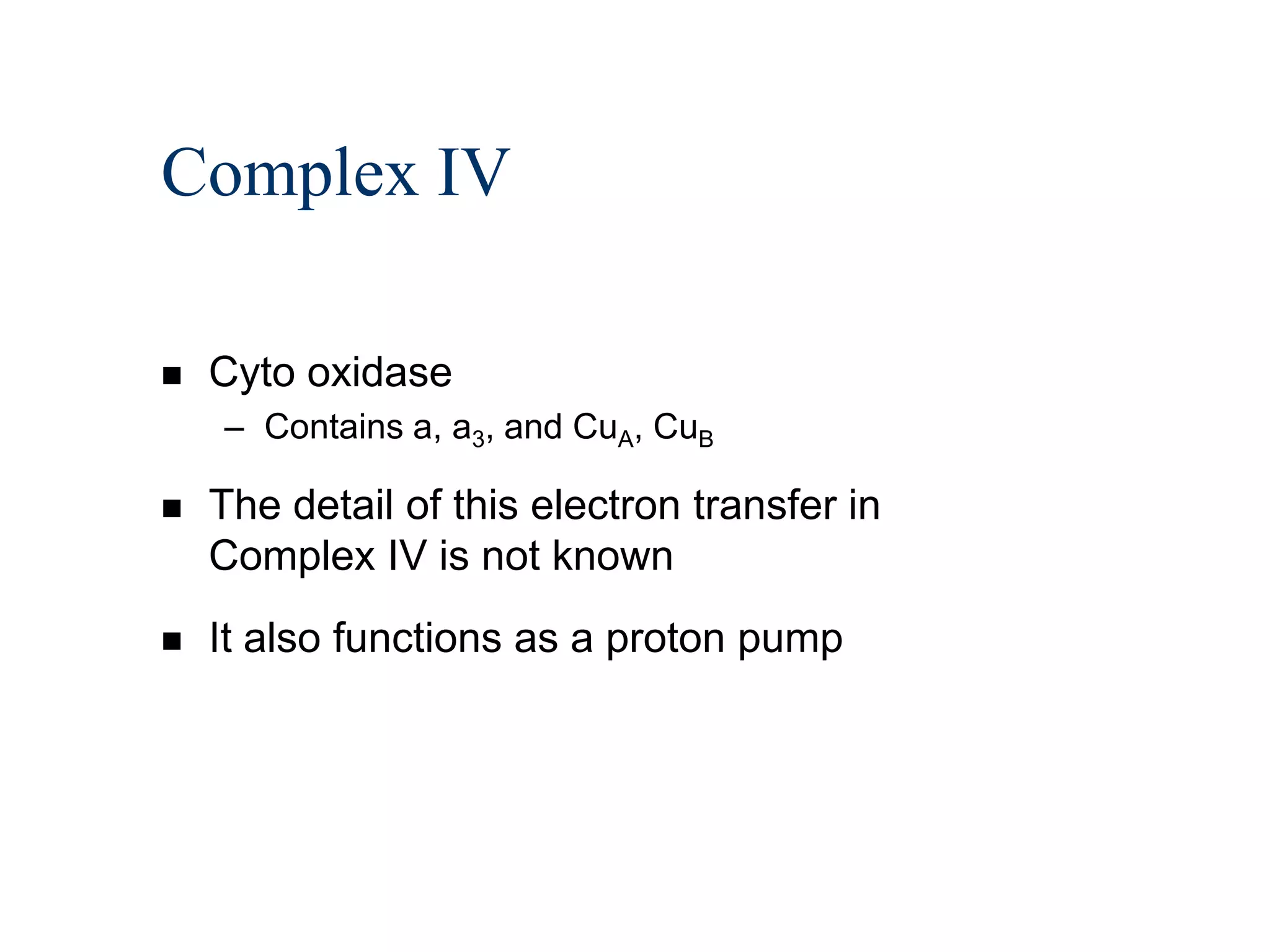
   Cyto oxidase
    – Contains a, a3, and CuA, CuB

   The detail of this electron transfer in
    Complex IV is not known
   It also functions as a proton pump
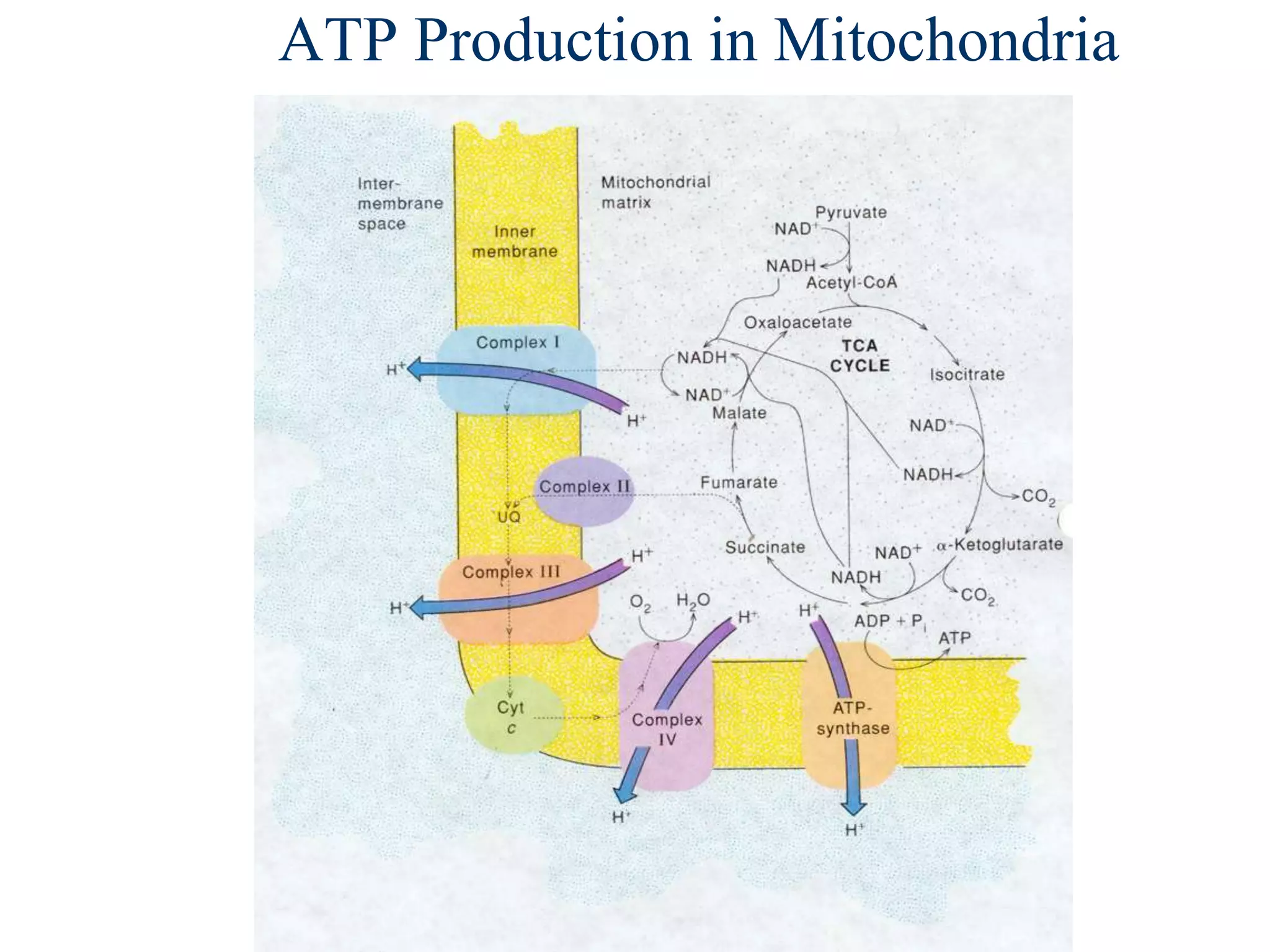
ATP Production in Mitochondria
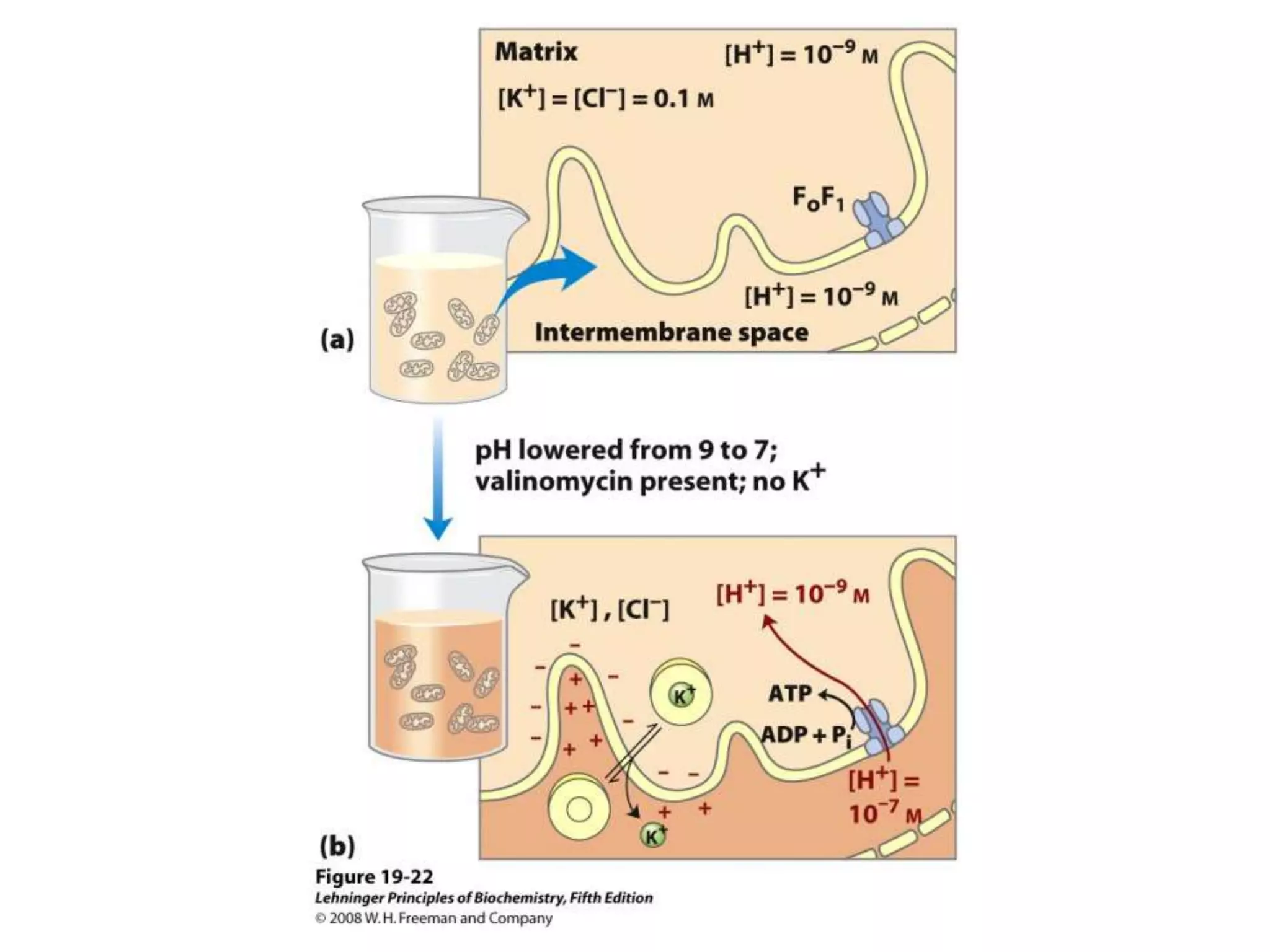
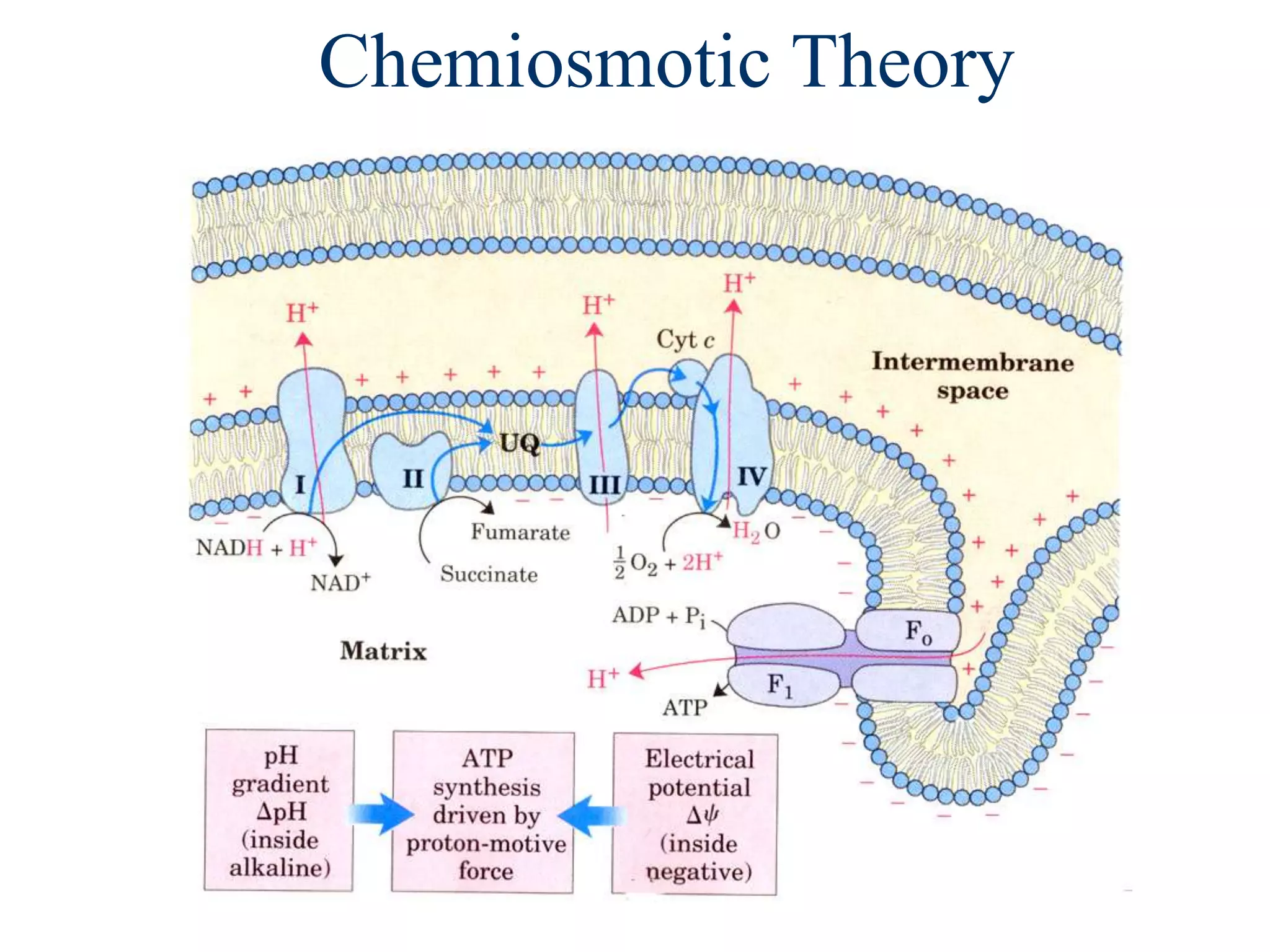
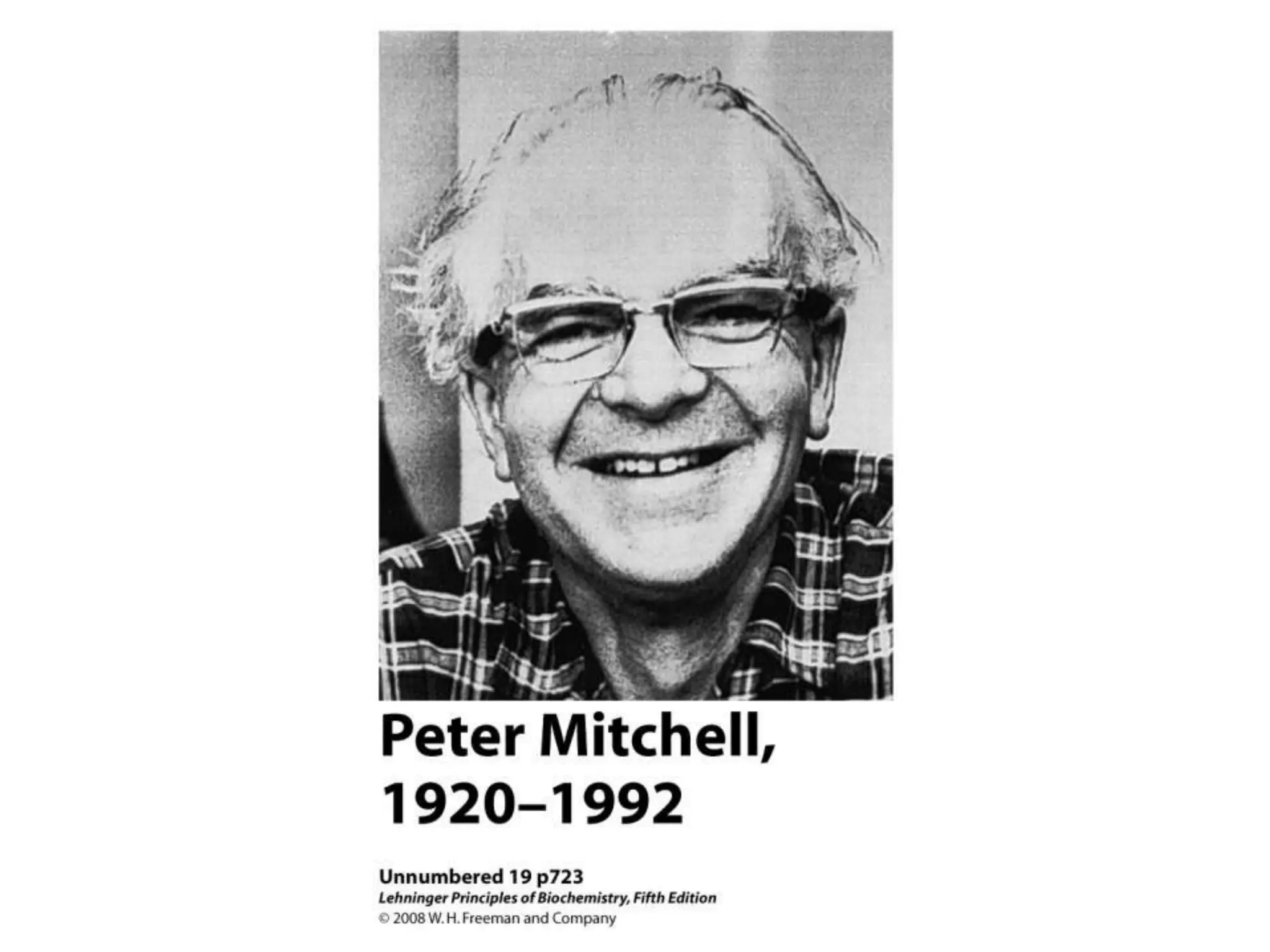
Chemiosmotic Theory
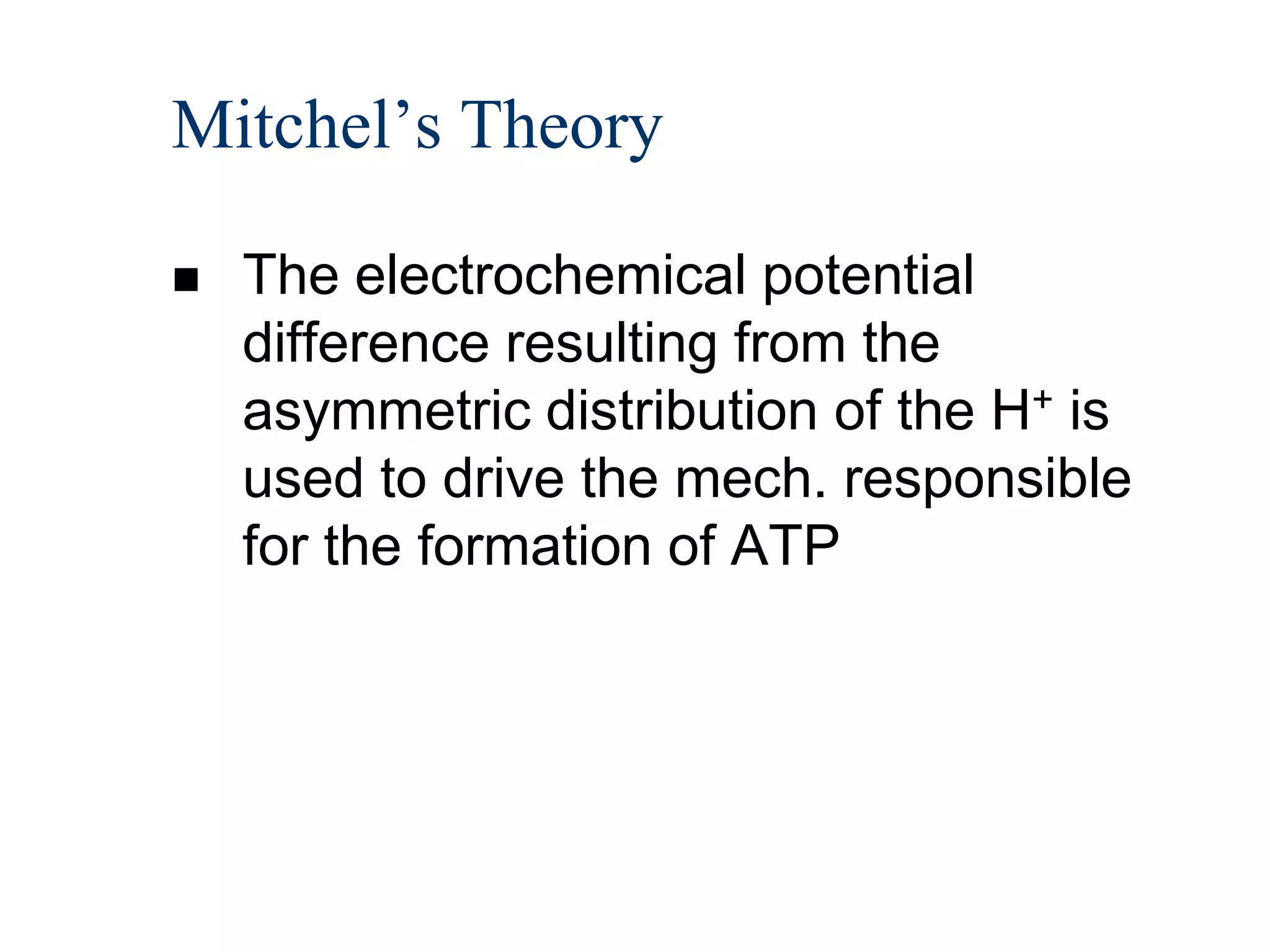
Mitchel’s Theory

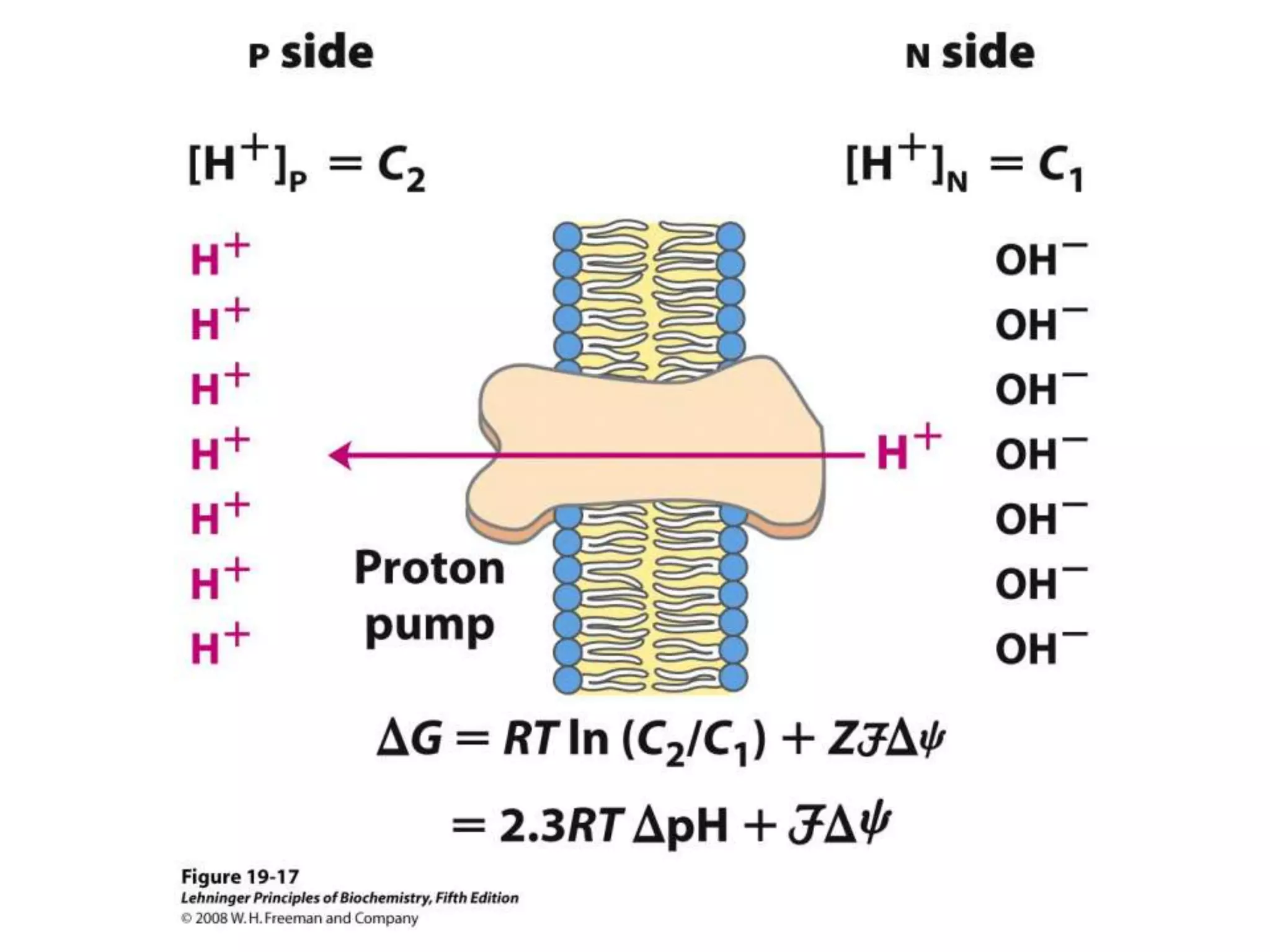
   The electrochemical potential
    difference resulting from the
    asymmetric distribution of the H+ is
    used to drive the mech. responsible
    for the formation of ATP
Chemiosmotic Theory Continued…
              G = RT ln(C2/C1) + ZF
                    [   +     ]   [   +   ]


When H+ is pumped against electrochemical gradient

                        G=+

 When protons flow back inside, this G becomes
 available to do the work!!
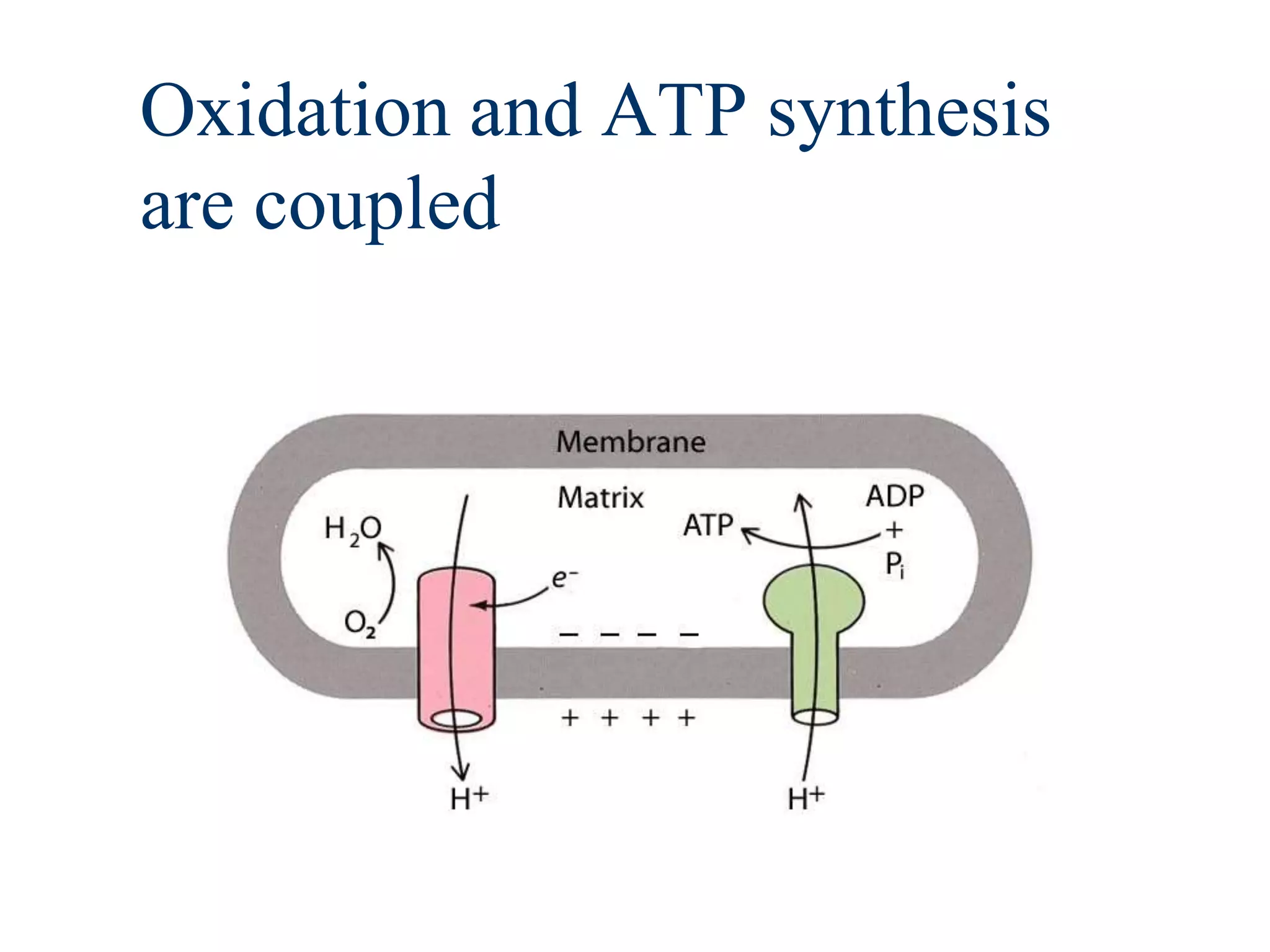
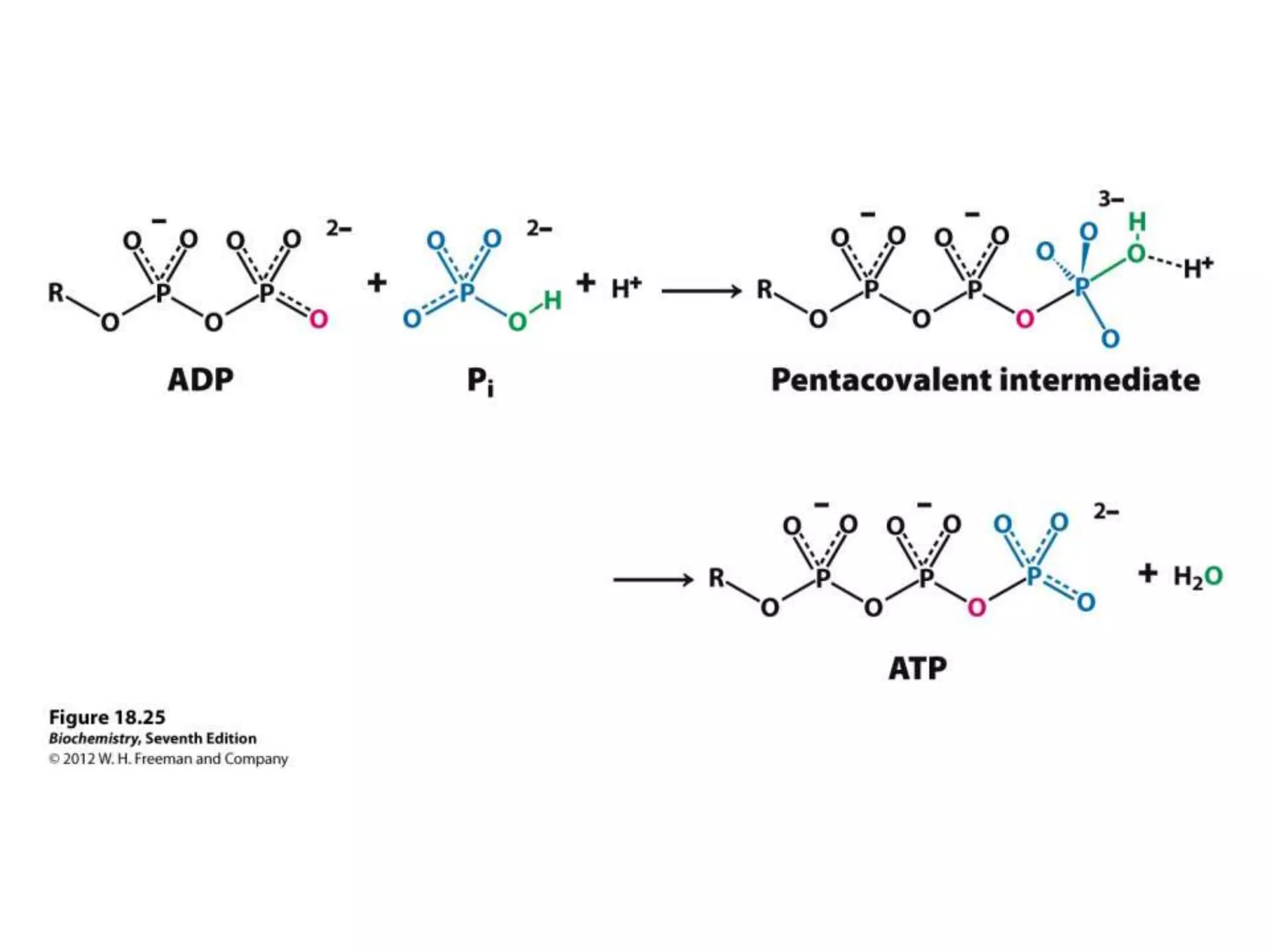
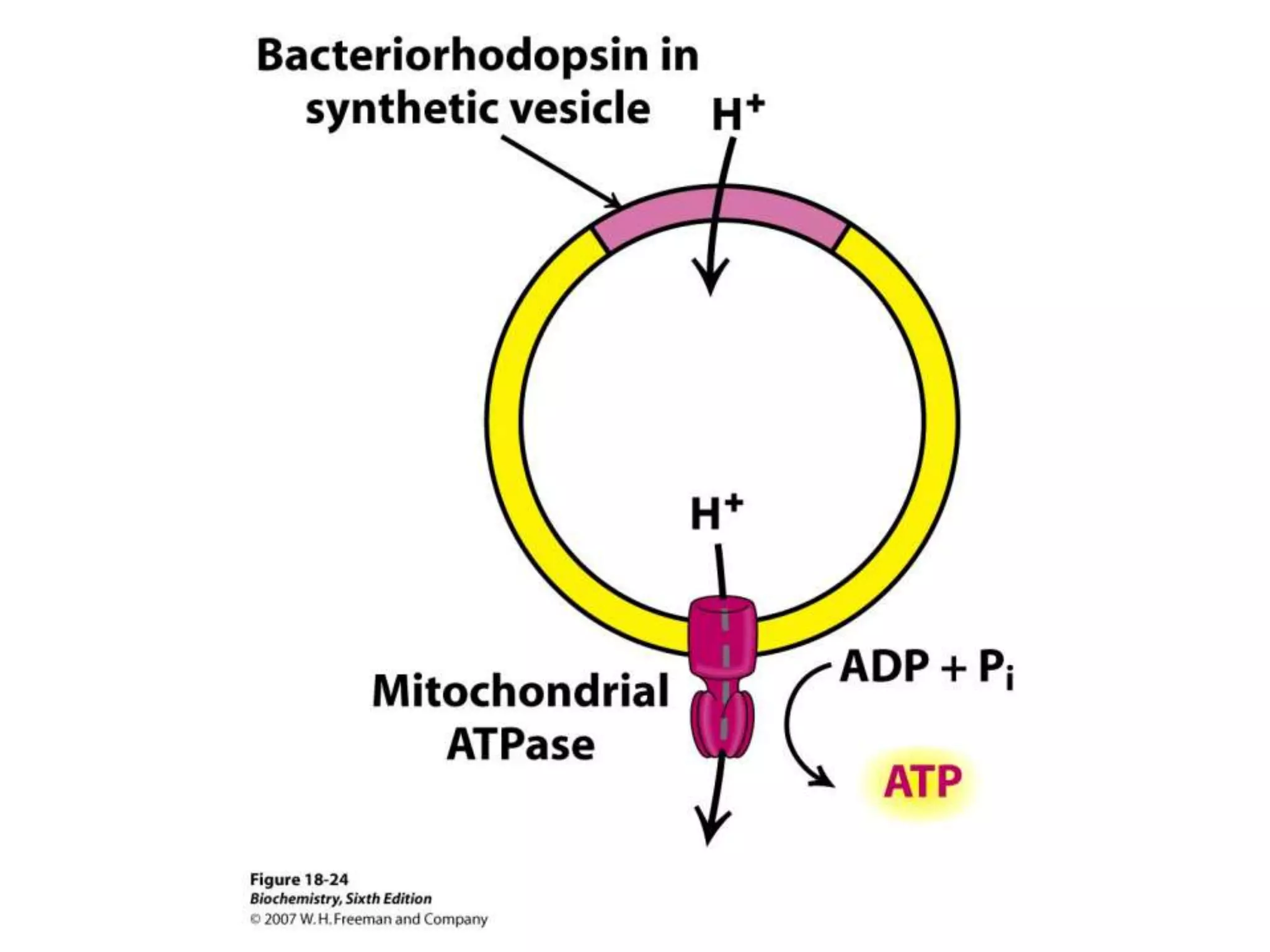
Oxidation and ATP synthesis
are coupled
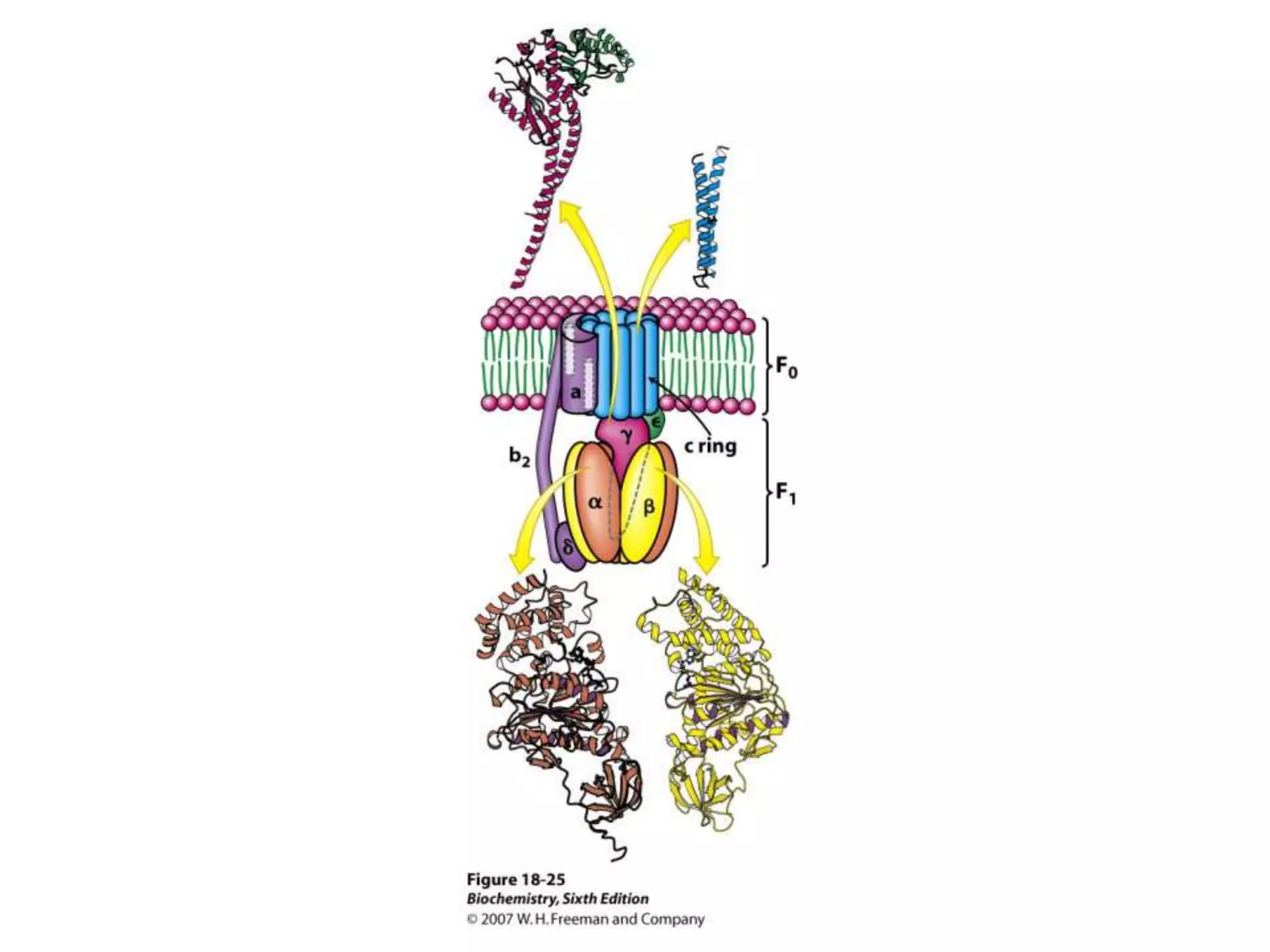
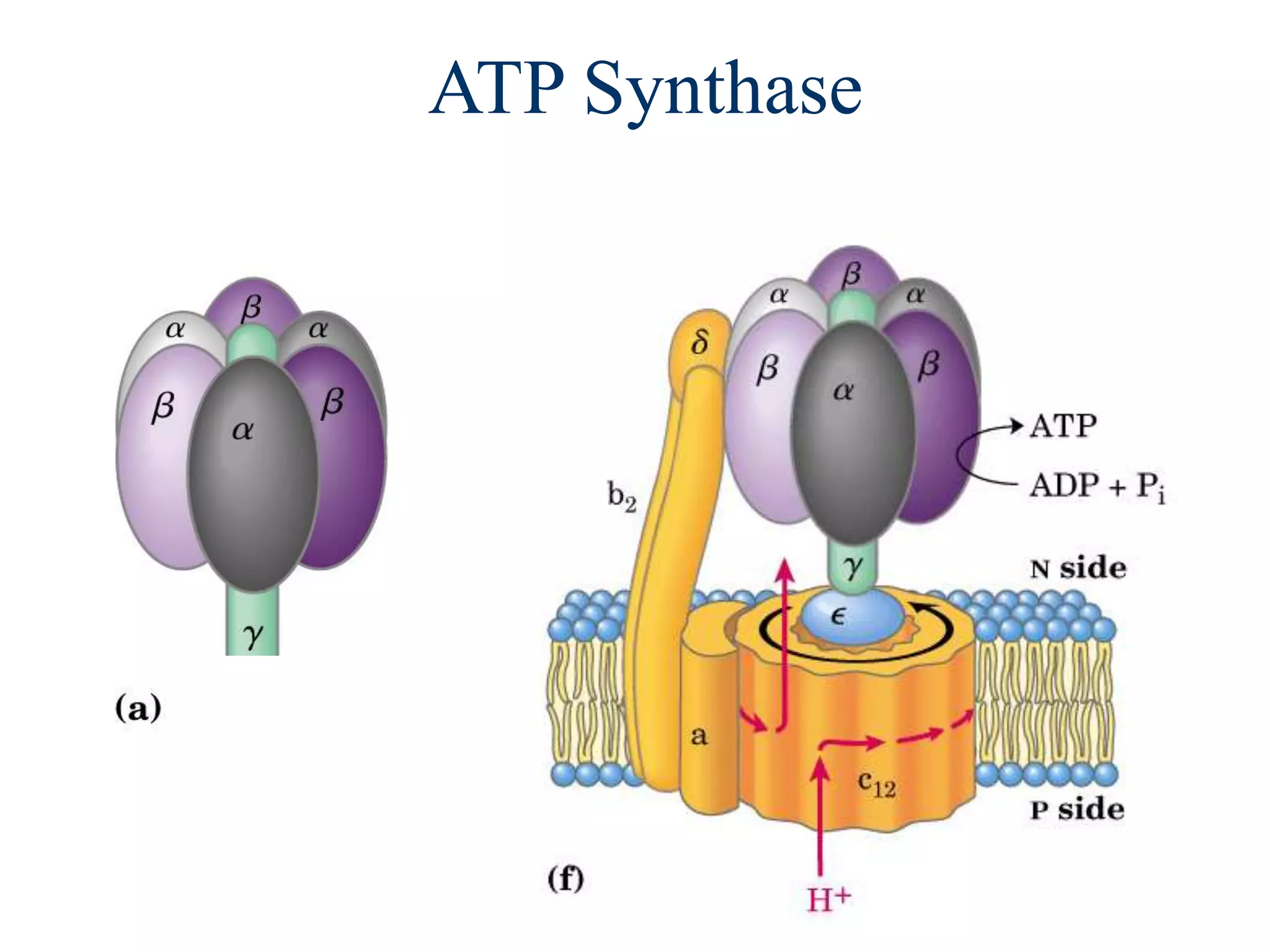
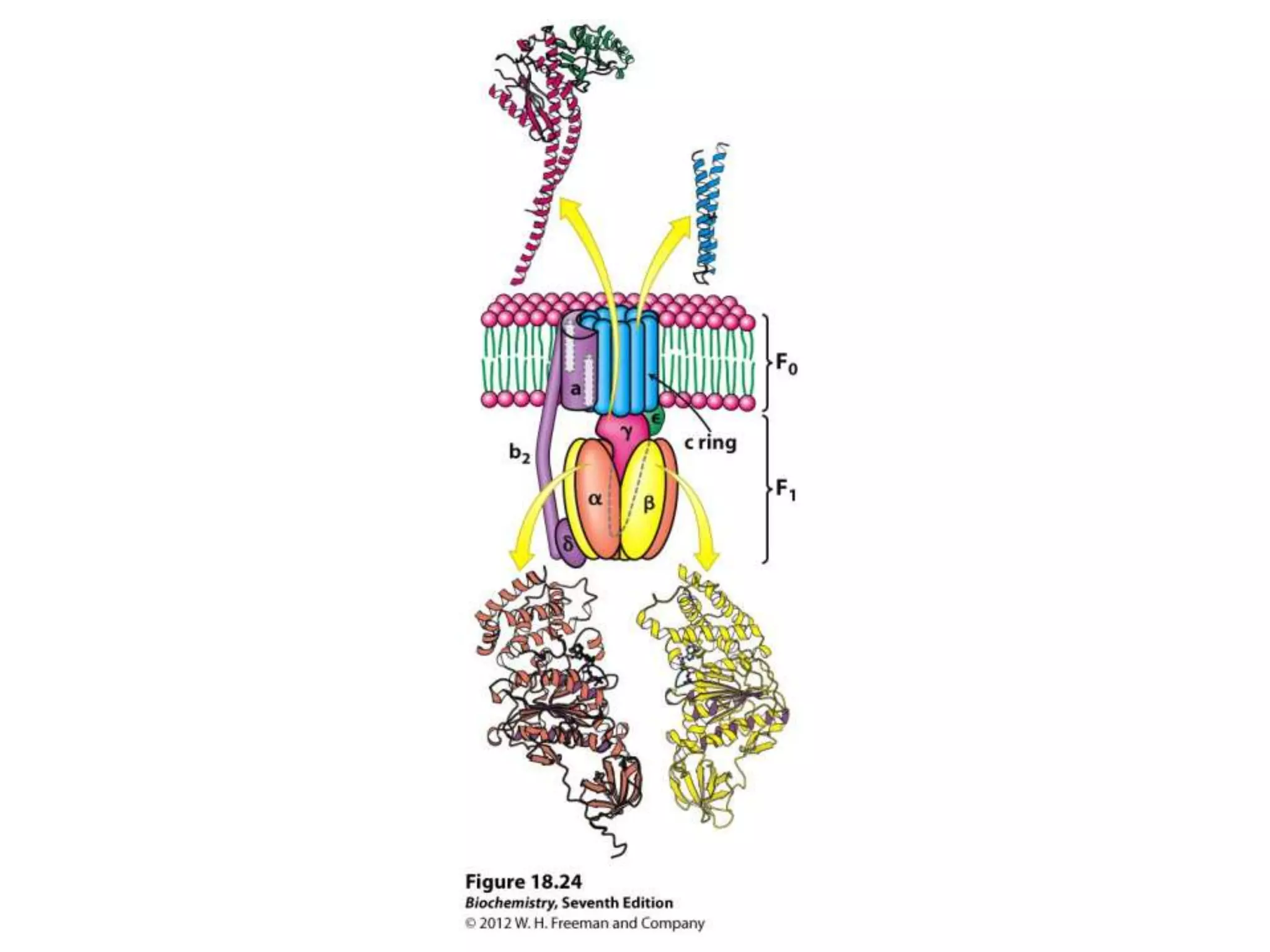
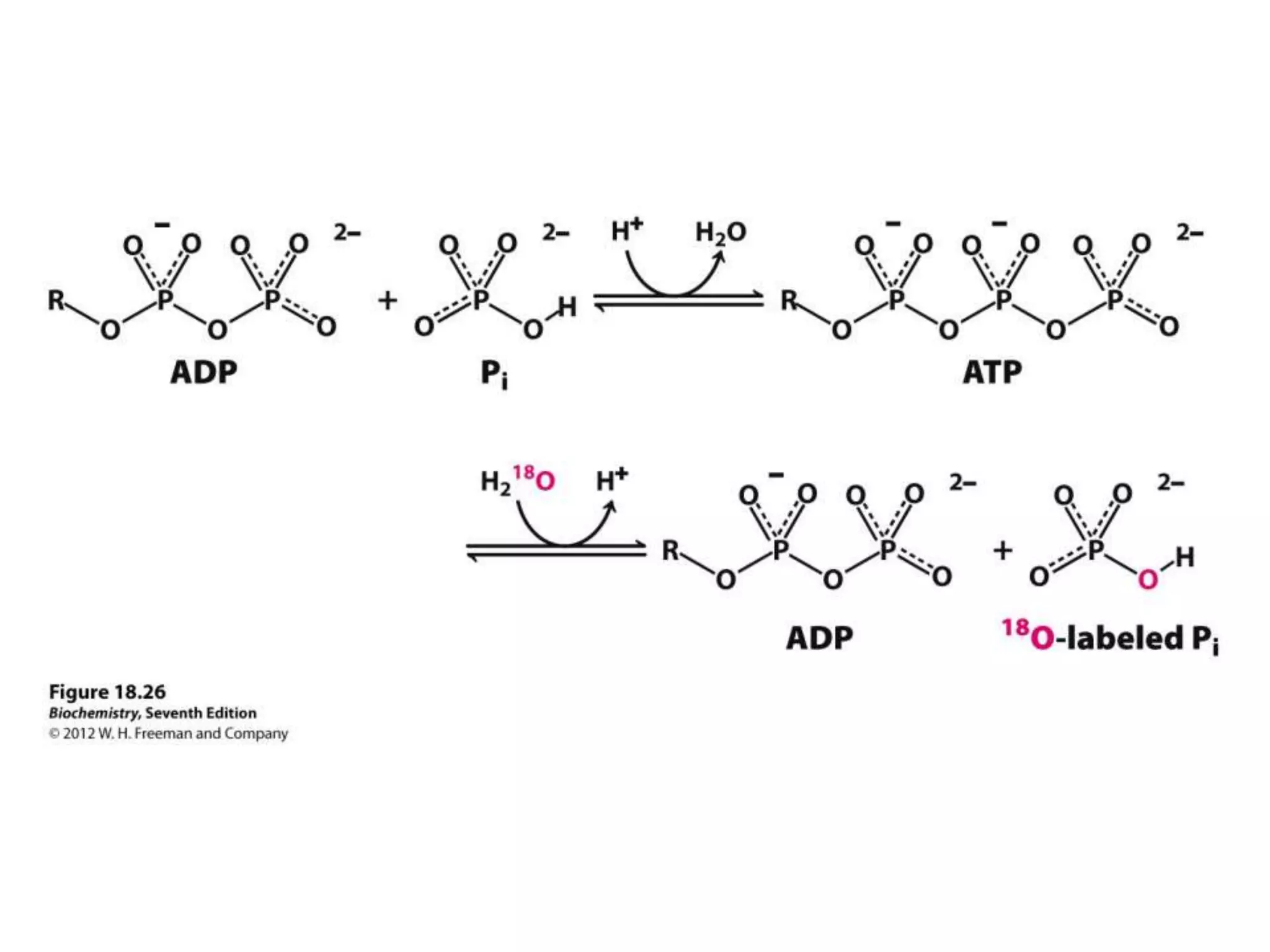
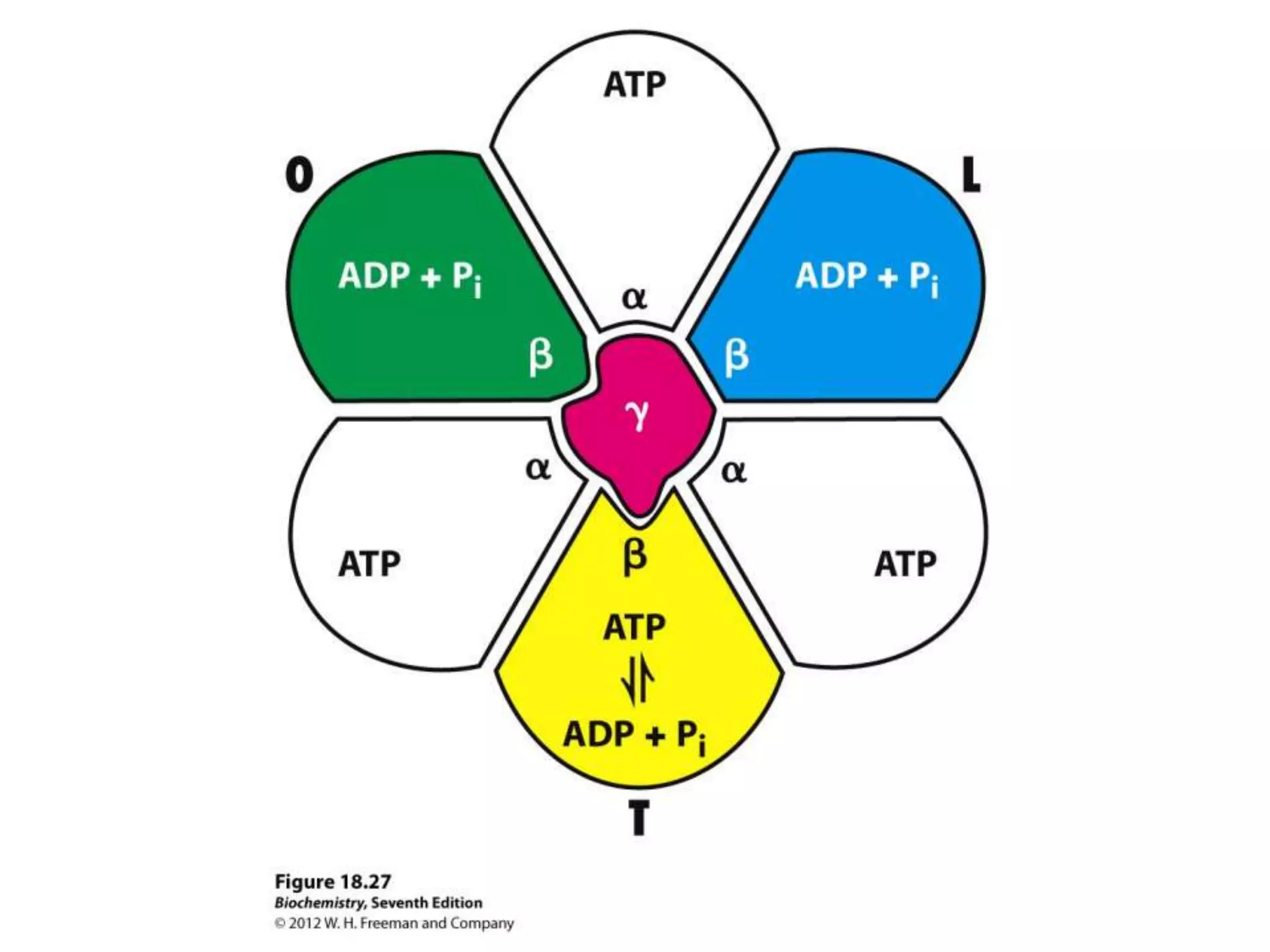
ATP Synthase
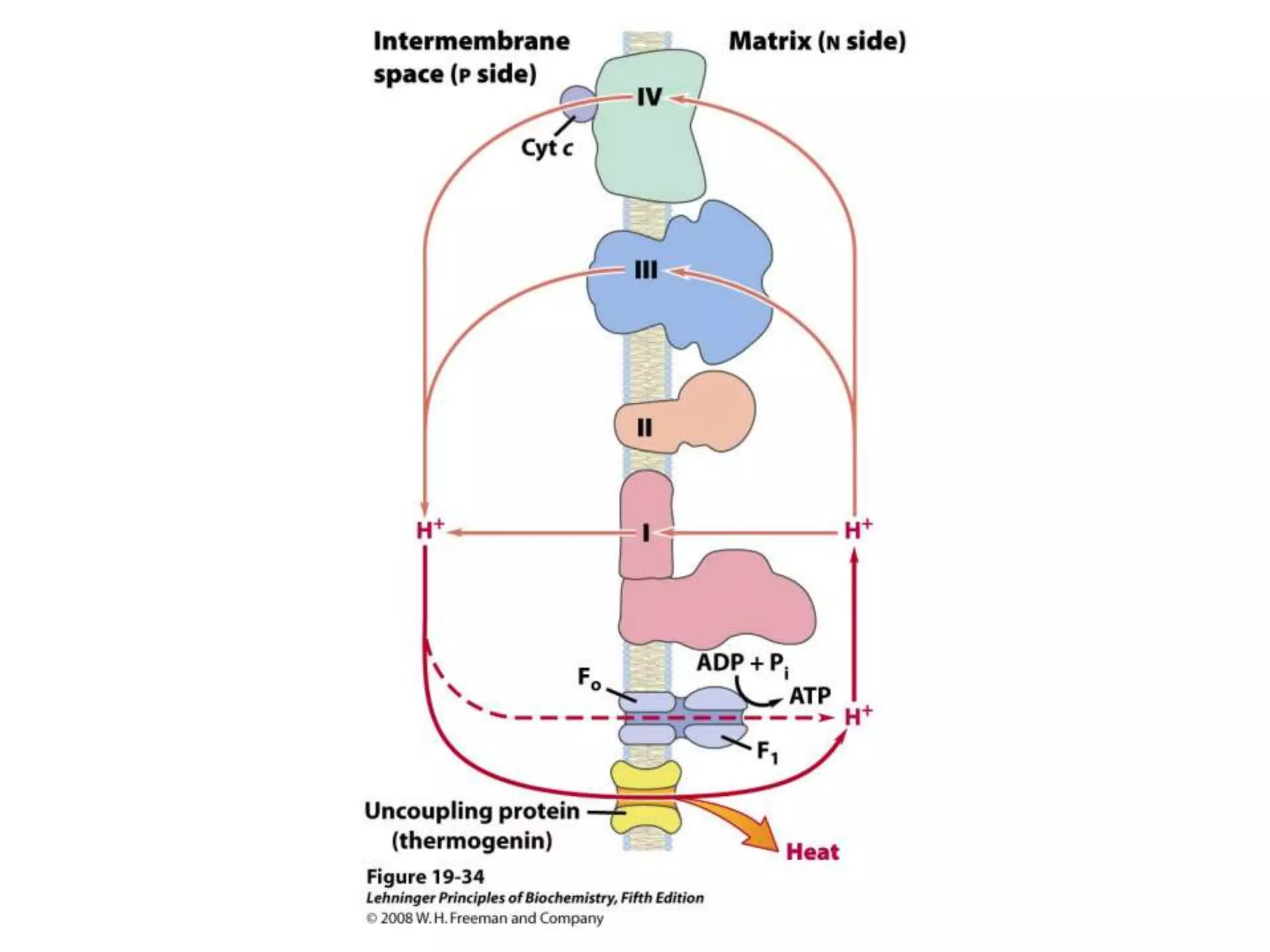
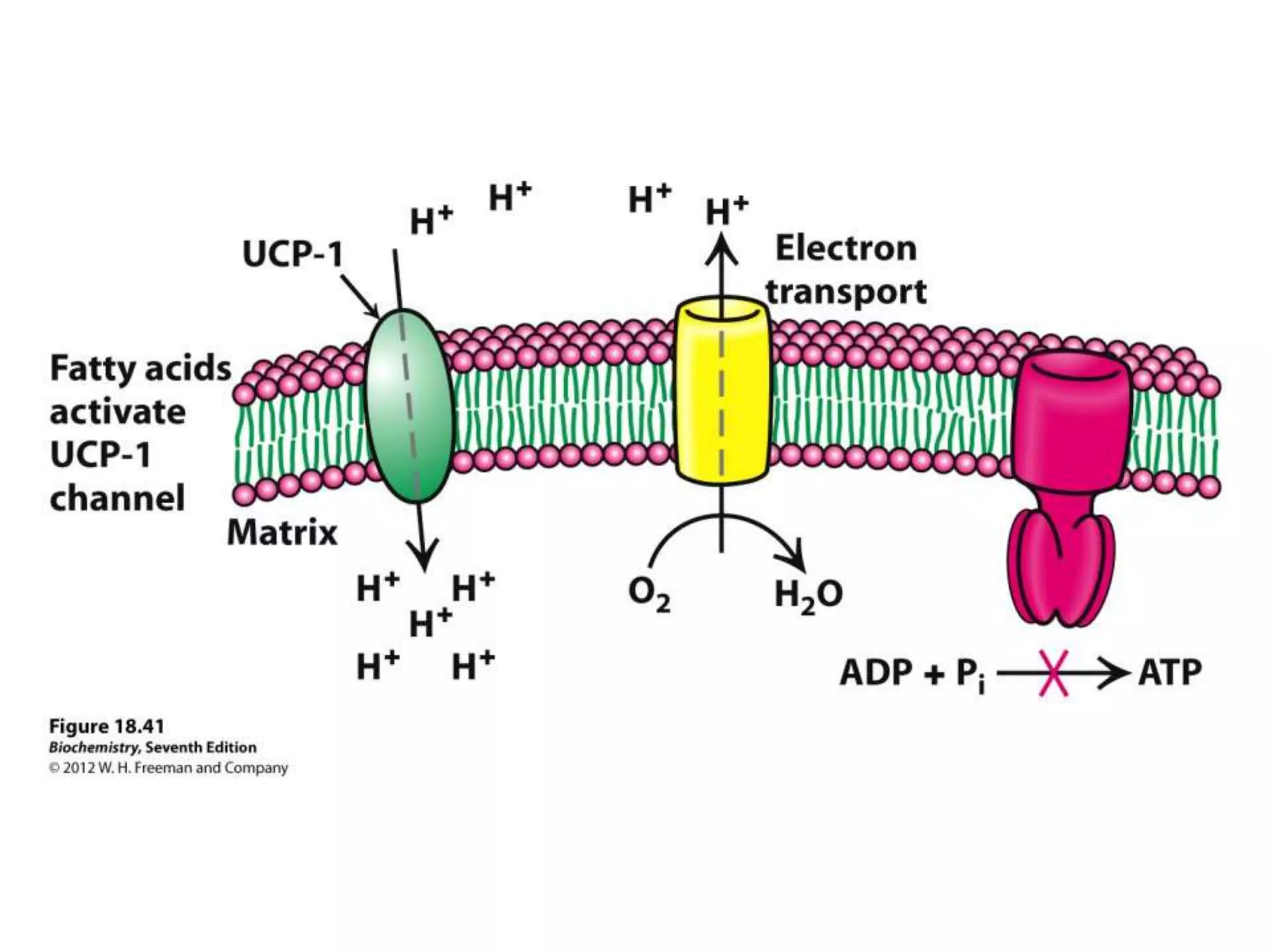
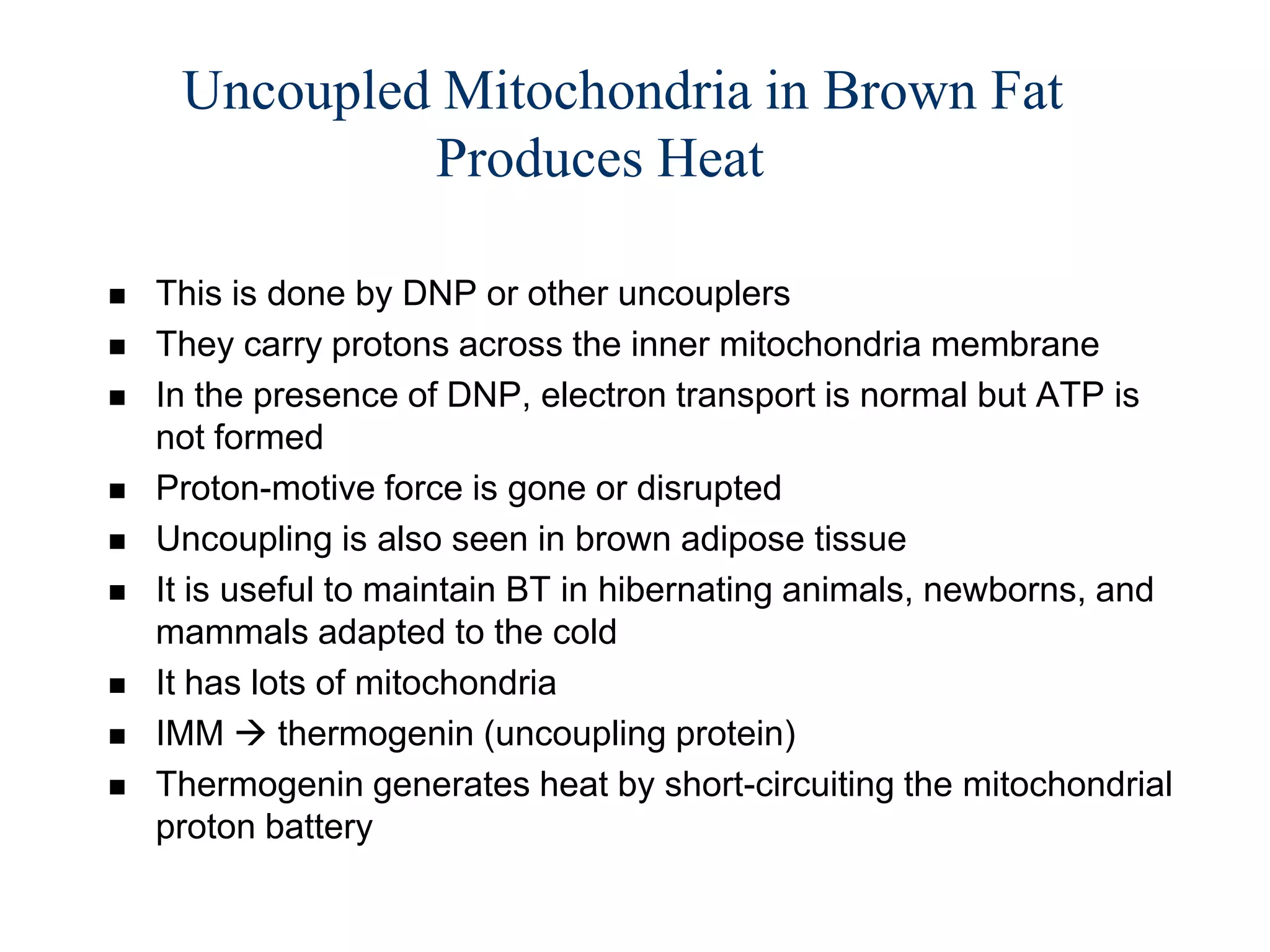
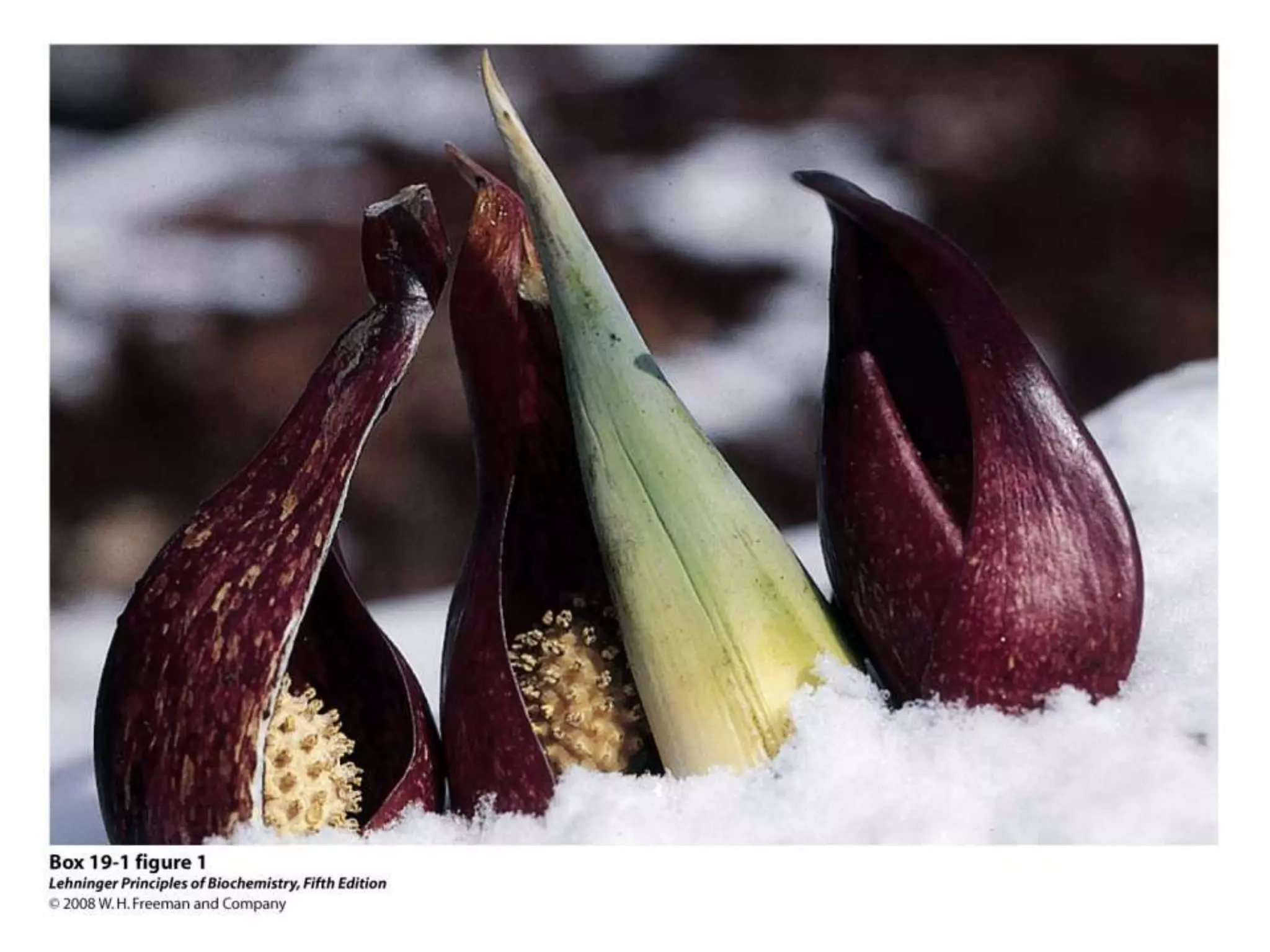
Uncoupled Mitochondria in Brown Fat
              Produces Heat

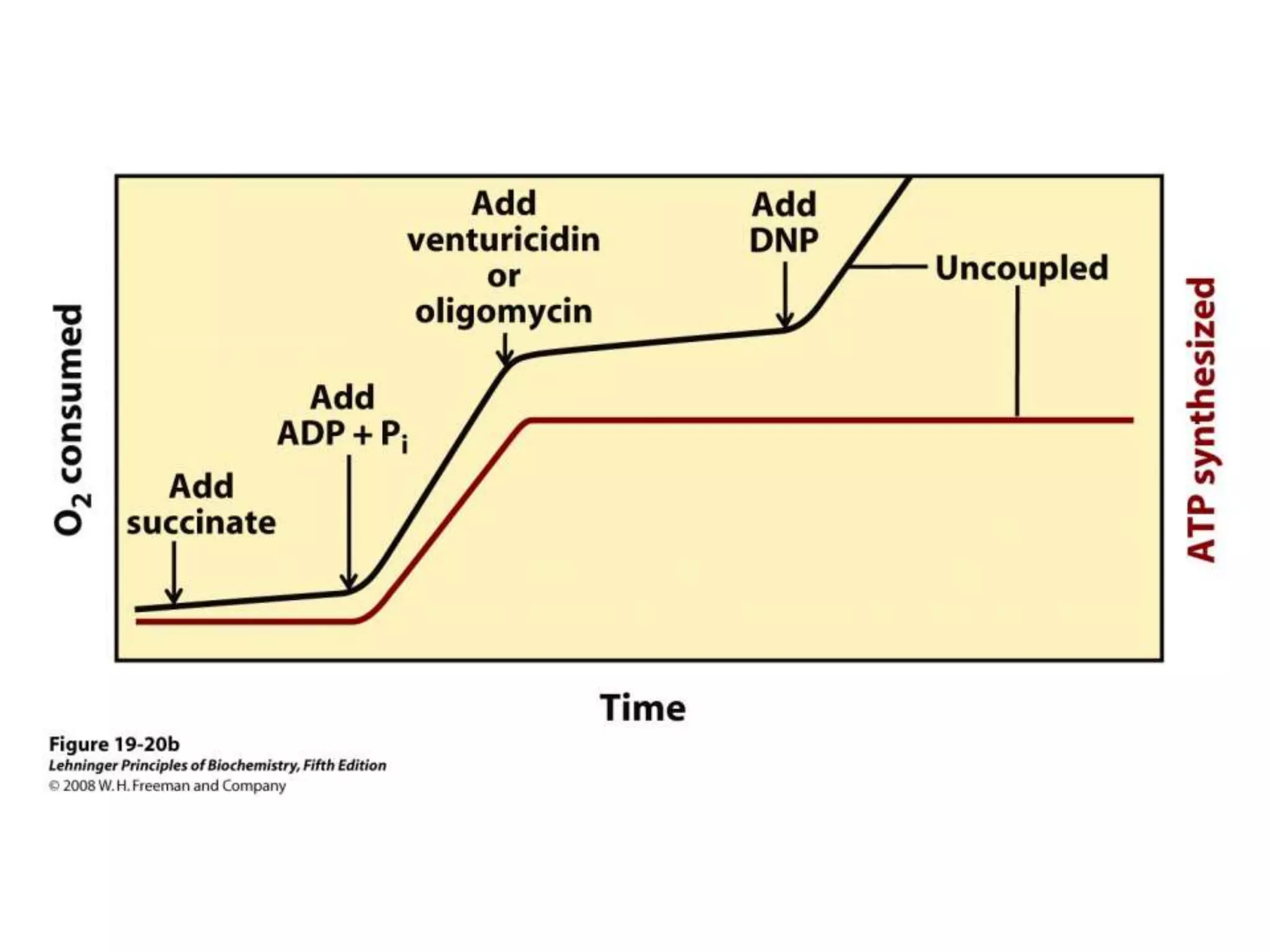
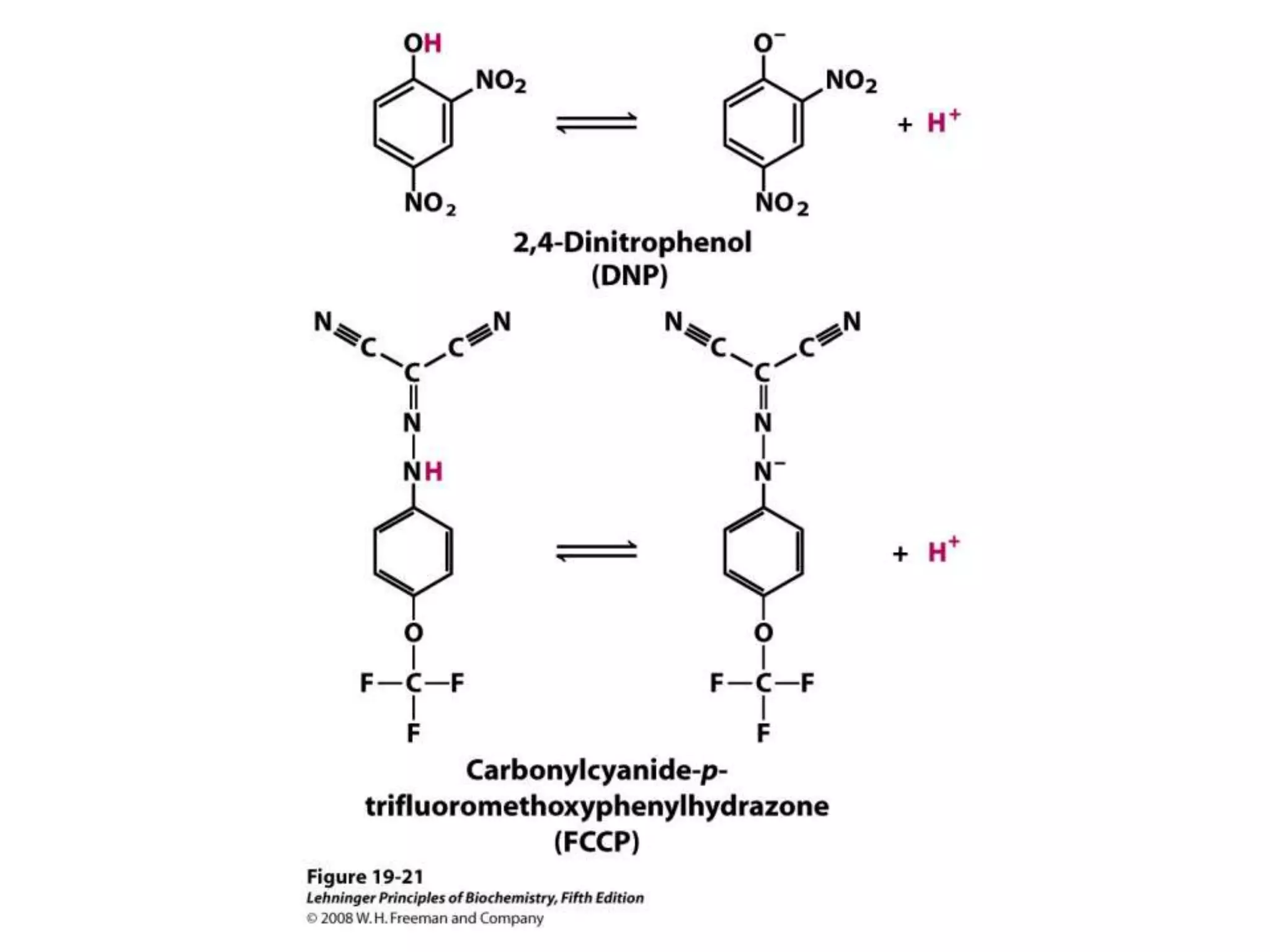
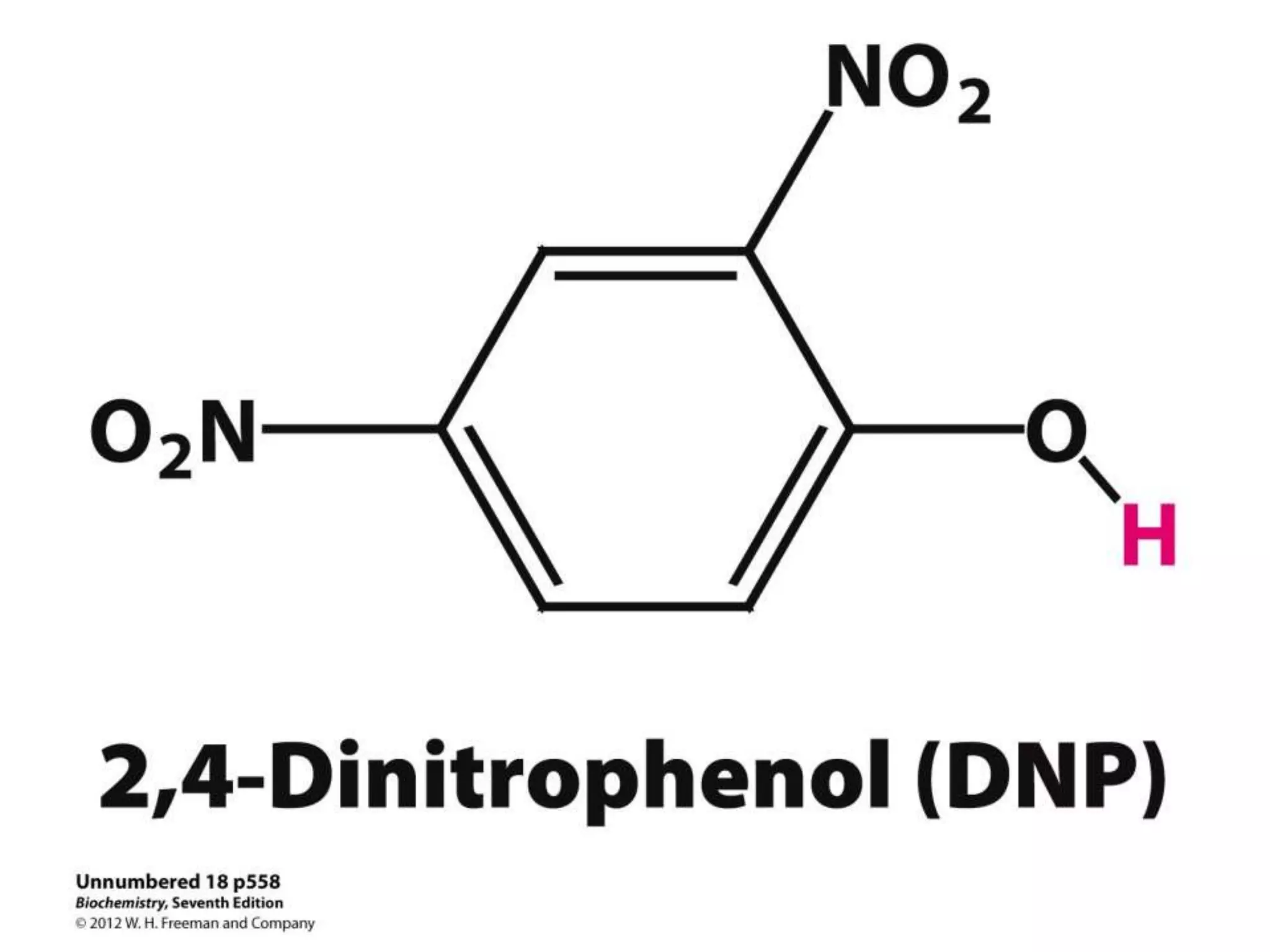
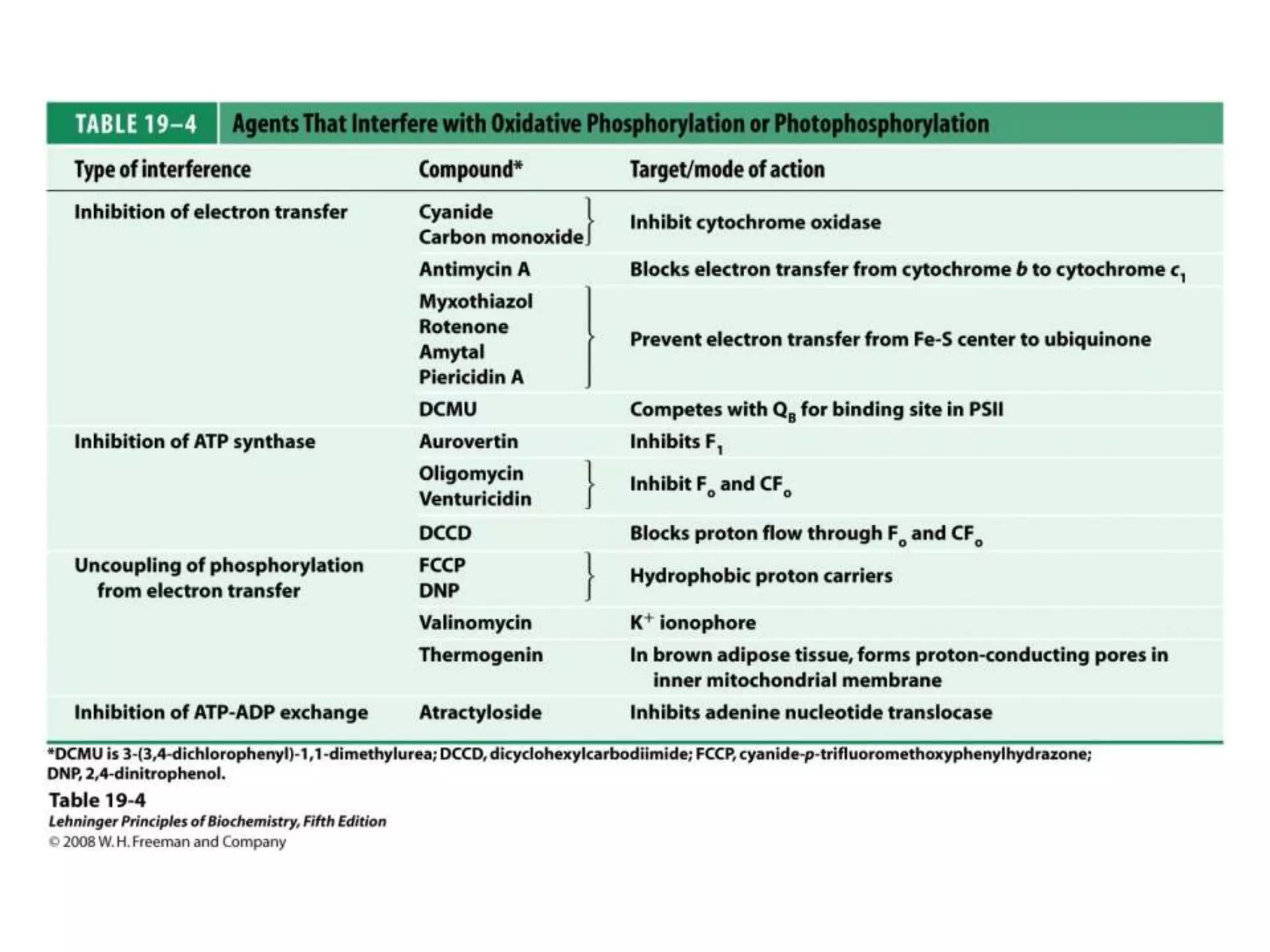
   This is done by DNP or other uncouplers
   They carry protons across the inner mitochondria membrane
   In the presence of DNP, electron transport is normal but ATP is
    not formed
   Proton-motive force is gone or disrupted
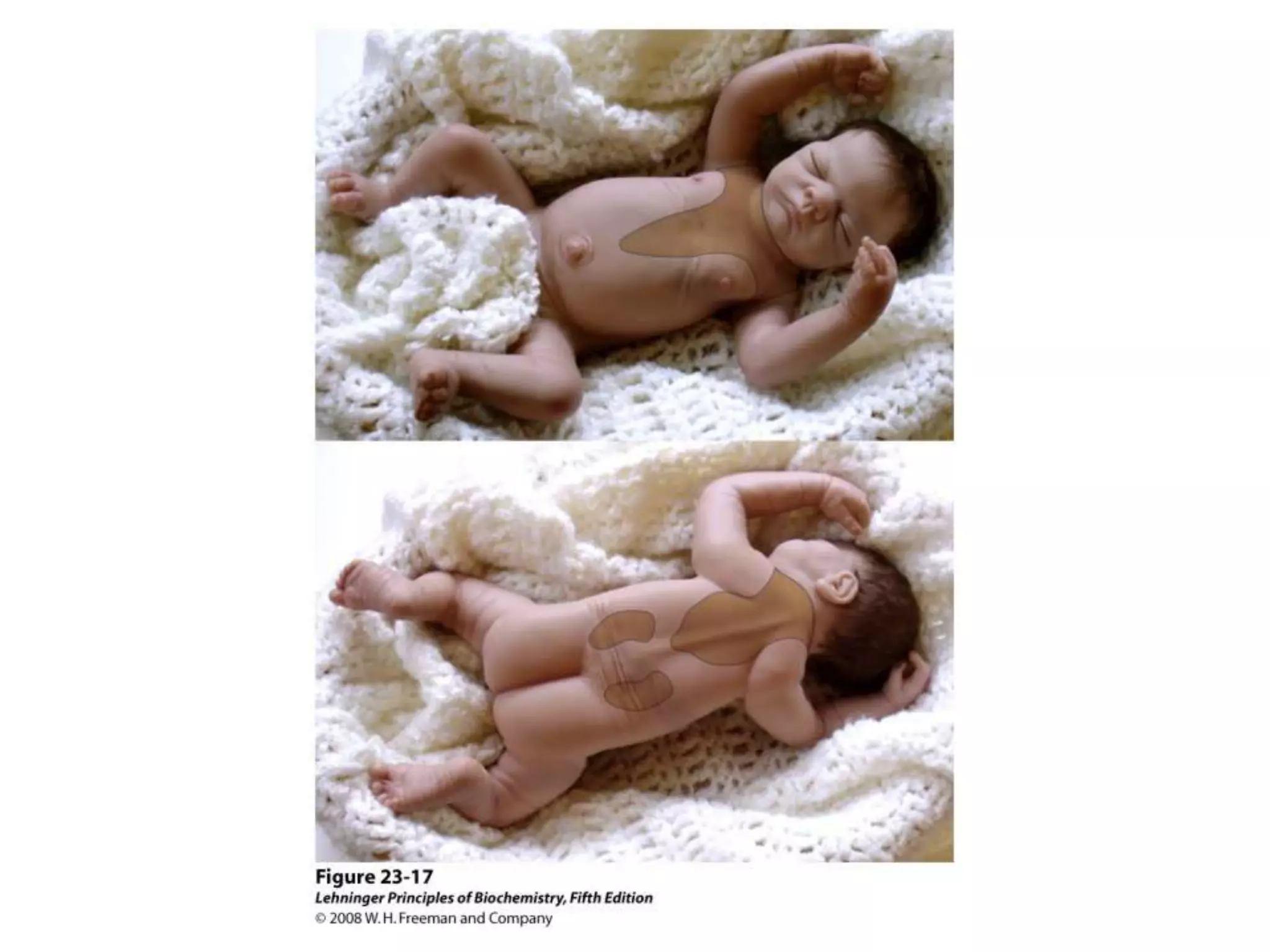
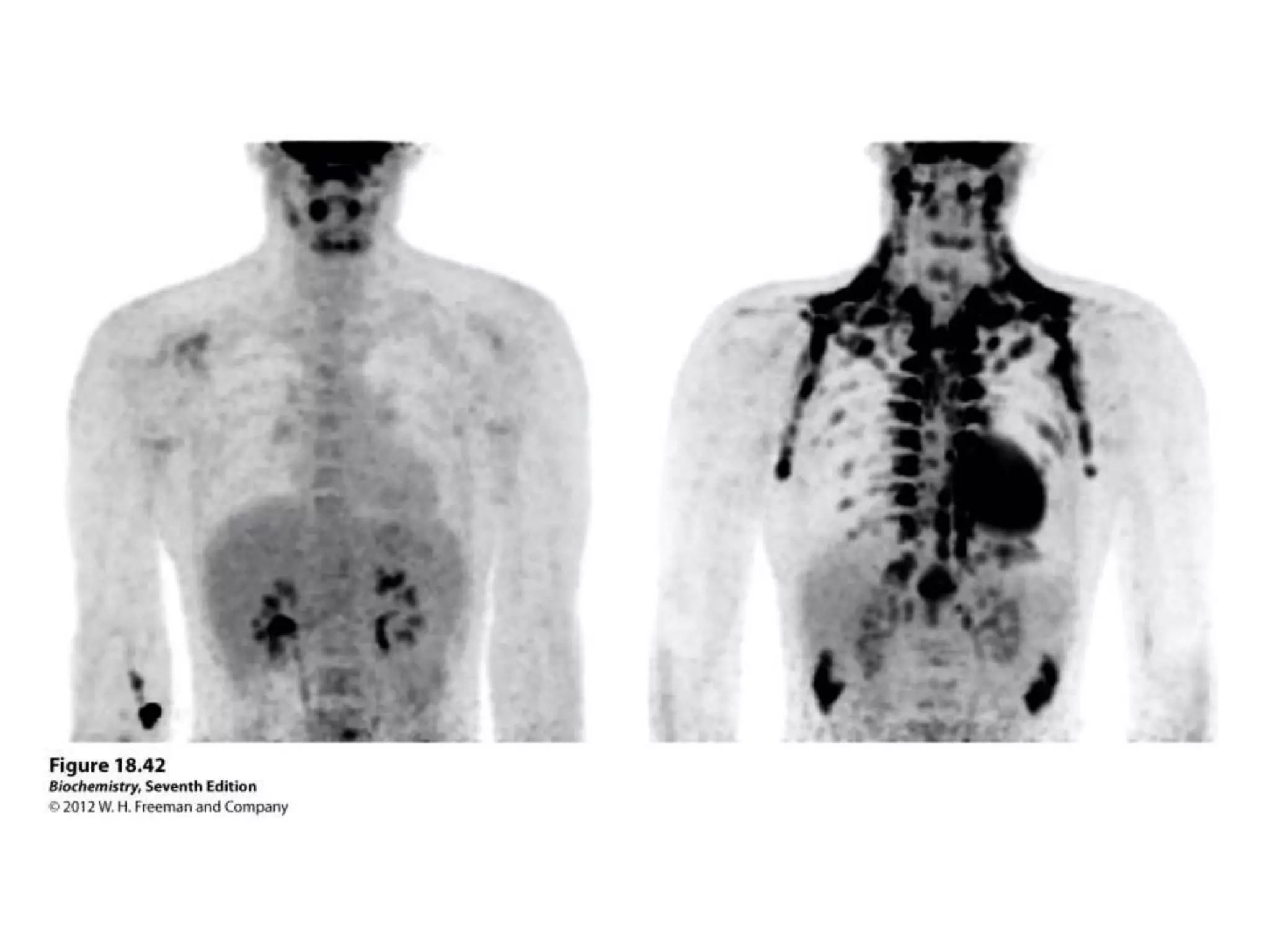
   Uncoupling is also seen in brown adipose tissue
   It is useful to maintain BT in hibernating animals, newborns, and
    mammals adapted to the cold
   It has lots of mitochondria
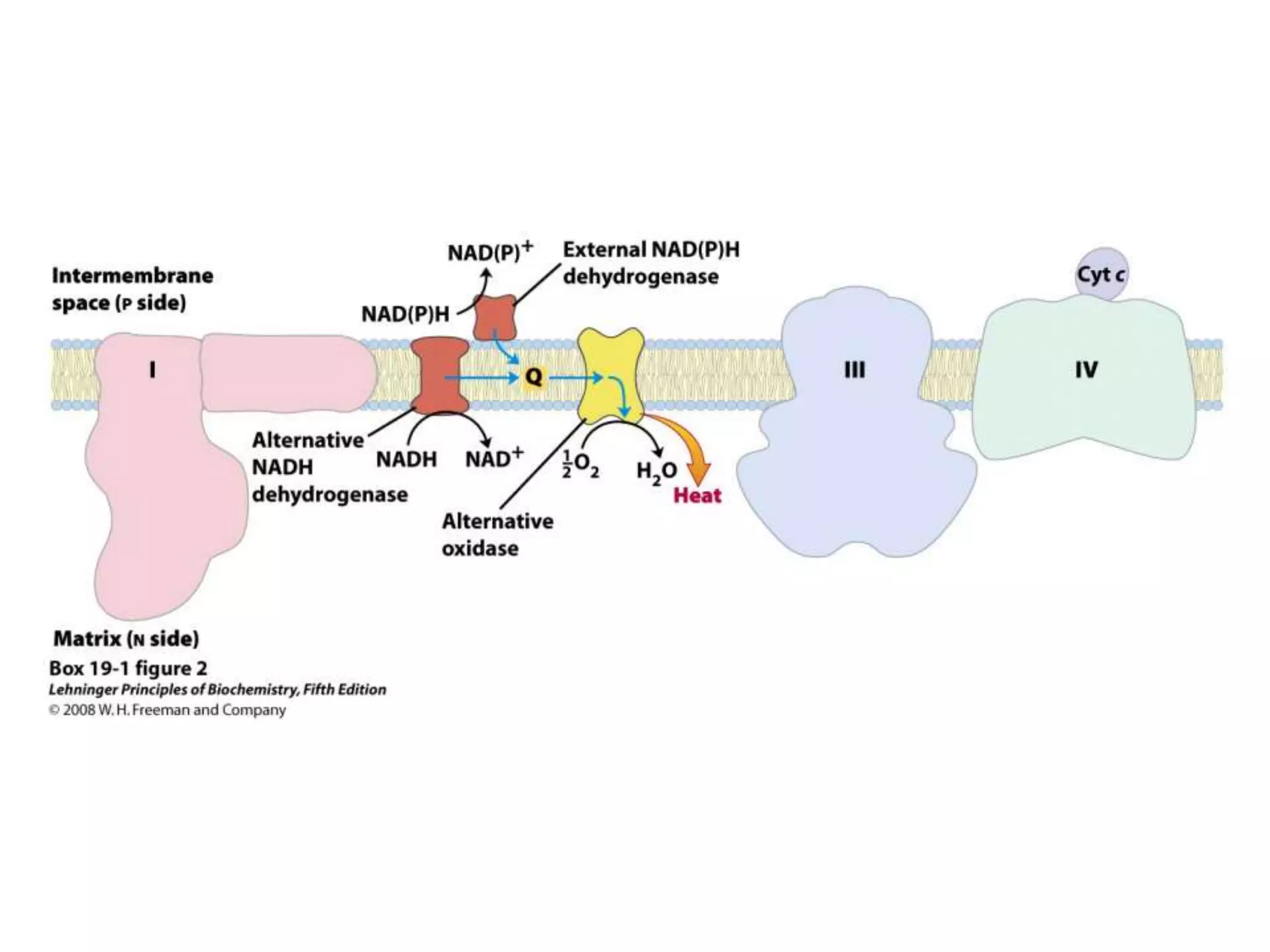
   IMM  thermogenin (uncoupling protein)
   Thermogenin generates heat by short-circuiting the mitochondrial
    proton battery
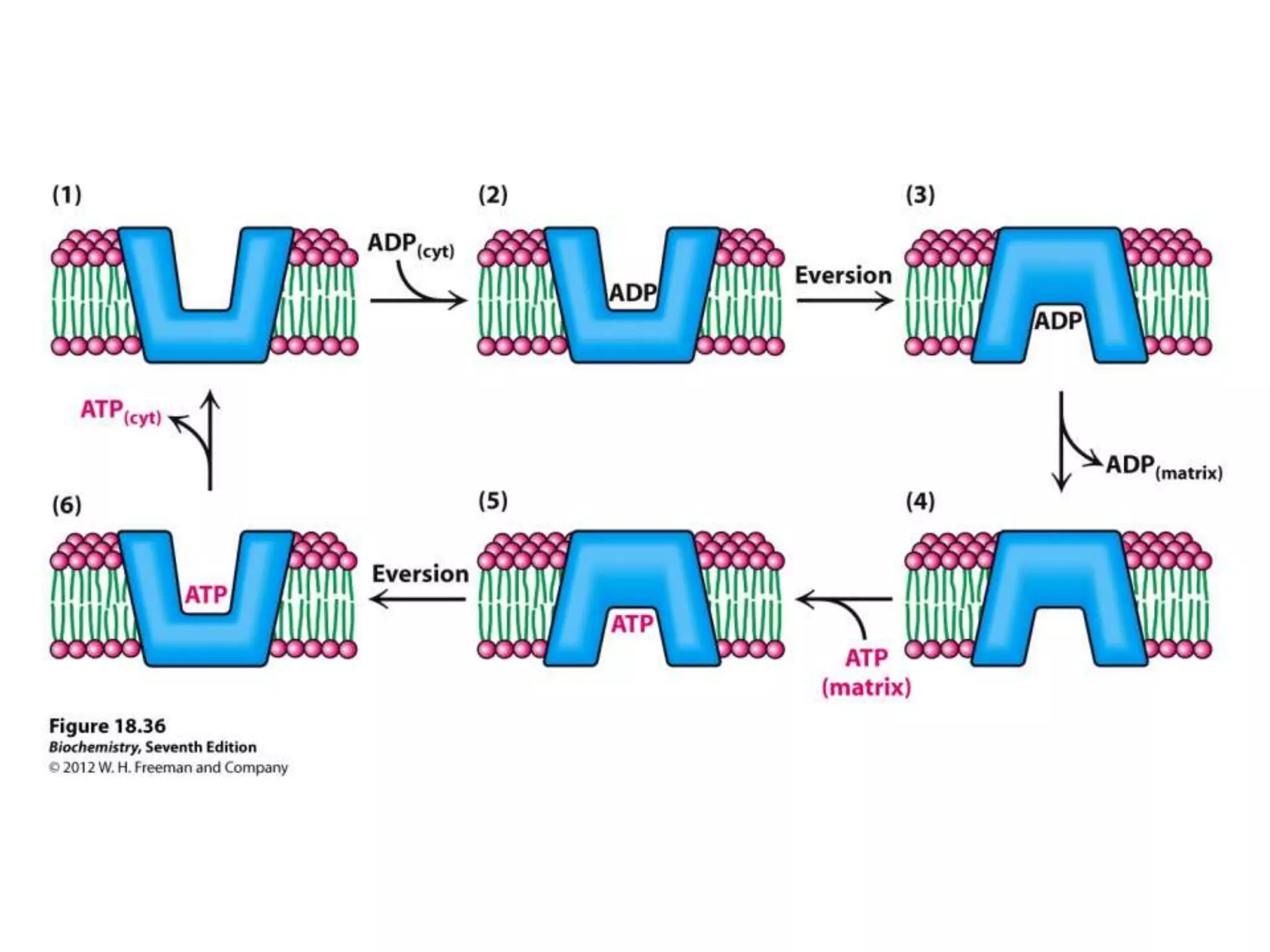
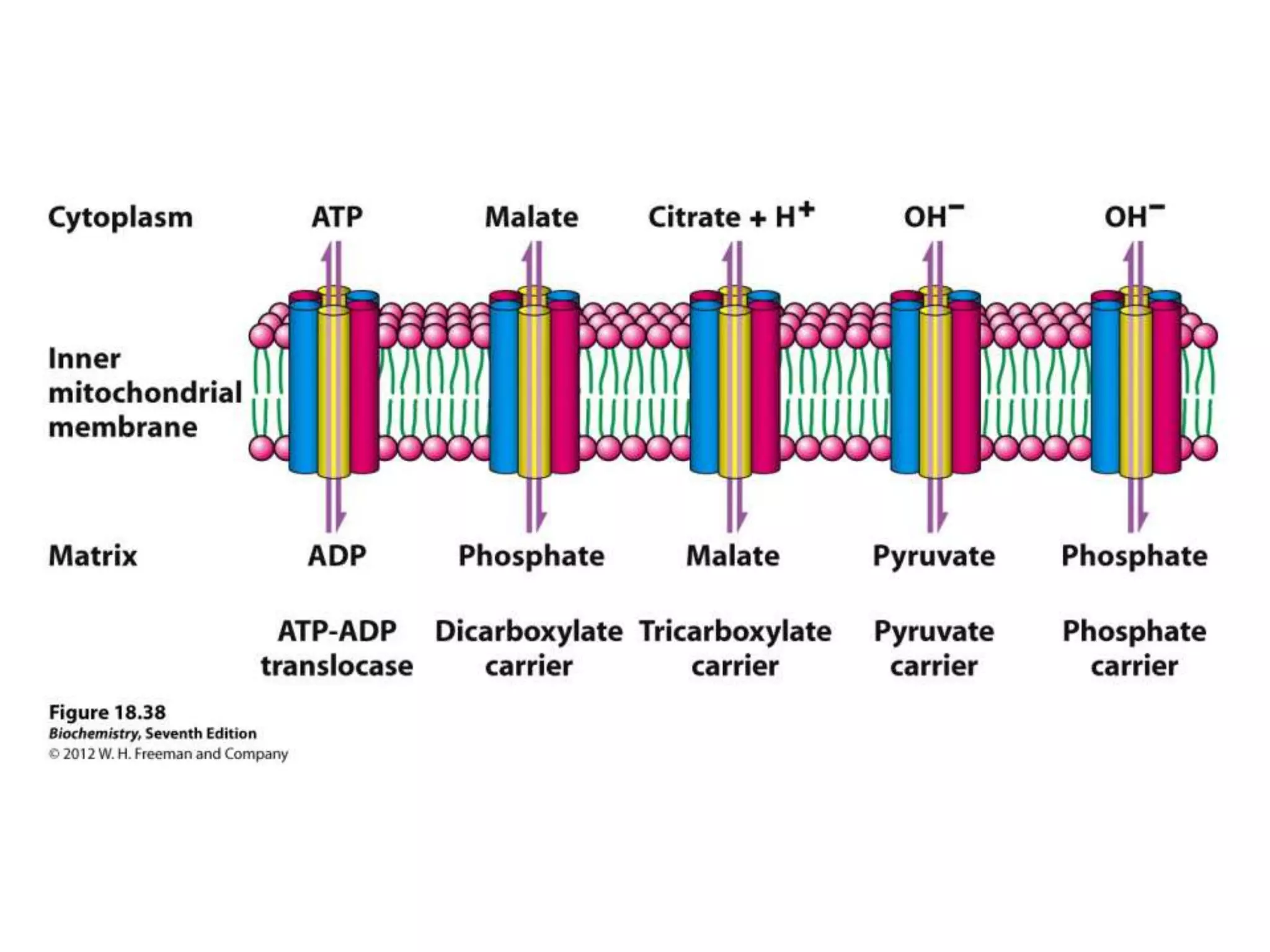
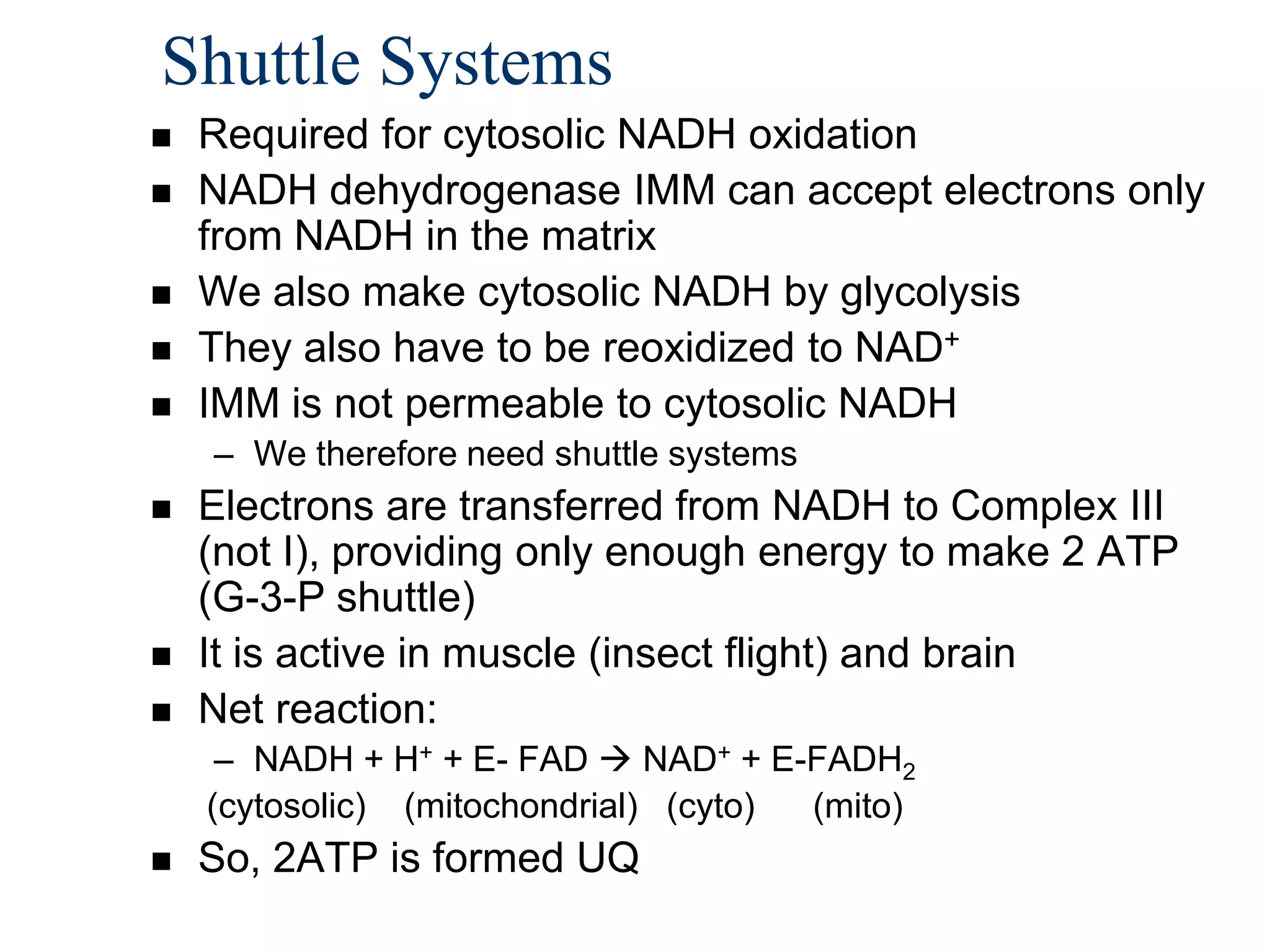
Shuttle Systems
   Required for cytosolic NADH oxidation
   NADH dehydrogenase IMM can accept electrons only
    from NADH in the matrix
   We also make cytosolic NADH by glycolysis
   They also have to be reoxidized to NAD+
   IMM is not permeable to cytosolic NADH
    – We therefore need shuttle systems
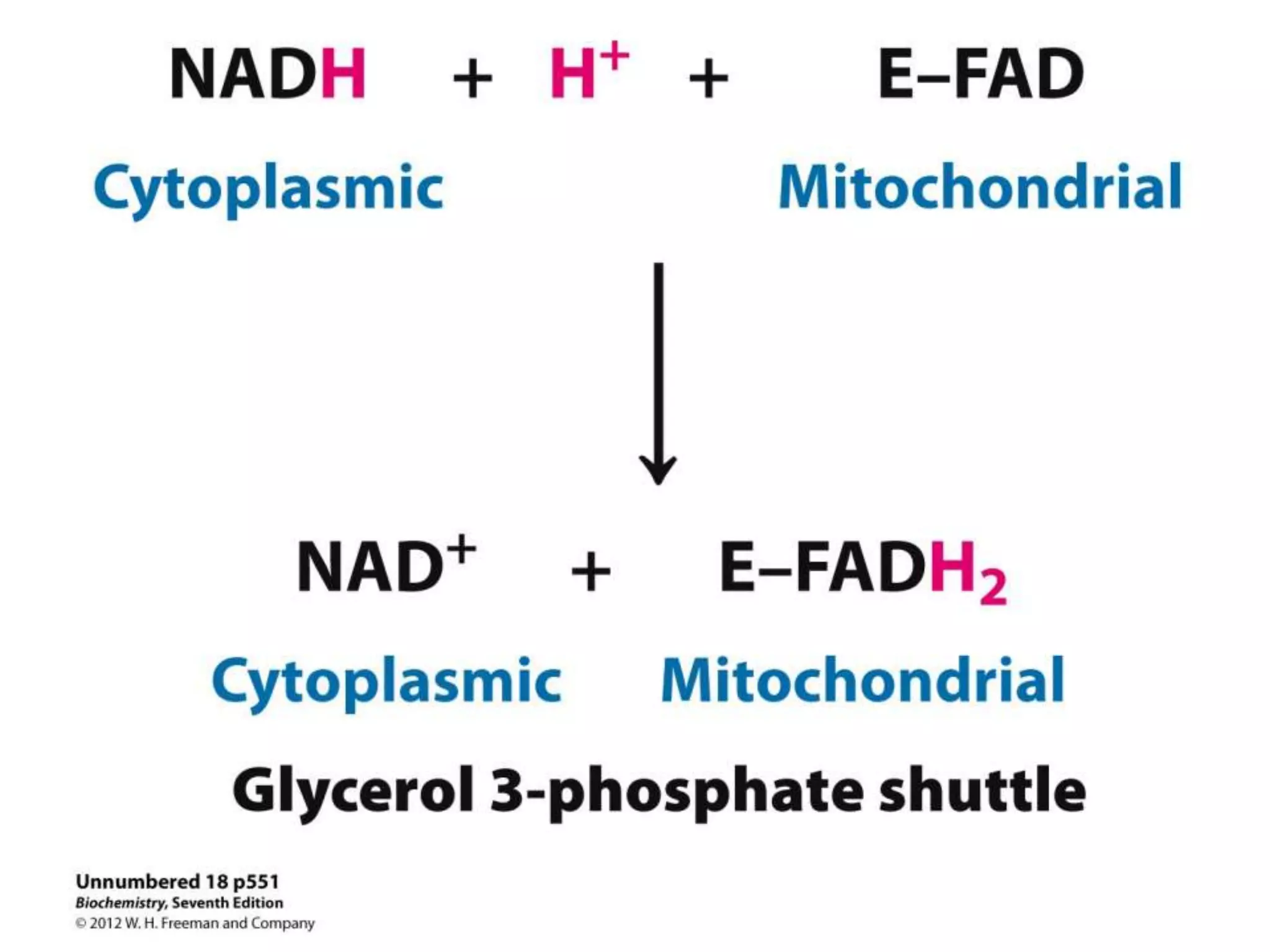
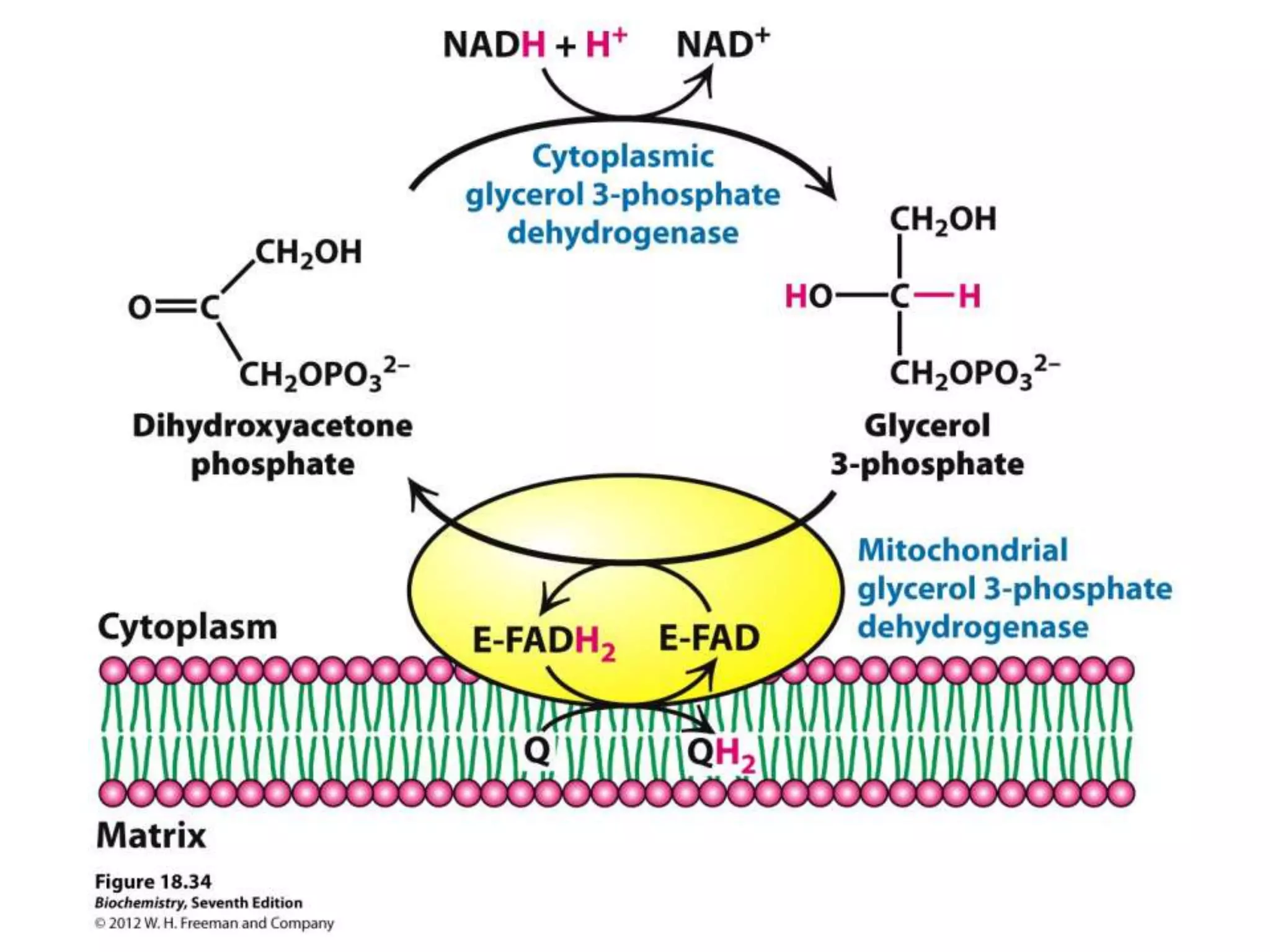
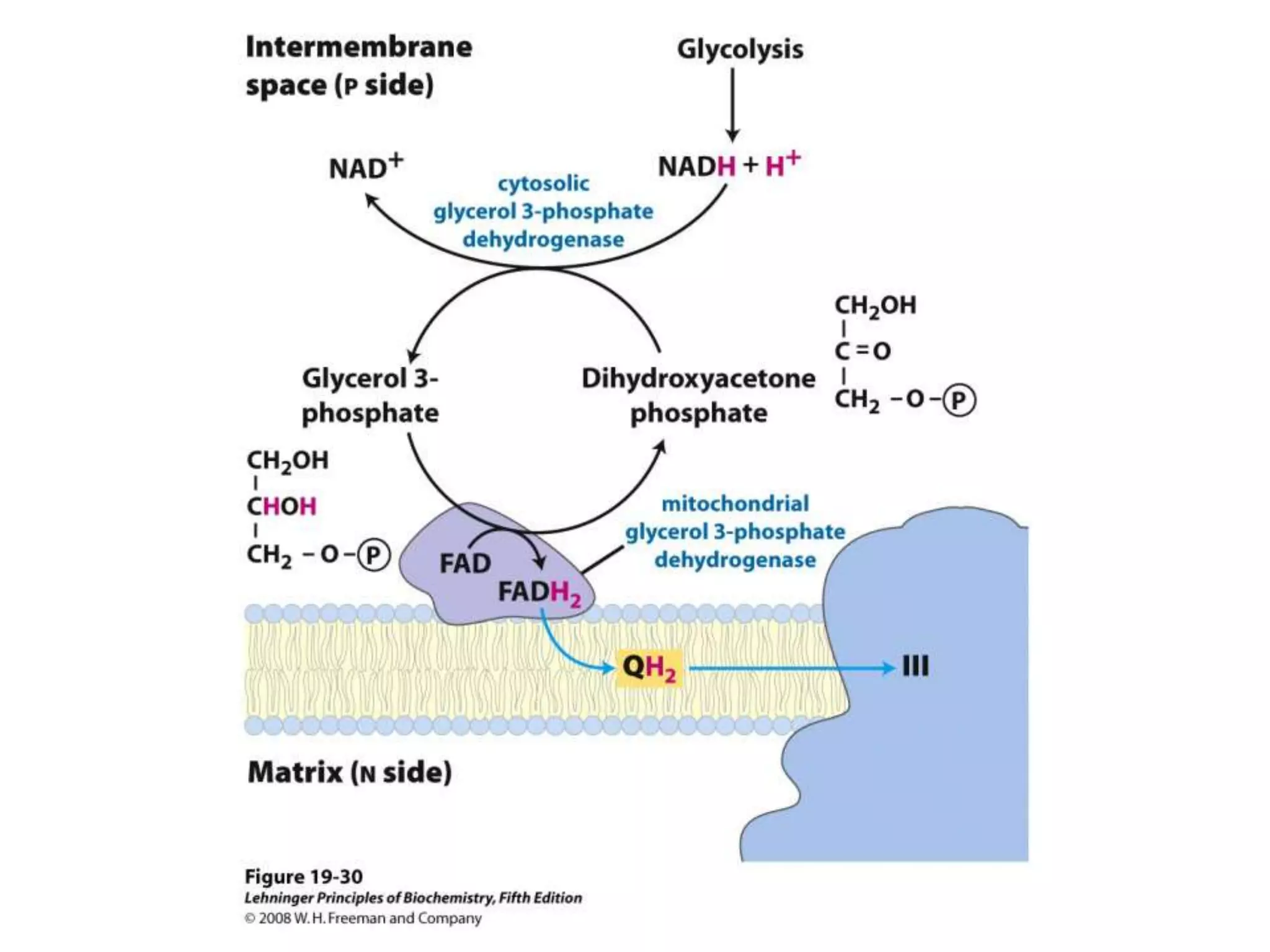
   Electrons are transferred from NADH to Complex III
    (not I), providing only enough energy to make 2 ATP
    (G-3-P shuttle)
   It is active in muscle (insect flight) and brain
   Net reaction:
     – NADH + H+ + E- FAD  NAD+ + E-FADH2
    (cytosolic) (mitochondrial) (cyto) (mito)
   So, 2ATP is formed UQ
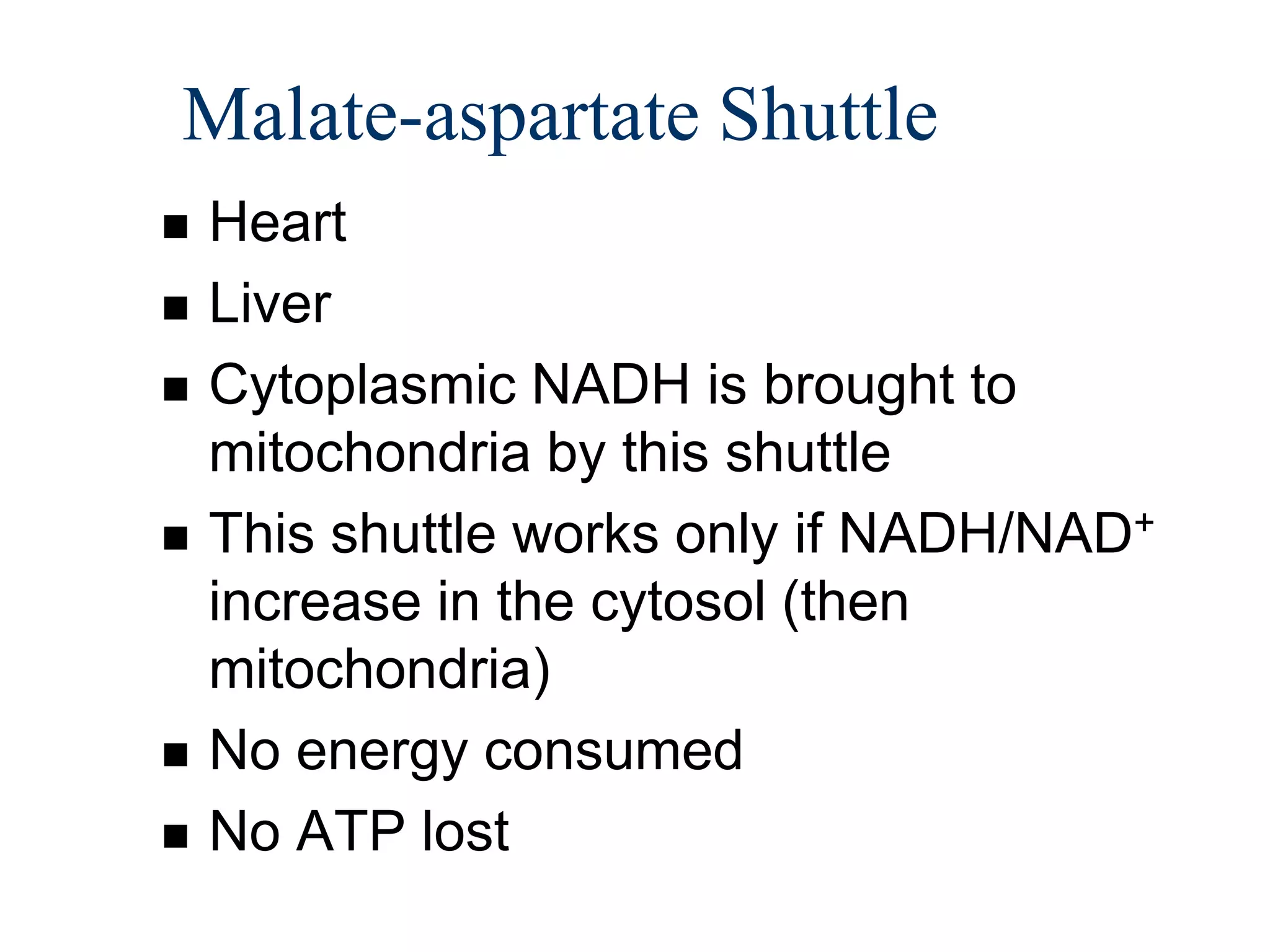
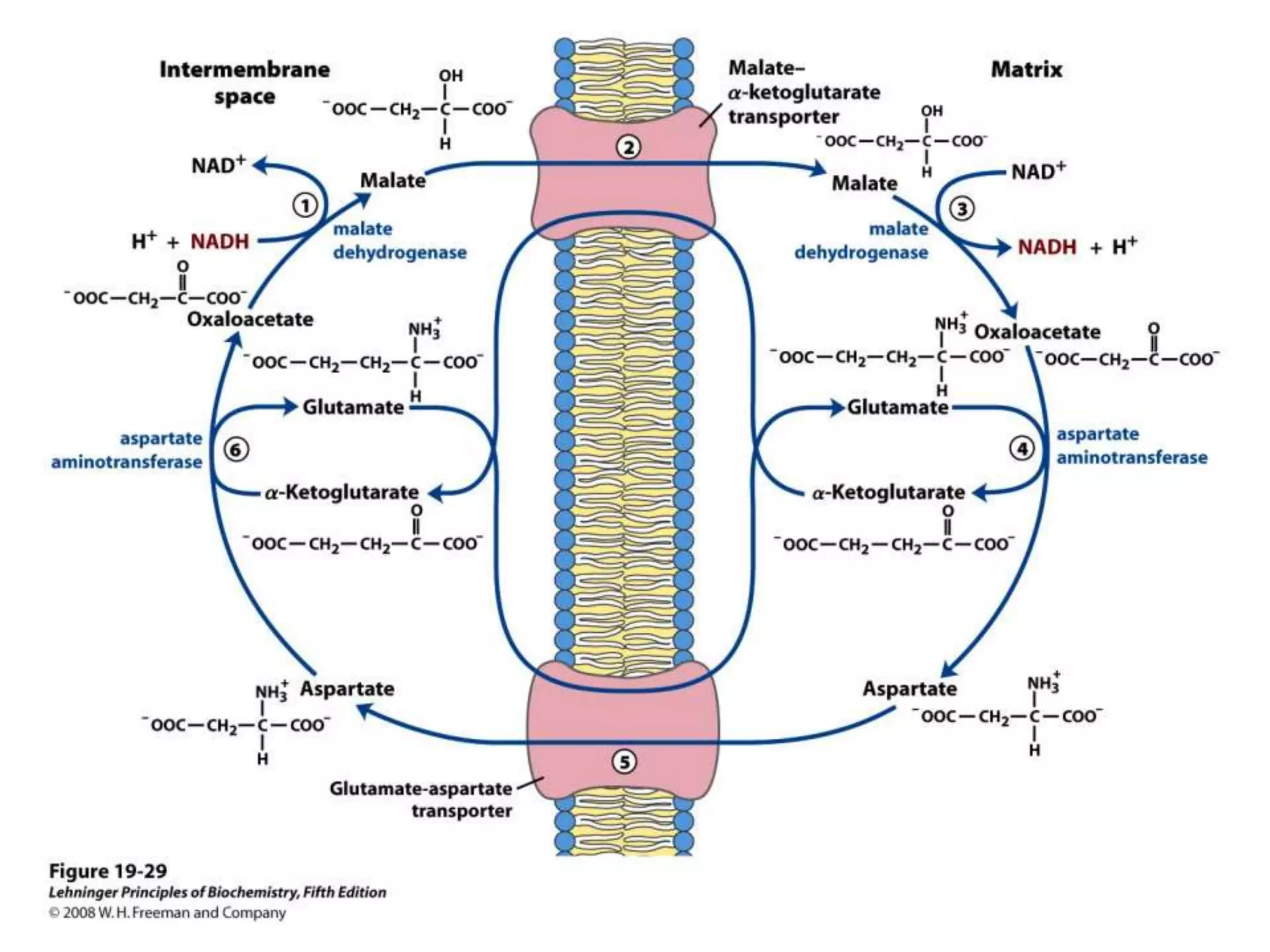
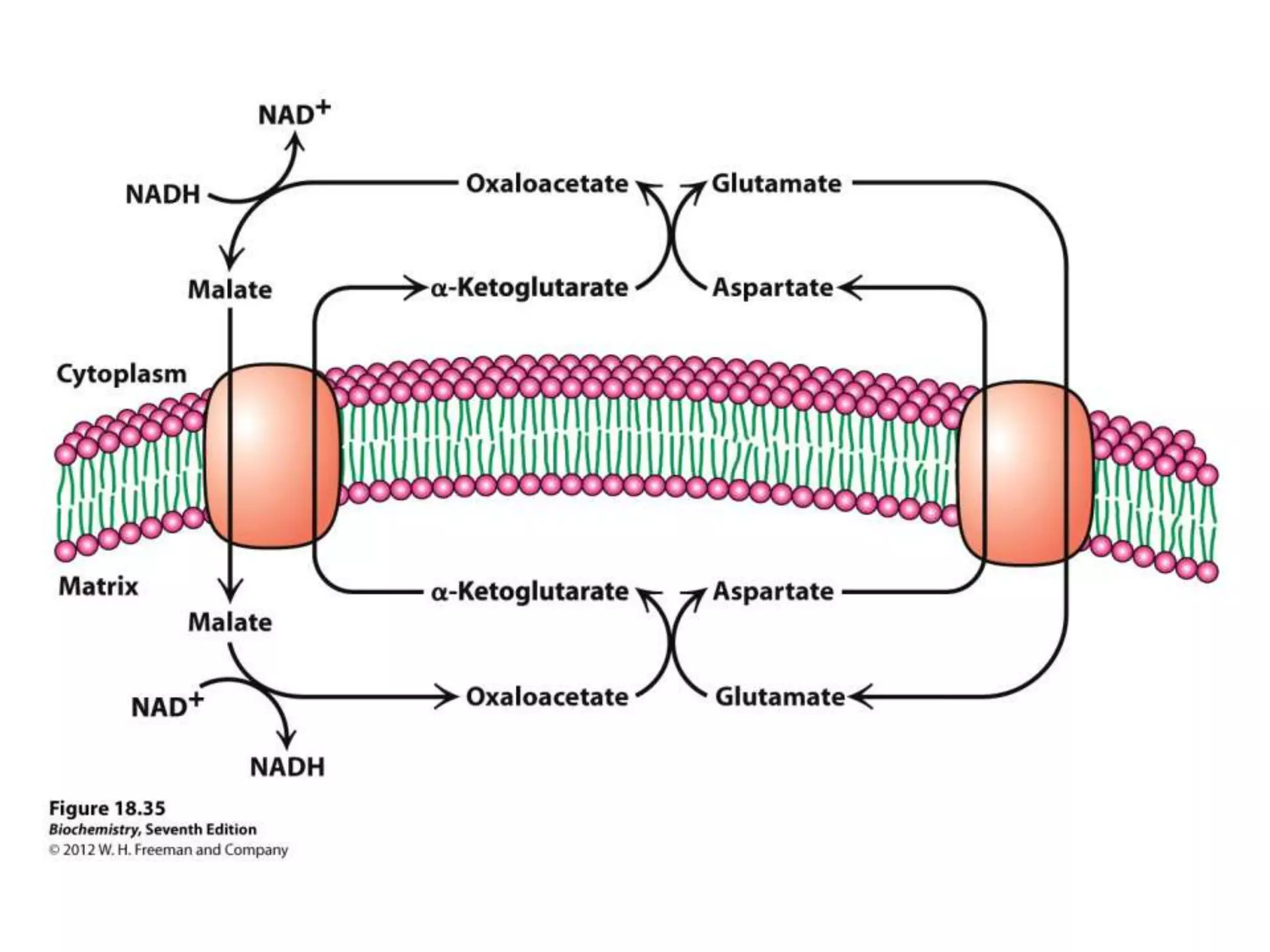
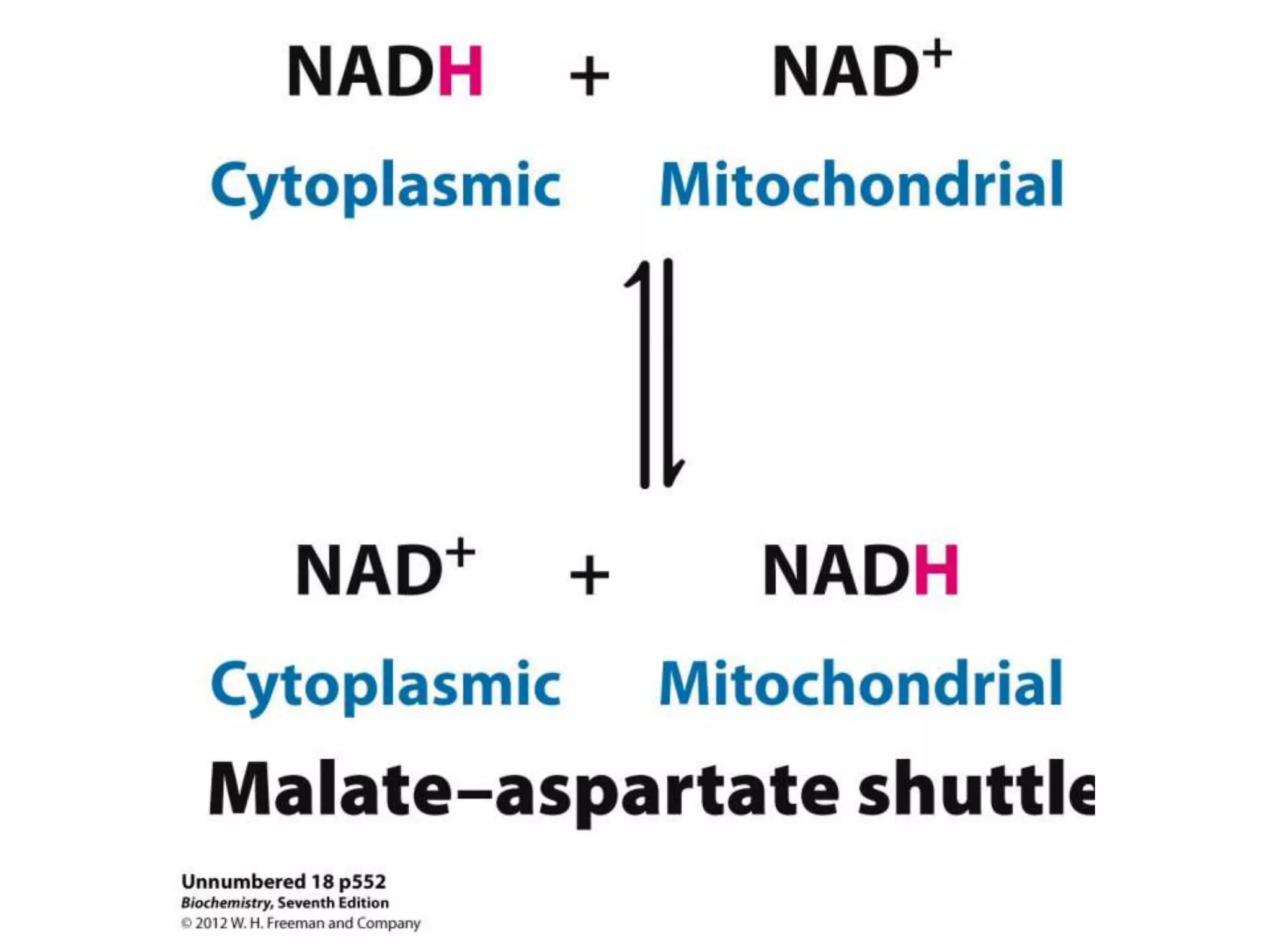
Malate-aspartate Shuttle
   Heart
   Liver
   Cytoplasmic NADH is brought to
    mitochondria by this shuttle
   This shuttle works only if NADH/NAD+
    increase in the cytosol (then
    mitochondria)
   No energy consumed
   No ATP lost
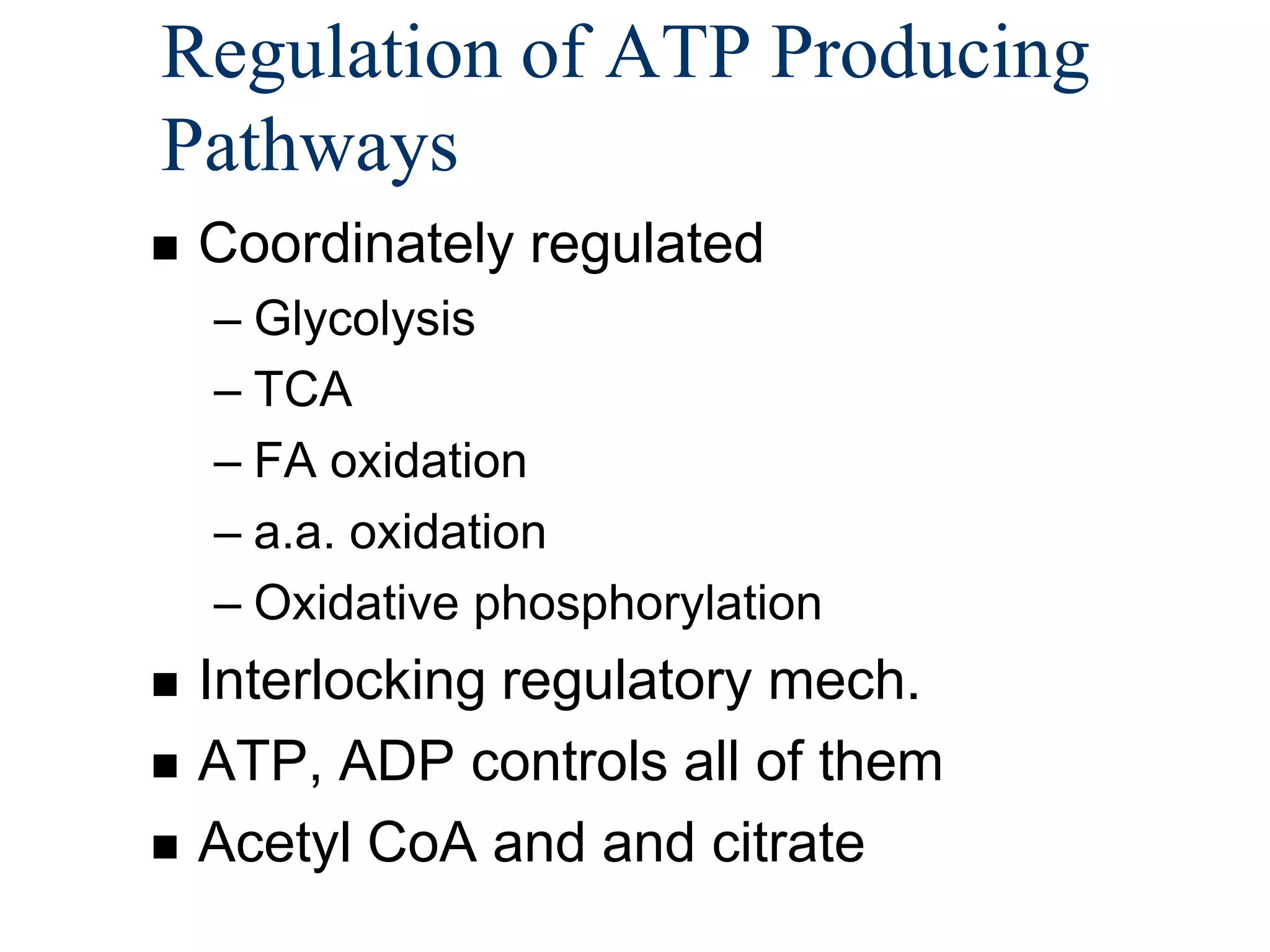
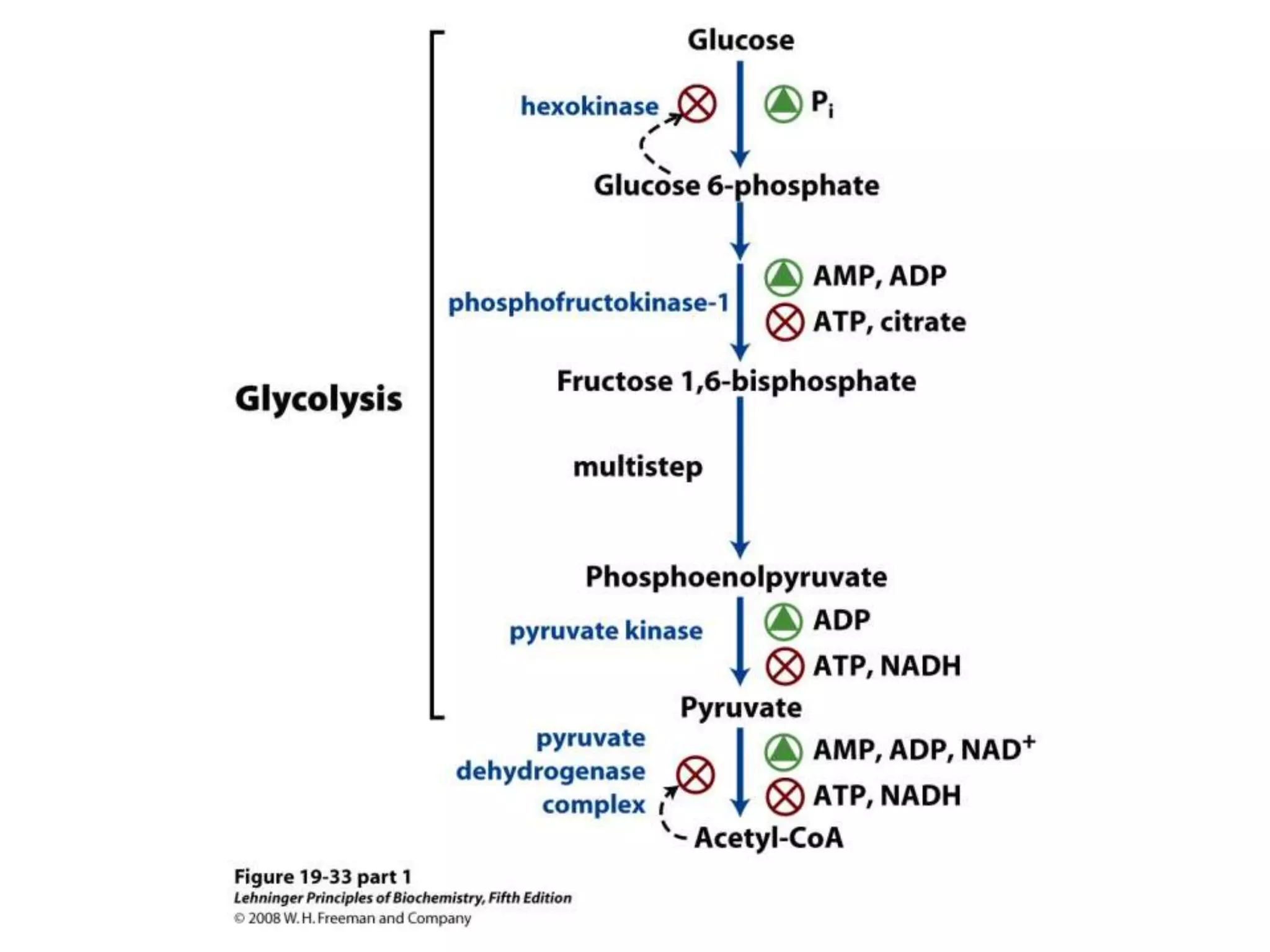
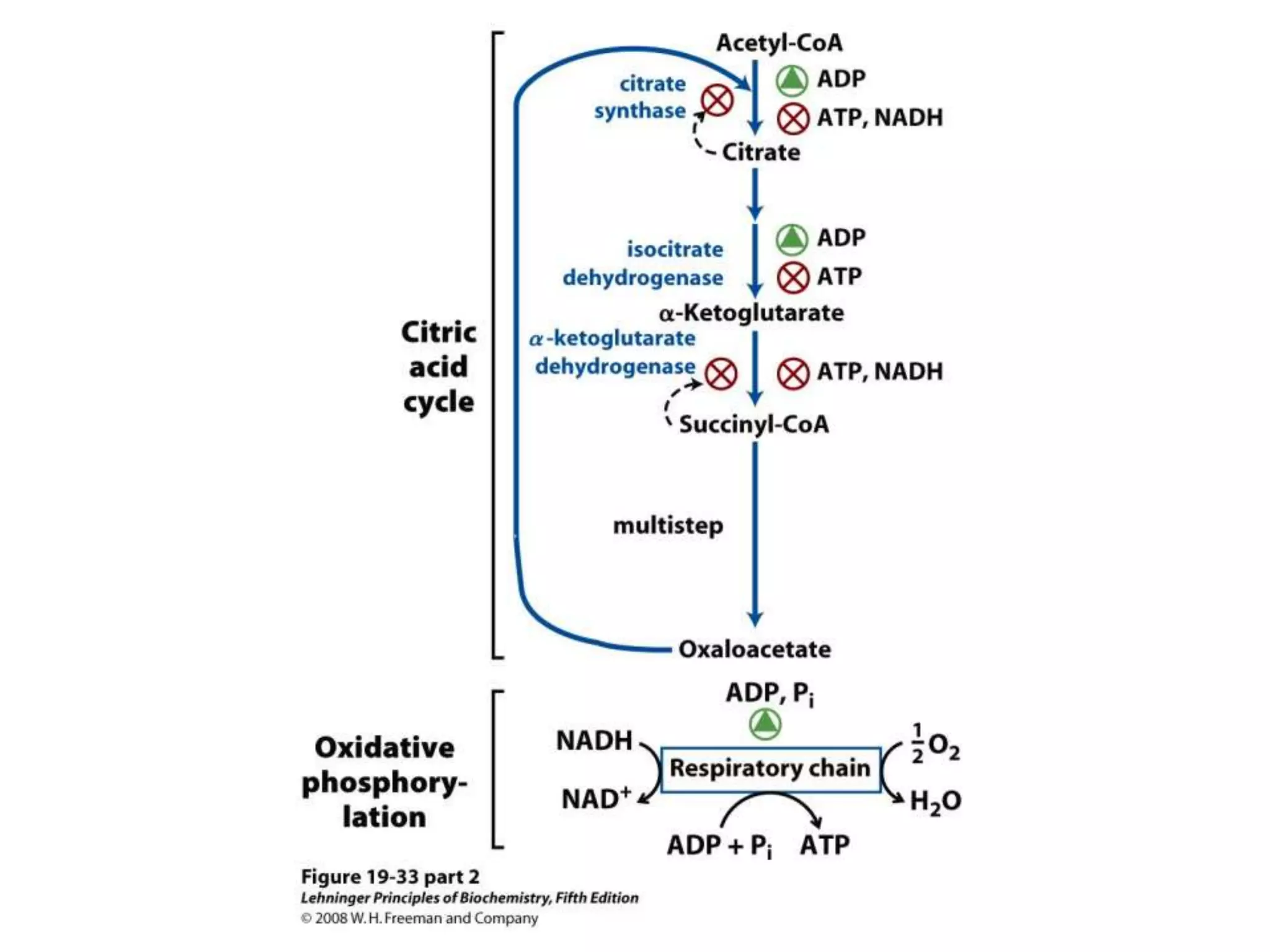
Regulation of ATP Producing
Pathways
   Coordinately regulated
    – Glycolysis
    – TCA
    – FA oxidation
    – a.a. oxidation
    – Oxidative phosphorylation
   Interlocking regulatory mech.
   ATP, ADP controls all of them
   Acetyl CoA and and citrate
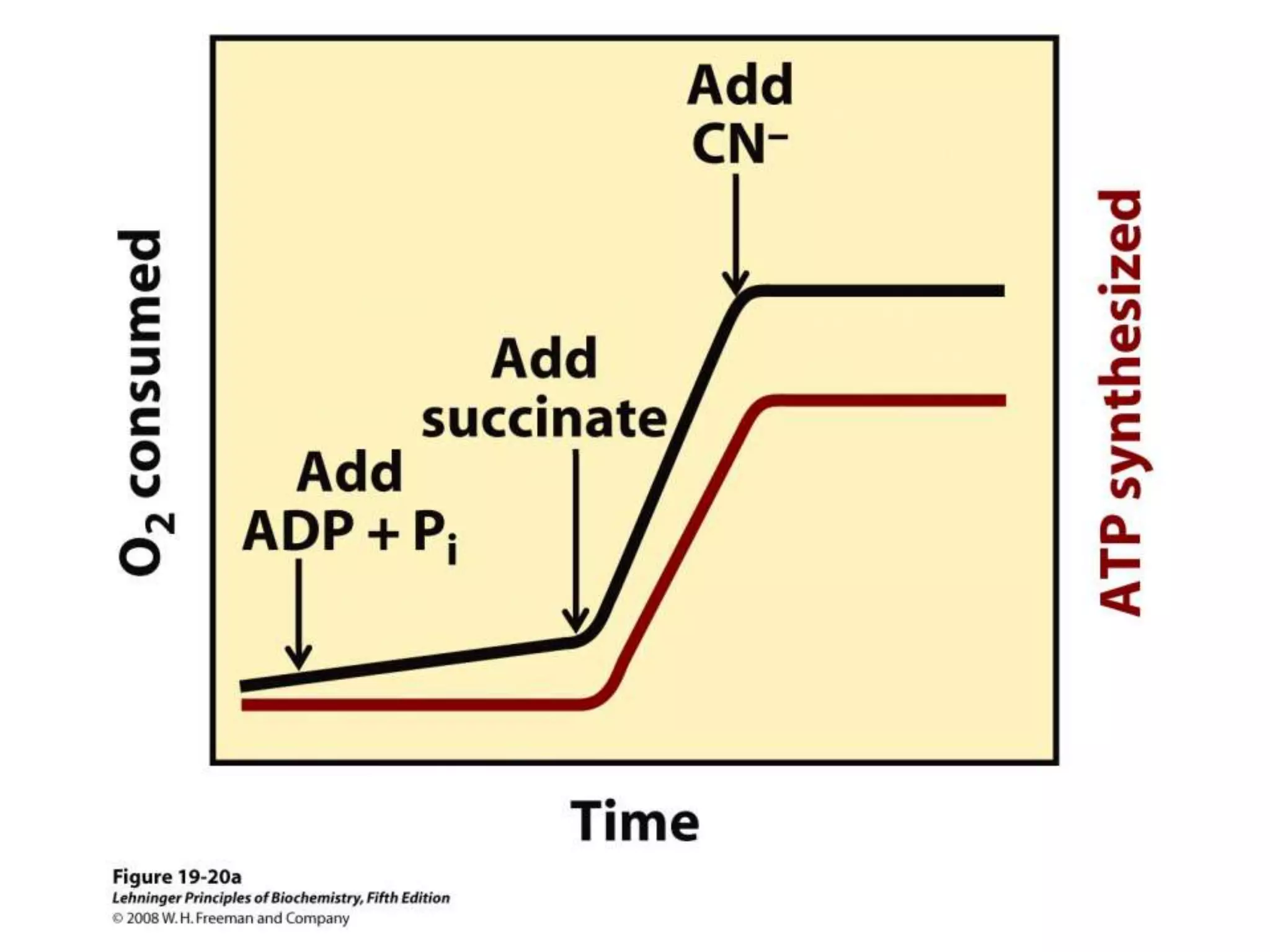
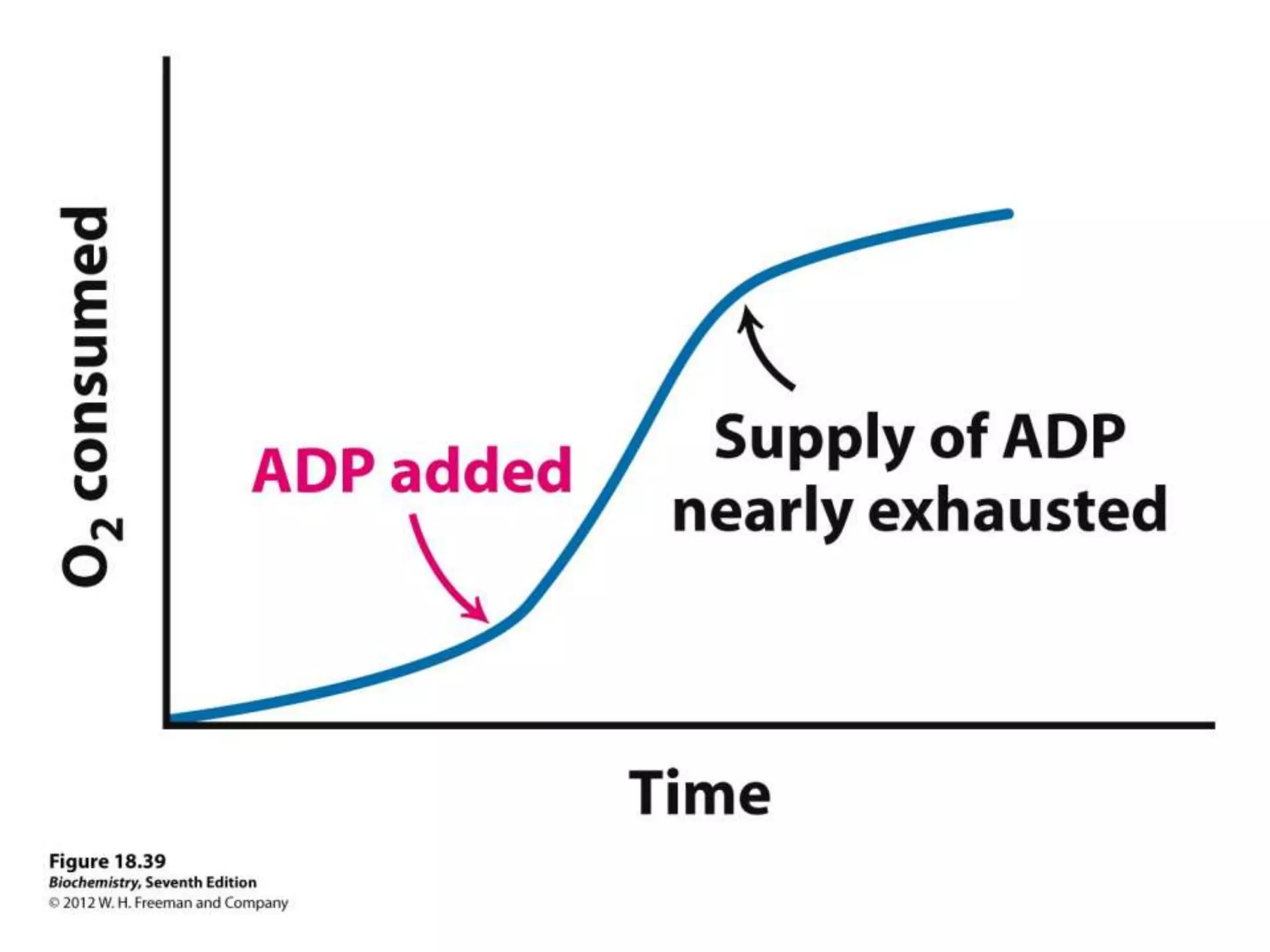
Regulation of Oxidative Phosphorylation
       Intracellular [ADP]
        If no ADP  no ATP
    –    The dependence of the rate of O2 consumption on the
         [ADP] (Pi acceptor) is called “acceptor control”

    acceptor control ratio = ADP-induced O2 consumption
                              O2 consumption without ADP
       Mass action ratio:
           ATP        is high normally
         [ADP][Pi]
    So, system is fully phosphorylated.

ATP used, ratio decreases, rate of oxidative phosphorylation
increases.
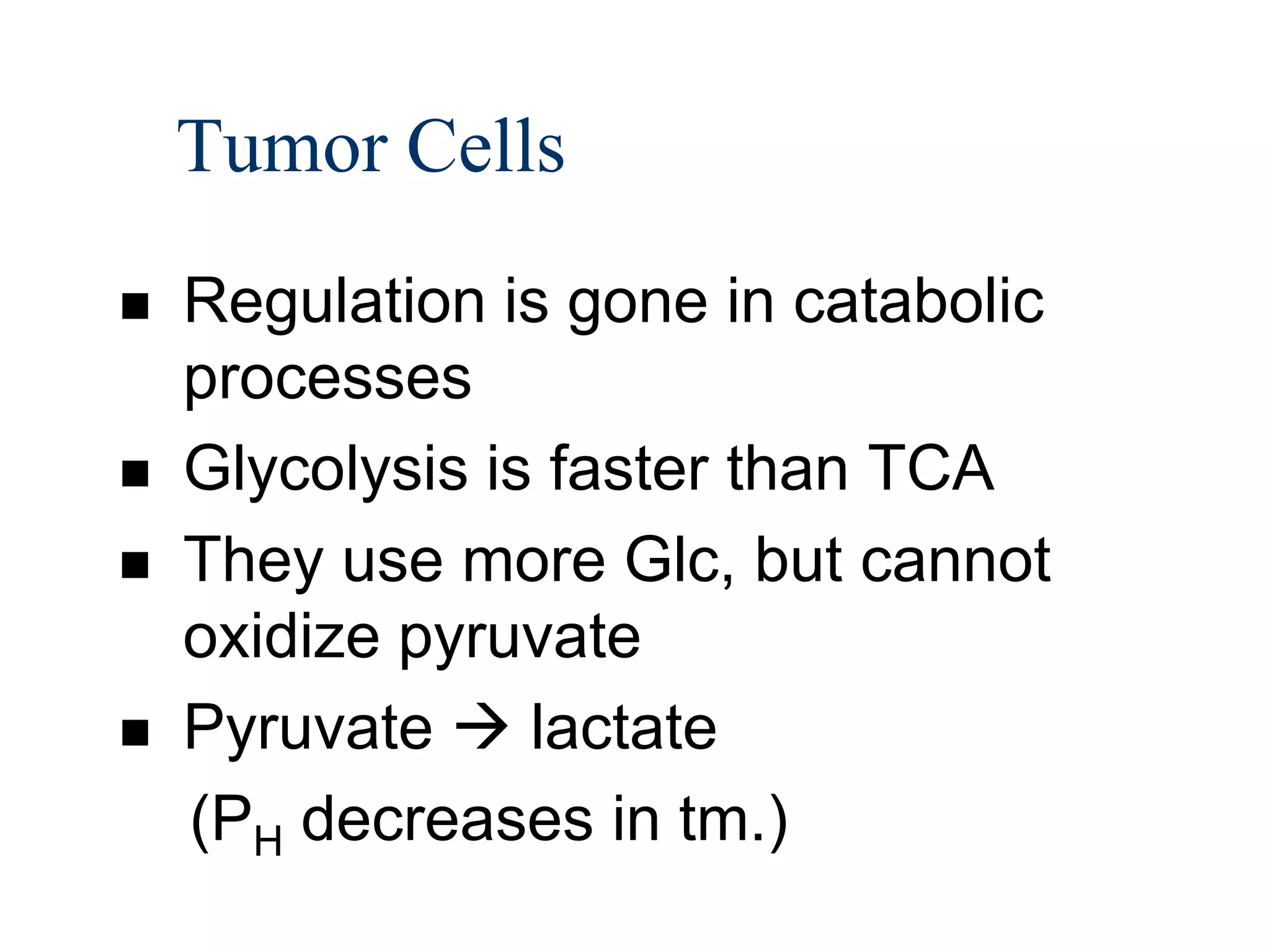
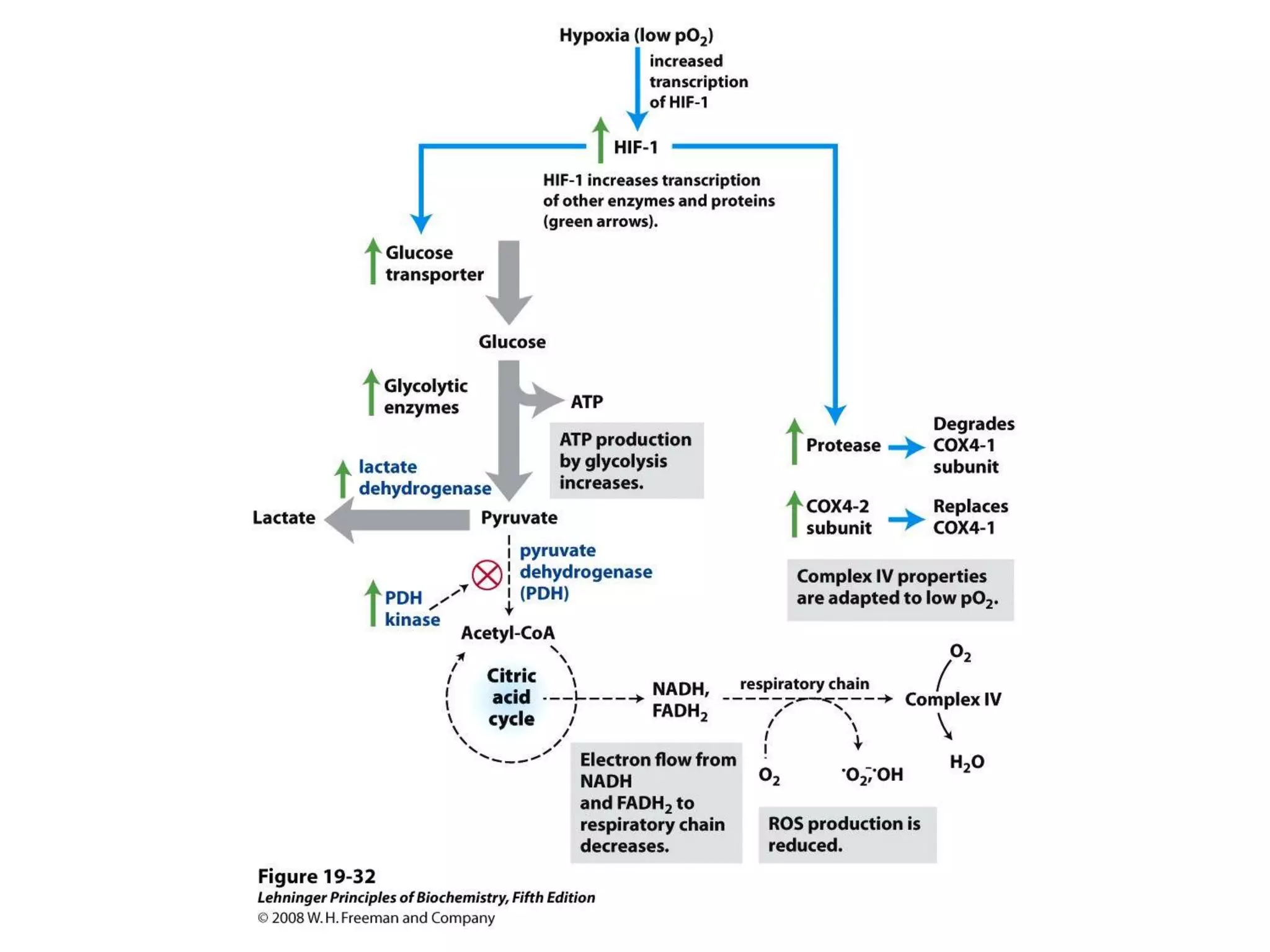
Tumor Cells
   Regulation is gone in catabolic
    processes
   Glycolysis is faster than TCA
   They use more Glc, but cannot
    oxidize pyruvate
   Pyruvate  lactate
    (PH decreases in tm.)
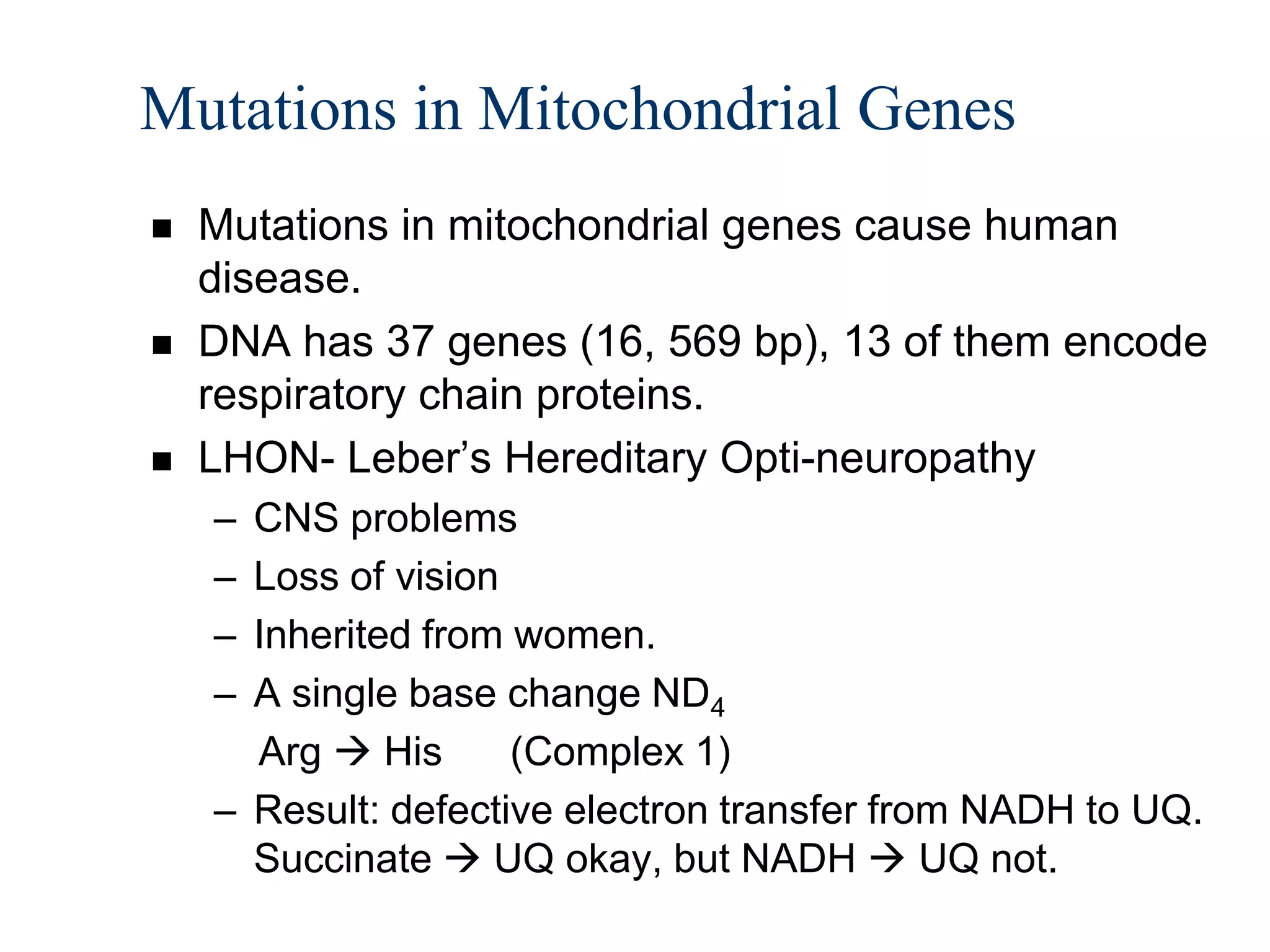
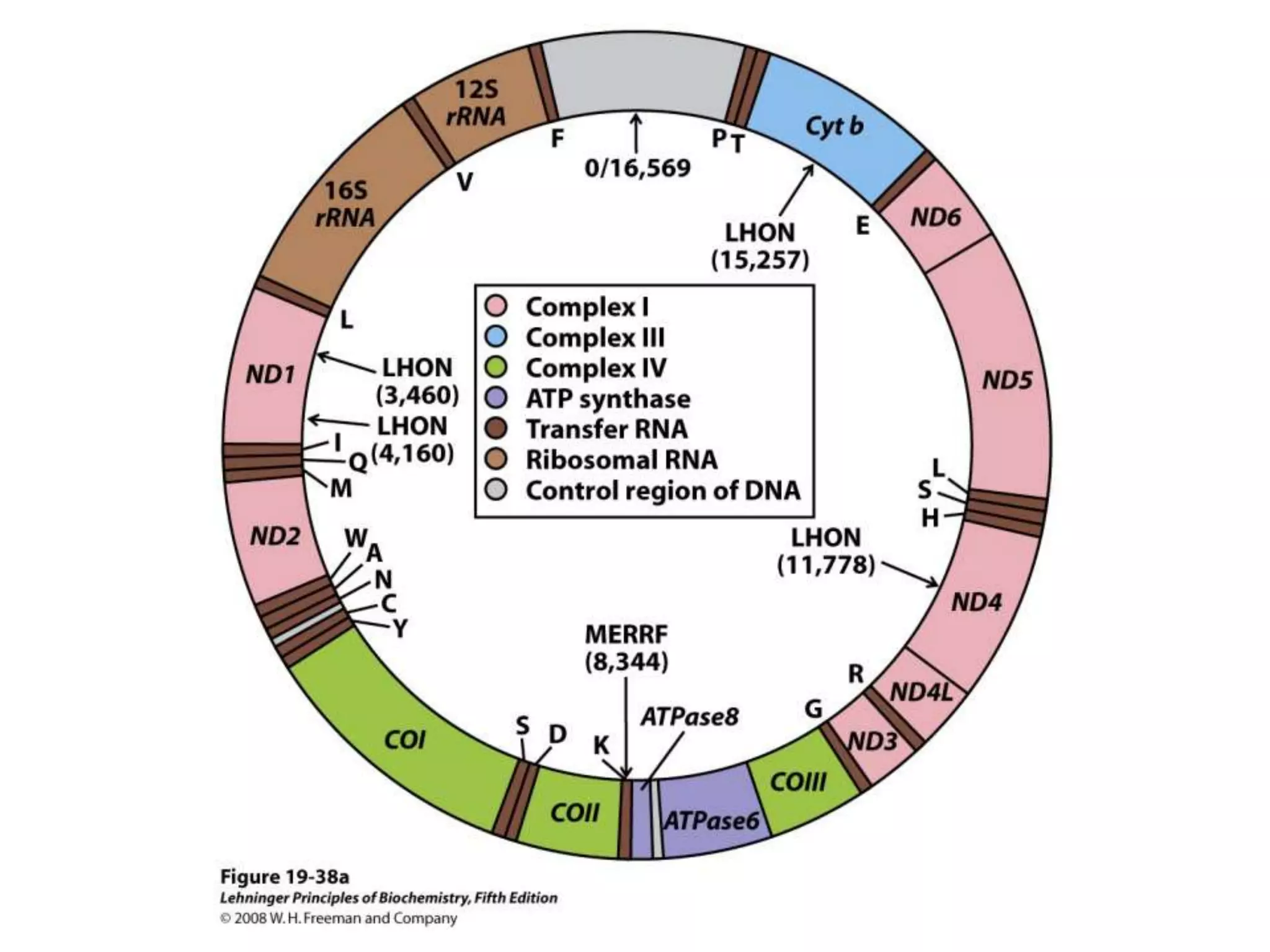
Mutations in Mitochondrial Genes
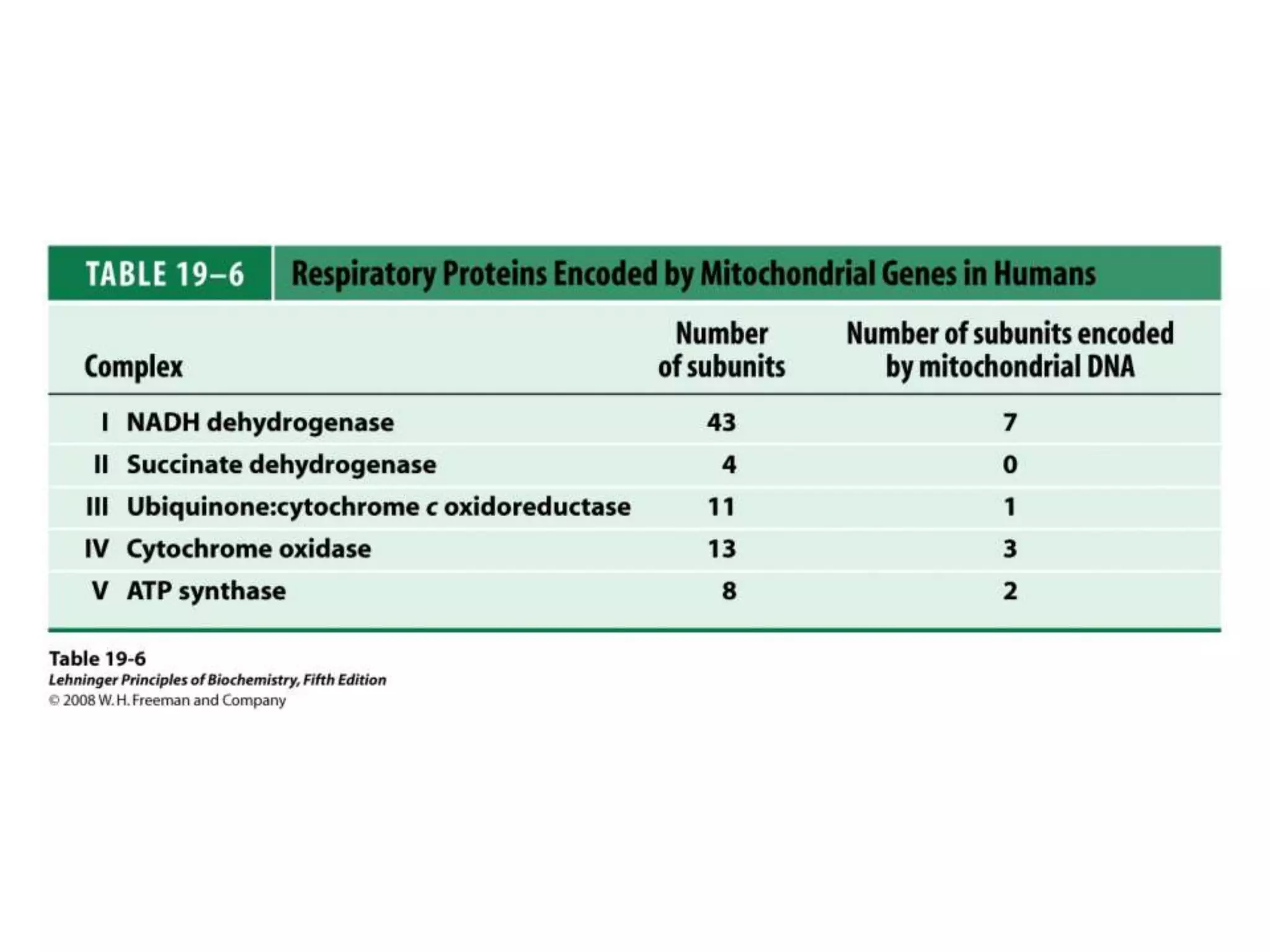
   Mutations in mitochondrial genes cause human
    disease.
   DNA has 37 genes (16, 569 bp), 13 of them encode
    respiratory chain proteins.
   LHON- Leber’s Hereditary Opti-neuropathy
    – CNS problems
    – Loss of vision
    – Inherited from women.
    – A single base change ND4
      Arg  His      (Complex 1)
    – Result: defective electron transfer from NADH to UQ.
      Succinate  UQ okay, but NADH  UQ not.
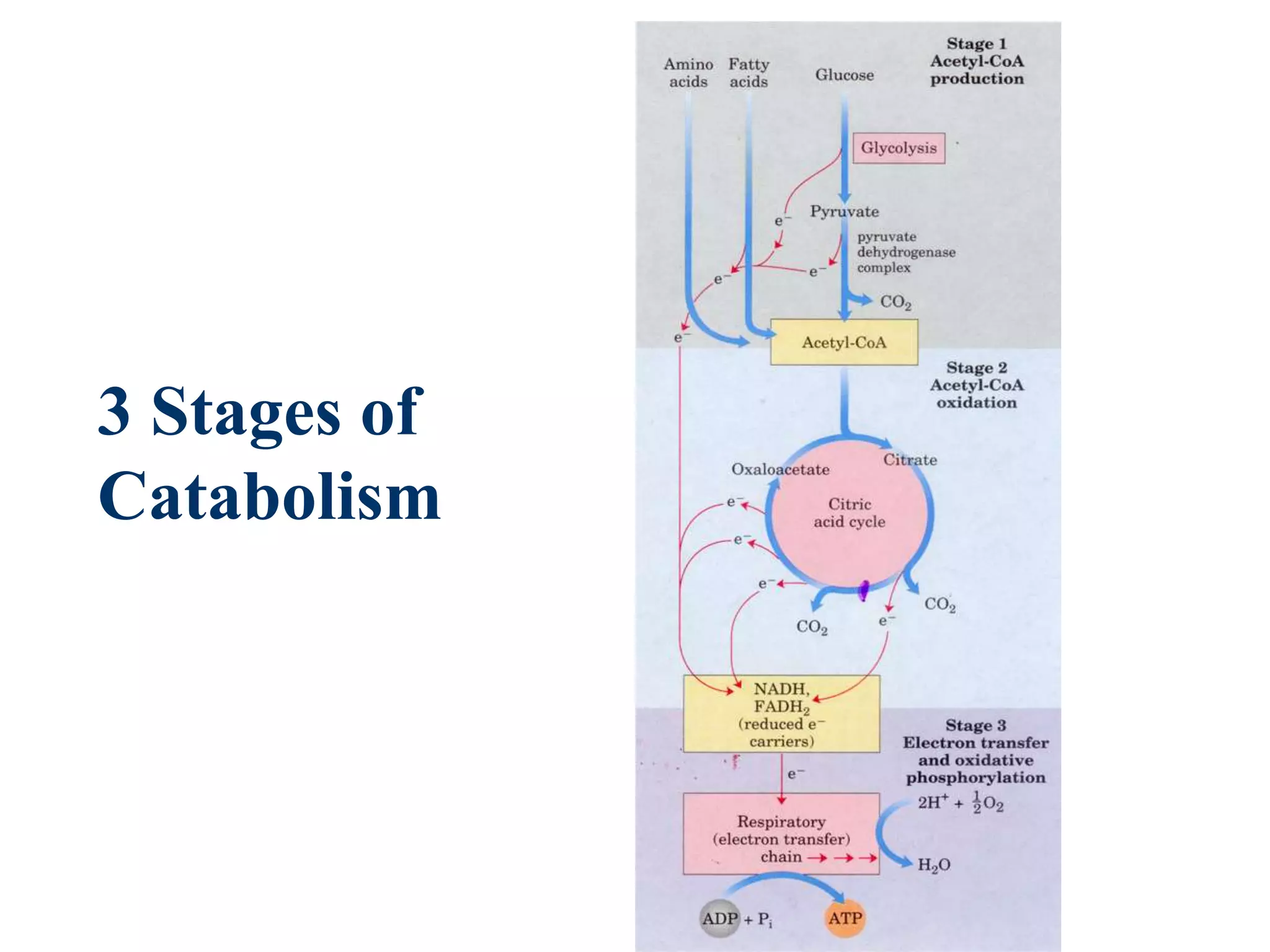
3 Stages of
Catabolism
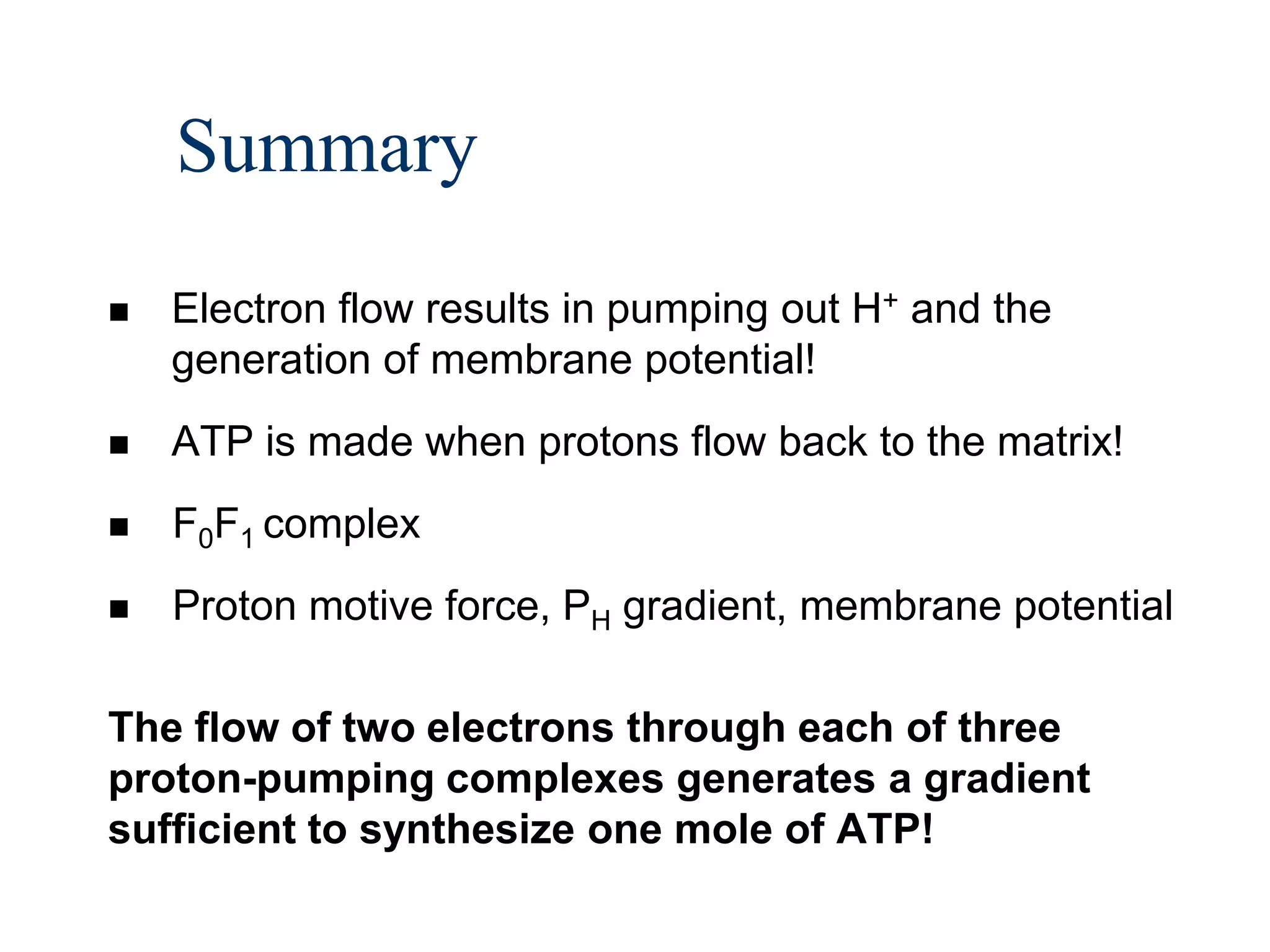
Summary
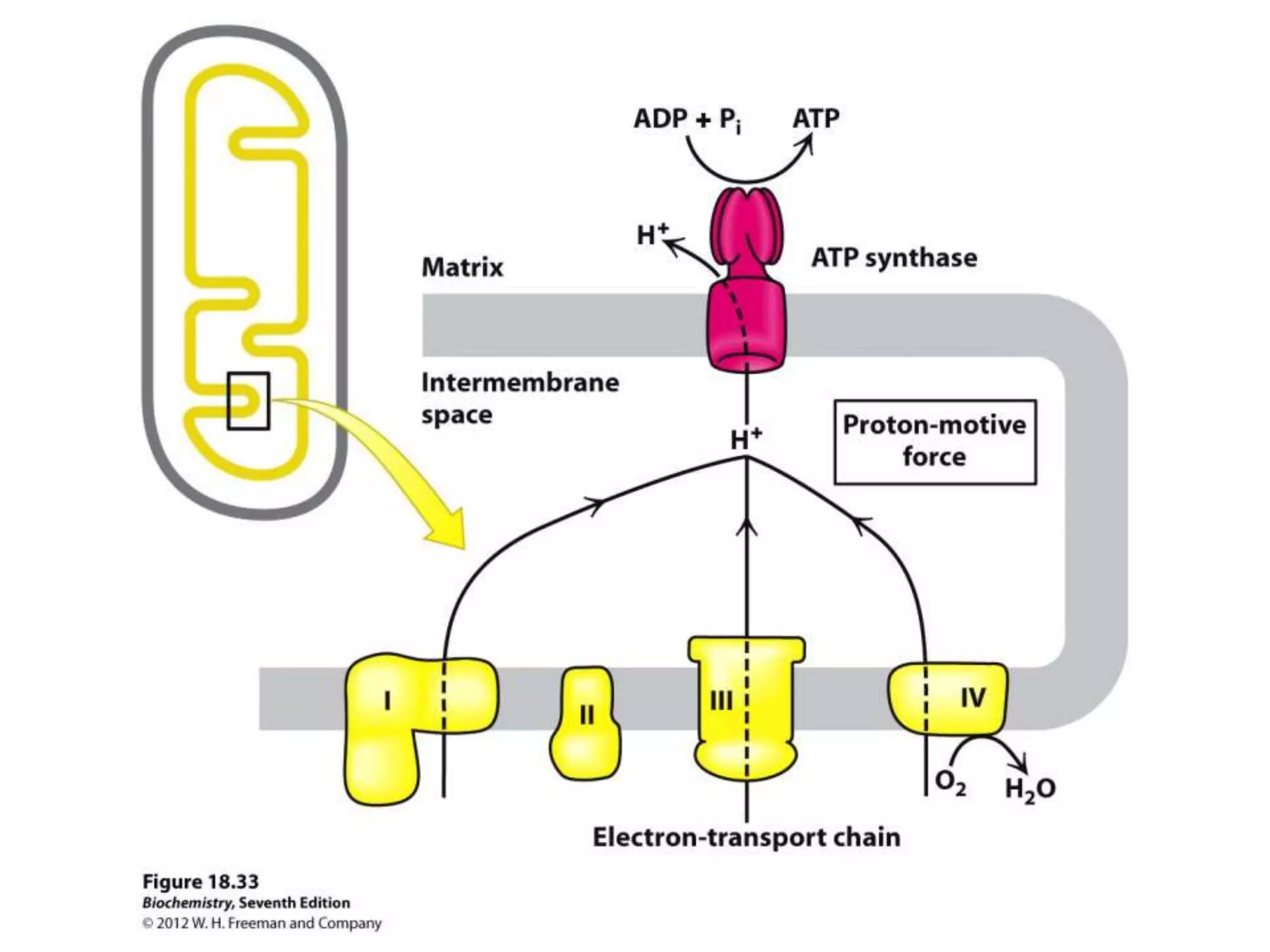
   Electron flow results in pumping out H+ and the
    generation of membrane potential!
   ATP is made when protons flow back to the matrix!
   F0F1 complex
   Proton motive force, PH gradient, membrane potential

The flow of two electrons through each of three
proton-pumping complexes generates a gradient
sufficient to synthesize one mole of ATP!
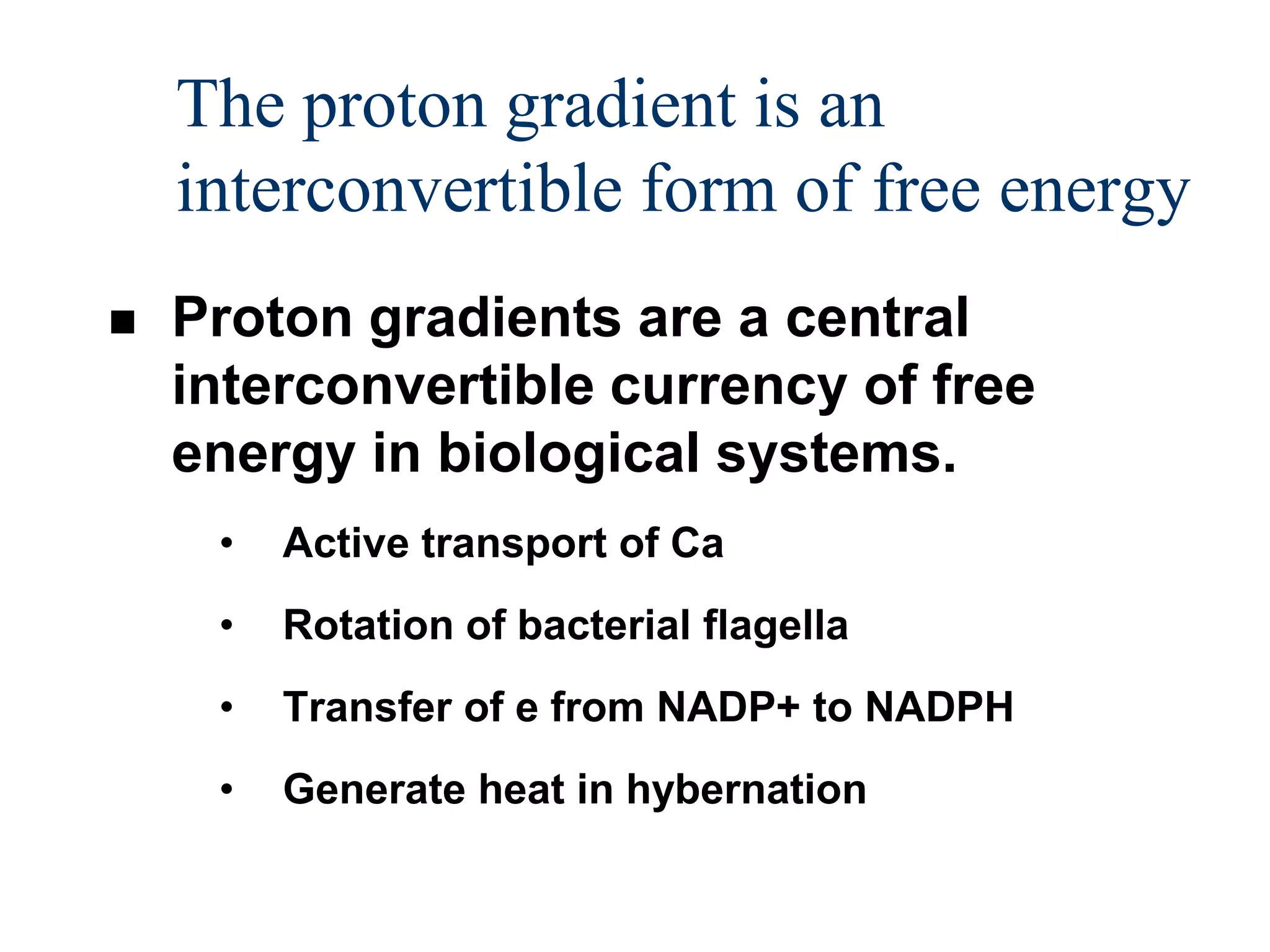
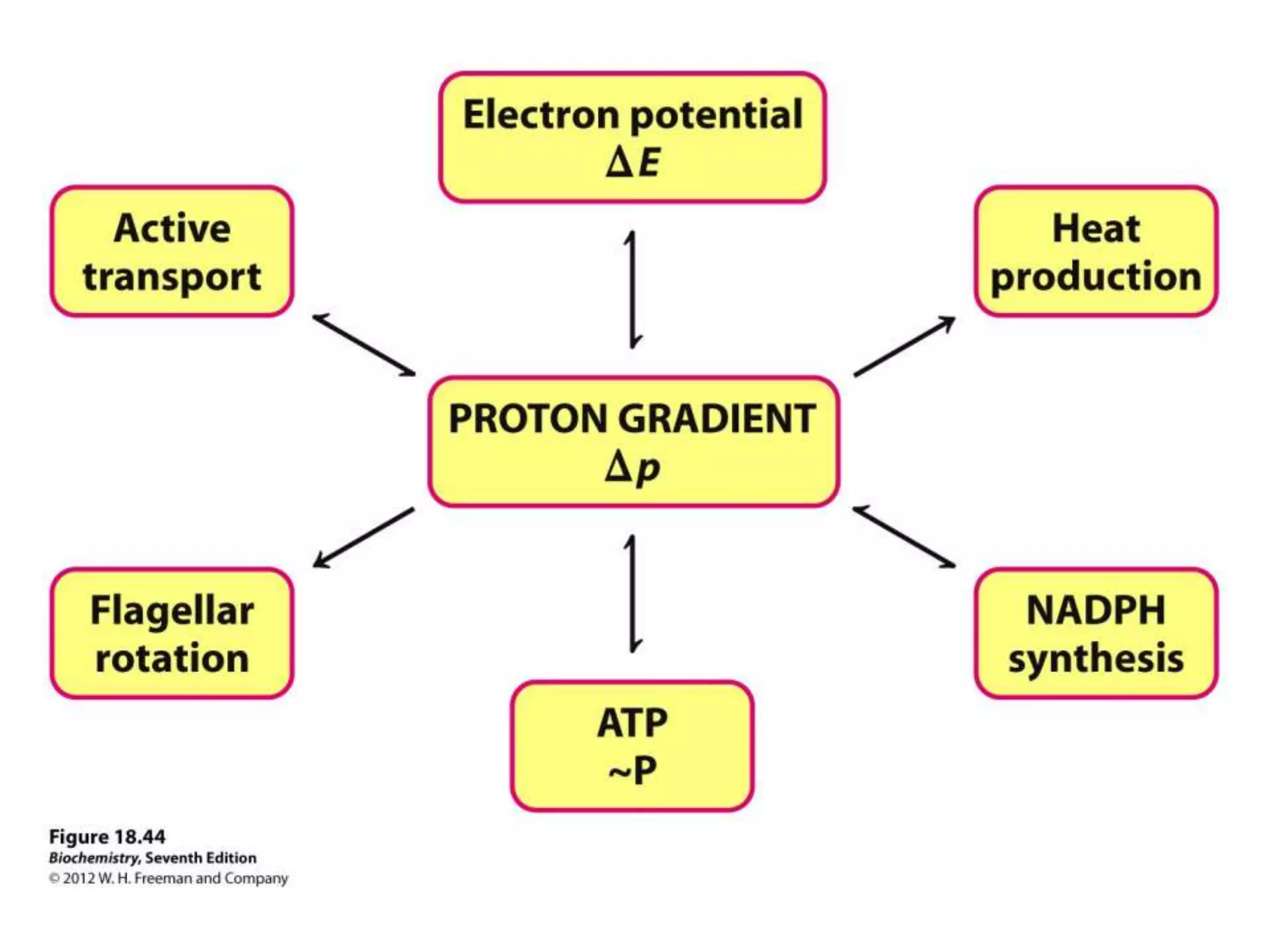
The proton gradient is an
    interconvertible form of free energy
   Proton gradients are a central
    interconvertible currency of free
    energy in biological systems.
     •   Active transport of Ca
     •   Rotation of bacterial flagella
     •   Transfer of e from NADP+ to NADPH
     •   Generate heat in hybernation
Lec06 oxidative p

Lec06 oxidative p

  • 1.
    Berg • Tymoczko• Stryer Biochemistry Sixth Edition Chapter 18: Oxidative Phosphorylation Copyright © 2007 by W. H. Freeman and Company
  • 5.
    Oxidative Phosphorylation and Mitochondria Transport Systems Mitochondria = power house of the cell glyco.  TCA  NADH, FADH2 (energy rich mols) f.a.oxi.  each has a pair of e- (having a transfer pot.) 2 e- 02 Energy released! (used for ATP) Oxidative Phoshorylation: the process in which ATP is formed as electrons are transferred from NADH or FADH2 to O2 by a series of electron carriers
  • 6.
    Some Features… 1. Oxidative phosphorylation is carried out by respiratory assemblies that are located in the inner membrane. – TCA is in the matrix 2. The oxidation of NADH  2.5 ATP 3. FADH2  1.5 ATP – Oxidation and phosphorylation are COUPLED 4. Respiratory assemblies contain numerous electron carriers – Such as cytochromes 5. When electrons are transferred H+ are pumped out 6. ATP is formed when H+ flow back to the mitochondria
  • 7.
    Some Features Continued…  Thus oxidation and phosphorylation are coupled by a proton gradient across the inner mitochondria membrane – So, we produce ATP through this – Glycolysis and TCA cycle can continue only if NADH and FADH2 are somehow reoxidized to NAD+ and FAD
  • 9.
    Release of FreeEnergy During Electron Transport 1. Electrons transferred electron donor (reductant)  electron acceptor (oxidant) They can be transferred – H- – H+ – Pure electrons 2. When a compound loses its electrons becomes oxidant cyt b (Fe ++) + cyt c1 (Fe +++)  cyt b (Fe +++) + cyt c1 (Fe ++) red. X oxi. Y oxi. X’ red. Y’ Red. X and Oxi. X’ Redox Red. Y’ and Oxi. Y Pairs
  • 10.
    Release of FreeEnergy Continued… 3. PAIRS differ in their tendency to lose electrons – It is a characteristic of a pair – Can be quantitatively specified by a constant… E0 (volts) – E0: standard reduction potential – The more negative E0, the higher the tendency of the reductant to lose electrons – The more positive E0, the higher the tendency of the oxidant to accept electrons – Electron transfer: more –E0 ---------- more +E0 4. Free energy decreases as electrons are transferred Go = -nF E0 where “n” is the number of electrons transferred, and F is Faraday’s constant (23, 062) E0 = E0 (electron accepting pair) – E0 (electron donating pair)
  • 19.
    What Are theElectron Carriers in mt?  Most of the electron carriers in mitochondria are integral proteins  There are four types of electron transfers 1. Direct transfer of electrons Fe+3  Fe+2 2. As a hydrogen atom H+ + electron 3. As a hydride ion :H- (has 2 electrons) 4. Direct combination of an organic reductant with O2
  • 21.
    Flow of electronsand protons thru the respiratory chain
  • 22.
    How Is ThisOrder Found? 1. NADH, UQ, cytb, cytc1, c, a, and a3 is the order – Their standard reduction potentials have been determined experimentally! – The order  increased E0 because electrons tend to flow from more negative E0 to more positive E0 2. Isolated mitochondria are incubated with a source of electrons but without O2 – a, a3 is oxidized first – c, c1, b are second, third, and fourth respectively – When the entire chain of carriers is reduced experimentally by providing an electron source but no O2 (electron acceptor) then O2 suddenly introduced into the system – The rate at which each electron carrier becomes oxidized shows the order in which the carriers function – The carrier nearest O2 is oxidized first, then second, third, etc.
  • 27.
    Action of Dehydrogenases  Most of the electrons come from  Electron acceptors NAD or FMN, FAD Reduced subs + NAD+  ox. sub + NADH + H+ Reduced subs + NADP+  ox. Sub + NADPH + H+  In addition to FAD and NAD, there are three other types of electron carrying groups – Ubiquinone – Iron containing proteins (cytochromes, Fe-S proteins)  Ubiquinone = CoQ or = UQ – When it accepts 1 electron  UQH (semiquinone) – When it accepts 2 electrons  UQH2 (ubiquinal)
  • 30.
  • 32.
    Oxidation states offlavins. • The reduction of flavin mononucleotide (FMN) to FMNH2 proceeds through a semiquinone intermediate.
  • 37.
    Complex I  NADH dehydrogenase (NADH Q reductase)  Huge protein – 25 pp  FMN, Fe-S  I electron  UQ
  • 39.
    Complex II  Succinate Q Recuctase (Succinate dhydrogenase) – Is the only membrane bound enzyme in the TCA cycle – Contains  FAD, Fe-S  II  electrons  UQ  Cytochrome: an electron transferring protein that contains a heme prosthetic group!
  • 42.
  • 43.
    Complex III  Cyt reductase (UQ-cyt c oxido reductase or cyt bc1 complex) – Contains cyt b, c1, Fe-S proteins and at least six other protein subunits  UQ is 2e- carrier, cyts are 1e- carriers – This switch is done in a series of reactions (called Q cycle)  Electron transfer in III seems to be complicated but it’s not  Net reaction: – UQH2  UQ and cyt c is reduced – H+ is pumped out also
  • 44.
    Complex IV  Cyto oxidase – Contains a, a3, and CuA, CuB  The detail of this electron transfer in Complex IV is not known  It also functions as a proton pump
  • 52.
    ATP Production inMitochondria
  • 53.
  • 57.
    Mitchel’s Theory  The electrochemical potential difference resulting from the asymmetric distribution of the H+ is used to drive the mech. responsible for the formation of ATP
  • 61.
    Chemiosmotic Theory Continued… G = RT ln(C2/C1) + ZF [ + ] [ + ] When H+ is pumped against electrochemical gradient G=+ When protons flow back inside, this G becomes available to do the work!!
  • 62.
    Oxidation and ATPsynthesis are coupled
  • 69.
  • 82.
    Uncoupled Mitochondria inBrown Fat Produces Heat  This is done by DNP or other uncouplers  They carry protons across the inner mitochondria membrane  In the presence of DNP, electron transport is normal but ATP is not formed  Proton-motive force is gone or disrupted  Uncoupling is also seen in brown adipose tissue  It is useful to maintain BT in hibernating animals, newborns, and mammals adapted to the cold  It has lots of mitochondria  IMM  thermogenin (uncoupling protein)  Thermogenin generates heat by short-circuiting the mitochondrial proton battery
  • 83.
    Shuttle Systems  Required for cytosolic NADH oxidation  NADH dehydrogenase IMM can accept electrons only from NADH in the matrix  We also make cytosolic NADH by glycolysis  They also have to be reoxidized to NAD+  IMM is not permeable to cytosolic NADH – We therefore need shuttle systems  Electrons are transferred from NADH to Complex III (not I), providing only enough energy to make 2 ATP (G-3-P shuttle)  It is active in muscle (insect flight) and brain  Net reaction: – NADH + H+ + E- FAD  NAD+ + E-FADH2 (cytosolic) (mitochondrial) (cyto) (mito)  So, 2ATP is formed UQ
  • 87.
    Malate-aspartate Shuttle  Heart  Liver  Cytoplasmic NADH is brought to mitochondria by this shuttle  This shuttle works only if NADH/NAD+ increase in the cytosol (then mitochondria)  No energy consumed  No ATP lost
  • 91.
    Regulation of ATPProducing Pathways  Coordinately regulated – Glycolysis – TCA – FA oxidation – a.a. oxidation – Oxidative phosphorylation  Interlocking regulatory mech.  ATP, ADP controls all of them  Acetyl CoA and and citrate
  • 94.
    Regulation of OxidativePhosphorylation  Intracellular [ADP] If no ADP  no ATP – The dependence of the rate of O2 consumption on the [ADP] (Pi acceptor) is called “acceptor control” acceptor control ratio = ADP-induced O2 consumption O2 consumption without ADP  Mass action ratio: ATP is high normally [ADP][Pi] So, system is fully phosphorylated. ATP used, ratio decreases, rate of oxidative phosphorylation increases.
  • 100.
    Tumor Cells  Regulation is gone in catabolic processes  Glycolysis is faster than TCA  They use more Glc, but cannot oxidize pyruvate  Pyruvate  lactate (PH decreases in tm.)
  • 102.
    Mutations in MitochondrialGenes  Mutations in mitochondrial genes cause human disease.  DNA has 37 genes (16, 569 bp), 13 of them encode respiratory chain proteins.  LHON- Leber’s Hereditary Opti-neuropathy – CNS problems – Loss of vision – Inherited from women. – A single base change ND4 Arg  His (Complex 1) – Result: defective electron transfer from NADH to UQ. Succinate  UQ okay, but NADH  UQ not.
  • 110.
  • 111.
    Summary  Electron flow results in pumping out H+ and the generation of membrane potential!  ATP is made when protons flow back to the matrix!  F0F1 complex  Proton motive force, PH gradient, membrane potential The flow of two electrons through each of three proton-pumping complexes generates a gradient sufficient to synthesize one mole of ATP!
  • 112.
    The proton gradientis an interconvertible form of free energy  Proton gradients are a central interconvertible currency of free energy in biological systems. • Active transport of Ca • Rotation of bacterial flagella • Transfer of e from NADP+ to NADPH • Generate heat in hybernation