DEFINITION TYPES OF RESPIRATION AEROBIC RESPIRATION: GLYCOLYSIS KREB’S CYCLE ELECTRONE TRANSPORT CHAIN ANAEROBIC RESPIRATION RESPIRATION
OBJECTIVES: By the end of the lesson, student should be able to : Define terms respiration. Understand the external and cellular respiration. Understand the 3 main steps in anaerobic respiration.
Respiration is the release of energy from glucose or another organic chemical. The chemical energy in glucose can be used to provide the energy required for growth, repair and movement.  RESPIRATION
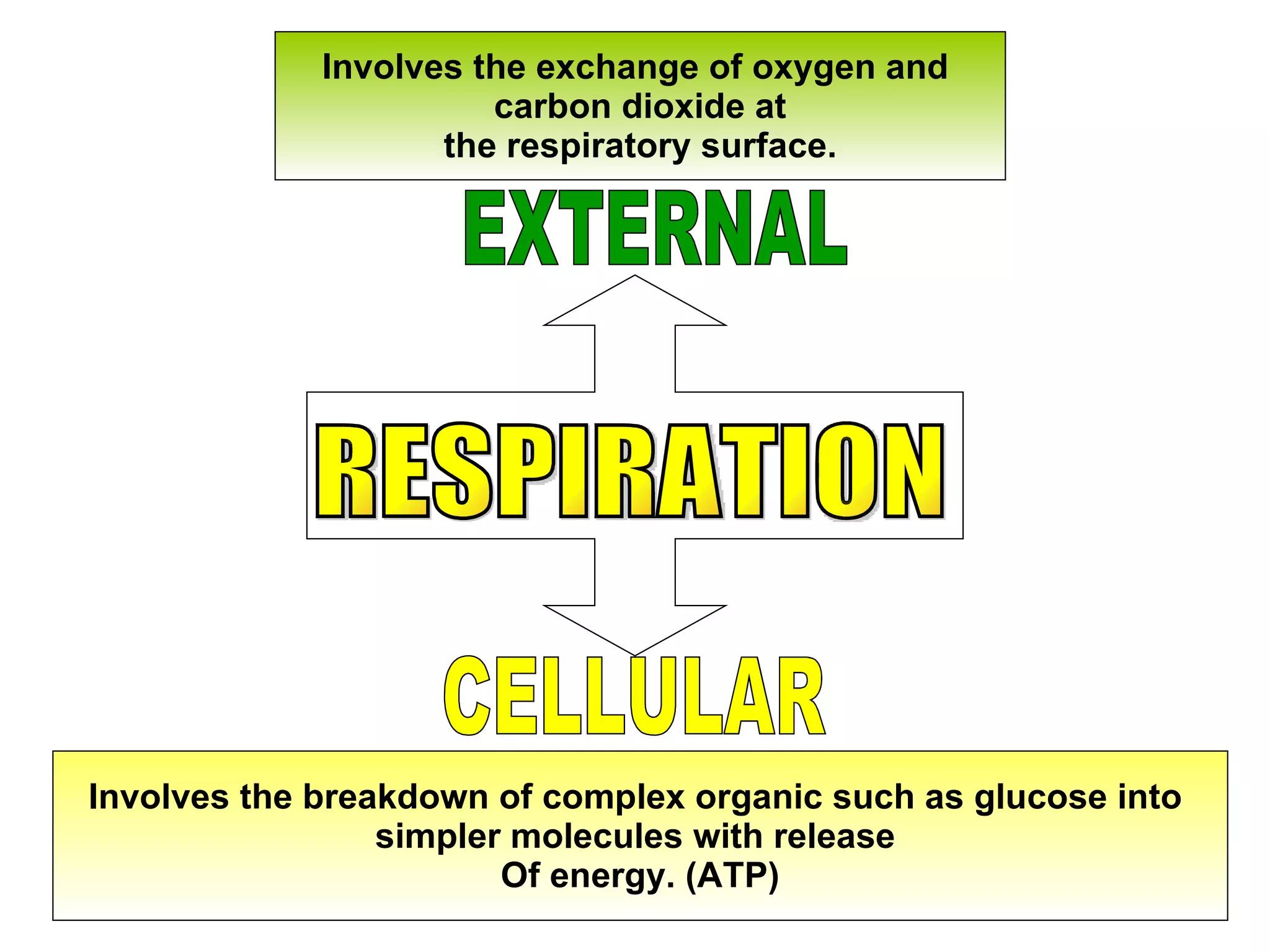
Involves the exchange of oxygen and  carbon dioxide at the respiratory surface. Involves the breakdown of complex organic such as glucose into  simpler molecules with release  Of energy. (ATP) RESPIRATION EXTERNAL CELLULAR
WITH OXYGEN 3 MAIN STAGES: GLYCOLYSIS KREB’S CYCLE ELECTRONE TRANSPORT CHAIN CELLULAR RESPIRATION: AEROBIC ANAEROBIC WITHOUT OXYGEN
The breakdown of food substances in the absence of oxygen with a small amount of energy.  Refers to the oxidation of molecules in the absence of oxygen to produce energy, in opposition to aerobic respiration which does use oxygen.  Anaerobic respiration processes require another electron acceptor to replace oxygen.  ANAEROBIC RESPIRATION
Anaerobic respiration is often used interchangeably with fermentation, especially when the glycolytic pathway is used for energy production in the cell.  General word and symbol equations for the anaerobic respiration of glucose can be shown as: glucose lactic acid (+ energy) (ATP) C 6 H 12 O 6  2C 3 H 6 O 3  + 2 ATP.
Aerobic respiration takes place in almost all living things.  It is easy to get rid of the Carbon Dioxide and excess water.  This is excretion (the removal of the toxic waste products of metabolism), and maximum energy is released from the glucose. Some organisms can respire in the absence of air: this is anaerobic respiration.  This does not release so much energy and it produces much more toxic waste products.  AEROBIC RESPIRATION
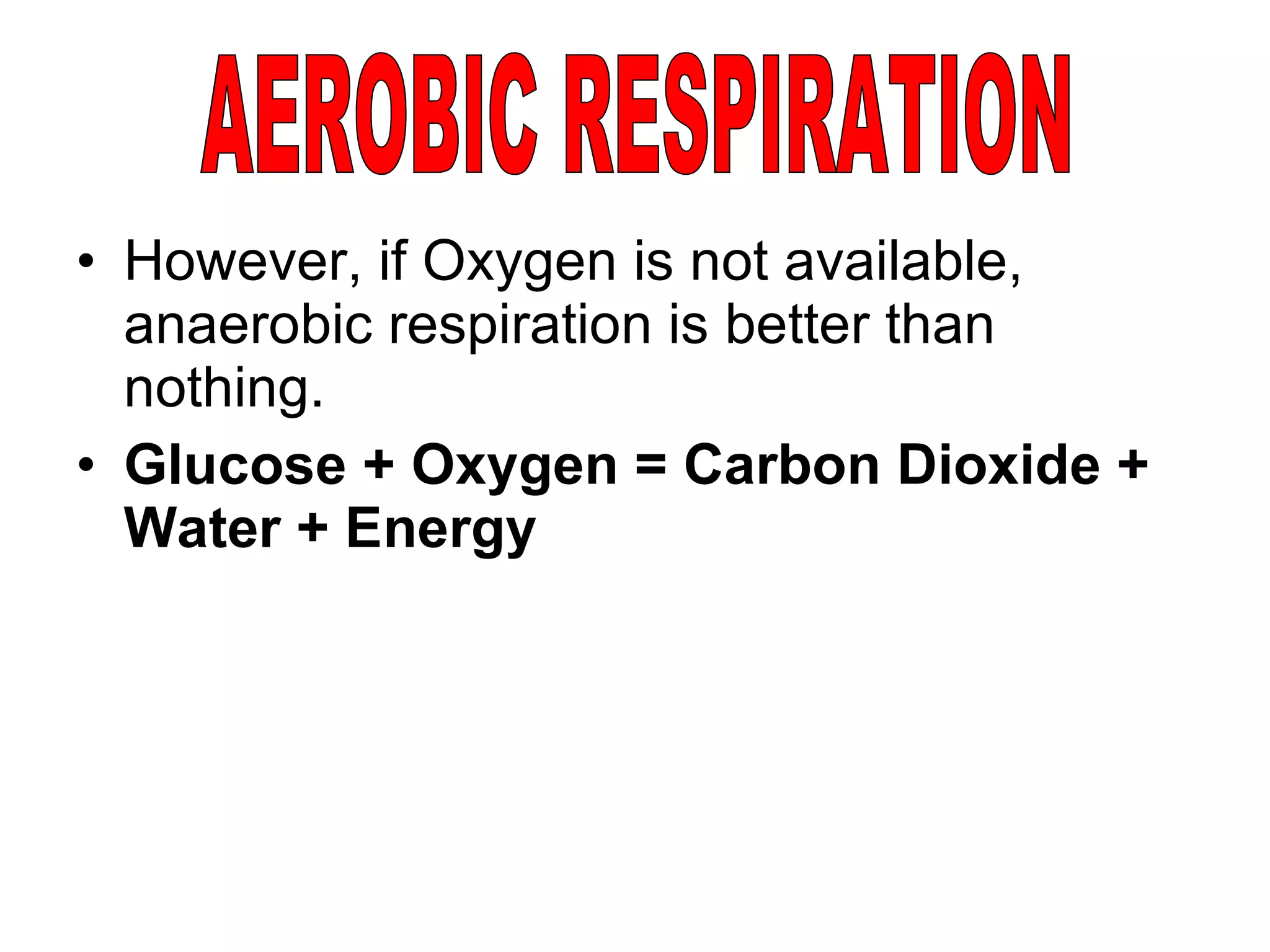
However, if Oxygen is not available, anaerobic respiration is better than nothing. Glucose + Oxygen = Carbon Dioxide + Water + Energy AEROBIC RESPIRATION
The Krebs cycle refers specifically to a complex series of chemical reactions in all cells that utilize oxygen as part of their respiration process.  This includes those cells of creatures from the higher animal kingdom, such as humans.  The Krebs cycle produces carbon dioxide and a compound rich in energy, Adenosine triphosphate (ATP).  KREB'S CYCLE
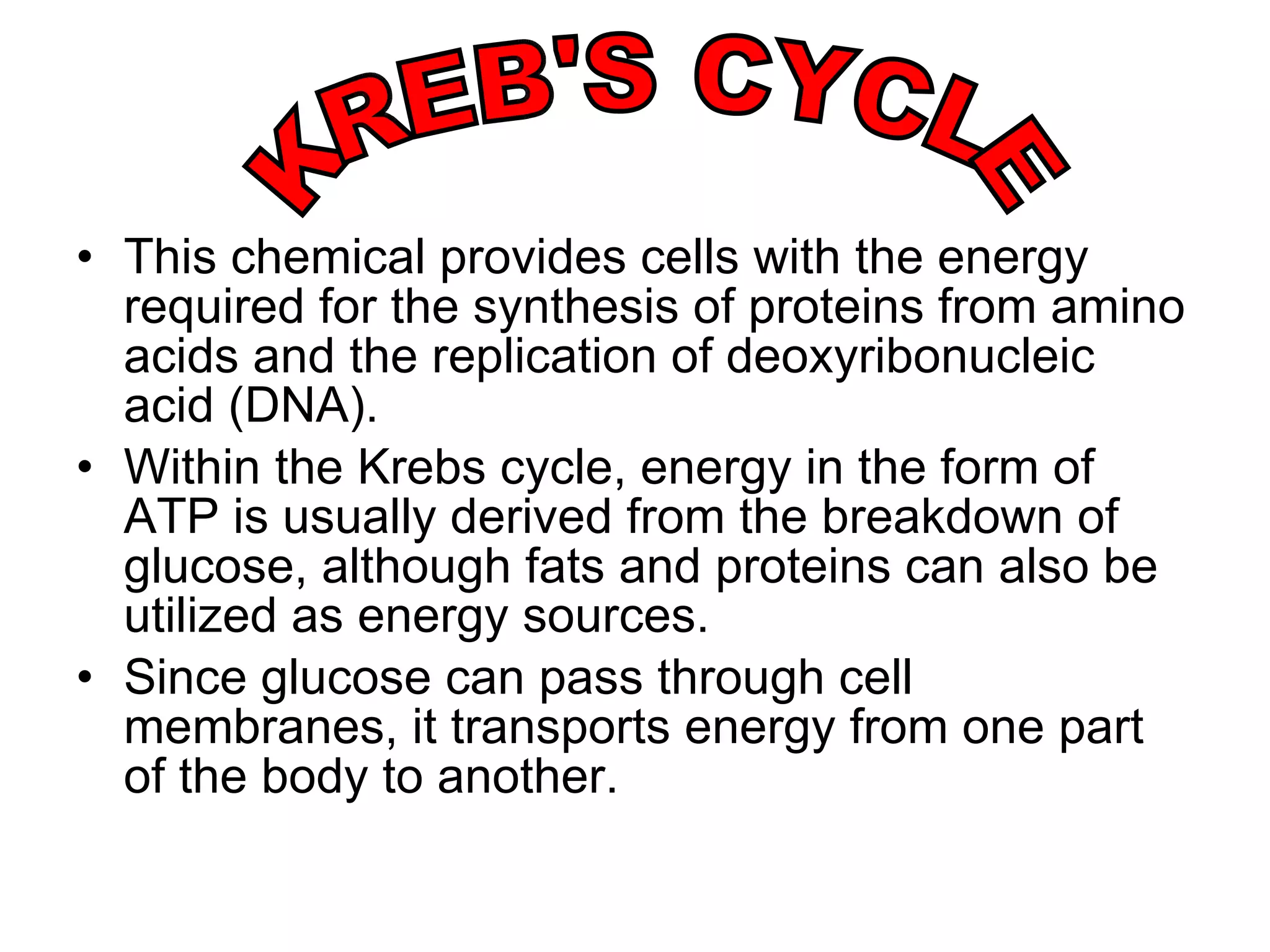
This chemical provides cells with the energy required for the synthesis of proteins from amino acids and the replication of deoxyribonucleic acid (DNA). Within the Krebs cycle, energy in the form of ATP is usually derived from the breakdown of glucose, although fats and proteins can also be utilized as energy sources.  Since glucose can pass through cell membranes, it transports energy from one part of the body to another.  KREB'S CYCLE
The Krebs cycle affects all types of life and as such, the metabolic pathway within the cells, which chemically converts carbohydrates, fats and proteins into carbon dioxide and converts water into serviceable energy. The Krebs cycle concerns the second of three major stages every living cell must undergo in order to produce energy, which it needs in order to survive. KREB'S CYCLE
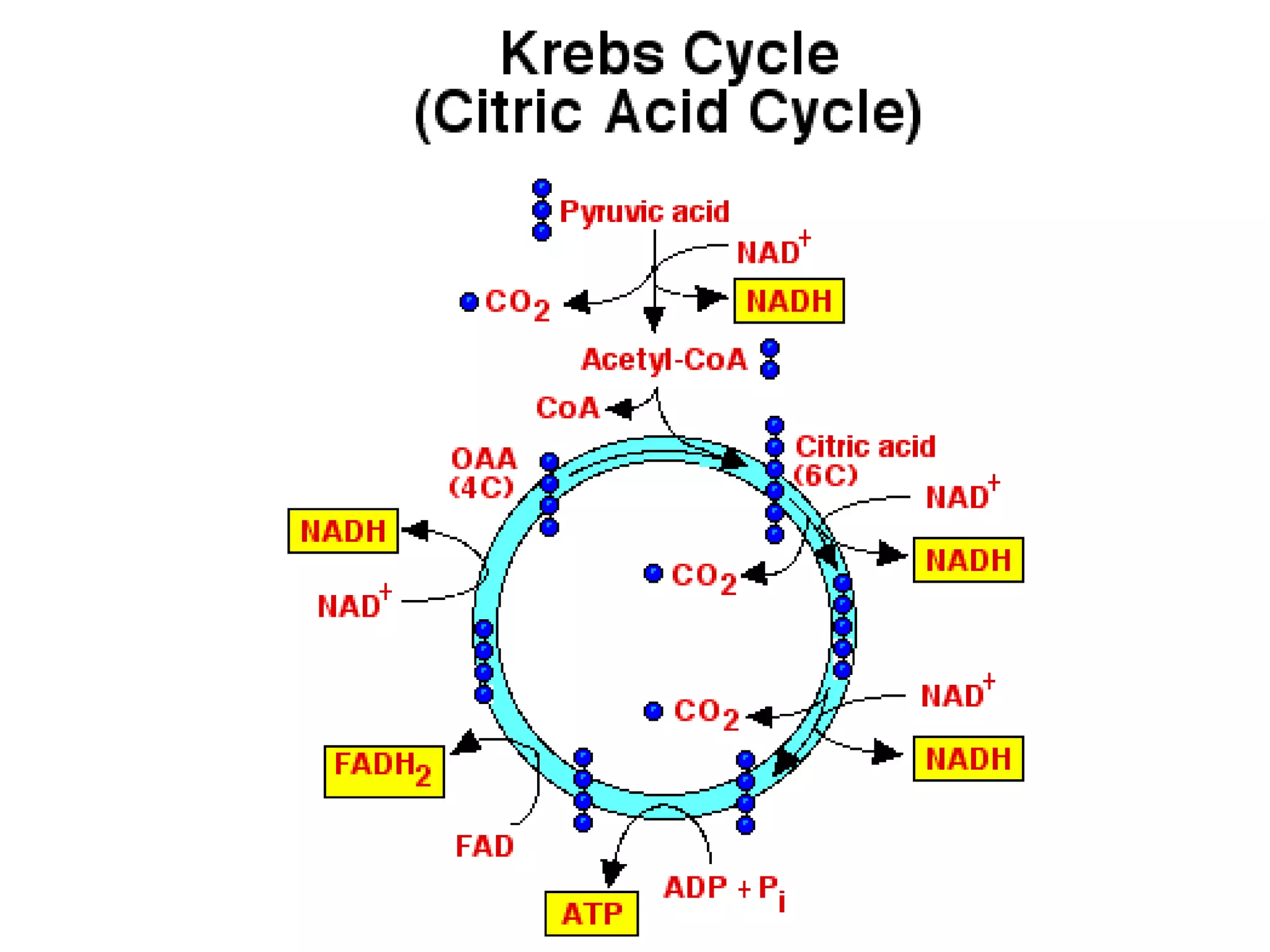
The enzymes that cause each step of the process to occur are all located in the cell’s “power plant.”  In animals this is the mitochondria, in plants it is the chloroplasts, and in microorganisms it can be found in the cell membrane.  The Krebs cycle is also known as the citric acid cycle because citric acid is the very first product generated by this sequence of chemical conversions. KREB'S CYCLE
 
KREB'S CYCLE
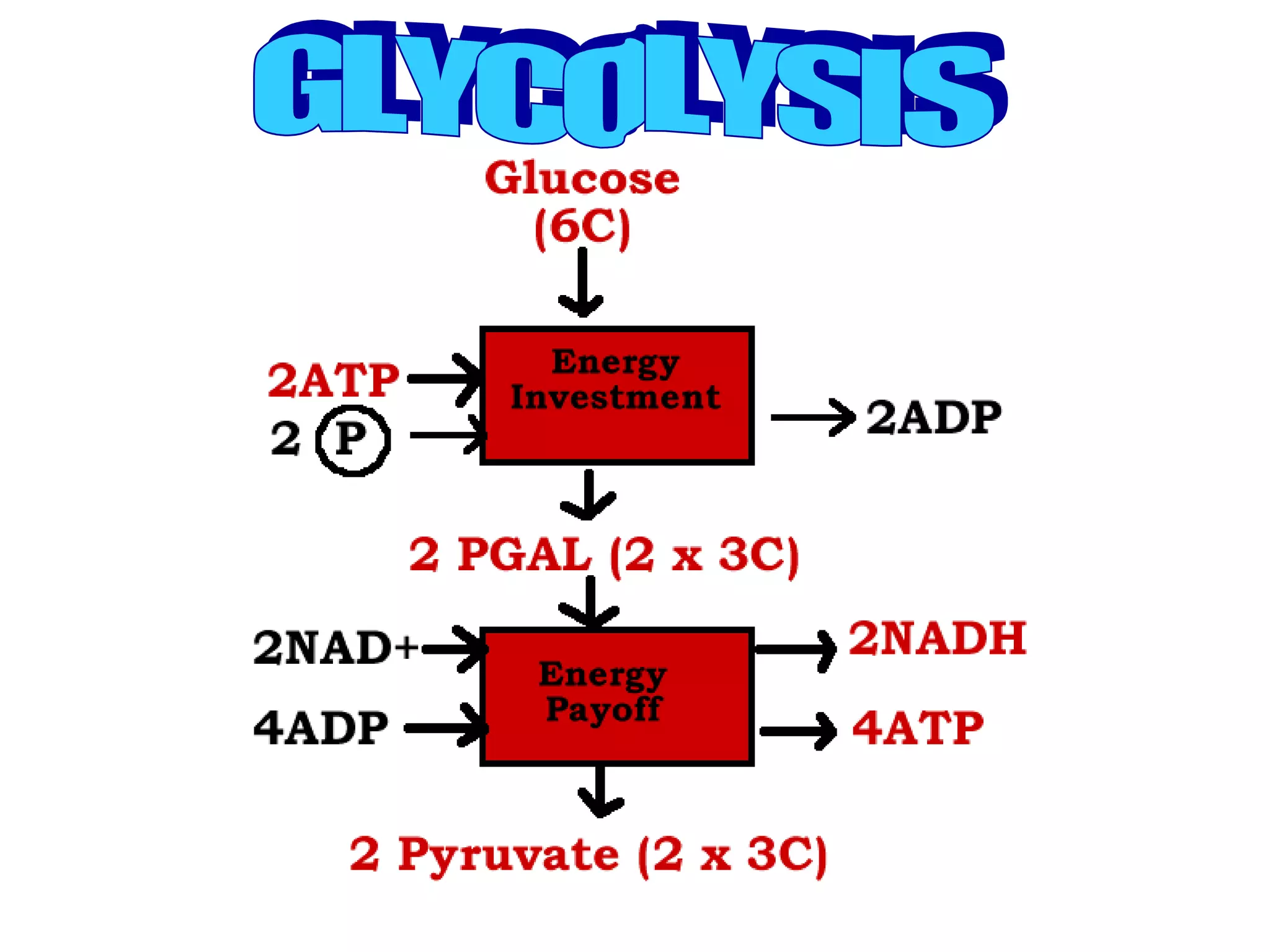
Glycolysis is a  metabolic pathway  that is found in the  cytoplasm of cells  in all living organisms and  does not require oxygen.   The process converts  one molecule of glucose  into  two molecules of pyruvate  and  makes energy  in the form of two net molecules of  ATP.   Four molecules of ATP per glucose are actually produced. However, two are consumed for the preparatory phase.  GLYCOLYSIS
The initial phosphorylation of glucose is required to destabilize the molecule for cleavage into two triose sugars.  During the pay-off phase of glycolysis, four phosphate groups are transferred to ADP by substrate-level phosphorylation to make four ATP, and two NADH are produced when the triose sugars are oxidized.  GLYCOLYSIS
Glycolysis takes place in the  cytoplasm  of the cell.  The overall reaction can be expressed this way: Glucose + 2 NAD+ + 2 Pi + 2 ADP -> 2 pyruvate +  2 NADH + 2 ATP + 2 H2O  GLYCOLYSIS
GLYCOLYSIS
An  electron transport chain  associates  (such as NADH and FADH2) and mediating biochemical reactions that produce adenosine triphosphate (ATP), which is a major energy intermediate in living organisms.  Only two sources of energy are available to biosynthesize organic molecules and maintain biochemical and kinetic processes in living organisms. Oxidation-reduction (redox) reactions and some forms of radiation, such as sunlight (used for photosynthesis). ELECTRON TRANSPORT CHAIN
Organisms that use redox reactions to produce ATP are called  chemotrophs .  Organisms that use sunlight are called  phototrophs .  Both chemotrophs and phototrophs use electron transport chains to convert energy into ATP.  ELECTRON TRANSPORT CHAIN
This is achieved through a three-step process: Gradually sap energy from high-energy electrons in a series of individual steps.  Use that energy to forcibly unbalance the proton concentration across the membrane, creating an electrochemical gradient.  Use the energy released by the drive to re-balance the proton distribution as a means of producing ATP.  ELECTRON TRANSPORT CHAIN
1. NADH and FADH2 donate electrons to electron transport chains. 2. Electron transport chains pump H +  to outer compartment of mitocondrion. 3. H +  Diffuse to inner compartment through ATP synthase channels. 4. ATP synthase catalyzes production of ATP from ADP  +  Pi(inorganic phosphate). 5. Electrons from the Electron transport chains are accepted by oxygen along with hydrogen ions to make water. ELECTRON TRANSPORT CHAIN
ELECTRON TRANSPORT CHAIN
Glycolysis – 1 glucose molecule: 2molecules of ATP (4created-2 used)         2 molecules of NAD+ reduced to 2NAD +2H+(transferred to electron transport system). 2 molecules of pyruvate 2x3carbons (they enter Link Reaction) SUMMARY
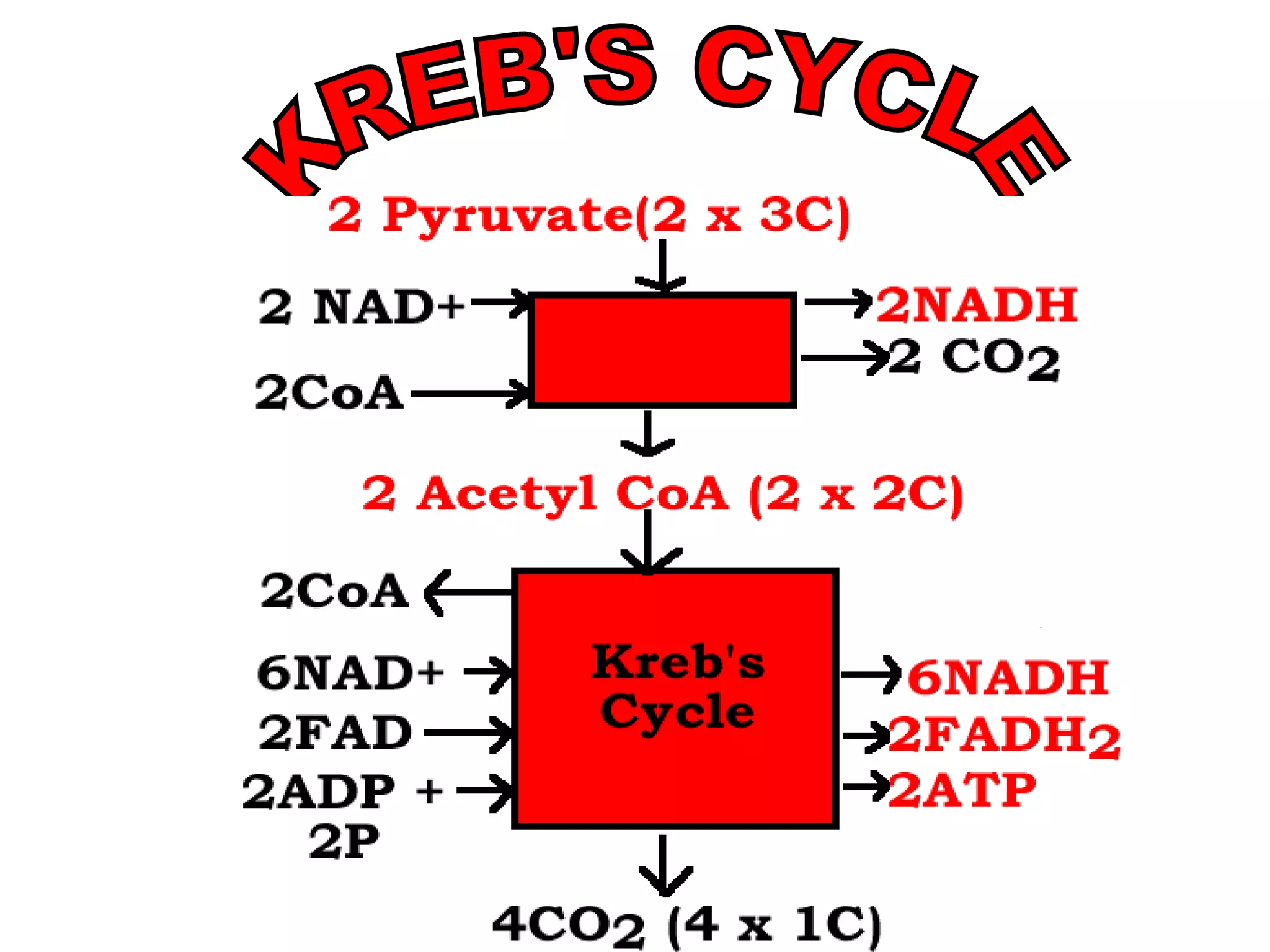
Link Reaction – Pyruvate Oxidation Occurs in the matrix of mitochondria. Pyruvate combines with coenzyme A to form acetyl coenzyme A. In the process a molecule of CO2 and 2H are removed. The hydrogen atoms are transferred to the Electron Transport System. The 2C acetyl coenzyme A disassociates forming coenzyme A acetate which enters the Krebs Cycle. SUMMARY
Krebs Cycle Acetyl coenzyme A from Link Reaction is used to make: 3 molecules of NAD+ reduced to NADH + H+ 1 molecule of FAD reduced to FADH2 2 molecules of CO2 1 molecule of ATP by phosphorylation Oxaloacetate is regenerated to start cycle again. For each glucose molecule, Krebs Cycle turns twice as 1 Glucose molecule = 2 Pyruvate molecules. The most important part of the Krebs Cycle is the release of hydrogen ions to be used in the Electron Transport System for generation of ATP. SUMMARY
Electron Transport System Occurs on the inner membrane of mitochondrion. Converts energy in form of hydrogen to ATP. The hydrogen ions received from the Krebs Cycle are attached to hydrogen carriers (NAD and FAD) which are reduced. As reduced NAD and FAD are passed along the electron transport chain, the hydrogens are removed and the hydrogen atoms split into: Hydrogen ion –  (H + ) (proton) Electron –  (e - ) SUMMARY
At the end of the system, the hydrogen ions and electrons recombine and are then used to reduce oxygen to form water. The formation of ATP through the oxidation of hydrogen atoms is called Oxidative Phosphorylation: 2 molecules of ATP are produced from each FADH2 molecule. 3 molecules of ATP are produced from each NADH + H+ molecule. SUMMARY
SUMMARY 2 10 2 40 Total - - - 30(NADH + H +) 4(FADH2) Electron Transport System 2 6 0 2 Krebs Cycle 0 2 0 0 Link Reaction 0 2 2 4 Glycolysis FADH2 produced NADH +  H + produced ATP  Used ATP Produced Stage in Aerobic Respiration
 

Respiration

  • 1.
    DEFINITION TYPES OFRESPIRATION AEROBIC RESPIRATION: GLYCOLYSIS KREB’S CYCLE ELECTRONE TRANSPORT CHAIN ANAEROBIC RESPIRATION RESPIRATION
  • 2.
    OBJECTIVES: By theend of the lesson, student should be able to : Define terms respiration. Understand the external and cellular respiration. Understand the 3 main steps in anaerobic respiration.
  • 3.
    Respiration is therelease of energy from glucose or another organic chemical. The chemical energy in glucose can be used to provide the energy required for growth, repair and movement. RESPIRATION
  • 4.
    Involves the exchangeof oxygen and carbon dioxide at the respiratory surface. Involves the breakdown of complex organic such as glucose into simpler molecules with release Of energy. (ATP) RESPIRATION EXTERNAL CELLULAR
  • 5.
    WITH OXYGEN 3MAIN STAGES: GLYCOLYSIS KREB’S CYCLE ELECTRONE TRANSPORT CHAIN CELLULAR RESPIRATION: AEROBIC ANAEROBIC WITHOUT OXYGEN
  • 6.
    The breakdown offood substances in the absence of oxygen with a small amount of energy. Refers to the oxidation of molecules in the absence of oxygen to produce energy, in opposition to aerobic respiration which does use oxygen. Anaerobic respiration processes require another electron acceptor to replace oxygen. ANAEROBIC RESPIRATION
  • 7.
    Anaerobic respiration isoften used interchangeably with fermentation, especially when the glycolytic pathway is used for energy production in the cell. General word and symbol equations for the anaerobic respiration of glucose can be shown as: glucose lactic acid (+ energy) (ATP) C 6 H 12 O 6 2C 3 H 6 O 3 + 2 ATP.
  • 8.
    Aerobic respiration takesplace in almost all living things. It is easy to get rid of the Carbon Dioxide and excess water. This is excretion (the removal of the toxic waste products of metabolism), and maximum energy is released from the glucose. Some organisms can respire in the absence of air: this is anaerobic respiration. This does not release so much energy and it produces much more toxic waste products. AEROBIC RESPIRATION
  • 9.
    However, if Oxygenis not available, anaerobic respiration is better than nothing. Glucose + Oxygen = Carbon Dioxide + Water + Energy AEROBIC RESPIRATION
  • 10.
    The Krebs cyclerefers specifically to a complex series of chemical reactions in all cells that utilize oxygen as part of their respiration process. This includes those cells of creatures from the higher animal kingdom, such as humans. The Krebs cycle produces carbon dioxide and a compound rich in energy, Adenosine triphosphate (ATP). KREB'S CYCLE
  • 11.
    This chemical providescells with the energy required for the synthesis of proteins from amino acids and the replication of deoxyribonucleic acid (DNA). Within the Krebs cycle, energy in the form of ATP is usually derived from the breakdown of glucose, although fats and proteins can also be utilized as energy sources. Since glucose can pass through cell membranes, it transports energy from one part of the body to another. KREB'S CYCLE
  • 12.
    The Krebs cycleaffects all types of life and as such, the metabolic pathway within the cells, which chemically converts carbohydrates, fats and proteins into carbon dioxide and converts water into serviceable energy. The Krebs cycle concerns the second of three major stages every living cell must undergo in order to produce energy, which it needs in order to survive. KREB'S CYCLE
  • 13.
    The enzymes thatcause each step of the process to occur are all located in the cell’s “power plant.” In animals this is the mitochondria, in plants it is the chloroplasts, and in microorganisms it can be found in the cell membrane. The Krebs cycle is also known as the citric acid cycle because citric acid is the very first product generated by this sequence of chemical conversions. KREB'S CYCLE
  • 14.
  • 15.
  • 16.
    Glycolysis is a metabolic pathway that is found in the cytoplasm of cells in all living organisms and does not require oxygen. The process converts one molecule of glucose into two molecules of pyruvate and makes energy in the form of two net molecules of ATP. Four molecules of ATP per glucose are actually produced. However, two are consumed for the preparatory phase. GLYCOLYSIS
  • 17.
    The initial phosphorylationof glucose is required to destabilize the molecule for cleavage into two triose sugars. During the pay-off phase of glycolysis, four phosphate groups are transferred to ADP by substrate-level phosphorylation to make four ATP, and two NADH are produced when the triose sugars are oxidized. GLYCOLYSIS
  • 18.
    Glycolysis takes placein the cytoplasm of the cell. The overall reaction can be expressed this way: Glucose + 2 NAD+ + 2 Pi + 2 ADP -> 2 pyruvate + 2 NADH + 2 ATP + 2 H2O GLYCOLYSIS
  • 19.
  • 20.
    An electrontransport chain associates (such as NADH and FADH2) and mediating biochemical reactions that produce adenosine triphosphate (ATP), which is a major energy intermediate in living organisms. Only two sources of energy are available to biosynthesize organic molecules and maintain biochemical and kinetic processes in living organisms. Oxidation-reduction (redox) reactions and some forms of radiation, such as sunlight (used for photosynthesis). ELECTRON TRANSPORT CHAIN
  • 21.
    Organisms that useredox reactions to produce ATP are called chemotrophs . Organisms that use sunlight are called phototrophs . Both chemotrophs and phototrophs use electron transport chains to convert energy into ATP. ELECTRON TRANSPORT CHAIN
  • 22.
    This is achievedthrough a three-step process: Gradually sap energy from high-energy electrons in a series of individual steps. Use that energy to forcibly unbalance the proton concentration across the membrane, creating an electrochemical gradient. Use the energy released by the drive to re-balance the proton distribution as a means of producing ATP. ELECTRON TRANSPORT CHAIN
  • 23.
    1. NADH andFADH2 donate electrons to electron transport chains. 2. Electron transport chains pump H + to outer compartment of mitocondrion. 3. H + Diffuse to inner compartment through ATP synthase channels. 4. ATP synthase catalyzes production of ATP from ADP + Pi(inorganic phosphate). 5. Electrons from the Electron transport chains are accepted by oxygen along with hydrogen ions to make water. ELECTRON TRANSPORT CHAIN
  • 24.
  • 25.
    Glycolysis – 1glucose molecule: 2molecules of ATP (4created-2 used)        2 molecules of NAD+ reduced to 2NAD +2H+(transferred to electron transport system). 2 molecules of pyruvate 2x3carbons (they enter Link Reaction) SUMMARY
  • 26.
    Link Reaction –Pyruvate Oxidation Occurs in the matrix of mitochondria. Pyruvate combines with coenzyme A to form acetyl coenzyme A. In the process a molecule of CO2 and 2H are removed. The hydrogen atoms are transferred to the Electron Transport System. The 2C acetyl coenzyme A disassociates forming coenzyme A acetate which enters the Krebs Cycle. SUMMARY
  • 27.
    Krebs Cycle Acetylcoenzyme A from Link Reaction is used to make: 3 molecules of NAD+ reduced to NADH + H+ 1 molecule of FAD reduced to FADH2 2 molecules of CO2 1 molecule of ATP by phosphorylation Oxaloacetate is regenerated to start cycle again. For each glucose molecule, Krebs Cycle turns twice as 1 Glucose molecule = 2 Pyruvate molecules. The most important part of the Krebs Cycle is the release of hydrogen ions to be used in the Electron Transport System for generation of ATP. SUMMARY
  • 28.
    Electron Transport SystemOccurs on the inner membrane of mitochondrion. Converts energy in form of hydrogen to ATP. The hydrogen ions received from the Krebs Cycle are attached to hydrogen carriers (NAD and FAD) which are reduced. As reduced NAD and FAD are passed along the electron transport chain, the hydrogens are removed and the hydrogen atoms split into: Hydrogen ion – (H + ) (proton) Electron – (e - ) SUMMARY
  • 29.
    At the endof the system, the hydrogen ions and electrons recombine and are then used to reduce oxygen to form water. The formation of ATP through the oxidation of hydrogen atoms is called Oxidative Phosphorylation: 2 molecules of ATP are produced from each FADH2 molecule. 3 molecules of ATP are produced from each NADH + H+ molecule. SUMMARY
  • 30.
    SUMMARY 2 102 40 Total - - - 30(NADH + H +) 4(FADH2) Electron Transport System 2 6 0 2 Krebs Cycle 0 2 0 0 Link Reaction 0 2 2 4 Glycolysis FADH2 produced NADH + H + produced ATP Used ATP Produced Stage in Aerobic Respiration
  • 31.