Analysis and Classification of Electromyogram
                   (EMG) Signals
Nur Hasanah Binti Shafei, Nur Sabrina Binti Risman, Kartini Binti Ibrahim, Idayu Binti Mohamed Rasid

                                      Faculty of Electrical Engineering
                    Universiti Teknologi Malaysia, 81310 UTM Skudai, Johor Darul Ta’zim

 Abstract – The early diagnosis in medical healthcare
 application were really needed and crucial. It is
 therefore important to devise accurate methods of
 diagnosis. Currently, methods of diagnosis include
 assessing the patients’ history, blood tests and
 muscle biopsies. The latter two methods, whilst
 being relatively accurate, may take weeks to obtain a
 result [1]. This paper investigates another commonly
 used method is electromyography by analysis and
 classification the EMG signals. The system has
 successfully implemented by using MATLAB’s
 software that was able to differentiate the EMG
 signal coming from different patients. The signal            Figure 1: How to perform EMG instrument
 from respective patients can be easily identified by
 development of Graphical User Interface (GUI).                    The input EMG signal can be captured
                                                          nicely and useful for diagnosis if the placing of
               I.        INTRODUCTION                     electrode heavily considered. The figure 2 below,
                                                          show the different signals captured for different
         Electromyography (EMG) is a technique for
                                                          place of muscles.
  evaluating and recording the electrical activity
  produced by skeletal muscles. EMG is performed
  using an instrument called an electromyograph, to
  produce a record called an electromyogram. An
  electromyograph detects the electrical potential
  generated by muscle cells when these cells are
  electrically or neurologically activated [2].

         The action of nerves and muscle is essentially
  electrical. Information is transmitted along nerves
  as a series of electrical discharges carrying
  information in pulse repetition frequency. [3] Figure
  1 shows how to perform EMG instrument by placing         Figure 2: Time & frequency graphs for different
  the electrode at the muscle.                                            place of muscles
EMG signals acquire advanced methods           then would be used as input to a rule base classifier
for detection, decomposition, processing, and           to be implemented in the software.
classification. The purpose to provide efficient
and effective ways of understanding the signal
and its nature, we further point up some of the
software implementation for identifying the
signals coming from different patients. This
knowledge may help in medical healthcare center
to develop more powerful, flexible, and efficient
applications [4].

            II.       METHODOLOGY

        First and foremost, a block diagram must
be designed to be the basic reference. Based on
                                                           Figure 4: The step involves for designing the
figure 3, this is a general block diagram of this
                                                                        complete system.
experiment. The system was received two
difference EMG signals coming from two different
patients. Then, the system was identified the signal
belong to which patient.


Patient 1                              Identify the
                   SYSTEM
                                         Patient’s
Patient 2         (MATLAB)
                                          signal


Figure 3: The block diagram of analysis of EMG
signal.

         In order to design the system, there are six
steps to be done. Below, in the figure 4, there were
the sequences of our procedure. The first step was
we needed to identify the EMG characteristic in
terms of its power and frequency. Those
characteristic helped us to continue the next step.

         From the input signals, the system
generated the power spectrum. By using the fast
Fourier transformation the EMG power spectrum
can be obtained with a better resolution. We
examined the power spectrum of the EMG patents
to define the parameters that can be used to
                                                         Figure 5: The flow chart of Matlab Programming.
identify the various patients. The signal parameters
The coding implemented for the above ideas in          elseif(absx > 10)
figure 5 were as follow [5]:                           % xH = avex2
                                                       msgbox('The signal belong to patient 2')
a) For load the data                                   end
%DSP Laboratory
                                                       % Parameter3: Root mean square
%Analysis and Classification of EMG Signals
                                                       rms_x = sqrt(mean(Y.^2))
%Load Data from user                                   absrms = abs (rms_x)
A = load ('emg1.txt');    % A = load ('emg2.txt') if   % Classification for the result process
emg2 signal                                            xH = 0;
Y = fft(A(:,1),1024); % FFT of sample data             if (absrms < 370)
figure, plot (A)     % Show FFT Figure                 % xH = avex1;
xlabel('Time (ms)')                                    msgbox('The signal belong to patient 1')
ylabel ('Amplitude (uV)')                              elseif(absrms > 370)
figure,stem (abs(Y)); % To generate power spectrum     % xH = avex2
xlabel('Frequency')                                    msgbox('The signal belong to patient 2')
ylabel ('Amplitude')                                   end


b) There are several parameters that can be used       % Parameter4: Maximum power
   as an input of rule base classifier. The system     z = abs (Y);
   designed for obtaining results by simply using      maxz = max (z)
   one of the following signal parameters.             % Classification for the result process
                                                       xH = 0;
% Parameter1: Median value                             if (maxz < 5200)
medianx = median (Y)                                   % xH = avex1;
absx = abs(median                                      msgbox('The signal belong to patient 1')
% Classification for the result process                elseif(maxz > 5200)
xH = 0;                                                % xH = avex2
if (absx < 580)                                        msgbox('The signal belong to patient 2')
% xH = avex1;                                          end
msgbox('The signal belong to patient 1')
elseif(absx > 580)                                     % Parameter5: Minimum power
% xH = avex2                                           z = abs (Y);
msgbox('The signal belong to patient 2')               minz = min (z)
end                                                    % Classification for the result process
                                                       xH = 0;
% Parameter2: Average value                            if (minz < 20)
avex = mean (Y)                                        % xH = avex1;
absx= abs(avex)                                        msgbox('The signal belong to patient 1')
% Classification for the result process                elseif(minz > 20)
xH = 0;                                                % xH = avex2
if (absx < 10)                                         msgbox('The signal belong to patient 2')
% xH = avex1;                                          end
msgbox('The signal belong to patient 1')
Last but not least, the analysis and
classification of EMG signal to differentiate the
signal coming from which patient can be verified.

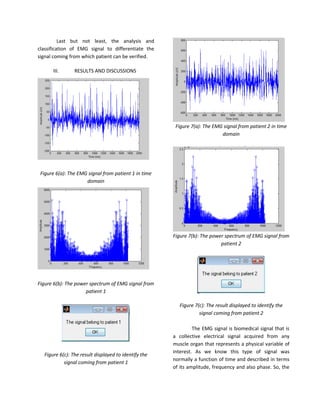
      III.      RESULTS AND DISCUSSIONS


                                                       Figure 7(a): The EMG signal from patient 2 in time
                                                                           domain


 Figure 6(a): The EMG signal from patient 1 in time
                     domain


                                                      Figure 7(b): The power spectrum of EMG signal from
                                                                           patient 2


Figure 6(b): The power spectrum of EMG signal from
                     patient 1

                                                         Figure 7(c): The result displayed to identify the
                                                                  signal coming from patient 2

                                                               The EMG signal is biomedical signal that is
                                                      a collective electrical signal acquired from any
                                                      muscle organ that represents a physical variable of
                                                      interest. As we know this type of signal was
  Figure 6(c): The result displayed to identify the
                                                      normally a function of time and described in terms
           signal coming from patient 1
                                                      of its amplitude, frequency and also phase. So, the
power spectrum that was generated from the input        EMG signals coming from which patient. The figures
signal was examined in order to identify the            6 showed the results obtained when the system
suitable signals parameters to differentiate the        was loaded the EMG signal from patient 1. The
signal from respective patients. In terms of power      displaying box was used to verify the performance
spectrum, the obvious characteristics of both           of our system. While the figures 7 were the results
signals which are in terms of amplitude, power          obtained when the system was loaded the EMG
spectrum density can be easily analyzed and             signal coming from another patient which was
classified.                                             patient 2. Last but not least, figures 8 below show
                                                        the verification of the results by using GUI.
        Several parameters can be accounted to
use as the input of rule base classifier which were                   IV.      CONCLUSIONS
median frequency, mean frequency, the amplitude
in terms of root mean square, maximum and                         The study investigates the rule based
minimum power spectrum density.                         classifier from the EMG signal parameters to
                                                        differentiate the EMG signal coming from different
                                                        patients. This application of EMG signals that were
                                                        generated by the muscles in human body
                                                        commonly use in medical field for diagnostic
                                                        purpose. According to our experimental results, the
                                                        suitable parameters were determined to successful
                                                        implemented to complete system. The performance
                                                        of the system which is the ability to identify the
                                                        EMG signals coming from different patients was
                                                        verified.

                                                                       V.       REFERENCES
  Figure 8(a): the result obtaining for patient 1 by
                      using GUI
                                                       [1].      Martin, L., Diagnosis of Neuromuscular
                                                       disease using surface EMG with neural network
                                                       analysis. COIN512(Comp.) Project Brief
                                                       [2].      David, M. Blake, Procedures Offered for
                                                       Lexington Neurology General Services. Lexington,
                                                       KY.
                                                       [3].      Malcown, C. Brown, The Medical
                                                       Equipment Dictionary- Electromygram. 2007.
                                                       Liverpool, United Kingdom.
                                                       [4].      M.B.I Raez, et al. Zhu, J., et al. Techniques
                                                       of EMG Signal Analysis: Detection, Processing,
                                                       Classification and Applications. 2006
  Figure 8(b): the result obtaining for patient 2 by   [5].      Wan Mohd Bukhari Bin Wan Daud
                      using GUI                        Classification of EOG signals of Eye Movement
                                                       Potentials. 2009
       Simply using only one of the above signal
parameter, the system was able to differentiate the

Dsp lab report- Analysis and classification of EMG signal using MATLAB.

  • 1.
    Analysis and Classificationof Electromyogram (EMG) Signals Nur Hasanah Binti Shafei, Nur Sabrina Binti Risman, Kartini Binti Ibrahim, Idayu Binti Mohamed Rasid Faculty of Electrical Engineering Universiti Teknologi Malaysia, 81310 UTM Skudai, Johor Darul Ta’zim Abstract – The early diagnosis in medical healthcare application were really needed and crucial. It is therefore important to devise accurate methods of diagnosis. Currently, methods of diagnosis include assessing the patients’ history, blood tests and muscle biopsies. The latter two methods, whilst being relatively accurate, may take weeks to obtain a result [1]. This paper investigates another commonly used method is electromyography by analysis and classification the EMG signals. The system has successfully implemented by using MATLAB’s software that was able to differentiate the EMG signal coming from different patients. The signal Figure 1: How to perform EMG instrument from respective patients can be easily identified by development of Graphical User Interface (GUI). The input EMG signal can be captured nicely and useful for diagnosis if the placing of I. INTRODUCTION electrode heavily considered. The figure 2 below, show the different signals captured for different Electromyography (EMG) is a technique for place of muscles. evaluating and recording the electrical activity produced by skeletal muscles. EMG is performed using an instrument called an electromyograph, to produce a record called an electromyogram. An electromyograph detects the electrical potential generated by muscle cells when these cells are electrically or neurologically activated [2]. The action of nerves and muscle is essentially electrical. Information is transmitted along nerves as a series of electrical discharges carrying information in pulse repetition frequency. [3] Figure 1 shows how to perform EMG instrument by placing Figure 2: Time & frequency graphs for different the electrode at the muscle. place of muscles
  • 2.
    EMG signals acquireadvanced methods then would be used as input to a rule base classifier for detection, decomposition, processing, and to be implemented in the software. classification. The purpose to provide efficient and effective ways of understanding the signal and its nature, we further point up some of the software implementation for identifying the signals coming from different patients. This knowledge may help in medical healthcare center to develop more powerful, flexible, and efficient applications [4]. II. METHODOLOGY First and foremost, a block diagram must be designed to be the basic reference. Based on Figure 4: The step involves for designing the figure 3, this is a general block diagram of this complete system. experiment. The system was received two difference EMG signals coming from two different patients. Then, the system was identified the signal belong to which patient. Patient 1 Identify the SYSTEM Patient’s Patient 2 (MATLAB) signal Figure 3: The block diagram of analysis of EMG signal. In order to design the system, there are six steps to be done. Below, in the figure 4, there were the sequences of our procedure. The first step was we needed to identify the EMG characteristic in terms of its power and frequency. Those characteristic helped us to continue the next step. From the input signals, the system generated the power spectrum. By using the fast Fourier transformation the EMG power spectrum can be obtained with a better resolution. We examined the power spectrum of the EMG patents to define the parameters that can be used to Figure 5: The flow chart of Matlab Programming. identify the various patients. The signal parameters
  • 3.
    The coding implementedfor the above ideas in elseif(absx > 10) figure 5 were as follow [5]: % xH = avex2 msgbox('The signal belong to patient 2') a) For load the data end %DSP Laboratory % Parameter3: Root mean square %Analysis and Classification of EMG Signals rms_x = sqrt(mean(Y.^2)) %Load Data from user absrms = abs (rms_x) A = load ('emg1.txt'); % A = load ('emg2.txt') if % Classification for the result process emg2 signal xH = 0; Y = fft(A(:,1),1024); % FFT of sample data if (absrms < 370) figure, plot (A) % Show FFT Figure % xH = avex1; xlabel('Time (ms)') msgbox('The signal belong to patient 1') ylabel ('Amplitude (uV)') elseif(absrms > 370) figure,stem (abs(Y)); % To generate power spectrum % xH = avex2 xlabel('Frequency') msgbox('The signal belong to patient 2') ylabel ('Amplitude') end b) There are several parameters that can be used % Parameter4: Maximum power as an input of rule base classifier. The system z = abs (Y); designed for obtaining results by simply using maxz = max (z) one of the following signal parameters. % Classification for the result process xH = 0; % Parameter1: Median value if (maxz < 5200) medianx = median (Y) % xH = avex1; absx = abs(median msgbox('The signal belong to patient 1') % Classification for the result process elseif(maxz > 5200) xH = 0; % xH = avex2 if (absx < 580) msgbox('The signal belong to patient 2') % xH = avex1; end msgbox('The signal belong to patient 1') elseif(absx > 580) % Parameter5: Minimum power % xH = avex2 z = abs (Y); msgbox('The signal belong to patient 2') minz = min (z) end % Classification for the result process xH = 0; % Parameter2: Average value if (minz < 20) avex = mean (Y) % xH = avex1; absx= abs(avex) msgbox('The signal belong to patient 1') % Classification for the result process elseif(minz > 20) xH = 0; % xH = avex2 if (absx < 10) msgbox('The signal belong to patient 2') % xH = avex1; end msgbox('The signal belong to patient 1')
  • 4.
    Last but notleast, the analysis and classification of EMG signal to differentiate the signal coming from which patient can be verified. III. RESULTS AND DISCUSSIONS Figure 7(a): The EMG signal from patient 2 in time domain Figure 6(a): The EMG signal from patient 1 in time domain Figure 7(b): The power spectrum of EMG signal from patient 2 Figure 6(b): The power spectrum of EMG signal from patient 1 Figure 7(c): The result displayed to identify the signal coming from patient 2 The EMG signal is biomedical signal that is a collective electrical signal acquired from any muscle organ that represents a physical variable of interest. As we know this type of signal was Figure 6(c): The result displayed to identify the normally a function of time and described in terms signal coming from patient 1 of its amplitude, frequency and also phase. So, the
  • 5.
    power spectrum thatwas generated from the input EMG signals coming from which patient. The figures signal was examined in order to identify the 6 showed the results obtained when the system suitable signals parameters to differentiate the was loaded the EMG signal from patient 1. The signal from respective patients. In terms of power displaying box was used to verify the performance spectrum, the obvious characteristics of both of our system. While the figures 7 were the results signals which are in terms of amplitude, power obtained when the system was loaded the EMG spectrum density can be easily analyzed and signal coming from another patient which was classified. patient 2. Last but not least, figures 8 below show the verification of the results by using GUI. Several parameters can be accounted to use as the input of rule base classifier which were IV. CONCLUSIONS median frequency, mean frequency, the amplitude in terms of root mean square, maximum and The study investigates the rule based minimum power spectrum density. classifier from the EMG signal parameters to differentiate the EMG signal coming from different patients. This application of EMG signals that were generated by the muscles in human body commonly use in medical field for diagnostic purpose. According to our experimental results, the suitable parameters were determined to successful implemented to complete system. The performance of the system which is the ability to identify the EMG signals coming from different patients was verified. V. REFERENCES Figure 8(a): the result obtaining for patient 1 by using GUI [1]. Martin, L., Diagnosis of Neuromuscular disease using surface EMG with neural network analysis. COIN512(Comp.) Project Brief [2]. David, M. Blake, Procedures Offered for Lexington Neurology General Services. Lexington, KY. [3]. Malcown, C. Brown, The Medical Equipment Dictionary- Electromygram. 2007. Liverpool, United Kingdom. [4]. M.B.I Raez, et al. Zhu, J., et al. Techniques of EMG Signal Analysis: Detection, Processing, Classification and Applications. 2006 Figure 8(b): the result obtaining for patient 2 by [5]. Wan Mohd Bukhari Bin Wan Daud using GUI Classification of EOG signals of Eye Movement Potentials. 2009 Simply using only one of the above signal parameter, the system was able to differentiate the