1© 2015 The MathWorks, Inc.
R&D for an IoT Product:
Analysis vs. Analytics
Rob Purser
Manager of Hardware Integration
MATLAB Products
2
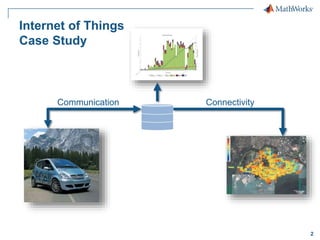
Internet of Things
Case Study
Communication Connectivity
3
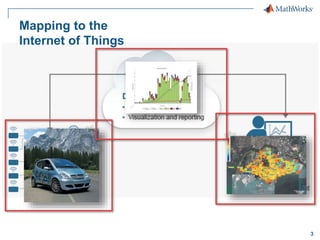
Mapping to the
Internet of Things
4
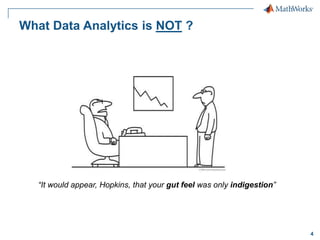
What Data Analytics is NOT ?
“It would appear, Hopkins, that your gut feel was only indigestion”
5
Data Analytics
Business critical
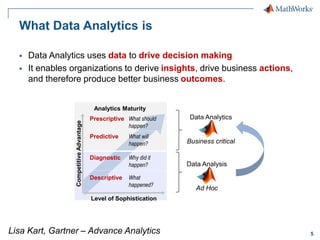
What Data Analytics is
 Data Analytics uses data to drive decision making
 It enables organizations to derive insights, drive business actions,
and therefore produce better business outcomes.
Analytics Maturity
Level of Sophistication
Prescriptive
Predictive
Diagnostic
Descriptive
What should
happen?
What will
happen?
Why did it
happen?
What
happened?
CompetitiveAdvantage
Data Analysis
Ad Hoc
Lisa Kart, Gartner – Advance Analytics
6
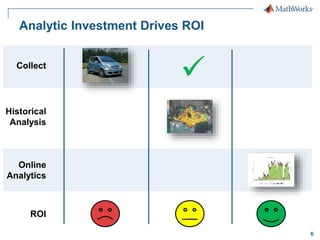
Analytic Investment Drives ROI
Collect
Historical
Analysis
Online
Analytics
ROI
 

7
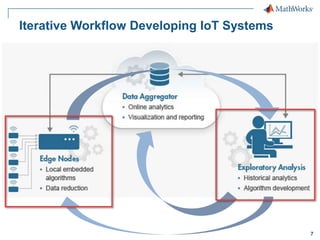
Iterative Workflow Developing IoT Systems
8
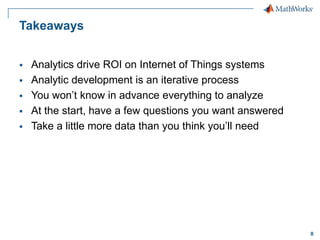
Takeaways
 Analytics drive ROI on Internet of Things systems
 Analytic development is an iterative process
 You won’t know in advance everything to analyze
 At the start, have a few questions you want answered
 Take a little more data than you think you’ll need

Mathworks case example

  • 1.
    1© 2015 TheMathWorks, Inc. R&D for an IoT Product: Analysis vs. Analytics Rob Purser Manager of Hardware Integration MATLAB Products
  • 2.
    2 Internet of Things CaseStudy Communication Connectivity
  • 3.
  • 4.
    4 What Data Analyticsis NOT ? “It would appear, Hopkins, that your gut feel was only indigestion”
  • 5.
    5 Data Analytics Business critical WhatData Analytics is  Data Analytics uses data to drive decision making  It enables organizations to derive insights, drive business actions, and therefore produce better business outcomes. Analytics Maturity Level of Sophistication Prescriptive Predictive Diagnostic Descriptive What should happen? What will happen? Why did it happen? What happened? CompetitiveAdvantage Data Analysis Ad Hoc Lisa Kart, Gartner – Advance Analytics
  • 6.
    6 Analytic Investment DrivesROI Collect Historical Analysis Online Analytics ROI   
  • 7.
  • 8.
    8 Takeaways  Analytics driveROI on Internet of Things systems  Analytic development is an iterative process  You won’t know in advance everything to analyze  At the start, have a few questions you want answered  Take a little more data than you think you’ll need

Editor's Notes

  • #3 Here’s a case study. An engineering team in Germany developed a fleet of test vehicles, which communicated information about the performance of the vehicles in real time. They used MATLAB to continuously analyze the data and make it available to the engineering team immediately. With this, they were able to assess the performance of the vehicles and understand how driving patterns affect vehicle performance. In addition, they also used MATLAB to connect to their database and do historical analytics, looking for patterns and behaviors in the data over a longer period to gain deeper insight into the fleet performance as a whole.
  • #4 Let’s map this onto the pieces and parts of an IoT system. (click) Our car is an example of an edge node in an IoT system. These embedded “things” sense and act locally. (click) Edge nodes communicate with a data storage and online analysis system, which in IoT is called a data aggregator. The data aggregator provides an place for “things” to connect to, always-on data storage, and continuous on-line analytics. (click) Finally, historical analytic tools allow you to gain insight into your data, and author algorithms. These algorithms might focus on insights from the historical data, be deployed back to the edge node, or deployed to the data aggregator for continuous online analytics. On question I hear a lot is “where is the smarts going to be?” At the edge? In the cloud? Answer – both – depends on the analysis being done.
  • #5 Traditionally we have relied on our experts and their intuition to guide our business decisions. Now we want to guide, augment and validate those decisions with data and the insights we can derive from our data.
  • #6 [Add an example here?] Different companies or groups within companies are at different places with analytics. You can ask questions to measure the maturity of an organization or group to see where they are with analytics. If you are using your data to describe what happened or why it happened, in other words, diagnostics, then this is the more traditional Data Analysis many of you are familiar with. That is where analytics starts. When you start to predict what will happen or go even further to use the data to tell you what should happen and feed that into business critical decisions, then you are moving more into the realm of analytics. Prescriptive analytics is about determining what should happen? How you can improve the outcome.
  • #7 Analytic investments are similar in scope, complexity, and resource requirements to edge node and data aggregation development. I contend that the ROI you get from your IoT system is directly related to the analytics that you do on the data. You can have the best, most technically sophisticated data collection system in the world…. But if you don’t look at the data, you get no value out of it. Crazy, right – but it happens all the time…. How many of you feel you’re getting all the insights you can get out of your CRM system? Historical analysis is really important – it helps you to see what happened, and helps to generate more questions, and take medium to long term action. Online Analytics shows you what is happening now…and helps to predict what is going to happen next, so that you can respond to trends right away, driving better outcomes, and thus, higher ROI.
  • #8 A typical workflow Start with simple questions that you want answers to (how often do people turn on my device?) Edge node Collects data and pushes to aggregator. Collect a little more data than you need Exploratory analysis will generate more questions Analysis Development Deploy analyses to data aggregator and edge nodes Where is the analysis going to happen? Everywhere Repeat. It’s a iterative process