This document discusses the evaluation of surface electromyogram (sEMG) signals using non-invasive techniques for upper arm prosthetic control. It covers the acquisition, signal processing, and analysis of sEMG data collected from subjects performing various arm movements to assess muscle activity and its relationship with contractions. The findings indicate that the placement of electrodes significantly affects signal quality and suggest that biceps and triceps muscles have different dominance in specific arm movements.
![ISSN (e): 2250 – 3005 || Vol, 04 || Issue, 6 || June – 2014 ||
International Journal of Computational Engineering Research (IJCER)
www.ijceronline.com Open Access Journal Page 45
Time Frequency Based Evaluation of Surface Electromyogram
Signal Using Non Invasive Technique
Tanu Sharma*1
, Deepak Agarwal2
1
M.tech Student , Computer Science Department, BBSBEC, Fathegarh Sahib, Punjab,
India
2
Assistant Professor, Computer Science Department, BBSBEC, Fathegarh Sahib, Punjab,
India
I. INTRODUCTION
Electromyogram signal is a measure of electrical currents generated in muscle for measuring its
responses. The nervous system controls the muscle activity i.e. contraction or relaxation of muscle. Because of
its random nature, signal is controlled by the nervous system and is dependent on the anatomical and
physiological properties of muscles. Surface Electromyogram sensor at the surface of the skin collects signals
from different motor units at a time generated due to interaction of different action potential signals. Due to the
complexity of Surface Electromyogram signal, powerful and advance methodologies of analysis are becoming a
very important requirement in biomedical engineering [1-2].
Electromyography provides easy access to physiological processes that cause the muscle to generate force,
produce movement and accomplish the countless functions to interact with the world around us. It provides
many important signals which are still to be understood to extract important information. Signal acquisition
using non invasive technique with its processing has been a challenging labor preferred as it does not require
any medical qualification [3].The membrane potential in the muscle is about -90 mV with the range of
measured Surface Electromyogram potential lying between 0 to 10mV (peak to peak) with frequency range of 2
to 10 kHz having the most relevant information below 500 Hz [4-5].
The effect of force contraction at different levels on median frequency of Surface Electromyogram has been
reported in various studies. Researchers have shown that under isometric conditions there exists linear
relationship between median frequencies of Surface Electromyogram and force contraction [6]. The formal
scheme of this paper is organized in following manner: the basic theory behind Surface Electromyogram signal
production from muscles and its acquisition using LABVIEW, subsequent signal conditioning and processing,
then the feature extractions and finally results and conclusion.
II. THE FORMAL SCHEME
A. Surface Electromyogram signal Acquisition
Surface Electromyogram signals were collected using non invasive electrodes at skin surface from the
above elbow arm which have further been used for upper limb prosthetic control. A good acquisition of the
Electromyogram signal is a prerequisite for good signal processing. The placement of electrodes of proper
location is an important issue as Surface Electromyogram signal amplitude is influenced by electrode location.
Abstract
It is well known that Surface Electromyography is activity generated due to a muscle activity and
these signals can be easily acquired from surface of skin of the body using non-invasively
technique and research with various algorithms for control of upper arm prostheses have been
reported. In this investigation the Surface Electromyogram signal’s study for upper arm muscles
with different operation of arms were presented. Myoelectric signals from said muscles were
extracted using Labview based soft scope simulated code. Acquiring Surface Electromyogram
data from selected locations were interpreted for various feature extractions using various time
and frequency domain parameters for computation of data in a way to analyze the effectiveness of
recorded signal.
Keywords: Electromyogram signal, Simulation, RMS, Median frequency, interpretation, signal
processing, arm motions.](https://image.slidesharecdn.com/f3602045049-140705020226-phpapp01/85/F3602045049-1-320.jpg)
![Time Frequency Based Evaluation…
www.ijceronline.com Open Access Journal Page 46
Two positions, namely Biceps Brachii and Triceps Brachii were identified for signal acquisition in this
experiment.
B. Signal Processing
The raw signal extracted using non invasive electrode consists of various kind of noise, so signal
conditioning and processing is required in order to reduce artifacts and getting important information for data
analysis. Signal processing is implemented using LABVIEW as this platform provides many mathematical tools
for analyzing signal characteristics. Signal is amplified and passed from band-pass filter with high CMRR and
gain in order to reduce motion artifacts (HPF) and noise (LPF) [4], [7].
C. Feature Extraction and Analysis
Different parameters are calculated for Surface Electromyogram signal acquired from all the subjects.
The calculation of parameters that extracted is as follows:
a. Root mean square: The root mean square is a statistical measure of the magnitude of a varying
quantity. It is especially useful when variants are positive and negative. RMS value is a quantity used to
quantify ac quantities. Hence signals with higher energy have higher RMS values. It is defined as:
Vrms=
b. Median Frequency [8]: Median frequency (MDF) is described as the frequency which divides the
power contained in the signal into two equal halves. The unit of measurement is Hz.
c. Standard Deviation: It is the measurement of variability or diversity used in statistics and probability
theory. It shows variation or dispersion from the average (mean, or expected value). A low standard deviation
indicates that the data points tend to be very close to the mean whereas high standard deviation indicates that
the data are spread out over a large range of values. It is given by the equation:
d. Energy: It is also defined as simple square integral (SSI). It is the summation of square values of the
amplitude of sEMG signal samples and is given by the equation:
E =
e. Power Spectrum: For a given signal, the power spectrum gives a plot of the portion of a signal's power
(energy per unit time) falling within given frequency limits. Power spectrum of signal gives peaks at the
fundamental harmonics. Quasi periodic signals give peaks at linear combinations of two or more irrationally
related frequencies (often giving the appearance of a main sequence and sidebands) and chaotic dynamics gives
broad band components to the spectrum.
III. METHODOLOGY
Activities Performed: Subjects were seated on a chair. Each subject was asked to perform four different
movements for different muscles activation. These four different movements are as follows:
P1- Arm was in rest with downward position parallel to body.
P2- Hand was moved upside. This position is called flexion elbow.
P3- Arm was rotated in clockwise direction.
P4- Arm was rotated in anticlockwise direction.
Experiment: Five healthy male volunteers, age 22-28 year, weight 55-90 Kg’s and height of 170 to 180 cm
participated in the complete part of this study. They were not informed of what the experiment was about. The
Surface Electromyogram signal was acquired from two upper-arm muscles, the biceps and triceps brachii as
shown in Fig. 1 through non invasive electrodes placed on the midline of muscle belly using NI DAQ card and
LABVIEW based soft scope code.](https://image.slidesharecdn.com/f3602045049-140705020226-phpapp01/85/F3602045049-2-320.jpg)
![Time Frequency Based Evaluation…
www.ijceronline.com Open Access Journal Page 47
Figure 1 SEMG Sensor placement for biceps and triceps positions for AE [9]
The samples were saved with specific name in the workspace. LABVIEW has large number of functions for
numerical analysis and design and visualization of data. It is a graphical development environment with built in
functionality for data acquisition, instrument control, measurement analysis, and data presentation.
About 1024 samples were recorded for the time window of 3000ms of the soft scope in the workspace. A
program was made to filter the signal in the frequency band 70 to 280 Hz in order to minimize movement
artifacts and aliasing effect. The different parameters were then calculated. The general schematic of proposed
system is illustrated in Fig. 2. In order to understand Surface Electromyogram signal’s behavior, the experiment
was carried out in two phases. In first phase, the arm is at “rest” without moving hand (No Surface
Electromyogram) and in second phase, it is with different movements (with Surface Electromyogram).
Figure 2 Block diagram of the system
IV. RESULT
The observations were taken from different subjects from two different points with different
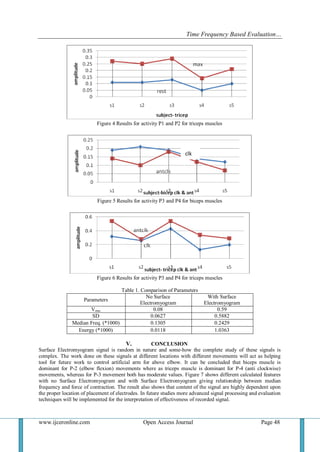
movements and are tabulated in figure 3 & 4. It is clear that there value of Root mean square amplitude are
more than in rest position from both muscles. From figure 3 and 4, it is evident that there is change in Vrms value
for flexion elbow (P2) movement for both biceps and triceps muscles as compared to rest (P1) position. Figure
5 and 6 shows that Vrms for clock wise (P3) movements is higher than anti-clock wise (P4) movements with
biceps muscle and for triceps muscle anti-clock (P4) has higher value compare to clk (P3) movement
respectively.
Power spectrum of EMG with muscle Power spectrum of EMG with muscle
in rest state in contraction state
Figure 3 Results for activity P1 and P2 for biceps muscles](https://image.slidesharecdn.com/f3602045049-140705020226-phpapp01/85/F3602045049-3-320.jpg)
![Time Frequency Based Evaluation…
www.ijceronline.com Open Access Journal Page 49
Figure 7 Comparisons of Parameter
REFERENCES
[1]. Reaz MBI, Hussain MS and Mohd-Yasin F. Techniques of EMG Signal Analysis: detection
processing, classification and applications. IEEE Transactions on Biomedical Engineering, 10:11-35,
2006.
[2]. http://www.ncbi.nlm.nih.gov/pmc/articles/PMC1455479.
[3]. DeLuca CJ. The use of surface electromyography in biomechanics. Journal of Applied Biomechanics,
13: 135-163, 1997.
[4]. Jung Kyung and Kim Joo Woong. EMG Pattern Classification using Spectral Estimation and Neural
network, SICE Annual Conference, Kagawa University, Japan, pages 1108-1111. 2007.
[5]. Micera Silvestro. Control of hand prostheses using peripheral information. IEEE reviews in BME, 3:
48-68, 2010.
[6]. K A Wheeler, H Shimada, D K Kumar and S P Arjunan. A sEMG Model with Experimentally Based
Simulation Parameters, 32nd Annual International Conference of the IEEE Engineering in Medicine
and Biology Society, Argentina, pages 4258-4261, 2010
[7]. Zecca M and Micera S. Control of Multifunctional Prosthetic Hands by Processing the
Electromyographic Signal. Critical Reviews in Biomedical Engineering, 30: 59–485, 2002.
[8]. DeLuca CJ and Roy Serge H. Median frequency of the myoelectric signal, effect of hand dominance.
Eur. Journal of Appl. Physiology, 55: 457-464, 1986.
[9]. Cram R J, Kasman S G, and Holtz J. Introduction to surface electromyography, Aspen Publishers,
1998.](https://image.slidesharecdn.com/f3602045049-140705020226-phpapp01/85/F3602045049-5-320.jpg)


