Smart Tech: Biosignals & Medical Electronics
Biosignal processing
Oresti Banos
May 19th, 2017
o.banoslegran@utwente.nl
@orestibanos
http://orestibanos.com/
19-Apr-18 1
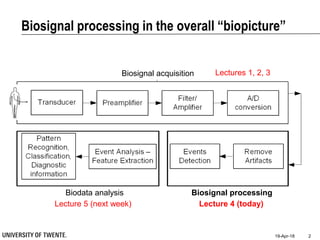
Biosignal processing in the overall “biopicture”
19-Apr-18 2
Lectures 1, 2, 3
Lecture 4 (today)Lecture 5 (next week)
Biosignal acquisition
Biosignal processingBiodata analysis
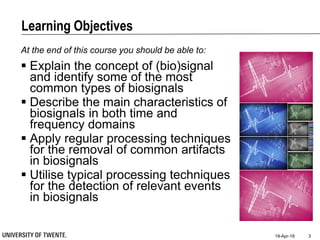
Learning Objectives
At the end of this course you should be able to:
 Explain the concept of (bio)signal
and identify some of the most
common types of biosignals
 Describe the main characteristics of
biosignals in both time and
frequency domains
 Apply regular processing techniques
for the removal of common artifacts
in biosignals
 Utilise typical processing techniques
for the detection of relevant events
in biosignals
19-Apr-18 3
Outline
 Biosignal definition
 Time and frequency
characterisation of biosignals
 Biosignal processing
 Filtering for removal of artifacts
 Event detection
 Compression
19-Apr-18 4
Outline
 Biosignal definition
 Time and frequency
characterisation of biosignals
 Biosignal processing
 Filtering for removal of artifacts
 Event detection
 Compression
19-Apr-18 5
Biosignal: definition
 Signal: function that "conveys information about
the behavior or attributes of some phenomenon”
 Biosignal (also biomedical signal, bioelectrical
signal or physiological signal):
 “any biological quantity or magnitude exhibiting variation
in time or variation in space is potentially a signal that
provides information on the status of a biological system”
19-Apr-18 6
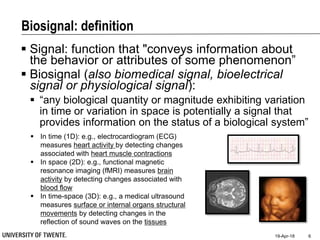
 In time (1D): e.g., electrocardiogram (ECG)
measures heart activity by detecting changes
associated with heart muscle contractions
 In space (2D): e.g., functional magnetic
resonance imaging (fMRI) measures brain
activity by detecting changes associated with
blood flow
 In time-space (3D): e.g., a medical ultrasound
measures surface or internal organs structural
movements by detecting changes in the
reflection of sound waves on the tissues
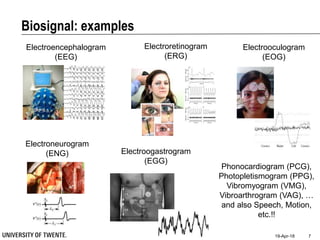
Biosignal: examples
19-Apr-18 7
Electroencephalogram
(EEG)
Electroneurogram
(ENG)
Electroretinogram
(ERG)
Electrooculogram
(EOG)
Electroogastrogram
(EGG)
Phonocardiogram (PCG),
Photopletismogram (PPG),
Vibromyogram (VMG),
Vibroarthrogram (VAG), …
and also Speech, Motion,
etc.!!
ECG
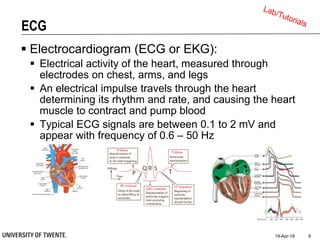
 Electrocardiogram (ECG or EKG):
 Electrical activity of the heart, measured through
electrodes on chest, arms, and legs
 An electrical impulse travels through the heart
determining its rhythm and rate, and causing the heart
muscle to contract and pump blood
 Typical ECG signals are between 0.1 to 2 mV and
appear with frequency of 0.6 – 50 Hz
19-Apr-18 8
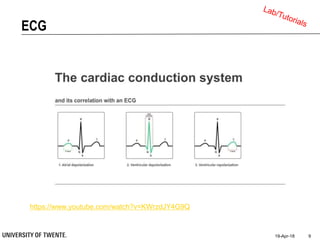
ECG
https://www.youtube.com/watch?v=KWrzdJY4G9Q
19-Apr-18 9
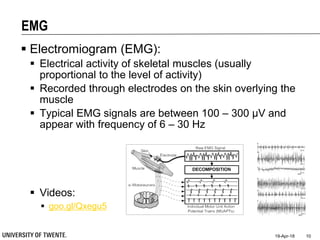
EMG
 Electromiogram (EMG):
 Electrical activity of skeletal muscles (usually
proportional to the level of activity)
 Recorded through electrodes on the skin overlying the
muscle
 Typical EMG signals are between 100 – 300 µV and
appear with frequency of 6 – 30 Hz
 Videos:
 goo.gl/Qxegu5
19-Apr-18 10
Outline
 Biosignal definition
 Time and frequency
characterisation of biosignals
 Biosignal processing
 Filtering for removal of artifacts
 Event detection
 Compression
19-Apr-18 11
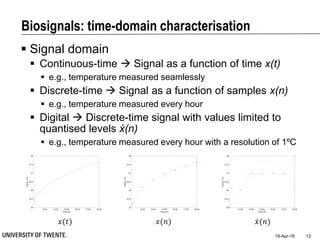
Biosignals: time-domain characterisation
 Signal domain
 Continuous-time  Signal as a function of time x(t)
 e.g., temperature measured seamlessly
 Discrete-time  Signal as a function of samples x(n)
 e.g., temperature measured every hour
 Digital  Discrete-time signal with values limited to
quantised levels ẋ(n)
 e.g., temperature measured every hour with a resolution of 1ºC
19-Apr-18 12
13:00 14:00 15:00 16:00 17:00 18:00
Time (h)
35
35.5
36
36.5
37
37.5
38
Temp(°C)
13:00 14:00 15:00 16:00 17:00 18:00
Time (h)
35
35.5
36
36.5
37
37.5
38
Temp(°C)
13:00 14:00 15:00 16:00 17:00 18:00
Time (h)
35
35.5
36
36.5
37
37.5
38
Temp(°C)𝑥(𝑡) 𝑥(𝑛) 𝑥(𝑛)
Biosignals: time-domain characterisation
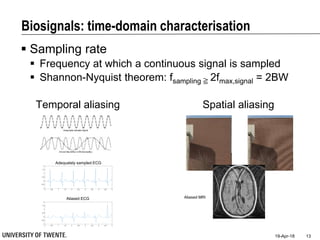
 Sampling rate
 Frequency at which a continuous signal is sampled
 Shannon-Nyquist theorem: fsampling ≧ 2fmax,signal = 2BW
Temporal aliasing Spatial aliasing
19-Apr-18 13
0 0.5 1 1.5 2 2.5 3 3.5 4 4.5 5
-1
-0.5
0
0.5
1
1.5
2
0 0.5 1 1.5 2 2.5 3 3.5 4 4.5 5
-1
-0.5
0
0.5
1
1.5
2
0 0.5 1 1.5 2 2.5 3 3.5 4 4.5 5
-1
-0.5
0
0.5
1
1.5
2
0 0.5 1 1.5 2 2.5 3 3.5 4 4.5 5
-1
-0.5
0
0.5
1
1.5
2
Adequately sampled ECG
Aliased ECG Aliased MRI
Biosignals: time-domain characterisation
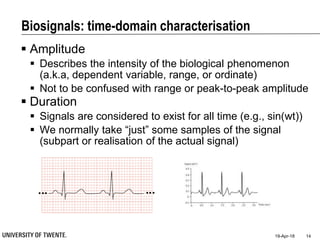
 Amplitude
 Describes the intensity of the biological phenomenon
(a.k.a, dependent variable, range, or ordinate)
 Not to be confused with range or peak-to-peak amplitude
 Duration
 Signals are considered to exist for all time (e.g., sin(wt))
 We normally take “just” some samples of the signal
(subpart or realisation of the actual signal)
19-Apr-18 14
Biosignals: time-domain characterisation
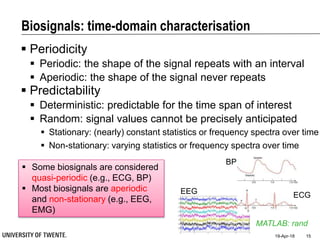
 Periodicity
 Periodic: the shape of the signal repeats with an interval
 Aperiodic: the shape of the signal never repeats
 Predictability
 Deterministic: predictable for the time span of interest
 Random: signal values cannot be precisely anticipated
 Stationary: (nearly) constant statistics or frequency spectra over time
 Non-stationary: varying statistics or frequency spectra over time
19-Apr-18 15
MATLAB: rand
 Some biosignals are considered
quasi-periodic (e.g., ECG, BP)
 Most biosignals are aperiodic
and non-stationary (e.g., EEG,
EMG)
EEG
BP
ECG
Biosignals: time-domain characterisation
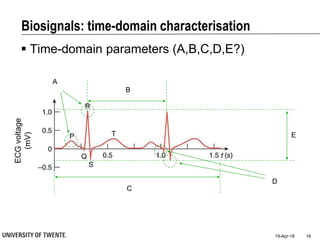
 Time-domain parameters (A,B,C,D,E?)
19-Apr-18 16
A
B
E
D
C
ECGvoltage
(mV)
Biosignals: time-domain characterisation
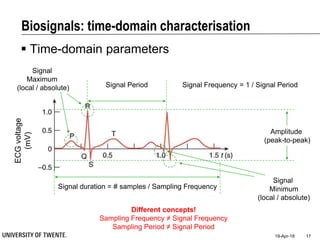
 Time-domain parameters
19-Apr-18 17
Amplitude
(peak-to-peak)
Signal Period Signal Frequency = 1 / Signal Period
Different concepts!
Sampling Frequency ≠ Signal Frequency
Sampling Period ≠ Signal Period
Signal duration = # samples / Sampling Frequency
Signal
Maximum
(local / absolute)
Signal
Minimum
(local / absolute)
ECGvoltage
(mV)
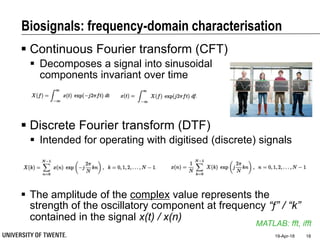
 Discrete Fourier transform (DTF)
 Intended for operating with digitised (discrete) signals
 The amplitude of the complex value represents the
strength of the oscillatory component at frequency “f” / “k”
contained in the signal x(t) / x(n)
Biosignals: frequency-domain characterisation
 Continuous Fourier transform (CFT)
 Decomposes a signal into sinusoidal
components invariant over time
19-Apr-18 18
MATLAB: fft, ifft
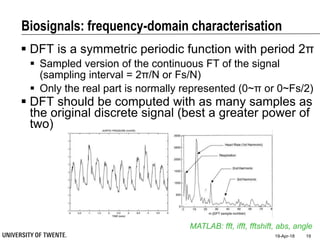
Biosignals: frequency-domain characterisation
 DFT is a symmetric periodic function with period 2π
 Sampled version of the continuous FT of the signal
(sampling interval = 2π/N or Fs/N)
 Only the real part is normally represented (0~π or 0~Fs/2)
 DFT should be computed with as many samples as
the original discrete signal (best a greater power of
two)
19-Apr-18 19
MATLAB: fft, ifft, fftshift, abs, angle
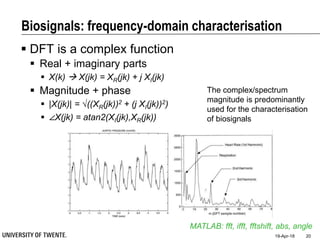
Biosignals: frequency-domain characterisation
 DFT is a complex function
 Real + imaginary parts
 X(k)  X(jk) = XR(jk) + j XI(jk)
 Magnitude + phase
 |X(jk)| = √((XR(jk))2 + (j XI(jk))2)
 ∠X(jk) = atan2(XI(jk),XR(jk))
19-Apr-18 20
MATLAB: fft, ifft, fftshift, abs, angle
The complex/spectrum
magnitude is predominantly
used for the characterisation
of biosignals
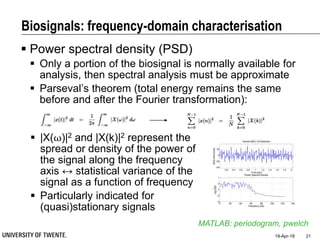
Biosignals: frequency-domain characterisation
 Power spectral density (PSD)
 Only a portion of the biosignal is normally available for
analysis, then spectral analysis must be approximate
 Parseval’s theorem (total energy remains the same
before and after the Fourier transformation):
19-Apr-18 21
MATLAB: periodogram, pwelch
 |X(⍵)|2 and |X(k)|2 represent the
spread or density of the power of
the signal along the frequency
axis ↔ statistical variance of the
signal as a function of frequency
 Particularly indicated for
(quasi)stationary signals
Biosignals: frequency-domain characterisation
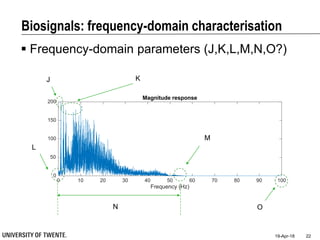
 Frequency-domain parameters (J,K,L,M,N,O?)
19-Apr-18 22
0 10 20 30 40 50 60
Time (s)
-1
-0.5
0
0.5
1
1.5
2
0 10 20 30 40 50 60 70 80 90 100
Frequency (Hz)
0
50
100
150
200
Magnitude response
J K
L
N
M
O
Biosignals: frequency-domain characterisation
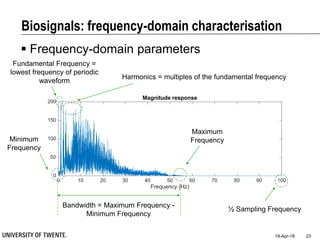
 Frequency-domain parameters
19-Apr-18 23
0 10 20 30 40 50 60
Time (s)
-1
-0.5
0
0.5
1
1.5
2
0 10 20 30 40 50 60 70 80 90 100
Frequency (Hz)
0
50
100
150
200
Magnitude response
Bandwidth = Maximum Frequency -
Minimum Frequency
Harmonics = multiples of the fundamental frequency
½ Sampling Frequency
Maximum
FrequencyMinimum
Frequency
Fundamental Frequency =
lowest frequency of periodic
waveform
Biosignals: time-frequency characterisation
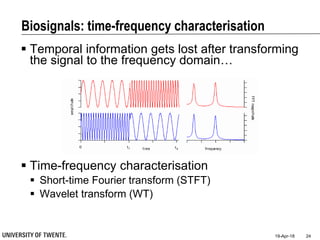
 Temporal information gets lost after transforming
the signal to the frequency domain…
19-Apr-18 24
 Time-frequency characterisation
 Short-time Fourier transform (STFT)
 Wavelet transform (WT)
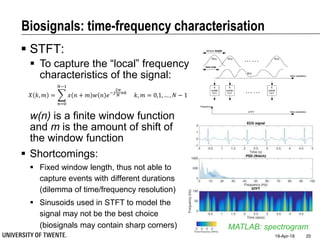
 STFT:
 To capture the “local” frequency
characteristics of the signal:
w(n) is a finite window function
and m is the amount of shift of
the window function
Biosignals: time-frequency characterisation
 Shortcomings:
 Fixed window length, thus not able to
capture events with different durations
(dilemma of time/frequency resolution)
 Sinusoids used in STFT to model the
signal may not be the best choice
(biosignals may contain sharp corners)
19-Apr-18 25
MATLAB: spectrogram
𝑋 𝑘, 𝑚 =
𝑛=0
𝑁−1
𝑥 𝑛 + 𝑚 𝑤 𝑛 𝑒−𝑗
2𝜋
𝑁
𝑛𝑘
𝑘, 𝑚 = 0,1, … , 𝑁 − 1
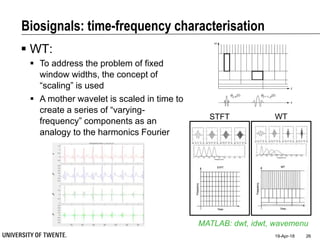
 WT:
 To address the problem of fixed
window widths, the concept of
“scaling” is used
 A mother wavelet is scaled in time to
create a series of “varying-
frequency” components as an
analogy to the harmonics Fourier
Biosignals: time-frequency characterisation
19-Apr-18 26
MATLAB: dwt, idwt, wavemenu
STFT WT
Outline
 Biosignal definition
 Time and frequency
characterisation of biosignals
 Biosignal processing
 Filtering for removal of artifacts
 Event detection
 Compression
19-Apr-18 27
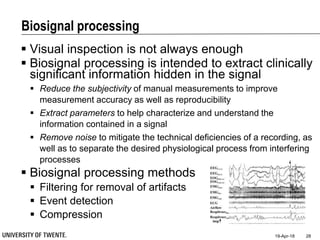
Biosignal processing
 Visual inspection is not always enough
 Biosignal processing is intended to extract clinically
significant information hidden in the signal
 Reduce the subjectivity of manual measurements to improve
measurement accuracy as well as reproducibility
 Extract parameters to help characterize and understand the
information contained in a signal
 Remove noise to mitigate the technical deficiencies of a recording, as
well as to separate the desired physiological process from interfering
processes
 Biosignal processing methods
 Filtering for removal of artifacts
 Event detection
 Compression
19-Apr-18 28
Outline
 Biosignal definition
 Time and frequency
characterisation of biosignals
 Biosignal processing
 Filtering for removal of artifacts
 Event detection
 Compression
19-Apr-18 29
Filtering for Removal of Artifacts
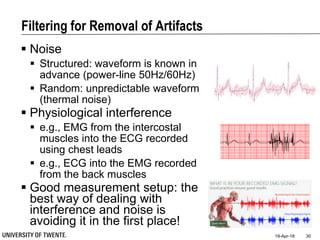
 Noise
 Structured: waveform is known in
advance (power-line 50Hz/60Hz)
 Random: unpredictable waveform
(thermal noise)
 Physiological interference
 e.g., EMG from the intercostal
muscles into the ECG recorded
using chest leads
 e.g., ECG into the EMG recorded
from the back muscles
 Good measurement setup: the
best way of dealing with
interference and noise is
avoiding it in the first place!
19-Apr-18 30
Filtering for Removal of Artifacts
 Time-domain digital filter
 Offset filter
 Moving average filter
 Median filter
 Detrending
 Frequency-domain digital filter
 Butterworth/Chebyshev
 Notch/Comb
 Savitzky–Golay
 (Optimal) Adaptive filters
 Wiener
 Kalman
19-Apr-18 31
Filtering for Removal of Artifacts
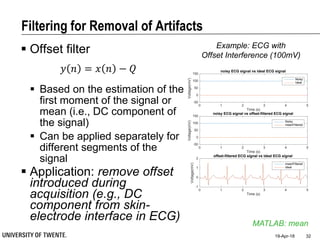
 Offset filter
𝑦 𝑛 = 𝑥 𝑛 − 𝑄
 Based on the estimation of the
first moment of the signal or
mean (i.e., DC component of
the signal)
 Can be applied separately for
different segments of the
signal
 Application: remove offset
introduced during
acquisition (e.g., DC
component from skin-
electrode interface in ECG)
19-Apr-18 32
MATLAB: mean
Example: ECG with
Offset Interference (100mV)
0 1 2 3 4 5
Time (s)
-50
0
50
100
150
Voltage(mV)
noisy ECG signal vs ideal ECG signal
Noisy
Ideal
0 1 2 3 4 5
Time (s)
-50
0
50
100
150
Voltage(mV)
noisy ECG signal vs offset-filtered ECG signal
Noisy
meanFiltered
0 1 2 3 4 5
Time (s)
-1
0
1
2
Voltage(mV)
offset-filtered ECG signal vs ideal ECG signal
meanFiltered
Ideal
Filtering for Removal of Artifacts
19-Apr-18 33
MATLAB: mean
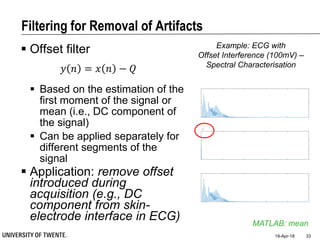
Example: ECG with
Offset Interference (100mV) –
Spectral Characterisation
 Offset filter
𝑦 𝑛 = 𝑥 𝑛 − 𝑄
 Based on the estimation of the
first moment of the signal or
mean (i.e., DC component of
the signal)
 Can be applied separately for
different segments of the
signal
 Application: remove offset
introduced during
acquisition (e.g., DC
component from skin-
electrode interface in ECG)
Filtering for Removal of Artifacts
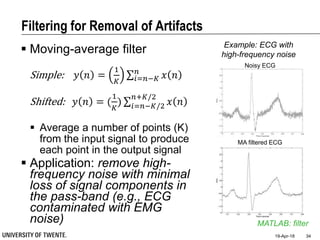
 Moving-average filter
Simple: 𝑦 𝑛 =
1
𝐾 𝑖=𝑛−𝐾
𝑛
𝑥 𝑛
Shifted: 𝑦 𝑛 = (
1
𝐾
) 𝑖=𝑛−𝐾/2
𝑛+𝐾/2
𝑥 𝑛
 Average a number of points (K)
from the input signal to produce
each point in the output signal
 Application: remove high-
frequency noise with minimal
loss of signal components in
the pass-band (e.g., ECG
contaminated with EMG
noise)
19-Apr-18 34
MATLAB: filter
Example: ECG with
high-frequency noise
MA filtered ECG
Noisy ECG
Filtering for Removal of Artifacts
 Median filter
 Ranks from lowest value to
highest value and picks the
middle one:
 e.g., median of [3, 3, 5, 9, 11] is 5
 Good for rejecting certain
types of noise in which some
samples take extreme values
(outliers)
 Application: regular power
source leading to ripples
riding on top of the signal
(e.g., power source
interference in ECG)
19-Apr-18 35
MATLAB: medfilt1
0 1 2 3 4 5
Time (s)
-1
0
1
2
ECG noisy signal and ideal signal
Noisy
Ideal
0 1 2 3 4 5
Time (s)
-1
0
1
2
ECG noisy signal and median-filtered signal
Noisy
medFiltered
0 1 2 3 4 5
Time (s)
-1
0
1
2
Median-filtered signal and ideal signal
medFiltered
Ideal
Example: ECG with
Powerline Interference (50Hz)
Filtering for Removal of Artifacts
 Median filter
 Ranks from lowest value to
highest value and picks the
middle one:
 e.g., median of [3, 3, 5, 9, 11] is 5
 Good for rejecting certain
types of noise in which some
samples take extreme values
(outliers)
 Application: regular power
source leading to ripples
riding on top of the signal
(e.g., power source
interference in ECG)
19-Apr-18 36
MATLAB: medfilt1
0 10 20 30 40 50 60 70 80 90 100
Frequency (Hz)
0
500
1000
PSD (ECG ideal)
0 10 20 30 40 50 60 70 80 90 100
Frequency (Hz)
0
500
1000
1500
PSD (ECG noisy)
0 10 20 30 40 50 60 70 80 90 100
Frequency (Hz)
0
500
1000
PSD (ECG filtered)
Example: ECG with
Powerline Interference (50Hz) –
Spectral Characterisation
Filtering for Removal of Artifacts
19-Apr-18 37
MATLAB: polyfit, polyval, detrend
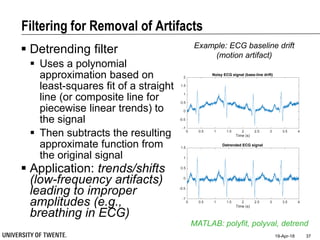
Example: ECG baseline drift
(motion artifact)
0 0.5 1 1.5 2 2.5 3 3.5 4
Time (s)
-1
-0.5
0
0.5
1
1.5
2
Noisy ECG signal (base-line drift)
0 0.5 1 1.5 2 2.5 3 3.5 4
Time (s)
-1
-0.5
0
0.5
1
1.5
Detrended ECG signal
 Detrending filter
 Uses a polynomial
approximation based on
least-squares fit of a straight
line (or composite line for
piecewise linear trends) to
the signal
 Then subtracts the resulting
approximate function from
the original signal
 Application: trends/shifts
(low-frequency artifacts)
leading to improper
amplitudes (e.g.,
breathing in ECG)
Filtering for Removal of Artifacts
19-Apr-18 38
MATLAB: polyfit, polyval, detrend
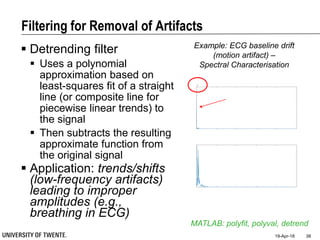
Example: ECG baseline drift
(motion artifact) –
Spectral Characterisation
 Detrending filter
 Uses a polynomial
approximation based on
least-squares fit of a straight
line (or composite line for
piecewise linear trends) to
the signal
 Then subtracts the resulting
approximate function from
the original signal
 Application: trends/shifts
(low-frequency artifacts)
leading to improper
amplitudes (e.g.,
breathing in ECG)
Filtering for Removal of Artifacts
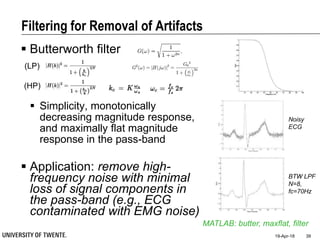
 Butterworth filter
 Simplicity, monotonically
decreasing magnitude response,
and maximally flat magnitude
response in the pass-band
 Application: remove high-
frequency noise with minimal
loss of signal components in
the pass-band (e.g., ECG
contaminated with EMG noise)
19-Apr-18 39
MATLAB: butter, maxflat, filter
Noisy
ECG
BTW LPF
N=8,
fc=70Hz
(LP)
(HP)
Filtering for Removal of Artifacts
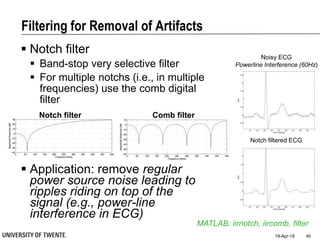
 Notch filter
 Band-stop very selective filter
 For multiple notchs (i.e., in multiple
frequencies) use the comb digital
filter
 Application: remove regular
power source noise leading to
ripples riding on top of the
signal (e.g., power-line
interference in ECG)
19-Apr-18 40
MATLAB: iirnotch, iircomb, filter
Noisy ECG
Powerline Interference (60Hz)
Notch filtered ECG
Notch filter Comb filter
Filtering for Removal of Artifacts
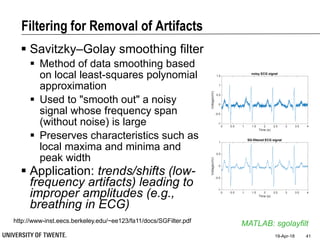
 Savitzky–Golay smoothing filter
 Method of data smoothing based
on local least-squares polynomial
approximation
 Used to "smooth out" a noisy
signal whose frequency span
(without noise) is large
 Preserves characteristics such as
local maxima and minima and
peak width
 Application: trends/shifts (low-
frequency artifacts) leading to
improper amplitudes (e.g.,
breathing in ECG)
19-Apr-18 41
MATLAB: sgolayfilthttp://www-inst.eecs.berkeley.edu/~ee123/fa11/docs/SGFilter.pdf
0 0.5 1 1.5 2 2.5 3 3.5 4
Time (s)
-1
-0.5
0
0.5
1
1.5
Voltage(mV)
noisy ECG signal
0 0.5 1 1.5 2 2.5 3 3.5 4
Time (s)
-1
-0.5
0
0.5
1
Voltage(mV)
SG-filtered ECG signal
Quiz
 Go to go.voxvote.com
 Insert the code PIN: 99020
19-Apr-18 42
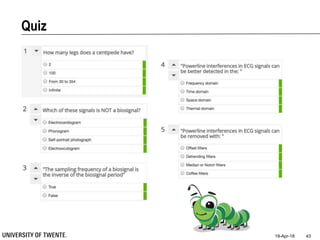
Quiz
19-Apr-18 43
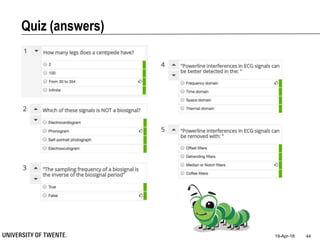
Quiz (answers)
19-Apr-18 44
Outline
 Biosignal definition
 Time and frequency
characterisation of biosignals
 Biosignal processing
 Filtering for removal of artifacts
 Event detection
 Compression
19-Apr-18 45
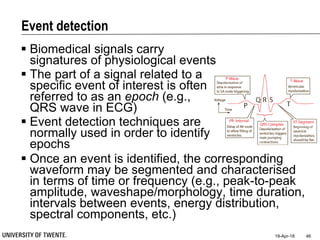
Event detection
 Biomedical signals carry
signatures of physiological events
 The part of a signal related to a
specific event of interest is often
referred to as an epoch (e.g.,
QRS wave in ECG)
 Event detection techniques are
normally used in order to identify
epochs
19-Apr-18 46
 Once an event is identified, the corresponding
waveform may be segmented and characterised
in terms of time or frequency (e.g., peak-to-peak
amplitude, waveshape/morphology, time duration,
intervals between events, energy distribution,
spectral components, etc.)
Event detection
 Envelope estimation
 Wave delineation
 Peak detection
 Cross-correlation
 Auto-correlation
19-Apr-18 47
Event detection
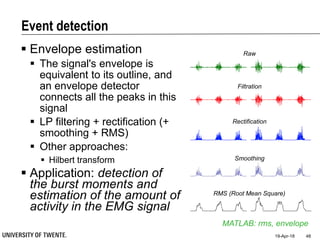
 Envelope estimation
 The signal's envelope is
equivalent to its outline, and
an envelope detector
connects all the peaks in this
signal
 LP filtering + rectification (+
smoothing + RMS)
 Other approaches:
 Hilbert transform
 Application: detection of
the burst moments and
estimation of the amount of
activity in the EMG signal
19-Apr-18 48
MATLAB: rms, envelope
Raw
Filtration
Rectification
Smoothing
RMS (Root Mean Square)
Event detection
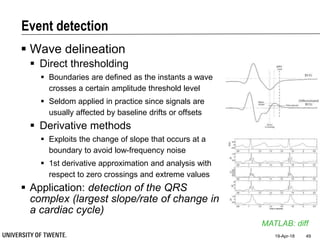
 Wave delineation
 Direct thresholding
 Boundaries are defined as the instants a wave
crosses a certain amplitude threshold level
 Seldom applied in practice since signals are
usually affected by baseline drifts or offsets
 Derivative methods
 Exploits the change of slope that occurs at a
boundary to avoid low-frequency noise
 1st derivative approximation and analysis with
respect to zero crossings and extreme values
 Application: detection of the QRS
complex (largest slope/rate of change in
a cardiac cycle)
19-Apr-18 49
MATLAB: diff
Event detection
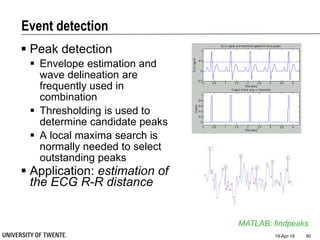
 Peak detection
 Envelope estimation and
wave delineation are
frequently used in
combination
 Thresholding is used to
determine candidate peaks
 A local maxima search is
normally needed to select
outstanding peaks
 Application: estimation of
the ECG R-R distance
19-Apr-18 50
MATLAB: findpeaks
Event detection
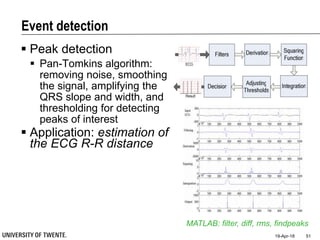
 Peak detection
 Pan-Tomkins algorithm:
removing noise, smoothing
the signal, amplifying the
QRS slope and width, and
thresholding for detecting
peaks of interest
 Application: estimation of
the ECG R-R distance
19-Apr-18 51
MATLAB: filter, diff, rms, findpeaks
Event detection
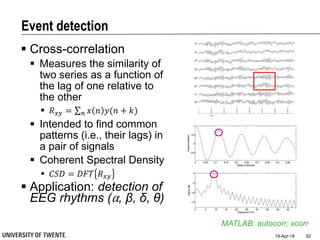
 Cross-correlation
 Measures the similarity of
two series as a function of
the lag of one relative to
the other
 𝑅 𝑥𝑦 = 𝑛 𝑥 𝑛 𝑦(𝑛 + 𝑘)
 Intended to find common
patterns (i.e., their lags) in
a pair of signals
 Coherent Spectral Density
 𝐶𝑆𝐷 = 𝐷𝐹𝑇 𝑅 𝑥𝑦
 Application: detection of
EEG rhythms (⍺, β, δ, θ)
19-Apr-18 52
MATLAB: autocorr, xcorr
Event detection
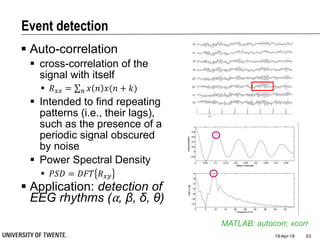
 Auto-correlation
 cross-correlation of the
signal with itself
 𝑅 𝑥𝑥 = 𝑛 𝑥 𝑛 𝑥(𝑛 + 𝑘)
 Intended to find repeating
patterns (i.e., their lags),
such as the presence of a
periodic signal obscured
by noise
 Power Spectral Density
 𝑃𝑆𝐷 = 𝐷𝐹𝑇 𝑅 𝑥𝑦
 Application: detection of
EEG rhythms (⍺, β, δ, θ)
19-Apr-18 53
MATLAB: autocorr, xcorr
Outline
 Biosignal definition
 Time and frequency
characterisation of biosignals
 Biosignal processing
 Filtering for removal of artifacts
 Event detection
 Compression
19-Apr-18 54
Compression
 Process of reducing the amount of data in a given
signal to in order to lower resource usage, such
as data storage space or transmission capacity
 Sampling and quantisation are typical simple
compression techniques used to reduce the size
of the digitised signal
 Advantages:
 Less storage
 Less bandwidth
 Faster processing
 Disadvantages
 Information loss
19-Apr-18 55
Compression
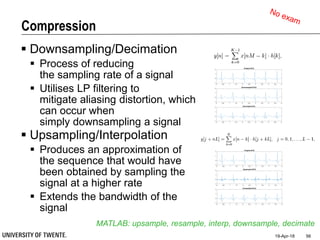
 Downsampling/Decimation
 Process of reducing
the sampling rate of a signal
 Utilises LP filtering to
mitigate aliasing distortion, which
can occur when
simply downsampling a signal
 Upsampling/Interpolation
 Produces an approximation of
the sequence that would have
been obtained by sampling the
signal at a higher rate
 Extends the bandwidth of the
signal
19-Apr-18 56
MATLAB: upsample, resample, interp, downsample, decimate
0 0.5 1 1.5 2 2.5 3 3.5 4 4.5 5
-1
0
1
2
Original ECG
0 0.5 1 1.5 2 2.5 3 3.5 4 4.5 5
-1
0
1
2
Downsampled ECG
0 0.5 1 1.5 2 2.5 3 3.5 4 4.5 5
-1
0
1
2
Decimated ECG
0 0.5 1 1.5 2 2.5 3 3.5 4 4.5 5
-1
0
1
2
Original ECG
0 0.5 1 1.5 2 2.5 3 3.5 4 4.5 5
-1
0
1
2
Upsampled ECG
0 0.5 1 1.5 2 2.5 3 3.5 4 4.5 5
-1
0
1
2
Interpolated ECG
References
 Biomedical Signal Processing and Analysis:
 Principal reference:
 Rangayyan, R. M. Biomedical Signal Analysis: A Case-Study Approach. New
York: IEEE Press, 2002 (Chapters 1, 3, 4, 6)
 Other references:
 Sörnmo, L., & Laguna, P. Bioelectrical signal processing in cardiac and
neurological applications. Academic Press, 2005
 Cerutti, S., & Marchesi, C. Advanced methods of biomedical signal processing.
John Wiley & Sons, 2011
 Devasahayam, S. R. Signals and systems in biomedical engineering: signal
processing and physiological systems modeling. Springer Science & Business
Media, 2012
19-Apr-18 57
References
 Digital Signal Processing
 Principal reference:
 Proakis, J. G., & Manolakis, D. G. Digital Signal Processing. Principles,
Algorithms, and Applications. New Jersey: Prentice-Hall, 1996
 Other references:
 Hayes, M. Statistical Digital Signal Proccessing and Modeling. New York: John
Wiley & Sons, 1996
 [OPEN BOOK] Smith, Steven W., The Scientist and Engineer's Guide to Digital
Signal Processing, http://www.dspguide.com/pdfbook.htm
 [OPEN BOOK] Prandoni, P., Martin, V., Signal Processing for Communications,
http://www.sp4comm.org/docs/sp4comm_corrected.pdf
19-Apr-18 58
References
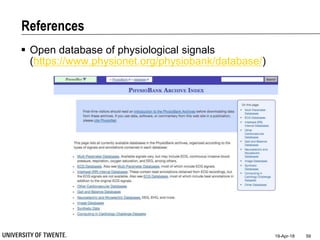
 Open database of physiological signals
(https://www.physionet.org/physiobank/database/)
19-Apr-18 59

Biosignal Processing

  • 1.
    Smart Tech: Biosignals& Medical Electronics Biosignal processing Oresti Banos May 19th, 2017 o.banoslegran@utwente.nl @orestibanos http://orestibanos.com/ 19-Apr-18 1
  • 2.
    Biosignal processing inthe overall “biopicture” 19-Apr-18 2 Lectures 1, 2, 3 Lecture 4 (today)Lecture 5 (next week) Biosignal acquisition Biosignal processingBiodata analysis
  • 3.
    Learning Objectives At theend of this course you should be able to:  Explain the concept of (bio)signal and identify some of the most common types of biosignals  Describe the main characteristics of biosignals in both time and frequency domains  Apply regular processing techniques for the removal of common artifacts in biosignals  Utilise typical processing techniques for the detection of relevant events in biosignals 19-Apr-18 3
  • 4.
    Outline  Biosignal definition Time and frequency characterisation of biosignals  Biosignal processing  Filtering for removal of artifacts  Event detection  Compression 19-Apr-18 4
  • 5.
    Outline  Biosignal definition Time and frequency characterisation of biosignals  Biosignal processing  Filtering for removal of artifacts  Event detection  Compression 19-Apr-18 5
  • 6.
    Biosignal: definition  Signal:function that "conveys information about the behavior or attributes of some phenomenon”  Biosignal (also biomedical signal, bioelectrical signal or physiological signal):  “any biological quantity or magnitude exhibiting variation in time or variation in space is potentially a signal that provides information on the status of a biological system” 19-Apr-18 6  In time (1D): e.g., electrocardiogram (ECG) measures heart activity by detecting changes associated with heart muscle contractions  In space (2D): e.g., functional magnetic resonance imaging (fMRI) measures brain activity by detecting changes associated with blood flow  In time-space (3D): e.g., a medical ultrasound measures surface or internal organs structural movements by detecting changes in the reflection of sound waves on the tissues
  • 7.
  • 8.
    ECG  Electrocardiogram (ECGor EKG):  Electrical activity of the heart, measured through electrodes on chest, arms, and legs  An electrical impulse travels through the heart determining its rhythm and rate, and causing the heart muscle to contract and pump blood  Typical ECG signals are between 0.1 to 2 mV and appear with frequency of 0.6 – 50 Hz 19-Apr-18 8
  • 9.
  • 10.
    EMG  Electromiogram (EMG): Electrical activity of skeletal muscles (usually proportional to the level of activity)  Recorded through electrodes on the skin overlying the muscle  Typical EMG signals are between 100 – 300 µV and appear with frequency of 6 – 30 Hz  Videos:  goo.gl/Qxegu5 19-Apr-18 10
  • 11.
    Outline  Biosignal definition Time and frequency characterisation of biosignals  Biosignal processing  Filtering for removal of artifacts  Event detection  Compression 19-Apr-18 11
  • 12.
    Biosignals: time-domain characterisation Signal domain  Continuous-time  Signal as a function of time x(t)  e.g., temperature measured seamlessly  Discrete-time  Signal as a function of samples x(n)  e.g., temperature measured every hour  Digital  Discrete-time signal with values limited to quantised levels ẋ(n)  e.g., temperature measured every hour with a resolution of 1ºC 19-Apr-18 12 13:00 14:00 15:00 16:00 17:00 18:00 Time (h) 35 35.5 36 36.5 37 37.5 38 Temp(°C) 13:00 14:00 15:00 16:00 17:00 18:00 Time (h) 35 35.5 36 36.5 37 37.5 38 Temp(°C) 13:00 14:00 15:00 16:00 17:00 18:00 Time (h) 35 35.5 36 36.5 37 37.5 38 Temp(°C)𝑥(𝑡) 𝑥(𝑛) 𝑥(𝑛)
  • 13.
    Biosignals: time-domain characterisation Sampling rate  Frequency at which a continuous signal is sampled  Shannon-Nyquist theorem: fsampling ≧ 2fmax,signal = 2BW Temporal aliasing Spatial aliasing 19-Apr-18 13 0 0.5 1 1.5 2 2.5 3 3.5 4 4.5 5 -1 -0.5 0 0.5 1 1.5 2 0 0.5 1 1.5 2 2.5 3 3.5 4 4.5 5 -1 -0.5 0 0.5 1 1.5 2 0 0.5 1 1.5 2 2.5 3 3.5 4 4.5 5 -1 -0.5 0 0.5 1 1.5 2 0 0.5 1 1.5 2 2.5 3 3.5 4 4.5 5 -1 -0.5 0 0.5 1 1.5 2 Adequately sampled ECG Aliased ECG Aliased MRI
  • 14.
    Biosignals: time-domain characterisation Amplitude  Describes the intensity of the biological phenomenon (a.k.a, dependent variable, range, or ordinate)  Not to be confused with range or peak-to-peak amplitude  Duration  Signals are considered to exist for all time (e.g., sin(wt))  We normally take “just” some samples of the signal (subpart or realisation of the actual signal) 19-Apr-18 14
  • 15.
    Biosignals: time-domain characterisation Periodicity  Periodic: the shape of the signal repeats with an interval  Aperiodic: the shape of the signal never repeats  Predictability  Deterministic: predictable for the time span of interest  Random: signal values cannot be precisely anticipated  Stationary: (nearly) constant statistics or frequency spectra over time  Non-stationary: varying statistics or frequency spectra over time 19-Apr-18 15 MATLAB: rand  Some biosignals are considered quasi-periodic (e.g., ECG, BP)  Most biosignals are aperiodic and non-stationary (e.g., EEG, EMG) EEG BP ECG
  • 16.
    Biosignals: time-domain characterisation Time-domain parameters (A,B,C,D,E?) 19-Apr-18 16 A B E D C ECGvoltage (mV)
  • 17.
    Biosignals: time-domain characterisation Time-domain parameters 19-Apr-18 17 Amplitude (peak-to-peak) Signal Period Signal Frequency = 1 / Signal Period Different concepts! Sampling Frequency ≠ Signal Frequency Sampling Period ≠ Signal Period Signal duration = # samples / Sampling Frequency Signal Maximum (local / absolute) Signal Minimum (local / absolute) ECGvoltage (mV)
  • 18.
     Discrete Fouriertransform (DTF)  Intended for operating with digitised (discrete) signals  The amplitude of the complex value represents the strength of the oscillatory component at frequency “f” / “k” contained in the signal x(t) / x(n) Biosignals: frequency-domain characterisation  Continuous Fourier transform (CFT)  Decomposes a signal into sinusoidal components invariant over time 19-Apr-18 18 MATLAB: fft, ifft
  • 19.
    Biosignals: frequency-domain characterisation DFT is a symmetric periodic function with period 2π  Sampled version of the continuous FT of the signal (sampling interval = 2π/N or Fs/N)  Only the real part is normally represented (0~π or 0~Fs/2)  DFT should be computed with as many samples as the original discrete signal (best a greater power of two) 19-Apr-18 19 MATLAB: fft, ifft, fftshift, abs, angle
  • 20.
    Biosignals: frequency-domain characterisation DFT is a complex function  Real + imaginary parts  X(k)  X(jk) = XR(jk) + j XI(jk)  Magnitude + phase  |X(jk)| = √((XR(jk))2 + (j XI(jk))2)  ∠X(jk) = atan2(XI(jk),XR(jk)) 19-Apr-18 20 MATLAB: fft, ifft, fftshift, abs, angle The complex/spectrum magnitude is predominantly used for the characterisation of biosignals
  • 21.
    Biosignals: frequency-domain characterisation Power spectral density (PSD)  Only a portion of the biosignal is normally available for analysis, then spectral analysis must be approximate  Parseval’s theorem (total energy remains the same before and after the Fourier transformation): 19-Apr-18 21 MATLAB: periodogram, pwelch  |X(⍵)|2 and |X(k)|2 represent the spread or density of the power of the signal along the frequency axis ↔ statistical variance of the signal as a function of frequency  Particularly indicated for (quasi)stationary signals
  • 22.
    Biosignals: frequency-domain characterisation Frequency-domain parameters (J,K,L,M,N,O?) 19-Apr-18 22 0 10 20 30 40 50 60 Time (s) -1 -0.5 0 0.5 1 1.5 2 0 10 20 30 40 50 60 70 80 90 100 Frequency (Hz) 0 50 100 150 200 Magnitude response J K L N M O
  • 23.
    Biosignals: frequency-domain characterisation Frequency-domain parameters 19-Apr-18 23 0 10 20 30 40 50 60 Time (s) -1 -0.5 0 0.5 1 1.5 2 0 10 20 30 40 50 60 70 80 90 100 Frequency (Hz) 0 50 100 150 200 Magnitude response Bandwidth = Maximum Frequency - Minimum Frequency Harmonics = multiples of the fundamental frequency ½ Sampling Frequency Maximum FrequencyMinimum Frequency Fundamental Frequency = lowest frequency of periodic waveform
  • 24.
    Biosignals: time-frequency characterisation Temporal information gets lost after transforming the signal to the frequency domain… 19-Apr-18 24  Time-frequency characterisation  Short-time Fourier transform (STFT)  Wavelet transform (WT)
  • 25.
     STFT:  Tocapture the “local” frequency characteristics of the signal: w(n) is a finite window function and m is the amount of shift of the window function Biosignals: time-frequency characterisation  Shortcomings:  Fixed window length, thus not able to capture events with different durations (dilemma of time/frequency resolution)  Sinusoids used in STFT to model the signal may not be the best choice (biosignals may contain sharp corners) 19-Apr-18 25 MATLAB: spectrogram 𝑋 𝑘, 𝑚 = 𝑛=0 𝑁−1 𝑥 𝑛 + 𝑚 𝑤 𝑛 𝑒−𝑗 2𝜋 𝑁 𝑛𝑘 𝑘, 𝑚 = 0,1, … , 𝑁 − 1
  • 26.
     WT:  Toaddress the problem of fixed window widths, the concept of “scaling” is used  A mother wavelet is scaled in time to create a series of “varying- frequency” components as an analogy to the harmonics Fourier Biosignals: time-frequency characterisation 19-Apr-18 26 MATLAB: dwt, idwt, wavemenu STFT WT
  • 27.
    Outline  Biosignal definition Time and frequency characterisation of biosignals  Biosignal processing  Filtering for removal of artifacts  Event detection  Compression 19-Apr-18 27
  • 28.
    Biosignal processing  Visualinspection is not always enough  Biosignal processing is intended to extract clinically significant information hidden in the signal  Reduce the subjectivity of manual measurements to improve measurement accuracy as well as reproducibility  Extract parameters to help characterize and understand the information contained in a signal  Remove noise to mitigate the technical deficiencies of a recording, as well as to separate the desired physiological process from interfering processes  Biosignal processing methods  Filtering for removal of artifacts  Event detection  Compression 19-Apr-18 28
  • 29.
    Outline  Biosignal definition Time and frequency characterisation of biosignals  Biosignal processing  Filtering for removal of artifacts  Event detection  Compression 19-Apr-18 29
  • 30.
    Filtering for Removalof Artifacts  Noise  Structured: waveform is known in advance (power-line 50Hz/60Hz)  Random: unpredictable waveform (thermal noise)  Physiological interference  e.g., EMG from the intercostal muscles into the ECG recorded using chest leads  e.g., ECG into the EMG recorded from the back muscles  Good measurement setup: the best way of dealing with interference and noise is avoiding it in the first place! 19-Apr-18 30
  • 31.
    Filtering for Removalof Artifacts  Time-domain digital filter  Offset filter  Moving average filter  Median filter  Detrending  Frequency-domain digital filter  Butterworth/Chebyshev  Notch/Comb  Savitzky–Golay  (Optimal) Adaptive filters  Wiener  Kalman 19-Apr-18 31
  • 32.
    Filtering for Removalof Artifacts  Offset filter 𝑦 𝑛 = 𝑥 𝑛 − 𝑄  Based on the estimation of the first moment of the signal or mean (i.e., DC component of the signal)  Can be applied separately for different segments of the signal  Application: remove offset introduced during acquisition (e.g., DC component from skin- electrode interface in ECG) 19-Apr-18 32 MATLAB: mean Example: ECG with Offset Interference (100mV) 0 1 2 3 4 5 Time (s) -50 0 50 100 150 Voltage(mV) noisy ECG signal vs ideal ECG signal Noisy Ideal 0 1 2 3 4 5 Time (s) -50 0 50 100 150 Voltage(mV) noisy ECG signal vs offset-filtered ECG signal Noisy meanFiltered 0 1 2 3 4 5 Time (s) -1 0 1 2 Voltage(mV) offset-filtered ECG signal vs ideal ECG signal meanFiltered Ideal
  • 33.
    Filtering for Removalof Artifacts 19-Apr-18 33 MATLAB: mean Example: ECG with Offset Interference (100mV) – Spectral Characterisation  Offset filter 𝑦 𝑛 = 𝑥 𝑛 − 𝑄  Based on the estimation of the first moment of the signal or mean (i.e., DC component of the signal)  Can be applied separately for different segments of the signal  Application: remove offset introduced during acquisition (e.g., DC component from skin- electrode interface in ECG)
  • 34.
    Filtering for Removalof Artifacts  Moving-average filter Simple: 𝑦 𝑛 = 1 𝐾 𝑖=𝑛−𝐾 𝑛 𝑥 𝑛 Shifted: 𝑦 𝑛 = ( 1 𝐾 ) 𝑖=𝑛−𝐾/2 𝑛+𝐾/2 𝑥 𝑛  Average a number of points (K) from the input signal to produce each point in the output signal  Application: remove high- frequency noise with minimal loss of signal components in the pass-band (e.g., ECG contaminated with EMG noise) 19-Apr-18 34 MATLAB: filter Example: ECG with high-frequency noise MA filtered ECG Noisy ECG
  • 35.
    Filtering for Removalof Artifacts  Median filter  Ranks from lowest value to highest value and picks the middle one:  e.g., median of [3, 3, 5, 9, 11] is 5  Good for rejecting certain types of noise in which some samples take extreme values (outliers)  Application: regular power source leading to ripples riding on top of the signal (e.g., power source interference in ECG) 19-Apr-18 35 MATLAB: medfilt1 0 1 2 3 4 5 Time (s) -1 0 1 2 ECG noisy signal and ideal signal Noisy Ideal 0 1 2 3 4 5 Time (s) -1 0 1 2 ECG noisy signal and median-filtered signal Noisy medFiltered 0 1 2 3 4 5 Time (s) -1 0 1 2 Median-filtered signal and ideal signal medFiltered Ideal Example: ECG with Powerline Interference (50Hz)
  • 36.
    Filtering for Removalof Artifacts  Median filter  Ranks from lowest value to highest value and picks the middle one:  e.g., median of [3, 3, 5, 9, 11] is 5  Good for rejecting certain types of noise in which some samples take extreme values (outliers)  Application: regular power source leading to ripples riding on top of the signal (e.g., power source interference in ECG) 19-Apr-18 36 MATLAB: medfilt1 0 10 20 30 40 50 60 70 80 90 100 Frequency (Hz) 0 500 1000 PSD (ECG ideal) 0 10 20 30 40 50 60 70 80 90 100 Frequency (Hz) 0 500 1000 1500 PSD (ECG noisy) 0 10 20 30 40 50 60 70 80 90 100 Frequency (Hz) 0 500 1000 PSD (ECG filtered) Example: ECG with Powerline Interference (50Hz) – Spectral Characterisation
  • 37.
    Filtering for Removalof Artifacts 19-Apr-18 37 MATLAB: polyfit, polyval, detrend Example: ECG baseline drift (motion artifact) 0 0.5 1 1.5 2 2.5 3 3.5 4 Time (s) -1 -0.5 0 0.5 1 1.5 2 Noisy ECG signal (base-line drift) 0 0.5 1 1.5 2 2.5 3 3.5 4 Time (s) -1 -0.5 0 0.5 1 1.5 Detrended ECG signal  Detrending filter  Uses a polynomial approximation based on least-squares fit of a straight line (or composite line for piecewise linear trends) to the signal  Then subtracts the resulting approximate function from the original signal  Application: trends/shifts (low-frequency artifacts) leading to improper amplitudes (e.g., breathing in ECG)
  • 38.
    Filtering for Removalof Artifacts 19-Apr-18 38 MATLAB: polyfit, polyval, detrend Example: ECG baseline drift (motion artifact) – Spectral Characterisation  Detrending filter  Uses a polynomial approximation based on least-squares fit of a straight line (or composite line for piecewise linear trends) to the signal  Then subtracts the resulting approximate function from the original signal  Application: trends/shifts (low-frequency artifacts) leading to improper amplitudes (e.g., breathing in ECG)
  • 39.
    Filtering for Removalof Artifacts  Butterworth filter  Simplicity, monotonically decreasing magnitude response, and maximally flat magnitude response in the pass-band  Application: remove high- frequency noise with minimal loss of signal components in the pass-band (e.g., ECG contaminated with EMG noise) 19-Apr-18 39 MATLAB: butter, maxflat, filter Noisy ECG BTW LPF N=8, fc=70Hz (LP) (HP)
  • 40.
    Filtering for Removalof Artifacts  Notch filter  Band-stop very selective filter  For multiple notchs (i.e., in multiple frequencies) use the comb digital filter  Application: remove regular power source noise leading to ripples riding on top of the signal (e.g., power-line interference in ECG) 19-Apr-18 40 MATLAB: iirnotch, iircomb, filter Noisy ECG Powerline Interference (60Hz) Notch filtered ECG Notch filter Comb filter
  • 41.
    Filtering for Removalof Artifacts  Savitzky–Golay smoothing filter  Method of data smoothing based on local least-squares polynomial approximation  Used to "smooth out" a noisy signal whose frequency span (without noise) is large  Preserves characteristics such as local maxima and minima and peak width  Application: trends/shifts (low- frequency artifacts) leading to improper amplitudes (e.g., breathing in ECG) 19-Apr-18 41 MATLAB: sgolayfilthttp://www-inst.eecs.berkeley.edu/~ee123/fa11/docs/SGFilter.pdf 0 0.5 1 1.5 2 2.5 3 3.5 4 Time (s) -1 -0.5 0 0.5 1 1.5 Voltage(mV) noisy ECG signal 0 0.5 1 1.5 2 2.5 3 3.5 4 Time (s) -1 -0.5 0 0.5 1 Voltage(mV) SG-filtered ECG signal
  • 42.
    Quiz  Go togo.voxvote.com  Insert the code PIN: 99020 19-Apr-18 42
  • 43.
  • 44.
  • 45.
    Outline  Biosignal definition Time and frequency characterisation of biosignals  Biosignal processing  Filtering for removal of artifacts  Event detection  Compression 19-Apr-18 45
  • 46.
    Event detection  Biomedicalsignals carry signatures of physiological events  The part of a signal related to a specific event of interest is often referred to as an epoch (e.g., QRS wave in ECG)  Event detection techniques are normally used in order to identify epochs 19-Apr-18 46  Once an event is identified, the corresponding waveform may be segmented and characterised in terms of time or frequency (e.g., peak-to-peak amplitude, waveshape/morphology, time duration, intervals between events, energy distribution, spectral components, etc.)
  • 47.
    Event detection  Envelopeestimation  Wave delineation  Peak detection  Cross-correlation  Auto-correlation 19-Apr-18 47
  • 48.
    Event detection  Envelopeestimation  The signal's envelope is equivalent to its outline, and an envelope detector connects all the peaks in this signal  LP filtering + rectification (+ smoothing + RMS)  Other approaches:  Hilbert transform  Application: detection of the burst moments and estimation of the amount of activity in the EMG signal 19-Apr-18 48 MATLAB: rms, envelope Raw Filtration Rectification Smoothing RMS (Root Mean Square)
  • 49.
    Event detection  Wavedelineation  Direct thresholding  Boundaries are defined as the instants a wave crosses a certain amplitude threshold level  Seldom applied in practice since signals are usually affected by baseline drifts or offsets  Derivative methods  Exploits the change of slope that occurs at a boundary to avoid low-frequency noise  1st derivative approximation and analysis with respect to zero crossings and extreme values  Application: detection of the QRS complex (largest slope/rate of change in a cardiac cycle) 19-Apr-18 49 MATLAB: diff
  • 50.
    Event detection  Peakdetection  Envelope estimation and wave delineation are frequently used in combination  Thresholding is used to determine candidate peaks  A local maxima search is normally needed to select outstanding peaks  Application: estimation of the ECG R-R distance 19-Apr-18 50 MATLAB: findpeaks
  • 51.
    Event detection  Peakdetection  Pan-Tomkins algorithm: removing noise, smoothing the signal, amplifying the QRS slope and width, and thresholding for detecting peaks of interest  Application: estimation of the ECG R-R distance 19-Apr-18 51 MATLAB: filter, diff, rms, findpeaks
  • 52.
    Event detection  Cross-correlation Measures the similarity of two series as a function of the lag of one relative to the other  𝑅 𝑥𝑦 = 𝑛 𝑥 𝑛 𝑦(𝑛 + 𝑘)  Intended to find common patterns (i.e., their lags) in a pair of signals  Coherent Spectral Density  𝐶𝑆𝐷 = 𝐷𝐹𝑇 𝑅 𝑥𝑦  Application: detection of EEG rhythms (⍺, β, δ, θ) 19-Apr-18 52 MATLAB: autocorr, xcorr
  • 53.
    Event detection  Auto-correlation cross-correlation of the signal with itself  𝑅 𝑥𝑥 = 𝑛 𝑥 𝑛 𝑥(𝑛 + 𝑘)  Intended to find repeating patterns (i.e., their lags), such as the presence of a periodic signal obscured by noise  Power Spectral Density  𝑃𝑆𝐷 = 𝐷𝐹𝑇 𝑅 𝑥𝑦  Application: detection of EEG rhythms (⍺, β, δ, θ) 19-Apr-18 53 MATLAB: autocorr, xcorr
  • 54.
    Outline  Biosignal definition Time and frequency characterisation of biosignals  Biosignal processing  Filtering for removal of artifacts  Event detection  Compression 19-Apr-18 54
  • 55.
    Compression  Process ofreducing the amount of data in a given signal to in order to lower resource usage, such as data storage space or transmission capacity  Sampling and quantisation are typical simple compression techniques used to reduce the size of the digitised signal  Advantages:  Less storage  Less bandwidth  Faster processing  Disadvantages  Information loss 19-Apr-18 55
  • 56.
    Compression  Downsampling/Decimation  Processof reducing the sampling rate of a signal  Utilises LP filtering to mitigate aliasing distortion, which can occur when simply downsampling a signal  Upsampling/Interpolation  Produces an approximation of the sequence that would have been obtained by sampling the signal at a higher rate  Extends the bandwidth of the signal 19-Apr-18 56 MATLAB: upsample, resample, interp, downsample, decimate 0 0.5 1 1.5 2 2.5 3 3.5 4 4.5 5 -1 0 1 2 Original ECG 0 0.5 1 1.5 2 2.5 3 3.5 4 4.5 5 -1 0 1 2 Downsampled ECG 0 0.5 1 1.5 2 2.5 3 3.5 4 4.5 5 -1 0 1 2 Decimated ECG 0 0.5 1 1.5 2 2.5 3 3.5 4 4.5 5 -1 0 1 2 Original ECG 0 0.5 1 1.5 2 2.5 3 3.5 4 4.5 5 -1 0 1 2 Upsampled ECG 0 0.5 1 1.5 2 2.5 3 3.5 4 4.5 5 -1 0 1 2 Interpolated ECG
  • 57.
    References  Biomedical SignalProcessing and Analysis:  Principal reference:  Rangayyan, R. M. Biomedical Signal Analysis: A Case-Study Approach. New York: IEEE Press, 2002 (Chapters 1, 3, 4, 6)  Other references:  Sörnmo, L., & Laguna, P. Bioelectrical signal processing in cardiac and neurological applications. Academic Press, 2005  Cerutti, S., & Marchesi, C. Advanced methods of biomedical signal processing. John Wiley & Sons, 2011  Devasahayam, S. R. Signals and systems in biomedical engineering: signal processing and physiological systems modeling. Springer Science & Business Media, 2012 19-Apr-18 57
  • 58.
    References  Digital SignalProcessing  Principal reference:  Proakis, J. G., & Manolakis, D. G. Digital Signal Processing. Principles, Algorithms, and Applications. New Jersey: Prentice-Hall, 1996  Other references:  Hayes, M. Statistical Digital Signal Proccessing and Modeling. New York: John Wiley & Sons, 1996  [OPEN BOOK] Smith, Steven W., The Scientist and Engineer's Guide to Digital Signal Processing, http://www.dspguide.com/pdfbook.htm  [OPEN BOOK] Prandoni, P., Martin, V., Signal Processing for Communications, http://www.sp4comm.org/docs/sp4comm_corrected.pdf 19-Apr-18 58
  • 59.
    References  Open databaseof physiological signals (https://www.physionet.org/physiobank/database/) 19-Apr-18 59