BIO MEDICAL SIGNAL
PROCESSING:
RESEARCH PERSPECTIVE
Dr. Meenakshi Sood
Department of Electronics & Communication Engg
Jaypee University of Information Technology
Meenakshi.s.sood@ieee.org, meenakshi.sood@juit.ac.in
Biomedical SIGNAL PROCESSING
• Application of engineering principles and techniques to
the medical field to close the gap between engineering
and medicine.
• Guide the medicine to use innovative educational tools
such as humanistic models, realistic simulations, web-
based online resources, etc.
• It combines the design and problem solving skills of
engineering with medical and biological sciences to
improve healthcare diagnosis and treatment.
11/6/2020
M Sood Jaypee University of
Information Technology
2
The Need…
• Medical decision-making requires the clinician to apply
accumulated knowledge to a specific amount of patient
information to produce a result that may be
 a diagnosis,
 prognosis,
 course of therapy, or
 the selection of further tests.
• Limited resources - increased demand
• Insufficient time available for diagnosis and treatment.
• Need for systems that can improve health care processes
and their outcomes in this scenario
11/6/2020 3
Sub-disciplines
• Bioinstrumentation
• Biomaterials
• Biomechanics
• BioInformatics
• Biomedical computing & signal processing
• Medical Imaging
• Orthopaedic Bioengineering
• Rehabilitation Engineering
• Minimally invasive surgery
11/6/2020
Jaypee University of Information
Technology
4
Application Areas
Examples of Biomedical Signals
Electroneurogram (ENG)
Electromyogram (EMG)
Electrocardiogram (ECG)
Electroencephalogram (EEG)
Electrogastrogram (EGG)
Electroocculogram (EOG)
Phonocardiogram (PCG)
Vibromyogram (VMG)
Vibroarthogram (VAG)
11/6/2020
Jaypee University of Information
Technology
6
ECG (electrocardiograph)
• electrical activity of the heart
11/6/2020
Jaypee University of Information
Technology
7
EMG
EMG (Electromyogram)
signal generated by muscle cells
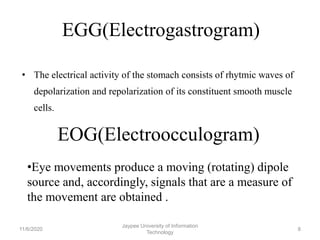
EGG(Electrogastrogram)
• The electrical activity of the stomach consists of rhytmic waves of
depolarization and repolarization of its constituent smooth muscle
cells.
11/6/2020
Jaypee University of Information
Technology
8
EOG(Electroocculogram)
•Eye movements produce a moving (rotating) dipole
source and, accordingly, signals that are a measure of
the movement are obtained .
IMAGES- 2D SIGNAL
Benign Malignant
CT Images US Images
Microscopic Images of Blood
MRI Images
DNA sequence signal
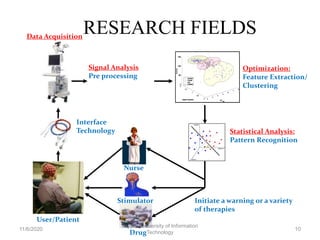
RESEARCH FIELDS
User/Patient
Interface
Technology
Signal Analysis
Pre processing
Data Acquisition
Statistical Analysis:
Pattern Recognition
Initiate a warning or a variety
of therapies
Stimulator
Drug
Optimization:
Feature Extraction/
Clustering
Nurse
Feature 1
Feature 2
Feature 3
11/6/2020
Jaypee University of Information
Technology
10
RESEARCH GAPS
11/6/2020
Jaypee University of Information
Technology
11
Signal Conditioning
Transformation and reduction of the signals
Identification of Diagnostic features
Non Stationarity
Non Linearity
Optimization
Classifiers
Pattern Recognition
Signal Conditioning
11/6/2020
Jaypee University of Information
Technology
12
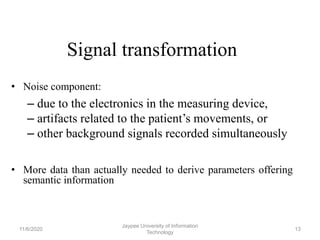
Signal transformation
• Noise component:
– due to the electronics in the measuring device,
– artifacts related to the patient’s movements, or
– other background signals recorded simultaneously
• More data than actually needed to derive parameters offering
semantic information
11/6/2020
Jaypee University of Information
Technology
13
Parameter/ Feature selection
• Usually, relevant information is not the direct result
of a sample or recording of a signal.
• Parameters bearing resemblance to the signs and
symptoms that are used to make diagnosis are
extracted from the signal.
11/6/2020
Jaypee University of Information
Technology
14
Featureextraction
Feature selection
Feature Selection
Steps
• Feature selection is an
optimization problem.
11/6/2020
Jaypee University of Information
Technology
17
Search strategies
Optimum
Heuristic
Randomized
Evaluation strategies
-Filter methods
-Wrapper methods
Optimization Techniques
11/6/2020
Jaypee University of Information
Technology
18
Classification methods
• Classification algorithms learn from the given input
data and uses this learning to classify new set of
observations.
• Different classification algorithms that can be used
are:
Classification Methods
Nearest
Neighbor
Naïve
Bayes
Decision
Tree
Random
Forest
ANN PNN SVM ANFC
11/6/2020
M Sood Jaypee University of
Information Technology
20
Signal classification:
Computer Aided Diagnostic system
Transition…….
11/6/2020
M Sood Jaypee University of
Information Technology
21
11/6/2020
M Sood Jaypee University of
Information Technology
22
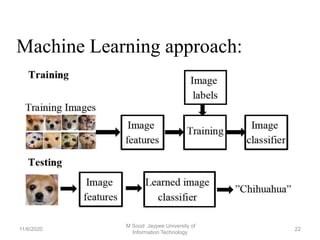
Machine Learning approach:
11/6/2020
M Sood Jaypee University of
Information Technology
23
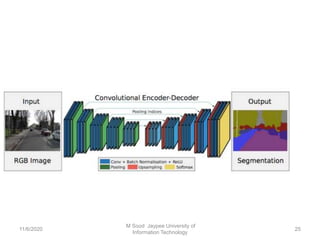
Deep Learning approach
11/6/2020
M Sood Jaypee University of
Information Technology
24
11/6/2020
M Sood Jaypee University of
Information Technology
25
11/6/2020
M Sood Jaypee University of
Information Technology
26
Convolutional Neural Network
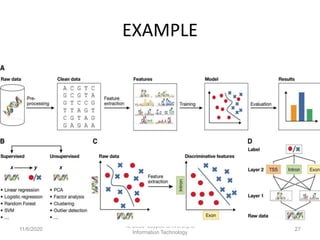
EXAMPLE
11/6/2020
M Sood Jaypee University of
Information Technology
27
Research and Application
• Phyological Research
• Neurological Research
• Medical Research
• BioInformatics Research
• Educational Research and Application
• Therapeutic Application
11/6/2020
Jaypee University of Information
Technology
28

biomedical signal processing

  • 1.
    BIO MEDICAL SIGNAL PROCESSING: RESEARCHPERSPECTIVE Dr. Meenakshi Sood Department of Electronics & Communication Engg Jaypee University of Information Technology Meenakshi.s.sood@ieee.org, meenakshi.sood@juit.ac.in
  • 2.
    Biomedical SIGNAL PROCESSING •Application of engineering principles and techniques to the medical field to close the gap between engineering and medicine. • Guide the medicine to use innovative educational tools such as humanistic models, realistic simulations, web- based online resources, etc. • It combines the design and problem solving skills of engineering with medical and biological sciences to improve healthcare diagnosis and treatment. 11/6/2020 M Sood Jaypee University of Information Technology 2
  • 3.
    The Need… • Medicaldecision-making requires the clinician to apply accumulated knowledge to a specific amount of patient information to produce a result that may be  a diagnosis,  prognosis,  course of therapy, or  the selection of further tests. • Limited resources - increased demand • Insufficient time available for diagnosis and treatment. • Need for systems that can improve health care processes and their outcomes in this scenario 11/6/2020 3
  • 4.
    Sub-disciplines • Bioinstrumentation • Biomaterials •Biomechanics • BioInformatics • Biomedical computing & signal processing • Medical Imaging • Orthopaedic Bioengineering • Rehabilitation Engineering • Minimally invasive surgery 11/6/2020 Jaypee University of Information Technology 4
  • 5.
  • 6.
    Examples of BiomedicalSignals Electroneurogram (ENG) Electromyogram (EMG) Electrocardiogram (ECG) Electroencephalogram (EEG) Electrogastrogram (EGG) Electroocculogram (EOG) Phonocardiogram (PCG) Vibromyogram (VMG) Vibroarthogram (VAG) 11/6/2020 Jaypee University of Information Technology 6
  • 7.
    ECG (electrocardiograph) • electricalactivity of the heart 11/6/2020 Jaypee University of Information Technology 7 EMG EMG (Electromyogram) signal generated by muscle cells
  • 8.
    EGG(Electrogastrogram) • The electricalactivity of the stomach consists of rhytmic waves of depolarization and repolarization of its constituent smooth muscle cells. 11/6/2020 Jaypee University of Information Technology 8 EOG(Electroocculogram) •Eye movements produce a moving (rotating) dipole source and, accordingly, signals that are a measure of the movement are obtained .
  • 9.
    IMAGES- 2D SIGNAL BenignMalignant CT Images US Images Microscopic Images of Blood MRI Images DNA sequence signal
  • 10.
    RESEARCH FIELDS User/Patient Interface Technology Signal Analysis Preprocessing Data Acquisition Statistical Analysis: Pattern Recognition Initiate a warning or a variety of therapies Stimulator Drug Optimization: Feature Extraction/ Clustering Nurse Feature 1 Feature 2 Feature 3 11/6/2020 Jaypee University of Information Technology 10
  • 11.
    RESEARCH GAPS 11/6/2020 Jaypee Universityof Information Technology 11 Signal Conditioning Transformation and reduction of the signals Identification of Diagnostic features Non Stationarity Non Linearity Optimization Classifiers Pattern Recognition
  • 12.
  • 13.
    Signal transformation • Noisecomponent: – due to the electronics in the measuring device, – artifacts related to the patient’s movements, or – other background signals recorded simultaneously • More data than actually needed to derive parameters offering semantic information 11/6/2020 Jaypee University of Information Technology 13
  • 14.
    Parameter/ Feature selection •Usually, relevant information is not the direct result of a sample or recording of a signal. • Parameters bearing resemblance to the signs and symptoms that are used to make diagnosis are extracted from the signal. 11/6/2020 Jaypee University of Information Technology 14
  • 15.
  • 16.
  • 17.
    Feature Selection Steps • Featureselection is an optimization problem. 11/6/2020 Jaypee University of Information Technology 17 Search strategies Optimum Heuristic Randomized Evaluation strategies -Filter methods -Wrapper methods
  • 18.
  • 19.
    Classification methods • Classificationalgorithms learn from the given input data and uses this learning to classify new set of observations. • Different classification algorithms that can be used are: Classification Methods Nearest Neighbor Naïve Bayes Decision Tree Random Forest ANN PNN SVM ANFC
  • 20.
    11/6/2020 M Sood JaypeeUniversity of Information Technology 20 Signal classification: Computer Aided Diagnostic system
  • 21.
    Transition……. 11/6/2020 M Sood JaypeeUniversity of Information Technology 21
  • 22.
    11/6/2020 M Sood JaypeeUniversity of Information Technology 22 Machine Learning approach:
  • 23.
    11/6/2020 M Sood JaypeeUniversity of Information Technology 23
  • 24.
    Deep Learning approach 11/6/2020 MSood Jaypee University of Information Technology 24
  • 25.
    11/6/2020 M Sood JaypeeUniversity of Information Technology 25
  • 26.
    11/6/2020 M Sood JaypeeUniversity of Information Technology 26 Convolutional Neural Network
  • 27.
    EXAMPLE 11/6/2020 M Sood JaypeeUniversity of Information Technology 27
  • 28.
    Research and Application •Phyological Research • Neurological Research • Medical Research • BioInformatics Research • Educational Research and Application • Therapeutic Application 11/6/2020 Jaypee University of Information Technology 28