INTERNATIONAL JOURNAL FOR TRENDS IN ENGINEERING & TECHNOLOGY
VOLUME 3 ISSUE 2 – FEBRUARY 2015 – ISSN: 2349 – 9303
68
IJTET©2015
Classification of EEG Signal for Epileptic Seizure
DetectionusingEMD and ELM
S. Divya S. Suja Priyadharsini
ECE Department ECE Department
Regional Centre: Anna University, Tirunelveli Regional Centre:Anna University, Tirunelveli
divya8jads@gmail.com Sujapriya_moni@yahoo.co.in
Abstract—This paper proposes the classification of EEG signal for epilepsy diagnosis. Epilepsy is a neurological
disorder which occurs due to synchronous neuronal activity in brain. Empirical Mode Decomposition (EMD), Extreme
Learning Machine (ELM) are the techniquedelivered in the proposed method.Input EEG signal, which is available in
online as Bonn Database is decomposed into five Intrinsic Mode Functions (IMFs) using EMD.Higher Order Statistical
moments such as Variance, Skewness and Kurtosis are drawn out as features from the decomposed signals. Extreme
Learning Machine is used as a classifier to classify the EEG signals with the taken features, under various categories that
include healthy and ictal, interictal and ictal, Non seizure and seizure, healthy, interictal and ictal. The proposed method
gives 100%accuracy, 100%sensitivity in discriminating interictal and ictal, non seizure and seizure, healthy and ictal,
healthy, interictal and ictal, 100% specificity in classifying healthy and ictal, interictal and ictal and 100% and
99%accuracy in case of discriminating interictal and ictal, non seizure and seizure.
Index Terms—Electroencephalogram(EEG), Empirical Mode Decomposition (EMD), Extreme Learning Machine
(ELM), Feature Extraction, seizure detection.
——————————  ——————————
1 INTRODUCTION
Epilepsy is a disorder which happens due to unusual
dischargesin brain.The intense electrical activity causes
a temporary disruption to normal brain making the
brain’s messages get mixed up. This results in recurrent
seizures. About60 million people are suffered with
epilepsy in the world. Epileptic seizures fall into two
types namely Partial seizures and Generalized seizures.
Partial seizures impact only a portion of the brain which
leads to temporal paralysis and generalized seizures
involve electrical discharges that occur all over the brain
which cause loss of consciousness.
Electroencephalogram (EEG), being a non-
invasive tool evaluates the patient with epilepsy. It
examines the brain patterns and assists in epilepsy
diagnosis, if any unusual activity takes place in the
brain. Extracranial EEG measurements are obtained by
keeping electrodes on the scalp whereas Intracranial
EEG (iEEG) recordings are examined by keeping
electrodes on the cortex of the brain or deep within the
structure of the brain. For a normal brain activity, the
firing of neuron occurs about 80 times per second and
neurons fires about 500 times per second for an epileptic
brain activity.
Various approaches have been integrated for
the seizure detection. Shafiul Alam et al. proposed
seizure detection using Artificial Neural Network
(ANN).Empirical Mode Decomposition is used for
decomposition purpose [1].Shufang Li et al. used EMD
to extract coefficient of variation and fluctuation index
as features. Support Vector Machine (SVM) classifier is
utilized for the classification of interictal and ictal
subjects [2].Complexity based features are taken using
Wavelet Transform and the features are selected using
Genetic Algorithm. Extreme Learning Machine is used
as the classifier for recognizing the epileptic activities.
The method proposed by Yuedong Song et al. gives less
accuracy without the use of Genetic Algorithm
[3].Bandwidth features namely Amplitude Modulation
Bandwidth and Frequency Modulation Bandwidth is
computed using EMD techniques and these features
were fed to the Least Square Support Vector Machine
(LS-SVM) for classification purpose [4].Nandish et al.
used Average method and Max-Min method for taking
the features. Among the two methods Max-min with
Neural Network gave better accuracy[6].Fuzzy classifier
could able to discriminate healthy, interictal and ictal
subjects with good accuracy by the usage of entropy
features [7].Multiwavelet Transform along with ANN
technique had been used by Ling Guo et al. Entropy
based features are extracted for classifying healthy and
epileptic subjects. Computation cost increases due to the
excessive number of features [11]. EEG signal is
analysed with time-frequency methods and Artificial
INTERNATIONAL JOURNAL FOR TRENDS IN ENGINEERING & TECHNOLOGY
VOLUME 3 ISSUE 2 – FEBRUARY 2015 – ISSN: 2349 – 9303
69
IJTET©2015
Neural Network (ANN)[16].Usage of ANN makes high
computational complexity and takes huge training time.
EMD delivered by Huang is widely adaptable
to non-stationary and nonlinear signals.It is used in the
case of reducing noise and providing information. In this
paper, classification of EEG signal for epileptic seizure
detection is done with EMD and ELM. Variance,
Skewness and Kurtosis are taken as features,which
describes the shape of EEG signals. The features are
then trained and tested using ELM classifier to
discriminate healthy, interictal and ictal subjects
underdifferent cases. ELM classifier requires no iterate
tuning and classifies signal with good accuracy.
2 METHODOLOGY
This section has three steps.
i) Decomposition of input signal
ii) Feature Extraction
iii) Classification of EEG signal
2.1 DatabaseDescription
Bonn Database [18] from the Department of
Epileptology is used. The dataset is possessed with five
sets namely Z, O, N, F, S. The dataset Z and O have
EEG recordings that were obtained from healthy
subjects with their eyes opened and closed respectively.
The measurements for the set Z and O were carried out
using extracranial electrodes. The dataset N, F, S have
recordings from epileptic patients. Sets F and N have
EEG measurements that were observed, intracranially
during seizure free interval, from epileptogenic zone and
from hippocampal formation of opposite hemisphere of
the brain. The dataset S has ictal EEG recordings from
the epileptogenic zone. The 100 single channel EEG
signals from each person are recorded in 23.6s with the
sampling rate of 173.6Hz.
2.2 EmpiricalModeDecomposition
An adaptive, nonlinear technique referred as
Empirical Mode Decomposition (EMD) fragments the
nonstationary signal into Amplitude-Frequency
modulated components namely Intrinsic Mode Function
(IMF).
The block diagram of seizure detection using
EMD with ELM is given in Fig.1.The steps involved in
EMD Algorithm is given below
i) Take an input signal s andconsider it to be s=h, n=0
ii) Local maxima and Local minima of input signals are
found
iii) Upper envelope (𝑒 𝑚𝑎𝑥 ) and lower envelope (𝑒 𝑚𝑖𝑛 )
are found by connecting the local maximum and local
minimum respectively, through cubic spline function
iv) Mean of upper envelope and lower envelope are
determined
m=(𝑒 𝑚𝑎𝑥 +𝑒 𝑚𝑖𝑛 )/2 (1)
v) The value of mean should be subtracted from the
input signal
H=h-m (2)
vi)Check whether the stopping criterion(α) lies in the
range 0.2-0.3, in the calculation of standard deviation
given in (3). If the condition is satisfied then take
𝑖𝑚𝑓𝑛 =H, n=n+1 and go to the step vii, elseconsider the
input signal s as H i.e. s=H and repeat the process from i
to vi
sd=
|𝐻−ℎ|2
ℎ2 < α (3)
vii)Calculate residue signal r=h-𝑖𝑚𝑓𝑛 , if r is a function
of monotonicity end the process else consider s=r and
repeat from (i)
Empirical mode decomposition is more
adaptable to nonlinear and nonstationary signals. The
frequency component decreases, as the number of
intrinsic mode function level increases. The information
does not get lost when the frequency decreases. Flow
chart of EMD algorithm is given in Fig.2.
Fig. 2. EMD Algorithm
INPUT
SIGNAL
(BONN
DATA)
DECOMPOSITION
OF FIVE IMFs
USING EMD
FEATURE
EXTRACTION
ELM
CLASSIFIER
OUTPUT
Fig. 1. Block diagram of Seizure detection using EMD- ELM
Take input s=h, n=0
If r is
monotonic
Start
Find local maxima and
local minima
Get upper and lower
envelope through
spline
Find mean (m) of
upper and lower
envelope
H=h-m
Calculate standard
deviation (sd)
𝑖𝑚𝑓𝑛=H, n=n+1, r=h-
𝑖𝑚𝑓𝑛,
If standard
deviation<α
End
s=
h1
s
=
r
INTERNATIONAL JOURNAL FOR TRENDS IN ENGINEERING & TECHNOLOGY
VOLUME 3 ISSUE 2 – FEBRUARY 2015 – ISSN: 2349 – 9303
70
IJTET©2015
The original signal(s) can be regained by
adding IMFs level and residue signal(r) that have the
lowest frequency. The representation of original signal
is given by (4)
s= 𝑖𝑚𝑓𝑛
𝑁
𝑛=1 +r (4)
2.3Feature Extraction
Variance, Skewness and Kurtosis are taken as
features from the decomposed signals of EMD.
Variance (𝜎2
), Skewness (sk) and Kurtosis (ku)are
given by
𝜎2
=
1
𝑁
(𝑥𝑖 − µ)2𝑁
𝑖=1 (5)
Sk=
1
𝑁
(
𝑥 𝑖−𝜇
𝜎
)3𝑁
𝑖=1 (6)
Ku=
1
𝑁
(
𝑥 𝑖−𝜇
𝜎
)4𝑁
𝑖=1 (7)
where the mean (μ) is µ=
1
𝑁
𝑥𝑖
𝑁
𝑖=1 , N is the length of
imf (N=1024),𝑥𝑖 is the imf of signal for ith sample and
standard deviation (σ) is 

N
i
ix
N 1
2
)(
1

Variance, Skewness and Kurtosis describes the
dispersion, asymmetry and peakness of the dataset.
2.4Extreme Learning Machine
Extreme Learning Machine makes use of
Single hidden layer feed forward neural network
(SLFN).Architecture of ELM is given in Fig.3.Single
hidden layer feed forward neural network (SLFN)
possessing L-hidden node with additive and Radial
Basis Function (RBF) is given by
𝛽𝑗 g (𝑤𝑗 , 𝑏𝑗 , 𝑥𝑖)) =𝑜𝑗 (8)
Fig. 3. ELM Architecture
The activation function for additive hidden node and
Radial Basis Function hidden node is given (9) and (10)
g (𝑤𝑗 , 𝑏𝑗 , 𝑥𝑖)=g (𝑤𝑗 .𝑥𝑖+𝑏𝑗 )(9)
g (𝑤𝑗 , 𝑏𝑗 , 𝑥𝑖)=g (𝑏𝑗 ||𝑥𝑖-𝑤𝑗 ||)(10)
𝑤𝑗 is the weight vector connecting the input layer to the
jth hidden nodeand 𝑏𝑗 isthe bias of the jth hidden
node.For N samples with L hidden nodes that has zero
error can be given as T=βH whereβ is the weight
between hidden and output layer and T is the
target.Unipolar sigmoidal activation function is given by
))*)*(((
1
1),,( jij bxwjij
e
bxwG 


(11)
where λ is the learning parameter that ranges between 0
to1.
ELM is carried out three steps that require no
tuning. It involves
i) Assigning randomly input weights (w) and bias (b)
ii) Calculating the hidden layer output matrix H
iii)Determining the output weights TH 1
 where
1
H is the Moore Penrose generalized inverse of H.
The steps are summarized and given in Fig.4.
Fig. 4. Steps for ELM
3 PERFORMANCE MEASURES
The performance analysis is carried out by
finding Sensitivity, Specificity and Accuracy.
Sensitivity= TP/ (TP + FN)(12)
Specificity= TN/ (TN +FP)(13)
Accuracy=(TP+TN) / (TP+FN+TN+FP)(14)
Where TP, FN, TN, FN represents True Positive,False
Negative,True Negative,False Positive respectively.
4 RESULTS AND DISCUSSIONS
Feature extraction and classification of EEG
signal is presented using Empirical Mode
Decomposition (EMD)with Extreme Learning Machine
(ELM) classifier. Bonn dataset being sampled at 173.6
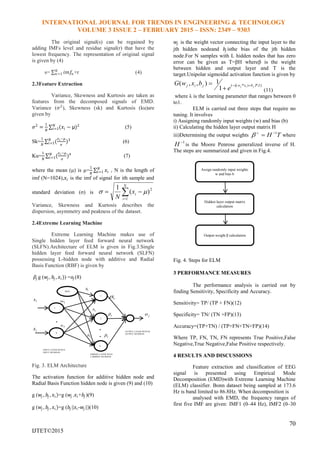
Hz is band limited to 86.8Hz. When decomposition is
analysed with EMD, the frequency ranges of
first five IMF are given: IMF1 (0–44 Hz), IMF2 (0–30
1
N
N
2
1
jo
1
2
L
1x
ix
INPUT LAYER WITH N
INPUT NEURONS
HIDDEN LAYER WITH
L HIDDEN NEURONS
OUTPUT LAYER WITH M
OUTPUT NEURONS
BIAS 1b
2b
Lb
1w
Nw
.
.
.
.
.
.
.
.
Hidden layer output matrix
calculation
Output weight β calculation
Assign randomly input weights
w and bias b
INTERNATIONAL JOURNAL FOR TRENDS IN ENGINEERING & TECHNOLOGY
VOLUME 3 ISSUE 2 – FEBRUARY 2015 – ISSN: 2349 – 9303
71
IJTET©2015
Hz), IMF3 (0–20Hz), IMF4 (0–9Hz),IMF5 (0–7
Hz).The frequency range gets decreased to the range 0-3
Hz for the 6th
IMF.
The epileptic EEG signal deals with the
frequency range of 3-29 Hz.So First Five IMF of the
signal is used when the decomposition is carried out
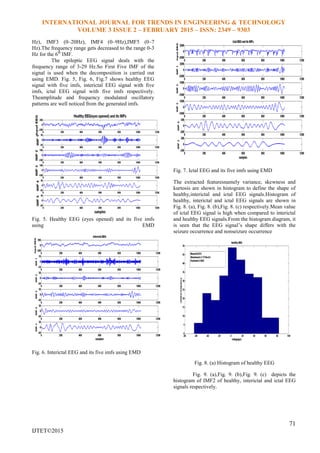
using EMD. Fig. 5, Fig. 6, Fig.7 shows healthy EEG
signal with five imfs, interictal EEG signal with five
imfs, ictal EEG signal with five imfs respectively.
Theamplitude and frequency modulated oscillatory
patterns are well noticed from the generated imfs.
Fig. 5. Healthy EEG (eyes opened) and its five imfs
using EMD
Fig. 6. Interictal EEG and its five imfs using EMD
Fig. 7. Ictal EEG and its five imfs using EMD
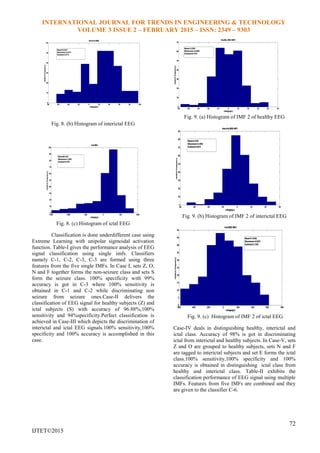
The extracted featuresnamely variance, skewness and
kurtosis are shown in histogram to define the shape of
healthy,interictal and ictal EEG signals.Histogram of
healthy, interictal and ictal EEG signals are shown in
Fig. 8. (a), Fig. 8. (b),Fig. 8. (c) respectively.Mean value
of ictal EEG signal is high when compared to interictal
and healthy EEG signals.From the histogram diagram, it
is seen that the EEG signal’s shape differs with the
seizure occurrence and nonseizure occurrence
Fig. 8. (a) Histogram of healthy EEG
Fig. 9. (a),Fig. 9. (b),Fig. 9. (c) depicts the
histogram of IMF2 of healthy, interictal and ictal EEG
signals respectively.
INTERNATIONAL JOURNAL FOR TRENDS IN ENGINEERING & TECHNOLOGY
VOLUME 3 ISSUE 2 – FEBRUARY 2015 – ISSN: 2349 – 9303
72
IJTET©2015
Fig. 8. (b) Histogram of interictal EEG
Fig. 8. (c) Histogram of ictal EEG
Classification is done underdifferent case using
Extreme Learning with unipolar sigmoidal activation
function. Table-I gives the performance analysis of EEG
signal classification using single imfs. Classifiers
namely C-1, C-2, C-3, C-3 are formed using three
features from the five single IMFs. In Case I, sets Z, O,
N and F together forms the non-seizure class and sets S
form the seizure class. 100% specificity with 99%
accuracy is got in C-3 where 100% sensitivity is
obtained in C-1 and C-2 while discriminating non
seizure from seizure ones.Case-II delivers the
classification of EEG signal for healthy subjects (Z) and
ictal subjects (S) with accuracy of 96.88%,100%
sensitivity and 94%specificity.Perfect classification is
achieved in Case-III which depicts the discrimination of
interictal and ictal EEG signals.100% sensitivity,100%
specificity and 100% accuracy is accomplished in this
case.
Fig. 9. (a) Histogram of IMF 2 of healthy EEG
Fig. 9. (b) Histogram of IMF 2 of interictal EEG
Fig. 9. (c) Histogram of IMF 2 of ictal EEG
Case-IV deals in distinguishing healthy, interictal and
ictal class. Accuracy of 98% is got in discriminating
ictal from interictal and healthy subjects. In Case-V, sets
Z and O are grouped to healthy subjects, sets N and F
are tagged to interictal subjects and set E forms the ictal
class.100% sensitivity,100% specificity and 100%
accuracy is obtained in distinguishing ictal class from
healthy and interictal class. Table-II exhibits the
classification performance of EEG signal using multiple
IMFs. Features from five IMFs are combined and they
are given to the classifier C-6.
INTERNATIONAL JOURNAL FOR TRENDS IN ENGINEERING & TECHNOLOGY
VOLUME 3 ISSUE 2 – FEBRUARY 2015 – ISSN: 2349 – 9303
73
IJTET©2015
TABLE 1
CLASSIFICATION PERFORMANCE USING SINGLE
IMFs
CLASSIFIERS C-1 C-2 C-3 C-4 C-5
Case I
(Z,O,N,
F),S
Sensitivity 100 100 93.33 93.3 100
Specificity 82.9 97.14 100 94.29 81.86
Accuracy 85.88 97.65 99 94.12 84.52
Case II
Z,S
Sensitivity 93.33 100 93.33 93.33 100
Specificity 100 94.12 100 82.35 70.59
Accuracy 96.88 96.88 96.88 87.50 84.38
Case III
N,S
Sensitivity 100 100 100 100 100
Specificity 100 82.35 88.24 52.94 82.35
Accuracy 100 90.6 93.75 75.00 90.63
Case IV
O,F,S
Sensitivity(O) 97 87.88 81.82 100 100
Specificity(O) 80 47.06 72.22 66.67 48
Accuracy(O) 91.67 74 79 88.24 78.43
Sensitivity(F) 94.44 84.85 61.11 83.33 44.64
Specificity(F) 90 76.47 78.79 78.79 90.91
Accuracy(F) 92.11 82 72 80.39 74.51
Sensitivity(S) 100 100 86.67 86.67 100
Specificity(S) 97.22 82.86 97.22 88.89 50
Accuracy(S) 98.04 88 94 88.24 64.71
Case V
(Z,O),
(N,F),S
Sensitivity(ZO) 88 70 70 80 92
Specificity(ZO) 51.43 60 85.71 35 25
Accuracy(ZO) 73 65 76.19 61.18 63.10
Sensitivity(NF) 84.62 60 57.14 53 40
Specificity(NF) 63 84 90 55.10 76
Accuracy(NF) 73 74.12 76.19 54.12 61.
Sensitivity(S) 80 100 100 100 100
Specificity(S) 95.71 88.57 100 88.73 53.62
Accuracy(S) 93 90.59 100 90.59 62
TABLE 2
CLASSIFICATION PERFORMANCE USING
MULTIPLE IMFs
CLASSIFIER C-6
Case I
(Z,O,N,F),S
Sensitivity 88.71
Specificity 34.71
Accuracy 74.12
Case II
Z,S
Sensitivity 80
Specificity 100
Accuracy 90.63
Case III
N,S
Sensitivity 60
Specificity 52.94
Accuracy 57
Case IV
O,F,S
Sensitivity(O) 61.76
Specificity(O) 39
Accuracy(O) 54
Sensitivity(F) 63.16
Specificity(F) 73
Accuracy(F) 69.23
Sensitivity(S) 20
Specificity(S) 75.68
Accuracy(S) 58
Case V
(Z,O),(N,F),S
Sensitivity(ZO) 82
Specificity(ZO) 88.57
Accuracy(ZO) 84
Sensitivity(NF) 65.71
Specificity(NF) 96
Accuracy(NF) 83.53
Sensitivity(S) 80
Specificity(S) 88.5
Accuracy(S) 87
From the Table-I and Table-II, it is expressed that
classification using single IMF gives good performance
when compared to multiple IMF in most of the cases.
Three features are taken when using with single IMF
whereas fifteen features are used when dealing with
multiple IMFs. Thecomputational time gets reduced when
performing with single IMF.
5 CONCLUSION
In this paper, classification of EEG signal for
seizure detection under various cases that includes
healthy and ictal, interictal and ictal, non seizure and
seizure, healthy, interictal an ictal is proposed. EMD is
applied to decompose the input signal into five IMFs.
Higher order statistical features like variance, skewness
and kurtosis are extracted from the decomposed signals
to distinguish healthy, interictal and ictal subjects. The
taken features aretrained and tested using the ELM
classifier. It has been exhibited that the proposed
method shows 100% sensitivity, 100% specificity and
100% accuracy in most of the cases when discriminating
with single IMF rather than multiple IMFs. Future
enhancement can be done by including the case of
classifying the EEG signal into sets Z, O, N, F, and S for
epilepsy detection.
REFERENCES
[1] S.M. Shafiul Alam and M.I.H. Bhuiyan,
―Detection of Seizure and Epilepsy Using Higher
Order Statistics in the EMD Domain‖, IEEE
Journal of Biomedical and Health Informatics,
Vol.17, No.2, pp. 312-318, March 2013.
[2] Shufang Li, Weidong Zhou and Dongmei Cai,
―Feature Extraction and Recognition of Ictal EEG
Using EMD and SVM‖, Computers in Biology and
Medicine, Vol. 43, pp. 807-816,April 2013.
[3] Yuedong Song,Jiaxiang Zhang, ―Automatic
recognition of epileptic EEG patterns via Extreme
Learning Machine and multiresolution feature
extraction‖,Expert Systems with Applications,
vol.40, pp. 5477-5489, 2013.
[4] Varun Bajaj and Ram Bilas Pachori,
―Classification of Seizure and Nonseizure EEG
Signals using Empirical Mode Decomposition‖,
IEEE Transactions on Information Technology in
Biomedicine, Vol.16, No.6, pp. 1135-1142, Nov.
2012.
[5] S. M. Shafiul Alam, M. I. H. Bhuiyan,
Aurangozeb, and Syed TarekShahriar,―EEG Signal
Discrimination using Non-linear Dynamics in the
EMD Domain‖, International Journal of
Computer and Electrical Engineering, Vol.4,
No.3, pp. 326-330, 2012.
[6] M. Nandish, Stafford Michahial, P.
HemanthKumar ,―Feature Extraction and
Classification of EEG Signal Using Neural
Network Based Techniques‖, International
Journal of Engineering and Innovative Technology
(IJEIT), Vol.2,No. 4,Oct.2012.
INTERNATIONAL JOURNAL FOR TRENDS IN ENGINEERING & TECHNOLOGY
VOLUME 3 ISSUE 2 – FEBRUARY 2015 – ISSN: 2349 – 9303
74
IJTET©2015
[7] U. Rajendra Acharya, Filippo Molinari, S. Vinitha
Sree, Subhagata Chattopadhyay,Kwan-Hoong Ng,
Jasjit S. Surig, ―Automated diagnosis of epileptic
EEG using entropies‖,Biomedical Signal
Processing and Control,Elseveir, vol.7, No. 4,
pp.401– 408,July 2012.
[8] J. Siva Prakash, ―Extreme Learning Machines - A
Review and State-of-the-art‖, International Journal
of Wisdom based Computing, Vol.1, No. 1,
Apr.2011.
[9] Tomasz M. Rutkowski, Danilo P. Mandic,
AndrzejCichocki, Andrzej
W.Przybyszewski,―EMD Approach to
Multichannel EEG Data — The Amplitude and
Phase Components Clustering Analysis‖, Journal
of Circuits, Systems, and Computers, Vol.19, No.1,
pp. 215-229, 2010
[10] Ali Shoeb, John Guttag, ―Application of Machine
Learning To Epileptic Seizure Detection‖,
Appearing in Proceedings of the 27th International
Conference on Machine Learning, Haifa, Israel,
2010.
[11] Ling Guo, Daniel Rivero, Alejandro Pazos,
―Epileptic seizure detection using multiwavelet
transform based approximate entropy and artificial
neural networks‖Journal of Neuroscience
Methods,vol. 193,No. 1,pp.156-63,Oct. 2010.
[12] Guang-Bin Huang,Xiaojian Ding, Hongming
Zhou,―Optimization method based extreme
learning machine for classification‖,
Neurocomputing, Elseveir,Vol.74,No. 1-3, pp.
155-163, Dec. 2010.
[13] Jean-Claude Nunes, Eric Del Echelle, ―Empirical
Mode Decomposition: Applications on Signal
and Image Processing‖, Advances in Data
Analysis, Vol.1, No.1, Jan. 2009.
[14] Alexandros T. Tzallas, Markos G. Tsipouras, and
Dimitrios I. Fotiadis, ―Epileptic Seizure Detection
in EEGs Using Time–Frequency Analysis‖, IEEE
Transactions on Information Technology in
Biomedicine, Vol.13, No.5, pp.703-10,Sep. 2009.
[15] Ram Bilas Pachori, ―Discrimination between Ictal
and Seizure-Free EEG Signals using Empirical
Mode Decomposition‖, Communication Research
Centre, Dec. 2008.
[16] A.T. Tzallas, M. G. Tsipouras,D.I.
Fotiadis,―Automatic Seizure Detection Based on
Time- FrequencyAnalysis and Artificial Neural
Networks‖,Computational Intelligence and
Neuroscience, Dec. 2007,doi:10.1155/2007/80510
[17] PariJahankhani, VassilisKodogiannis and Kenneth
Revett ,―EEG Signal Classification Using Wavelet
Feature Extraction and Neural Networks‖, IEEE
John Vincent Atanasoff 2006 International
Symposium on Modern Computing, pp. 120-124,
Oct. 2006.
[18] Ralph G.Andrzejak, Klaus Lehnertz, Christoph
Rieke, Peter David, Christian E. Elger,
―Indications of nonlinear deterministic and finite-
dimensional structures in time series of brain
electrical activity: Dependence on recording region
and brain state‖, Physical Review E, Vol.64,No.6,
Nov. 2001.

Classification of EEG Signal for Epileptic Seizure DetectionusingEMD and ELM

  • 1.
    INTERNATIONAL JOURNAL FORTRENDS IN ENGINEERING & TECHNOLOGY VOLUME 3 ISSUE 2 – FEBRUARY 2015 – ISSN: 2349 – 9303 68 IJTET©2015 Classification of EEG Signal for Epileptic Seizure DetectionusingEMD and ELM S. Divya S. Suja Priyadharsini ECE Department ECE Department Regional Centre: Anna University, Tirunelveli Regional Centre:Anna University, Tirunelveli divya8jads@gmail.com Sujapriya_moni@yahoo.co.in Abstract—This paper proposes the classification of EEG signal for epilepsy diagnosis. Epilepsy is a neurological disorder which occurs due to synchronous neuronal activity in brain. Empirical Mode Decomposition (EMD), Extreme Learning Machine (ELM) are the techniquedelivered in the proposed method.Input EEG signal, which is available in online as Bonn Database is decomposed into five Intrinsic Mode Functions (IMFs) using EMD.Higher Order Statistical moments such as Variance, Skewness and Kurtosis are drawn out as features from the decomposed signals. Extreme Learning Machine is used as a classifier to classify the EEG signals with the taken features, under various categories that include healthy and ictal, interictal and ictal, Non seizure and seizure, healthy, interictal and ictal. The proposed method gives 100%accuracy, 100%sensitivity in discriminating interictal and ictal, non seizure and seizure, healthy and ictal, healthy, interictal and ictal, 100% specificity in classifying healthy and ictal, interictal and ictal and 100% and 99%accuracy in case of discriminating interictal and ictal, non seizure and seizure. Index Terms—Electroencephalogram(EEG), Empirical Mode Decomposition (EMD), Extreme Learning Machine (ELM), Feature Extraction, seizure detection. ——————————  —————————— 1 INTRODUCTION Epilepsy is a disorder which happens due to unusual dischargesin brain.The intense electrical activity causes a temporary disruption to normal brain making the brain’s messages get mixed up. This results in recurrent seizures. About60 million people are suffered with epilepsy in the world. Epileptic seizures fall into two types namely Partial seizures and Generalized seizures. Partial seizures impact only a portion of the brain which leads to temporal paralysis and generalized seizures involve electrical discharges that occur all over the brain which cause loss of consciousness. Electroencephalogram (EEG), being a non- invasive tool evaluates the patient with epilepsy. It examines the brain patterns and assists in epilepsy diagnosis, if any unusual activity takes place in the brain. Extracranial EEG measurements are obtained by keeping electrodes on the scalp whereas Intracranial EEG (iEEG) recordings are examined by keeping electrodes on the cortex of the brain or deep within the structure of the brain. For a normal brain activity, the firing of neuron occurs about 80 times per second and neurons fires about 500 times per second for an epileptic brain activity. Various approaches have been integrated for the seizure detection. Shafiul Alam et al. proposed seizure detection using Artificial Neural Network (ANN).Empirical Mode Decomposition is used for decomposition purpose [1].Shufang Li et al. used EMD to extract coefficient of variation and fluctuation index as features. Support Vector Machine (SVM) classifier is utilized for the classification of interictal and ictal subjects [2].Complexity based features are taken using Wavelet Transform and the features are selected using Genetic Algorithm. Extreme Learning Machine is used as the classifier for recognizing the epileptic activities. The method proposed by Yuedong Song et al. gives less accuracy without the use of Genetic Algorithm [3].Bandwidth features namely Amplitude Modulation Bandwidth and Frequency Modulation Bandwidth is computed using EMD techniques and these features were fed to the Least Square Support Vector Machine (LS-SVM) for classification purpose [4].Nandish et al. used Average method and Max-Min method for taking the features. Among the two methods Max-min with Neural Network gave better accuracy[6].Fuzzy classifier could able to discriminate healthy, interictal and ictal subjects with good accuracy by the usage of entropy features [7].Multiwavelet Transform along with ANN technique had been used by Ling Guo et al. Entropy based features are extracted for classifying healthy and epileptic subjects. Computation cost increases due to the excessive number of features [11]. EEG signal is analysed with time-frequency methods and Artificial
  • 2.
    INTERNATIONAL JOURNAL FORTRENDS IN ENGINEERING & TECHNOLOGY VOLUME 3 ISSUE 2 – FEBRUARY 2015 – ISSN: 2349 – 9303 69 IJTET©2015 Neural Network (ANN)[16].Usage of ANN makes high computational complexity and takes huge training time. EMD delivered by Huang is widely adaptable to non-stationary and nonlinear signals.It is used in the case of reducing noise and providing information. In this paper, classification of EEG signal for epileptic seizure detection is done with EMD and ELM. Variance, Skewness and Kurtosis are taken as features,which describes the shape of EEG signals. The features are then trained and tested using ELM classifier to discriminate healthy, interictal and ictal subjects underdifferent cases. ELM classifier requires no iterate tuning and classifies signal with good accuracy. 2 METHODOLOGY This section has three steps. i) Decomposition of input signal ii) Feature Extraction iii) Classification of EEG signal 2.1 DatabaseDescription Bonn Database [18] from the Department of Epileptology is used. The dataset is possessed with five sets namely Z, O, N, F, S. The dataset Z and O have EEG recordings that were obtained from healthy subjects with their eyes opened and closed respectively. The measurements for the set Z and O were carried out using extracranial electrodes. The dataset N, F, S have recordings from epileptic patients. Sets F and N have EEG measurements that were observed, intracranially during seizure free interval, from epileptogenic zone and from hippocampal formation of opposite hemisphere of the brain. The dataset S has ictal EEG recordings from the epileptogenic zone. The 100 single channel EEG signals from each person are recorded in 23.6s with the sampling rate of 173.6Hz. 2.2 EmpiricalModeDecomposition An adaptive, nonlinear technique referred as Empirical Mode Decomposition (EMD) fragments the nonstationary signal into Amplitude-Frequency modulated components namely Intrinsic Mode Function (IMF). The block diagram of seizure detection using EMD with ELM is given in Fig.1.The steps involved in EMD Algorithm is given below i) Take an input signal s andconsider it to be s=h, n=0 ii) Local maxima and Local minima of input signals are found iii) Upper envelope (𝑒 𝑚𝑎𝑥 ) and lower envelope (𝑒 𝑚𝑖𝑛 ) are found by connecting the local maximum and local minimum respectively, through cubic spline function iv) Mean of upper envelope and lower envelope are determined m=(𝑒 𝑚𝑎𝑥 +𝑒 𝑚𝑖𝑛 )/2 (1) v) The value of mean should be subtracted from the input signal H=h-m (2) vi)Check whether the stopping criterion(α) lies in the range 0.2-0.3, in the calculation of standard deviation given in (3). If the condition is satisfied then take 𝑖𝑚𝑓𝑛 =H, n=n+1 and go to the step vii, elseconsider the input signal s as H i.e. s=H and repeat the process from i to vi sd= |𝐻−ℎ|2 ℎ2 < α (3) vii)Calculate residue signal r=h-𝑖𝑚𝑓𝑛 , if r is a function of monotonicity end the process else consider s=r and repeat from (i) Empirical mode decomposition is more adaptable to nonlinear and nonstationary signals. The frequency component decreases, as the number of intrinsic mode function level increases. The information does not get lost when the frequency decreases. Flow chart of EMD algorithm is given in Fig.2. Fig. 2. EMD Algorithm INPUT SIGNAL (BONN DATA) DECOMPOSITION OF FIVE IMFs USING EMD FEATURE EXTRACTION ELM CLASSIFIER OUTPUT Fig. 1. Block diagram of Seizure detection using EMD- ELM Take input s=h, n=0 If r is monotonic Start Find local maxima and local minima Get upper and lower envelope through spline Find mean (m) of upper and lower envelope H=h-m Calculate standard deviation (sd) 𝑖𝑚𝑓𝑛=H, n=n+1, r=h- 𝑖𝑚𝑓𝑛, If standard deviation<α End s= h1 s = r
  • 3.
    INTERNATIONAL JOURNAL FORTRENDS IN ENGINEERING & TECHNOLOGY VOLUME 3 ISSUE 2 – FEBRUARY 2015 – ISSN: 2349 – 9303 70 IJTET©2015 The original signal(s) can be regained by adding IMFs level and residue signal(r) that have the lowest frequency. The representation of original signal is given by (4) s= 𝑖𝑚𝑓𝑛 𝑁 𝑛=1 +r (4) 2.3Feature Extraction Variance, Skewness and Kurtosis are taken as features from the decomposed signals of EMD. Variance (𝜎2 ), Skewness (sk) and Kurtosis (ku)are given by 𝜎2 = 1 𝑁 (𝑥𝑖 − µ)2𝑁 𝑖=1 (5) Sk= 1 𝑁 ( 𝑥 𝑖−𝜇 𝜎 )3𝑁 𝑖=1 (6) Ku= 1 𝑁 ( 𝑥 𝑖−𝜇 𝜎 )4𝑁 𝑖=1 (7) where the mean (μ) is µ= 1 𝑁 𝑥𝑖 𝑁 𝑖=1 , N is the length of imf (N=1024),𝑥𝑖 is the imf of signal for ith sample and standard deviation (σ) is   N i ix N 1 2 )( 1  Variance, Skewness and Kurtosis describes the dispersion, asymmetry and peakness of the dataset. 2.4Extreme Learning Machine Extreme Learning Machine makes use of Single hidden layer feed forward neural network (SLFN).Architecture of ELM is given in Fig.3.Single hidden layer feed forward neural network (SLFN) possessing L-hidden node with additive and Radial Basis Function (RBF) is given by 𝛽𝑗 g (𝑤𝑗 , 𝑏𝑗 , 𝑥𝑖)) =𝑜𝑗 (8) Fig. 3. ELM Architecture The activation function for additive hidden node and Radial Basis Function hidden node is given (9) and (10) g (𝑤𝑗 , 𝑏𝑗 , 𝑥𝑖)=g (𝑤𝑗 .𝑥𝑖+𝑏𝑗 )(9) g (𝑤𝑗 , 𝑏𝑗 , 𝑥𝑖)=g (𝑏𝑗 ||𝑥𝑖-𝑤𝑗 ||)(10) 𝑤𝑗 is the weight vector connecting the input layer to the jth hidden nodeand 𝑏𝑗 isthe bias of the jth hidden node.For N samples with L hidden nodes that has zero error can be given as T=βH whereβ is the weight between hidden and output layer and T is the target.Unipolar sigmoidal activation function is given by ))*)*((( 1 1),,( jij bxwjij e bxwG    (11) where λ is the learning parameter that ranges between 0 to1. ELM is carried out three steps that require no tuning. It involves i) Assigning randomly input weights (w) and bias (b) ii) Calculating the hidden layer output matrix H iii)Determining the output weights TH 1  where 1 H is the Moore Penrose generalized inverse of H. The steps are summarized and given in Fig.4. Fig. 4. Steps for ELM 3 PERFORMANCE MEASURES The performance analysis is carried out by finding Sensitivity, Specificity and Accuracy. Sensitivity= TP/ (TP + FN)(12) Specificity= TN/ (TN +FP)(13) Accuracy=(TP+TN) / (TP+FN+TN+FP)(14) Where TP, FN, TN, FN represents True Positive,False Negative,True Negative,False Positive respectively. 4 RESULTS AND DISCUSSIONS Feature extraction and classification of EEG signal is presented using Empirical Mode Decomposition (EMD)with Extreme Learning Machine (ELM) classifier. Bonn dataset being sampled at 173.6 Hz is band limited to 86.8Hz. When decomposition is analysed with EMD, the frequency ranges of first five IMF are given: IMF1 (0–44 Hz), IMF2 (0–30 1 N N 2 1 jo 1 2 L 1x ix INPUT LAYER WITH N INPUT NEURONS HIDDEN LAYER WITH L HIDDEN NEURONS OUTPUT LAYER WITH M OUTPUT NEURONS BIAS 1b 2b Lb 1w Nw . . . . . . . . Hidden layer output matrix calculation Output weight β calculation Assign randomly input weights w and bias b
  • 4.
    INTERNATIONAL JOURNAL FORTRENDS IN ENGINEERING & TECHNOLOGY VOLUME 3 ISSUE 2 – FEBRUARY 2015 – ISSN: 2349 – 9303 71 IJTET©2015 Hz), IMF3 (0–20Hz), IMF4 (0–9Hz),IMF5 (0–7 Hz).The frequency range gets decreased to the range 0-3 Hz for the 6th IMF. The epileptic EEG signal deals with the frequency range of 3-29 Hz.So First Five IMF of the signal is used when the decomposition is carried out using EMD. Fig. 5, Fig. 6, Fig.7 shows healthy EEG signal with five imfs, interictal EEG signal with five imfs, ictal EEG signal with five imfs respectively. Theamplitude and frequency modulated oscillatory patterns are well noticed from the generated imfs. Fig. 5. Healthy EEG (eyes opened) and its five imfs using EMD Fig. 6. Interictal EEG and its five imfs using EMD Fig. 7. Ictal EEG and its five imfs using EMD The extracted featuresnamely variance, skewness and kurtosis are shown in histogram to define the shape of healthy,interictal and ictal EEG signals.Histogram of healthy, interictal and ictal EEG signals are shown in Fig. 8. (a), Fig. 8. (b),Fig. 8. (c) respectively.Mean value of ictal EEG signal is high when compared to interictal and healthy EEG signals.From the histogram diagram, it is seen that the EEG signal’s shape differs with the seizure occurrence and nonseizure occurrence Fig. 8. (a) Histogram of healthy EEG Fig. 9. (a),Fig. 9. (b),Fig. 9. (c) depicts the histogram of IMF2 of healthy, interictal and ictal EEG signals respectively.
  • 5.
    INTERNATIONAL JOURNAL FORTRENDS IN ENGINEERING & TECHNOLOGY VOLUME 3 ISSUE 2 – FEBRUARY 2015 – ISSN: 2349 – 9303 72 IJTET©2015 Fig. 8. (b) Histogram of interictal EEG Fig. 8. (c) Histogram of ictal EEG Classification is done underdifferent case using Extreme Learning with unipolar sigmoidal activation function. Table-I gives the performance analysis of EEG signal classification using single imfs. Classifiers namely C-1, C-2, C-3, C-3 are formed using three features from the five single IMFs. In Case I, sets Z, O, N and F together forms the non-seizure class and sets S form the seizure class. 100% specificity with 99% accuracy is got in C-3 where 100% sensitivity is obtained in C-1 and C-2 while discriminating non seizure from seizure ones.Case-II delivers the classification of EEG signal for healthy subjects (Z) and ictal subjects (S) with accuracy of 96.88%,100% sensitivity and 94%specificity.Perfect classification is achieved in Case-III which depicts the discrimination of interictal and ictal EEG signals.100% sensitivity,100% specificity and 100% accuracy is accomplished in this case. Fig. 9. (a) Histogram of IMF 2 of healthy EEG Fig. 9. (b) Histogram of IMF 2 of interictal EEG Fig. 9. (c) Histogram of IMF 2 of ictal EEG Case-IV deals in distinguishing healthy, interictal and ictal class. Accuracy of 98% is got in discriminating ictal from interictal and healthy subjects. In Case-V, sets Z and O are grouped to healthy subjects, sets N and F are tagged to interictal subjects and set E forms the ictal class.100% sensitivity,100% specificity and 100% accuracy is obtained in distinguishing ictal class from healthy and interictal class. Table-II exhibits the classification performance of EEG signal using multiple IMFs. Features from five IMFs are combined and they are given to the classifier C-6.
  • 6.
    INTERNATIONAL JOURNAL FORTRENDS IN ENGINEERING & TECHNOLOGY VOLUME 3 ISSUE 2 – FEBRUARY 2015 – ISSN: 2349 – 9303 73 IJTET©2015 TABLE 1 CLASSIFICATION PERFORMANCE USING SINGLE IMFs CLASSIFIERS C-1 C-2 C-3 C-4 C-5 Case I (Z,O,N, F),S Sensitivity 100 100 93.33 93.3 100 Specificity 82.9 97.14 100 94.29 81.86 Accuracy 85.88 97.65 99 94.12 84.52 Case II Z,S Sensitivity 93.33 100 93.33 93.33 100 Specificity 100 94.12 100 82.35 70.59 Accuracy 96.88 96.88 96.88 87.50 84.38 Case III N,S Sensitivity 100 100 100 100 100 Specificity 100 82.35 88.24 52.94 82.35 Accuracy 100 90.6 93.75 75.00 90.63 Case IV O,F,S Sensitivity(O) 97 87.88 81.82 100 100 Specificity(O) 80 47.06 72.22 66.67 48 Accuracy(O) 91.67 74 79 88.24 78.43 Sensitivity(F) 94.44 84.85 61.11 83.33 44.64 Specificity(F) 90 76.47 78.79 78.79 90.91 Accuracy(F) 92.11 82 72 80.39 74.51 Sensitivity(S) 100 100 86.67 86.67 100 Specificity(S) 97.22 82.86 97.22 88.89 50 Accuracy(S) 98.04 88 94 88.24 64.71 Case V (Z,O), (N,F),S Sensitivity(ZO) 88 70 70 80 92 Specificity(ZO) 51.43 60 85.71 35 25 Accuracy(ZO) 73 65 76.19 61.18 63.10 Sensitivity(NF) 84.62 60 57.14 53 40 Specificity(NF) 63 84 90 55.10 76 Accuracy(NF) 73 74.12 76.19 54.12 61. Sensitivity(S) 80 100 100 100 100 Specificity(S) 95.71 88.57 100 88.73 53.62 Accuracy(S) 93 90.59 100 90.59 62 TABLE 2 CLASSIFICATION PERFORMANCE USING MULTIPLE IMFs CLASSIFIER C-6 Case I (Z,O,N,F),S Sensitivity 88.71 Specificity 34.71 Accuracy 74.12 Case II Z,S Sensitivity 80 Specificity 100 Accuracy 90.63 Case III N,S Sensitivity 60 Specificity 52.94 Accuracy 57 Case IV O,F,S Sensitivity(O) 61.76 Specificity(O) 39 Accuracy(O) 54 Sensitivity(F) 63.16 Specificity(F) 73 Accuracy(F) 69.23 Sensitivity(S) 20 Specificity(S) 75.68 Accuracy(S) 58 Case V (Z,O),(N,F),S Sensitivity(ZO) 82 Specificity(ZO) 88.57 Accuracy(ZO) 84 Sensitivity(NF) 65.71 Specificity(NF) 96 Accuracy(NF) 83.53 Sensitivity(S) 80 Specificity(S) 88.5 Accuracy(S) 87 From the Table-I and Table-II, it is expressed that classification using single IMF gives good performance when compared to multiple IMF in most of the cases. Three features are taken when using with single IMF whereas fifteen features are used when dealing with multiple IMFs. Thecomputational time gets reduced when performing with single IMF. 5 CONCLUSION In this paper, classification of EEG signal for seizure detection under various cases that includes healthy and ictal, interictal and ictal, non seizure and seizure, healthy, interictal an ictal is proposed. EMD is applied to decompose the input signal into five IMFs. Higher order statistical features like variance, skewness and kurtosis are extracted from the decomposed signals to distinguish healthy, interictal and ictal subjects. The taken features aretrained and tested using the ELM classifier. It has been exhibited that the proposed method shows 100% sensitivity, 100% specificity and 100% accuracy in most of the cases when discriminating with single IMF rather than multiple IMFs. Future enhancement can be done by including the case of classifying the EEG signal into sets Z, O, N, F, and S for epilepsy detection. REFERENCES [1] S.M. Shafiul Alam and M.I.H. Bhuiyan, ―Detection of Seizure and Epilepsy Using Higher Order Statistics in the EMD Domain‖, IEEE Journal of Biomedical and Health Informatics, Vol.17, No.2, pp. 312-318, March 2013. [2] Shufang Li, Weidong Zhou and Dongmei Cai, ―Feature Extraction and Recognition of Ictal EEG Using EMD and SVM‖, Computers in Biology and Medicine, Vol. 43, pp. 807-816,April 2013. [3] Yuedong Song,Jiaxiang Zhang, ―Automatic recognition of epileptic EEG patterns via Extreme Learning Machine and multiresolution feature extraction‖,Expert Systems with Applications, vol.40, pp. 5477-5489, 2013. [4] Varun Bajaj and Ram Bilas Pachori, ―Classification of Seizure and Nonseizure EEG Signals using Empirical Mode Decomposition‖, IEEE Transactions on Information Technology in Biomedicine, Vol.16, No.6, pp. 1135-1142, Nov. 2012. [5] S. M. Shafiul Alam, M. I. H. Bhuiyan, Aurangozeb, and Syed TarekShahriar,―EEG Signal Discrimination using Non-linear Dynamics in the EMD Domain‖, International Journal of Computer and Electrical Engineering, Vol.4, No.3, pp. 326-330, 2012. [6] M. Nandish, Stafford Michahial, P. HemanthKumar ,―Feature Extraction and Classification of EEG Signal Using Neural Network Based Techniques‖, International Journal of Engineering and Innovative Technology (IJEIT), Vol.2,No. 4,Oct.2012.
  • 7.
    INTERNATIONAL JOURNAL FORTRENDS IN ENGINEERING & TECHNOLOGY VOLUME 3 ISSUE 2 – FEBRUARY 2015 – ISSN: 2349 – 9303 74 IJTET©2015 [7] U. Rajendra Acharya, Filippo Molinari, S. Vinitha Sree, Subhagata Chattopadhyay,Kwan-Hoong Ng, Jasjit S. Surig, ―Automated diagnosis of epileptic EEG using entropies‖,Biomedical Signal Processing and Control,Elseveir, vol.7, No. 4, pp.401– 408,July 2012. [8] J. Siva Prakash, ―Extreme Learning Machines - A Review and State-of-the-art‖, International Journal of Wisdom based Computing, Vol.1, No. 1, Apr.2011. [9] Tomasz M. Rutkowski, Danilo P. Mandic, AndrzejCichocki, Andrzej W.Przybyszewski,―EMD Approach to Multichannel EEG Data — The Amplitude and Phase Components Clustering Analysis‖, Journal of Circuits, Systems, and Computers, Vol.19, No.1, pp. 215-229, 2010 [10] Ali Shoeb, John Guttag, ―Application of Machine Learning To Epileptic Seizure Detection‖, Appearing in Proceedings of the 27th International Conference on Machine Learning, Haifa, Israel, 2010. [11] Ling Guo, Daniel Rivero, Alejandro Pazos, ―Epileptic seizure detection using multiwavelet transform based approximate entropy and artificial neural networks‖Journal of Neuroscience Methods,vol. 193,No. 1,pp.156-63,Oct. 2010. [12] Guang-Bin Huang,Xiaojian Ding, Hongming Zhou,―Optimization method based extreme learning machine for classification‖, Neurocomputing, Elseveir,Vol.74,No. 1-3, pp. 155-163, Dec. 2010. [13] Jean-Claude Nunes, Eric Del Echelle, ―Empirical Mode Decomposition: Applications on Signal and Image Processing‖, Advances in Data Analysis, Vol.1, No.1, Jan. 2009. [14] Alexandros T. Tzallas, Markos G. Tsipouras, and Dimitrios I. Fotiadis, ―Epileptic Seizure Detection in EEGs Using Time–Frequency Analysis‖, IEEE Transactions on Information Technology in Biomedicine, Vol.13, No.5, pp.703-10,Sep. 2009. [15] Ram Bilas Pachori, ―Discrimination between Ictal and Seizure-Free EEG Signals using Empirical Mode Decomposition‖, Communication Research Centre, Dec. 2008. [16] A.T. Tzallas, M. G. Tsipouras,D.I. Fotiadis,―Automatic Seizure Detection Based on Time- FrequencyAnalysis and Artificial Neural Networks‖,Computational Intelligence and Neuroscience, Dec. 2007,doi:10.1155/2007/80510 [17] PariJahankhani, VassilisKodogiannis and Kenneth Revett ,―EEG Signal Classification Using Wavelet Feature Extraction and Neural Networks‖, IEEE John Vincent Atanasoff 2006 International Symposium on Modern Computing, pp. 120-124, Oct. 2006. [18] Ralph G.Andrzejak, Klaus Lehnertz, Christoph Rieke, Peter David, Christian E. Elger, ―Indications of nonlinear deterministic and finite- dimensional structures in time series of brain electrical activity: Dependence on recording region and brain state‖, Physical Review E, Vol.64,No.6, Nov. 2001.