PHONOCARDIOGRAPHY (PCG)
Ms.P.NISHANTHI
Assistant Professor/ Department of ECE
KIT-Kalaignarkarunanidhi Institute of Technology
PCG
 Graphic record heart sound - Phonogram.
 Recording the sounds connected with the pumping action of heart.
 Sound from heart – phonocardiogram
 Instrument to measure this – phonocardiograph
 Basic function – to pick up the different heart sound,filter the required and
display.
 Two categories –
 heart sound – transient characteristics with short duration.(closing and
opening of valves)
 murmurs – noisy characteristics with long duration.(turbulent blood flow in
heart)
MEDICAL ELECTRONICS - MV/AP/ECE 2
Origin of sound
 Valve closure
 Movement of heart wall
 Valve opening
 Extra cardiac sounds
1. Frequency – 10 to 1000 Hz.
LOW RANGE – 10 – 60 Hz(3rd and 4th)
MEDIUM RANGE – 60 – 150 Hz(1st and 2nd)
HIGH RANGE – 150 – 1000 Hz
2.Amplitude
3.Quality
MEDICAL ELECTRONICS - MV/AP/ECE 3
 1st sound:
Closure of mitral and tricuspid valves.
Freq – 30 to 100 Hz and duration 50 to 100 ms
 2nd sound:
Closure of aortic and pulmonary valves(slight back flow of blood).
Freq – 30 to 100 Hz and duration 25 to 50 ms .
 3rd and 4th low intensity and inaudible.(heard among children).
MEDICAL ELECTRONICS - MV/AP/ECE 4
 3rd sound:
Blood rapid movement into relaxed ventricular chambers
Freq – 10 to 100 Hz and duration 0.04 to 0.08 s.
 4th sound:
atrial contraction.
Freq – 10 to 50 Hz and duration 0.03 to 0.06 s.
MEDICAL ELECTRONICS - MV/AP/ECE 5
 Microphones for PCG:
 Crystal microphone – contains wafer of piezo-electric material, which
generates potentials when subjected to mechanical stresses due to heart
sound. Smaller in size, high sensitivity.
 Dynamic microphone – consists of a moving coil having a fixed magnetic core
inside it. The coil moves with the heart sound and produce a voltage because
of interaction with the magnetic flux.
 New acoustic sensors – polymer based adherent differential-output sensors.
MEDICAL ELECTRONICS - MV/AP/ECE 6
Writing methods
 Light beam galvanometer – expensive and require more power from amplifiers
when used for high freq.
 Direct writing recorders – upper freq 150 Hz.(used for only low freq).
 Technique – envelope detection.
 Fans, Air conditioners and other noise producing gadgets will result in
artefacts on the recordings.
MEDICAL ELECTRONICS - MV/AP/ECE 7
8
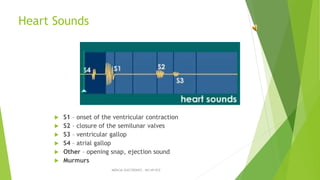
Heart Sounds
 S1 – onset of the ventricular contraction
 S2 – closure of the semilunar valves
 S3 – ventricular gallop
 S4 – atrial gallop
 Other – opening snap, ejection sound
 Murmurs
MEDICAL ELECTRONICS - MV/AP/ECE
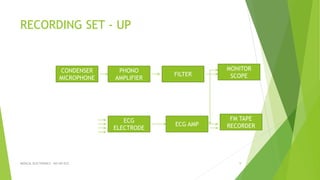
RECORDING SET - UP
MEDICAL ELECTRONICS - MV/AP/ECE 9
CONDENSER
MICROPHONE
ECG AMP
ECG
ELECTRODE
FILTER
PHONO
AMPLIFIER
FM TAPE
RECORDER
MONITOR
SCOPE
 Amplifiers used to process biopotentials are called
biopotential amplifier.
 Biopotential Signals (e.g., ECG, EMG, EEG, EOG, …
etc.)
 The basic function of biopotential amplifier is to
increase the amplitude of a weak electric signal of
biological origin.
 Biopotential amplifiers typically process voltages, but
in some cases they also process currents.
 The frequency response of typical bioelectric
amplifiers may be from dc (or near dc, i.e., 0.05 Hz)
up to 100 kHz.
Biopotential Amplifier
 Some biopotential amplifiers are ac-coupled, while some are dc-coupled.
 The dc-coupling is required where input signals are clearly dc or changes
very slowly.
 At frequencies as low as 0.05Hz, the ac-coupling should be used instead of
dc-coupling.
 This is to overcome the electrode offset potential.
 Also, the skin-electrode interface generates dc offsets.
 The gain of biopotential amplifiers can be low, medium or high (x10, x100,
x1000, x10000).
Cont…
 Gain factors x1 and x10.
 The unity-gain amplifier is mainly for isolation,
buffering and possibly impedance
transformation between signal source and
readout device.
 Used for measurement of action potentials and
other relatively high-amplitude bioelectric
events.
Low Gain Biopotential Amplifier
 Gain factors x100 and x1000.
 Used for recording of ECG waveforms and
muscles potentials (EMG), etc.
Medium Gain Biopotential Amplifier
 Gain factors over x1000.
 Used in very sensitive measurement such as
recording of brain potentials (EEG).
High Gain Biopotential Amplifier
Body Surface Recording Electrodes
1. Metal Plate Electrodes
(historic)
2. Suction Electrodes
(historic interest)
3. Floating Electrodes
4. Flexible Electrodes
Electrode metal
Electrolyte
Think of the
construction of
electrosurgical
electrode
And, how does
electro-surgery
work?
Commonly Used Biopotential Electrodes
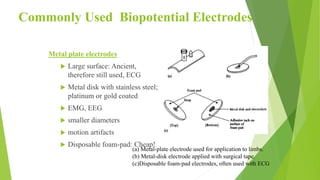
Metal plate electrodes
 Large surface: Ancient,
therefore still used, ECG
 Metal disk with stainless steel;
platinum or gold coated
 EMG, EEG
 smaller diameters
 motion artifacts
 Disposable foam-pad: Cheap!
(a) Metal-plate electrode used for application to limbs.
(b) Metal-disk electrode applied with surgical tape.
(c)Disposable foam-pad electrodes, often used with ECG
Commonly Used Biopotential
Electrodes
Suction electrodes
- No straps or adhesives
required
- precordial (chest) ECG
- can only be used for short
periods
Floating electrodes
- metal disk is recessed
- swimming in the electrolyte gel
- not in contact with the skin
- reduces motion artifact
Suction Electrode
Double-sided
Adhesive-tape
ring
Insulating
package
Metal disk
Electrolyte gel
in recess
(a) (b)
(c)
Snap coated with Ag-AgCl External snap
Plastic cup
Tack
Plastic disk
Foam pad
Capillary loops
Dead cellular material
Germinating layer
Gel-coated sponge
Commonly Used Biopotential
Electrodes
Floating Electrodes
Reusable
Disposable
(a) Carbon-filled silicone rubber electrode.
(b) Flexible thin-film neonatal electrode.
(c) Cross-sectional view of the thin-film
electrode in (b).
Commonly Used Biopotential
Electrodes
Flexible electrodes
- Body contours are often
irregular
- Regularly shaped rigid
electrodes
may not always work.
- Special case : infants
- Material :
- Polymer or nylon with silver
- Carbon filled silicon rubber
(Mylar film)
Internal Electrodes
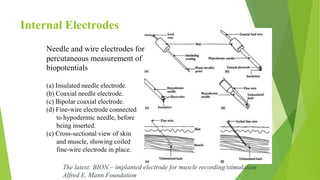
Needle and wire electrodes for
percutaneous measurement of
biopotentials
(a) Insulated needle electrode.
(b) Coaxial needle electrode.
(c) Bipolar coaxial electrode.
(d) Fine-wire electrode connected
to hypodermic needle, before
being inserted.
(e) Cross-sectional view of skin
and muscle, showing coiled
fine-wire electrode in place.
The latest: BION – implanted electrode for muscle recording/stimulation
Alfred E. Mann Foundation
Fetal ECG Electrodes
Electrodes for detecting fetal electrocardiogram during labor, by means
of intracutaneous needles (a) Suction electrode. (b) Cross-sectional view of
suction electrode in place, showing penetration of probe through epidermis.
(c) Helical electrode, which is attached to fetal skin by corkscrew type action.
MEDICAL APPLICATION
 Rheumatic valvular lesions
Allergic disease in which the heart valves are likely to be damaged. This creates abnormal heart
sound.
 The murmurs of aortic steonosis
The blood is ejected from the left ventricles through a small opening of aortic valve. High
pressure 350 mm of Hg and causes turbulent flow of blood.
 The murmurs of aortic regurgitation
During diastole, blood flow backward from aorta to left ventricles,causing a blowing murmur.
 The murmurs of mitral regurgitation
During systole, blood flow backward through mitral valve.
 The murmurs of mitral steonosis
It produce murmurs when,Blood passes with difficulty from LA into the LV due to pressure
difference.
MEDICAL ELECTRONICS - MV/AP/ECE 22
SPECIAL APPLICATION OF PCG
 Fetal PCG
 Esophageal PCG
 Tracheal PCG - Cannula
MEDICAL ELECTRONICS - MV/AP/ECE 23
Thank you

Phonocardiography(PCG)

  • 1.
    PHONOCARDIOGRAPHY (PCG) Ms.P.NISHANTHI Assistant Professor/Department of ECE KIT-Kalaignarkarunanidhi Institute of Technology
  • 2.
    PCG  Graphic recordheart sound - Phonogram.  Recording the sounds connected with the pumping action of heart.  Sound from heart – phonocardiogram  Instrument to measure this – phonocardiograph  Basic function – to pick up the different heart sound,filter the required and display.  Two categories –  heart sound – transient characteristics with short duration.(closing and opening of valves)  murmurs – noisy characteristics with long duration.(turbulent blood flow in heart) MEDICAL ELECTRONICS - MV/AP/ECE 2
  • 3.
    Origin of sound Valve closure  Movement of heart wall  Valve opening  Extra cardiac sounds 1. Frequency – 10 to 1000 Hz. LOW RANGE – 10 – 60 Hz(3rd and 4th) MEDIUM RANGE – 60 – 150 Hz(1st and 2nd) HIGH RANGE – 150 – 1000 Hz 2.Amplitude 3.Quality MEDICAL ELECTRONICS - MV/AP/ECE 3
  • 4.
     1st sound: Closureof mitral and tricuspid valves. Freq – 30 to 100 Hz and duration 50 to 100 ms  2nd sound: Closure of aortic and pulmonary valves(slight back flow of blood). Freq – 30 to 100 Hz and duration 25 to 50 ms .  3rd and 4th low intensity and inaudible.(heard among children). MEDICAL ELECTRONICS - MV/AP/ECE 4
  • 5.
     3rd sound: Bloodrapid movement into relaxed ventricular chambers Freq – 10 to 100 Hz and duration 0.04 to 0.08 s.  4th sound: atrial contraction. Freq – 10 to 50 Hz and duration 0.03 to 0.06 s. MEDICAL ELECTRONICS - MV/AP/ECE 5
  • 6.
     Microphones forPCG:  Crystal microphone – contains wafer of piezo-electric material, which generates potentials when subjected to mechanical stresses due to heart sound. Smaller in size, high sensitivity.  Dynamic microphone – consists of a moving coil having a fixed magnetic core inside it. The coil moves with the heart sound and produce a voltage because of interaction with the magnetic flux.  New acoustic sensors – polymer based adherent differential-output sensors. MEDICAL ELECTRONICS - MV/AP/ECE 6
  • 7.
    Writing methods  Lightbeam galvanometer – expensive and require more power from amplifiers when used for high freq.  Direct writing recorders – upper freq 150 Hz.(used for only low freq).  Technique – envelope detection.  Fans, Air conditioners and other noise producing gadgets will result in artefacts on the recordings. MEDICAL ELECTRONICS - MV/AP/ECE 7
  • 8.
    8 Heart Sounds  S1– onset of the ventricular contraction  S2 – closure of the semilunar valves  S3 – ventricular gallop  S4 – atrial gallop  Other – opening snap, ejection sound  Murmurs MEDICAL ELECTRONICS - MV/AP/ECE
  • 9.
    RECORDING SET -UP MEDICAL ELECTRONICS - MV/AP/ECE 9 CONDENSER MICROPHONE ECG AMP ECG ELECTRODE FILTER PHONO AMPLIFIER FM TAPE RECORDER MONITOR SCOPE
  • 10.
     Amplifiers usedto process biopotentials are called biopotential amplifier.  Biopotential Signals (e.g., ECG, EMG, EEG, EOG, … etc.)  The basic function of biopotential amplifier is to increase the amplitude of a weak electric signal of biological origin.  Biopotential amplifiers typically process voltages, but in some cases they also process currents.  The frequency response of typical bioelectric amplifiers may be from dc (or near dc, i.e., 0.05 Hz) up to 100 kHz. Biopotential Amplifier
  • 11.
     Some biopotentialamplifiers are ac-coupled, while some are dc-coupled.  The dc-coupling is required where input signals are clearly dc or changes very slowly.  At frequencies as low as 0.05Hz, the ac-coupling should be used instead of dc-coupling.  This is to overcome the electrode offset potential.  Also, the skin-electrode interface generates dc offsets.  The gain of biopotential amplifiers can be low, medium or high (x10, x100, x1000, x10000). Cont…
  • 12.
     Gain factorsx1 and x10.  The unity-gain amplifier is mainly for isolation, buffering and possibly impedance transformation between signal source and readout device.  Used for measurement of action potentials and other relatively high-amplitude bioelectric events. Low Gain Biopotential Amplifier
  • 13.
     Gain factorsx100 and x1000.  Used for recording of ECG waveforms and muscles potentials (EMG), etc. Medium Gain Biopotential Amplifier
  • 14.
     Gain factorsover x1000.  Used in very sensitive measurement such as recording of brain potentials (EEG). High Gain Biopotential Amplifier
  • 15.
    Body Surface RecordingElectrodes 1. Metal Plate Electrodes (historic) 2. Suction Electrodes (historic interest) 3. Floating Electrodes 4. Flexible Electrodes Electrode metal Electrolyte Think of the construction of electrosurgical electrode And, how does electro-surgery work?
  • 16.
    Commonly Used BiopotentialElectrodes Metal plate electrodes  Large surface: Ancient, therefore still used, ECG  Metal disk with stainless steel; platinum or gold coated  EMG, EEG  smaller diameters  motion artifacts  Disposable foam-pad: Cheap! (a) Metal-plate electrode used for application to limbs. (b) Metal-disk electrode applied with surgical tape. (c)Disposable foam-pad electrodes, often used with ECG
  • 17.
    Commonly Used Biopotential Electrodes Suctionelectrodes - No straps or adhesives required - precordial (chest) ECG - can only be used for short periods Floating electrodes - metal disk is recessed - swimming in the electrolyte gel - not in contact with the skin - reduces motion artifact Suction Electrode
  • 18.
    Double-sided Adhesive-tape ring Insulating package Metal disk Electrolyte gel inrecess (a) (b) (c) Snap coated with Ag-AgCl External snap Plastic cup Tack Plastic disk Foam pad Capillary loops Dead cellular material Germinating layer Gel-coated sponge Commonly Used Biopotential Electrodes Floating Electrodes Reusable Disposable
  • 19.
    (a) Carbon-filled siliconerubber electrode. (b) Flexible thin-film neonatal electrode. (c) Cross-sectional view of the thin-film electrode in (b). Commonly Used Biopotential Electrodes Flexible electrodes - Body contours are often irregular - Regularly shaped rigid electrodes may not always work. - Special case : infants - Material : - Polymer or nylon with silver - Carbon filled silicon rubber (Mylar film)
  • 20.
    Internal Electrodes Needle andwire electrodes for percutaneous measurement of biopotentials (a) Insulated needle electrode. (b) Coaxial needle electrode. (c) Bipolar coaxial electrode. (d) Fine-wire electrode connected to hypodermic needle, before being inserted. (e) Cross-sectional view of skin and muscle, showing coiled fine-wire electrode in place. The latest: BION – implanted electrode for muscle recording/stimulation Alfred E. Mann Foundation
  • 21.
    Fetal ECG Electrodes Electrodesfor detecting fetal electrocardiogram during labor, by means of intracutaneous needles (a) Suction electrode. (b) Cross-sectional view of suction electrode in place, showing penetration of probe through epidermis. (c) Helical electrode, which is attached to fetal skin by corkscrew type action.
  • 22.
    MEDICAL APPLICATION  Rheumaticvalvular lesions Allergic disease in which the heart valves are likely to be damaged. This creates abnormal heart sound.  The murmurs of aortic steonosis The blood is ejected from the left ventricles through a small opening of aortic valve. High pressure 350 mm of Hg and causes turbulent flow of blood.  The murmurs of aortic regurgitation During diastole, blood flow backward from aorta to left ventricles,causing a blowing murmur.  The murmurs of mitral regurgitation During systole, blood flow backward through mitral valve.  The murmurs of mitral steonosis It produce murmurs when,Blood passes with difficulty from LA into the LV due to pressure difference. MEDICAL ELECTRONICS - MV/AP/ECE 22
  • 23.
    SPECIAL APPLICATION OFPCG  Fetal PCG  Esophageal PCG  Tracheal PCG - Cannula MEDICAL ELECTRONICS - MV/AP/ECE 23
  • 24.