



Towards Design and Implementation of EMG
Signal Recorder for Application in Prosthetic
Arm Control
Presented by
Sagar Dakua (ID 1421658)
Alamgir Kabir Rusad (ID 1421477)
Supervised by
Dr. Md. Kafiul Islam, Asst. Prof.
1
Senior Project Defense
Outline
Introduction
• Motivation and Objectives
• Electromyography (EMG) Basics
• State-of-the-Art Prosthetic Systems
Proposed System Design
Hardware Implementation
Signal Analysis in MATLAB
Accuracy Calculation
Problem Faced/Limitations
Conclusion
Future work
2
Introduction
3
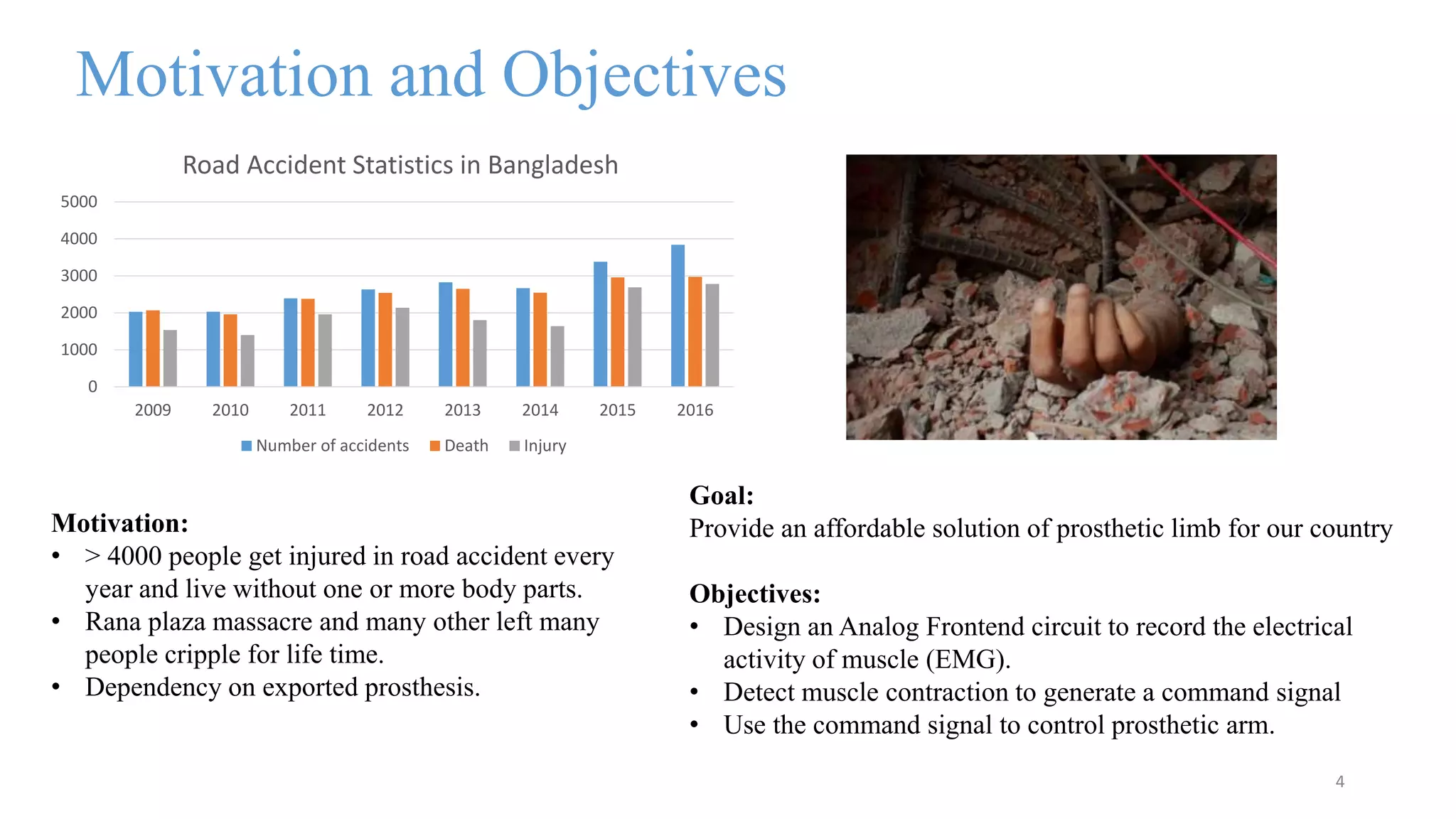
Motivation and Objectives
0
1000
2000
3000
4000
5000
2009 2010 2011 2012 2013 2014 2015 2016
Road Accident Statistics in Bangladesh
Number of accidents Death Injury
4
Motivation:
• > 4000 people get injured in road accident every
year and live without one or more body parts.
• Rana plaza massacre and many other left many
people cripple for life time.
• Dependency on exported prosthesis.
Goal:
Provide an affordable solution of prosthetic limb for our country
Objectives:
• Design an Analog Frontend circuit to record the electrical
activity of muscle (EMG).
• Detect muscle contraction to generate a command signal
• Use the command signal to control prosthetic arm.
Electromyography (EMG)
5
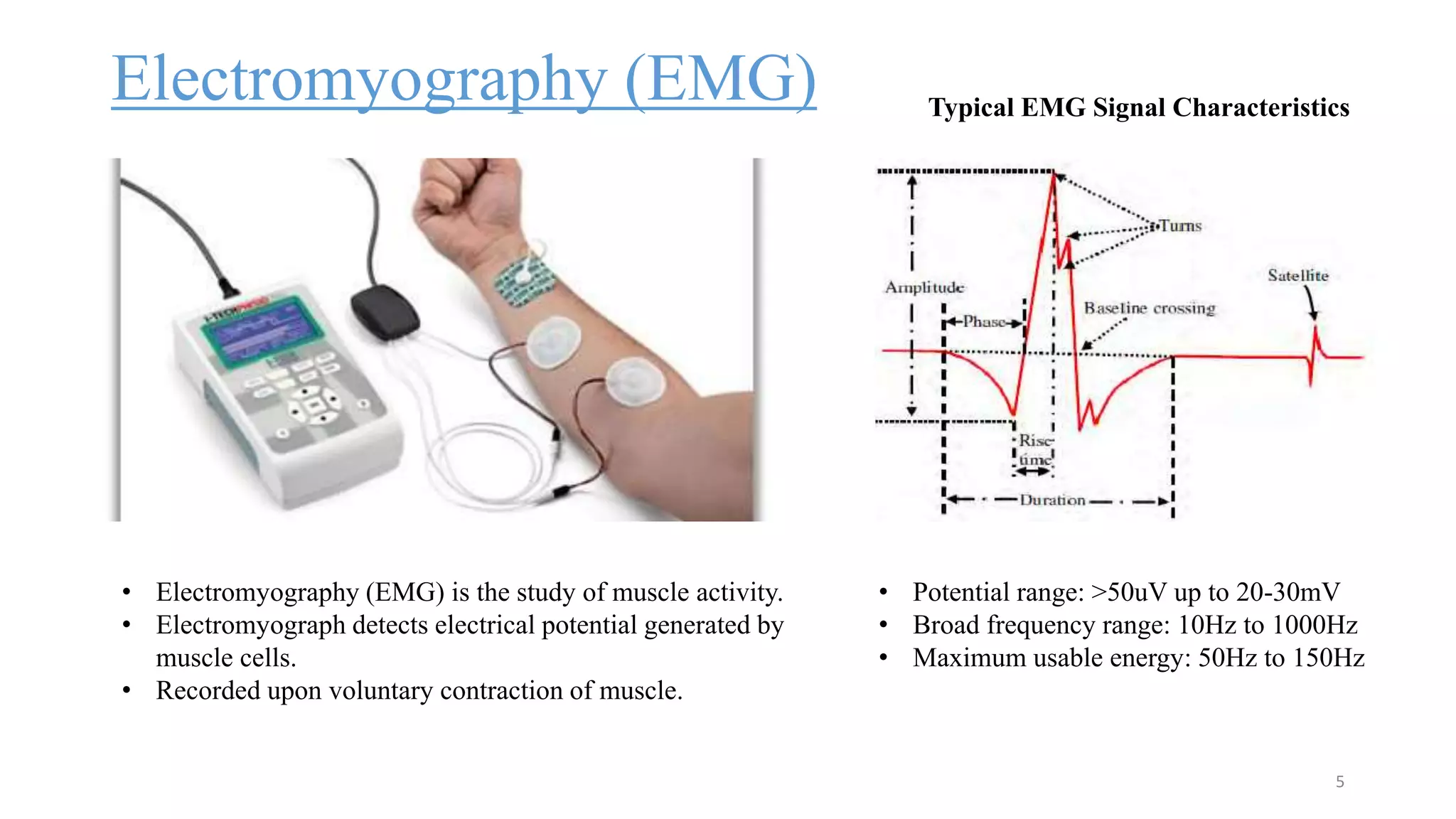
• Electromyography (EMG) is the study of muscle activity.
• Electromyograph detects electrical potential generated by
muscle cells.
• Recorded upon voluntary contraction of muscle.
• Potential range: >50uV up to 20-30mV
• Broad frequency range: 10Hz to 1000Hz
• Maximum usable energy: 50Hz to 150Hz
Typical EMG Signal Characteristics
Electromyography (Cont...)
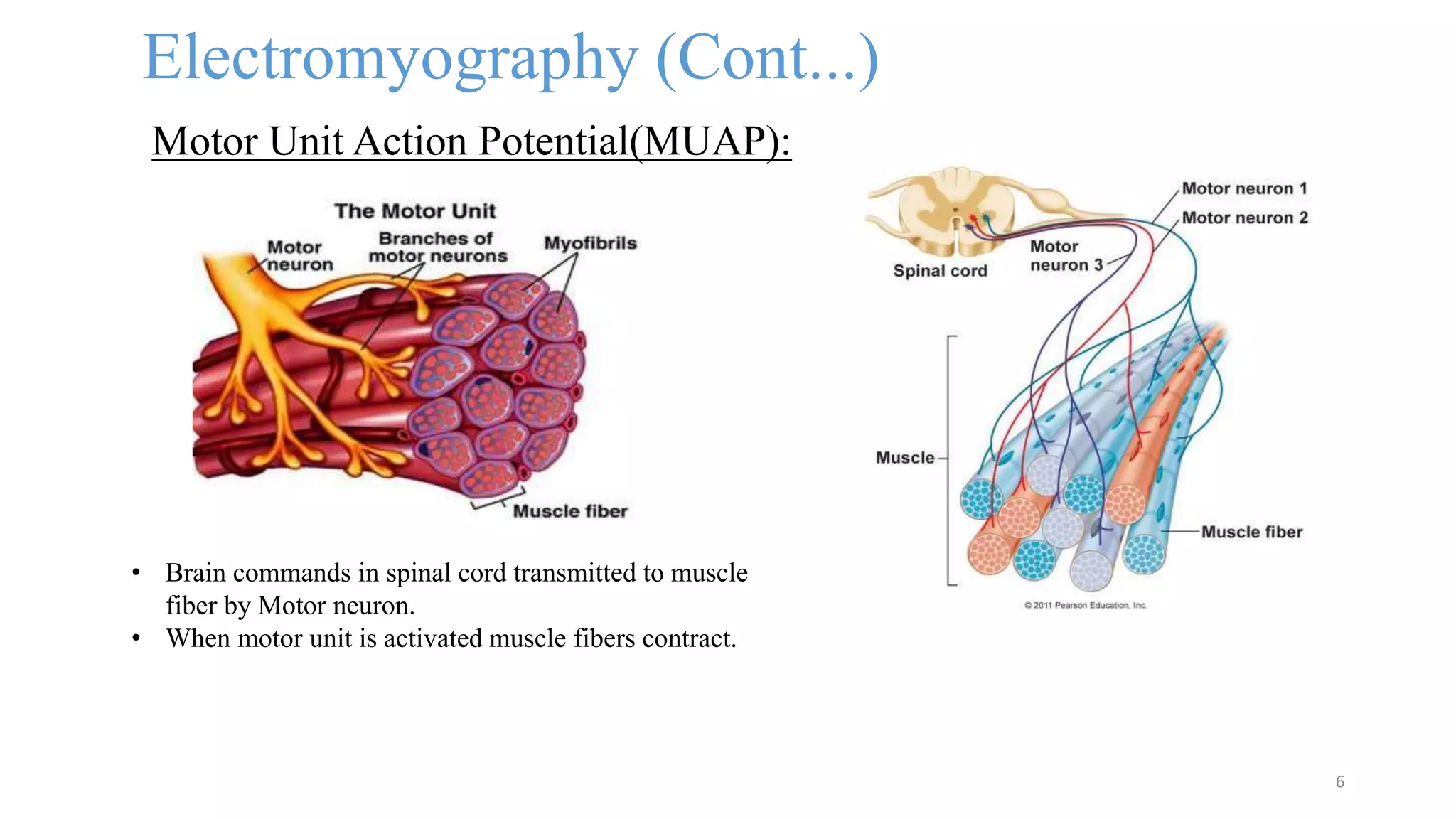
Motor Unit Action Potential(MUAP):
6
• Brain commands in spinal cord transmitted to muscle
fiber by Motor neuron.
• When motor unit is activated muscle fibers contract.
Currently Available Prosthetic Systems
7
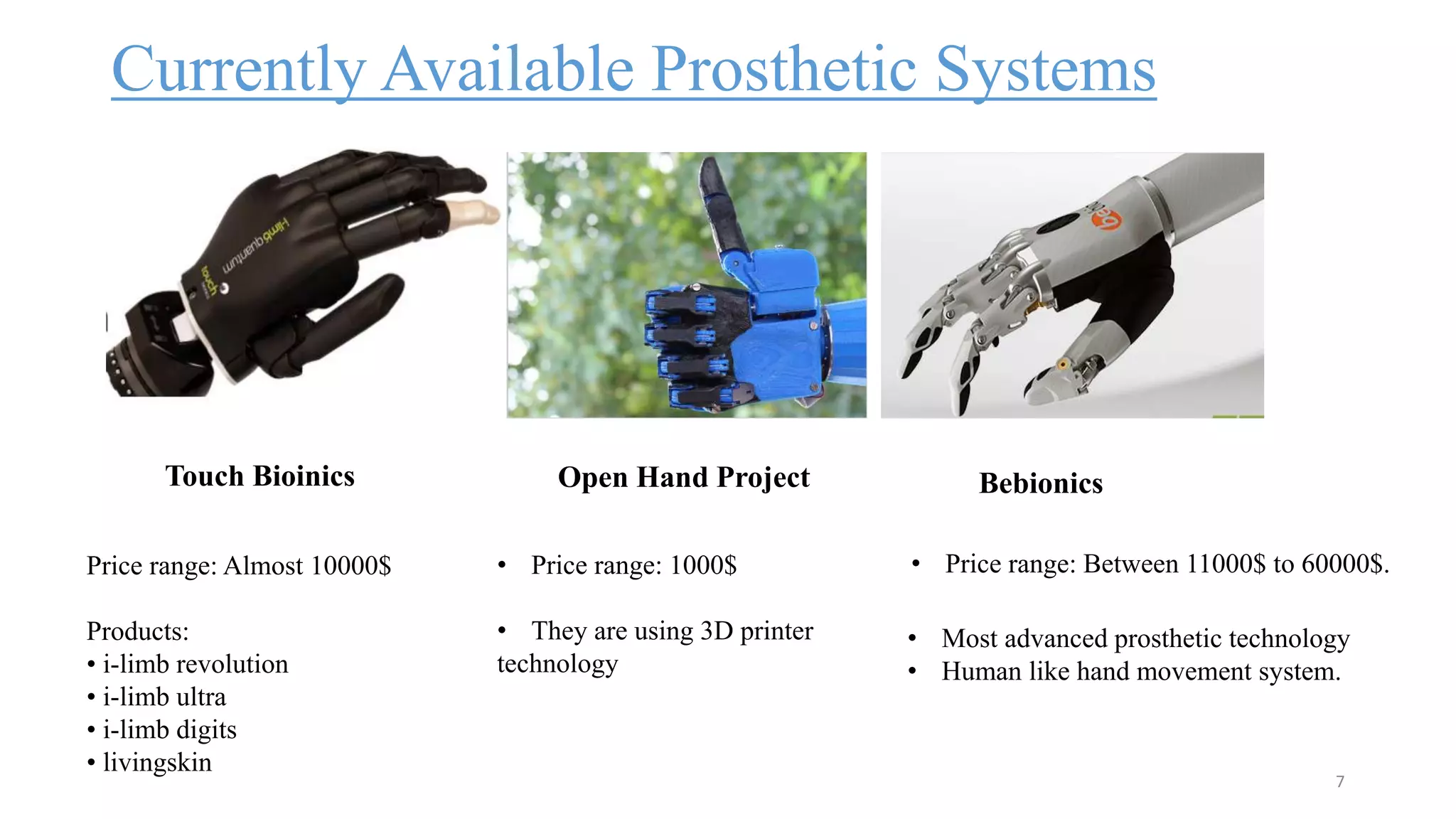
Touch Bioinics Open Hand Project Bebionics
Price range: Almost 10000$
Products:
• i-limb revolution
• i-limb ultra
• i-limb digits
• livingskin
• Price range: 1000$
• They are using 3D printer
technology
• Most advanced prosthetic technology
• Human like hand movement system.
• Price range: Between 11000$ to 60000$.
8
Proposed System
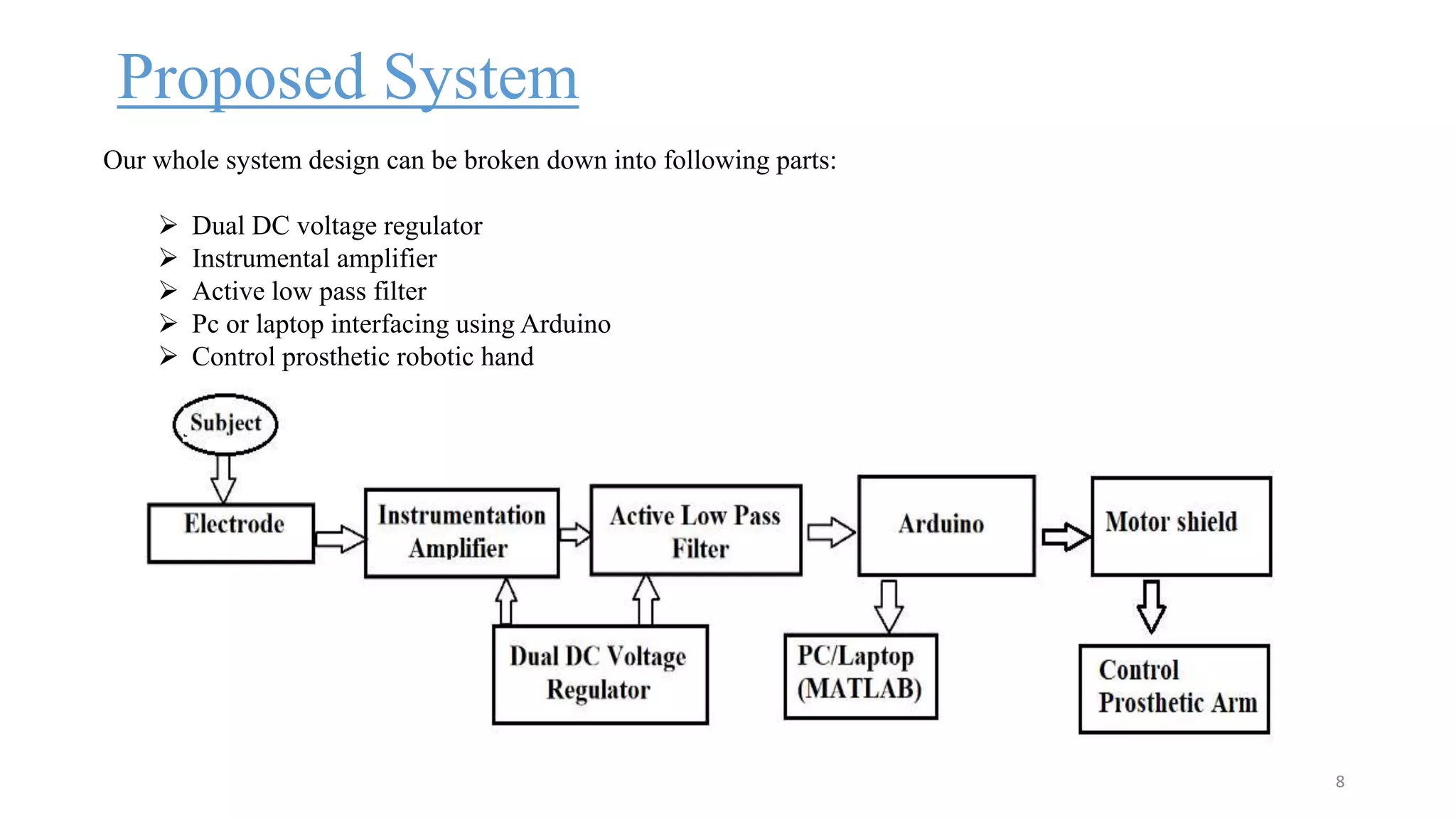
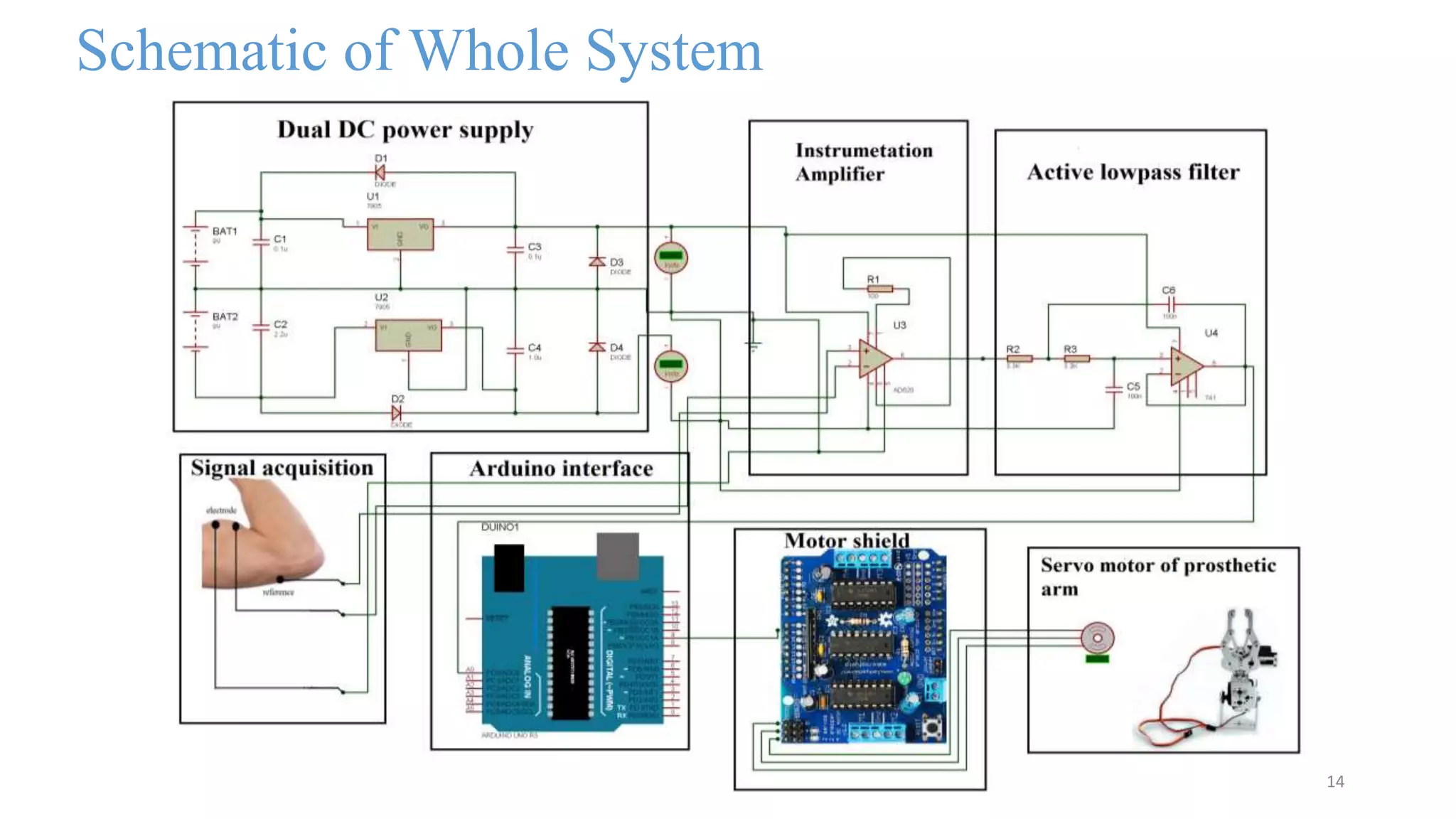
Our whole system design can be broken down into following parts:
 Dual DC voltage regulator
 Instrumental amplifier
 Active low pass filter
 Pc or laptop interfacing using Arduino
 Control prosthetic robotic hand
Electrodes
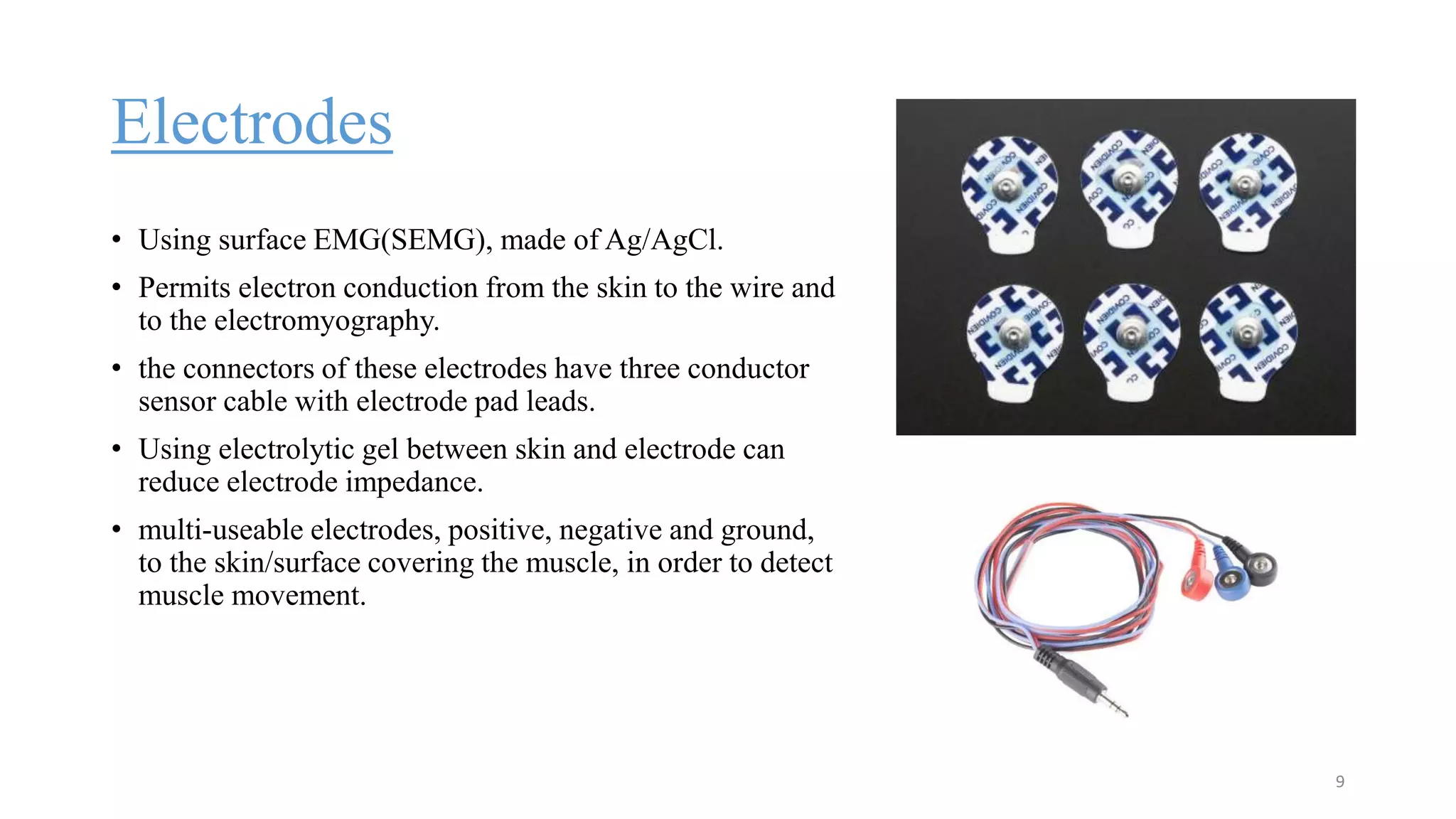
• Using surface EMG(SEMG), made of Ag/AgCl.
• Permits electron conduction from the skin to the wire and
to the electromyography.
• the connectors of these electrodes have three conductor
sensor cable with electrode pad leads.
• Using electrolytic gel between skin and electrode can
reduce electrode impedance.
• multi-useable electrodes, positive, negative and ground,
to the skin/surface covering the muscle, in order to detect
muscle movement.
9
Dual DC Voltage Regulator
10
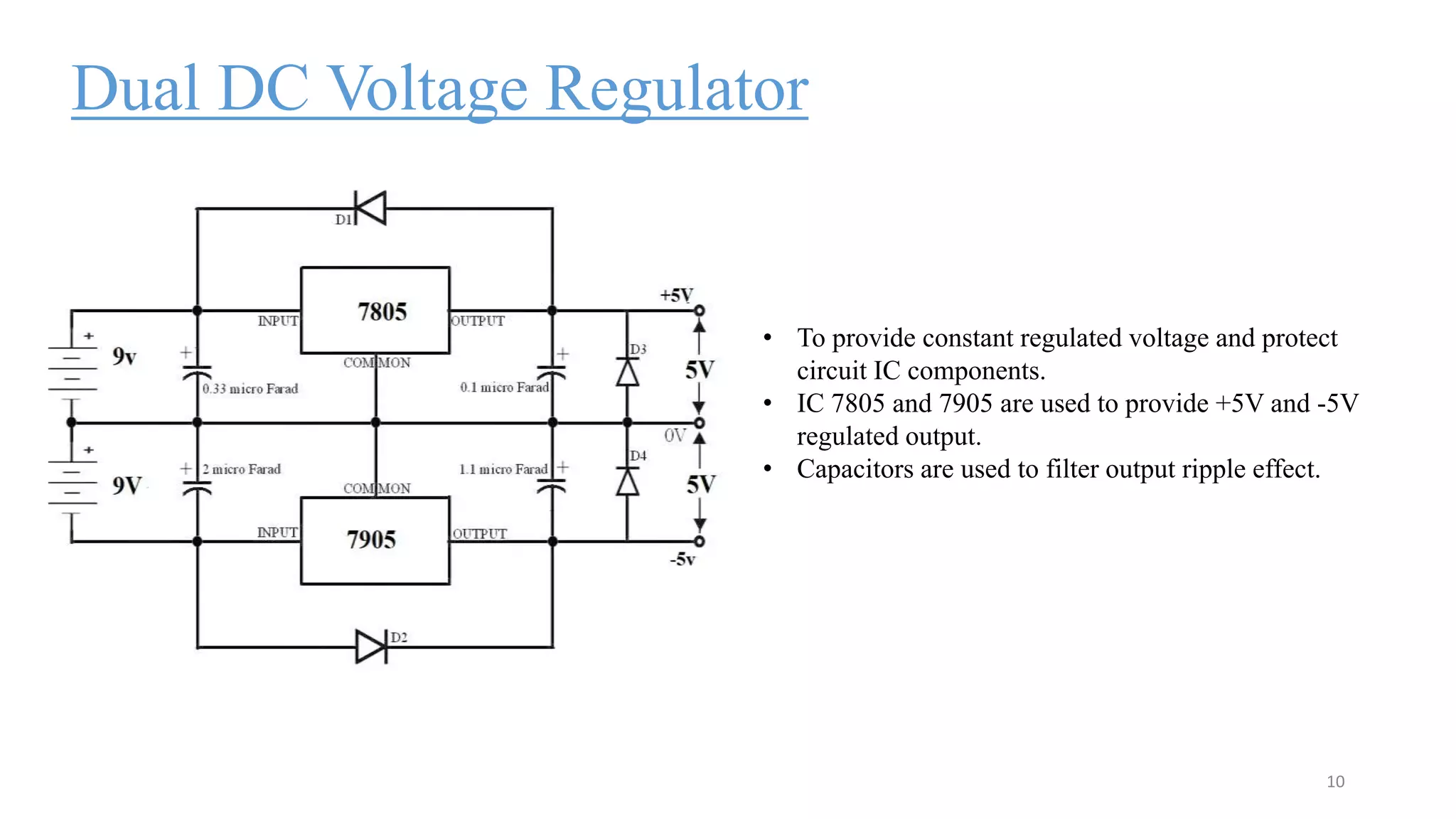
• To provide constant regulated voltage and protect
circuit IC components.
• IC 7805 and 7905 are used to provide +5V and -5V
regulated output.
• Capacitors are used to filter output ripple effect.
Instrumentation Amplifier
11
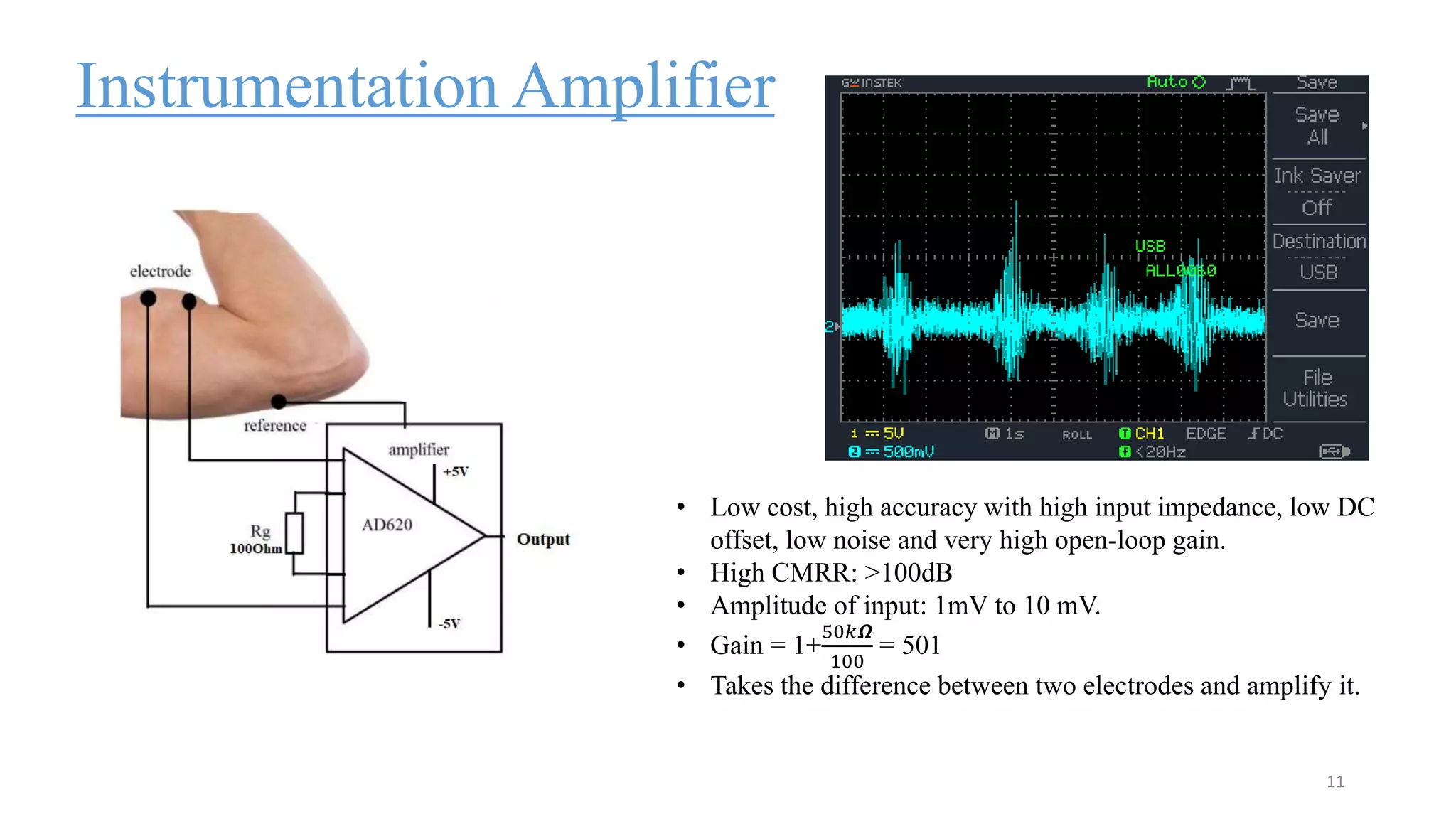
• Low cost, high accuracy with high input impedance, low DC
offset, low noise and very high open-loop gain.
• High CMRR: >100dB
• Amplitude of input: 1mV to 10 mV.
• Gain = 1+
50𝑘𝞨
100
= 501
• Takes the difference between two electrodes and amplify it.
Active Low-Pass Filter
12
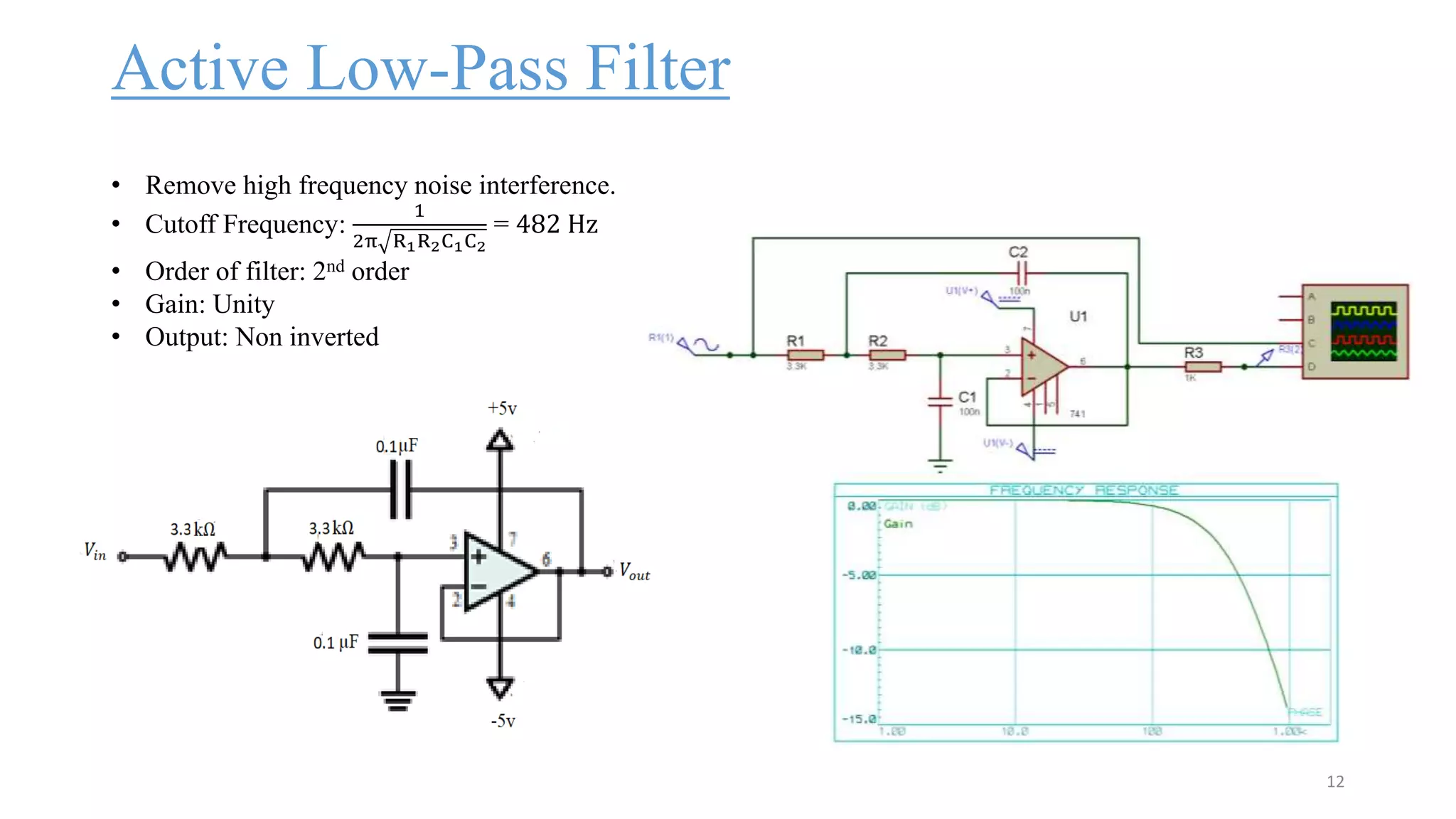
• Remove high frequency noise interference.
• Cutoff Frequency:
1
2π R1R2C1C2
= 482 Hz
• Order of filter: 2nd order
• Gain: Unity
• Output: Non inverted
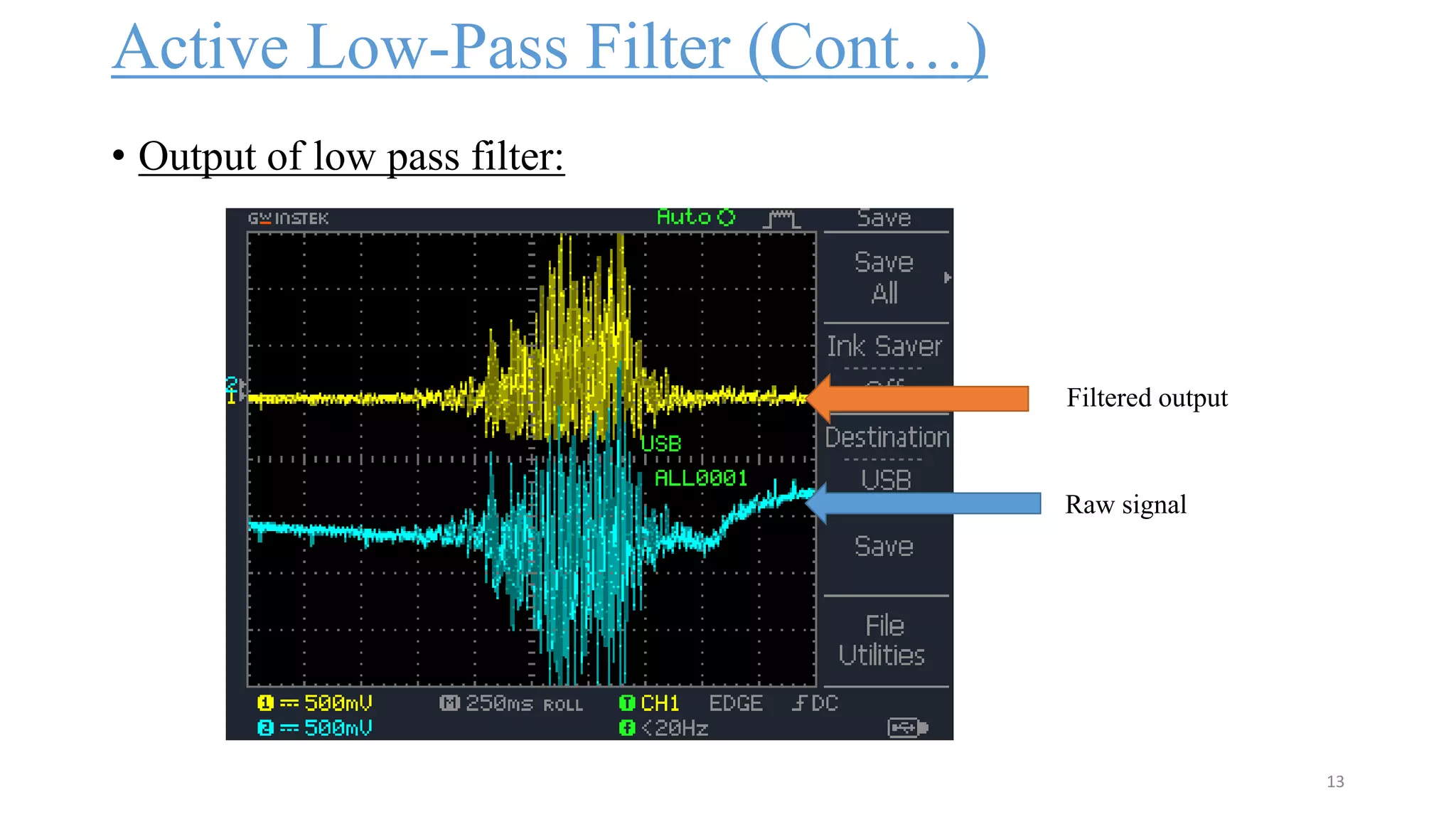
Active Low-Pass Filter (Cont…)
• Output of low pass filter:
13
Filtered output
Raw signal
Schematic of Whole System
14
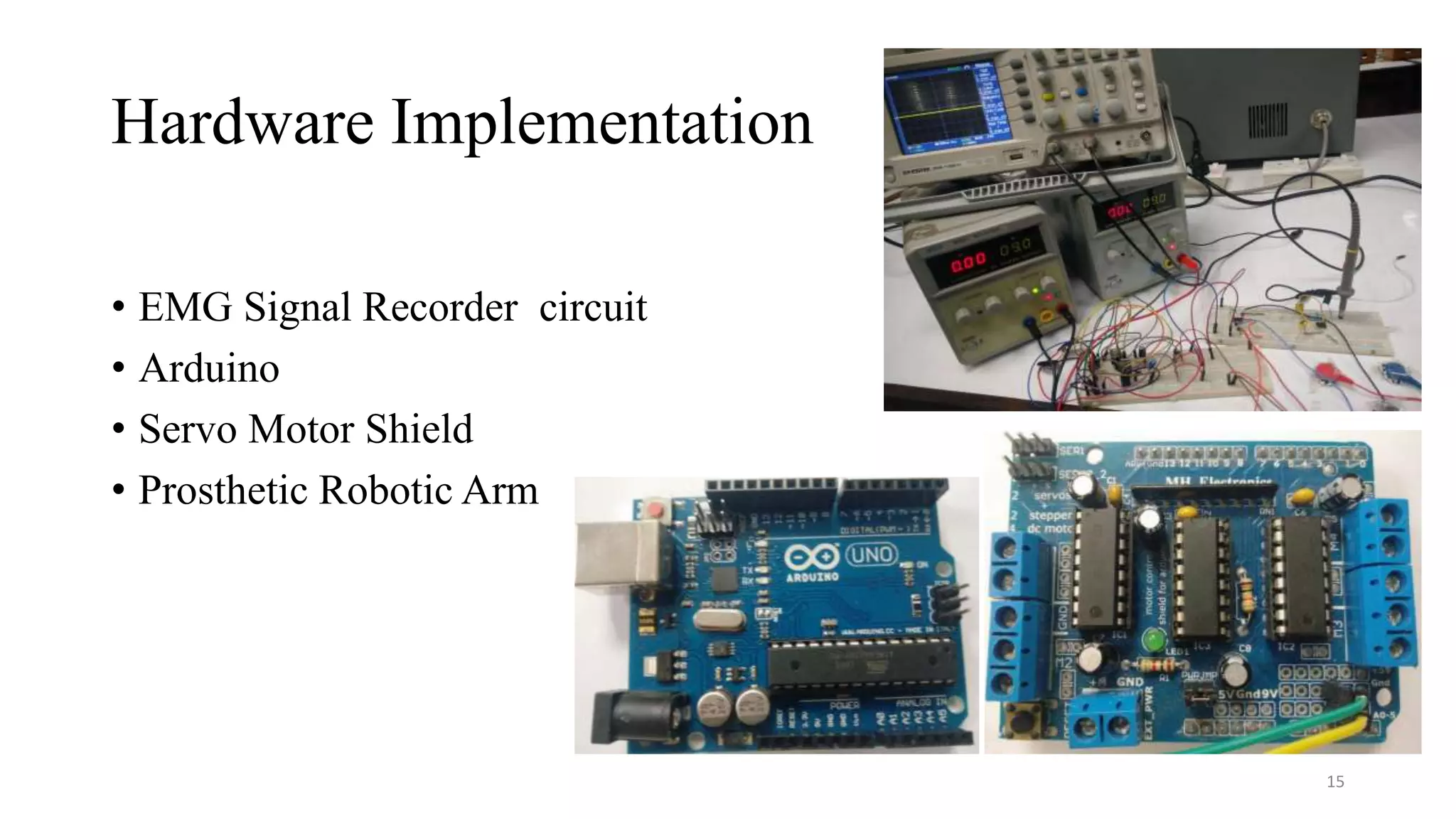
Hardware Implementation
• EMG Signal Recorder circuit
• Arduino
• Servo Motor Shield
• Prosthetic Robotic Arm
15
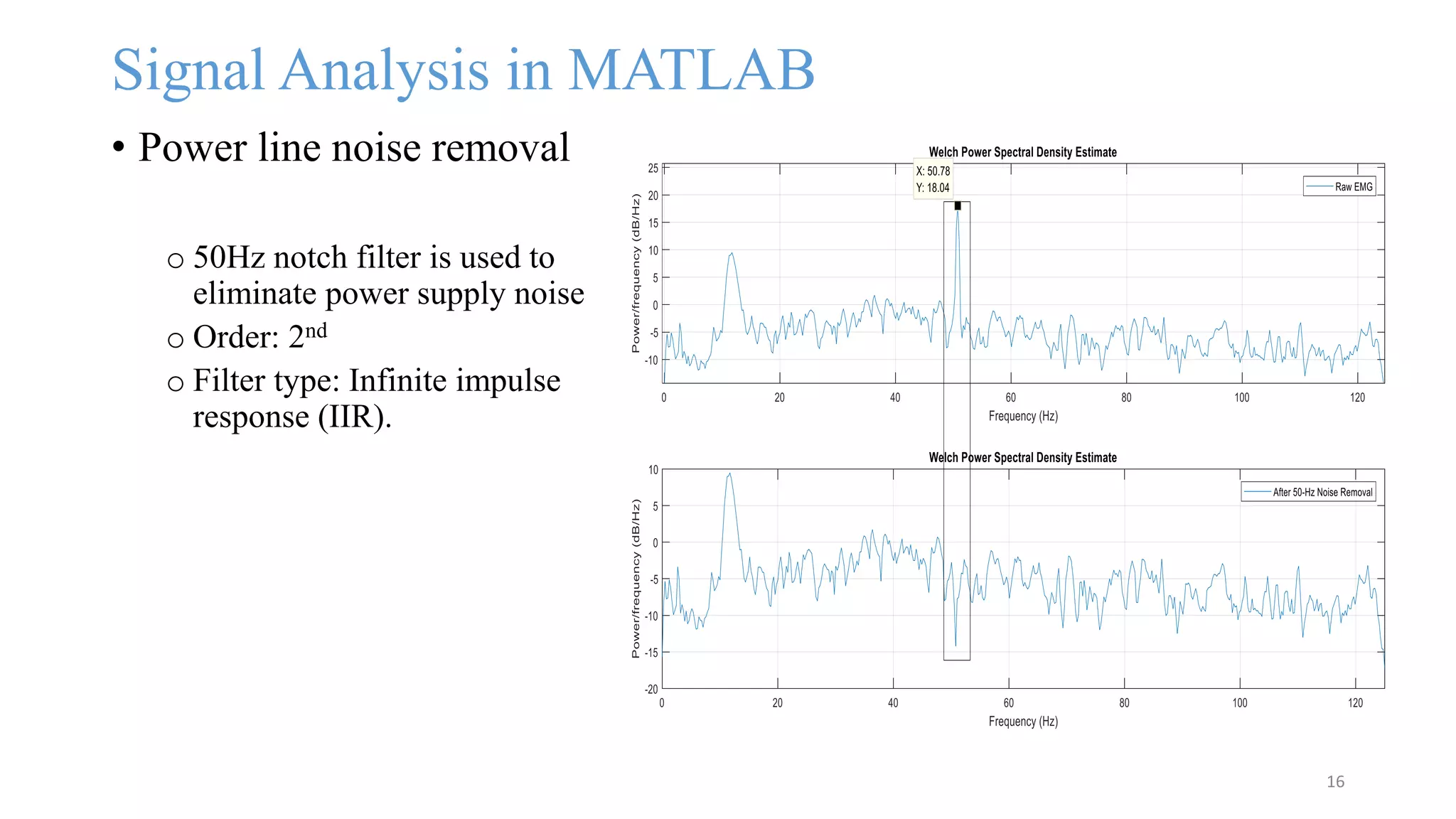
Signal Analysis in MATLAB
• Power line noise removal
o 50Hz notch filter is used to
eliminate power supply noise
o Order: 2nd
o Filter type: Infinite impulse
response (IIR).
16
Signal Analysis in MATLAB (Contd…)
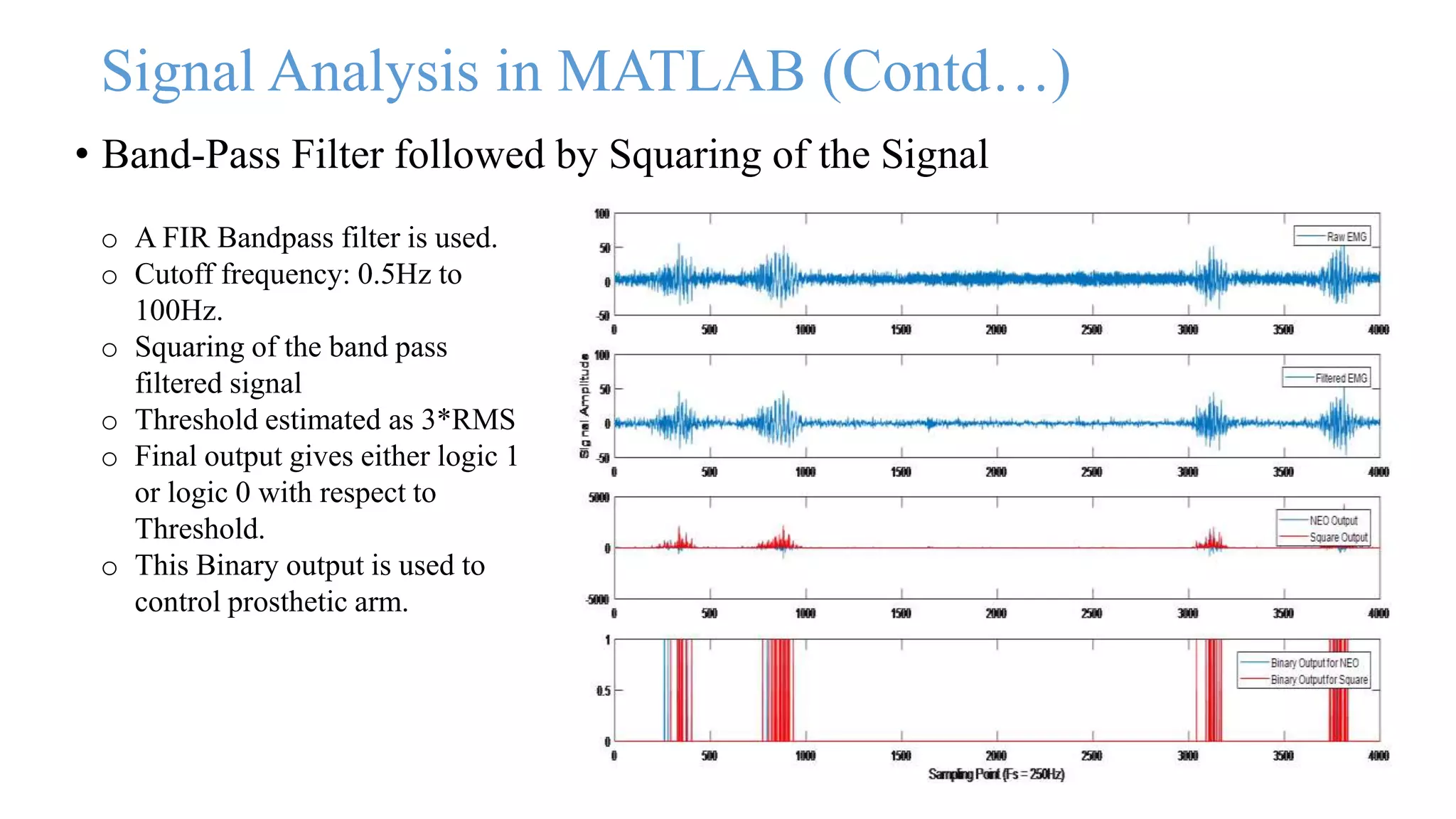
• Band-Pass Filter followed by Squaring of the Signal
17
o A FIR Bandpass filter is used.
o Cutoff frequency: 0.5Hz to
100Hz.
o Squaring of the band pass
filtered signal
o Threshold estimated as 3*RMS
o Final output gives either logic 1
or logic 0 with respect to
Threshold.
o This Binary output is used to
control prosthetic arm.
Accuracy Calculation
18
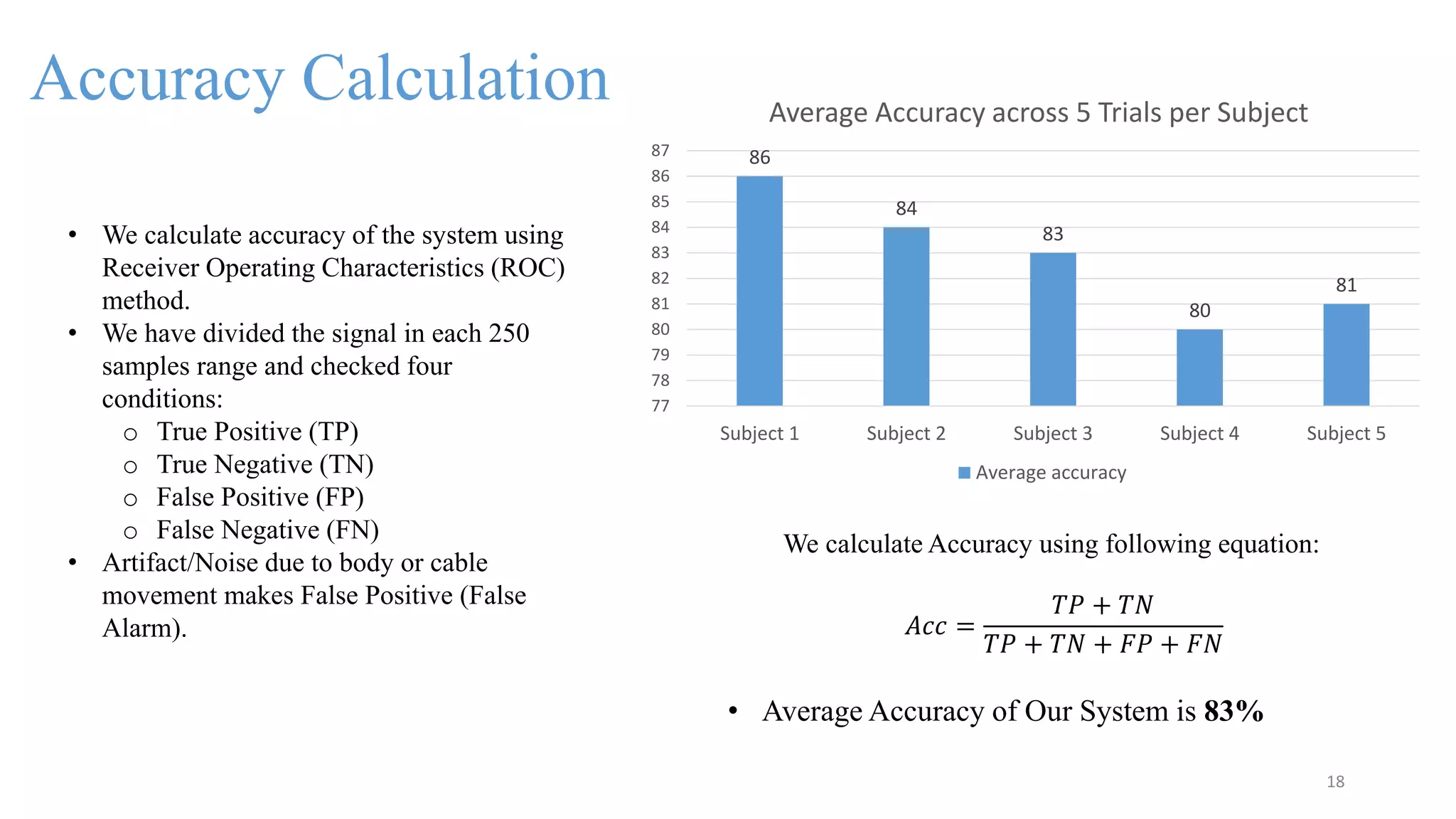
• We calculate accuracy of the system using
Receiver Operating Characteristics (ROC)
method.
• We have divided the signal in each 250
samples range and checked four
conditions:
o True Positive (TP)
o True Negative (TN)
o False Positive (FP)
o False Negative (FN)
• Artifact/Noise due to body or cable
movement makes False Positive (False
Alarm).
We calculate Accuracy using following equation:
𝐴𝑐𝑐 =
𝑇𝑃 + 𝑇𝑁
𝑇𝑃 + 𝑇𝑁 + 𝐹𝑃 + 𝐹𝑁
86
84
83
80
81
77
78
79
80
81
82
83
84
85
86
87
Subject 1 Subject 2 Subject 3 Subject 4 Subject 5
Average Accuracy across 5 Trials per Subject
Average accuracy
• Average Accuracy of Our System is 83%
Cost Analysis
19
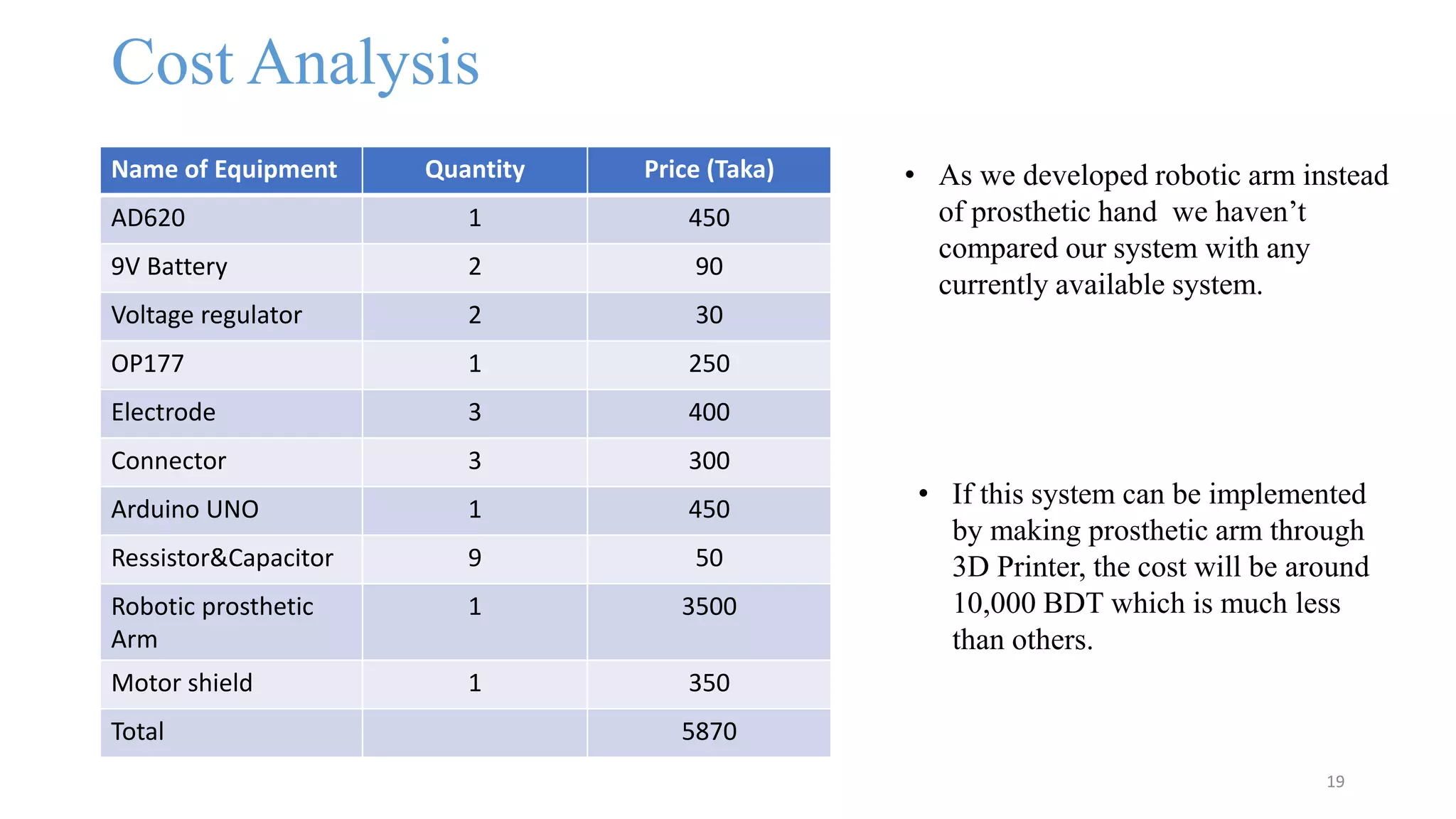
Name of Equipment Quantity Price (Taka)
AD620 1 450
9V Battery 2 90
Voltage regulator 2 30
OP177 1 250
Electrode 3 400
Connector 3 300
Arduino UNO 1 450
Ressistor&Capacitor 9 50
Robotic prosthetic
Arm
1 3500
Motor shield 1 350
Total 5870
• As we developed robotic arm instead
of prosthetic hand we haven’t
compared our system with any
currently available system.
• If this system can be implemented
by making prosthetic arm through
3D Printer, the cost will be around
10,000 BDT which is much less
than others.
Problem Faced/Limitations
• Very low signal amplitude (0 to 10mv)
• Internal and external noises:
o Inherent noise
o Motion artifact
o Electromagnetic noise
20
• Availability of affordable electrodes
• Limited usability of electrodes
• Making it portable
• Others
Conclusion
• The EMG recording and prosthetic system we developed are very cheap and can
be affordable for peoples in developing country like Bangladesh.
• We successfully digitally process the signal in MATLAB which can be used
further for any EMG based diagnosis.
21
Future Works
• 3D printed prosthetic hand.
• Controlling each finger movement.
• Convert the circuit into PCB
• Packaging the whole system.
22
23
Sample Video
References
24
Acknowledgement
• Nazmus Sakib and Md. Ahsan-Ul Kabir Shawon
• Lab officer and technician
25
Thank You!
26

Senior Project Student's Presentation on Design of EMG Signal Recording System

  • 1.
    Towards Design andImplementation of EMG Signal Recorder for Application in Prosthetic Arm Control Presented by Sagar Dakua (ID 1421658) Alamgir Kabir Rusad (ID 1421477) Supervised by Dr. Md. Kafiul Islam, Asst. Prof. 1 Senior Project Defense
  • 2.
    Outline Introduction • Motivation andObjectives • Electromyography (EMG) Basics • State-of-the-Art Prosthetic Systems Proposed System Design Hardware Implementation Signal Analysis in MATLAB Accuracy Calculation Problem Faced/Limitations Conclusion Future work 2
  • 3.
  • 4.
    Motivation and Objectives 0 1000 2000 3000 4000 5000 20092010 2011 2012 2013 2014 2015 2016 Road Accident Statistics in Bangladesh Number of accidents Death Injury 4 Motivation: • > 4000 people get injured in road accident every year and live without one or more body parts. • Rana plaza massacre and many other left many people cripple for life time. • Dependency on exported prosthesis. Goal: Provide an affordable solution of prosthetic limb for our country Objectives: • Design an Analog Frontend circuit to record the electrical activity of muscle (EMG). • Detect muscle contraction to generate a command signal • Use the command signal to control prosthetic arm.
  • 5.
    Electromyography (EMG) 5 • Electromyography(EMG) is the study of muscle activity. • Electromyograph detects electrical potential generated by muscle cells. • Recorded upon voluntary contraction of muscle. • Potential range: >50uV up to 20-30mV • Broad frequency range: 10Hz to 1000Hz • Maximum usable energy: 50Hz to 150Hz Typical EMG Signal Characteristics
  • 6.
    Electromyography (Cont...) Motor UnitAction Potential(MUAP): 6 • Brain commands in spinal cord transmitted to muscle fiber by Motor neuron. • When motor unit is activated muscle fibers contract.
  • 7.
    Currently Available ProstheticSystems 7 Touch Bioinics Open Hand Project Bebionics Price range: Almost 10000$ Products: • i-limb revolution • i-limb ultra • i-limb digits • livingskin • Price range: 1000$ • They are using 3D printer technology • Most advanced prosthetic technology • Human like hand movement system. • Price range: Between 11000$ to 60000$.
  • 8.
    8 Proposed System Our wholesystem design can be broken down into following parts:  Dual DC voltage regulator  Instrumental amplifier  Active low pass filter  Pc or laptop interfacing using Arduino  Control prosthetic robotic hand
  • 9.
    Electrodes • Using surfaceEMG(SEMG), made of Ag/AgCl. • Permits electron conduction from the skin to the wire and to the electromyography. • the connectors of these electrodes have three conductor sensor cable with electrode pad leads. • Using electrolytic gel between skin and electrode can reduce electrode impedance. • multi-useable electrodes, positive, negative and ground, to the skin/surface covering the muscle, in order to detect muscle movement. 9
  • 10.
    Dual DC VoltageRegulator 10 • To provide constant regulated voltage and protect circuit IC components. • IC 7805 and 7905 are used to provide +5V and -5V regulated output. • Capacitors are used to filter output ripple effect.
  • 11.
    Instrumentation Amplifier 11 • Lowcost, high accuracy with high input impedance, low DC offset, low noise and very high open-loop gain. • High CMRR: >100dB • Amplitude of input: 1mV to 10 mV. • Gain = 1+ 50𝑘𝞨 100 = 501 • Takes the difference between two electrodes and amplify it.
  • 12.
    Active Low-Pass Filter 12 •Remove high frequency noise interference. • Cutoff Frequency: 1 2π R1R2C1C2 = 482 Hz • Order of filter: 2nd order • Gain: Unity • Output: Non inverted
  • 13.
    Active Low-Pass Filter(Cont…) • Output of low pass filter: 13 Filtered output Raw signal
  • 14.
  • 15.
    Hardware Implementation • EMGSignal Recorder circuit • Arduino • Servo Motor Shield • Prosthetic Robotic Arm 15
  • 16.
    Signal Analysis inMATLAB • Power line noise removal o 50Hz notch filter is used to eliminate power supply noise o Order: 2nd o Filter type: Infinite impulse response (IIR). 16
  • 17.
    Signal Analysis inMATLAB (Contd…) • Band-Pass Filter followed by Squaring of the Signal 17 o A FIR Bandpass filter is used. o Cutoff frequency: 0.5Hz to 100Hz. o Squaring of the band pass filtered signal o Threshold estimated as 3*RMS o Final output gives either logic 1 or logic 0 with respect to Threshold. o This Binary output is used to control prosthetic arm.
  • 18.
    Accuracy Calculation 18 • Wecalculate accuracy of the system using Receiver Operating Characteristics (ROC) method. • We have divided the signal in each 250 samples range and checked four conditions: o True Positive (TP) o True Negative (TN) o False Positive (FP) o False Negative (FN) • Artifact/Noise due to body or cable movement makes False Positive (False Alarm). We calculate Accuracy using following equation: 𝐴𝑐𝑐 = 𝑇𝑃 + 𝑇𝑁 𝑇𝑃 + 𝑇𝑁 + 𝐹𝑃 + 𝐹𝑁 86 84 83 80 81 77 78 79 80 81 82 83 84 85 86 87 Subject 1 Subject 2 Subject 3 Subject 4 Subject 5 Average Accuracy across 5 Trials per Subject Average accuracy • Average Accuracy of Our System is 83%
  • 19.
    Cost Analysis 19 Name ofEquipment Quantity Price (Taka) AD620 1 450 9V Battery 2 90 Voltage regulator 2 30 OP177 1 250 Electrode 3 400 Connector 3 300 Arduino UNO 1 450 Ressistor&Capacitor 9 50 Robotic prosthetic Arm 1 3500 Motor shield 1 350 Total 5870 • As we developed robotic arm instead of prosthetic hand we haven’t compared our system with any currently available system. • If this system can be implemented by making prosthetic arm through 3D Printer, the cost will be around 10,000 BDT which is much less than others.
  • 20.
    Problem Faced/Limitations • Verylow signal amplitude (0 to 10mv) • Internal and external noises: o Inherent noise o Motion artifact o Electromagnetic noise 20 • Availability of affordable electrodes • Limited usability of electrodes • Making it portable • Others
  • 21.
    Conclusion • The EMGrecording and prosthetic system we developed are very cheap and can be affordable for peoples in developing country like Bangladesh. • We successfully digitally process the signal in MATLAB which can be used further for any EMG based diagnosis. 21
  • 22.
    Future Works • 3Dprinted prosthetic hand. • Controlling each finger movement. • Convert the circuit into PCB • Packaging the whole system. 22
  • 23.
  • 24.
  • 25.
    Acknowledgement • Nazmus Sakiband Md. Ahsan-Ul Kabir Shawon • Lab officer and technician 25
  • 26.