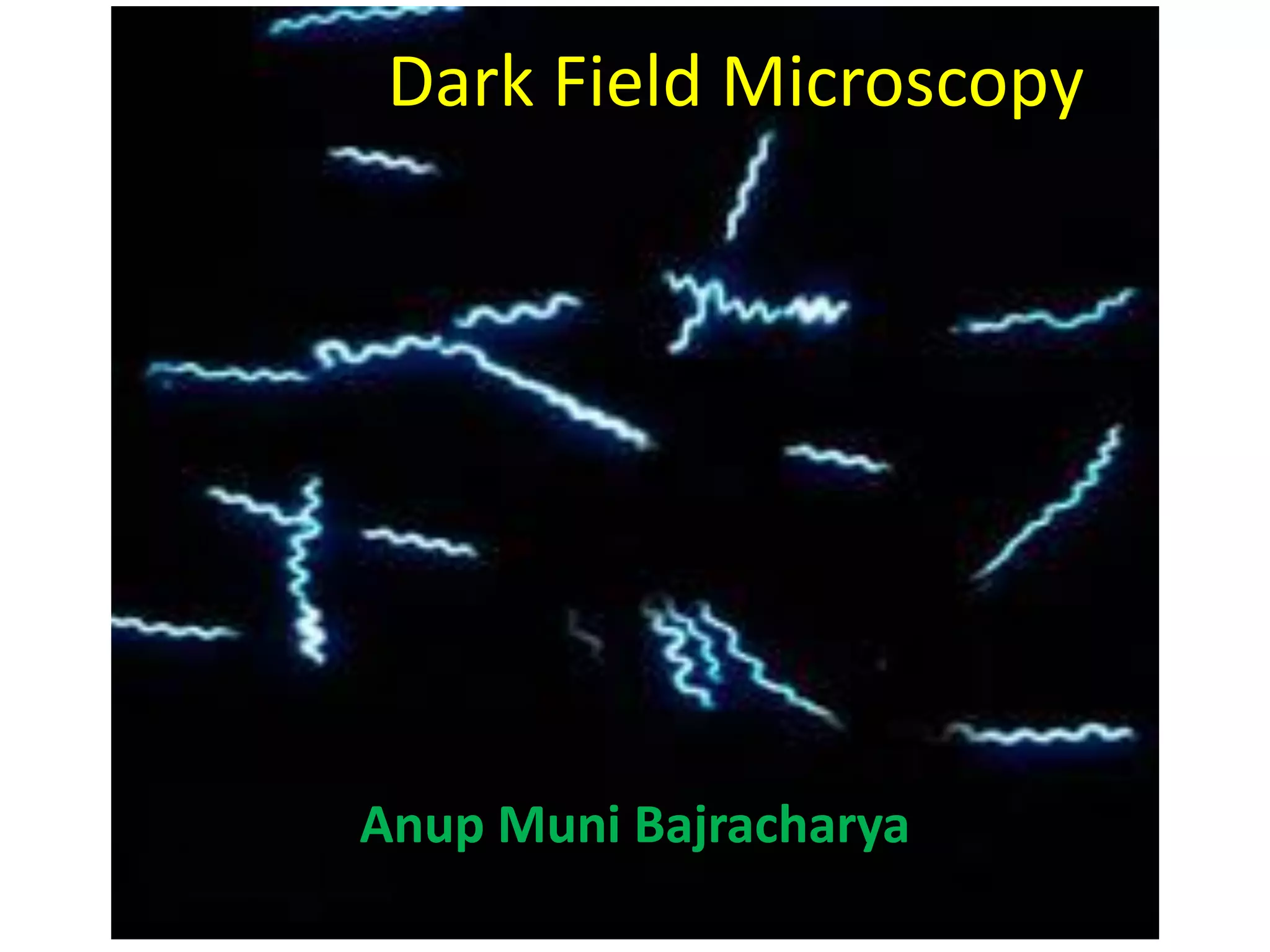
Dark Field Microscopy
Anup Muni Bajracharya
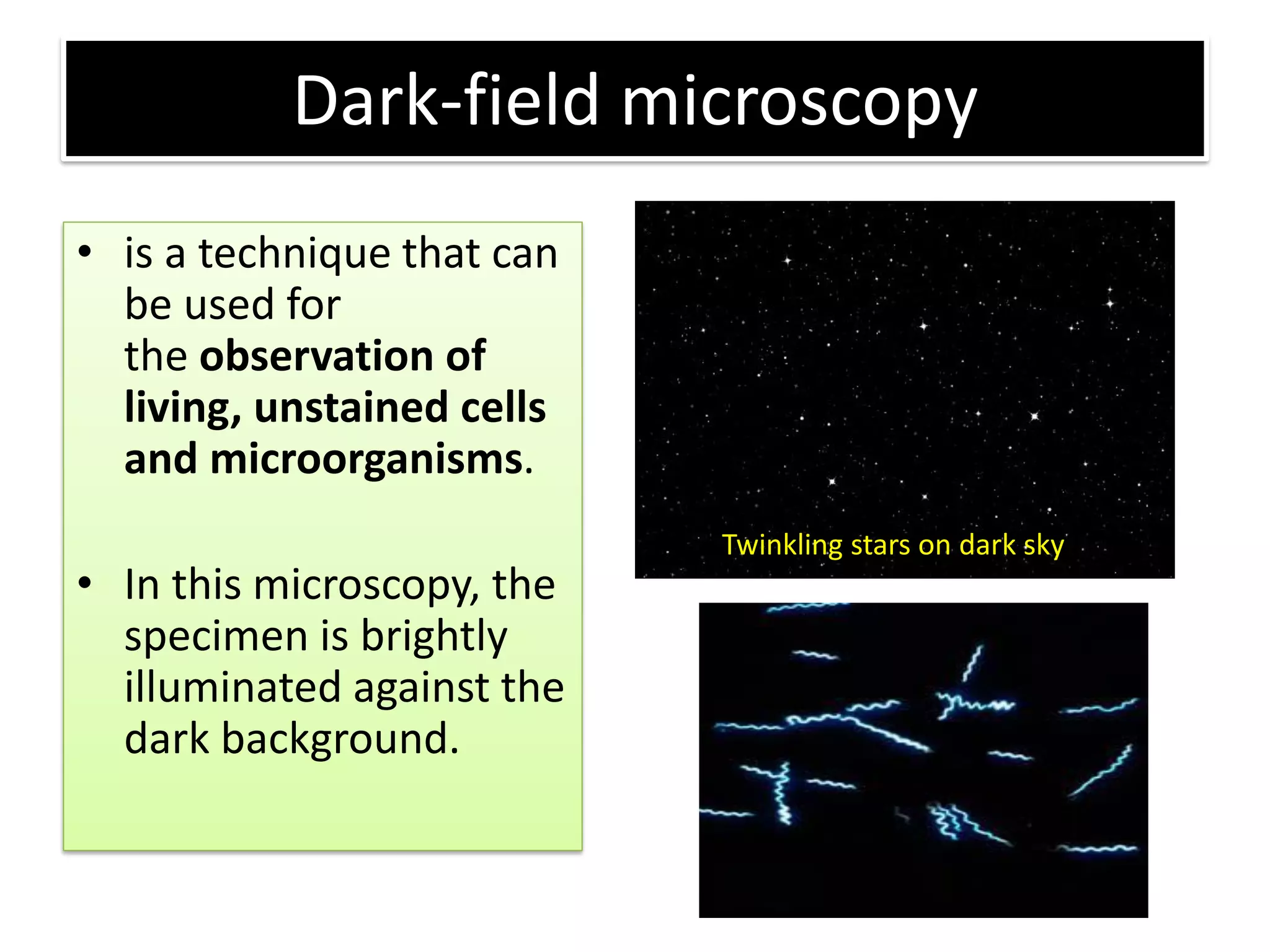
Dark-field microscopy
• is a technique that can
be used for
the observation of
living, unstained cells
and microorganisms.
• In this microscopy, the
specimen is brightly
illuminated against the
dark background.
Twinkling stars on dark sky
History
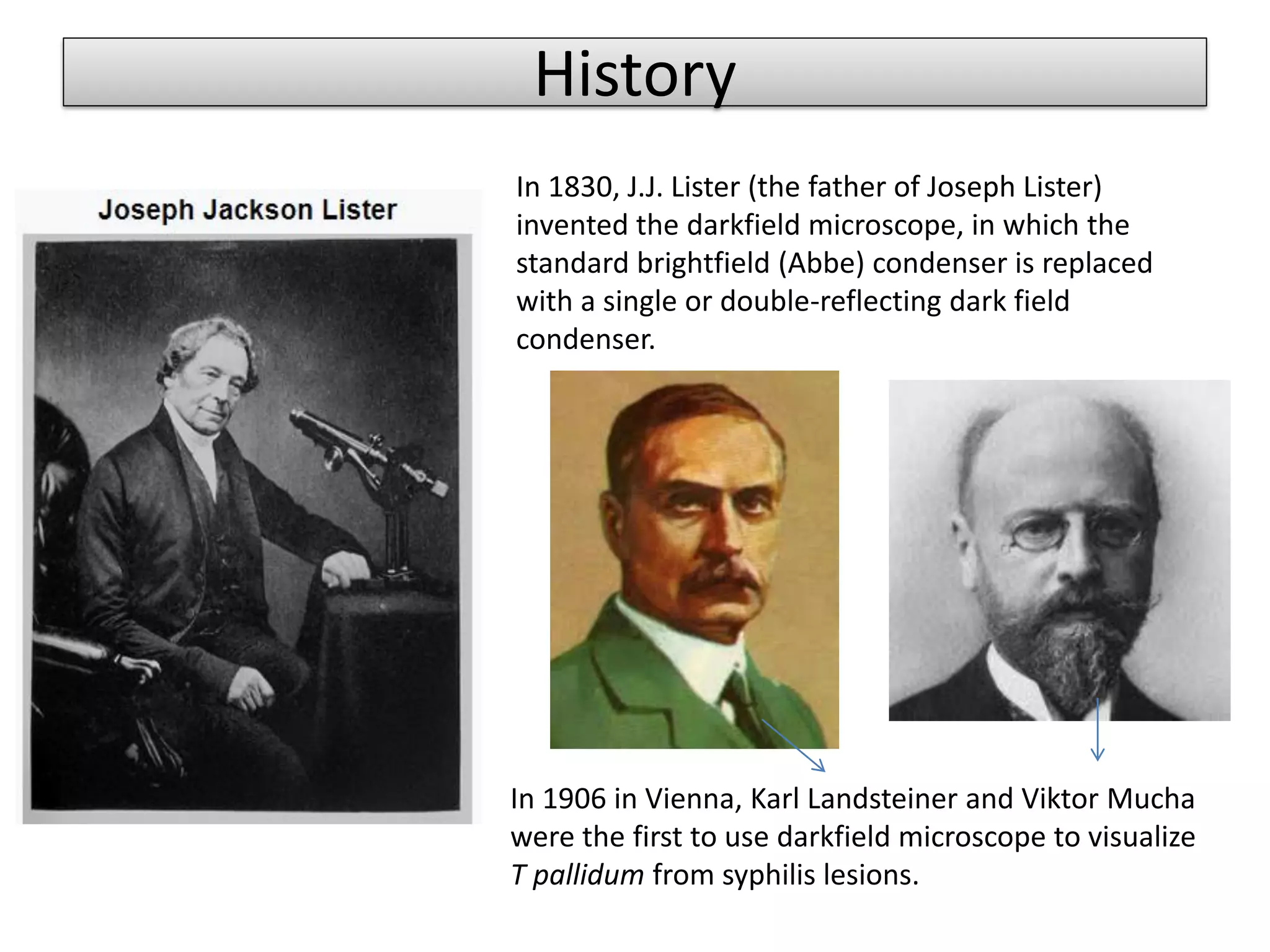
In 1906 in Vienna, Karl Landsteiner and Viktor Mucha
were the first to use darkfield microscope to visualize
T pallidum from syphilis lesions.
In 1830, J.J. Lister (the father of Joseph Lister)
invented the darkfield microscope, in which the
standard brightfield (Abbe) condenser is replaced
with a single or double-reflecting dark field
condenser.
Working Principle
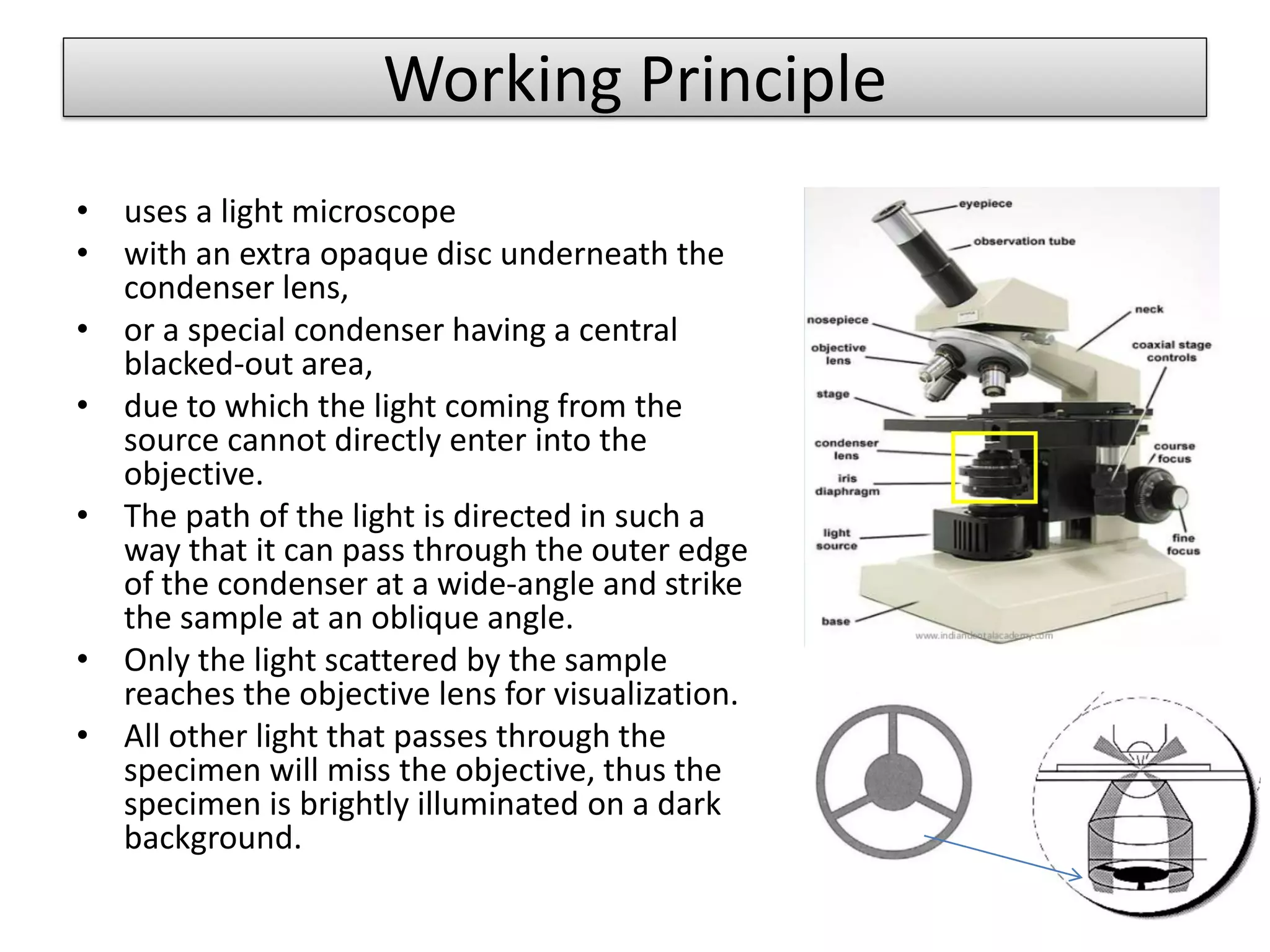
• uses a light microscope
• with an extra opaque disc underneath the
condenser lens,
• or a special condenser having a central
blacked-out area,
• due to which the light coming from the
source cannot directly enter into the
objective.
• The path of the light is directed in such a
way that it can pass through the outer edge
of the condenser at a wide-angle and strike
the sample at an oblique angle.
• Only the light scattered by the sample
reaches the objective lens for visualization.
• All other light that passes through the
specimen will miss the objective, thus the
specimen is brightly illuminated on a dark
background.
Principle of Dark field Microscopy
The light's path
• The steps are illustrated in the figure where
an inverted microscope is used.
• Light enters the microscope for
illumination of the sample.
• A specially sized disc, the patch stop, blocks
some light from the light source, leaving an
outer ring of illumination.
• The condenser lens focuses the light
towards the sample.
• The light enters the sample. Most is
directly transmitted, while some is
scattered from the sample.
• The scattered light enters the objective
lens, while the directly transmitted
light simply misses the lens and is not
collected due to a direct-illumination
block .
• Only the scattered light goes on to produce
the image, while the directly transmitted
light is omitted.
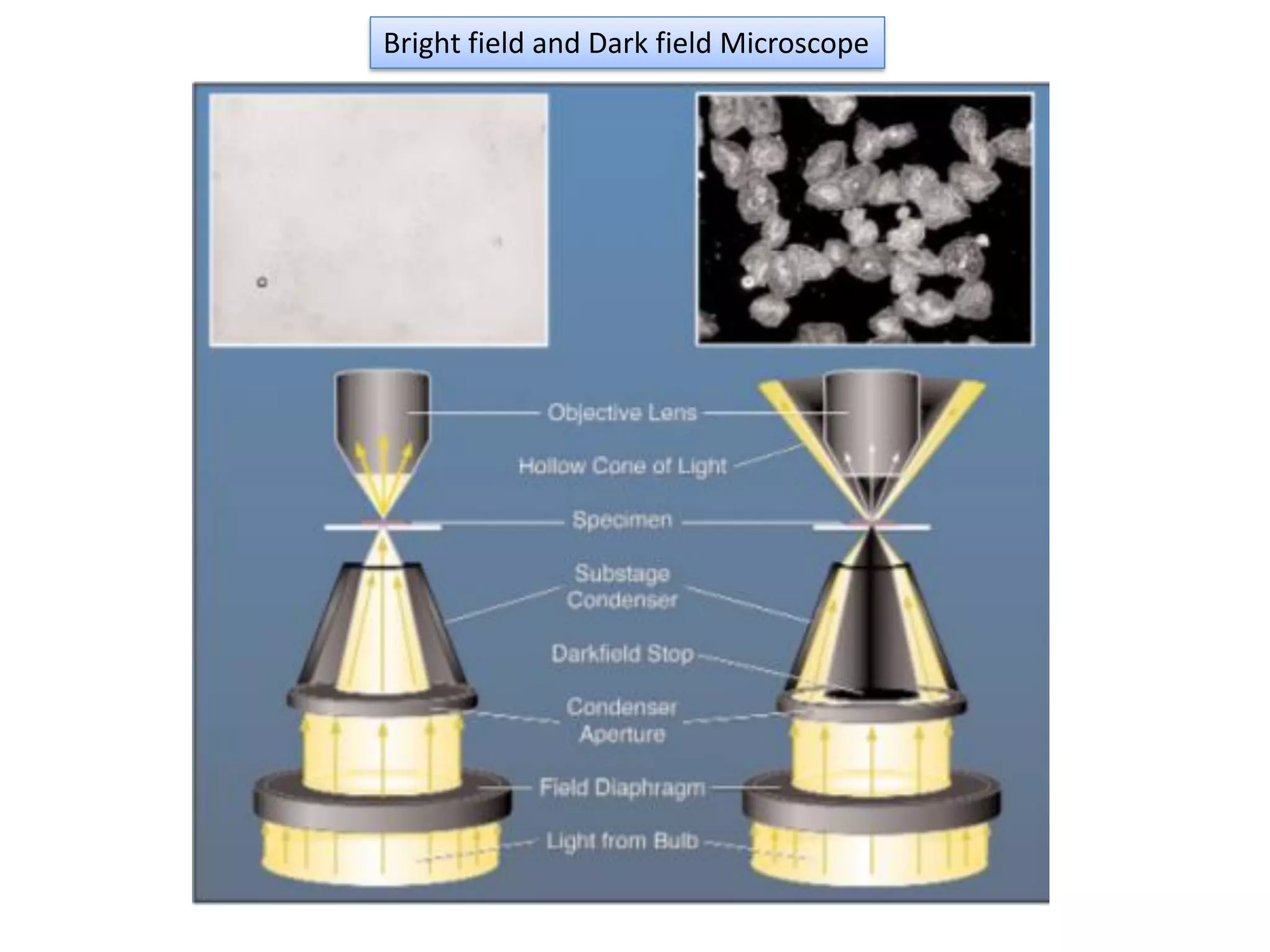
Bright field and Dark field Microscope
Uses of Dark-Field Microscopy
 Visualization of
• spirochetes such as Treponema pallidum (syphilis),
• Borrelia burgdorferi (lyme borreliosis) and
• Leptospira interrogans (leptospirosis)
 Observation of microbial motility; tufts of bacterial
flagella can often be seen in unstained cells by dark-field
or phase-contrast microscopy
 Observation of internal structure in larger eukaryotic
microorganisms such as algae, yeasts, etc.
is employed particularly for the examination of ‘living microbes’ which
are either invisible in the ordinary light microscope i.e., cannot be
properly stained by standard methods, or get distorted to a great
extent after due staining that their characteristic features may not be
identified satisfactorily.
Spirochetes
Leptospira
Treponema
Borrelia
Advantages of Dark-Field Microscopy
• Resolution by dark-field microscopy is
somewhat better than bright-field microscopy
• Improves image contrast without the use of
stain, and thus do not kill cells.
• No sample preparation is required
• Requires no special set up, even a light
microscope can be converted to dark field.
Limitations of Dark-Field Microscopy
• Besides the sample, dust particles also scatter the light
and appear bright.
• Glass slides need to be thoroughly cleaned of
extraneous dust and dirt.
• The sample must be very strongly illuminated, which
can cause damage to the sample.
• Sample material needs to be spread thinly, dense
preparations can grossly affect the contrast and
accuracy of the dark field’s image.
• Necessity to examine wet, moist specimens containing
living organisms very quickly, because visualization of
the moving bacteria is essential to detection.
Any Queries???
Anup Muni Bajracharya

Dark field microscopy

  • 1.
  • 2.
    Dark-field microscopy • isa technique that can be used for the observation of living, unstained cells and microorganisms. • In this microscopy, the specimen is brightly illuminated against the dark background. Twinkling stars on dark sky
  • 3.
    History In 1906 inVienna, Karl Landsteiner and Viktor Mucha were the first to use darkfield microscope to visualize T pallidum from syphilis lesions. In 1830, J.J. Lister (the father of Joseph Lister) invented the darkfield microscope, in which the standard brightfield (Abbe) condenser is replaced with a single or double-reflecting dark field condenser.
  • 4.
    Working Principle • usesa light microscope • with an extra opaque disc underneath the condenser lens, • or a special condenser having a central blacked-out area, • due to which the light coming from the source cannot directly enter into the objective. • The path of the light is directed in such a way that it can pass through the outer edge of the condenser at a wide-angle and strike the sample at an oblique angle. • Only the light scattered by the sample reaches the objective lens for visualization. • All other light that passes through the specimen will miss the objective, thus the specimen is brightly illuminated on a dark background.
  • 5.
    Principle of Darkfield Microscopy
  • 6.
    The light's path •The steps are illustrated in the figure where an inverted microscope is used. • Light enters the microscope for illumination of the sample. • A specially sized disc, the patch stop, blocks some light from the light source, leaving an outer ring of illumination. • The condenser lens focuses the light towards the sample. • The light enters the sample. Most is directly transmitted, while some is scattered from the sample. • The scattered light enters the objective lens, while the directly transmitted light simply misses the lens and is not collected due to a direct-illumination block . • Only the scattered light goes on to produce the image, while the directly transmitted light is omitted.
  • 7.
    Bright field andDark field Microscope
  • 8.
    Uses of Dark-FieldMicroscopy  Visualization of • spirochetes such as Treponema pallidum (syphilis), • Borrelia burgdorferi (lyme borreliosis) and • Leptospira interrogans (leptospirosis)  Observation of microbial motility; tufts of bacterial flagella can often be seen in unstained cells by dark-field or phase-contrast microscopy  Observation of internal structure in larger eukaryotic microorganisms such as algae, yeasts, etc. is employed particularly for the examination of ‘living microbes’ which are either invisible in the ordinary light microscope i.e., cannot be properly stained by standard methods, or get distorted to a great extent after due staining that their characteristic features may not be identified satisfactorily.
  • 9.
  • 10.
    Advantages of Dark-FieldMicroscopy • Resolution by dark-field microscopy is somewhat better than bright-field microscopy • Improves image contrast without the use of stain, and thus do not kill cells. • No sample preparation is required • Requires no special set up, even a light microscope can be converted to dark field.
  • 11.
    Limitations of Dark-FieldMicroscopy • Besides the sample, dust particles also scatter the light and appear bright. • Glass slides need to be thoroughly cleaned of extraneous dust and dirt. • The sample must be very strongly illuminated, which can cause damage to the sample. • Sample material needs to be spread thinly, dense preparations can grossly affect the contrast and accuracy of the dark field’s image. • Necessity to examine wet, moist specimens containing living organisms very quickly, because visualization of the moving bacteria is essential to detection.
  • 12.