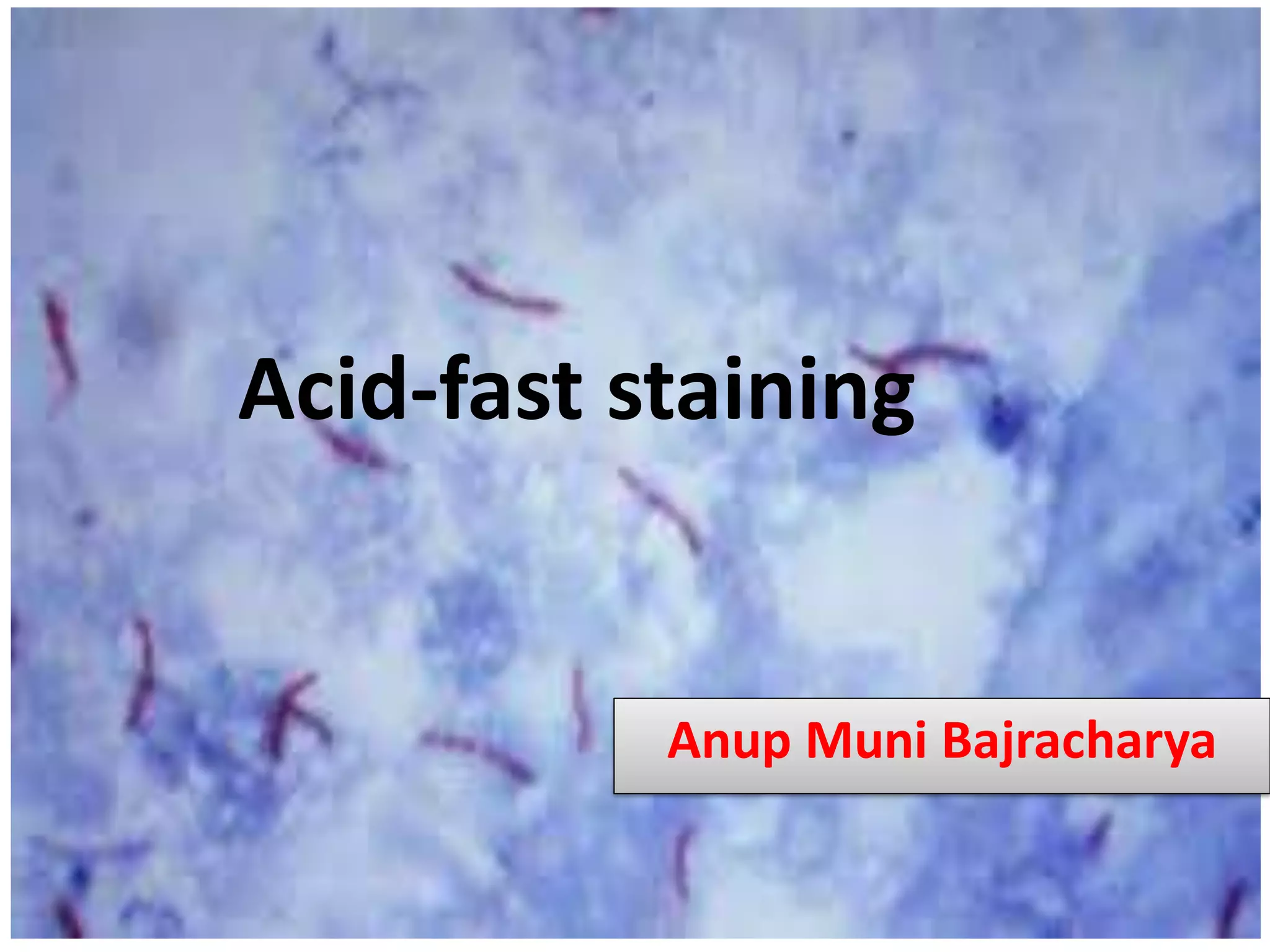
Acid-fast staining
Anup Muni Bajracharya
Acid-fast staining
• is a differential staining
• used to differentiate acid fast and non acid fast bacteria.
• used to identify acid-fast organisms such as members of
the genus Mycobacterium .
• also known as Ziehl-Neelsen method
• first introduced by Paul Ehrlich later modified by two
German doctors bacteriologist Franz Ziehl (1859–1926)
and the pathologist Friedrich Neelsen (1854–1898).
A.B
History
• In 1882 Robert Koch discovered the etiology of tuberculosis.
• Soon after Koch’s discovery, Paul Ehrlich developed a stain for
mycobacterium tuberculosis, called the alum hematoxylin stain.
• Franz Ziehl then altered Ehrlich’s staining technique by using
carbolic acid as the mordant.
• Friedrich Neelsen kept Ziehl’s choice of mordant but changed the
primary stain to carbol fuchsin.
• Ziehl and Neelsen’s modifications together have developed the
Ziehl-Neelsen stain.
• Another acid-fast satin was developed by Joseph Kinyoun by using
the Ziehl-Neelsen staining technique but removing the heating step
from the procedure.
• This new stain from Kinyoun was named the Kinyoun stain.
A.B
What are acid fast bacteria?
• those which have a high content of mycolic acids in
their cell walls.
• are characterized by
• wax-like, nearly impermeable cell walls;
• contain mycolic acid and large amounts of fatty acids,
waxes, and complex lipids.
• are highly resistant to disinfectants and dry conditions.
• Due to their waxy cell wall components,
Mycobacterium are acid fast; that is, they retain the
red dye, carbol fuchsin, after rinsing with acid solvents.
A.B
Acid fast organisms
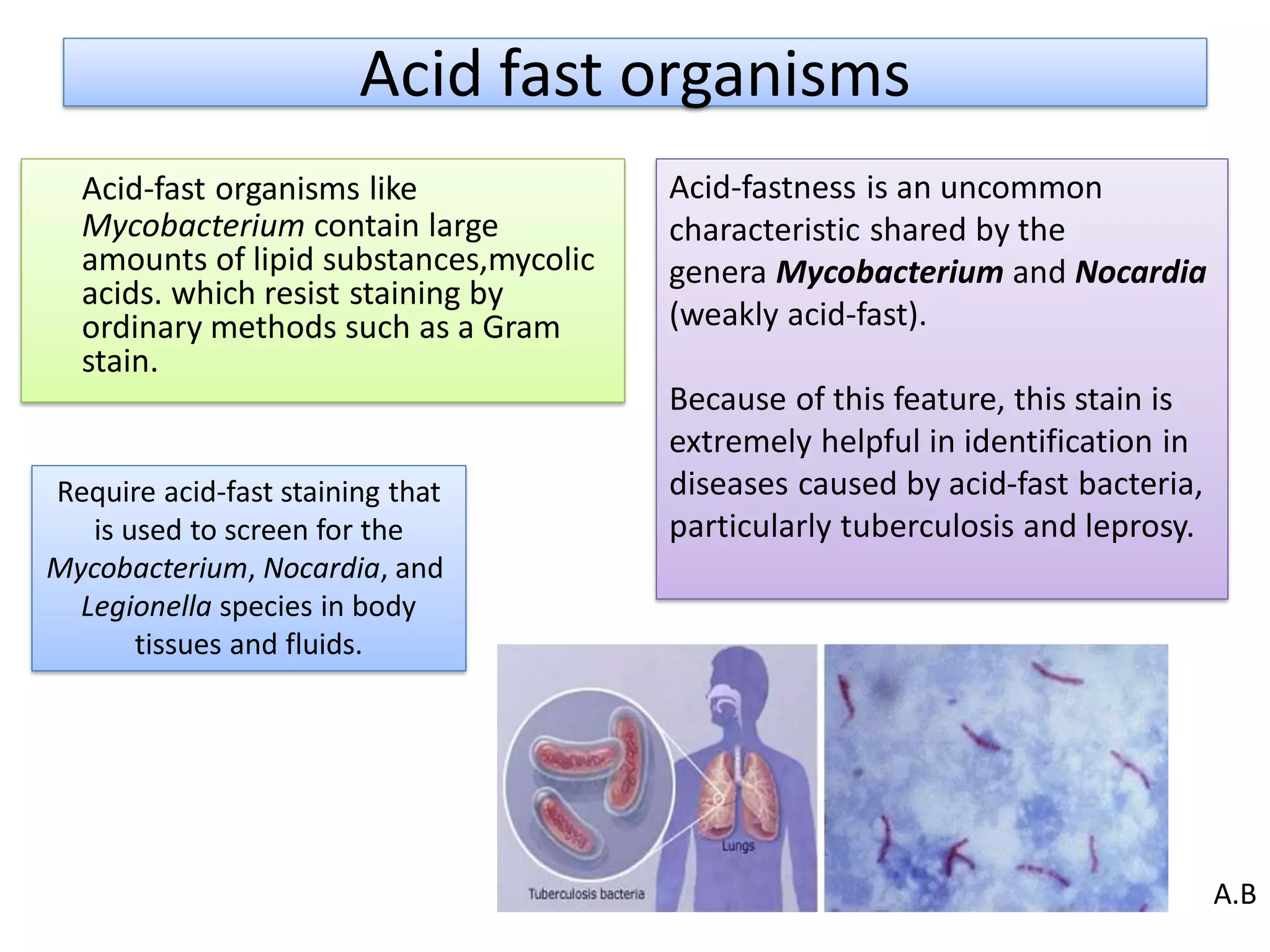
Acid-fast organisms like
Mycobacterium contain large
amounts of lipid substances,mycolic
acids. which resist staining by
ordinary methods such as a Gram
stain.
Require acid-fast staining that
is used to screen for the
Mycobacterium, Nocardia, and
Legionella species in body
tissues and fluids.
Acid-fastness is an uncommon
characteristic shared by the
genera Mycobacterium and Nocardia
(weakly acid-fast).
Because of this feature, this stain is
extremely helpful in identification in
diseases caused by acid-fast bacteria,
particularly tuberculosis and leprosy.
A.B
Principle
• Because the cell wall containing mycolic acid is so waxy and
resistant to most compounds, acid-fast organisms require a
special staining technique.
• The primary stain used in acid-fast staining, carbol fuchsin,
is lipid-soluble and contains phenol, which helps the stain
penetrate the cell wall. This is further assisted by the
addition of heat.
• The smear is then rinsed with a very strong decolorizer,
which strips the stain from all non-acid-fast cells but does
not permeate the cell wall of acid-fast organisms.
• The decolorized non-acid-fast cells then take up the
counterstain.
• Acid fast bacteria will be red, while nonacid fast bacteria
will stain green.
A.B
A.B
Requirements
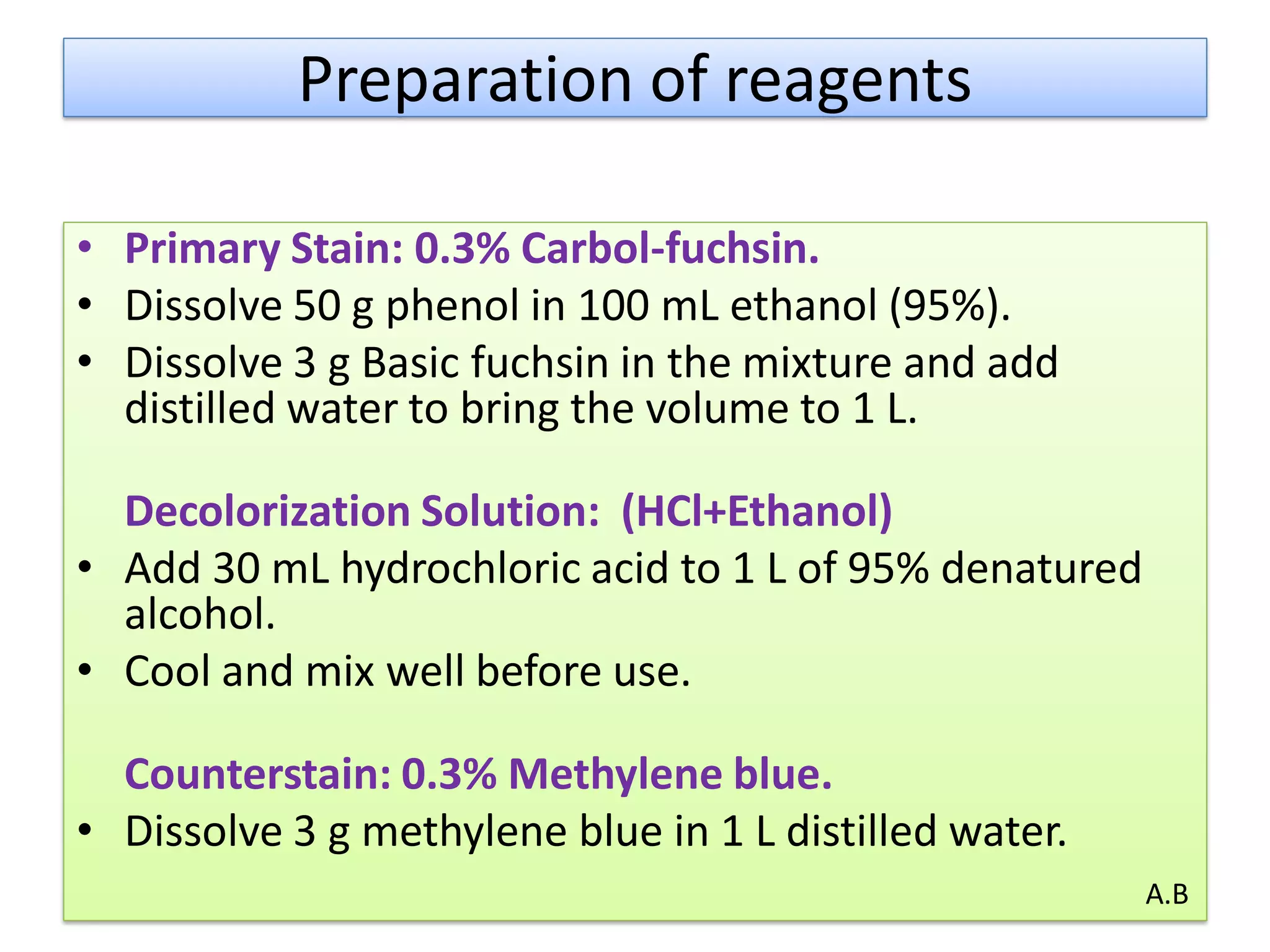
Reagents
• Primary Stain: Carbol-fuchsin.
• Decoloriser: (HCl+Ethanol)
• Counterstain: Methylene blue.
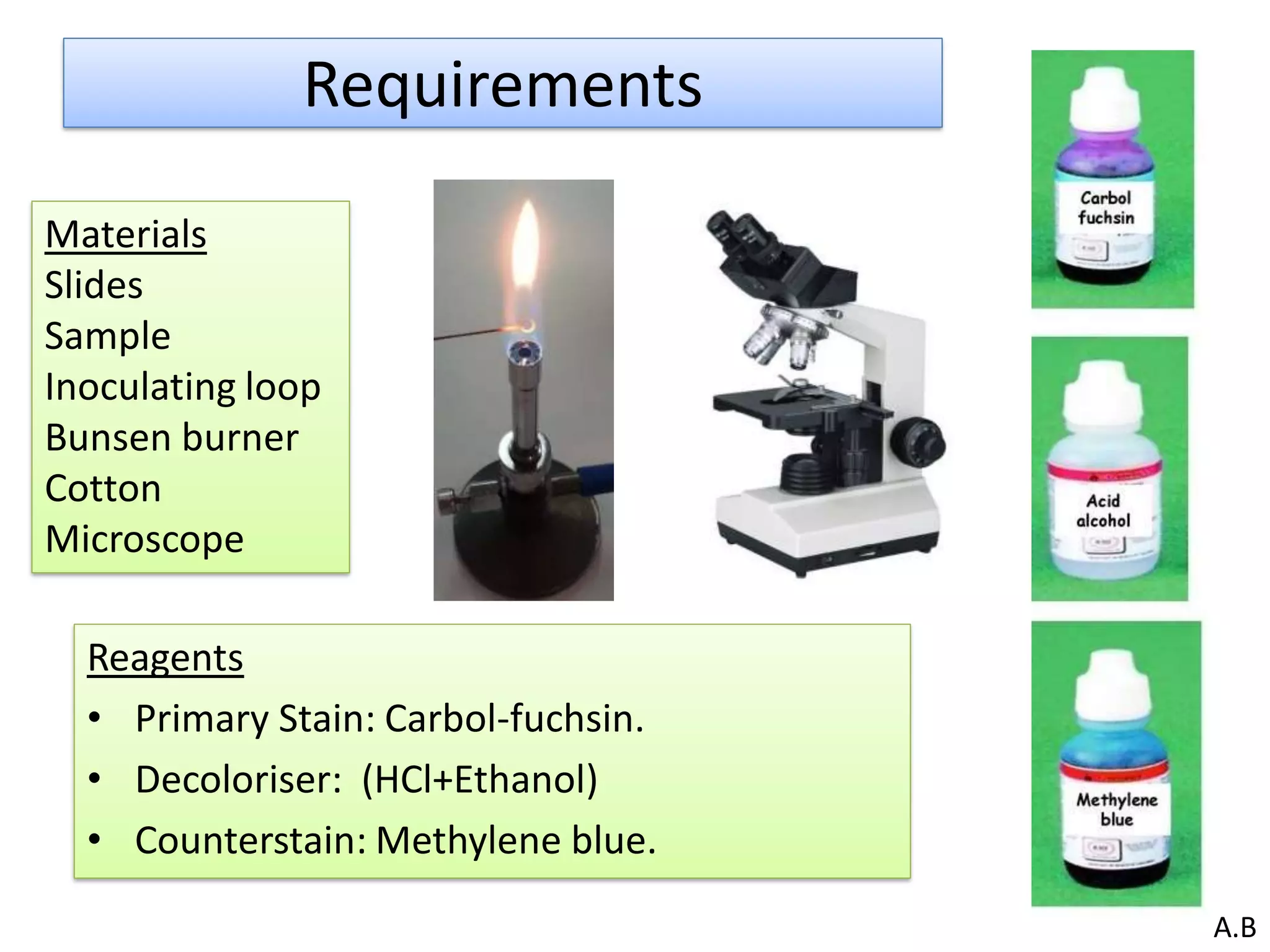
Materials
Slides
Sample
Inoculating loop
Bunsen burner
Cotton
Microscope
A.B
Preparation of reagents
• Primary Stain: 0.3% Carbol-fuchsin.
• Dissolve 50 g phenol in 100 mL ethanol (95%).
• Dissolve 3 g Basic fuchsin in the mixture and add
distilled water to bring the volume to 1 L.
Decolorization Solution: (HCl+Ethanol)
• Add 30 mL hydrochloric acid to 1 L of 95% denatured
alcohol.
• Cool and mix well before use.
Counterstain: 0.3% Methylene blue.
• Dissolve 3 g methylene blue in 1 L distilled water.
A.B
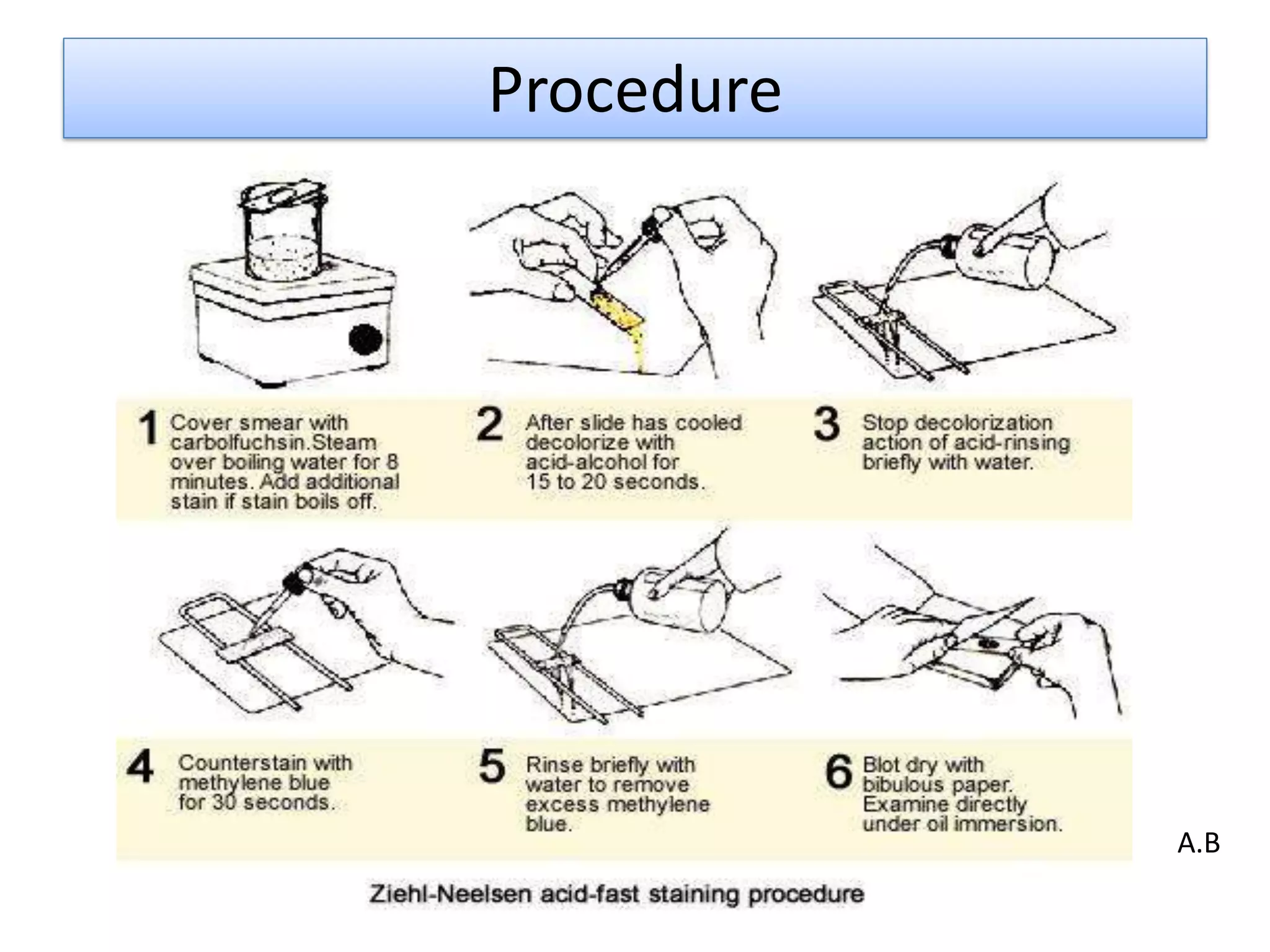
Procedure
• Take a clean grease free slide.
• Prepare the smear from provided sample.
• Air dry and heat fixed the smear.
• Place a small strip of filter paper over the top of smear and place the slide
over a boiling hot water bath on a mesh surface.
• Cover the filter paper with the primary stain, carbol fuchsin.
• Leave the slide on the water bath for 5 minutes or more.
• Note- Continue to apply stain if the filter paper begins to dry.
• Remove the filter paper and rinse the slide with water until the solution
runs clear.
• Run acid-alcohol decolorizer over the slide for approximately 10 to 15
seconds.
• Rinse the slide with water.
• Cover the smear with the counterstain, methylene blue, for 1 minute.
• Gently rinse the slide with water.
• Blot the slide dry with bibulous paper.
• Observe under microscope. A.B
Procedure
A.B
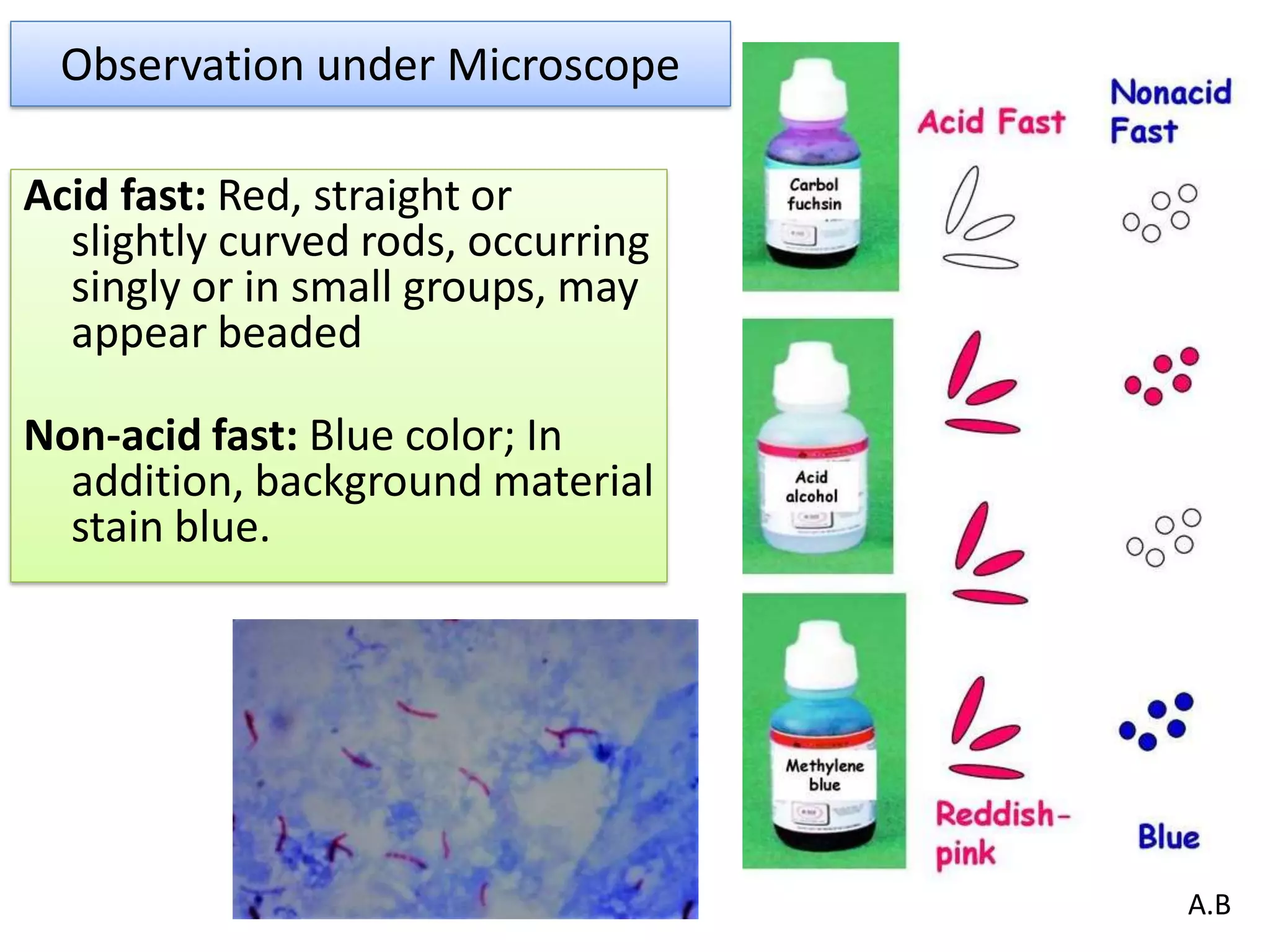
Observation under Microscope
Acid fast: Red, straight or
slightly curved rods, occurring
singly or in small groups, may
appear beaded
Non-acid fast: Blue color; In
addition, background material
stain blue.
A.B
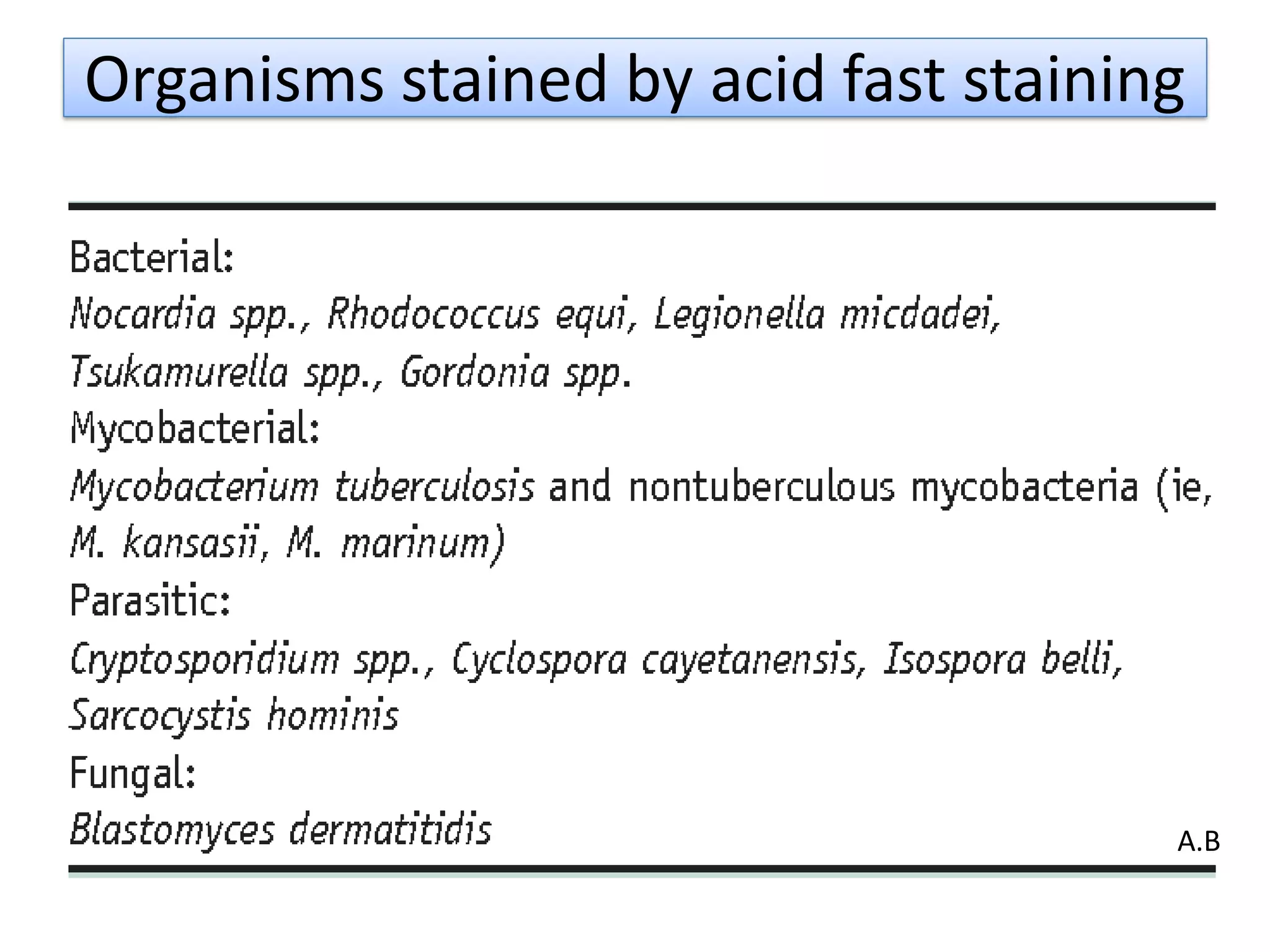
Organisms stained by acid fast staining
A.B
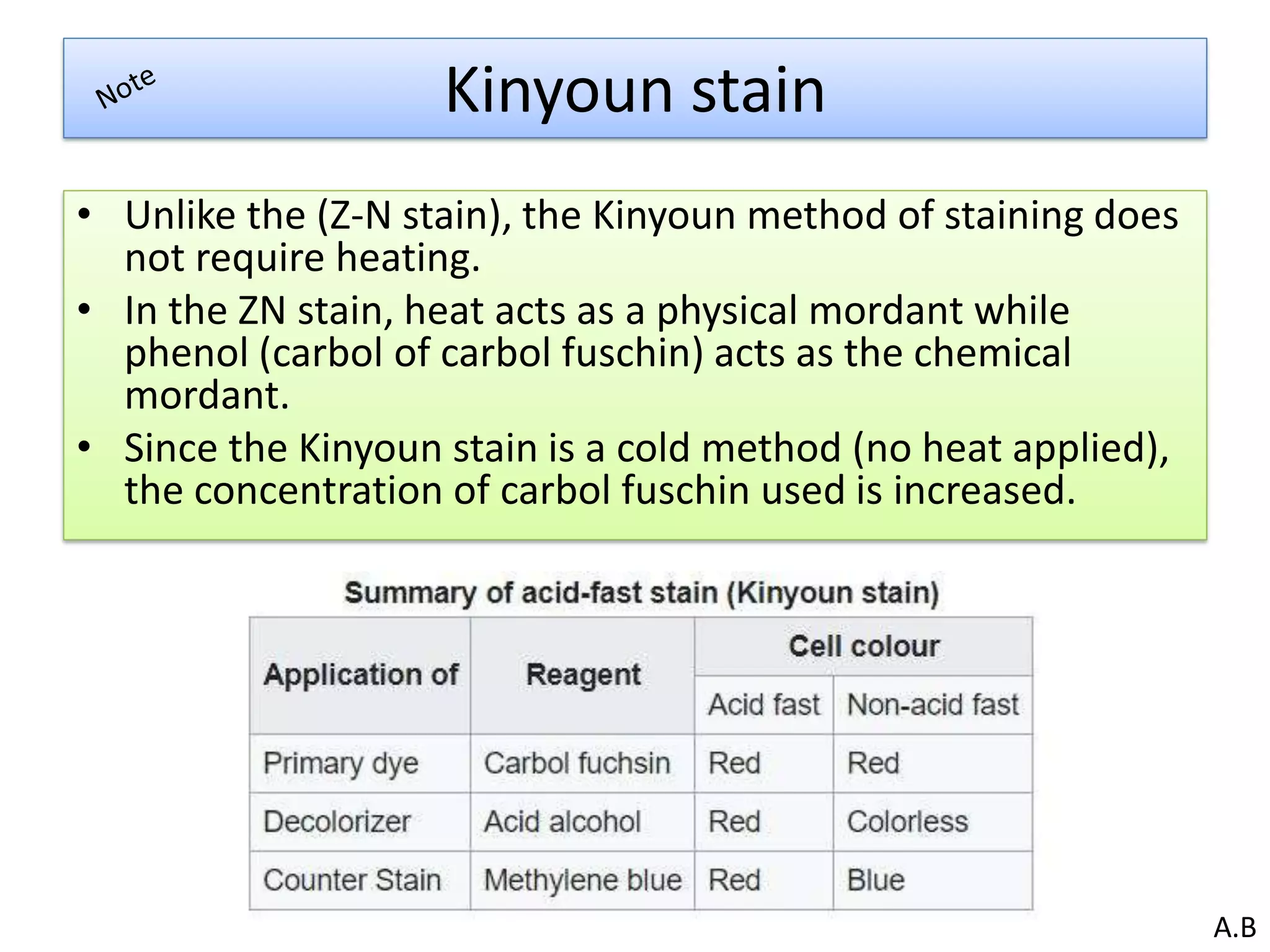
Kinyoun stain
• Unlike the (Z-N stain), the Kinyoun method of staining does
not require heating.
• In the ZN stain, heat acts as a physical mordant while
phenol (carbol of carbol fuschin) acts as the chemical
mordant.
• Since the Kinyoun stain is a cold method (no heat applied),
the concentration of carbol fuschin used is increased.
A.B
Acid fast staining

Acid fast staining

  • 1.
  • 2.
    Acid-fast staining • isa differential staining • used to differentiate acid fast and non acid fast bacteria. • used to identify acid-fast organisms such as members of the genus Mycobacterium . • also known as Ziehl-Neelsen method • first introduced by Paul Ehrlich later modified by two German doctors bacteriologist Franz Ziehl (1859–1926) and the pathologist Friedrich Neelsen (1854–1898). A.B
  • 3.
    History • In 1882Robert Koch discovered the etiology of tuberculosis. • Soon after Koch’s discovery, Paul Ehrlich developed a stain for mycobacterium tuberculosis, called the alum hematoxylin stain. • Franz Ziehl then altered Ehrlich’s staining technique by using carbolic acid as the mordant. • Friedrich Neelsen kept Ziehl’s choice of mordant but changed the primary stain to carbol fuchsin. • Ziehl and Neelsen’s modifications together have developed the Ziehl-Neelsen stain. • Another acid-fast satin was developed by Joseph Kinyoun by using the Ziehl-Neelsen staining technique but removing the heating step from the procedure. • This new stain from Kinyoun was named the Kinyoun stain. A.B
  • 4.
    What are acidfast bacteria? • those which have a high content of mycolic acids in their cell walls. • are characterized by • wax-like, nearly impermeable cell walls; • contain mycolic acid and large amounts of fatty acids, waxes, and complex lipids. • are highly resistant to disinfectants and dry conditions. • Due to their waxy cell wall components, Mycobacterium are acid fast; that is, they retain the red dye, carbol fuchsin, after rinsing with acid solvents. A.B
  • 5.
    Acid fast organisms Acid-fastorganisms like Mycobacterium contain large amounts of lipid substances,mycolic acids. which resist staining by ordinary methods such as a Gram stain. Require acid-fast staining that is used to screen for the Mycobacterium, Nocardia, and Legionella species in body tissues and fluids. Acid-fastness is an uncommon characteristic shared by the genera Mycobacterium and Nocardia (weakly acid-fast). Because of this feature, this stain is extremely helpful in identification in diseases caused by acid-fast bacteria, particularly tuberculosis and leprosy. A.B
  • 6.
    Principle • Because thecell wall containing mycolic acid is so waxy and resistant to most compounds, acid-fast organisms require a special staining technique. • The primary stain used in acid-fast staining, carbol fuchsin, is lipid-soluble and contains phenol, which helps the stain penetrate the cell wall. This is further assisted by the addition of heat. • The smear is then rinsed with a very strong decolorizer, which strips the stain from all non-acid-fast cells but does not permeate the cell wall of acid-fast organisms. • The decolorized non-acid-fast cells then take up the counterstain. • Acid fast bacteria will be red, while nonacid fast bacteria will stain green. A.B
  • 7.
  • 8.
    Requirements Reagents • Primary Stain:Carbol-fuchsin. • Decoloriser: (HCl+Ethanol) • Counterstain: Methylene blue. Materials Slides Sample Inoculating loop Bunsen burner Cotton Microscope A.B
  • 9.
    Preparation of reagents •Primary Stain: 0.3% Carbol-fuchsin. • Dissolve 50 g phenol in 100 mL ethanol (95%). • Dissolve 3 g Basic fuchsin in the mixture and add distilled water to bring the volume to 1 L. Decolorization Solution: (HCl+Ethanol) • Add 30 mL hydrochloric acid to 1 L of 95% denatured alcohol. • Cool and mix well before use. Counterstain: 0.3% Methylene blue. • Dissolve 3 g methylene blue in 1 L distilled water. A.B
  • 10.
    Procedure • Take aclean grease free slide. • Prepare the smear from provided sample. • Air dry and heat fixed the smear. • Place a small strip of filter paper over the top of smear and place the slide over a boiling hot water bath on a mesh surface. • Cover the filter paper with the primary stain, carbol fuchsin. • Leave the slide on the water bath for 5 minutes or more. • Note- Continue to apply stain if the filter paper begins to dry. • Remove the filter paper and rinse the slide with water until the solution runs clear. • Run acid-alcohol decolorizer over the slide for approximately 10 to 15 seconds. • Rinse the slide with water. • Cover the smear with the counterstain, methylene blue, for 1 minute. • Gently rinse the slide with water. • Blot the slide dry with bibulous paper. • Observe under microscope. A.B
  • 11.
  • 12.
    Observation under Microscope Acidfast: Red, straight or slightly curved rods, occurring singly or in small groups, may appear beaded Non-acid fast: Blue color; In addition, background material stain blue. A.B
  • 13.
    Organisms stained byacid fast staining A.B
  • 14.
    Kinyoun stain • Unlikethe (Z-N stain), the Kinyoun method of staining does not require heating. • In the ZN stain, heat acts as a physical mordant while phenol (carbol of carbol fuschin) acts as the chemical mordant. • Since the Kinyoun stain is a cold method (no heat applied), the concentration of carbol fuschin used is increased. A.B