Bacteria
Anup Muni Bajracharya
Bacteria
• single-celled microorganisms- Unicellular
• Prokaryotic cells, meaning they lack a membrane-bound
nucleus, do not have a true nucleus, the bacterial nucleus is
known as nucleoid.
• Their genetic material, in the form of a single circular DNA
molecule, is located in the cytoplasm.
• do not have organelles like mitochondria, golgi bodies etc
except ribosome.
• Ribosomes present- 70S type
• Bacteria have a cell membrane and a cell wall made of
peptidoglycan, which provides structural support.
• Reproduction occurs through binary fission, a process
where a single bacterium divides into two identical
daughter cells.
• Some are motile, due to the presence of flagella
Morphology
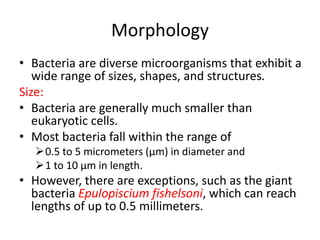
• Bacteria are diverse microorganisms that exhibit a
wide range of sizes, shapes, and structures.
Size:
• Bacteria are generally much smaller than
eukaryotic cells.
• Most bacteria fall within the range of
➢0.5 to 5 micrometers (µm) in diameter and
➢1 to 10 µm in length.
• However, there are exceptions, such as the giant
bacteria Epulopiscium fishelsoni, which can reach
lengths of up to 0.5 millimeters.
Shape
• Morphologically bacteria are divided into
three major shapes:
• Cocci (Singular: coccus)
• Bacilli (rods) (Singular: rod, bacillus)
• Spirilla (Singular: spirillum)
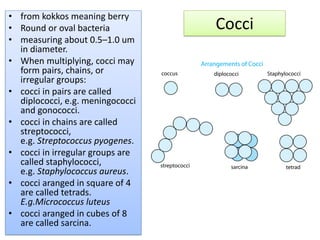
Cocci
• from kokkos meaning berry
• Round or oval bacteria
• measuring about 0.5–1.0 um
in diameter.
• When multiplying, cocci may
form pairs, chains, or
irregular groups:
• cocci in pairs are called
diplococci, e.g. meningococci
and gonococci.
• cocci in chains are called
streptococci,
e.g. Streptococcus pyogenes.
• cocci in irregular groups are
called staphylococci,
e.g. Staphylococcus aureus.
• cocci aranged in square of 4
are called tetrads.
E.g.Micrococcus luteus
• cocci aranged in cubes of 8
are called sarcina.
Bacillus
• These are stick-like bacteria with rounded, tapered (fusiform),
square, or swollen ends.
• They measure 1–10 um in length by 0.3–1.0 um in width.
• Different forms of Bacillus
• Bacillus: Single unattached cell, Bacillus cereus, Salmonella enterica
• Diplobacilli: Two rods found in pairs eg- Moraxella bovis, Klebsiella
rhinoscleromatis
• Streptobacilli: bacilli are arranged in a chain. Eg- Streptobacillus
moniliformis, Streptobacillus felis.
• Coccobacilli: These are short compared to other bacilli and oval in
shape, they appear like a coccus. Eg- Haemophilus influenzae,
Gardnerella vaginalis, etc.
• Palisades: The bacilli arranged in a palisade, fence-like structure,
resembling Chinese letters Eg-Corynebacterium diptheria
Spiral
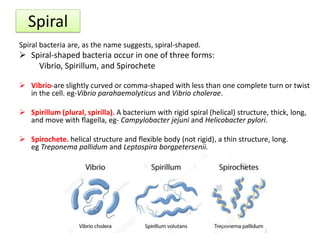
Spiral bacteria are, as the name suggests, spiral-shaped.
➢ Spiral-shaped bacteria occur in one of three forms:
Vibrio, Spirillum, and Spirochete
➢ Vibrio-are slightly curved or comma-shaped with less than one complete turn or twist
in the cell. eg-Vibrio parahaemolyticus and Vibrio cholerae.
➢ Spirillum (plural, spirilla). A bacterium with rigid spiral (helical) structure, thick, long,
and move with flagella, eg- Campylobacter jejuni and Helicobacter pylori.
➢ Spirochete. helical structure and flexible body (not rigid), a thin structure, long.
eg Treponema pallidum and Leptospira borgpetersenii.
• Note- Pleomorphic: Some bacteria do not
have a fixed shape and can vary in shape or
undergo changes depending on environmental
conditions.
• These are referred to as pleomorphic bacteria.
Examples include Caulobacter and
Mycoplasma.
Bacterial cell Structure and
Function
Anup Muni Bajracharya
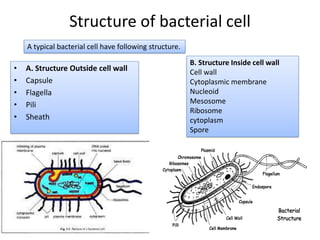
Structure of bacterial cell
• A. Structure Outside cell wall
• Capsule
• Flagella
• Pili
• Sheath
A typical bacterial cell have following structure.
B. Structure Inside cell wall
Cell wall
Cytoplasmic membrane
Nucleoid
Mesosome
Ribosome
cytoplasm
Spore
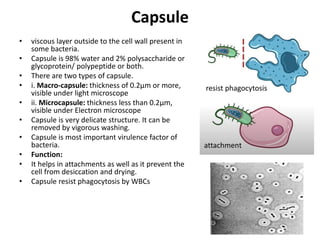
Capsule
• viscous layer outside to the cell wall present in
some bacteria.
• Capsule is 98% water and 2% polysaccharide or
glycoprotein/ polypeptide or both.
• There are two types of capsule.
• i. Macro-capsule: thickness of 0.2µm or more,
visible under light microscope
• ii. Microcapsule: thickness less than 0.2µm,
visible under Electron microscope
• Capsule is very delicate structure. It can be
removed by vigorous washing.
• Capsule is most important virulence factor of
bacteria.
• Function:
• It helps in attachments as well as it prevent the
cell from desiccation and drying.
• Capsule resist phagocytosis by WBCs
resist phagocytosis
attachment
Capsules and slime layers
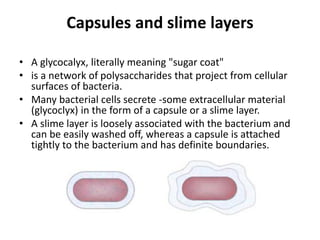
• A glycocalyx, literally meaning "sugar coat"
• is a network of polysaccharides that project from cellular
surfaces of bacteria.
• Many bacterial cells secrete -some extracellular material
(glycoclyx) in the form of a capsule or a slime layer.
• A slime layer is loosely associated with the bacterium and
can be easily washed off, whereas a capsule is attached
tightly to the bacterium and has definite boundaries.
Flagella
• Flagella (singular, flagellum)- hair like helical structure
emerges from cell wall.
• provide a means of locomotion
• It is 15-20 nm
• composed of flagellin protein (globular protein) and
known as H antigen.
• Flagella has three parts. Basal body, Hook and filament
• Function:
• It helps in motility of the bacteria
• The flagella beat in a propeller-like motion to help the
bacterium move toward nutrients; away from toxic
chemicals; or, in the case of the photosynthetic
cyanobacteria; towards the light.
three parts.
Basal body, Hook and filament
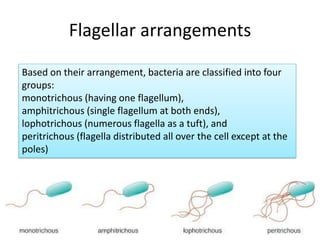
Flagellar arrangements
Based on their arrangement, bacteria are classified into four
groups:
monotrichous (having one flagellum),
amphitrichous (single flagellum at both ends),
lophotrichous (numerous flagella as a tuft), and
peritrichous (flagella distributed all over the cell except at the
poles)
Pili or fimbriae
• Fimbriae and pili are thin, protein tubes originating from
the cytoplasmic membrane of many bacteria.
• Both are able to stick bacteria to surfaces, but pili are
typically longer and fewer in number than fimbriae.
• They are found in virtually all Gram-negative bacteria but
not in many Gram-positive bacteria.
• small hairlike projections or hollow filamentous and non-
helical structure.
• They are numerous and shorter than flagella
• Pili is composed of pilin protein.
• Bacteria containing pili: Shigella, Proteus, Neisseria
gonorrhoae, E. coli
Pili or fimbriae
• Function:
• Attachment: pili helps the bacteria to attach the host cell surface. Most of the
human pathogens of respiratory tract, urinary tract are attached with the help of
pili.
• These outgrowths assist the bacteria in attaching to other cells and surfaces, such
as teeth, intestines, and rocks. Without pili, many disease-causing bacteria lose
their ability to infect because they're unable to attach to host tissue.
• Pili (fimbrae) possess antigenic property
• Specialized function: some pili are modified for specialized function. Eg. Sex pilus
(F-pili) help in transfer of DNA from donor to recipient cell during conjugation.
• F-pili also act as receptor for bacteriophage.
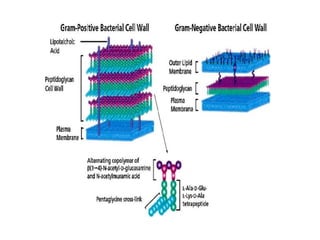
Cell wall
• Each bacterium is enclosed by a rigid cell wall composed of
peptidoglycan, a protein-sugar (polysaccharide) molecule.
• On the basis of cell wall composition, bacteria are classified
into two major group ie.
• Gram Positive and Gram negative.
Gram positive cell wall
Cell wall composition of gram
positive bacteria.
Peptidoglycan
Lipid
Teichoic acid
Gram negative cell wall
Cell wall composition of gram negative
bacteria
Peptidoglycan
Outermembrane:
Lipid
Protein
Lipopopysaccharide (LPS)
• Peptidoglycan:
• It consists of glycan backbone formed by repeated unit of NAG (n-acetyl
Glucosamine) and NAM (N-acetyl muramic acid) and the glycan backbone
is cross linked by peptide bond.
• Peptidoglycan layer is present in cell wall of both gram positive as well as
gram negative bacteria. However, gram positive have thick layer of
peptidoglycan.
• Teichoic acid:
• Teichoic acid is water soluble polymer of glycerol or ribitol phosphate
present in gram positive bacteria.
• It constitutes about 50% of dry weight of cell wall.
• It is the major surface antigen of gram positive bacteria
• Outer membrane:
• It is an additional layer present in gram negative bacteria.
• It is composed of lipid bilayer, protein and lipo-polysaccharide(LPS)
• LPS:
• LPS is composed of lipid-A and polysaccharide.
• Lipid-A: it is phosphorylated glucosamine disaccharide. It is antigenic
• Polysaccharide: it consists of core-polysaccharide and O-polysaccharide.
Functions of cell wall
• The wall gives the cell its shape and surrounds
the cytoplasmic membrane, protecting it from
the environment.
• It also helps to anchor appendages like the pili
and flagella, which originate in the cytoplasm
membrane and protrude through the wall to the
outside.
• The strength of the wall is responsible for keeping the
cell from bursting when there are large differences in
osmotic pressure between the cytoplasm and the
environment.
Cell membrane
• Cell membrane is the inner
layer that lies inside the cell
wall and encloses the
cytoplasm.
• It is also known as cytoplasmic
membrane or plasma
membrane.
• It is about 80nm thick.
• Cell membrane of bacteria is
composed of phospholipid and
proteins.
• Function:
• It is selectively permeable as it
allows to pass selective
substances such as sugar,
aminoacids across it.
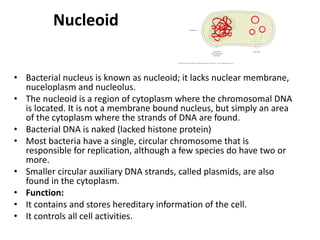
Nucleoid
• Bacterial nucleus is known as nucleoid; it lacks nuclear membrane,
nuceloplasm and nucleolus.
• The nucleoid is a region of cytoplasm where the chromosomal DNA
is located. It is not a membrane bound nucleus, but simply an area
of the cytoplasm where the strands of DNA are found.
• Bacterial DNA is naked (lacked histone protein)
• Most bacteria have a single, circular chromosome that is
responsible for replication, although a few species do have two or
more.
• Smaller circular auxiliary DNA strands, called plasmids, are also
found in the cytoplasm.
• Function:
• It contains and stores hereditary information of the cell.
• It controls all cell activities.
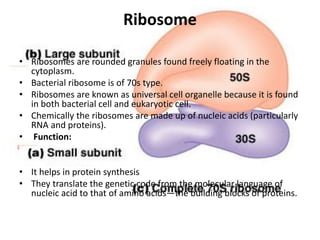
Ribosome
• Ribosomes are rounded granules found freely floating in the
cytoplasm.
• Bacterial ribosome is of 70s type.
• Ribosomes are known as universal cell organelle because it is found
in both bacterial cell and eukaryotic cell.
• Chemically the ribosomes are made up of nucleic acids (particularly
RNA and proteins).
• Function:
• It helps in protein synthesis
• They translate the genetic code from the molecular language of
nucleic acid to that of amino acids—the building blocks of proteins.
Mesosome
• Mesosome is a spherical or round sac like
structure found commonly in gram positive
bacteria.
• Function: It is the site for respiration in
bacterial cell
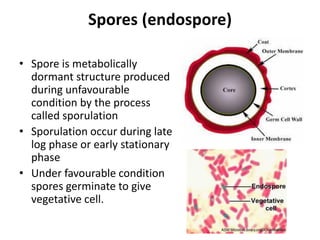
Spores (endospore)
• Spore is metabolically
dormant structure produced
during unfavourable
condition by the process
called sporulation
• Sporulation occur during late
log phase or early stationary
phase
• Under favourable condition
spores germinate to give
vegetative cell.
Bacteria.pdf

Bacteria.pdf

  • 1.
  • 2.
    Bacteria • single-celled microorganisms-Unicellular • Prokaryotic cells, meaning they lack a membrane-bound nucleus, do not have a true nucleus, the bacterial nucleus is known as nucleoid. • Their genetic material, in the form of a single circular DNA molecule, is located in the cytoplasm. • do not have organelles like mitochondria, golgi bodies etc except ribosome. • Ribosomes present- 70S type • Bacteria have a cell membrane and a cell wall made of peptidoglycan, which provides structural support. • Reproduction occurs through binary fission, a process where a single bacterium divides into two identical daughter cells. • Some are motile, due to the presence of flagella
  • 3.
    Morphology • Bacteria arediverse microorganisms that exhibit a wide range of sizes, shapes, and structures. Size: • Bacteria are generally much smaller than eukaryotic cells. • Most bacteria fall within the range of ➢0.5 to 5 micrometers (µm) in diameter and ➢1 to 10 µm in length. • However, there are exceptions, such as the giant bacteria Epulopiscium fishelsoni, which can reach lengths of up to 0.5 millimeters.
  • 4.
    Shape • Morphologically bacteriaare divided into three major shapes: • Cocci (Singular: coccus) • Bacilli (rods) (Singular: rod, bacillus) • Spirilla (Singular: spirillum)
  • 6.
    Cocci • from kokkosmeaning berry • Round or oval bacteria • measuring about 0.5–1.0 um in diameter. • When multiplying, cocci may form pairs, chains, or irregular groups: • cocci in pairs are called diplococci, e.g. meningococci and gonococci. • cocci in chains are called streptococci, e.g. Streptococcus pyogenes. • cocci in irregular groups are called staphylococci, e.g. Staphylococcus aureus. • cocci aranged in square of 4 are called tetrads. E.g.Micrococcus luteus • cocci aranged in cubes of 8 are called sarcina.
  • 7.
    Bacillus • These arestick-like bacteria with rounded, tapered (fusiform), square, or swollen ends. • They measure 1–10 um in length by 0.3–1.0 um in width. • Different forms of Bacillus • Bacillus: Single unattached cell, Bacillus cereus, Salmonella enterica • Diplobacilli: Two rods found in pairs eg- Moraxella bovis, Klebsiella rhinoscleromatis • Streptobacilli: bacilli are arranged in a chain. Eg- Streptobacillus moniliformis, Streptobacillus felis. • Coccobacilli: These are short compared to other bacilli and oval in shape, they appear like a coccus. Eg- Haemophilus influenzae, Gardnerella vaginalis, etc. • Palisades: The bacilli arranged in a palisade, fence-like structure, resembling Chinese letters Eg-Corynebacterium diptheria
  • 9.
    Spiral Spiral bacteria are,as the name suggests, spiral-shaped. ➢ Spiral-shaped bacteria occur in one of three forms: Vibrio, Spirillum, and Spirochete ➢ Vibrio-are slightly curved or comma-shaped with less than one complete turn or twist in the cell. eg-Vibrio parahaemolyticus and Vibrio cholerae. ➢ Spirillum (plural, spirilla). A bacterium with rigid spiral (helical) structure, thick, long, and move with flagella, eg- Campylobacter jejuni and Helicobacter pylori. ➢ Spirochete. helical structure and flexible body (not rigid), a thin structure, long. eg Treponema pallidum and Leptospira borgpetersenii.
  • 10.
    • Note- Pleomorphic:Some bacteria do not have a fixed shape and can vary in shape or undergo changes depending on environmental conditions. • These are referred to as pleomorphic bacteria. Examples include Caulobacter and Mycoplasma.
  • 11.
    Bacterial cell Structureand Function Anup Muni Bajracharya
  • 12.
    Structure of bacterialcell • A. Structure Outside cell wall • Capsule • Flagella • Pili • Sheath A typical bacterial cell have following structure. B. Structure Inside cell wall Cell wall Cytoplasmic membrane Nucleoid Mesosome Ribosome cytoplasm Spore
  • 13.
    Capsule • viscous layeroutside to the cell wall present in some bacteria. • Capsule is 98% water and 2% polysaccharide or glycoprotein/ polypeptide or both. • There are two types of capsule. • i. Macro-capsule: thickness of 0.2µm or more, visible under light microscope • ii. Microcapsule: thickness less than 0.2µm, visible under Electron microscope • Capsule is very delicate structure. It can be removed by vigorous washing. • Capsule is most important virulence factor of bacteria. • Function: • It helps in attachments as well as it prevent the cell from desiccation and drying. • Capsule resist phagocytosis by WBCs resist phagocytosis attachment
  • 14.
    Capsules and slimelayers • A glycocalyx, literally meaning "sugar coat" • is a network of polysaccharides that project from cellular surfaces of bacteria. • Many bacterial cells secrete -some extracellular material (glycoclyx) in the form of a capsule or a slime layer. • A slime layer is loosely associated with the bacterium and can be easily washed off, whereas a capsule is attached tightly to the bacterium and has definite boundaries.
  • 15.
    Flagella • Flagella (singular,flagellum)- hair like helical structure emerges from cell wall. • provide a means of locomotion • It is 15-20 nm • composed of flagellin protein (globular protein) and known as H antigen. • Flagella has three parts. Basal body, Hook and filament • Function: • It helps in motility of the bacteria • The flagella beat in a propeller-like motion to help the bacterium move toward nutrients; away from toxic chemicals; or, in the case of the photosynthetic cyanobacteria; towards the light.
  • 16.
    three parts. Basal body,Hook and filament
  • 17.
    Flagellar arrangements Based ontheir arrangement, bacteria are classified into four groups: monotrichous (having one flagellum), amphitrichous (single flagellum at both ends), lophotrichous (numerous flagella as a tuft), and peritrichous (flagella distributed all over the cell except at the poles)
  • 18.
    Pili or fimbriae •Fimbriae and pili are thin, protein tubes originating from the cytoplasmic membrane of many bacteria. • Both are able to stick bacteria to surfaces, but pili are typically longer and fewer in number than fimbriae. • They are found in virtually all Gram-negative bacteria but not in many Gram-positive bacteria. • small hairlike projections or hollow filamentous and non- helical structure. • They are numerous and shorter than flagella • Pili is composed of pilin protein. • Bacteria containing pili: Shigella, Proteus, Neisseria gonorrhoae, E. coli
  • 19.
    Pili or fimbriae •Function: • Attachment: pili helps the bacteria to attach the host cell surface. Most of the human pathogens of respiratory tract, urinary tract are attached with the help of pili. • These outgrowths assist the bacteria in attaching to other cells and surfaces, such as teeth, intestines, and rocks. Without pili, many disease-causing bacteria lose their ability to infect because they're unable to attach to host tissue. • Pili (fimbrae) possess antigenic property • Specialized function: some pili are modified for specialized function. Eg. Sex pilus (F-pili) help in transfer of DNA from donor to recipient cell during conjugation. • F-pili also act as receptor for bacteriophage.
  • 20.
    Cell wall • Eachbacterium is enclosed by a rigid cell wall composed of peptidoglycan, a protein-sugar (polysaccharide) molecule. • On the basis of cell wall composition, bacteria are classified into two major group ie. • Gram Positive and Gram negative. Gram positive cell wall Cell wall composition of gram positive bacteria. Peptidoglycan Lipid Teichoic acid Gram negative cell wall Cell wall composition of gram negative bacteria Peptidoglycan Outermembrane: Lipid Protein Lipopopysaccharide (LPS)
  • 24.
    • Peptidoglycan: • Itconsists of glycan backbone formed by repeated unit of NAG (n-acetyl Glucosamine) and NAM (N-acetyl muramic acid) and the glycan backbone is cross linked by peptide bond. • Peptidoglycan layer is present in cell wall of both gram positive as well as gram negative bacteria. However, gram positive have thick layer of peptidoglycan. • Teichoic acid: • Teichoic acid is water soluble polymer of glycerol or ribitol phosphate present in gram positive bacteria. • It constitutes about 50% of dry weight of cell wall. • It is the major surface antigen of gram positive bacteria • Outer membrane: • It is an additional layer present in gram negative bacteria. • It is composed of lipid bilayer, protein and lipo-polysaccharide(LPS) • LPS: • LPS is composed of lipid-A and polysaccharide. • Lipid-A: it is phosphorylated glucosamine disaccharide. It is antigenic • Polysaccharide: it consists of core-polysaccharide and O-polysaccharide.
  • 25.
    Functions of cellwall • The wall gives the cell its shape and surrounds the cytoplasmic membrane, protecting it from the environment. • It also helps to anchor appendages like the pili and flagella, which originate in the cytoplasm membrane and protrude through the wall to the outside. • The strength of the wall is responsible for keeping the cell from bursting when there are large differences in osmotic pressure between the cytoplasm and the environment.
  • 26.
    Cell membrane • Cellmembrane is the inner layer that lies inside the cell wall and encloses the cytoplasm. • It is also known as cytoplasmic membrane or plasma membrane. • It is about 80nm thick. • Cell membrane of bacteria is composed of phospholipid and proteins. • Function: • It is selectively permeable as it allows to pass selective substances such as sugar, aminoacids across it.
  • 28.
    Nucleoid • Bacterial nucleusis known as nucleoid; it lacks nuclear membrane, nuceloplasm and nucleolus. • The nucleoid is a region of cytoplasm where the chromosomal DNA is located. It is not a membrane bound nucleus, but simply an area of the cytoplasm where the strands of DNA are found. • Bacterial DNA is naked (lacked histone protein) • Most bacteria have a single, circular chromosome that is responsible for replication, although a few species do have two or more. • Smaller circular auxiliary DNA strands, called plasmids, are also found in the cytoplasm. • Function: • It contains and stores hereditary information of the cell. • It controls all cell activities.
  • 29.
    Ribosome • Ribosomes arerounded granules found freely floating in the cytoplasm. • Bacterial ribosome is of 70s type. • Ribosomes are known as universal cell organelle because it is found in both bacterial cell and eukaryotic cell. • Chemically the ribosomes are made up of nucleic acids (particularly RNA and proteins). • Function: • It helps in protein synthesis • They translate the genetic code from the molecular language of nucleic acid to that of amino acids—the building blocks of proteins.
  • 30.
    Mesosome • Mesosome isa spherical or round sac like structure found commonly in gram positive bacteria. • Function: It is the site for respiration in bacterial cell
  • 31.
    Spores (endospore) • Sporeis metabolically dormant structure produced during unfavourable condition by the process called sporulation • Sporulation occur during late log phase or early stationary phase • Under favourable condition spores germinate to give vegetative cell.