Electron Microscope
Electron microscope
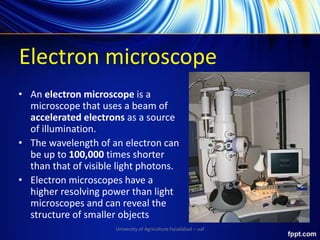
• An electron microscope is a
microscope that uses a beam of
accelerated electrons as a source
of illumination.
• The wavelength of an electron can
be up to 100,000 times shorter
than that of visible light photons.
• Electron microscopes have a
higher resolving power than light
microscopes and can reveal the
structure of smaller objects
University of Agriculture Faisalabad – uaf
• It offers unique possibilities to gain insight into
1. Structure
2. Topology
3. Morphology
4. Composition of materials.
Advantages Of Electron Microscopy
• To study objects of >0.2 micrometer.
• For analysis of subcellular structure.
• For study of intracellular pathogens & viruses.
• For cell metabolism
• For study of minute structure in nature.
Types of Electron Microscope:
• There are basic 4 types of Electron Microscope:
1. Analytical Electron Microscopy (AEM)
2. Scanning Transmission Electron Microscope (STEM)
3. Scanning Electron Microscope (SEM)
4. Transmission Electron Microscope (TEM)
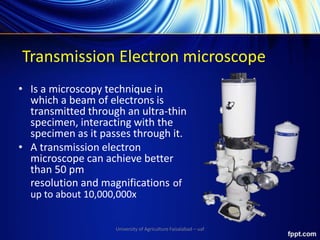
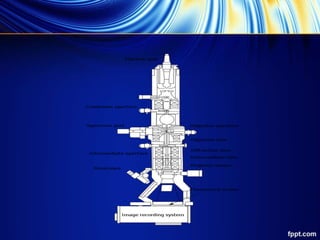
Transmission Electron microscope
• Is a microscopy technique in
which a beam of electrons is
transmitted through an ultra-thin
specimen, interacting with the
specimen as it passes through it.
• A transmission electron
microscope can achieve better
than 50 pm
resolution and magnifications of
up to about 10,000,000x
University of Agriculture Faisalabad – uaf
Types of TEM:
• Bright Field (BF) – BFTEM
• Dark field (DF) – DFTEM
• High Resolution TEM – HRTEM
• Energy Filtered TEM – EFTEM
• Electron Diffraction – ED
Techniques Of TEM:
• There are 4 techniques of TEM:
– Negative staining
– Shadow casting
– Freeze fracture replication
– Freeze etching.
Applications Of TEM
• It can be used for the study of:
– To examine a small column of atoms.
– Cancer research
– Virology
– Pollution Nanotechnology
– Semiconductor research
– Chemical Identity
– Crystal orientation
– Electronic structure
Limitations of TEM:
• It is difficult to produce thin sample.
• Relatively time consuming process with a low throughput of
samples.
• The structure of the sample may be change during the
preparation process.
• Small field of view may not give conclusion result of the whole
sample.
Scanning Electron Microscope (SEM)
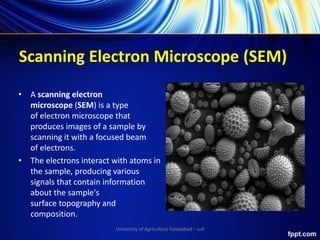
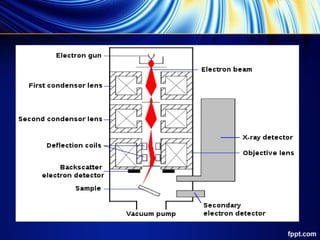
• A scanning electron
microscope (SEM) is a type
of electron microscope that
produces images of a sample by
scanning it with a focused beam
of electrons.
• The electrons interact with atoms in
the sample, producing various
signals that contain information
about the sample's
surface topography and
composition.
University of Agriculture Faisalabad – uaf
• Types of signals produce by a SEM include:
– Secondary electrons
– Back scattered electrons (BSE)
– X-rays
– Light rays
• A standard SEM uses secondary electrons & back scattered
electrons.
Advantages of SEM:
• Better resolution.
• Work with low voltages.
• High brightness source.
• Fast imaging.
• High count rates in X-ray analysis.
• Easy to operate.
Applications of SEM:
• Use in ultra high vacuum, air, water & various liquid
environment.
• Use for the live specimen examination.
• Use for the visualization of intra cellular changes.
Limitation of SEM:
• It cannot detect very light element (H, He & Li).
• It cannot detect elements with atomic numbers less than 11.
University of Agriculture Faisalabad – uaf

Electron microscope

  • 1.
  • 2.
    Electron microscope • Anelectron microscope is a microscope that uses a beam of accelerated electrons as a source of illumination. • The wavelength of an electron can be up to 100,000 times shorter than that of visible light photons. • Electron microscopes have a higher resolving power than light microscopes and can reveal the structure of smaller objects University of Agriculture Faisalabad – uaf
  • 3.
    • It offersunique possibilities to gain insight into 1. Structure 2. Topology 3. Morphology 4. Composition of materials.
  • 4.
    Advantages Of ElectronMicroscopy • To study objects of >0.2 micrometer. • For analysis of subcellular structure. • For study of intracellular pathogens & viruses. • For cell metabolism • For study of minute structure in nature.
  • 5.
    Types of ElectronMicroscope: • There are basic 4 types of Electron Microscope: 1. Analytical Electron Microscopy (AEM) 2. Scanning Transmission Electron Microscope (STEM) 3. Scanning Electron Microscope (SEM) 4. Transmission Electron Microscope (TEM)
  • 6.
    Transmission Electron microscope •Is a microscopy technique in which a beam of electrons is transmitted through an ultra-thin specimen, interacting with the specimen as it passes through it. • A transmission electron microscope can achieve better than 50 pm resolution and magnifications of up to about 10,000,000x University of Agriculture Faisalabad – uaf
  • 8.
    Types of TEM: •Bright Field (BF) – BFTEM • Dark field (DF) – DFTEM • High Resolution TEM – HRTEM • Energy Filtered TEM – EFTEM • Electron Diffraction – ED
  • 9.
    Techniques Of TEM: •There are 4 techniques of TEM: – Negative staining – Shadow casting – Freeze fracture replication – Freeze etching.
  • 10.
    Applications Of TEM •It can be used for the study of: – To examine a small column of atoms. – Cancer research – Virology – Pollution Nanotechnology – Semiconductor research – Chemical Identity – Crystal orientation – Electronic structure
  • 11.
    Limitations of TEM: •It is difficult to produce thin sample. • Relatively time consuming process with a low throughput of samples. • The structure of the sample may be change during the preparation process. • Small field of view may not give conclusion result of the whole sample.
  • 12.
    Scanning Electron Microscope(SEM) • A scanning electron microscope (SEM) is a type of electron microscope that produces images of a sample by scanning it with a focused beam of electrons. • The electrons interact with atoms in the sample, producing various signals that contain information about the sample's surface topography and composition. University of Agriculture Faisalabad – uaf
  • 13.
    • Types ofsignals produce by a SEM include: – Secondary electrons – Back scattered electrons (BSE) – X-rays – Light rays • A standard SEM uses secondary electrons & back scattered electrons.
  • 15.
    Advantages of SEM: •Better resolution. • Work with low voltages. • High brightness source. • Fast imaging. • High count rates in X-ray analysis. • Easy to operate.
  • 16.
    Applications of SEM: •Use in ultra high vacuum, air, water & various liquid environment. • Use for the live specimen examination. • Use for the visualization of intra cellular changes.
  • 17.
    Limitation of SEM: •It cannot detect very light element (H, He & Li). • It cannot detect elements with atomic numbers less than 11.
  • 18.
    University of AgricultureFaisalabad – uaf

Editor's Notes

  • #3 Dennis Gabor, the physicist Leó Szilárd tried in 1928.
  • #13 presented by McMullan  1937 These pollen grains taken on an SEM show the characteristic depth of field of SEM micrographs.