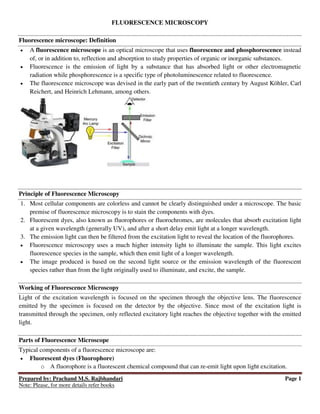
Fluorescence microscopy uses fluorescent dyes and high intensity light to illuminate stained samples, which emit light of a longer wavelength. The image is based on this emitted light rather than the illuminating light. Key components include a light source, excitation and emission filters, and a dichroic mirror to separate the excitation and emission wavelengths. Fluorescence microscopy is widely used in biological research to identify structures, label cellular components, and study dynamic behaviors through live-cell imaging.