Cognitive Processes
Ari Sudan Tiwari, Ph.
D.
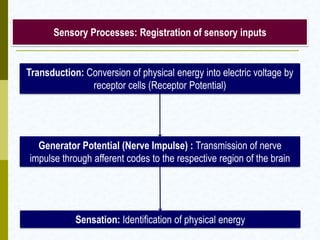
Sensory Processes: Registration of sensory inputs
Transduction: Conversion of physical energy into electric voltage by
receptor cells (Receptor Potential)
Sensation: Identification of physical energy
Generator Potential (Nerve Impulse) : Transmission of nerve
impulse through afferent codes to the respective region of the brain
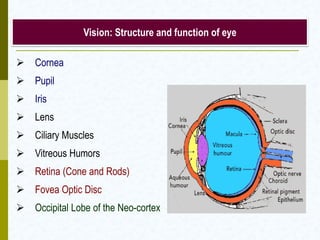
Vision: Structure and function of eye
 Cornea
 Pupil
 Iris
 Lens
 Ciliary Muscles
 Vitreous Humors
 Retina (Cone and Rods)
 Fovea Optic Disc
 Occipital Lobe of the Neo-cortex
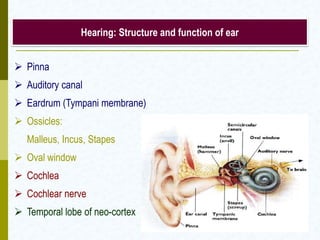
Hearing: Structure and function of ear
 Pinna
 Auditory canal
 Eardrum (Tympani membrane)
 Ossicles:
Malleus, Incus, Stapes
 Oval window
 Cochlea
 Cochlear nerve
 Temporal lobe of neo-cortex
Smell
 Smell Receptors: reactive to chemical energy
 Location of smell receptors: In the roots of nasal
passages leading from the nostrils to the throat
 Olfactory bulb
Taste
 Taste Receptors (Taste buds): Reactive to chemical energy
 Location of Taste Buds : Mostly on the tongue; Some of them at the
back of mouth and in the throat,
 Primary Tastes: Salty, Sour, Sweet and Bitter
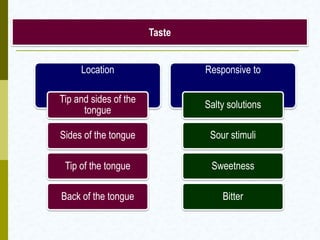
Location
Tip and sides of the
tongue
Sides of the tongue
Tip of the tongue
Back of the tongue
Responsive to
Salty solutions
Sour stimuli
Sweetness
Bitter
Taste
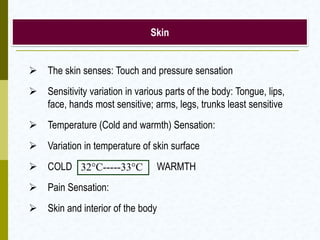
Skin
 The skin senses: Touch and pressure sensation
 Sensitivity variation in various parts of the body: Tongue, lips,
face, hands most sensitive; arms, legs, trunks least sensitive
 Temperature (Cold and warmth) Sensation:
 Variation in temperature of skin surface
 COLD WARMTH
 Pain Sensation:
 Skin and interior of the body
32°C-----33°C
Attention
Attention is a selective process to bring certain stimuli into focus
of consciousness among a number of stimuli present in the
perceptual field.
 Attention is selective process
 Limited capacity perceptual system
 Selection of certain stimuli for deeper level perceptual analysis
 Filtering of other stimuli
 State of readiness and responsiveness
 Limited span
 Fluctuation and shifting
 Division of attention
Characteristics of attention
Perception
Perception is the process of organizing and interpreting
patterns of stimuli in the environment.
Form perception
 Figure- Background: Perception of a figure/object standing out of a
background
 Contours: A marked or abrupt change in brightness or colour in the
visual field which separates figure from the background
 Physiological process in contour formation: Differential distribution of
light energy across the retina
 Camouflage: Continuous change in brightness and colour; contours
broken up; difficult to distinguish object from the background
Gestalt principles of perceptual organization
1. Law of proximity
2. Law of similarity
3. Law of symmetry
4. Law of continuation
5. Law of closure
6. Law of common fate
Gestalt (Whole): Tendency to perceive the sensory field as
organized as possible/situation allows
Visual depth perception
Meaning
 Relative distance of the objects
 Depth in the surface of the objects
Paradox of sensory process
 Flat retinal surface : Perception of depth and distance
 Use of cues coming from sensory inputs
Cues in depth perception
Binocular Cues
 Retinal disparity
 Accommodation and adjustment
Monocular Cues
 Linear perspective
 Clearness
 Interposition
 Aerial perspective
 Texture gradient
 Size of the retinal image
Perceptual constancy
 Brightness Constancy
 Size Constancy
 Unconscious Inference
 A ratio between the retinal image and distance of the object is
calculated unconsciously
 This ratio is constant across situations; therefore, perceptual
constancy
Movement perception
Real movement: Movement of stimulation across the retina despite
steady eyes (movement of retinal image)
Apparent movement: Perception of movement in the absence of
physical of an image across the retina
Stroboscopic motion: Successive pictures of a moving scene:
perception of a smooth action (kind of perception in the movies)
Auto kinetic effect: Staring at a small stationary spot of light in a
completely dark room: The spot appears to move
Induced movement: Movement in the framework induces perception of
movement in the object
Plasticity of perception
 Modifiability of perceptual ability along the
developmental period
 Sensitive period of perceptual development
Individual Differences in Perception
 Perceptual learning: Environmental richness
 Set
 Motives and needs
 Cognitive styles: Field dependent-independent
Learning
 Change in behaviour: Adaptive or maladaptive
 Occurs through practice and experience
 Does not occur through maturation, fatigue or species-specific
behaviour
 Relatively permanent
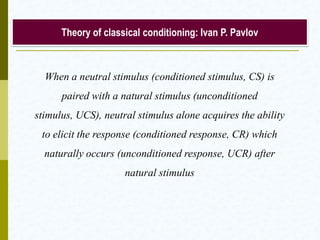
Theory of classical conditioning: Ivan P. Pavlov
When a neutral stimulus (conditioned stimulus, CS) is
paired with a natural stimulus (unconditioned stimulus,
UCS), neutral stimulus alone acquires the ability to elicit
the response (conditioned response, CR) which naturally
occurs (unconditioned response, UCR) after natural
stimulus
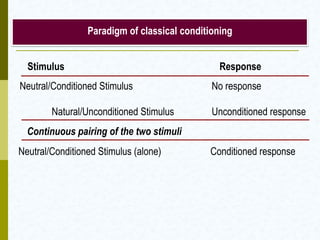
Paradigm of classical conditioning
Stimulus Response
Neutral/Conditioned Stimulus No response
Natural/Unconditioned Stimulus Unconditioned response
Continuous pairing of the two stimuli
Neutral/Conditioned Stimulus (alone) Conditioned response
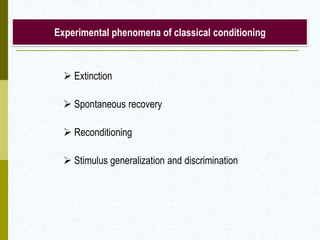
Experimental phenomena of classical conditioning
 Extinction
 Spontaneous recovery
 Reconditioning
 Stimulus generalization and discrimination
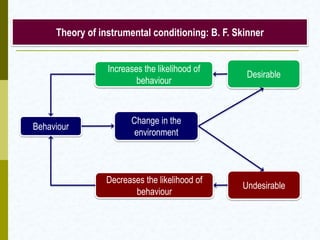
Theory of instrumental conditioning: B. F. Skinner
Behaviour
Change in the
environment
Desirable
Undesirable
Increases the likelihood of
behaviour
Decreases the likelihood of
behaviour
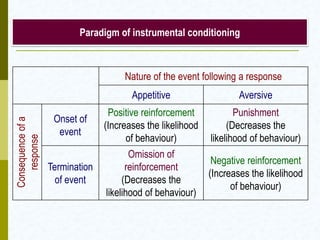
Paradigm of instrumental conditioning
Nature of the event following a response
Appetitive Aversive
Consequenceofa
response
Onset of
event
Positive reinforcement
(Increases the likelihood
of behaviour)
Punishment
(Decreases the
likelihood of behaviour)
Termination
of event
Omission of
reinforcement
(Decreases the
likelihood of behaviour)
Negative reinforcement
(Increases the likelihood
of behaviour)
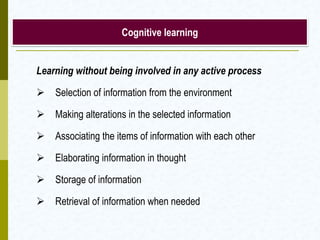
Cognitive learning
Learning without being involved in any active process
 Selection of information from the environment
 Making alterations in the selected information
 Associating the items of information with each other
 Elaborating information in thought
 Storage of information
 Retrieval of information when needed
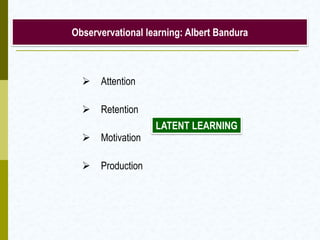
Observervational learning: Albert Bandura
 Attention
 Retention
 Motivation
 Production
LATENT LEARNING
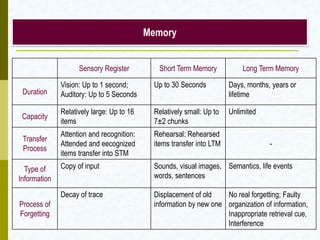
Memory
Sensory Register Short Term Memory Long Term Memory
Duration
Vision: Up to 1 second;
Auditory: Up to 5 Seconds
Up to 30 Seconds Days, months, years or
lifetime
Capacity
Relatively large: Up to 16
items
Relatively small: Up to
7±2 chunks
Unlimited
Transfer
Process
Attention and recognition:
Attended and eecognized
items transfer into STM
Rehearsal: Rehearsed
items transfer into LTM -
Type of
Information
Copy of input Sounds, visual images,
words, sentences
Semantics, life events
Process of
Forgetting
Decay of trace Displacement of old
information by new one
No real forgetting; Faulty
organization of information,
Inappropriate retrieval cue,
Interference
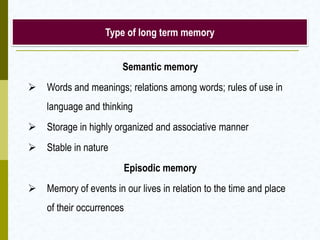
Type of long term memory
Semantic memory
 Words and meanings; relations among words; rules of use in
language and thinking
 Storage in highly organized and associative manner
 Stable in nature
Episodic memory
 Memory of events in our lives in relation to the time and place
of their occurrences
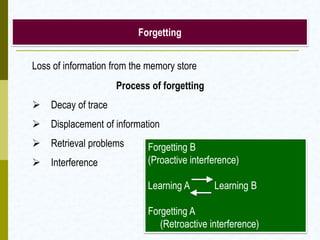
Forgetting
Loss of information from the memory store
Process of forgetting
 Decay of trace
 Displacement of information
 Retrieval problems
 Interference
Forgetting B
(Proactive interference)
Learning A Learning B
Forgetting A
(Retroactive interference)
Amnesia
Loss of memory which remains unexplained with the
normal process of forgetting
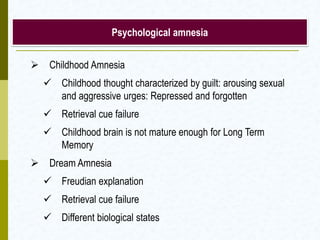
 Childhood Amnesia
 Childhood thought characterized by guilt: arousing sexual
and aggressive urges: Repressed and forgotten
 Retrieval cue failure
 Childhood brain is not mature enough for Long Term
Memory
 Dream Amnesia
 Freudian explanation
 Retrieval cue failure
 Different biological states
Psychological amnesia
Biological amnesia
 Global amnesia: Global loss of memory
Retrograde amnesia (Forgetting of events previously exposed to) and
anterograde amnesia (Inability to encode and store new information)
 Alcoholic amnesia
State dependent forgetting, prolonged alcoholism (Korsakoff
syndrome) vitamin-B deficits, chemical imbalances and irreversible
brain damages
 Diseases of brain
Senile dementia and Alzheimer’s disease
Improving memory
 Mnemonics: Acronyms
 The Method of Loci
 Deeper level of analysis: Association and elaboration of
information
 Chunking
 Making story by relating items
Thinking and language
Thinking
 Cognitive rearrangement and manipulation of
 Information from environment
 Symbols stored in LTM
 Cognitive process mediating between stimuli and
responses
Thinking and language
Images and thinking
 Images are mental representation of environmental objects
 We use images in our thought process as replacement of
the environmental objects
Thinking and language
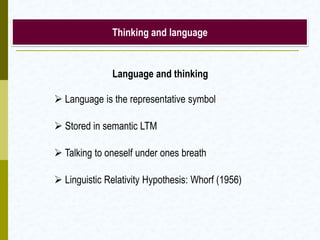
Language and thinking
 Language is the representative symbol
 Stored in semantic LTM
 Talking to oneself under ones breath
 Linguistic Relativity Hypothesis: Whorf (1956)
Creative thinking
 A novel and unique way of conceptualizing the world
 Insight: Sudden appearance of new ideas
Stages of creative thinking
1. Preparation: Formulating problem and collecting facts
2. Incubation: Obstruction in thinking; Lack of motivation
3. Illumination: Insight; Sudden solution
4. Evaluation: Testing whether idea works or not
5. Revision
Creative thinking
Nature of creative thinking and thinkers
 Divergent and autistic thinking
 Prefer complexity
 Greater independence in judgment
 Self-assertive and dominant
 Suppressed mechanism for the control of impulses
 Origence
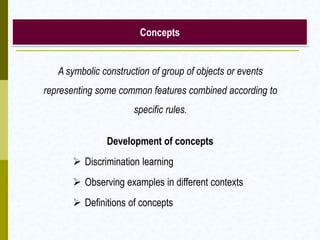
Concepts
Development of concepts
 Discrimination learning
 Observing examples in different contexts
 Definitions of concepts
A symbolic construction of group of objects or events
representing some common features combined according to
specific rules.
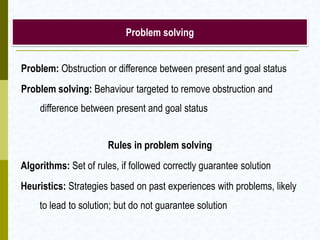
Problem solving
Problem: Obstruction or difference between present and goal status
Problem solving: Behaviour targeted to remove obstruction and
difference between present and goal status
Rules in problem solving
Algorithms: Set of rules, if followed correctly guarantee solution
Heuristics: Strategies based on past experiences with problems, likely
to lead to solution; but do not guarantee solution
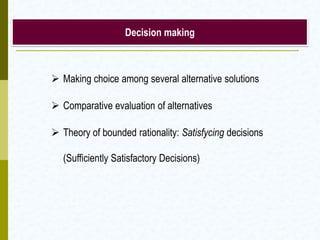
Decision making
 Making choice among several alternative solutions
 Comparative evaluation of alternatives
 Theory of bounded rationality: Satisfycing decisions
(Sufficiently Satisfactory Decisions)
Thank You

Cognitive Processes

  • 1.
  • 2.
    Sensory Processes: Registrationof sensory inputs Transduction: Conversion of physical energy into electric voltage by receptor cells (Receptor Potential) Sensation: Identification of physical energy Generator Potential (Nerve Impulse) : Transmission of nerve impulse through afferent codes to the respective region of the brain
  • 3.
    Vision: Structure andfunction of eye  Cornea  Pupil  Iris  Lens  Ciliary Muscles  Vitreous Humors  Retina (Cone and Rods)  Fovea Optic Disc  Occipital Lobe of the Neo-cortex
  • 4.
    Hearing: Structure andfunction of ear  Pinna  Auditory canal  Eardrum (Tympani membrane)  Ossicles: Malleus, Incus, Stapes  Oval window  Cochlea  Cochlear nerve  Temporal lobe of neo-cortex
  • 5.
    Smell  Smell Receptors:reactive to chemical energy  Location of smell receptors: In the roots of nasal passages leading from the nostrils to the throat  Olfactory bulb
  • 6.
    Taste  Taste Receptors(Taste buds): Reactive to chemical energy  Location of Taste Buds : Mostly on the tongue; Some of them at the back of mouth and in the throat,  Primary Tastes: Salty, Sour, Sweet and Bitter
  • 7.
    Location Tip and sidesof the tongue Sides of the tongue Tip of the tongue Back of the tongue Responsive to Salty solutions Sour stimuli Sweetness Bitter Taste
  • 8.
    Skin  The skinsenses: Touch and pressure sensation  Sensitivity variation in various parts of the body: Tongue, lips, face, hands most sensitive; arms, legs, trunks least sensitive  Temperature (Cold and warmth) Sensation:  Variation in temperature of skin surface  COLD WARMTH  Pain Sensation:  Skin and interior of the body 32°C-----33°C
  • 9.
    Attention Attention is aselective process to bring certain stimuli into focus of consciousness among a number of stimuli present in the perceptual field.
  • 10.
     Attention isselective process  Limited capacity perceptual system  Selection of certain stimuli for deeper level perceptual analysis  Filtering of other stimuli  State of readiness and responsiveness  Limited span  Fluctuation and shifting  Division of attention Characteristics of attention
  • 11.
    Perception Perception is theprocess of organizing and interpreting patterns of stimuli in the environment.
  • 12.
    Form perception  Figure-Background: Perception of a figure/object standing out of a background  Contours: A marked or abrupt change in brightness or colour in the visual field which separates figure from the background  Physiological process in contour formation: Differential distribution of light energy across the retina  Camouflage: Continuous change in brightness and colour; contours broken up; difficult to distinguish object from the background
  • 13.
    Gestalt principles ofperceptual organization 1. Law of proximity 2. Law of similarity 3. Law of symmetry 4. Law of continuation 5. Law of closure 6. Law of common fate Gestalt (Whole): Tendency to perceive the sensory field as organized as possible/situation allows
  • 14.
    Visual depth perception Meaning Relative distance of the objects  Depth in the surface of the objects Paradox of sensory process  Flat retinal surface : Perception of depth and distance  Use of cues coming from sensory inputs
  • 15.
    Cues in depthperception Binocular Cues  Retinal disparity  Accommodation and adjustment Monocular Cues  Linear perspective  Clearness  Interposition  Aerial perspective  Texture gradient  Size of the retinal image
  • 16.
    Perceptual constancy  BrightnessConstancy  Size Constancy  Unconscious Inference  A ratio between the retinal image and distance of the object is calculated unconsciously  This ratio is constant across situations; therefore, perceptual constancy
  • 17.
    Movement perception Real movement:Movement of stimulation across the retina despite steady eyes (movement of retinal image) Apparent movement: Perception of movement in the absence of physical of an image across the retina Stroboscopic motion: Successive pictures of a moving scene: perception of a smooth action (kind of perception in the movies) Auto kinetic effect: Staring at a small stationary spot of light in a completely dark room: The spot appears to move Induced movement: Movement in the framework induces perception of movement in the object
  • 18.
    Plasticity of perception Modifiability of perceptual ability along the developmental period  Sensitive period of perceptual development Individual Differences in Perception  Perceptual learning: Environmental richness  Set  Motives and needs  Cognitive styles: Field dependent-independent
  • 19.
    Learning  Change inbehaviour: Adaptive or maladaptive  Occurs through practice and experience  Does not occur through maturation, fatigue or species-specific behaviour  Relatively permanent
  • 20.
    Theory of classicalconditioning: Ivan P. Pavlov When a neutral stimulus (conditioned stimulus, CS) is paired with a natural stimulus (unconditioned stimulus, UCS), neutral stimulus alone acquires the ability to elicit the response (conditioned response, CR) which naturally occurs (unconditioned response, UCR) after natural stimulus
  • 21.
    Paradigm of classicalconditioning Stimulus Response Neutral/Conditioned Stimulus No response Natural/Unconditioned Stimulus Unconditioned response Continuous pairing of the two stimuli Neutral/Conditioned Stimulus (alone) Conditioned response
  • 22.
    Experimental phenomena ofclassical conditioning  Extinction  Spontaneous recovery  Reconditioning  Stimulus generalization and discrimination
  • 23.
    Theory of instrumentalconditioning: B. F. Skinner Behaviour Change in the environment Desirable Undesirable Increases the likelihood of behaviour Decreases the likelihood of behaviour
  • 24.
    Paradigm of instrumentalconditioning Nature of the event following a response Appetitive Aversive Consequenceofa response Onset of event Positive reinforcement (Increases the likelihood of behaviour) Punishment (Decreases the likelihood of behaviour) Termination of event Omission of reinforcement (Decreases the likelihood of behaviour) Negative reinforcement (Increases the likelihood of behaviour)
  • 25.
    Cognitive learning Learning withoutbeing involved in any active process  Selection of information from the environment  Making alterations in the selected information  Associating the items of information with each other  Elaborating information in thought  Storage of information  Retrieval of information when needed
  • 26.
    Observervational learning: AlbertBandura  Attention  Retention  Motivation  Production LATENT LEARNING
  • 27.
    Memory Sensory Register ShortTerm Memory Long Term Memory Duration Vision: Up to 1 second; Auditory: Up to 5 Seconds Up to 30 Seconds Days, months, years or lifetime Capacity Relatively large: Up to 16 items Relatively small: Up to 7±2 chunks Unlimited Transfer Process Attention and recognition: Attended and eecognized items transfer into STM Rehearsal: Rehearsed items transfer into LTM - Type of Information Copy of input Sounds, visual images, words, sentences Semantics, life events Process of Forgetting Decay of trace Displacement of old information by new one No real forgetting; Faulty organization of information, Inappropriate retrieval cue, Interference
  • 28.
    Type of longterm memory Semantic memory  Words and meanings; relations among words; rules of use in language and thinking  Storage in highly organized and associative manner  Stable in nature Episodic memory  Memory of events in our lives in relation to the time and place of their occurrences
  • 29.
    Forgetting Loss of informationfrom the memory store Process of forgetting  Decay of trace  Displacement of information  Retrieval problems  Interference Forgetting B (Proactive interference) Learning A Learning B Forgetting A (Retroactive interference)
  • 30.
    Amnesia Loss of memorywhich remains unexplained with the normal process of forgetting
  • 31.
     Childhood Amnesia Childhood thought characterized by guilt: arousing sexual and aggressive urges: Repressed and forgotten  Retrieval cue failure  Childhood brain is not mature enough for Long Term Memory  Dream Amnesia  Freudian explanation  Retrieval cue failure  Different biological states Psychological amnesia
  • 32.
    Biological amnesia  Globalamnesia: Global loss of memory Retrograde amnesia (Forgetting of events previously exposed to) and anterograde amnesia (Inability to encode and store new information)  Alcoholic amnesia State dependent forgetting, prolonged alcoholism (Korsakoff syndrome) vitamin-B deficits, chemical imbalances and irreversible brain damages  Diseases of brain Senile dementia and Alzheimer’s disease
  • 33.
    Improving memory  Mnemonics:Acronyms  The Method of Loci  Deeper level of analysis: Association and elaboration of information  Chunking  Making story by relating items
  • 34.
    Thinking and language Thinking Cognitive rearrangement and manipulation of  Information from environment  Symbols stored in LTM  Cognitive process mediating between stimuli and responses
  • 35.
    Thinking and language Imagesand thinking  Images are mental representation of environmental objects  We use images in our thought process as replacement of the environmental objects
  • 36.
    Thinking and language Languageand thinking  Language is the representative symbol  Stored in semantic LTM  Talking to oneself under ones breath  Linguistic Relativity Hypothesis: Whorf (1956)
  • 37.
    Creative thinking  Anovel and unique way of conceptualizing the world  Insight: Sudden appearance of new ideas Stages of creative thinking 1. Preparation: Formulating problem and collecting facts 2. Incubation: Obstruction in thinking; Lack of motivation 3. Illumination: Insight; Sudden solution 4. Evaluation: Testing whether idea works or not 5. Revision
  • 38.
    Creative thinking Nature ofcreative thinking and thinkers  Divergent and autistic thinking  Prefer complexity  Greater independence in judgment  Self-assertive and dominant  Suppressed mechanism for the control of impulses  Origence
  • 39.
    Concepts Development of concepts Discrimination learning  Observing examples in different contexts  Definitions of concepts A symbolic construction of group of objects or events representing some common features combined according to specific rules.
  • 40.
    Problem solving Problem: Obstructionor difference between present and goal status Problem solving: Behaviour targeted to remove obstruction and difference between present and goal status Rules in problem solving Algorithms: Set of rules, if followed correctly guarantee solution Heuristics: Strategies based on past experiences with problems, likely to lead to solution; but do not guarantee solution
  • 41.
    Decision making  Makingchoice among several alternative solutions  Comparative evaluation of alternatives  Theory of bounded rationality: Satisfycing decisions (Sufficiently Satisfactory Decisions)
  • 42.