Thinking about Thinking Cognitive Development Through The Curriculum
Theoretical Foundations Jean Piaget : Maturation evolves from a human organism’s self-motivated efforts to adapt to and make sense of day-to-day experiences. Based on the premise that allows children to build concepts actively rather than providing those concepts through direct teaching. “Development leads to learning”.  This theory is also called a “constructivist theory” because it allows for children to “construct” their knowledge from prior experiences.
Theoretical Foundations Piagetian theory Sensori-motor period (the first 2 years of life) Everything is dependent on the senses and on movement. The preoperational period (2-7 years) Mental ability of  Symbolic representation  is achieved Concrete Operations Period (7-11)  Children become much more reliant on logic than external appearances We have discussed these stages in detail  in previous classes, but here is a web site for further clarification Theory of cognitive development
Theoretical Foundations Behaviorism ;  Learning is controlled through by the consequences of behavior.  Through careful control of the learning environment through appropriate reinforcement to selected behaviors theorists believe they can affect children’s learning.  “Teaching is the art of changing the behavior of students.  Thus one focus of …teaching is the systematic management of the consequences of student behaviors” (Bushell, 1982, p. 161) Behaviorism
Theoretical Foundations Information Processing; Information processing defines itself because it is   concerned primarily with how human beings process information  (see figure 11-1 on pg. 337) Some terms associated with information processing Sensory register Short-term memory Long-term memory Central processor Information processing theory
Theoretical Foundations  The Zone of Proximal Development Development is not a fixed entity, but rather a dynamic and constantly changing continuum of behavior, degree of maturation. Two levels that form the parameters of development: Independent performance Maximally assisted performance Lev  Vygotsky
Thinking and Reasoning Skills  Cognitive Tasks Matching:  The ability to perceive that two items are identical, it depends on the child’s grasping concept of sameness and differences. “Show me the one that matches” or “Find me one that looks exactly the same” Grouping/Classification : Sorting objects or pictures into categories that are meaningful to them.  “Show me which ones you think should go together” “How come you put those together?”  To teach grouping, it is necessary to use materials that possess common properties but are not identical.
Thinking and Reasoning Skills Cognitive Tasks Perceiving Common Relations : The ability to identify and pair items that are usually associated together, but not identical.  It is similar to grouping because it depends on the identification of a common property or bond.  It differs from grouping because it involves pairing such items, rather than working with larger numbers of them.  Cause and Effect : It takes children a long time to develop clear ideas of physical causality, but they can begin to acquire this concept with the use of logical consequences as a primary means of discipline.  Questions such as, “What will happen if…?” or “What do you think made ……. Happen?”
Thinking and Reasoning Skills Cognitive Tasks Ordering : Arranging objects of events in logical order.  Two kinds of ordering that appear to be most useful: Spatial Ordering : arranging a variety of items according to a graduated seriated scale  Temporal Ordering :  arranging events as they occur in time   Conserving : The ability to recognize that the amount of the substance remains the same despite changes in the appearance.
Math Math Standards Number and operations:  recognizing how many are in a set, understanding one-to-one correspondence, and arranging objects in increasing order Algebra:  understanding patterns and relationships and being able to repeat these Geometry:  recognizing attributes of shape and describing spatial relationship Measurement:  comparing and seriating objects, beginning to measure objects, either using standard or nonstandard units of measure Problem solving:  providing an environment that encourages problem solving and verbalize children’s methods as they solve problems Data analysis and probability:  asking meaningful questions, and then charting answers
Science Science is a natural endeavor for young children who are constantly exploring, asking questions, wondering why or why not, observing touching, and tasting. Science IS children! Biological Sciences The human body Animals Plants Physical Sciences Physics Chemistry Meteorology
How can teachers help? Four factors working together to promote cognitive growth maturation -physical maturation (sound nutrition, good rest, physical activity) experience -an essential cornerstone of the early childhood experience socialization -conversational exchanges that allow children to test and modify what they think equilibration -the mechanism by which the child regulates her ideas and “puts everything together”
How to provide opportunities for practicing concept formation skills Develop needed materials Provide consistent opportunities for practice Make certain the activities are FUN!
What are They Learning? How can you make the activities “fun” and still meet the needs  of parents, administrators, political figures who insist that our children be “learning”?  Know the right word to say…so if someone says to you “ All I see them doing is playing with bubbles (or blocks, or playdough, or shaving cream) or any of the endless things chidren experiment with you can say… They are learning……
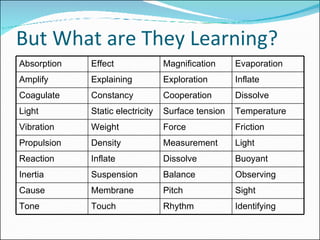
But What are They Learning? Absorption Effect Magnification Evaporation Amplify Explaining Exploration Inflate Coagulate Constancy Cooperation Dissolve Light Static electricity Surface tension Temperature Vibration Weight Force Friction Propulsion Density Measurement Light Reaction Inflate Dissolve Buoyant Inertia Suspension Balance Observing Cause Membrane Pitch Sight Tone Touch Rhythm Identifying
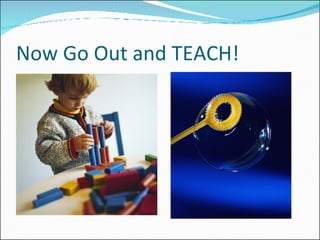
Now Go Out and TEACH!

Cognitive Development Through the Curriculum

  • 1.
    Thinking about ThinkingCognitive Development Through The Curriculum
  • 2.
    Theoretical Foundations JeanPiaget : Maturation evolves from a human organism’s self-motivated efforts to adapt to and make sense of day-to-day experiences. Based on the premise that allows children to build concepts actively rather than providing those concepts through direct teaching. “Development leads to learning”. This theory is also called a “constructivist theory” because it allows for children to “construct” their knowledge from prior experiences.
  • 3.
    Theoretical Foundations Piagetiantheory Sensori-motor period (the first 2 years of life) Everything is dependent on the senses and on movement. The preoperational period (2-7 years) Mental ability of Symbolic representation is achieved Concrete Operations Period (7-11) Children become much more reliant on logic than external appearances We have discussed these stages in detail in previous classes, but here is a web site for further clarification Theory of cognitive development
  • 4.
    Theoretical Foundations Behaviorism; Learning is controlled through by the consequences of behavior. Through careful control of the learning environment through appropriate reinforcement to selected behaviors theorists believe they can affect children’s learning. “Teaching is the art of changing the behavior of students. Thus one focus of …teaching is the systematic management of the consequences of student behaviors” (Bushell, 1982, p. 161) Behaviorism
  • 5.
    Theoretical Foundations InformationProcessing; Information processing defines itself because it is concerned primarily with how human beings process information (see figure 11-1 on pg. 337) Some terms associated with information processing Sensory register Short-term memory Long-term memory Central processor Information processing theory
  • 6.
    Theoretical Foundations The Zone of Proximal Development Development is not a fixed entity, but rather a dynamic and constantly changing continuum of behavior, degree of maturation. Two levels that form the parameters of development: Independent performance Maximally assisted performance Lev Vygotsky
  • 7.
    Thinking and ReasoningSkills Cognitive Tasks Matching: The ability to perceive that two items are identical, it depends on the child’s grasping concept of sameness and differences. “Show me the one that matches” or “Find me one that looks exactly the same” Grouping/Classification : Sorting objects or pictures into categories that are meaningful to them. “Show me which ones you think should go together” “How come you put those together?” To teach grouping, it is necessary to use materials that possess common properties but are not identical.
  • 8.
    Thinking and ReasoningSkills Cognitive Tasks Perceiving Common Relations : The ability to identify and pair items that are usually associated together, but not identical. It is similar to grouping because it depends on the identification of a common property or bond. It differs from grouping because it involves pairing such items, rather than working with larger numbers of them. Cause and Effect : It takes children a long time to develop clear ideas of physical causality, but they can begin to acquire this concept with the use of logical consequences as a primary means of discipline. Questions such as, “What will happen if…?” or “What do you think made ……. Happen?”
  • 9.
    Thinking and ReasoningSkills Cognitive Tasks Ordering : Arranging objects of events in logical order. Two kinds of ordering that appear to be most useful: Spatial Ordering : arranging a variety of items according to a graduated seriated scale Temporal Ordering : arranging events as they occur in time Conserving : The ability to recognize that the amount of the substance remains the same despite changes in the appearance.
  • 10.
    Math Math StandardsNumber and operations: recognizing how many are in a set, understanding one-to-one correspondence, and arranging objects in increasing order Algebra: understanding patterns and relationships and being able to repeat these Geometry: recognizing attributes of shape and describing spatial relationship Measurement: comparing and seriating objects, beginning to measure objects, either using standard or nonstandard units of measure Problem solving: providing an environment that encourages problem solving and verbalize children’s methods as they solve problems Data analysis and probability: asking meaningful questions, and then charting answers
  • 11.
    Science Science isa natural endeavor for young children who are constantly exploring, asking questions, wondering why or why not, observing touching, and tasting. Science IS children! Biological Sciences The human body Animals Plants Physical Sciences Physics Chemistry Meteorology
  • 12.
    How can teachershelp? Four factors working together to promote cognitive growth maturation -physical maturation (sound nutrition, good rest, physical activity) experience -an essential cornerstone of the early childhood experience socialization -conversational exchanges that allow children to test and modify what they think equilibration -the mechanism by which the child regulates her ideas and “puts everything together”
  • 13.
    How to provideopportunities for practicing concept formation skills Develop needed materials Provide consistent opportunities for practice Make certain the activities are FUN!
  • 14.
    What are TheyLearning? How can you make the activities “fun” and still meet the needs of parents, administrators, political figures who insist that our children be “learning”? Know the right word to say…so if someone says to you “ All I see them doing is playing with bubbles (or blocks, or playdough, or shaving cream) or any of the endless things chidren experiment with you can say… They are learning……
  • 15.
    But What areThey Learning? Absorption Effect Magnification Evaporation Amplify Explaining Exploration Inflate Coagulate Constancy Cooperation Dissolve Light Static electricity Surface tension Temperature Vibration Weight Force Friction Propulsion Density Measurement Light Reaction Inflate Dissolve Buoyant Inertia Suspension Balance Observing Cause Membrane Pitch Sight Tone Touch Rhythm Identifying
  • 16.
    Now Go Outand TEACH!