THINKING
Thinking  are  mental   forms  and  processes , respectively. Thinking  allows beings to  model  the world and to deal with it according to their  objectives ,  plans , ends and  desires .  Thinking  involves the mental manipulation of  information , as when we form  concepts , engage in  problem solving ,  reason  and make  decisions .  Definition:
TYPES OF THINKING Autistic thinking   preoccupation with inner thoughts, daydreams, fantasies, private logic; egocentric, subjective thinking lacking objectivity and connection with external reality.  Realistic Thinking  is controlled, constructive, directive, realistic and factual based thinking.
COGNITIVE PSYCHOLOGY Cognitive psychology is the branch of psychology that studies mental processes including how people think, perceive, remember and learn. As part of the larger field of cognitive science, this branch of psychology is related to other disciplines including neuroscience, philosophy, and linguistics.
COGNITIVE PSYCHOLOGY AND  COMPUTER SCIENCES
Computer programming potentially involves  understanding  (application context and possibility),  planning  (design),  imaging  (imagination and visualization),  attitude  (acceptance of work involved and confidence in completing projects),  logic  (conceptualization, language use, and knowledge),  creativity  (artistry) and  work  (persistance, exploration, purpose and commitment). It adds together small steps of progress that may reach vast distances and a seemingly endless vista. Computer programming involves some of the same skills as writing (creativity, sequence, logic), offers tests as regimental as athletics or the military (in a demanding environment) and yields products that function as engineered tools (manufactured objects) capable of multiplying the effect of one who uses the programs. Computer programming perhaps more than any other manufacturing endeavor begins with a thought and through skilled application of knowledge yields an intrinsically proven object that is itself almost mental (encoded electrical information). Work that is so much a product of thought may benefit from cognitive psychology, the study of mental processes. Though the present report focuses on computer programming, the applications of cognitive psychology will be seen to benefit other mental work as well.
Uses of Cognitive Psychology in Computer Programming Understanding, Planning, and Logic   Capacity   Knowledge   Association   Objects   Imaging and Creativity   Analogies for program functions   Attitude and Work   Behavior   Team Work
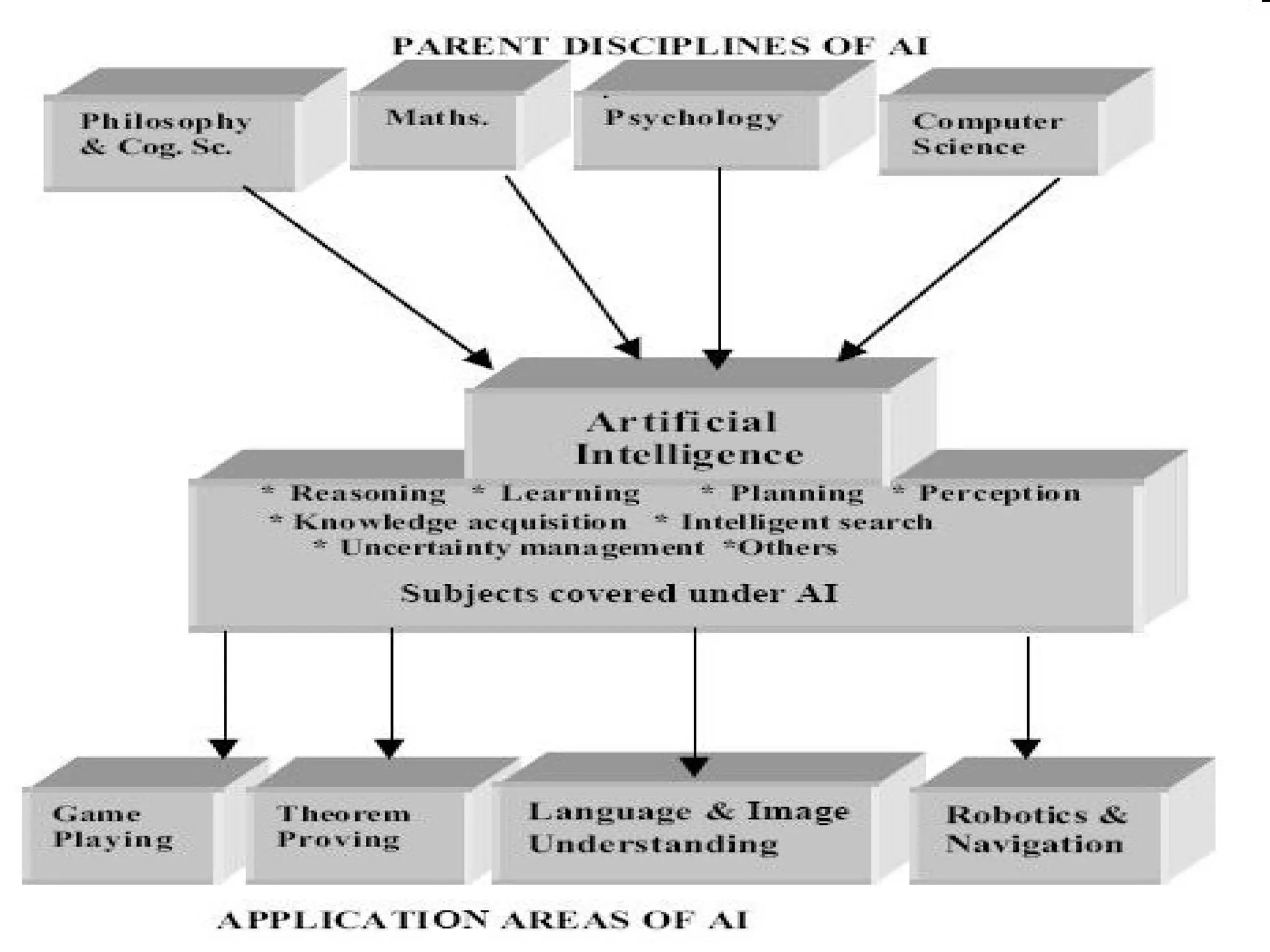
Artificial Intelligence Artificial intelligence (AI) involves the study of cognitive phenomena in machines. One of the practical goals of AI is to implement aspects of human intelligence in computers. Computers are also widely used as a tool with which to study cognitive phenomena.  Computational modeling  uses simulations to study how human intelligence may be structured.
 
Tools of Thoughts: Language  is a form of communication that is:- Based on system of symbols. Through written and spoken. Rules of language: Phonology (study of language by sound system) Morphology (they are meaningful strings of sound that contains no smaller meaningful parts) Syntax (the way words are combined to form acceptable phrases and sentences) Semantics (giving meaning to your words)
Decision making Decision making  can be regarded as an outcome of mental processes ( cognitive process ) leading to the selection of a course of action among several alternatives. Every decision making process produces a final  choice . [1]  The output can be an action or an opinion of choice.
TECHNIQUES OF DECISION MAKING Identify the purpose of your decision.   Gather information.   Identify the principles to judge the alternatives.   Brainstorm and list different possible choices.   Evaluate each choice in terms of its consequences.   Determine the best alternative.   Put the decision into action.   Evaluate the outcome of your decision and action steps.
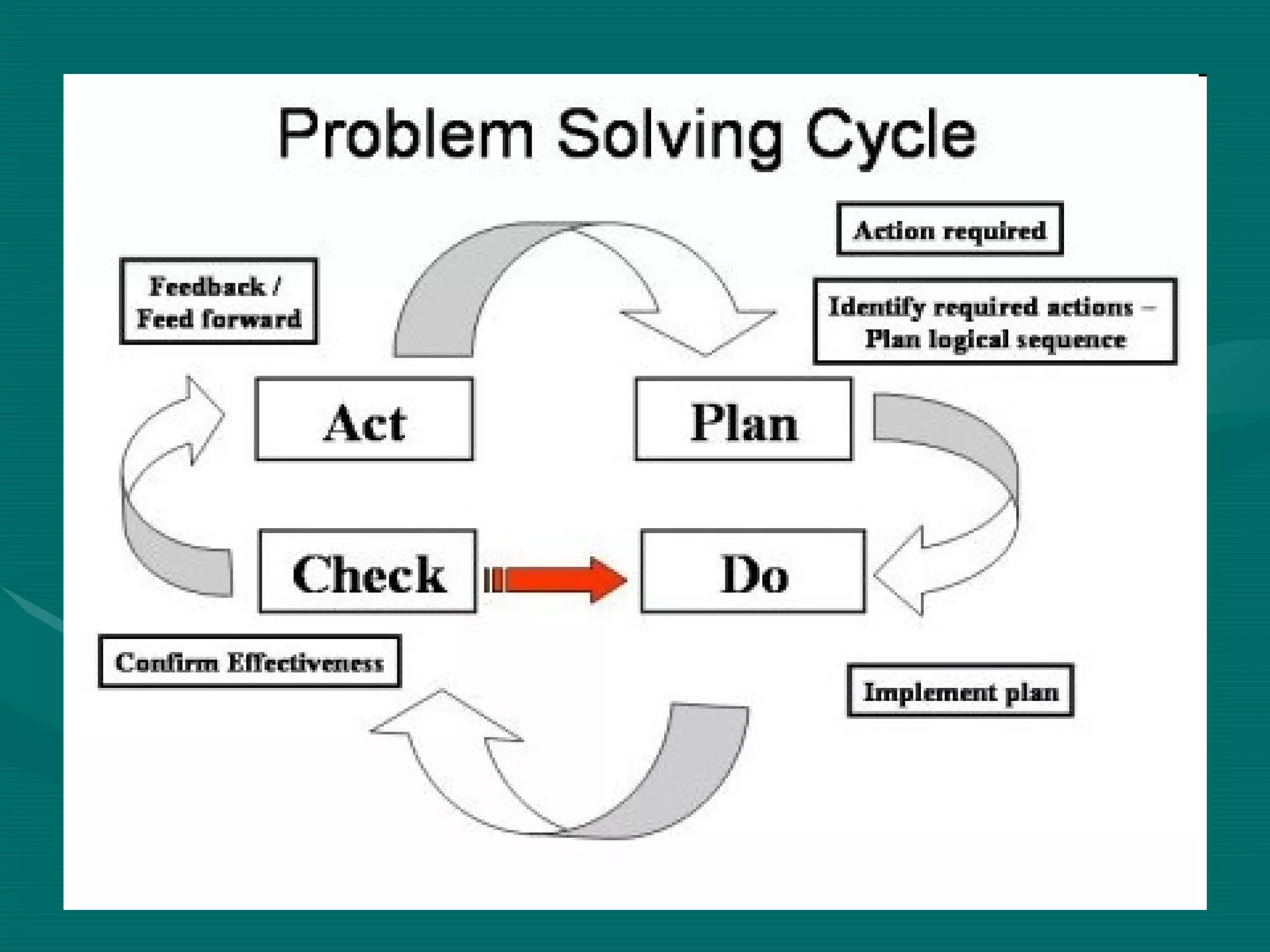
PROBLEM SOLVING Problem solving  forms part of  thinking . Considered the most complex of all  intellectual  functions, problem solving has been defined as higher-order  cognitive  process that requires the modulation and control of more routine or fundamental skills.  [1]  It occurs if an  organism  or an  artificial intelligence   system  does not know how to proceed from a given state to a desired goal state. It is part of the larger  problem  process that includes  problem finding  and  problem shaping .
 
Types of Problems: Problems are categorized in three ways: Arrangement Problems  require the problem solver to rearrange or recombine elements in a way that will satisfy a certain criterion. For example scrabble in which we arrange different letters to make word.  Inducing structure  requires a solver to identify the existing relationship among the elements presented and then construct a new relationship among them. Transformation  problems gives you only the start and end state and the procedure or method to be followed, for example the problem of tower of Hanoi, in which 52 rings are to placed using the 3 pegs only with the condition that you cannot place a bigger ring on the smaller one. Such problems are solved by the  knowledge ,  Insight  and  hit and trial method  (trial and error). Through practicing we can make our problem solving skills better.
Problem Solving (IDEAL) John Branford and Berry Stain introduced the  IDEAL  method, a  very basic type  of method, for solving a problem:- I = I dentify your problem. D =  D efine, specify and present your problem. E =  E xplore possible strategies. A =  A ct on the explored strategies and plans. L =  L ook back and evaluate the results.
Problem solving methods are classified  as: Algorithms Heuristics
Algorithm  is an approach to find a step by step solution to a problem. It is a rule that if applied appropriately, guarantees a solution to a problem.  Example of algorithmic approach: You have given the two sides of a right angle triangle and have to find the third side. You have to ponder on the problem that is you are going to think on it and the steps will almost be: Make a shape of right angle triangle in your mind (concept). Get the length of the base of triangle. Get the perpendicular of the triangle. Now you will apply the Pythagoras theorem. Finally, you will get a correct result.
Heuristic  is a rule of thumb that can suggest a solution to a problem but it does not ensure that it will solve the problem. It is a cognitive shortcut that may lead to a solution. Example of the heuristic approach: You are playing tic-tac-toe, when you are going to start the game you will the cross at the center… why? The past experiences shows that placing your cross at the center will increase the probability of winning the game, again that does not ensure that you are going to win the game.
REASONING Reasoning  is the  cognitive  process of looking for  reasons  for beliefs, conclusions, actions or feelings. Although reasoning was once thought to be a uniquely human capability, other animals also engage in  reasoning .  The mental activity of transforming information to reach conclusion.
Deductive Reasoning Reasoning from general to specific. It begins with the series of assumptions or premises that are thought to be true. If assumptions are true then conclusion must be true. One classic example of deductive reasoning is that found in  syllogisms  like the following: Premise 1: All humans are mortal. Premise 2: Socrates is a human. Conclusion: Socrates is mortal.
Inductive Reasoning Reasoning from specific to general. It is a reasoning process where by a general rule is inferred from specific cases using Observation Knowledge and experience.  A classic example of inductive reasoning : Premise: The sun has risen in the east every morning up until now. Conclusion: The sun will also rise in the east tomorrow.
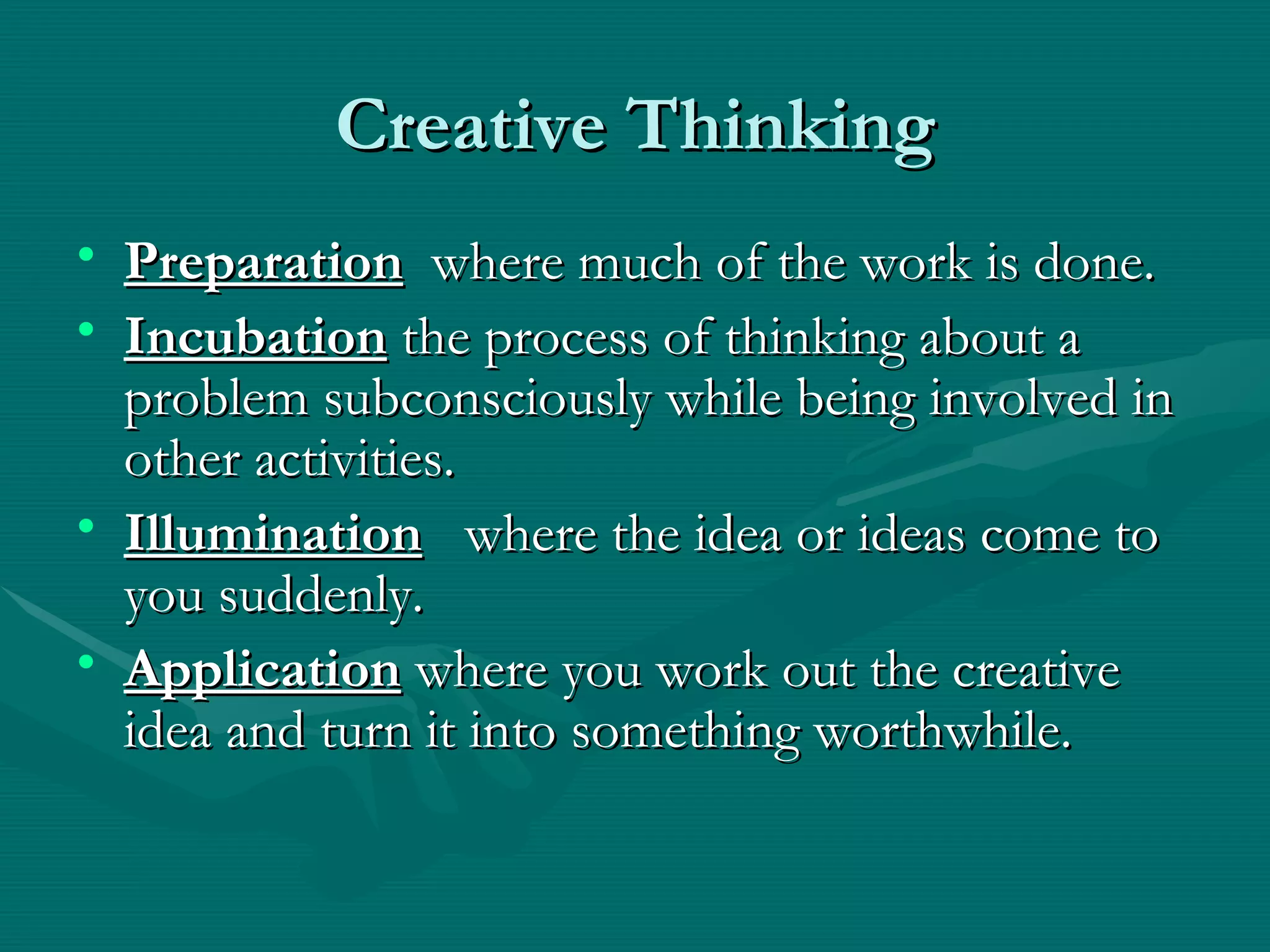
Creative Thinking Preparation   where much of the work is done.  Incubation  the process of thinking about a problem subconsciously while being involved in other activities. Illumination   where the idea or ideas come to you suddenly.  Application  where you work out the creative idea and turn it into something worthwhile.
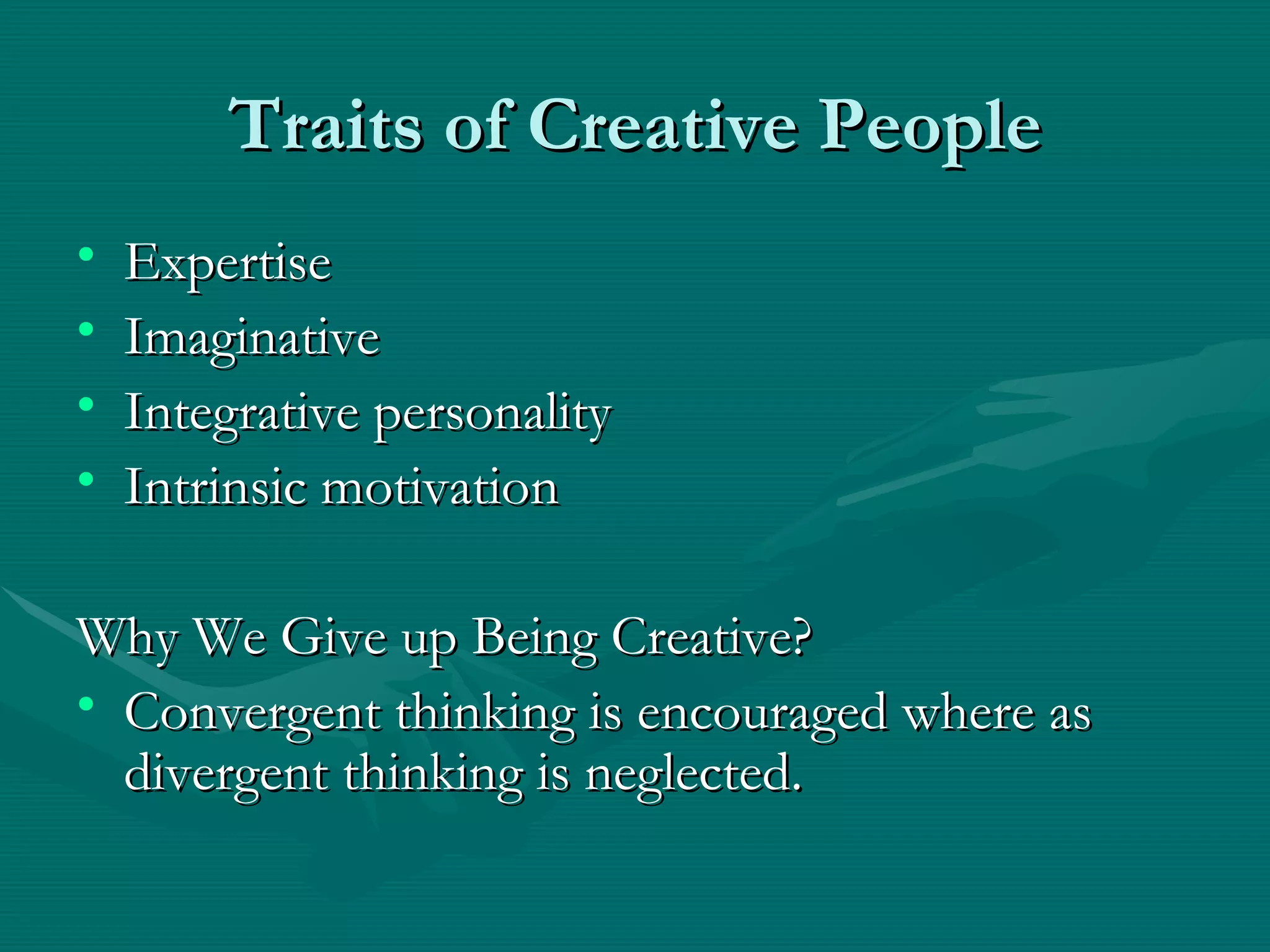
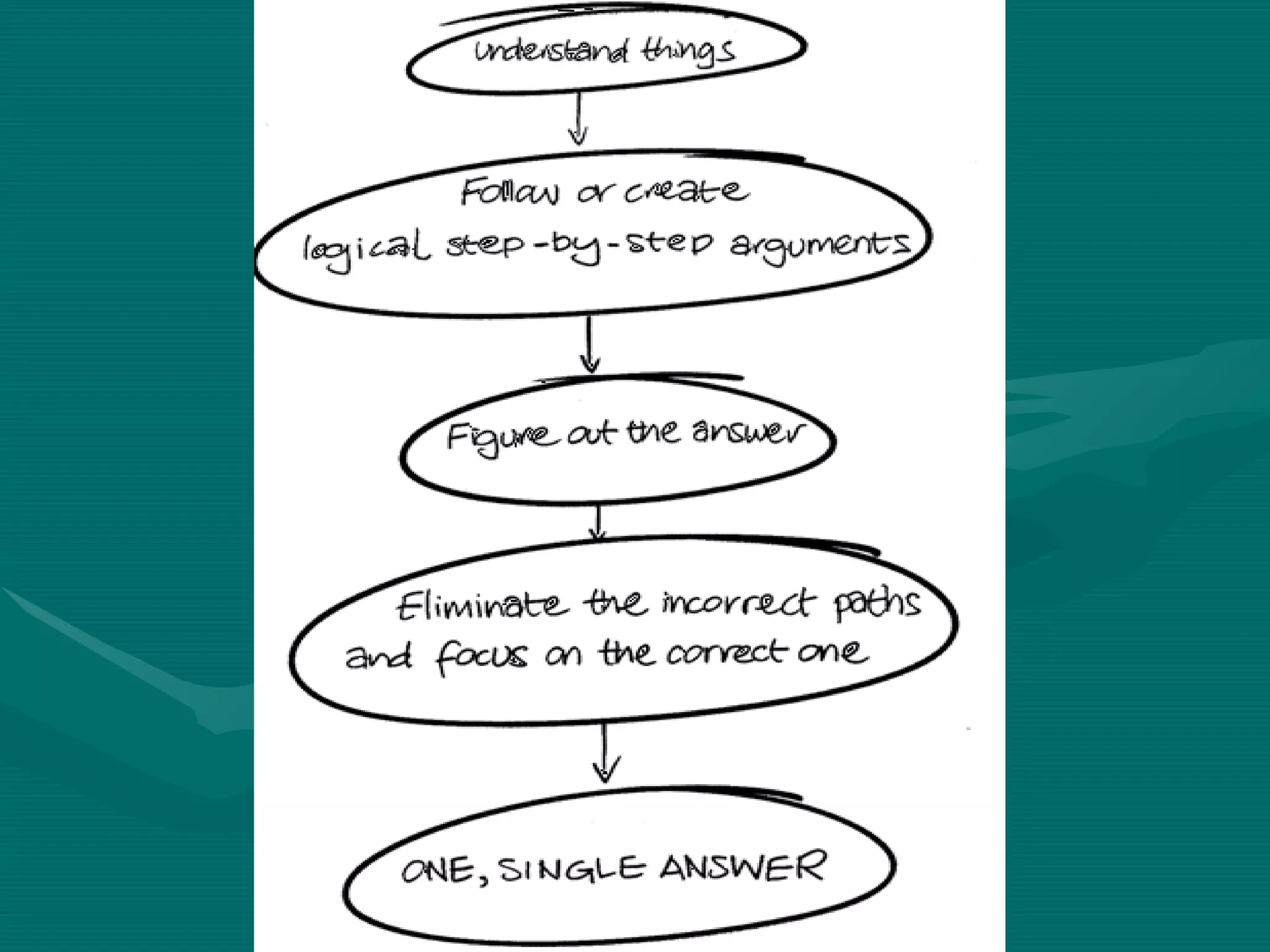
Traits of Creative People Expertise Imaginative Integrative personality Intrinsic motivation Why We Give up Being Creative? Convergent thinking is encouraged where as divergent thinking is neglected.
 

Thinking

  • 1.
  • 2.
    Thinking are mental forms and processes , respectively. Thinking allows beings to model the world and to deal with it according to their objectives , plans , ends and desires . Thinking involves the mental manipulation of information , as when we form concepts , engage in problem solving , reason and make decisions . Definition:
  • 3.
    TYPES OF THINKINGAutistic thinking   preoccupation with inner thoughts, daydreams, fantasies, private logic; egocentric, subjective thinking lacking objectivity and connection with external reality. Realistic Thinking is controlled, constructive, directive, realistic and factual based thinking.
  • 4.
    COGNITIVE PSYCHOLOGY Cognitivepsychology is the branch of psychology that studies mental processes including how people think, perceive, remember and learn. As part of the larger field of cognitive science, this branch of psychology is related to other disciplines including neuroscience, philosophy, and linguistics.
  • 5.
    COGNITIVE PSYCHOLOGY AND COMPUTER SCIENCES
  • 6.
    Computer programming potentiallyinvolves understanding (application context and possibility), planning (design), imaging (imagination and visualization), attitude (acceptance of work involved and confidence in completing projects), logic (conceptualization, language use, and knowledge), creativity (artistry) and work (persistance, exploration, purpose and commitment). It adds together small steps of progress that may reach vast distances and a seemingly endless vista. Computer programming involves some of the same skills as writing (creativity, sequence, logic), offers tests as regimental as athletics or the military (in a demanding environment) and yields products that function as engineered tools (manufactured objects) capable of multiplying the effect of one who uses the programs. Computer programming perhaps more than any other manufacturing endeavor begins with a thought and through skilled application of knowledge yields an intrinsically proven object that is itself almost mental (encoded electrical information). Work that is so much a product of thought may benefit from cognitive psychology, the study of mental processes. Though the present report focuses on computer programming, the applications of cognitive psychology will be seen to benefit other mental work as well.
  • 7.
    Uses of CognitivePsychology in Computer Programming Understanding, Planning, and Logic Capacity Knowledge Association Objects Imaging and Creativity Analogies for program functions Attitude and Work Behavior Team Work
  • 8.
    Artificial Intelligence Artificialintelligence (AI) involves the study of cognitive phenomena in machines. One of the practical goals of AI is to implement aspects of human intelligence in computers. Computers are also widely used as a tool with which to study cognitive phenomena. Computational modeling uses simulations to study how human intelligence may be structured.
  • 9.
  • 10.
    Tools of Thoughts:Language is a form of communication that is:- Based on system of symbols. Through written and spoken. Rules of language: Phonology (study of language by sound system) Morphology (they are meaningful strings of sound that contains no smaller meaningful parts) Syntax (the way words are combined to form acceptable phrases and sentences) Semantics (giving meaning to your words)
  • 11.
    Decision making Decisionmaking can be regarded as an outcome of mental processes ( cognitive process ) leading to the selection of a course of action among several alternatives. Every decision making process produces a final choice . [1] The output can be an action or an opinion of choice.
  • 12.
    TECHNIQUES OF DECISIONMAKING Identify the purpose of your decision. Gather information. Identify the principles to judge the alternatives. Brainstorm and list different possible choices. Evaluate each choice in terms of its consequences. Determine the best alternative. Put the decision into action. Evaluate the outcome of your decision and action steps.
  • 13.
    PROBLEM SOLVING Problemsolving forms part of thinking . Considered the most complex of all intellectual functions, problem solving has been defined as higher-order cognitive process that requires the modulation and control of more routine or fundamental skills. [1] It occurs if an organism or an artificial intelligence system does not know how to proceed from a given state to a desired goal state. It is part of the larger problem process that includes problem finding and problem shaping .
  • 14.
  • 15.
    Types of Problems:Problems are categorized in three ways: Arrangement Problems require the problem solver to rearrange or recombine elements in a way that will satisfy a certain criterion. For example scrabble in which we arrange different letters to make word. Inducing structure requires a solver to identify the existing relationship among the elements presented and then construct a new relationship among them. Transformation problems gives you only the start and end state and the procedure or method to be followed, for example the problem of tower of Hanoi, in which 52 rings are to placed using the 3 pegs only with the condition that you cannot place a bigger ring on the smaller one. Such problems are solved by the knowledge , Insight and hit and trial method (trial and error). Through practicing we can make our problem solving skills better.
  • 16.
    Problem Solving (IDEAL)John Branford and Berry Stain introduced the IDEAL method, a very basic type of method, for solving a problem:- I = I dentify your problem. D = D efine, specify and present your problem. E = E xplore possible strategies. A = A ct on the explored strategies and plans. L = L ook back and evaluate the results.
  • 17.
    Problem solving methodsare classified as: Algorithms Heuristics
  • 18.
    Algorithm isan approach to find a step by step solution to a problem. It is a rule that if applied appropriately, guarantees a solution to a problem. Example of algorithmic approach: You have given the two sides of a right angle triangle and have to find the third side. You have to ponder on the problem that is you are going to think on it and the steps will almost be: Make a shape of right angle triangle in your mind (concept). Get the length of the base of triangle. Get the perpendicular of the triangle. Now you will apply the Pythagoras theorem. Finally, you will get a correct result.
  • 19.
    Heuristic isa rule of thumb that can suggest a solution to a problem but it does not ensure that it will solve the problem. It is a cognitive shortcut that may lead to a solution. Example of the heuristic approach: You are playing tic-tac-toe, when you are going to start the game you will the cross at the center… why? The past experiences shows that placing your cross at the center will increase the probability of winning the game, again that does not ensure that you are going to win the game.
  • 20.
    REASONING Reasoning is the cognitive process of looking for reasons for beliefs, conclusions, actions or feelings. Although reasoning was once thought to be a uniquely human capability, other animals also engage in reasoning . The mental activity of transforming information to reach conclusion.
  • 21.
    Deductive Reasoning Reasoningfrom general to specific. It begins with the series of assumptions or premises that are thought to be true. If assumptions are true then conclusion must be true. One classic example of deductive reasoning is that found in syllogisms like the following: Premise 1: All humans are mortal. Premise 2: Socrates is a human. Conclusion: Socrates is mortal.
  • 22.
    Inductive Reasoning Reasoningfrom specific to general. It is a reasoning process where by a general rule is inferred from specific cases using Observation Knowledge and experience. A classic example of inductive reasoning : Premise: The sun has risen in the east every morning up until now. Conclusion: The sun will also rise in the east tomorrow.
  • 23.
    Creative Thinking Preparation where much of the work is done. Incubation the process of thinking about a problem subconsciously while being involved in other activities. Illumination where the idea or ideas come to you suddenly. Application where you work out the creative idea and turn it into something worthwhile.
  • 24.
    Traits of CreativePeople Expertise Imaginative Integrative personality Intrinsic motivation Why We Give up Being Creative? Convergent thinking is encouraged where as divergent thinking is neglected.
  • 25.