Attention
 The activity of concentrating our mind on one particular
task is called attention.
 It means to take possession of by the mind in clear and
vivid form of one out of several simultaneous objects.
 The heightened focus which we experience during
attention increases our ability to respond speedily and
accurately to interesting stimuli
 Major benefits of attention are :
 Helps in monitoring our interaction with environment.
 Assists us in linking past & present to give a sense of
continuity of experience .
 Helps us in controlling and planning for future actions.
Definition
 “Attention is taking possession of the mind . In clear
and vivid form, of one out of what seems several
simultaneously possible objects or train of thoughts ….
It implies withdrawal from some things in order to
deal effectively with others”
-William James
Principles of psychology
 “Attention is the concentration of consciousness upon
one object rather than others”
- Dumvile
Nature
 It is changeable
 It is selective
 It is a mental process
 It is a state of preparedness
 It is alertness
 It has a narrow span
 It is to focus on a particular
object
 It has limited span
Determinants
 Internal factors
 Interest
 Curiosity
 Emotional state
 Motive
 Expectancy
 External factor
 Nature of stimulus
 Intensity and size
 Contrast , change and
variety
 Repetition and movement
of stimulus
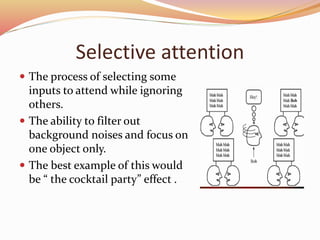
Selective attention
 The process of selecting some
inputs to attend while ignoring
others.
 The ability to filter out
background noises and focus on
one object only.
 The best example of this would
be “ the cocktail party” effect .
Studies
CHERRY (1953) studied the process of “ Dichotic
Listening” He presented two messages to subjects –
one to each ear through earphones. It involves
simultaneously sending one message to a persons right
ear and a different message to their left ear.
Participants had to listen to both at the same time and
repeat what they heard.
The experiment showed that very little content was
picked up from unsharpened message and processing
was minimal. They could notice change in voice when
it was switched from male voice to female voice.
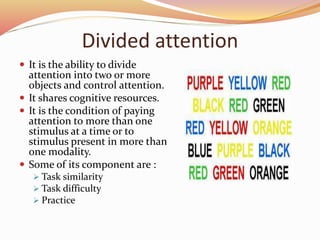
Divided attention
 It is the ability to divide
attention into two or more
objects and control attention.
 It shares cognitive resources.
 It is the condition of paying
attention to more than one
stimulus at a time or to
stimulus present in more than
one modality.
 Some of its component are :
 Task similarity
 Task difficulty
 Practice
Studies
Spelke,hirst &Neisser (1976) investigated on Dual
Task Paradigm which involves two tasks ( Task A and
B) and three conditions ( Task A only , Task B only ,
Tasks A &B) The idea was to compare and contrast
latency (response time) and accuracy of performance
in all 3 conditions .
The research showed that speed and accuracy of
simultaneous performance was quite poor. But given
time to practice their performance improved in speed
of reading , accuracy of reading comprehension,
increased in recognition words.
Automaticity
 It is the ability to do things without occupying mind
with low level details required, allowing it to become
an automatic response, pattern or habit.
 It is the result of learning , repetition & practice.
 it frees up resources and makes cognitive components
independently active .
 It basically means self executing.
 Posner & Snyder (1974) have given some criteria;
 It should be unintentional.
 It should occur unconsciously
 It should occur without depliting additional
processes(ongoing cognitive activities)
Sustained Attention
 It refers to a persons ability to attend to a field of
stimulation over a prolonged period of time , during which
individual is to detect the appearance of a particular target
stimulus of interest.
 Factors influencing sustained attention
 Clarity of stimuli : intense & long lasting stimuli facilitates
sustained attention and performance is relatively better.
 Sensory modality :performance is better when stimulus is
visual .
 Temporal uncertainty :stimulus which appears at regular
interval are better attended to than stimulus which are
appering at irregular intervals.
 Spatial uncertainty :stimulus that appear at fixed place readily
attended to than those that appear at random location.
Studies
Mackworth (1950) used Clock Test method to study
sustained attention. A clock hand moves in
continuous steps. Every once in a while the clock takes
a double step. The task of participants was to press a
button as soon as possible after observing double step .
Their performance deteriorated after half an hour of
observation.
It appears to be due to the increased doubtfulness
about perceived observation. Participants became less
likely to report false alarm and increased rate of miss.
Fatigue also hinders performance
Thank You
For Paying Attention

Attention in cognitive Psychology

  • 2.
    Attention  The activityof concentrating our mind on one particular task is called attention.  It means to take possession of by the mind in clear and vivid form of one out of several simultaneous objects.  The heightened focus which we experience during attention increases our ability to respond speedily and accurately to interesting stimuli  Major benefits of attention are :  Helps in monitoring our interaction with environment.  Assists us in linking past & present to give a sense of continuity of experience .  Helps us in controlling and planning for future actions.
  • 3.
    Definition  “Attention istaking possession of the mind . In clear and vivid form, of one out of what seems several simultaneously possible objects or train of thoughts …. It implies withdrawal from some things in order to deal effectively with others” -William James Principles of psychology  “Attention is the concentration of consciousness upon one object rather than others” - Dumvile
  • 4.
    Nature  It ischangeable  It is selective  It is a mental process  It is a state of preparedness  It is alertness  It has a narrow span  It is to focus on a particular object  It has limited span Determinants  Internal factors  Interest  Curiosity  Emotional state  Motive  Expectancy  External factor  Nature of stimulus  Intensity and size  Contrast , change and variety  Repetition and movement of stimulus
  • 5.
    Selective attention  Theprocess of selecting some inputs to attend while ignoring others.  The ability to filter out background noises and focus on one object only.  The best example of this would be “ the cocktail party” effect .
  • 6.
    Studies CHERRY (1953) studiedthe process of “ Dichotic Listening” He presented two messages to subjects – one to each ear through earphones. It involves simultaneously sending one message to a persons right ear and a different message to their left ear. Participants had to listen to both at the same time and repeat what they heard. The experiment showed that very little content was picked up from unsharpened message and processing was minimal. They could notice change in voice when it was switched from male voice to female voice.
  • 7.
    Divided attention  Itis the ability to divide attention into two or more objects and control attention.  It shares cognitive resources.  It is the condition of paying attention to more than one stimulus at a time or to stimulus present in more than one modality.  Some of its component are :  Task similarity  Task difficulty  Practice
  • 8.
    Studies Spelke,hirst &Neisser (1976)investigated on Dual Task Paradigm which involves two tasks ( Task A and B) and three conditions ( Task A only , Task B only , Tasks A &B) The idea was to compare and contrast latency (response time) and accuracy of performance in all 3 conditions . The research showed that speed and accuracy of simultaneous performance was quite poor. But given time to practice their performance improved in speed of reading , accuracy of reading comprehension, increased in recognition words.
  • 9.
    Automaticity  It isthe ability to do things without occupying mind with low level details required, allowing it to become an automatic response, pattern or habit.  It is the result of learning , repetition & practice.  it frees up resources and makes cognitive components independently active .  It basically means self executing.  Posner & Snyder (1974) have given some criteria;  It should be unintentional.  It should occur unconsciously  It should occur without depliting additional processes(ongoing cognitive activities)
  • 10.
    Sustained Attention  Itrefers to a persons ability to attend to a field of stimulation over a prolonged period of time , during which individual is to detect the appearance of a particular target stimulus of interest.  Factors influencing sustained attention  Clarity of stimuli : intense & long lasting stimuli facilitates sustained attention and performance is relatively better.  Sensory modality :performance is better when stimulus is visual .  Temporal uncertainty :stimulus which appears at regular interval are better attended to than stimulus which are appering at irregular intervals.  Spatial uncertainty :stimulus that appear at fixed place readily attended to than those that appear at random location.
  • 11.
    Studies Mackworth (1950) usedClock Test method to study sustained attention. A clock hand moves in continuous steps. Every once in a while the clock takes a double step. The task of participants was to press a button as soon as possible after observing double step . Their performance deteriorated after half an hour of observation. It appears to be due to the increased doubtfulness about perceived observation. Participants became less likely to report false alarm and increased rate of miss. Fatigue also hinders performance
  • 12.