Chapter 4: Perception
 
Ilusiones Perceptuales Ilusiones Ópticas – estímulos físicos que producen todo el tiempo errores en la percepción
http://www.anarkasis.com/percepcion/0900_Ebbyngh/
Perception Is… The process of recognizing, organizing and interpreting information How do you recognize these items?
 
Perceptual Basics Sensory Adaptation Occurs when sensory receptors change their sensitivity to the stimulus Constant stimulation leads to lower sensitivity Our senses respond to change
Perceptual Basics Perceptual Constancy Object remains the same even though our sensation of the object changes  Example:  Shape constancy
Depth Perception The ability to see the world in 3 dimensions and detect distance Vision only has a 2-dimensional view We must interpret the information given to perceive depth We take flat images and create a three dimensional view Optical illusions demonstrate that this interpretation does not always have to be correct
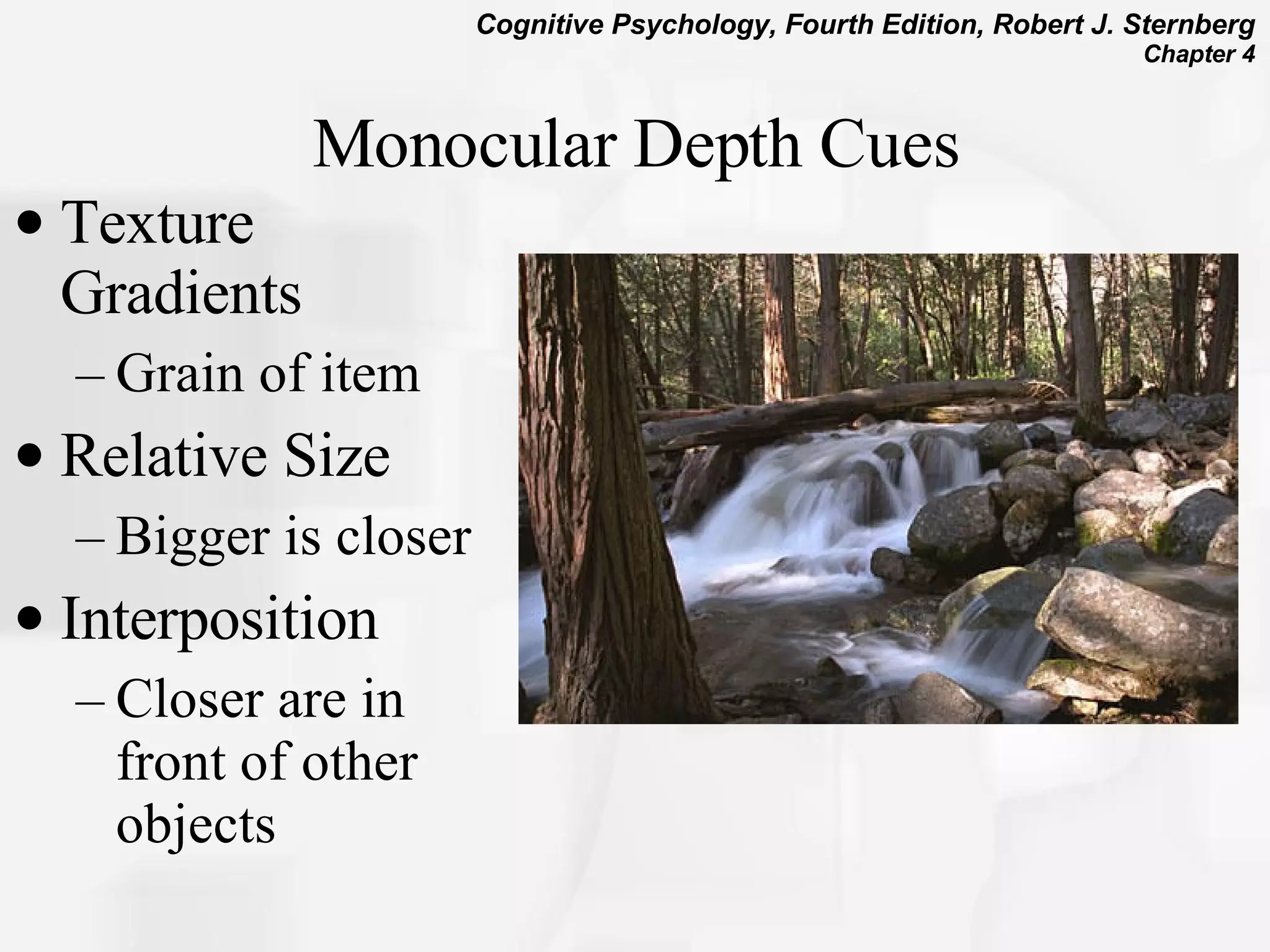
Texture Gradients Grain of item Relative Size Bigger is closer Interposition Closer are in front of other objects Monocular Depth Cues
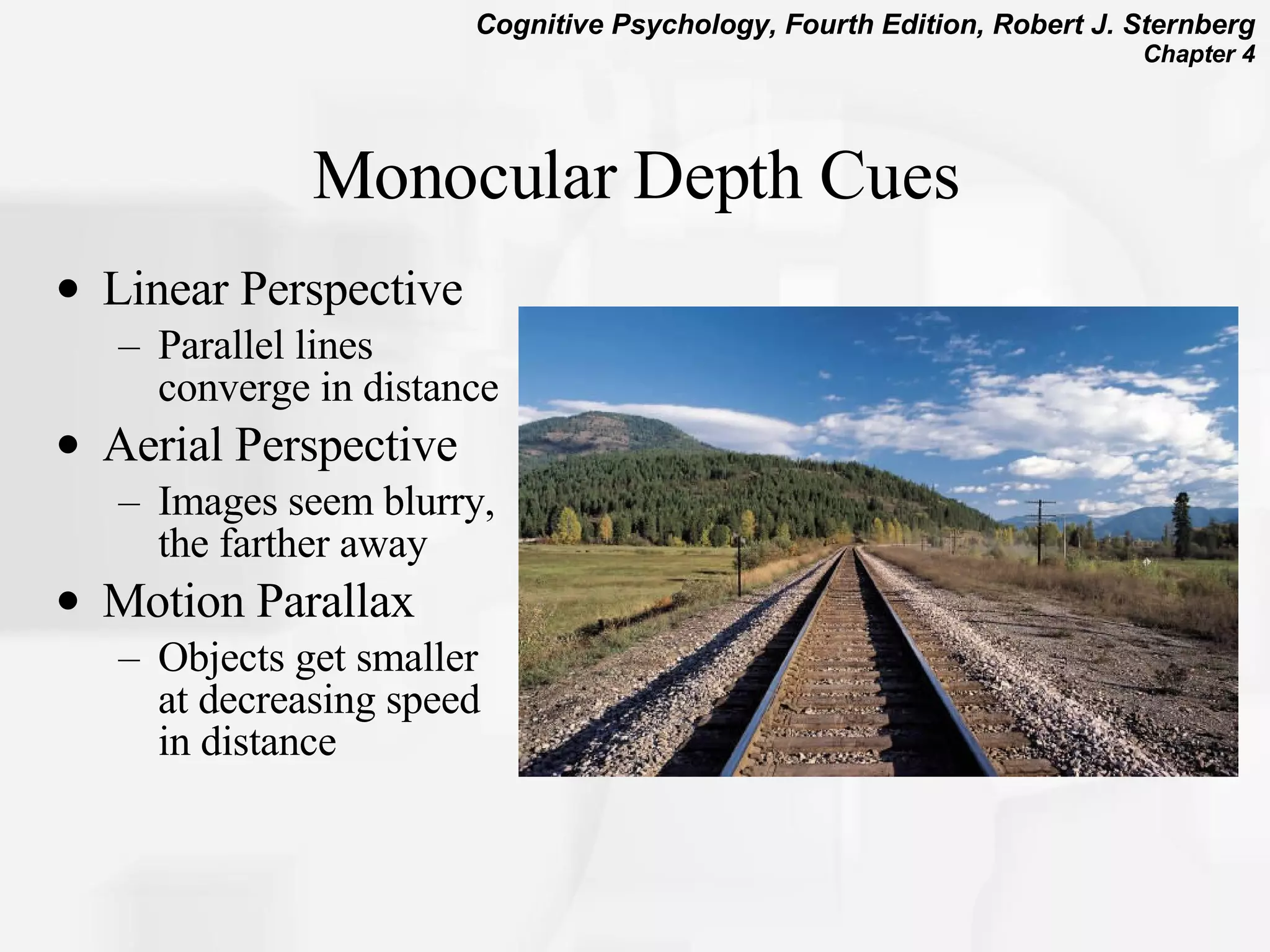
Monocular Depth Cues Linear Perspective Parallel lines converge in distance Aerial Perspective Images seem blurry, the farther away Motion Parallax Objects get smaller at decreasing speed in distance
Binocular Depth Cues Binocular Convergence Eyes turn inward as object moves towards you, brain uses this information to judge distance Binocular Disparity Each eye views a slightly different angle of an object; Brain uses this to create a 3-d image
Object Perception Viewer-centered representation  Object is stored in the perspective seen Store multiple views of object as seen under various conditions  Viewpoint dependent process Object-centered representation  Object is stored in a way that best represents the object  Viewpoint invariant process
Object Perception Evidence supports both  How to reconcile? Maybe both contribute to object recognition Two ends of a continuum that contribute to object recognition Burgund & Tarr researched this issue
Gestalt’s View of Perception Basic Tenet “The whole is more than a sum of its parts.” Law of Pr ä gnanz Individuals organize their experience in as simple, concise, symmetrical and complete manner as possible
Gestalt’s Principles of Visual Perception Figure-Ground Organize perceptions by distinguishing between a figure and a background  Proximity Elements tend to be grouped together according to their nearness  Similarity Items similar in some respect tend to be grouped together     
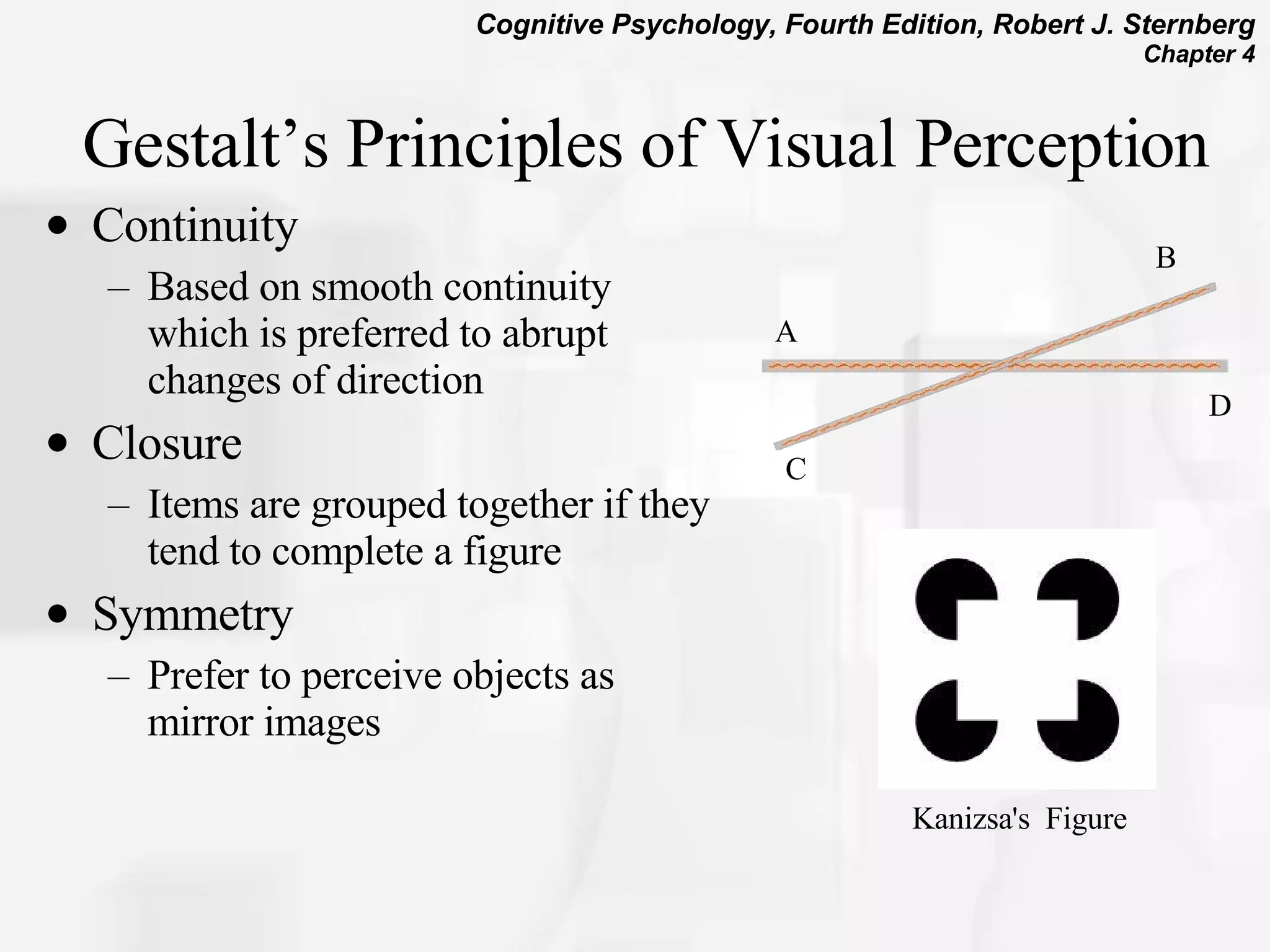
Gestalt’s Principles of Visual Perception Continuity Based on smooth continuity which is preferred to abrupt changes of direction  Closure Items are grouped together if they tend to complete a figure  Symmetry Prefer to perceive objects as mirror images Kanizsa's  Figure   C B A D
Theories of Perception Direct Perception theories Perception comes from the stimuli in the environment Bottom up processing  Parts are identified, put together, and then recognition occurs Constructive Perception theories People actively construct perceptions using information based on expectations Top down processing
Gibson’s Direct Perception  (Ecological model) All the information needed to form a perception is available in the environment  Perception is immediate and spontaneous No top down processing is necessary Perception and action cannot be separated Perception guides action and action generates more new perceptual information
Bottom Up Processing Theories Template theories Prototype theories Feature theories Structural description theories 0
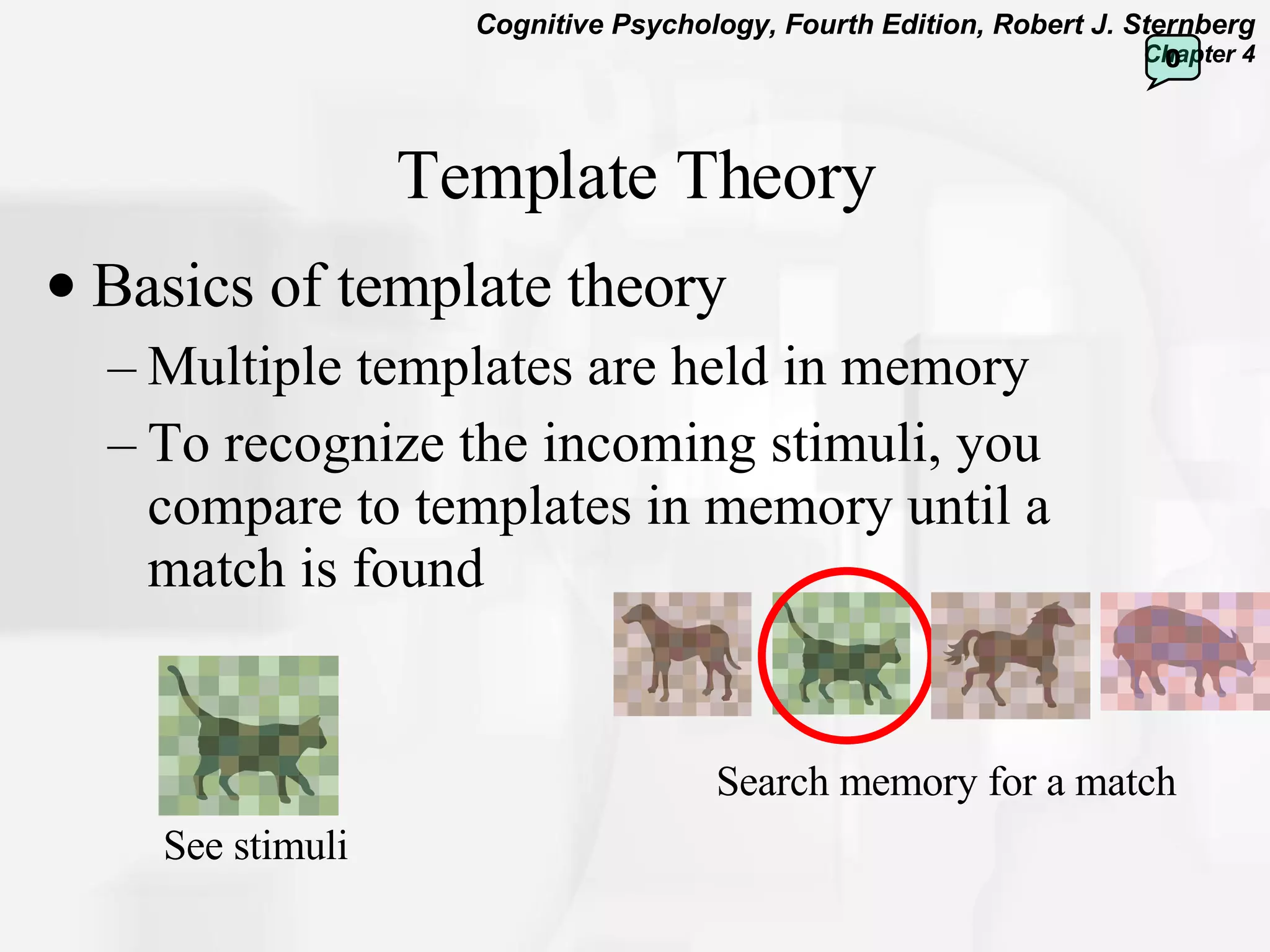
Template Theory Basics of template theory Multiple templates are held in memory To recognize the incoming stimuli, you compare to templates in memory until a match is found See stimuli Search memory for a match 0
Template Theory Weakness of theory Problem of imperfect matches Cannot account for the flexibility of pattern recognition system See stimuli No perfect match in memory Search for match in memory 0
Prototype Theories Modification of template matching (flexible templates)  Takes various instances of an object and abstracts out the common characteristics  No match is perfect; a criterion for matching is needed  0
Prototype Evidence Franks & Bransford (1971) Presented objects based on prototypes Prototype not shown Yet participants are confident they had seen prototype Suggests existence of prototypes 0
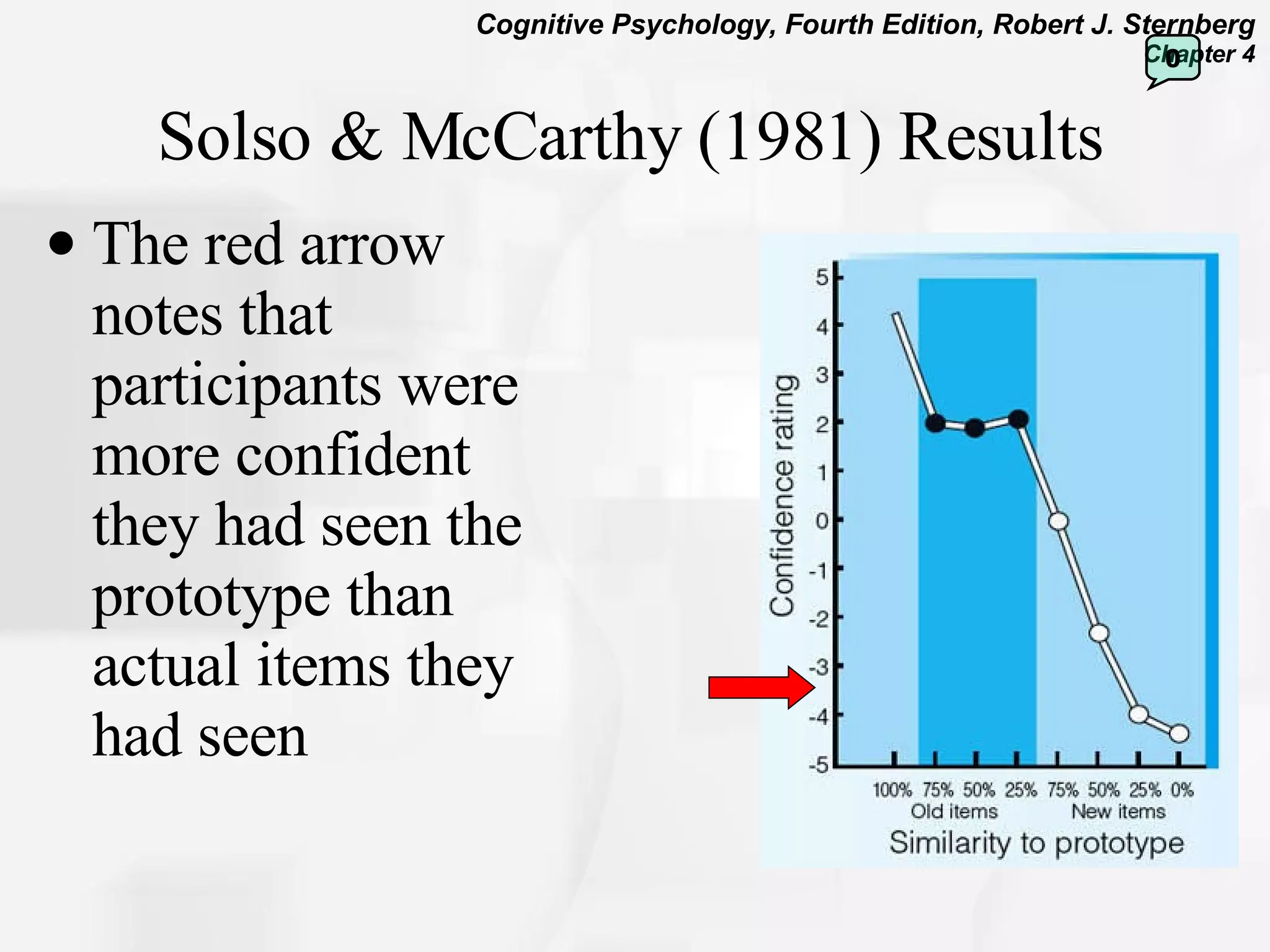
Prototype Evidence Solso & McCarthy (1981) Participants were shown a series of faces Later, a recognition test was given with some old faces,  a prototype face, and some new faces that differed in degree from prototype 0
Solso & McCarthy (1981) Results The red arrow notes that participants were more confident they had seen the prototype than actual items they had seen  0
Research on Prototypes Researchers have found that prototypical faces are found to be more attractive to participants Halberstadt & Rhodes (2000) Examined the impact of prototypes of dogs, wristwatches, and birds on attractiveness of the stimuli Results indicate a strong relationship between averageness and attractiveness of the dogs, birds, and wristwatches  0
Feature Theories Recognize objects on the basis of a small number of characteristics (features) Detect specific elements and assemble them into more complex forms Brain cells that respond to specific features, such as lines and angles are referred to as “feature detectors”  0
Feature Evidence Hubel & Wiesel (1979) using single cell technique Simple cells detect bars or edges of particular orientation in particular location  Complex cells detect bars or edges of particular orientation, exact location abstracted  Hypercomplex cells detect particular colors (simple and complex cells), bars, or edges of particular length or moving in a particular direction  0
Structural-Description Theories Biederman (1987) Describes how 3D images are identified  Breaks objects down into geons  Objects are identified by geons and relationship between them  0
Evidence of Geons Beiderman (1987) Can you identify these objects? These objects have been rendered unidentifiable because their geons are nonrecoverable 0
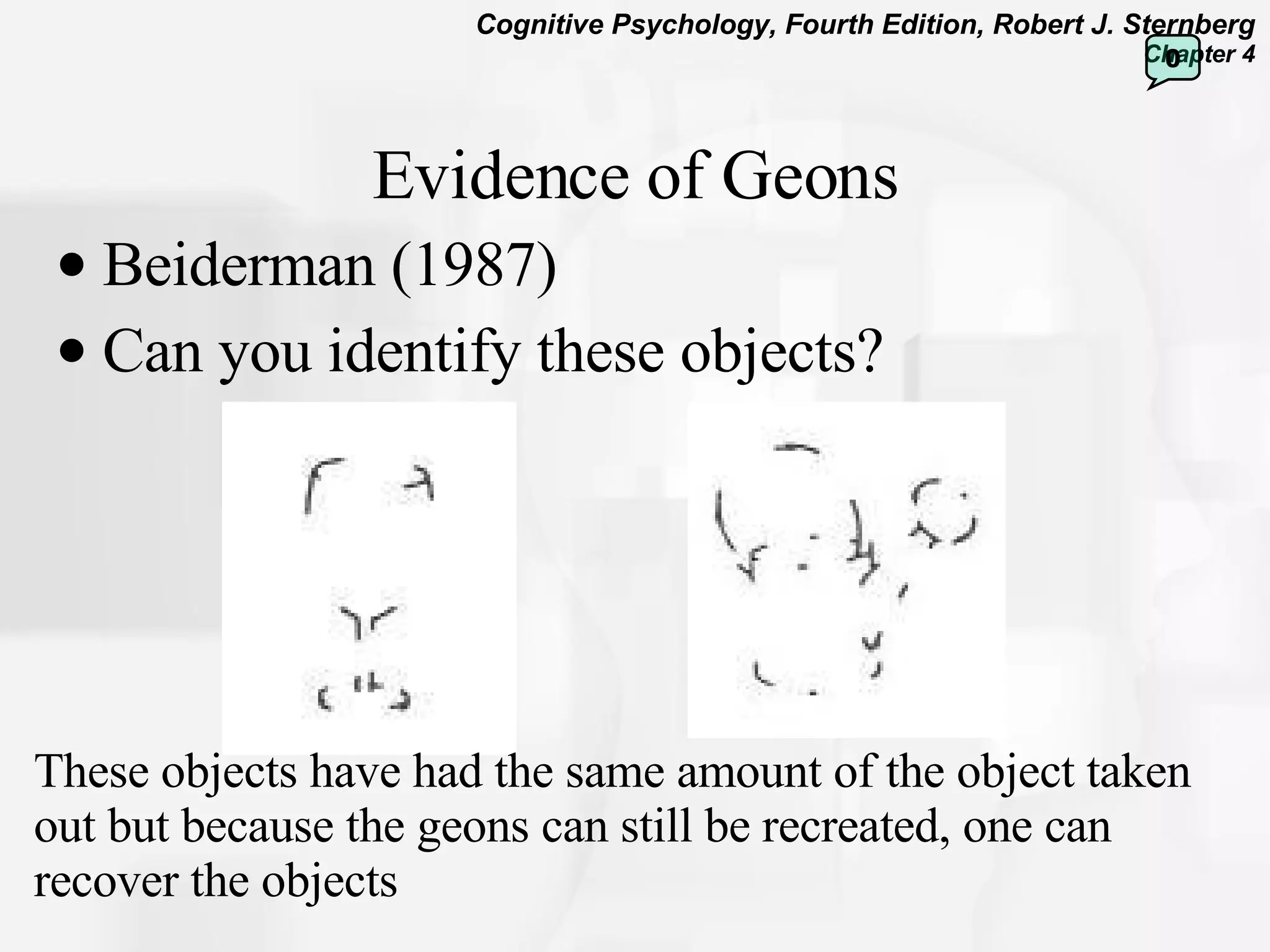
Evidence of Geons Beiderman (1987) Can you identify these objects? These objects have had the same amount of the object taken out but because the geons can still be recreated, one can recover the objects 0
Evidence for Geons Beiderman (1987) demonstrated the importance of the use of geons to recognize objects Original  Recoverable  Nonrecoverable 0
Evidence for Geons Biederman & Cooper (1991) Used visual priming to demonstrate the existence of geons in a picture naming task Subjects were shown a series of fragmented pictures and were asked to identify the objects  0
Biederman & Cooper (1991) After naming novel objects, the second phase begins … Name these fragmented objects 0
Biederman & Cooper (1991) 1 st  fragment  Complementary fragment  Different exemplar   Several different kinds of stimuli were used: identical repeats, complementary, novel, and different exemplars.  Reaction time to name object was noted.  0
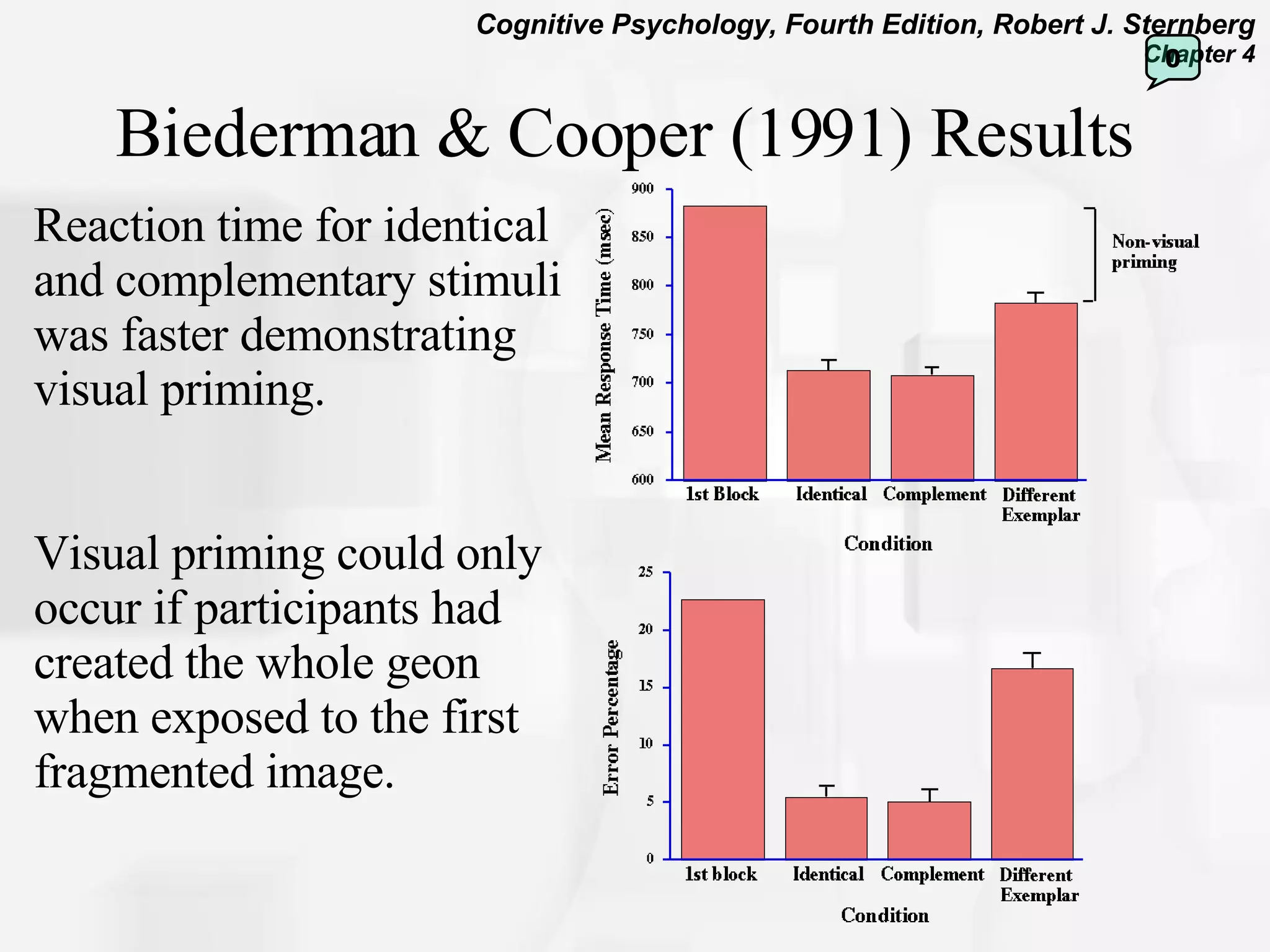
Biederman & Cooper (1991) Results Reaction time for identical and complementary stimuli was faster demonstrating visual priming.  Visual priming could only occur if participants had created the whole geon when exposed to the first fragmented image.  0
Top-down Processing (Constructive Perspective) Perception is not automatic from raw stimuli Processing is needed to build perception  Top down processing occurs quickly and involves making inferences, guessing from experience, and basing one perception on another  0
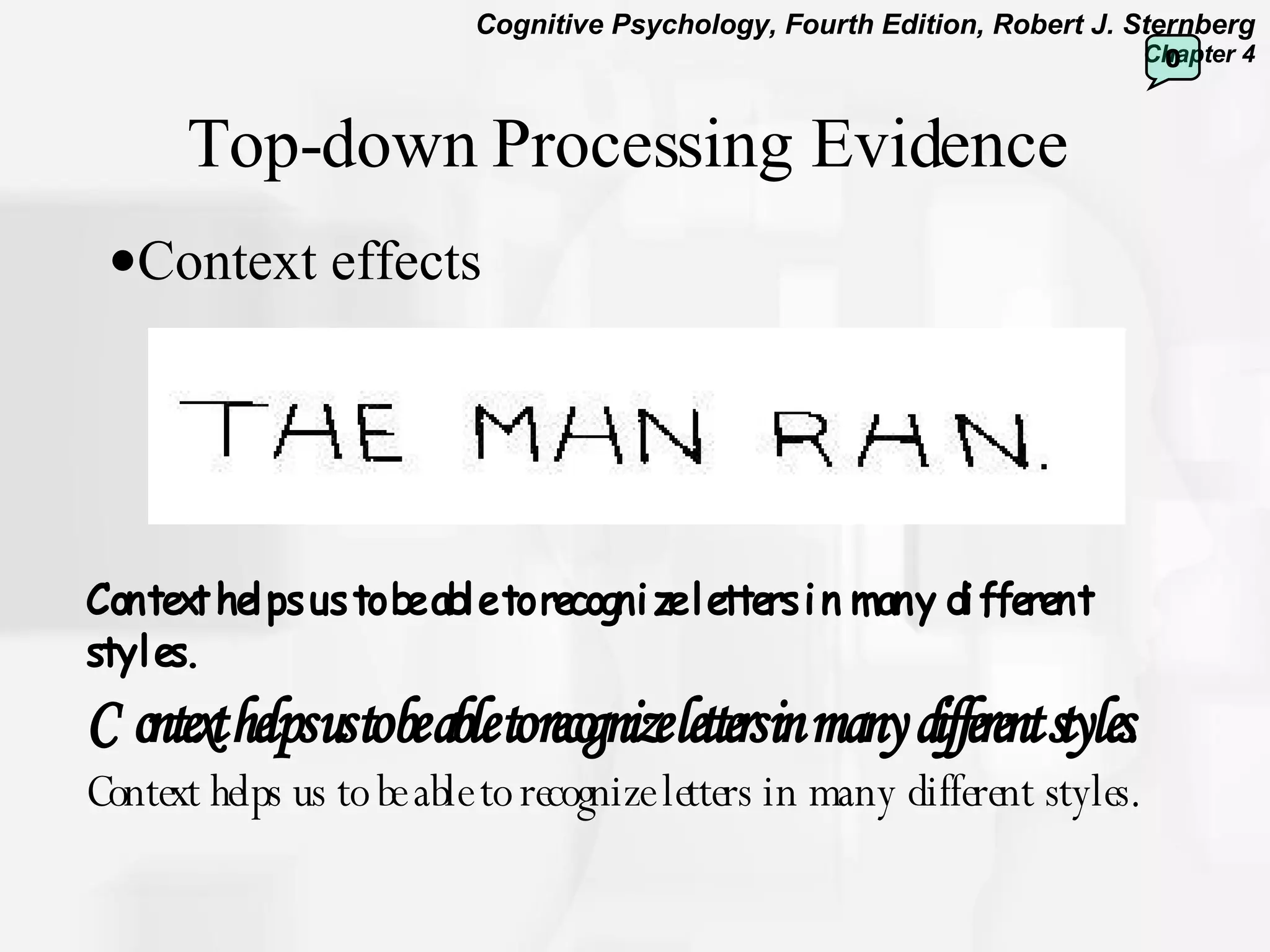
Top-down Processing Evidence  Context effects 0
Palmer (1975) Context Effect Showed participants a related scene, an unrelated scene, or no context Immediately after, asked participants to name a briefly seen object  Objects that were appropriate to the scene (or context) were recognized more rapidly than objects that were unrelated to the scene
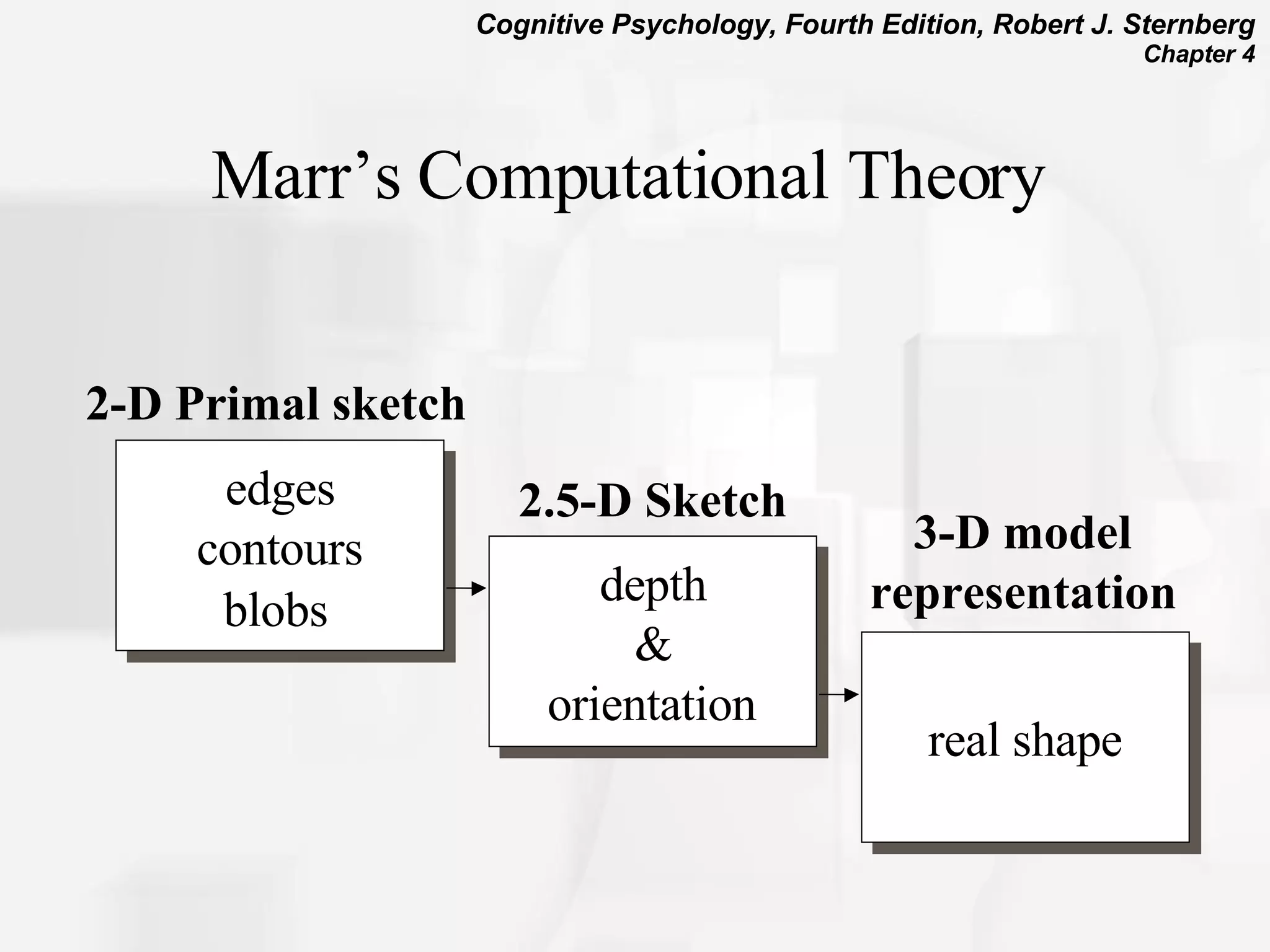
Marr’s Computational Theory   edges contours blobs edges contours blobs depth & orientation depth & orientation real shape real shape 2-D Primal sketch 2.5-D Sketch 3-D model representation
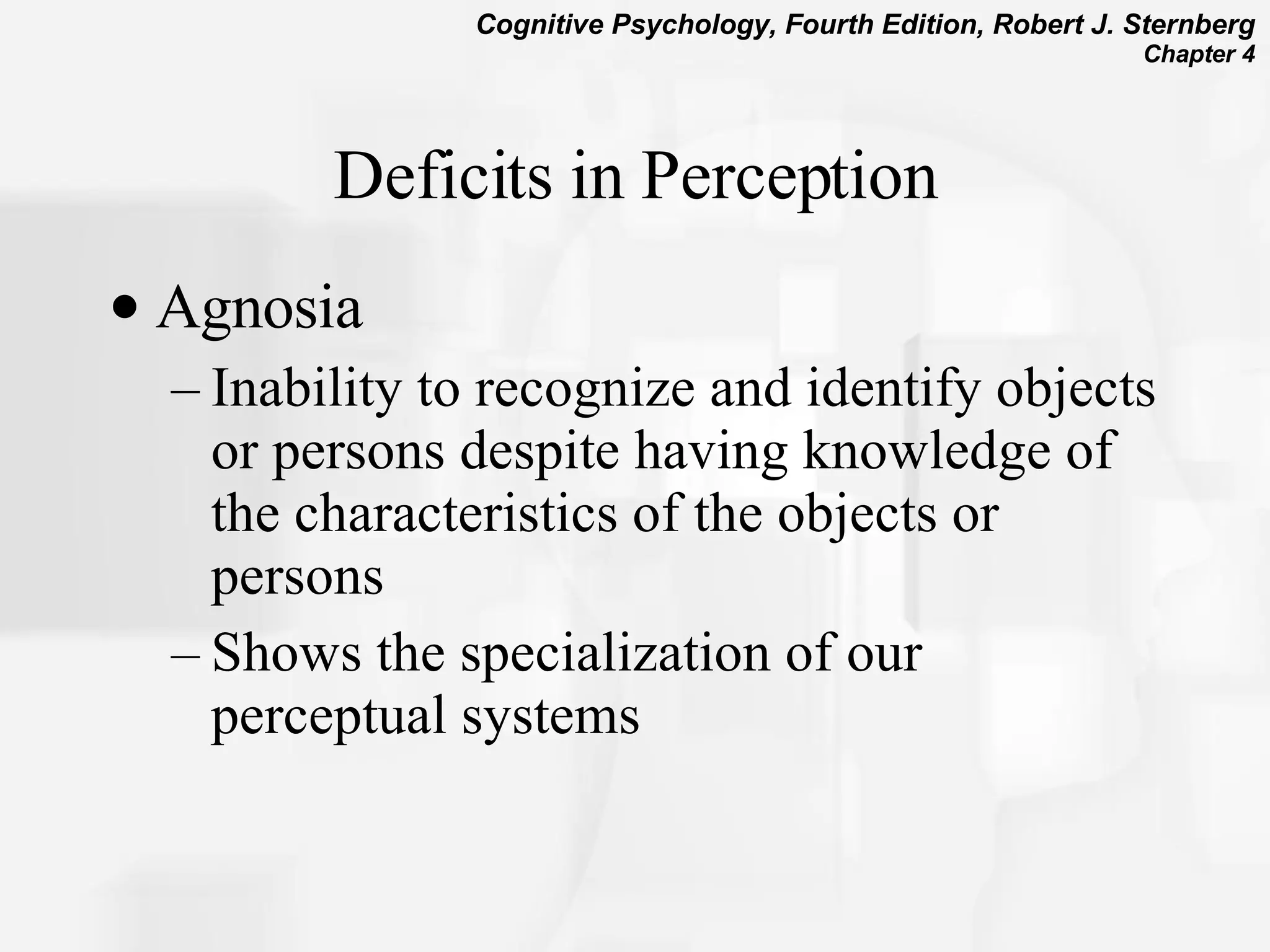
Deficits in Perception Agnosia Inability to recognize and identify objects or persons despite having knowledge of the characteristics of the objects or persons Shows the specialization of our perceptual systems
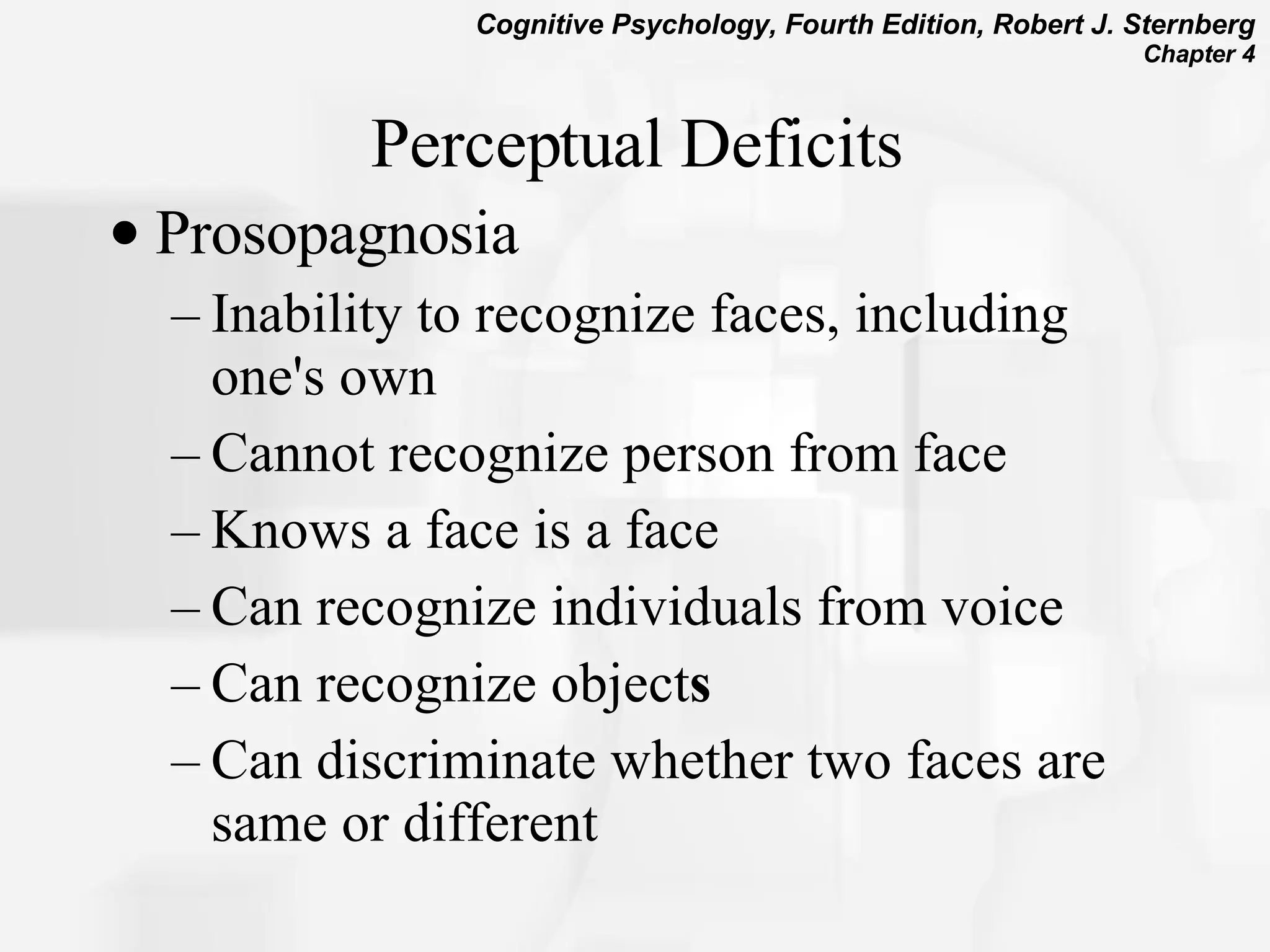
Perceptual Deficits Prosopagnosia Inability to recognize faces, including one's own Cannot recognize person from face Knows a face is a face   Can recognize individuals from voice  Can recognize object s Can discriminate whether two faces are same or different
Deficits in Perception Simultagnosic  Normal visual fields, yet act blind Perceives only one stimulus at a time—single word or object

Perception

  • 1.
  • 2.
  • 3.
    Ilusiones Perceptuales IlusionesÓpticas – estímulos físicos que producen todo el tiempo errores en la percepción
  • 4.
  • 5.
    Perception Is… Theprocess of recognizing, organizing and interpreting information How do you recognize these items?
  • 6.
  • 7.
    Perceptual Basics SensoryAdaptation Occurs when sensory receptors change their sensitivity to the stimulus Constant stimulation leads to lower sensitivity Our senses respond to change
  • 8.
    Perceptual Basics PerceptualConstancy Object remains the same even though our sensation of the object changes Example: Shape constancy
  • 9.
    Depth Perception Theability to see the world in 3 dimensions and detect distance Vision only has a 2-dimensional view We must interpret the information given to perceive depth We take flat images and create a three dimensional view Optical illusions demonstrate that this interpretation does not always have to be correct
  • 10.
    Texture Gradients Grainof item Relative Size Bigger is closer Interposition Closer are in front of other objects Monocular Depth Cues
  • 11.
    Monocular Depth CuesLinear Perspective Parallel lines converge in distance Aerial Perspective Images seem blurry, the farther away Motion Parallax Objects get smaller at decreasing speed in distance
  • 12.
    Binocular Depth CuesBinocular Convergence Eyes turn inward as object moves towards you, brain uses this information to judge distance Binocular Disparity Each eye views a slightly different angle of an object; Brain uses this to create a 3-d image
  • 13.
    Object Perception Viewer-centeredrepresentation Object is stored in the perspective seen Store multiple views of object as seen under various conditions Viewpoint dependent process Object-centered representation Object is stored in a way that best represents the object Viewpoint invariant process
  • 14.
    Object Perception Evidencesupports both How to reconcile? Maybe both contribute to object recognition Two ends of a continuum that contribute to object recognition Burgund & Tarr researched this issue
  • 15.
    Gestalt’s View ofPerception Basic Tenet “The whole is more than a sum of its parts.” Law of Pr ä gnanz Individuals organize their experience in as simple, concise, symmetrical and complete manner as possible
  • 16.
    Gestalt’s Principles ofVisual Perception Figure-Ground Organize perceptions by distinguishing between a figure and a background Proximity Elements tend to be grouped together according to their nearness Similarity Items similar in some respect tend to be grouped together    
  • 17.
    Gestalt’s Principles ofVisual Perception Continuity Based on smooth continuity which is preferred to abrupt changes of direction Closure Items are grouped together if they tend to complete a figure Symmetry Prefer to perceive objects as mirror images Kanizsa's Figure C B A D
  • 18.
    Theories of PerceptionDirect Perception theories Perception comes from the stimuli in the environment Bottom up processing Parts are identified, put together, and then recognition occurs Constructive Perception theories People actively construct perceptions using information based on expectations Top down processing
  • 19.
    Gibson’s Direct Perception (Ecological model) All the information needed to form a perception is available in the environment Perception is immediate and spontaneous No top down processing is necessary Perception and action cannot be separated Perception guides action and action generates more new perceptual information
  • 20.
    Bottom Up ProcessingTheories Template theories Prototype theories Feature theories Structural description theories 0
  • 21.
    Template Theory Basicsof template theory Multiple templates are held in memory To recognize the incoming stimuli, you compare to templates in memory until a match is found See stimuli Search memory for a match 0
  • 22.
    Template Theory Weaknessof theory Problem of imperfect matches Cannot account for the flexibility of pattern recognition system See stimuli No perfect match in memory Search for match in memory 0
  • 23.
    Prototype Theories Modificationof template matching (flexible templates) Takes various instances of an object and abstracts out the common characteristics No match is perfect; a criterion for matching is needed 0
  • 24.
    Prototype Evidence Franks& Bransford (1971) Presented objects based on prototypes Prototype not shown Yet participants are confident they had seen prototype Suggests existence of prototypes 0
  • 25.
    Prototype Evidence Solso& McCarthy (1981) Participants were shown a series of faces Later, a recognition test was given with some old faces, a prototype face, and some new faces that differed in degree from prototype 0
  • 26.
    Solso & McCarthy(1981) Results The red arrow notes that participants were more confident they had seen the prototype than actual items they had seen 0
  • 27.
    Research on PrototypesResearchers have found that prototypical faces are found to be more attractive to participants Halberstadt & Rhodes (2000) Examined the impact of prototypes of dogs, wristwatches, and birds on attractiveness of the stimuli Results indicate a strong relationship between averageness and attractiveness of the dogs, birds, and wristwatches 0
  • 28.
    Feature Theories Recognizeobjects on the basis of a small number of characteristics (features) Detect specific elements and assemble them into more complex forms Brain cells that respond to specific features, such as lines and angles are referred to as “feature detectors” 0
  • 29.
    Feature Evidence Hubel& Wiesel (1979) using single cell technique Simple cells detect bars or edges of particular orientation in particular location Complex cells detect bars or edges of particular orientation, exact location abstracted Hypercomplex cells detect particular colors (simple and complex cells), bars, or edges of particular length or moving in a particular direction 0
  • 30.
    Structural-Description Theories Biederman(1987) Describes how 3D images are identified Breaks objects down into geons Objects are identified by geons and relationship between them 0
  • 31.
    Evidence of GeonsBeiderman (1987) Can you identify these objects? These objects have been rendered unidentifiable because their geons are nonrecoverable 0
  • 32.
    Evidence of GeonsBeiderman (1987) Can you identify these objects? These objects have had the same amount of the object taken out but because the geons can still be recreated, one can recover the objects 0
  • 33.
    Evidence for GeonsBeiderman (1987) demonstrated the importance of the use of geons to recognize objects Original Recoverable Nonrecoverable 0
  • 34.
    Evidence for GeonsBiederman & Cooper (1991) Used visual priming to demonstrate the existence of geons in a picture naming task Subjects were shown a series of fragmented pictures and were asked to identify the objects 0
  • 35.
    Biederman & Cooper(1991) After naming novel objects, the second phase begins … Name these fragmented objects 0
  • 36.
    Biederman & Cooper(1991) 1 st fragment Complementary fragment Different exemplar Several different kinds of stimuli were used: identical repeats, complementary, novel, and different exemplars. Reaction time to name object was noted. 0
  • 37.
    Biederman & Cooper(1991) Results Reaction time for identical and complementary stimuli was faster demonstrating visual priming. Visual priming could only occur if participants had created the whole geon when exposed to the first fragmented image. 0
  • 38.
    Top-down Processing (ConstructivePerspective) Perception is not automatic from raw stimuli Processing is needed to build perception Top down processing occurs quickly and involves making inferences, guessing from experience, and basing one perception on another 0
  • 39.
    Top-down Processing Evidence Context effects 0
  • 40.
    Palmer (1975) ContextEffect Showed participants a related scene, an unrelated scene, or no context Immediately after, asked participants to name a briefly seen object Objects that were appropriate to the scene (or context) were recognized more rapidly than objects that were unrelated to the scene
  • 41.
    Marr’s Computational Theory edges contours blobs edges contours blobs depth & orientation depth & orientation real shape real shape 2-D Primal sketch 2.5-D Sketch 3-D model representation
  • 42.
    Deficits in PerceptionAgnosia Inability to recognize and identify objects or persons despite having knowledge of the characteristics of the objects or persons Shows the specialization of our perceptual systems
  • 43.
    Perceptual Deficits ProsopagnosiaInability to recognize faces, including one's own Cannot recognize person from face Knows a face is a face   Can recognize individuals from voice Can recognize object s Can discriminate whether two faces are same or different
  • 44.
    Deficits in PerceptionSimultagnosic Normal visual fields, yet act blind Perceives only one stimulus at a time—single word or object