Zaid Ali Alsagoff
zaid.alsagoff@gmail.com
Module 2:Module 2:
Thinking ToolsThinking Tools
Do You Agree with These Statements?Do You Agree with These Statements?
““There are many students who areThere are many students who are
educated but few who caneducated but few who can think out of thethink out of the
boxbox.” – Pak Lah.” – Pak Lah
““We want the development of modal insanWe want the development of modal insan
(model citizen), students who can(model citizen), students who can thinkthink
criticallycritically andand creativelycreatively, who are able to, who are able to
solve problemssolve problems and have theand have the ability toability to
adaptadapt themselves to an ever-changingthemselves to an ever-changing
global environment.”global environment.”
- Blueprint for Education Development (2006 – 2010)
Why?Why?
* During the launch of the National Education Blueprint 2006-2010 at the Putrajaya International Convention Centre 16/01-2007.
Questions?Questions?
Look at this picture. What kind of questions can we
ask in relation to this picture?
Use your imagination 
Questions?Questions?
Look at this picture. What kind of questions can we
ask in relation to this picture?
Use your imagination 
Module 2: Thinking ToolsModule 2: Thinking Tools
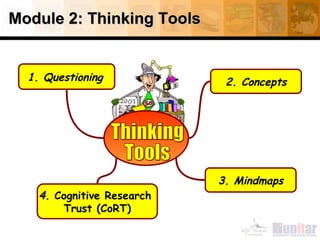
1. Questioning
4. Cognitive Research
Trust (CoRT)
2. Concepts
3. Mindmaps
But first, What is a Thinking Tool?But first, What is a Thinking Tool?
A Thinking ToolThinking Tool is an instrument that can help us in
using our minds systematically and effectively. With the use
of thinking tools, the intended ideas will be arranged more
systematically, clearly, and easy to be understood.
This module will explore four (4) types of thinking Tools:
Questioning
Concepts
Mindmaps
Cognitive Research Trust (CoRT)
2.1 Questioning2.1 Questioning
Questioning is one approach to motivate others to:
Get information
Test understanding
Develop interest
Evaluate the ability of individuals towards
understanding certain things.
““A person who asks questionsA person who asks questions
is a person who thinks.”’is a person who thinks.”’
- William Wilen
““A person who asks questionsA person who asks questions
is a person who thinks.”’is a person who thinks.”’
- William Wilen
WhyWhy
me?me?
2.1 Questioning (2)2.1 Questioning (2)
Look at this picture. Let’s construct questionsLook at this picture. Let’s construct questions
usingusing What, Who, Where, When, WhyWhat, Who, Where, When, Why andand HowHow..
2.1 Questioning -2.1 Questioning - Five Ws and HFive Ws and H
The Five W’s and HFive W’s and H, is an
influential, inspirational and
imaginative checklist (often used
by journalists) to generate:
Data-gathering questions, during
the early stages of problem
solving when you are gathering
data.
Idea-provoking questions (e.g.
whilst brainstorming).
Criteria for evaluating options.
WWhathat
WWhoho
WWherehere
WWhenhen
WWhyhy
HHowow
5Ws5Ws
HH
2.1 Questioning - Bloom’s Taxonomy2.1 Questioning - Bloom’s Taxonomy
KnowledgeKnowledge
InterpretationInterpretation
Application
AnalysisAnalysis
SynthesisSynthesis
EvaluationEvaluation
Lower-level
Thinking
Higher-Level
Thinking
2.1 Questioning – Fact2.1 Questioning – Fact
FactFact – Seek to determine the basic information of a
situation: 5 Ws and H
What happened?
Who…?Who…?
Where…?Where…?
When…?When…?
Why…?Why…?
How…?How…?
2.1 Questioning – Interpretation2.1 Questioning – Interpretation
InterpretationInterpretation – Seek to select and organize facts
and ideas, discovering the relationships between
them.
What is the main idea of…
Retell in your on words what happened.
““There are many students who are educatedThere are many students who are educated
but few who canbut few who can think out of the boxthink out of the box.” – Pak Lah.” – Pak Lah
““There are many students who are educatedThere are many students who are educated
but few who canbut few who can think out of the boxthink out of the box.” – Pak Lah.” – Pak Lah
2.1 Questioning – Application2.1 Questioning – Application
ApplicationApplication – Help us take knowledge or concepts
learnt in one situation and apply them to other
situations.
How would you apply the principles of decision
making when seeking a job?
How do you apply this rule in your daily life?
You’re
Fired!
Really?
2.1 Questioning – Analysis2.1 Questioning – Analysis
AnalysisAnalysis - To separate the entire process into
component parts and understand the relation of
these parts to the whole.
What are the parts or features of …
What evidence can you present to support…
Explain the reasons why you think…
I was fired
because I
was…
1. Intelligent
2. Hardworking
3. Proactive
2.1 Questioning – Synthesis2.1 Questioning – Synthesis
SynthesisSynthesis - to combine ideas and come to a
conclusion.
What ideas can you add to…
What might happen if you combine … with …?
What solution would you suggest for…
2.1 Questioning – Evaluation2.1 Questioning – Evaluation
EvaluationEvaluation - to make informed judgments and
decisions by determining the reliability of things.
Do you agree with…?
Why or why not?
What criteria would you use to assess…
2.2 Concepts2.2 Concepts
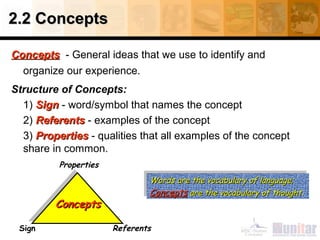
ConceptsConcepts - General ideas that we use to identify and
organize our experience.
Structure of Concepts:
1) SignSign - word/symbol that names the concept
2) ReferentsReferents - examples of the concept
3) PropertiesProperties - qualities that all examples of the concept
share in common.
Properties
ReferentsSign
ConceptsConcepts
Words are the vocabulary of language;Words are the vocabulary of language;
ConceptsConcepts are the vocabulary of thought.are the vocabulary of thought.
Words are the vocabulary of language;Words are the vocabulary of language;
ConceptsConcepts are the vocabulary of thought.are the vocabulary of thought.
2.2 Concepts: Example2.2 Concepts: Example
Properties:
Wheels, Engine, Seats, Dashboard
Sign:
“Automobile”
Concept:Concept:
AutomobileAutomobile
Concept:Concept:
AutomobileAutomobile
Referents:
Lamborghini
Proton Satria Neo
Aristotle once
said that an
intelligent
person is a
'master of
concepts'.
Aristotle once
said that an
intelligent
person is a
'master of
concepts'.
2.2 Forming Concepts2.2 Forming Concepts
You form concepts by the interactive process of:
GeneralizingGeneralizing - Focusing on the
common properties shared by a
group of things.
InterpretingInterpreting - Finding
examples of the concept.
2.2 Forming Concepts: Example2.2 Forming Concepts: Example
Study the following dialogue on the concept of Friendship:Friendship:
Amir Is 'friendship' what happens when two people meet and say hello?
Alfonso No, I think 'friendship' takes time to develop.
Amir Does 'friendship' occur after they have an interesting conversation?
Alfonso I think 'friendship' involves an amount of trust and loyalty, which
can hardly be established after just one interesting conversation.
Amir So can I say that the relationship between my employee and I at
work as a 'friendship'.
Alfonso I think in a 'friendship', trust and loyalty is given willingly and
unconditionally. It should touch on different aspects of people's
lives; and not just work.
2.2 Forming Concepts: Example2.2 Forming Concepts: Example
By studying the dialogue, we can imply that in order toBy studying the dialogue, we can imply that in order to
determine which concept to apply to a situation, we have to:determine which concept to apply to a situation, we have to:
Be aware of the properties that form the boundaries of theBe aware of the properties that form the boundaries of the
concept.concept.
Be sure that the experience meets the properties orBe sure that the experience meets the properties or
requirements.requirements.
2.2 Applying Concepts2.2 Applying Concepts
Applying conceptsApplying concepts means meeting the concept’s
necessary requirements. In determining exactly
what the requirements of the concept are, ask:
Would something still be an example of thisWould something still be an example of this
concept if it did not meet this requirement?concept if it did not meet this requirement?
When we are able to identify all of the
requirements of the concept, we say these
requirements are both necessary and sufficientsufficient
for applying the concept.
2.2 Applying Concepts (2)2.2 Applying Concepts (2)
When you apply a concept to an object, idea, or
experience, you are in effect classifying the object, idea, or
experience by placing it into the group of things defined by
the properties/requirements of the concept.
The way you classify reflects and influences the way you
see the world, the way you think about the world, and the
way you behave in the world.
The specific categories you use depends on the purposes
of your classification.
2.2 Applying Concepts: Example2.2 Applying Concepts: Example
Some may attribute a girl'sSome may attribute a girl's BEAUTYBEAUTY to her fair skin,to her fair skin,
rosy cheeks and long silky hair. Others, however,rosy cheeks and long silky hair. Others, however,
may attribute beauty to the kindness of her heartmay attribute beauty to the kindness of her heart
and considerate nature.and considerate nature.
How do you classify the concept ofHow do you classify the concept of
BEAUTY?BEAUTY?
2.2 Defining Concepts2.2 Defining Concepts
Giving an effective definition of a concept means both:
Identifying the general qualitiesgeneral qualities of the concept, which
determine when it can be correctly applied.
Using appropriate examplesappropriate examples to demonstrate actual
applications of the concept. That is, examples that embody
the general qualities of the concept.
RoleRole
Models?Models?
2.2 Defining Concepts: Example2.2 Defining Concepts: Example
How would you define the word car?How would you define the word car?
What are the properties of a car?What are the properties of a car?
Tony BuzanTony Buzan
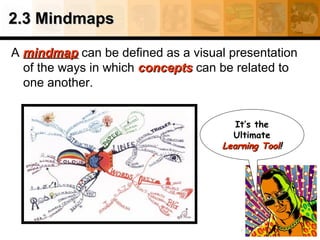
2.3 Mindmaps2.3 Mindmaps
A mindmapmindmap can be defined as a visual presentation
of the ways in which conceptsconcepts can be related to
one another.
It’s the
Ultimate
Learning ToolLearning Tool!!
2.3 Mindmaps – Why?2.3 Mindmaps – Why?
It Helps YouHelps You to:
Save timeSave time as it uses only keywords (or concepts).
Understand betterUnderstand better
Increase your ability to rememberIncrease your ability to remember by utilizing the seven
principles of Super Memory:
 Visualization
 Association
 Making Things Outstanding
 Imagination
 Colour
 Rhythm
 Holism
The Rock
Agrees!!
2.3 Mindmaps: When?2.3 Mindmaps: When?
MindmapsMindmaps are useful for:
Note takingNote taking (listening)
Oral presentationOral presentation (speaking)
WritingWriting
YEAH!!
2.3 Mindmaps: How?2.3 Mindmaps: How?
Step 1:Step 1: Draw the topic at the centre.Draw the topic at the centre.
Step 2:Step 2: Add the Sub-Headings.Add the Sub-Headings.
Step 3:Step 3: For each Sub-Heading, Add the MainFor each Sub-Heading, Add the Main
Points and Supporting Details.Points and Supporting Details.
Step 4:Step 4: Use your Imagination (pictures/images)Use your Imagination (pictures/images)
to make it outstanding and memorable.to make it outstanding and memorable.
The Rock Says
You Must Try…!!
2.3 Mindmaps: Example2.3 Mindmaps: Example
The Rock
Likes
Barry
Mapp…!!
Source: http://www.positivehealth.com/permit/Articles/Mind_Matters/mapp18b.jpg
Edward de BonoEdward de Bono
CoRT Thinking MethodCoRT Thinking Method
The essence of the CoRT (Cognitive Research
Trust) Thinking Method is to focus attention
directly on different aspects of thinking and to
crystallize these aspects into definite concepts and
tools that can be used deliberately.
It is designed to encourage students to broaden
their thinking.
CoRT Thinking ToolsCoRT Thinking Tools
CAF: Consider All Factors
FIP: First Important Priorities
PMI: Plus, Minus, Interesting (ideas)
APC: Alternatives, Possibilities, Choices
OPV: Other People's Views
AGO: Aims, Goals, Objectives (purpose)
C&S: Consequence and Sequel
CAF: Consider All FactorsCAF: Consider All Factors
Used to look as widely as possible at all the factors
involved in a situation.
Steps involved:
List down all the factors.
Consider each factor.
What is the appropriate decision to be made?
Example:
Should UNITAR have a main campus?
FIP: First Important PrioritiesFIP: First Important Priorities
Choosing from a number of different possibilities and
alternatives (e.g. putting priorities in order).
Steps involved:
What are the important matters involved?
Which is the most important one to be considered?
Which one should be given priority?
Example:
Helping the flood victims in Johor.
PMI: Plus, Minus, InterestingPMI: Plus, Minus, Interesting
Examining an idea for good, bad or interesting points,
instead of immediate acceptance or rejection.
Steps involved:
List down all the plus points.
List down all the minus points.
List down all the interesting points.
What is your decision after considering all the factors?
Example:
Should UNITAR have OLT?
APC: Alternatives, Possibilities, ChoicesAPC: Alternatives, Possibilities, Choices
Generating new alternatives and choices, instead of
feeling confined to the obvious ones.
Steps involved
What are the other alternatives to overcome the
problem?
What are the implications incur if every step is taken?
What is the best solution?
Example
Exams should be abolished.
OPV: Other People's ViewsOPV: Other People's Views
Moving out of one’s own viewpoint to consider the points
of view of all others involved in any situation.
Steps involved
Will this idea influence others?
Other’s people opinion on this matter?
Is your idea relevant before actions are taken?
Example
Student should be barred from VOISS if they do
not pay their study fees.
AGO: Aims, Goals, ObjectivesAGO: Aims, Goals, Objectives
Picking out and defining the objectives so as one is
clear about his own aims and understanding those of
others (Purpose).
Steps involved:
What is the AGO of the plan?
Are the implementations out of The AGO?
How do I make sure that the AGO is achieved?
Example
What is the AGO of the Critical Thinking
Course?
C&S: Consequence and SequelC&S: Consequence and Sequel
Considering the immediate, short (e.g. 1 - 2 years),
medium (e.g. 2 - 5 year) and long term (e.g. over 5
years) consequences.
Steps involved:
What are the long term effects?
What are the risks I have to face?
To what extent the new plan would bring changes?
Example:
The future of e-Learning at UNITAR.
Group ActivityGroup Activity
Break into groups of 4-5, and then discuss:
How can UNITAR students help the flood
victims in Malaysia?
Choose one member of your group to take notes.
10 min Use one (or more) of the CoRT thinking tools
to come up with suggestions.
5 min Draw a mindmap of your group findings.
15 min Group presentation & discussion
The RockThe Rock
LikesLikes
UNITAR.UNITAR.
SummarySummary
1. Questioning Questioning is one approach to motivate others to get
information, test understanding, develop interest, and evaluate
the ability of individuals towards understanding certain things.
Tools include the “5 Ws and H”, Bloom’s taxonomy, etc.
2. Concepts Concepts are general ideas that we use to identify and organize
our experience. Structure of Concepts: Sign, Referents and
Properties.
3. Mindmaps Helps you to save time as it uses only keywords (or concepts),
understand better and Increase your ability to remember. It is
useful for: Note taking, Oral presentation and Writing.
4. CoRT CAF: Consider All Factors
FIP: First Important Priorities
PMI: Plus, Minus, Interesting
APC: Alternatives, Possibilities, Choices
OPV: Other People's Views
AGO: Aims, Goals, Objectives
C&S: Consequence and Sequel
Any Questions?Any Questions?
The EndThe End
ReferencesReferences
OOnnlliinnee RReessoouurrcceess
Mindmapping in 8 Easy Steps:
http://www.thinksmart.com/mission/workout/mindm
apping_intro.html
Contact DetailsContact Details
Zaid Ali AlsagoffZaid Ali Alsagoff
UNIVERSITI TUN ABDUL RAZAK
16-5, Jalan SS 6/12
47301 Kelana Jaya
Selangor Darul Ehsan
Malaysia
E-mail: zaid.alsagoff@gmail.com
Tel: 603-7627 7238
Fax: 603-7627 7246

Thinking tools

  • 1.
    Zaid Ali Alsagoff zaid.alsagoff@gmail.com Module2:Module 2: Thinking ToolsThinking Tools
  • 2.
    Do You Agreewith These Statements?Do You Agree with These Statements? ““There are many students who areThere are many students who are educated but few who caneducated but few who can think out of thethink out of the boxbox.” – Pak Lah.” – Pak Lah ““We want the development of modal insanWe want the development of modal insan (model citizen), students who can(model citizen), students who can thinkthink criticallycritically andand creativelycreatively, who are able to, who are able to solve problemssolve problems and have theand have the ability toability to adaptadapt themselves to an ever-changingthemselves to an ever-changing global environment.”global environment.” - Blueprint for Education Development (2006 – 2010) Why?Why? * During the launch of the National Education Blueprint 2006-2010 at the Putrajaya International Convention Centre 16/01-2007.
  • 3.
    Questions?Questions? Look at thispicture. What kind of questions can we ask in relation to this picture? Use your imagination 
  • 4.
    Questions?Questions? Look at thispicture. What kind of questions can we ask in relation to this picture? Use your imagination 
  • 5.
    Module 2: ThinkingToolsModule 2: Thinking Tools 1. Questioning 4. Cognitive Research Trust (CoRT) 2. Concepts 3. Mindmaps
  • 6.
    But first, Whatis a Thinking Tool?But first, What is a Thinking Tool? A Thinking ToolThinking Tool is an instrument that can help us in using our minds systematically and effectively. With the use of thinking tools, the intended ideas will be arranged more systematically, clearly, and easy to be understood. This module will explore four (4) types of thinking Tools: Questioning Concepts Mindmaps Cognitive Research Trust (CoRT)
  • 8.
    2.1 Questioning2.1 Questioning Questioningis one approach to motivate others to: Get information Test understanding Develop interest Evaluate the ability of individuals towards understanding certain things. ““A person who asks questionsA person who asks questions is a person who thinks.”’is a person who thinks.”’ - William Wilen ““A person who asks questionsA person who asks questions is a person who thinks.”’is a person who thinks.”’ - William Wilen WhyWhy me?me?
  • 9.
    2.1 Questioning (2)2.1Questioning (2) Look at this picture. Let’s construct questionsLook at this picture. Let’s construct questions usingusing What, Who, Where, When, WhyWhat, Who, Where, When, Why andand HowHow..
  • 10.
    2.1 Questioning -2.1Questioning - Five Ws and HFive Ws and H The Five W’s and HFive W’s and H, is an influential, inspirational and imaginative checklist (often used by journalists) to generate: Data-gathering questions, during the early stages of problem solving when you are gathering data. Idea-provoking questions (e.g. whilst brainstorming). Criteria for evaluating options. WWhathat WWhoho WWherehere WWhenhen WWhyhy HHowow 5Ws5Ws HH
  • 11.
    2.1 Questioning -Bloom’s Taxonomy2.1 Questioning - Bloom’s Taxonomy KnowledgeKnowledge InterpretationInterpretation Application AnalysisAnalysis SynthesisSynthesis EvaluationEvaluation Lower-level Thinking Higher-Level Thinking
  • 12.
    2.1 Questioning –Fact2.1 Questioning – Fact FactFact – Seek to determine the basic information of a situation: 5 Ws and H What happened? Who…?Who…? Where…?Where…? When…?When…? Why…?Why…? How…?How…?
  • 13.
    2.1 Questioning –Interpretation2.1 Questioning – Interpretation InterpretationInterpretation – Seek to select and organize facts and ideas, discovering the relationships between them. What is the main idea of… Retell in your on words what happened. ““There are many students who are educatedThere are many students who are educated but few who canbut few who can think out of the boxthink out of the box.” – Pak Lah.” – Pak Lah ““There are many students who are educatedThere are many students who are educated but few who canbut few who can think out of the boxthink out of the box.” – Pak Lah.” – Pak Lah
  • 14.
    2.1 Questioning –Application2.1 Questioning – Application ApplicationApplication – Help us take knowledge or concepts learnt in one situation and apply them to other situations. How would you apply the principles of decision making when seeking a job? How do you apply this rule in your daily life? You’re Fired! Really?
  • 15.
    2.1 Questioning –Analysis2.1 Questioning – Analysis AnalysisAnalysis - To separate the entire process into component parts and understand the relation of these parts to the whole. What are the parts or features of … What evidence can you present to support… Explain the reasons why you think… I was fired because I was… 1. Intelligent 2. Hardworking 3. Proactive
  • 16.
    2.1 Questioning –Synthesis2.1 Questioning – Synthesis SynthesisSynthesis - to combine ideas and come to a conclusion. What ideas can you add to… What might happen if you combine … with …? What solution would you suggest for…
  • 17.
    2.1 Questioning –Evaluation2.1 Questioning – Evaluation EvaluationEvaluation - to make informed judgments and decisions by determining the reliability of things. Do you agree with…? Why or why not? What criteria would you use to assess…
  • 19.
    2.2 Concepts2.2 Concepts ConceptsConcepts- General ideas that we use to identify and organize our experience. Structure of Concepts: 1) SignSign - word/symbol that names the concept 2) ReferentsReferents - examples of the concept 3) PropertiesProperties - qualities that all examples of the concept share in common. Properties ReferentsSign ConceptsConcepts Words are the vocabulary of language;Words are the vocabulary of language; ConceptsConcepts are the vocabulary of thought.are the vocabulary of thought. Words are the vocabulary of language;Words are the vocabulary of language; ConceptsConcepts are the vocabulary of thought.are the vocabulary of thought.
  • 20.
    2.2 Concepts: Example2.2Concepts: Example Properties: Wheels, Engine, Seats, Dashboard Sign: “Automobile” Concept:Concept: AutomobileAutomobile Concept:Concept: AutomobileAutomobile Referents: Lamborghini Proton Satria Neo Aristotle once said that an intelligent person is a 'master of concepts'. Aristotle once said that an intelligent person is a 'master of concepts'.
  • 21.
    2.2 Forming Concepts2.2Forming Concepts You form concepts by the interactive process of: GeneralizingGeneralizing - Focusing on the common properties shared by a group of things. InterpretingInterpreting - Finding examples of the concept.
  • 22.
    2.2 Forming Concepts:Example2.2 Forming Concepts: Example Study the following dialogue on the concept of Friendship:Friendship: Amir Is 'friendship' what happens when two people meet and say hello? Alfonso No, I think 'friendship' takes time to develop. Amir Does 'friendship' occur after they have an interesting conversation? Alfonso I think 'friendship' involves an amount of trust and loyalty, which can hardly be established after just one interesting conversation. Amir So can I say that the relationship between my employee and I at work as a 'friendship'. Alfonso I think in a 'friendship', trust and loyalty is given willingly and unconditionally. It should touch on different aspects of people's lives; and not just work.
  • 23.
    2.2 Forming Concepts:Example2.2 Forming Concepts: Example By studying the dialogue, we can imply that in order toBy studying the dialogue, we can imply that in order to determine which concept to apply to a situation, we have to:determine which concept to apply to a situation, we have to: Be aware of the properties that form the boundaries of theBe aware of the properties that form the boundaries of the concept.concept. Be sure that the experience meets the properties orBe sure that the experience meets the properties or requirements.requirements.
  • 24.
    2.2 Applying Concepts2.2Applying Concepts Applying conceptsApplying concepts means meeting the concept’s necessary requirements. In determining exactly what the requirements of the concept are, ask: Would something still be an example of thisWould something still be an example of this concept if it did not meet this requirement?concept if it did not meet this requirement? When we are able to identify all of the requirements of the concept, we say these requirements are both necessary and sufficientsufficient for applying the concept.
  • 25.
    2.2 Applying Concepts(2)2.2 Applying Concepts (2) When you apply a concept to an object, idea, or experience, you are in effect classifying the object, idea, or experience by placing it into the group of things defined by the properties/requirements of the concept. The way you classify reflects and influences the way you see the world, the way you think about the world, and the way you behave in the world. The specific categories you use depends on the purposes of your classification.
  • 26.
    2.2 Applying Concepts:Example2.2 Applying Concepts: Example Some may attribute a girl'sSome may attribute a girl's BEAUTYBEAUTY to her fair skin,to her fair skin, rosy cheeks and long silky hair. Others, however,rosy cheeks and long silky hair. Others, however, may attribute beauty to the kindness of her heartmay attribute beauty to the kindness of her heart and considerate nature.and considerate nature. How do you classify the concept ofHow do you classify the concept of BEAUTY?BEAUTY?
  • 27.
    2.2 Defining Concepts2.2Defining Concepts Giving an effective definition of a concept means both: Identifying the general qualitiesgeneral qualities of the concept, which determine when it can be correctly applied. Using appropriate examplesappropriate examples to demonstrate actual applications of the concept. That is, examples that embody the general qualities of the concept. RoleRole Models?Models?
  • 28.
    2.2 Defining Concepts:Example2.2 Defining Concepts: Example How would you define the word car?How would you define the word car? What are the properties of a car?What are the properties of a car?
  • 29.
  • 30.
    2.3 Mindmaps2.3 Mindmaps Amindmapmindmap can be defined as a visual presentation of the ways in which conceptsconcepts can be related to one another. It’s the Ultimate Learning ToolLearning Tool!!
  • 31.
    2.3 Mindmaps –Why?2.3 Mindmaps – Why? It Helps YouHelps You to: Save timeSave time as it uses only keywords (or concepts). Understand betterUnderstand better Increase your ability to rememberIncrease your ability to remember by utilizing the seven principles of Super Memory:  Visualization  Association  Making Things Outstanding  Imagination  Colour  Rhythm  Holism The Rock Agrees!!
  • 32.
    2.3 Mindmaps: When?2.3Mindmaps: When? MindmapsMindmaps are useful for: Note takingNote taking (listening) Oral presentationOral presentation (speaking) WritingWriting YEAH!!
  • 33.
    2.3 Mindmaps: How?2.3Mindmaps: How? Step 1:Step 1: Draw the topic at the centre.Draw the topic at the centre. Step 2:Step 2: Add the Sub-Headings.Add the Sub-Headings. Step 3:Step 3: For each Sub-Heading, Add the MainFor each Sub-Heading, Add the Main Points and Supporting Details.Points and Supporting Details. Step 4:Step 4: Use your Imagination (pictures/images)Use your Imagination (pictures/images) to make it outstanding and memorable.to make it outstanding and memorable. The Rock Says You Must Try…!!
  • 34.
    2.3 Mindmaps: Example2.3Mindmaps: Example The Rock Likes Barry Mapp…!! Source: http://www.positivehealth.com/permit/Articles/Mind_Matters/mapp18b.jpg
  • 35.
  • 36.
    CoRT Thinking MethodCoRTThinking Method The essence of the CoRT (Cognitive Research Trust) Thinking Method is to focus attention directly on different aspects of thinking and to crystallize these aspects into definite concepts and tools that can be used deliberately. It is designed to encourage students to broaden their thinking.
  • 37.
    CoRT Thinking ToolsCoRTThinking Tools CAF: Consider All Factors FIP: First Important Priorities PMI: Plus, Minus, Interesting (ideas) APC: Alternatives, Possibilities, Choices OPV: Other People's Views AGO: Aims, Goals, Objectives (purpose) C&S: Consequence and Sequel
  • 38.
    CAF: Consider AllFactorsCAF: Consider All Factors Used to look as widely as possible at all the factors involved in a situation. Steps involved: List down all the factors. Consider each factor. What is the appropriate decision to be made? Example: Should UNITAR have a main campus?
  • 39.
    FIP: First ImportantPrioritiesFIP: First Important Priorities Choosing from a number of different possibilities and alternatives (e.g. putting priorities in order). Steps involved: What are the important matters involved? Which is the most important one to be considered? Which one should be given priority? Example: Helping the flood victims in Johor.
  • 40.
    PMI: Plus, Minus,InterestingPMI: Plus, Minus, Interesting Examining an idea for good, bad or interesting points, instead of immediate acceptance or rejection. Steps involved: List down all the plus points. List down all the minus points. List down all the interesting points. What is your decision after considering all the factors? Example: Should UNITAR have OLT?
  • 41.
    APC: Alternatives, Possibilities,ChoicesAPC: Alternatives, Possibilities, Choices Generating new alternatives and choices, instead of feeling confined to the obvious ones. Steps involved What are the other alternatives to overcome the problem? What are the implications incur if every step is taken? What is the best solution? Example Exams should be abolished.
  • 42.
    OPV: Other People'sViewsOPV: Other People's Views Moving out of one’s own viewpoint to consider the points of view of all others involved in any situation. Steps involved Will this idea influence others? Other’s people opinion on this matter? Is your idea relevant before actions are taken? Example Student should be barred from VOISS if they do not pay their study fees.
  • 43.
    AGO: Aims, Goals,ObjectivesAGO: Aims, Goals, Objectives Picking out and defining the objectives so as one is clear about his own aims and understanding those of others (Purpose). Steps involved: What is the AGO of the plan? Are the implementations out of The AGO? How do I make sure that the AGO is achieved? Example What is the AGO of the Critical Thinking Course?
  • 44.
    C&S: Consequence andSequelC&S: Consequence and Sequel Considering the immediate, short (e.g. 1 - 2 years), medium (e.g. 2 - 5 year) and long term (e.g. over 5 years) consequences. Steps involved: What are the long term effects? What are the risks I have to face? To what extent the new plan would bring changes? Example: The future of e-Learning at UNITAR.
  • 45.
    Group ActivityGroup Activity Breakinto groups of 4-5, and then discuss: How can UNITAR students help the flood victims in Malaysia? Choose one member of your group to take notes. 10 min Use one (or more) of the CoRT thinking tools to come up with suggestions. 5 min Draw a mindmap of your group findings. 15 min Group presentation & discussion The RockThe Rock LikesLikes UNITAR.UNITAR.
  • 46.
    SummarySummary 1. Questioning Questioningis one approach to motivate others to get information, test understanding, develop interest, and evaluate the ability of individuals towards understanding certain things. Tools include the “5 Ws and H”, Bloom’s taxonomy, etc. 2. Concepts Concepts are general ideas that we use to identify and organize our experience. Structure of Concepts: Sign, Referents and Properties. 3. Mindmaps Helps you to save time as it uses only keywords (or concepts), understand better and Increase your ability to remember. It is useful for: Note taking, Oral presentation and Writing. 4. CoRT CAF: Consider All Factors FIP: First Important Priorities PMI: Plus, Minus, Interesting APC: Alternatives, Possibilities, Choices OPV: Other People's Views AGO: Aims, Goals, Objectives C&S: Consequence and Sequel
  • 47.
  • 48.
  • 49.
    ReferencesReferences OOnnlliinnee RReessoouurrcceess Mindmapping in8 Easy Steps: http://www.thinksmart.com/mission/workout/mindm apping_intro.html
  • 50.
    Contact DetailsContact Details ZaidAli AlsagoffZaid Ali Alsagoff UNIVERSITI TUN ABDUL RAZAK 16-5, Jalan SS 6/12 47301 Kelana Jaya Selangor Darul Ehsan Malaysia E-mail: zaid.alsagoff@gmail.com Tel: 603-7627 7238 Fax: 603-7627 7246