MEMORY
MR. KULTHE VIKRANT RATNAKAR
M Sc NURSING
INTRODUCTION
• The momory was the first phenomenon to be studied in a
psychological laboratory(Ebbinghaus 1864).
• Memory is the encoding ,storage and retrieval of information.
• The memorising process are organised in the form of memory
traces which functions like a computer.
• ENCODING :
“ Is the process of receiving sensory input and transforming it
in to a code that can be stored.”
• STORAGE:
“ Is the process of actually putting the coded, stored information
in to memory.”
• RETRIEVAL:
“ Is process of gaining to the encoded,stored information when it
is to be used.”
DEFINITION:
“The power to store
experience and to bring
them into the field of
consciousness sometimes
after the experience has
occurred is called Memory.”
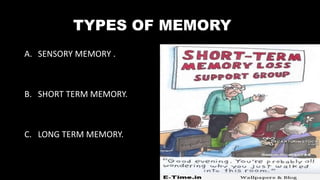
TYPES OF MEMORY
A. SENSORY MEMORY .
B. SHORT TERM MEMORY.
C. LONG TERM MEMORY.
A) SENSORY MEMORY
• The stores incoming information in a sensory register which has large
capacity.
• In formation in sensory register lasts for s very short duration ranging
from fraction of second to a few seconds.
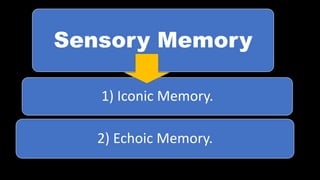
Sensory Memory
1) Iconic Memory.
2) Echoic Memory.
1) ICONIC MEMORY :
The iconic memory is the form of sensory memory that holds
visual information for almost quarter of second or more.
2) ECHOIC MEMORY:
it is a momentary sensory memory of auditory stimulus; if
attention is elsewhere, sounds and words can still be recalled
within 3-4 seconds.
FUNCTIONS OF SENSORY
MEMORY:
1. Gives the decision time.
2. Provide stability, playback and recognition.
B) SHORT TERM MEMORY
• Short term memory holds a relatively small amount of information about
seven items for a short period of 15-30 seconds .
• The types of information stored consists of sounds, images, wourds or
sentence.
• Information from Short term memory may be transferred to long term
memory through either maintenance rehearsal.
•
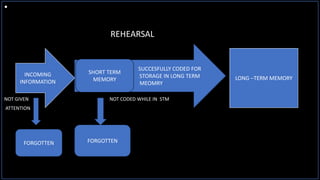
REHEARSAL
NOT GIVEN NOT CODED WHILE IN STM
ATTENTION
INCOMING
INFORMATION
LONG –TERM MEMORY
SUCCESFULLY CODED FOR
STORAGE IN LONG TERM
MEOMRY
FORGOTTEN FORGOTTEN
SHORT TERM
MEMORY
C) LONG TERM MEMORY
• The long term memory has the unlimited capacity to store information
for days, months, years and even a life time.
• Information may be lost or , at least not retrieved from long term
memory because of difficulties in the search process or interference by
other long term memories.
TYPES OF LONG TERM MEMORY
a) Episodic memory
b) Semantic memory
a) EPISODIC MEMORY:
IS the memory related to our personal affairs like NAME,
QUALIFICATION, DATE OF BIRTH AND PERSONAL EXPERIENCE.
It is record of what has happened with us.
b) SEMANTIC MEMORY
Its comprises our knowledge and information related to world.
Example : erth is around and goes around the sun.
A semantic memory is not easily forgotten as the information Is stored
highly organized way, in logical hierarchies from general to specific
ones.
FACTOR AFFECTING THE
MEMORY
• Age
• Intelligence
• Motivation
• Physical factors such as cold, fatigue
• Stress
• Meaningful material
• Interference from previous learning.
Memory

Memory

  • 1.
    MEMORY MR. KULTHE VIKRANTRATNAKAR M Sc NURSING
  • 3.
    INTRODUCTION • The momorywas the first phenomenon to be studied in a psychological laboratory(Ebbinghaus 1864). • Memory is the encoding ,storage and retrieval of information. • The memorising process are organised in the form of memory traces which functions like a computer.
  • 4.
    • ENCODING : “Is the process of receiving sensory input and transforming it in to a code that can be stored.” • STORAGE: “ Is the process of actually putting the coded, stored information in to memory.” • RETRIEVAL: “ Is process of gaining to the encoded,stored information when it is to be used.”
  • 5.
    DEFINITION: “The power tostore experience and to bring them into the field of consciousness sometimes after the experience has occurred is called Memory.”
  • 6.
    TYPES OF MEMORY A.SENSORY MEMORY . B. SHORT TERM MEMORY. C. LONG TERM MEMORY.
  • 7.
    A) SENSORY MEMORY •The stores incoming information in a sensory register which has large capacity. • In formation in sensory register lasts for s very short duration ranging from fraction of second to a few seconds.
  • 8.
    Sensory Memory 1) IconicMemory. 2) Echoic Memory.
  • 9.
    1) ICONIC MEMORY: The iconic memory is the form of sensory memory that holds visual information for almost quarter of second or more. 2) ECHOIC MEMORY: it is a momentary sensory memory of auditory stimulus; if attention is elsewhere, sounds and words can still be recalled within 3-4 seconds.
  • 10.
    FUNCTIONS OF SENSORY MEMORY: 1.Gives the decision time. 2. Provide stability, playback and recognition.
  • 11.
    B) SHORT TERMMEMORY • Short term memory holds a relatively small amount of information about seven items for a short period of 15-30 seconds . • The types of information stored consists of sounds, images, wourds or sentence. • Information from Short term memory may be transferred to long term memory through either maintenance rehearsal.
  • 12.
    • REHEARSAL NOT GIVEN NOTCODED WHILE IN STM ATTENTION INCOMING INFORMATION LONG –TERM MEMORY SUCCESFULLY CODED FOR STORAGE IN LONG TERM MEOMRY FORGOTTEN FORGOTTEN SHORT TERM MEMORY
  • 13.
    C) LONG TERMMEMORY • The long term memory has the unlimited capacity to store information for days, months, years and even a life time. • Information may be lost or , at least not retrieved from long term memory because of difficulties in the search process or interference by other long term memories.
  • 14.
    TYPES OF LONGTERM MEMORY a) Episodic memory b) Semantic memory a) EPISODIC MEMORY: IS the memory related to our personal affairs like NAME, QUALIFICATION, DATE OF BIRTH AND PERSONAL EXPERIENCE. It is record of what has happened with us.
  • 15.
    b) SEMANTIC MEMORY Itscomprises our knowledge and information related to world. Example : erth is around and goes around the sun. A semantic memory is not easily forgotten as the information Is stored highly organized way, in logical hierarchies from general to specific ones.
  • 16.
    FACTOR AFFECTING THE MEMORY •Age • Intelligence • Motivation • Physical factors such as cold, fatigue • Stress • Meaningful material • Interference from previous learning.