Psychology
Unit 2: Biopsychology
Lesson 1: The Brain
ACTIVATOR:

Parts of the Brain
Lesson 1: The Brain
EQ: How do biological processes and systems
impact behavior?

Vocabulary
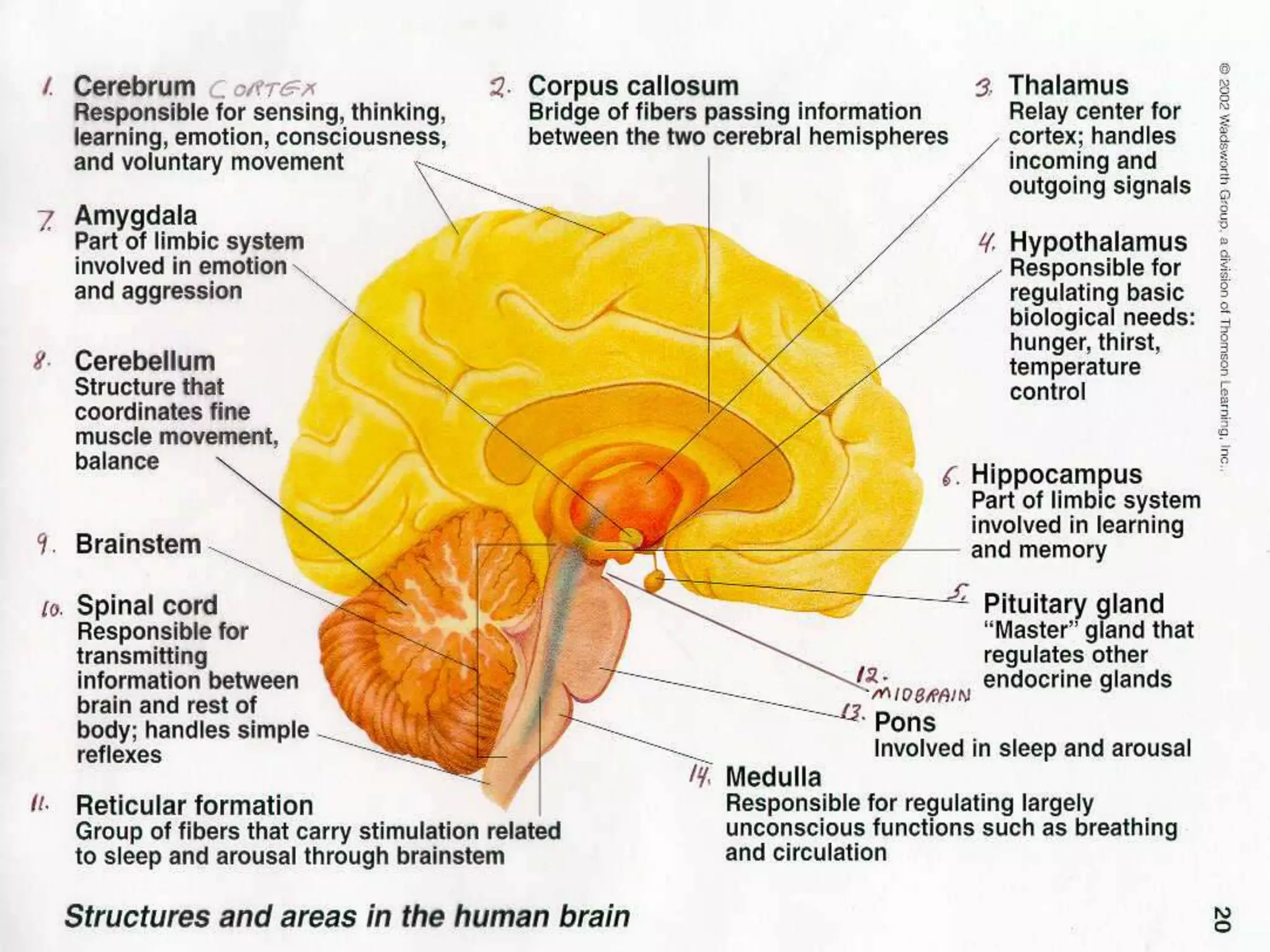
• Cerebrum (Cerebral Cortex)
• Cerebellum
• Pons
• Medulla
• Reticular Activating System
• Corpus Callosum

• Thalamus
• Hypothalamus
• Hippocampus
• Amygdala
• Pituitary Gland
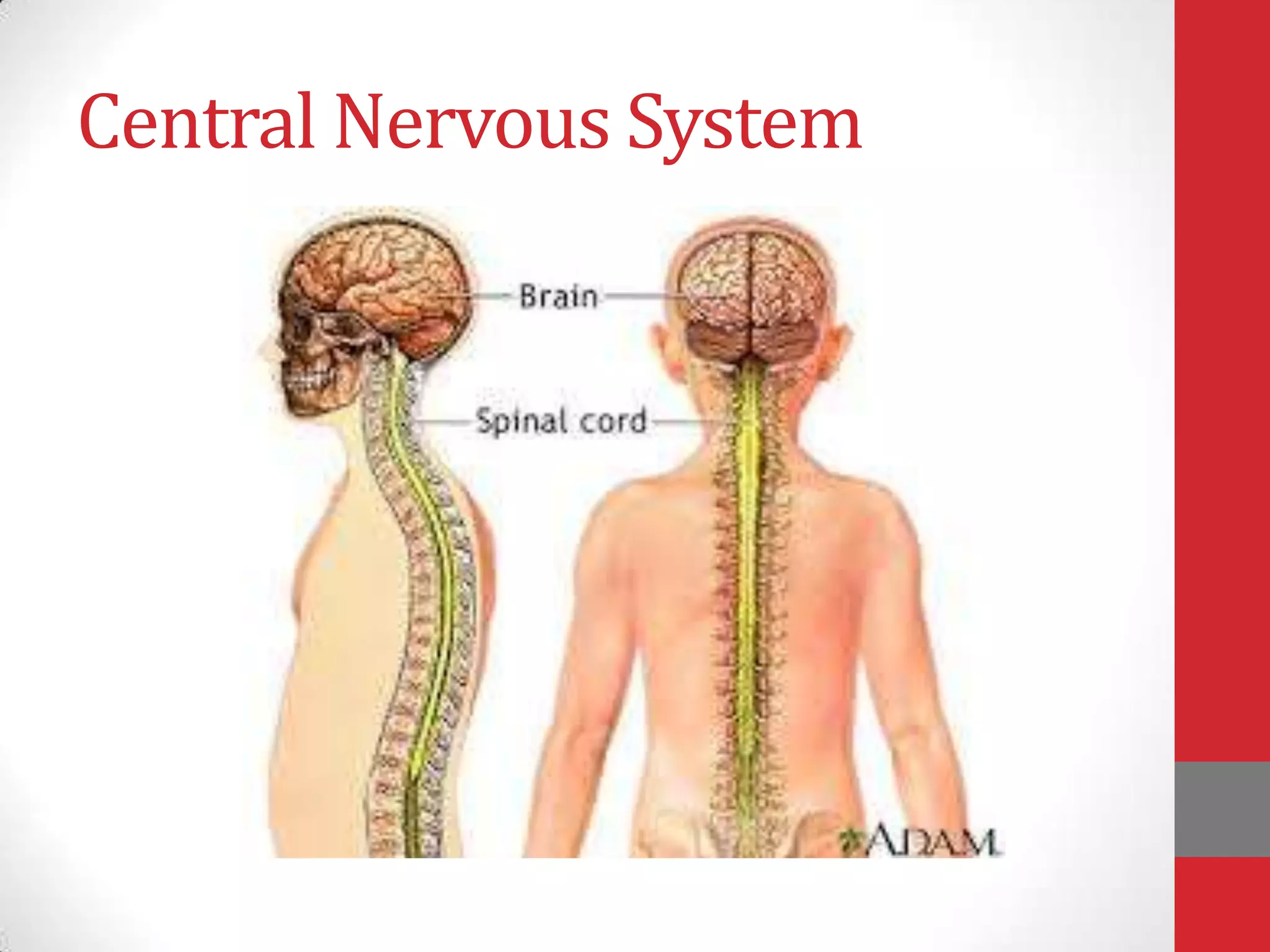
• Spinal Cord
Parts of the Brain
Use Your Textbook Resources to Complete the Chart Below
Part of the Brain

Medulla
Pons
Reticular
Activating System
Cerebellum
Thalamus

Hypothalamus
Hippocampus
Amygdala
Pituitary Gland
Cerebral Cortex
Corpus Callosum

Primary Function(s)
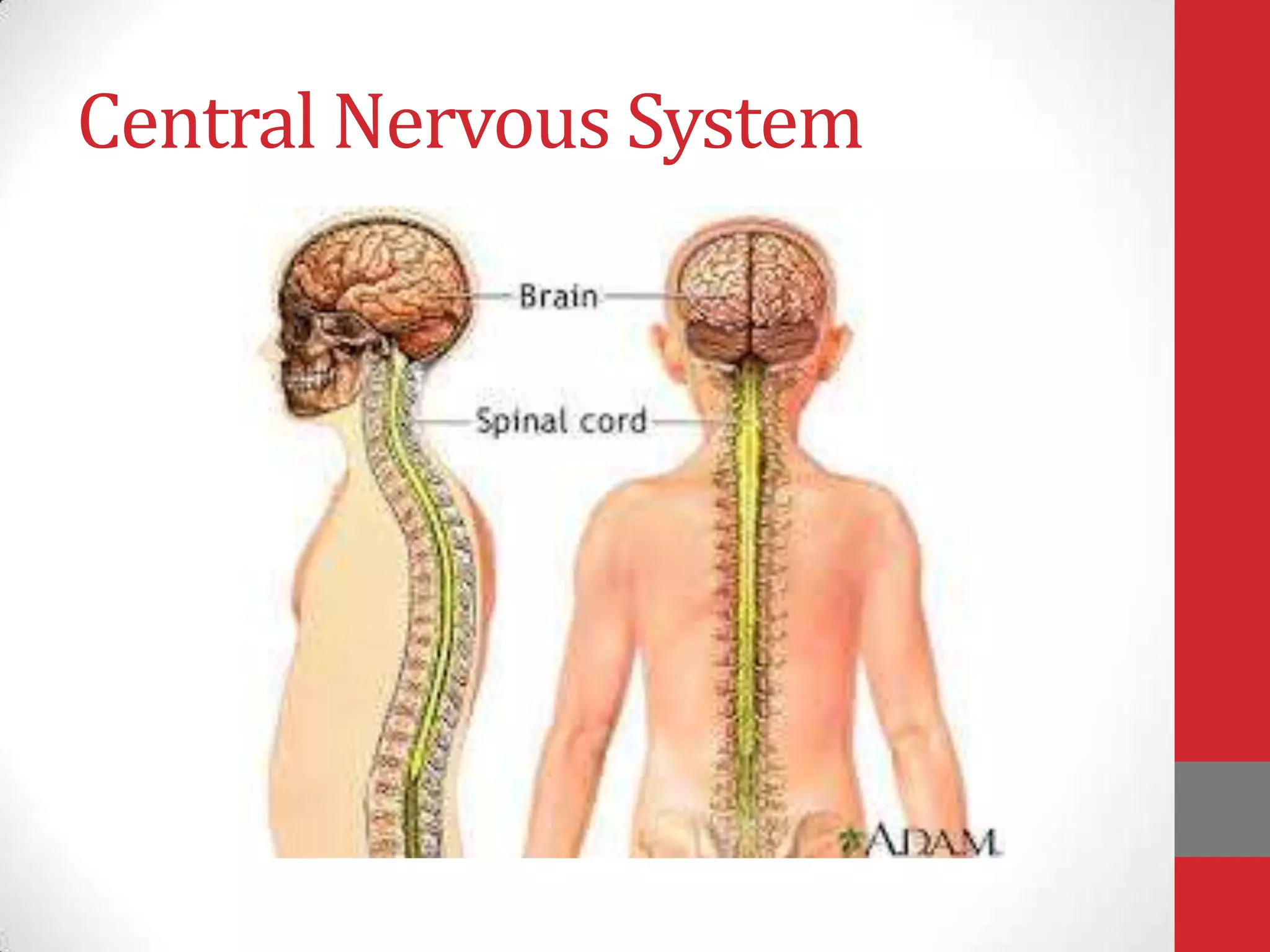
Central Nervous System
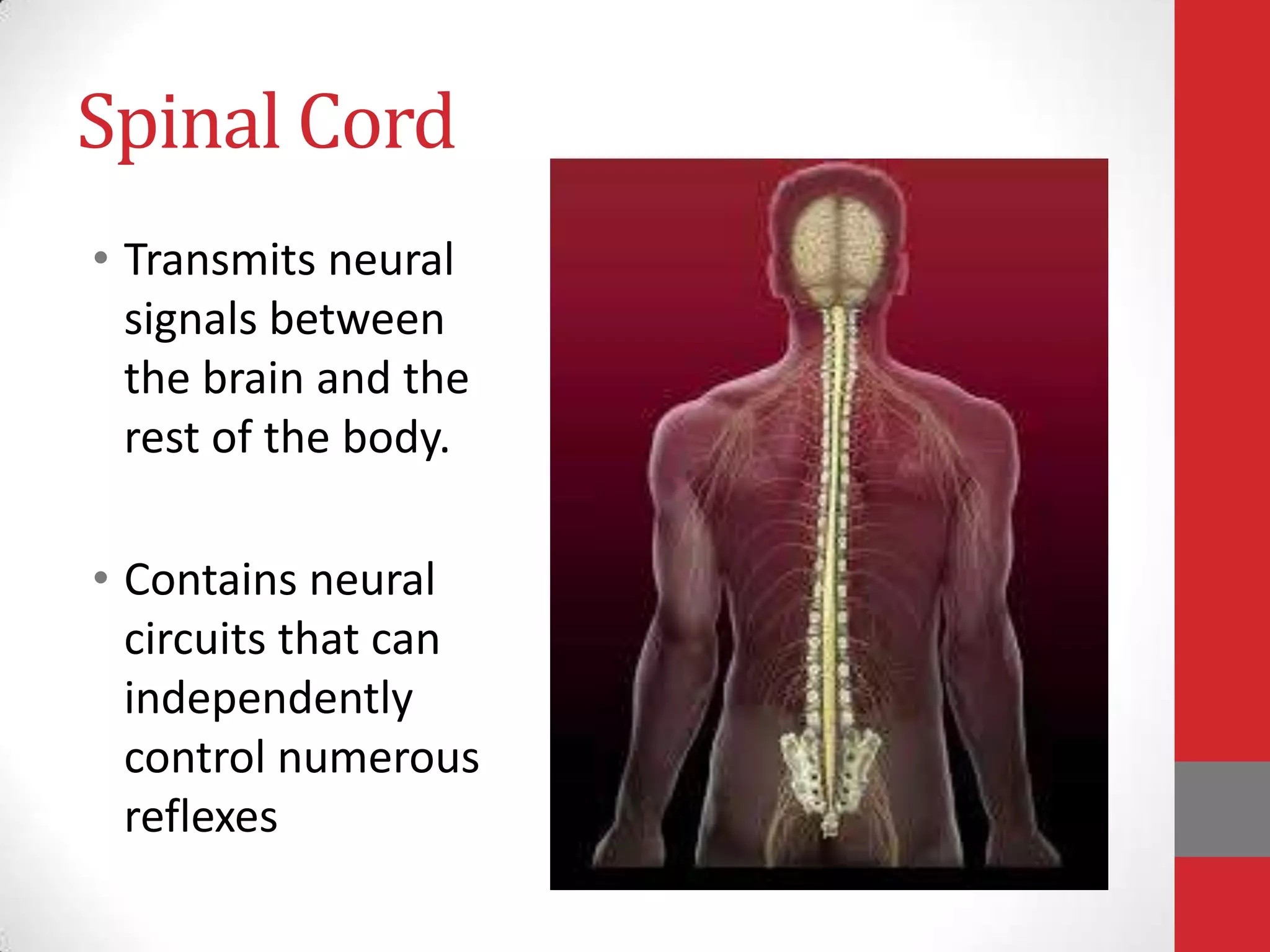
Spinal Cord
• Transmits neural
signals between
the brain and the
rest of the body.
• Contains neural
circuits that can
independently
control numerous
reflexes
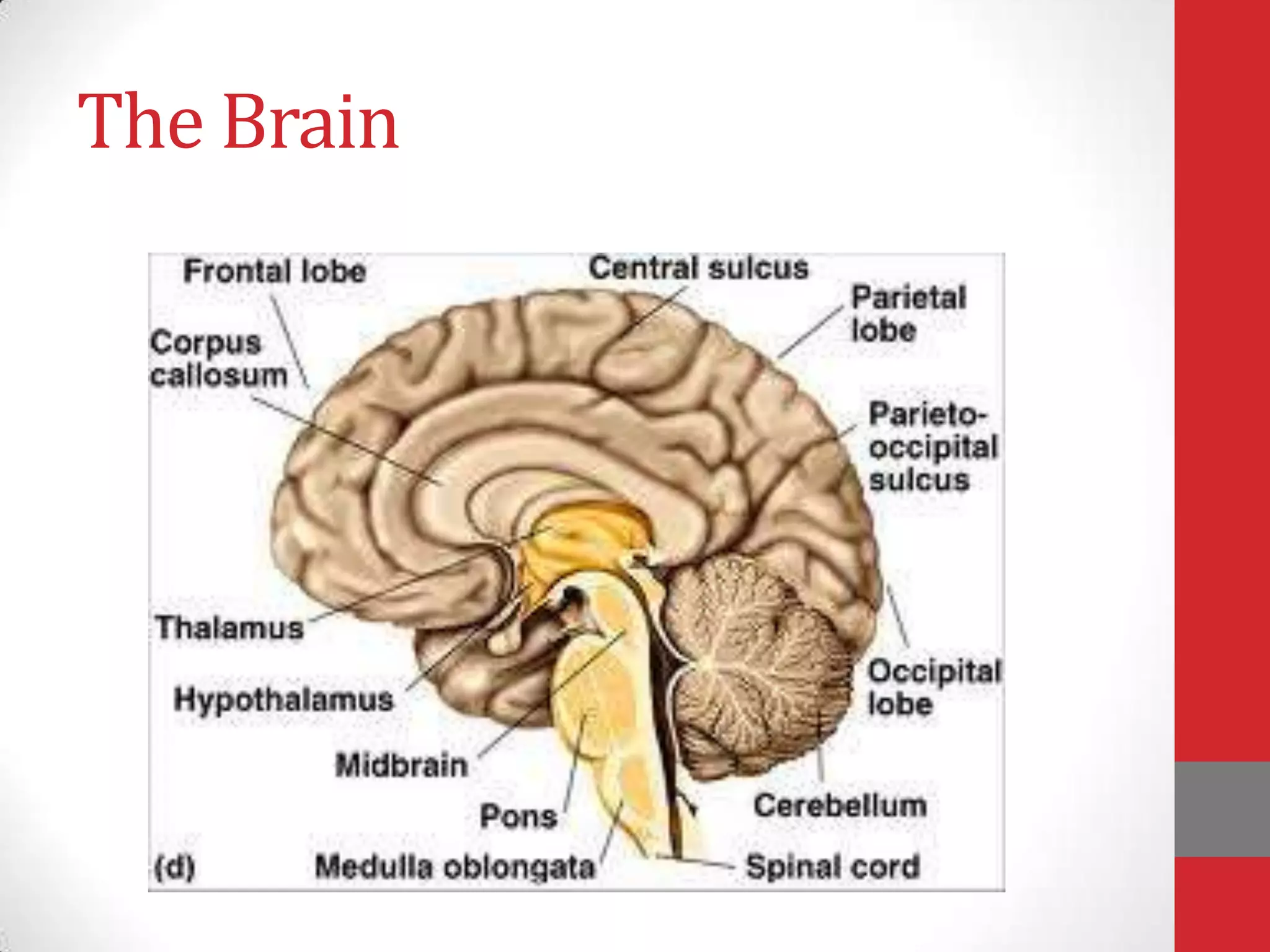
The Brain
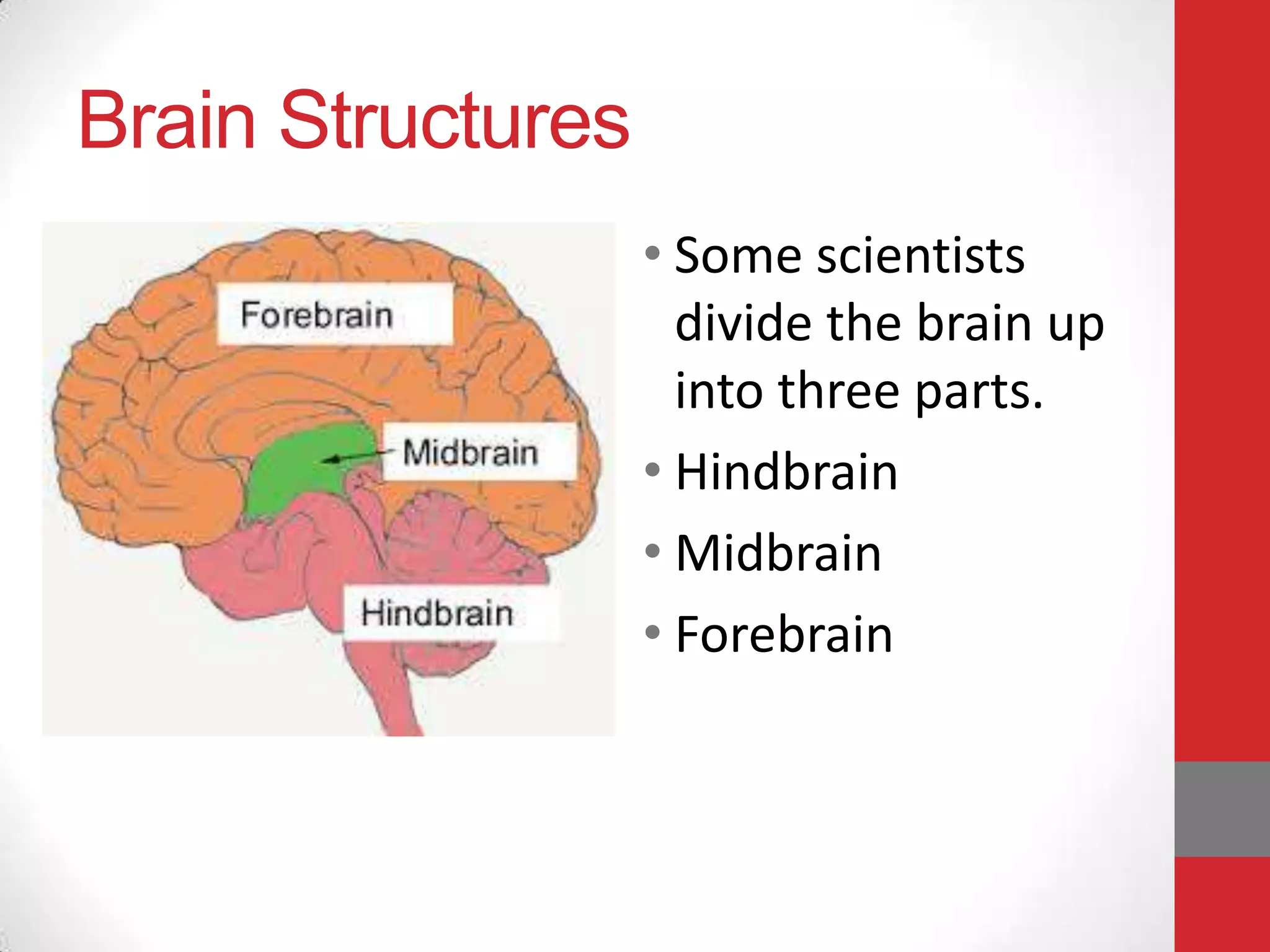
Brain Structures
• Some scientists
divide the brain up
into three parts.
• Hindbrain
• Midbrain
• Forebrain
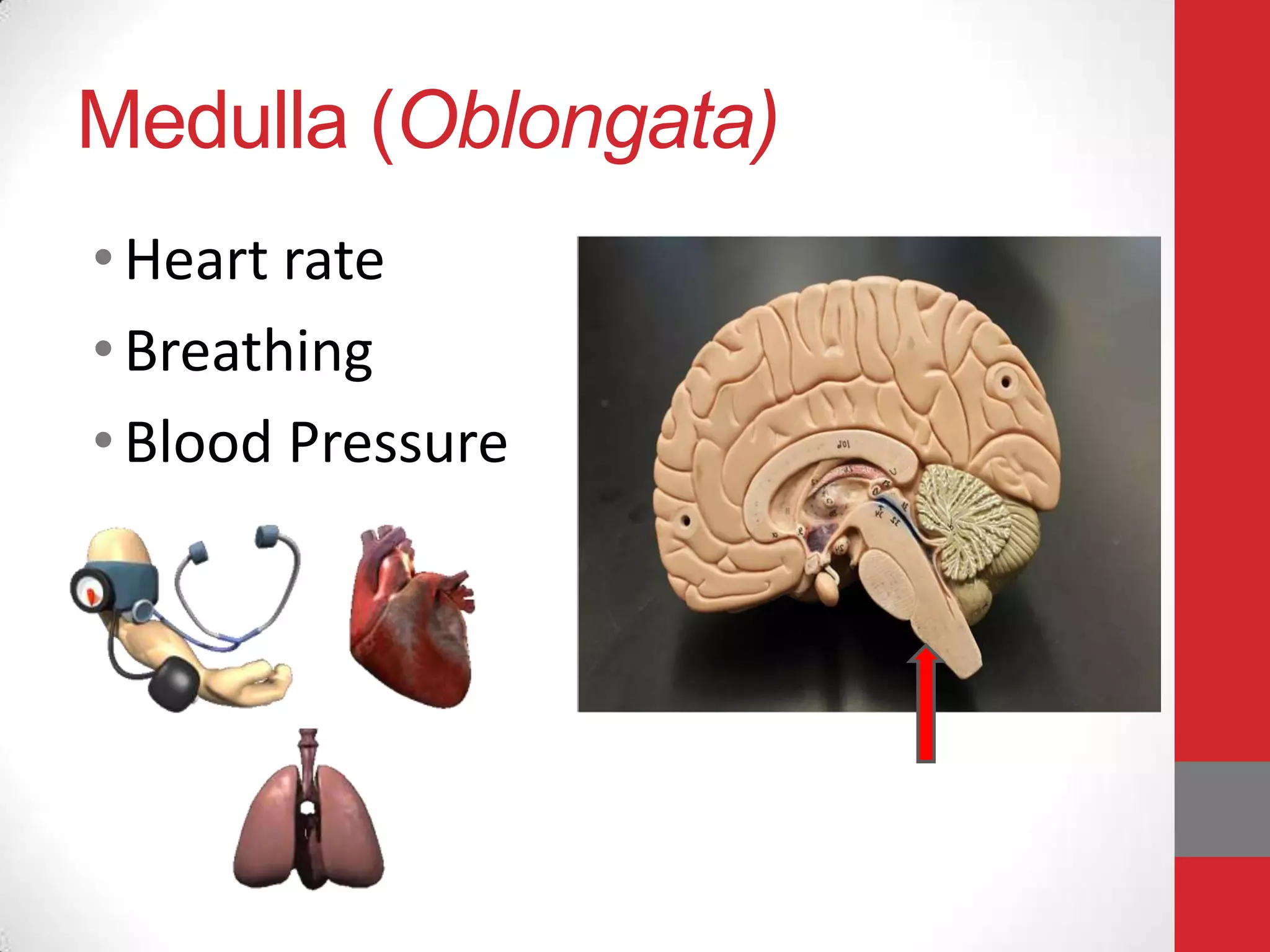
Medulla (Oblongata)
• Heart rate
• Breathing
• Blood Pressure
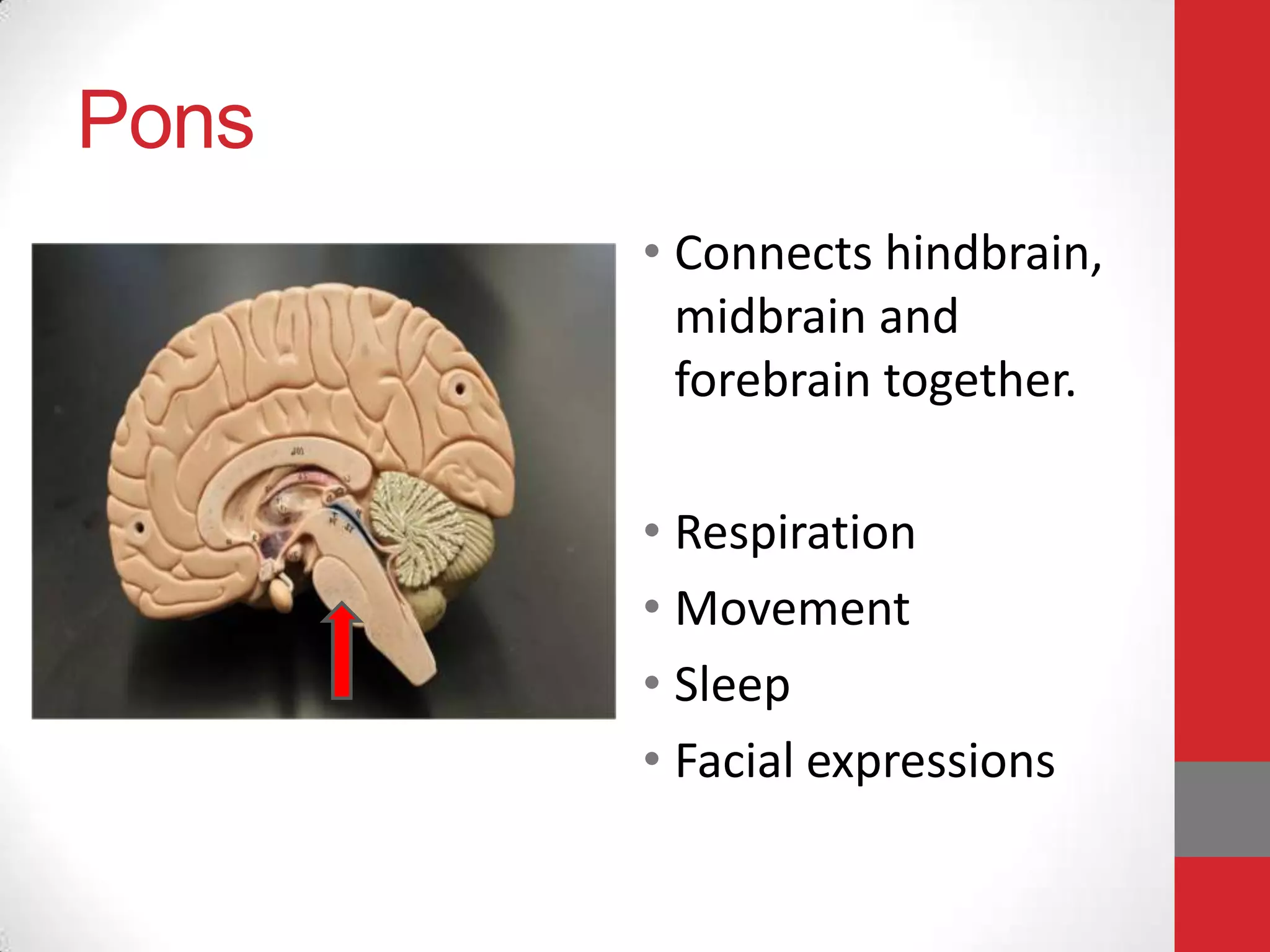
Pons
• Connects hindbrain,
midbrain and
forebrain together.
• Respiration
• Movement
• Sleep
• Facial expressions
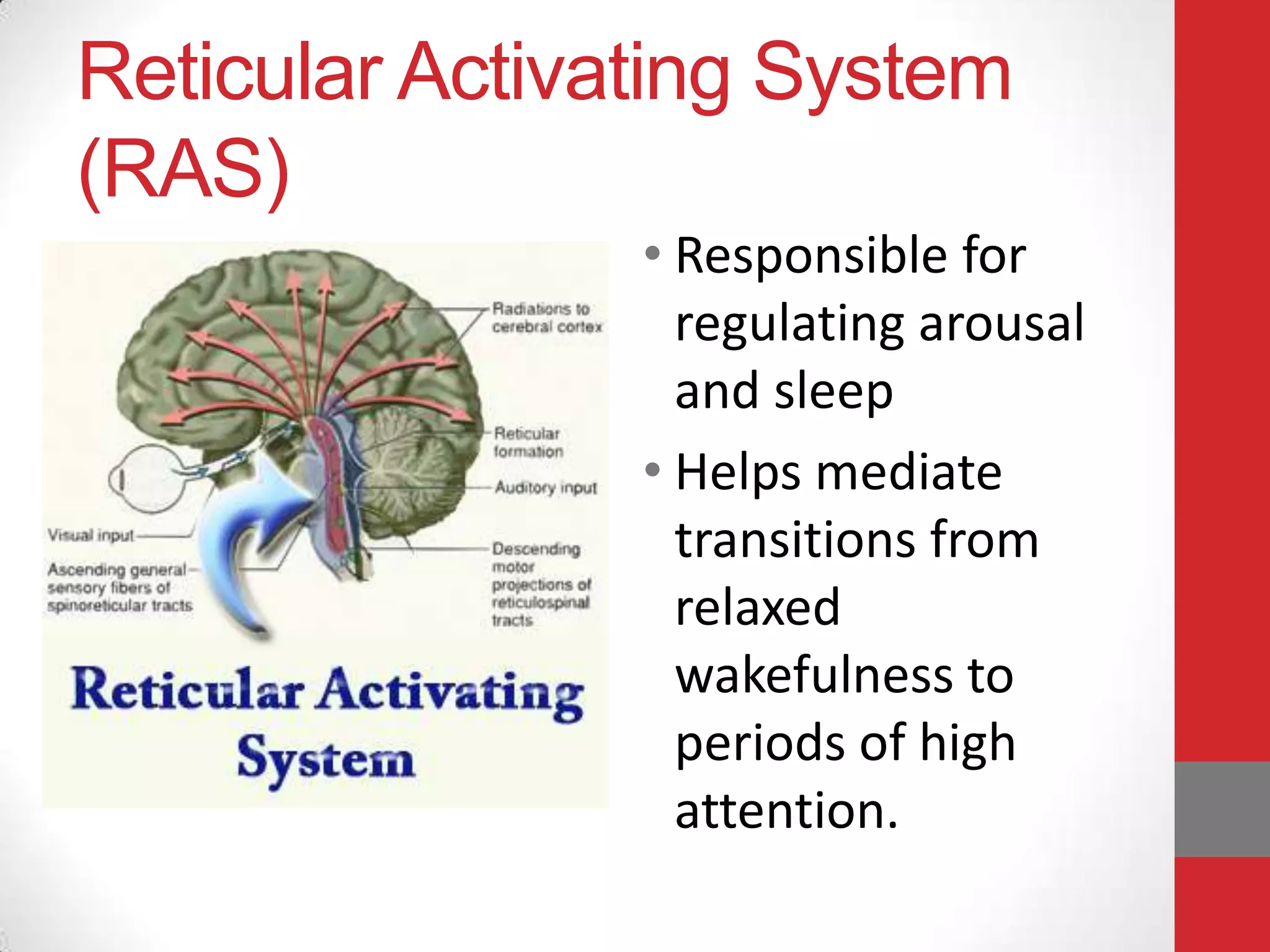
Reticular Activating System
(RAS)
• Responsible for
regulating arousal
and sleep
• Helps mediate
transitions from
relaxed
wakefulness to
periods of high
attention.
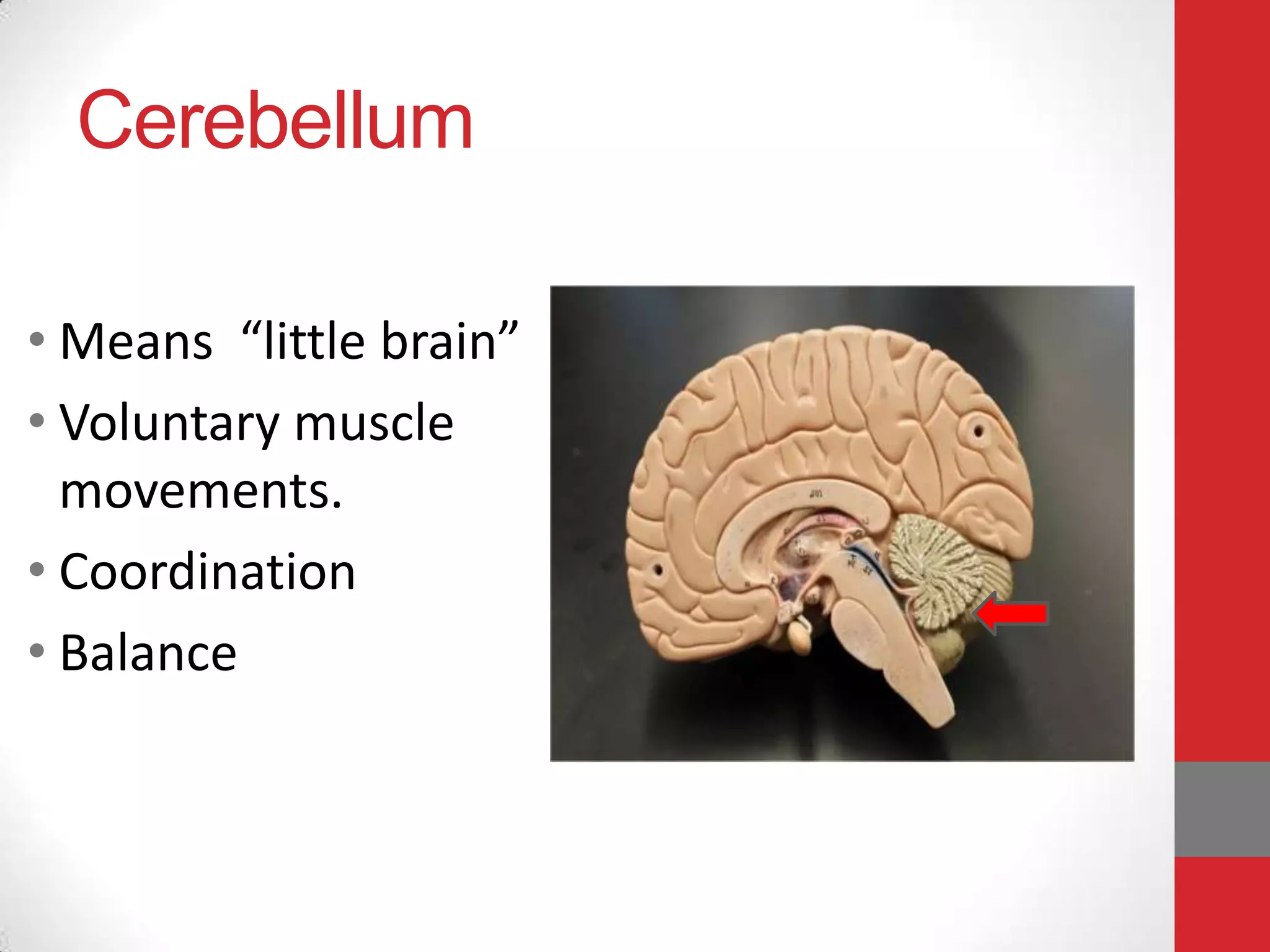
Cerebellum
• Means “little brain”
• Voluntary muscle
movements.
• Coordination
• Balance
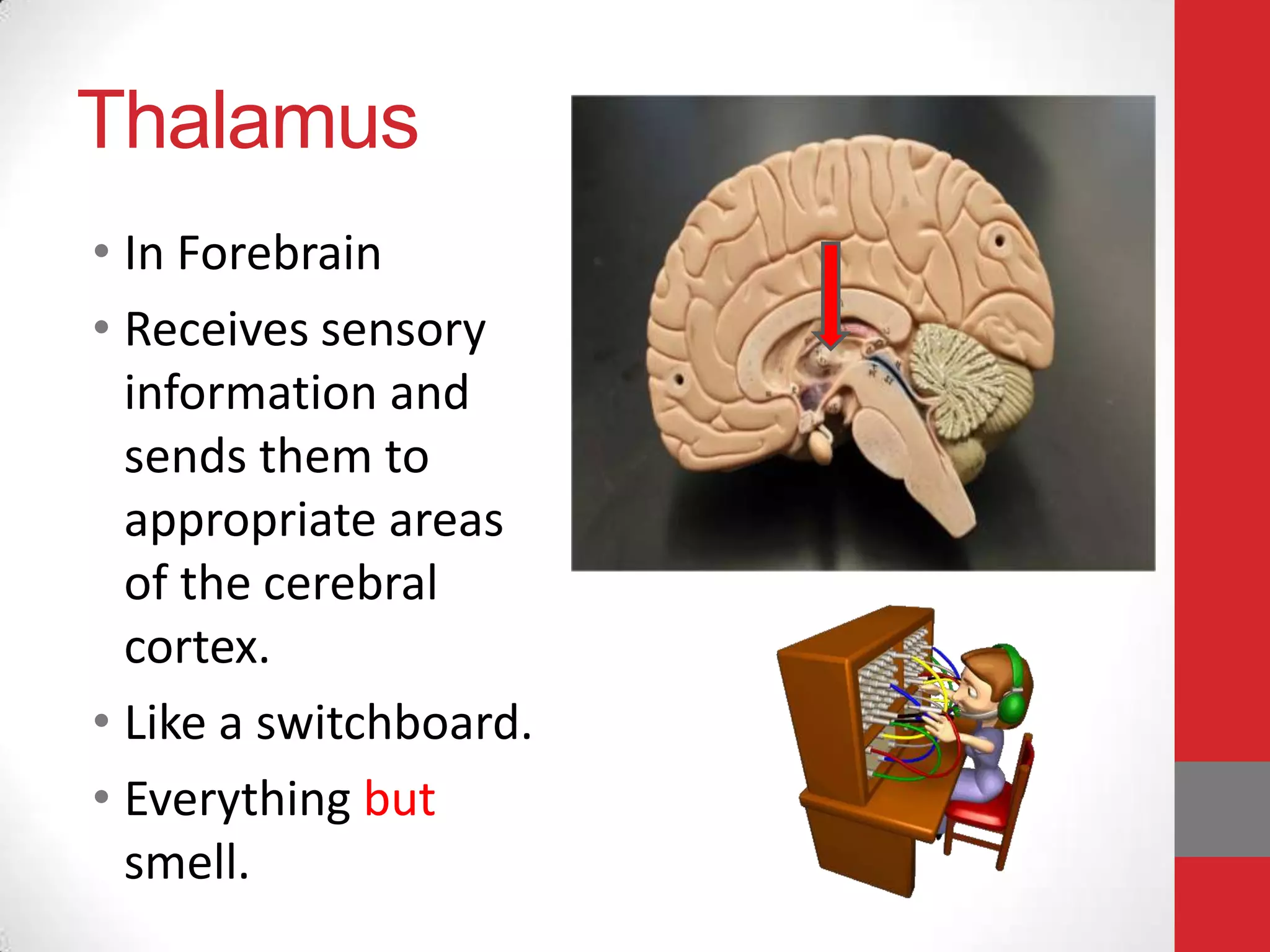
Thalamus
• In Forebrain
• Receives sensory
information and
sends them to
appropriate areas
of the cerebral
cortex.
• Like a switchboard.
• Everything but
smell.
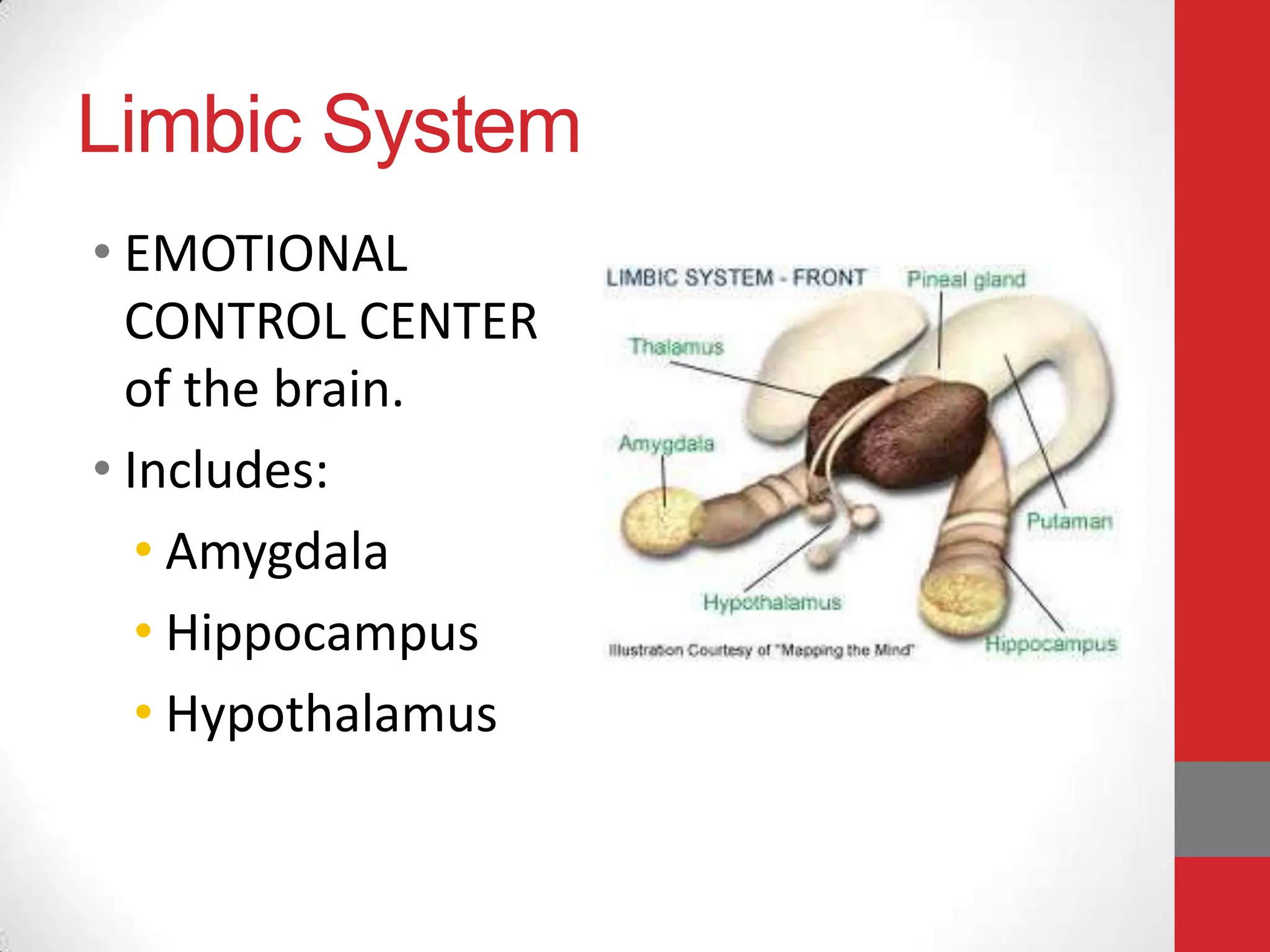
Limbic System
• EMOTIONAL
CONTROL CENTER
of the brain.
• Includes:
• Amygdala
• Hippocampus
• Hypothalamus
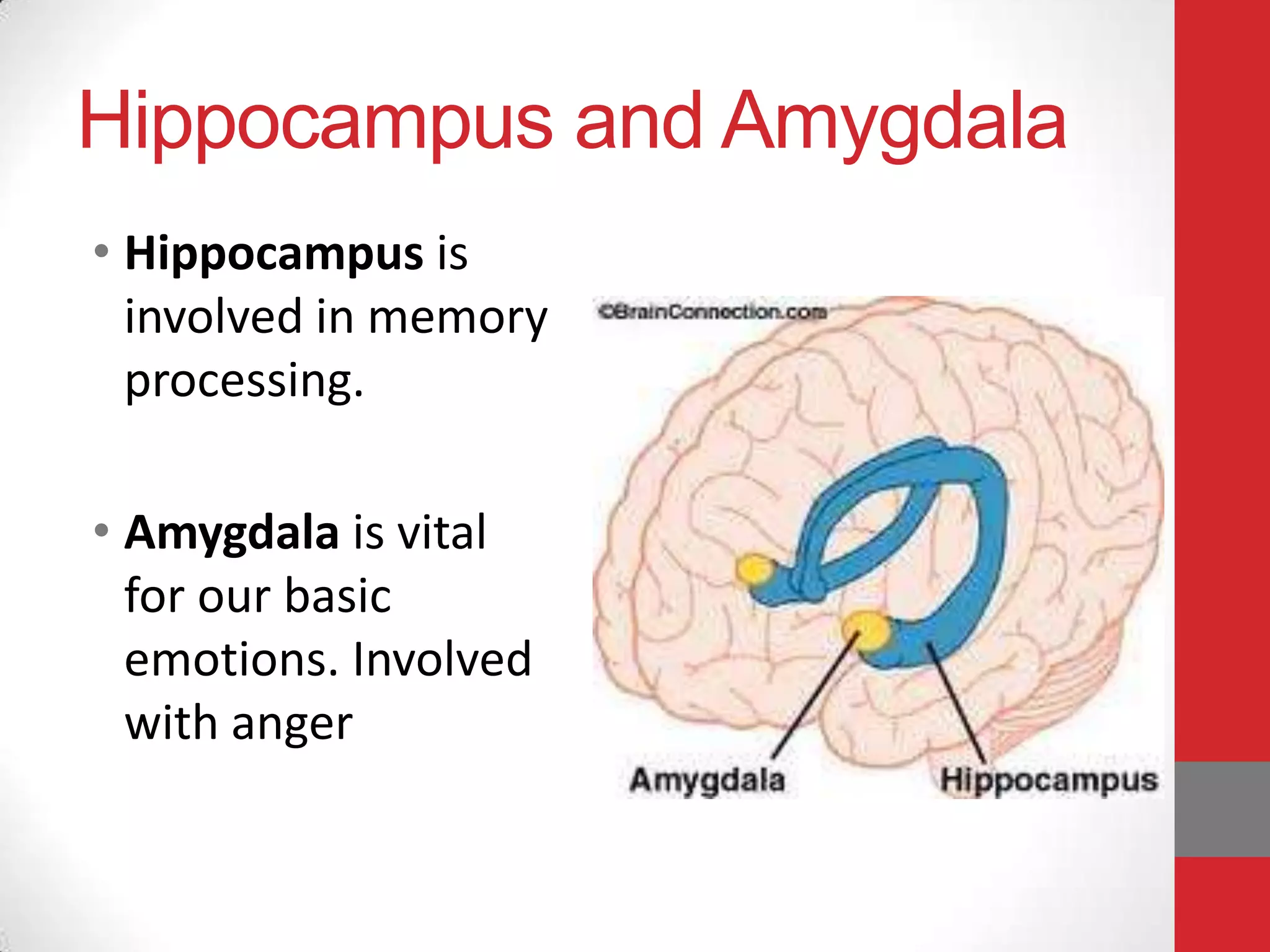
Hippocampus and Amygdala
• Hippocampus is
involved in memory
processing.
• Amygdala is vital
for our basic
emotions. Involved
with anger
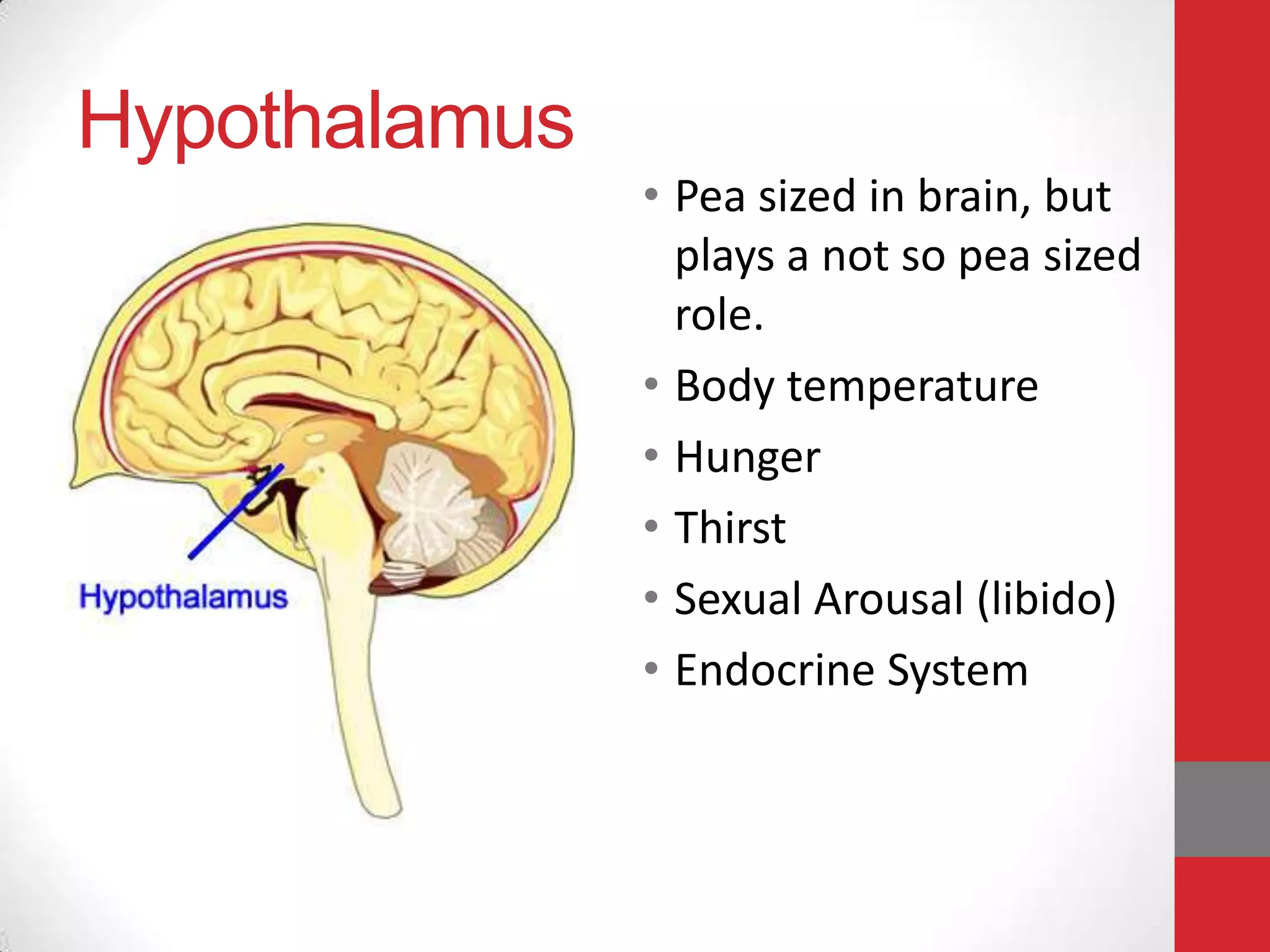
Hypothalamus
• Pea sized in brain, but
plays a not so pea sized
role.
• Body temperature
• Hunger
• Thirst
• Sexual Arousal (libido)
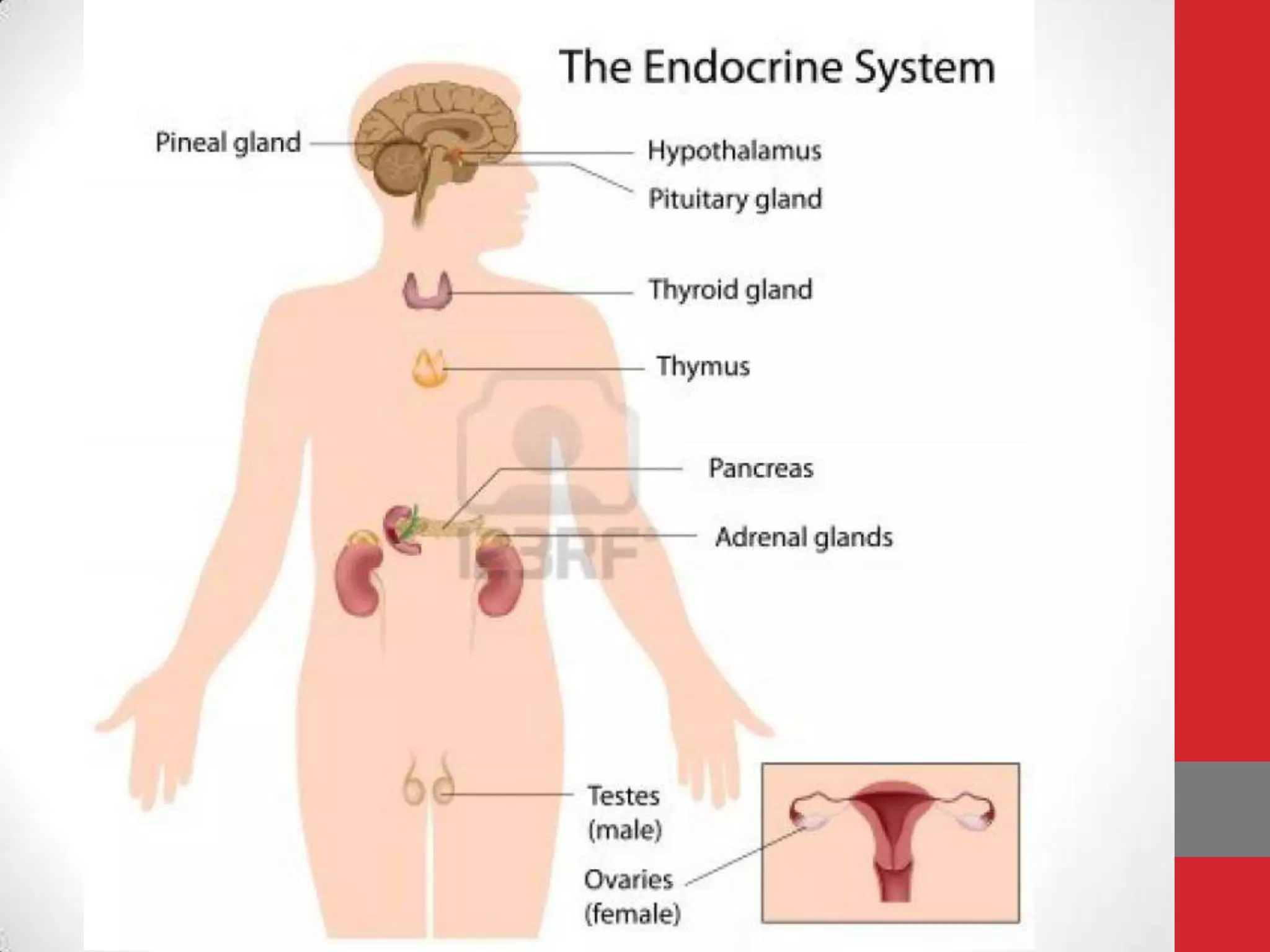
• Endocrine System
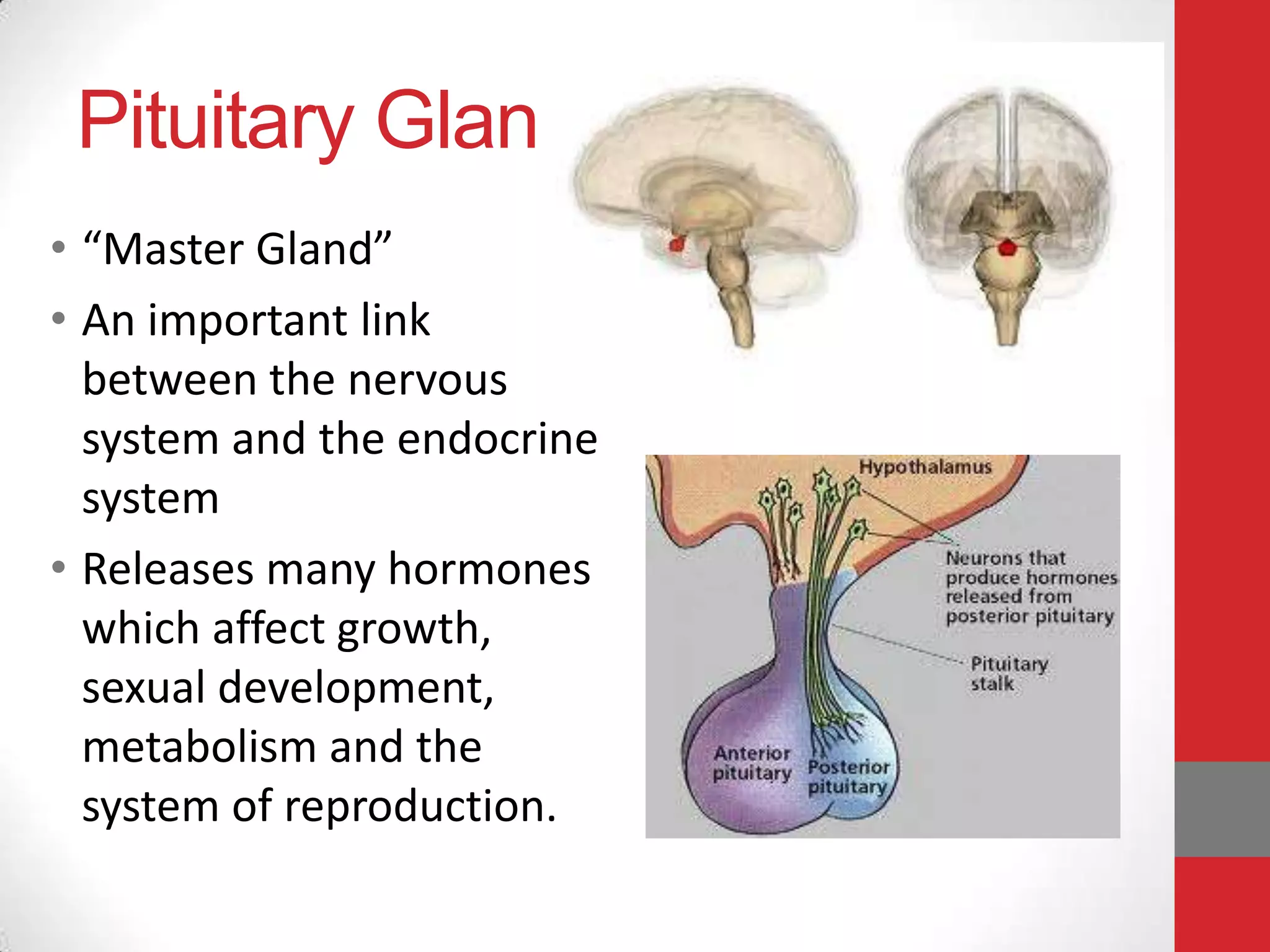
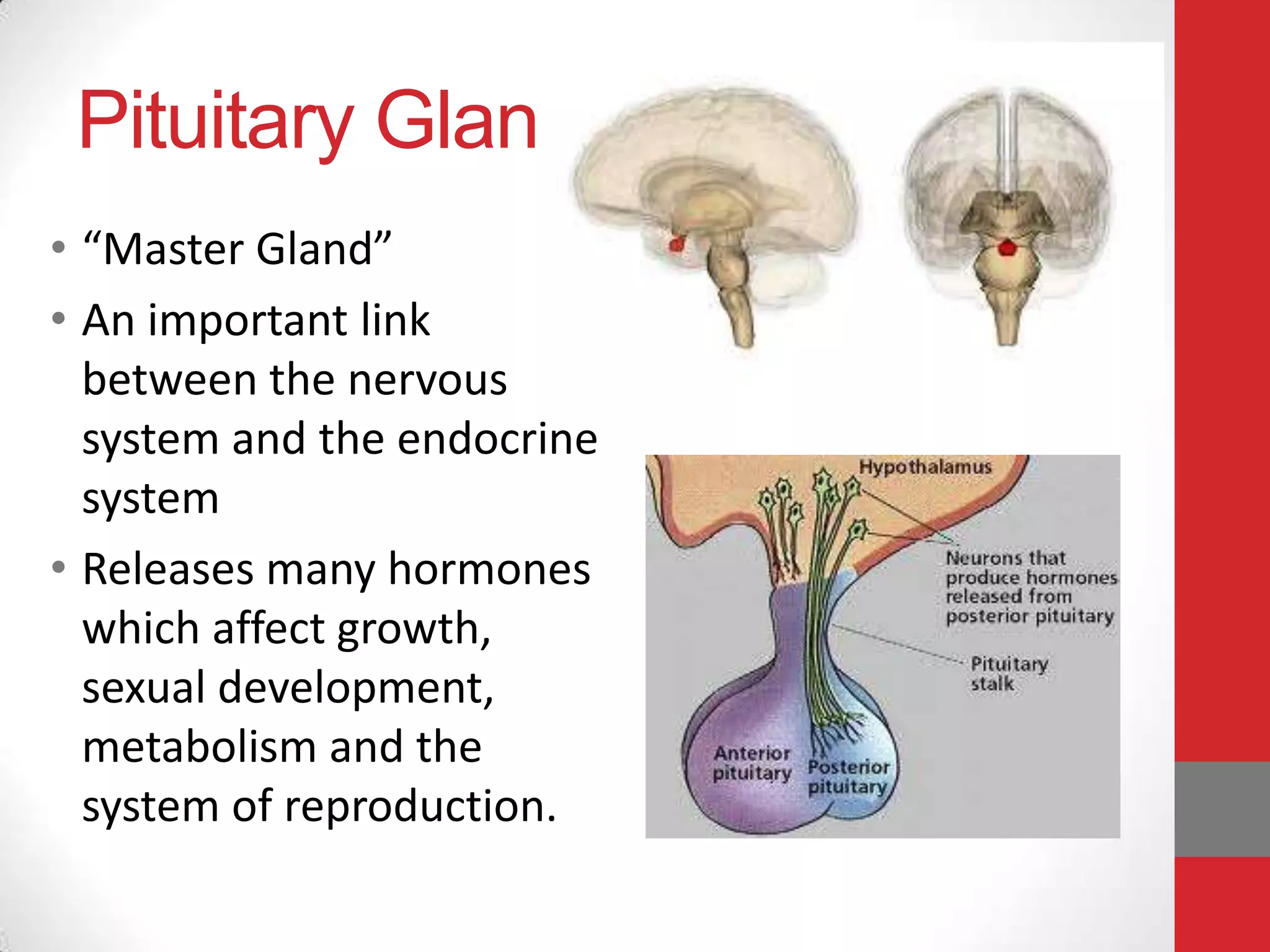
Pituitary Gland
• “Master Gland”
• An important link
between the nervous
system and the endocrine
system
• Releases many hormones
which affect growth,
sexual development,
metabolism and the
system of reproduction.
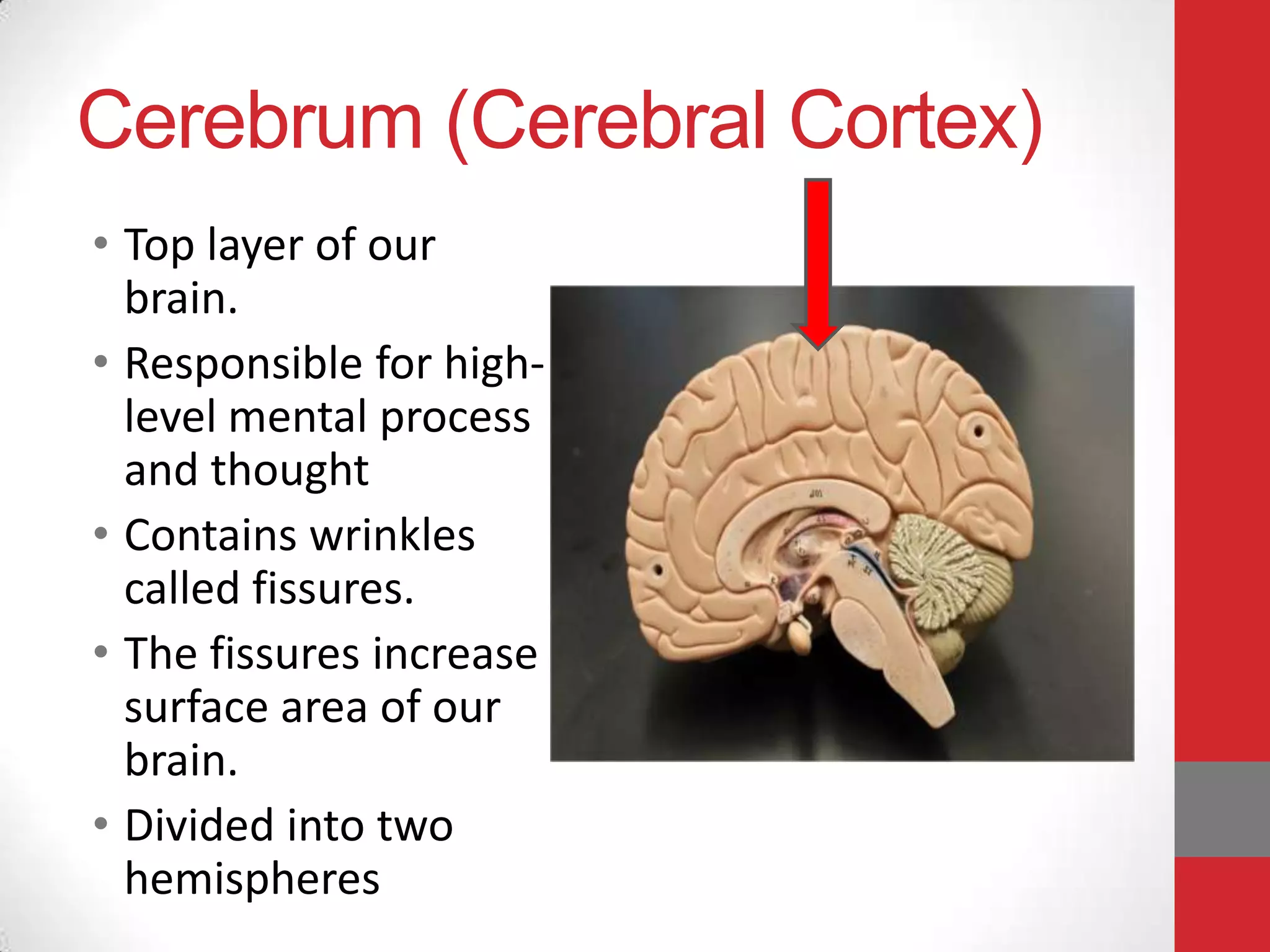
Cerebrum (Cerebral Cortex)
• Top layer of our
brain.
• Responsible for highlevel mental process
and thought
• Contains wrinkles
called fissures.
• The fissures increase
surface area of our
brain.
• Divided into two
hemispheres
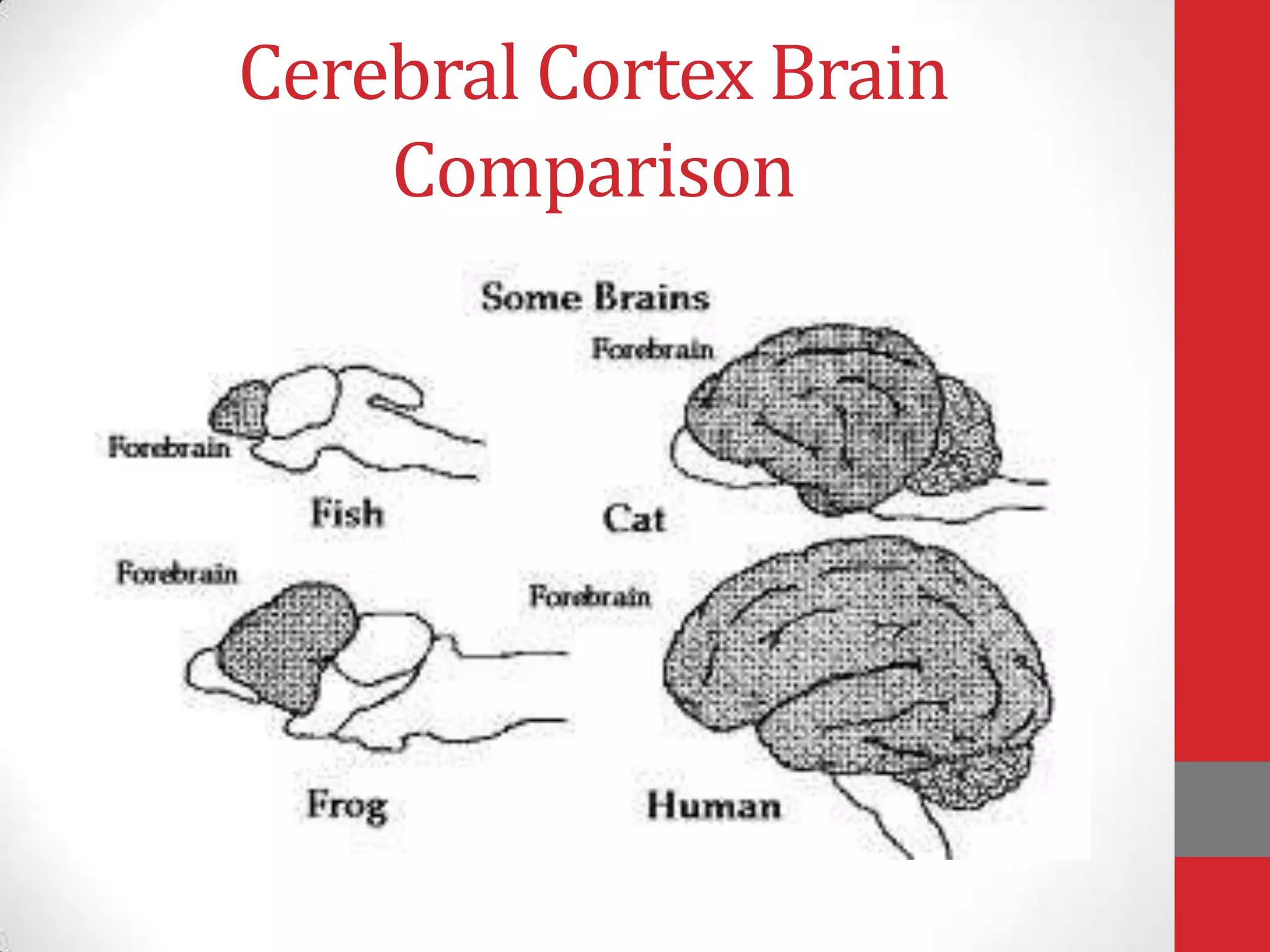
Cerebral Cortex Brain
Comparison
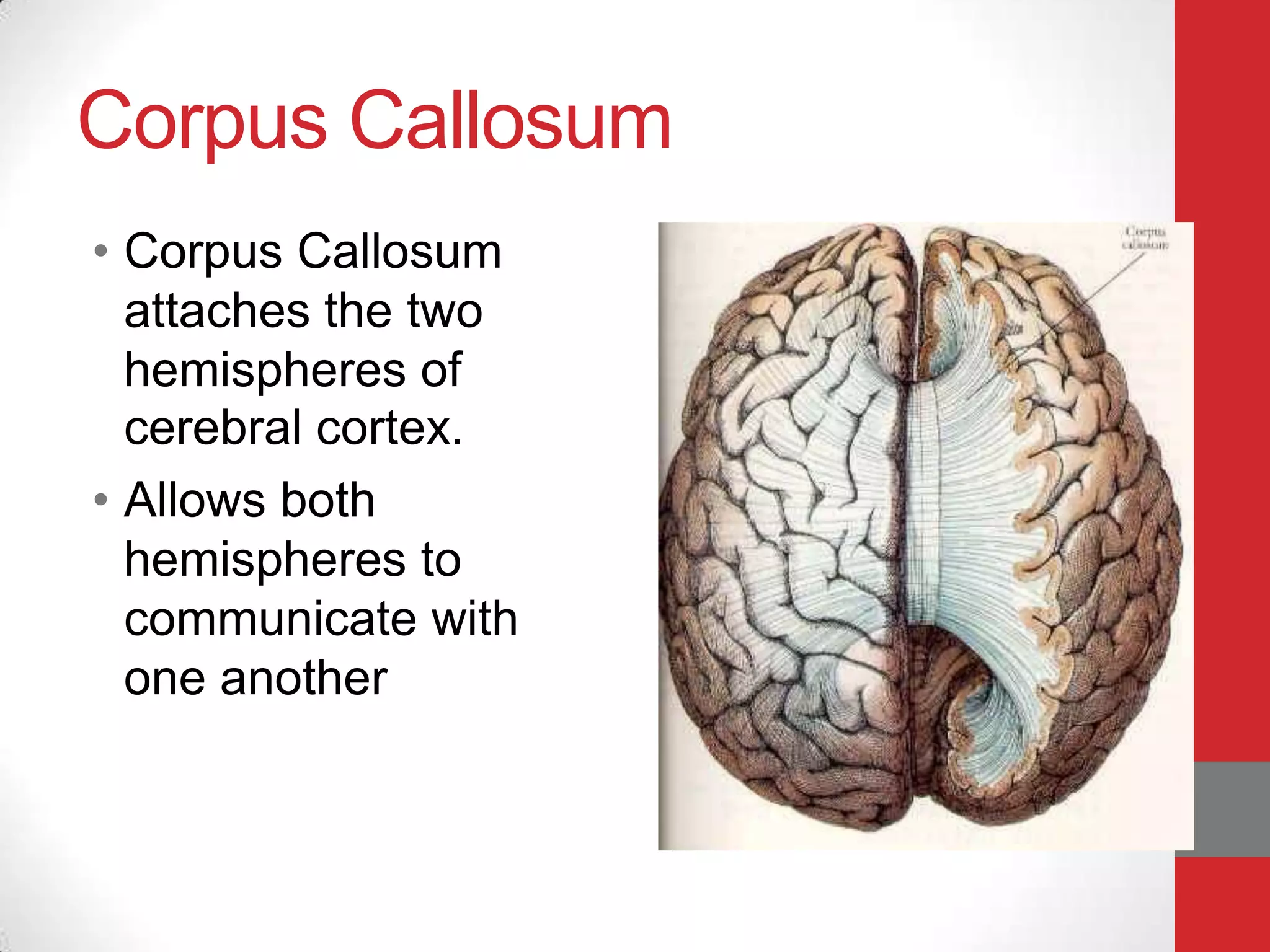
Corpus Callosum
• Corpus Callosum
attaches the two
hemispheres of
cerebral cortex.
• Allows both
hemispheres to
communicate with
one another
Lesson 1: The Brain
Summarizer:

Brain Parts and
Functions
Lesson 2: The Brain
ACTIVATOR:

3 Parts of the Brain
2 Facts learned
1 Question
Lesson 2: The Brain
EQ: How do biological processes and systems
impact behavior?

Vocabulary
• Frontal Lobe
• Parietal Lobe
• Occipital Lobe
• Temporal Lobe

• Motor Cortex (Strip)
• (Soma)Sensory
Cortex (Strip)
• Broca’s Area
• Wernicke’s Area
Lobes and Areas Assignment
1. Read the article in your packet entitled Men and
Women are Different and answer the questions on
the accompanying question sheet.
2. Using colored pencils, locate, label, and shade the
following: (Use pg. 74 in your text)
• Frontal Lobe, Parietal Lobe, Temporal Lobe, Occipital
Lobe, Motor Cortex, Somasensory Cortex, Broca’s
Area, and Wernicke’s Area.
• Note: The areas and cortexes are located in lobes. This
means you must locate all areas prior to coloring.
3. Meet with a partner to check each other’s work
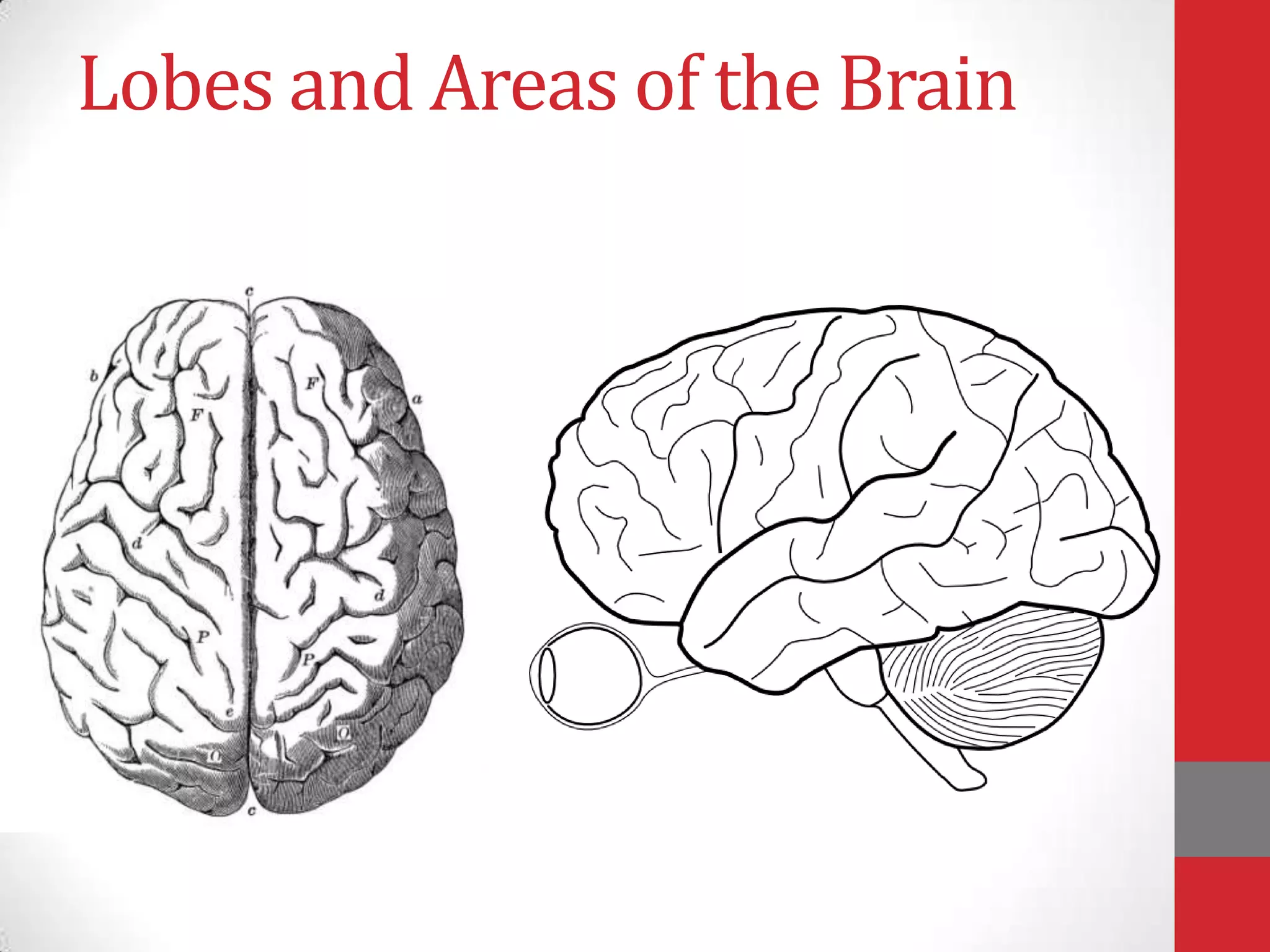
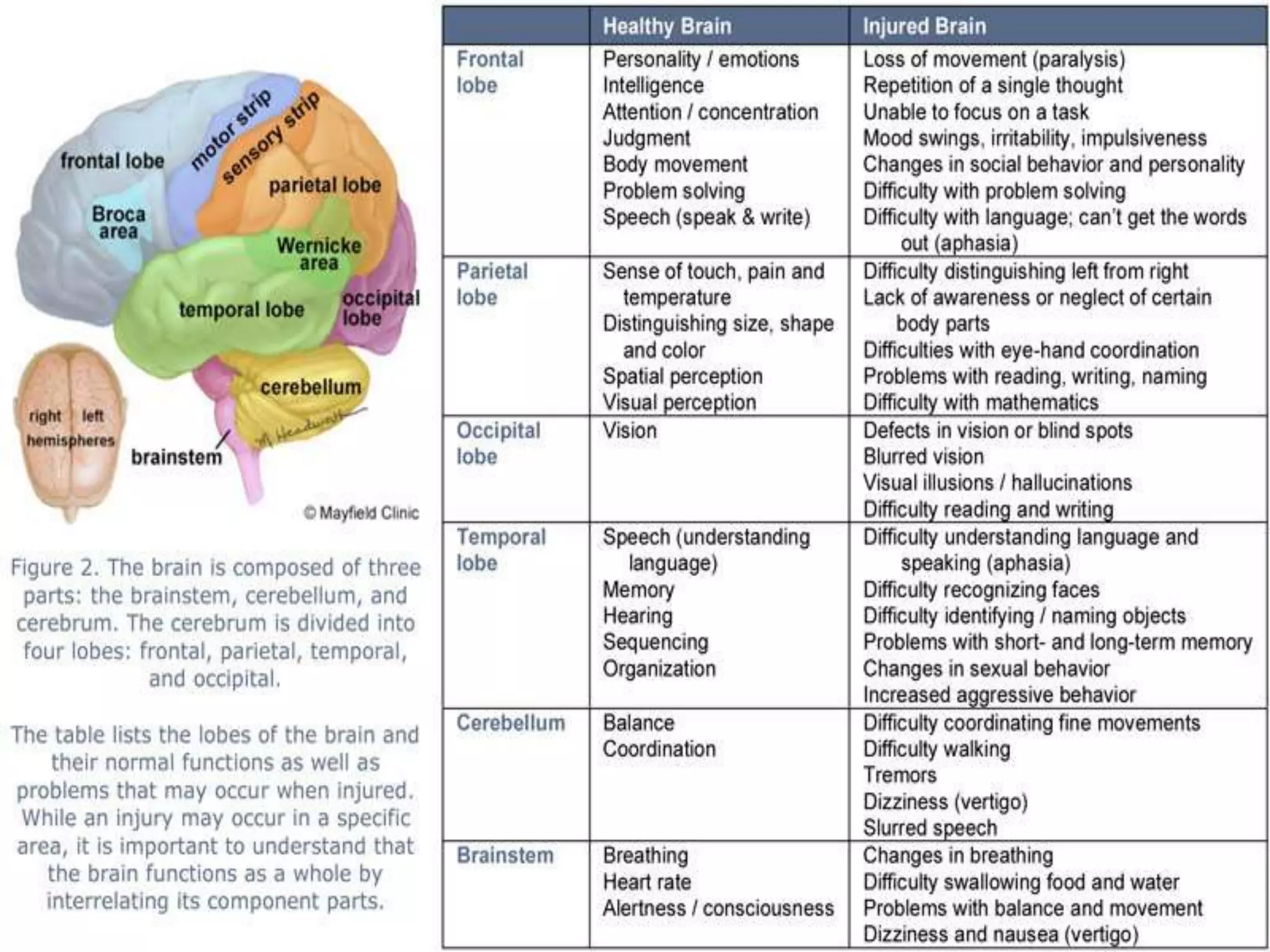
Lobes and Areas of the Brain
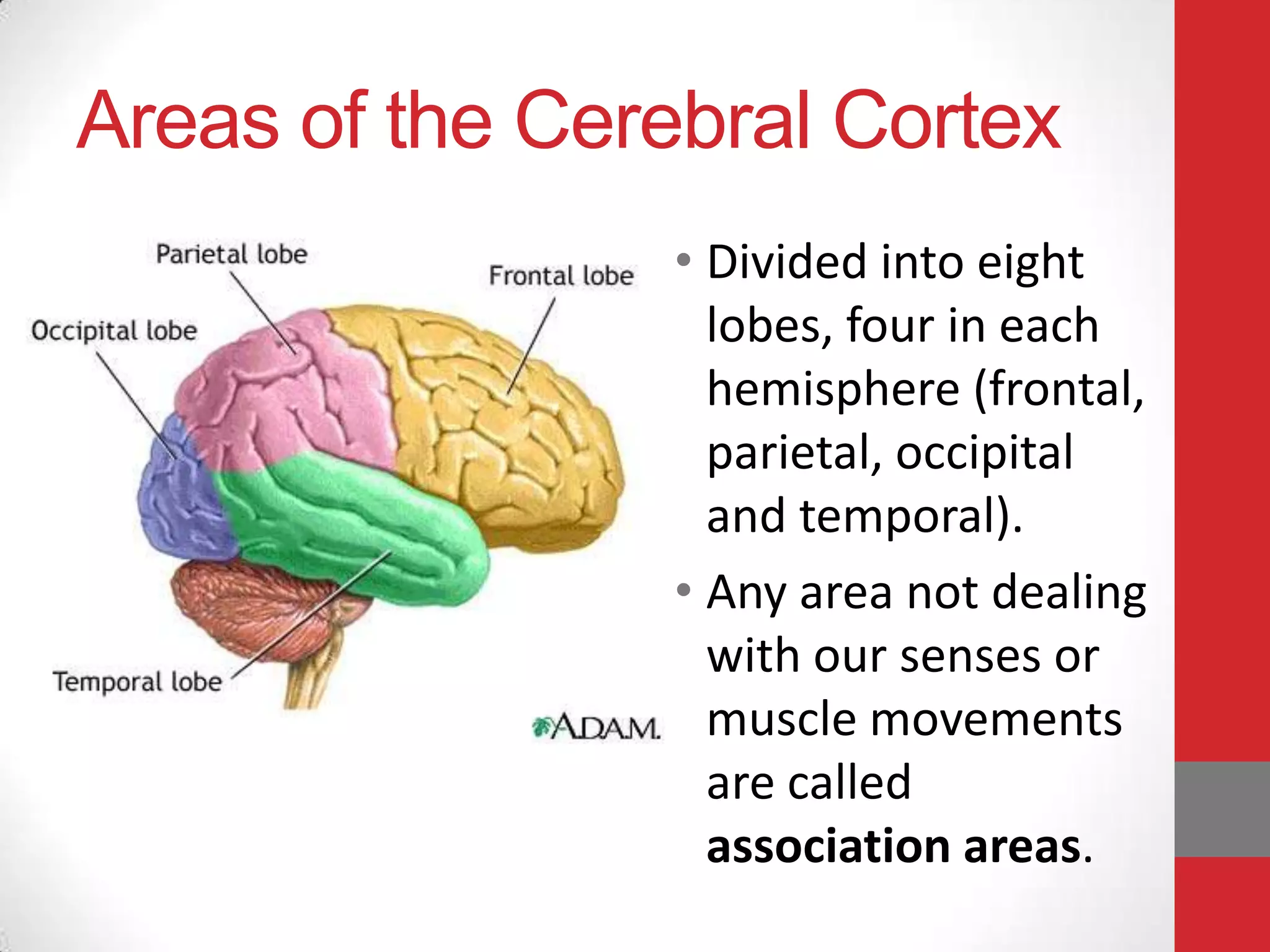
Areas of the Cerebral Cortex
• Divided into eight
lobes, four in each
hemisphere (frontal,
parietal, occipital
and temporal).
• Any area not dealing
with our senses or
muscle movements
are called
association areas.
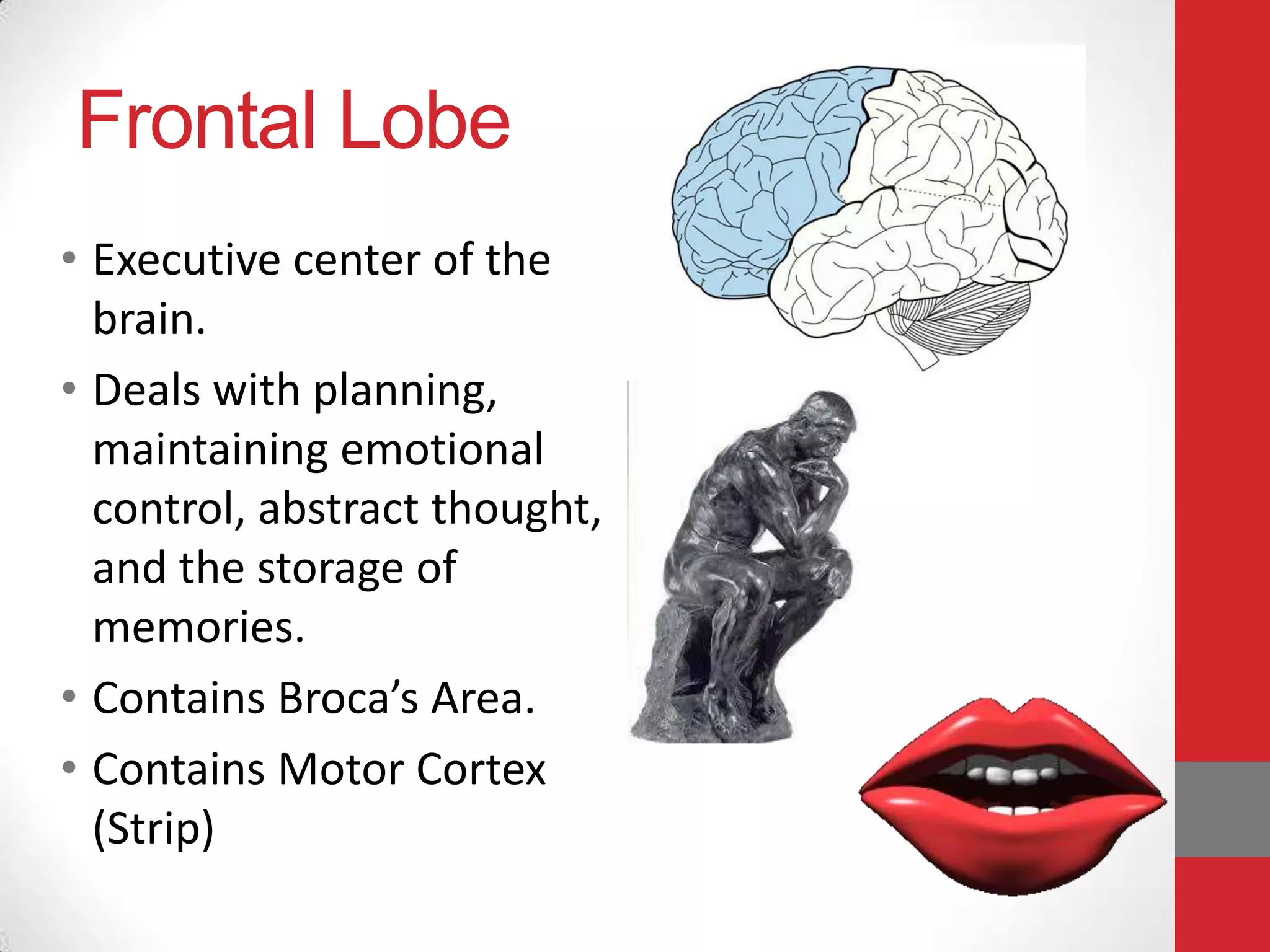
Frontal Lobe
• Executive center of the
brain.
• Deals with planning,
maintaining emotional
control, abstract thought,
and the storage of
memories.
• Contains Broca’s Area.
• Contains Motor Cortex
(Strip)
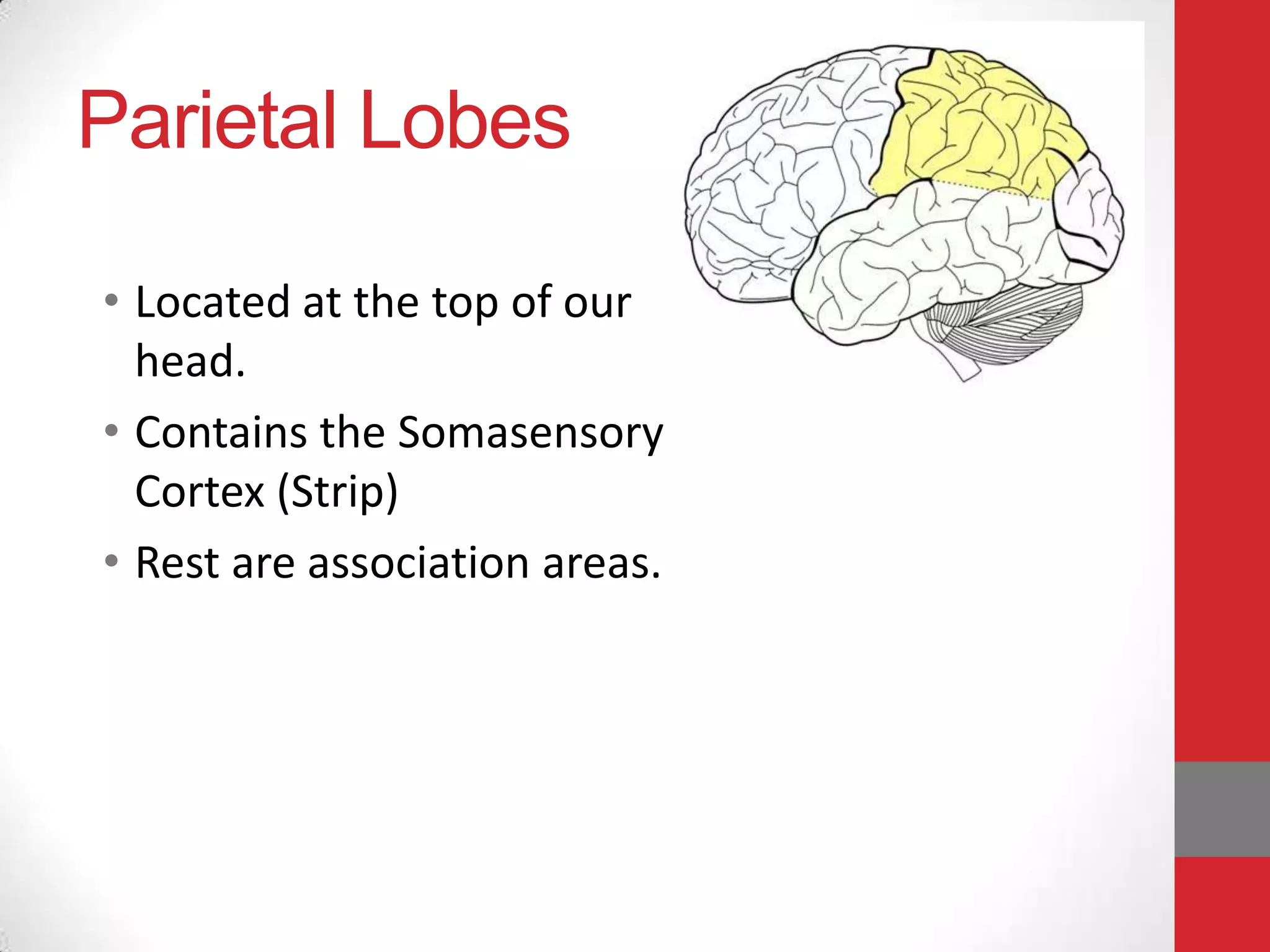
Parietal Lobes
• Located at the top of our
head.
• Contains the Somasensory
Cortex (Strip)
• Rest are association areas.
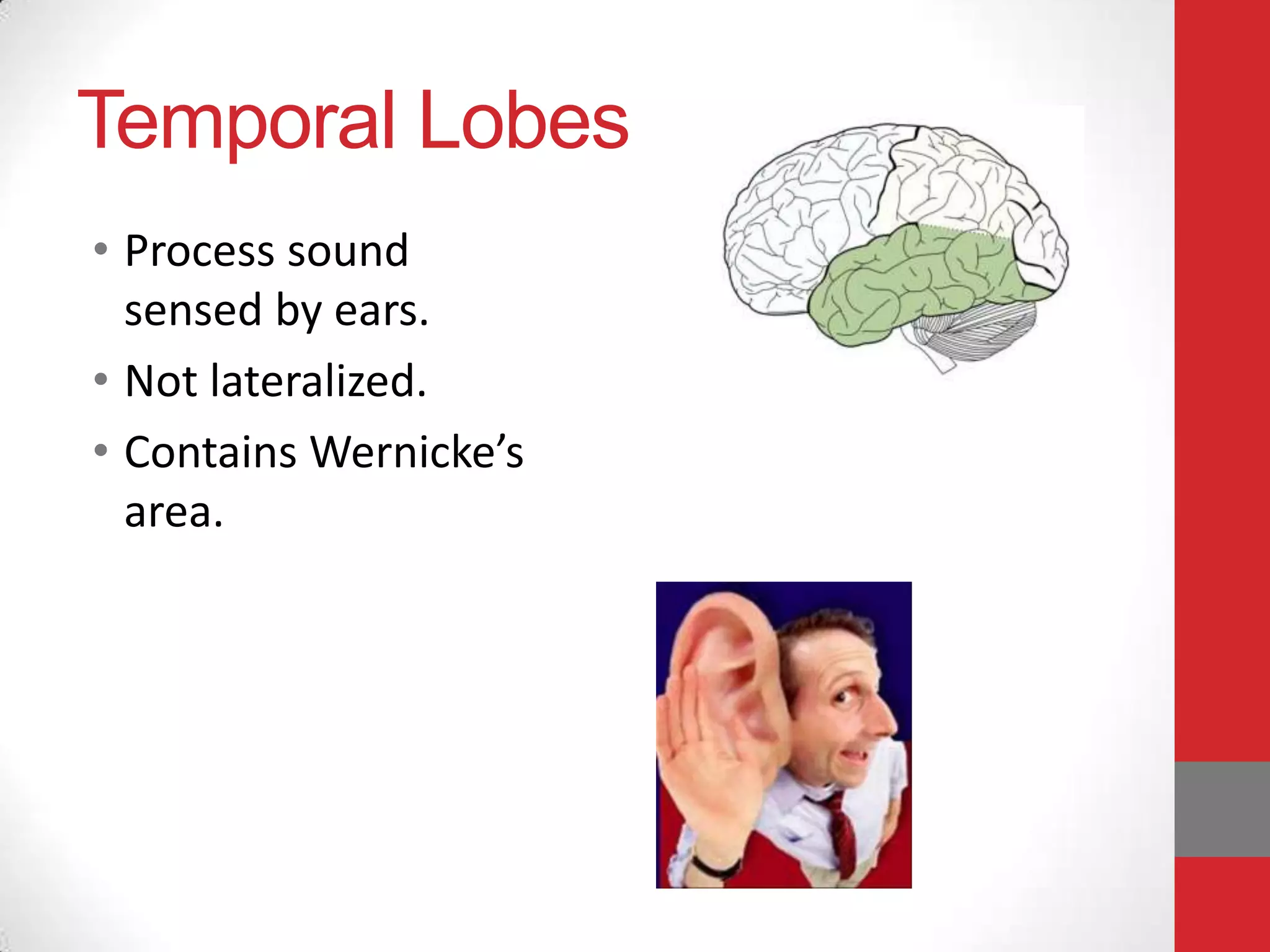
Temporal Lobes
• Process sound
sensed by ears.
• Not lateralized.
• Contains Wernicke’s
area.
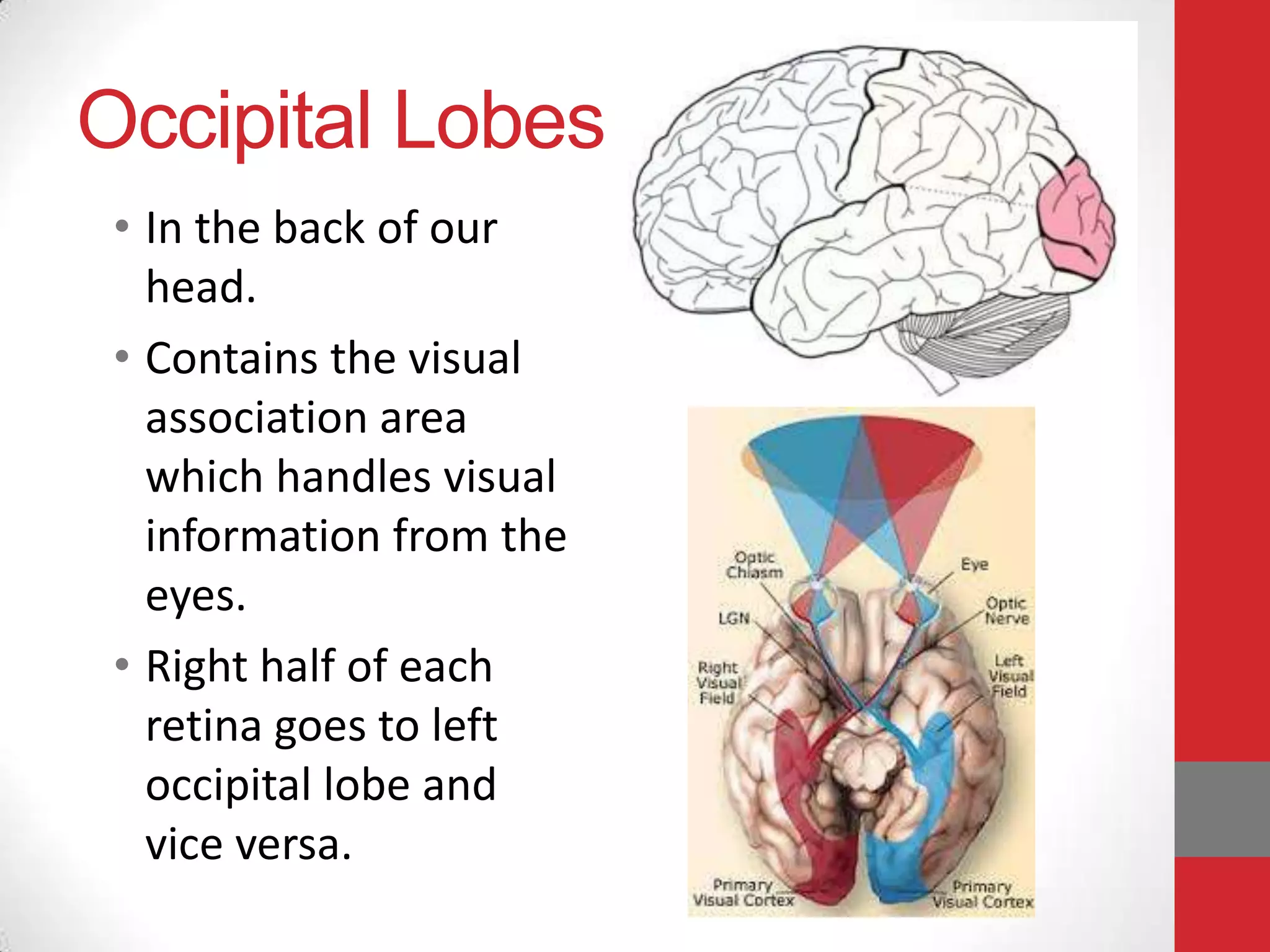
Occipital Lobes
• In the back of our
head.
• Contains the visual
association area
which handles visual
information from the
eyes.
• Right half of each
retina goes to left
occipital lobe and
vice versa.
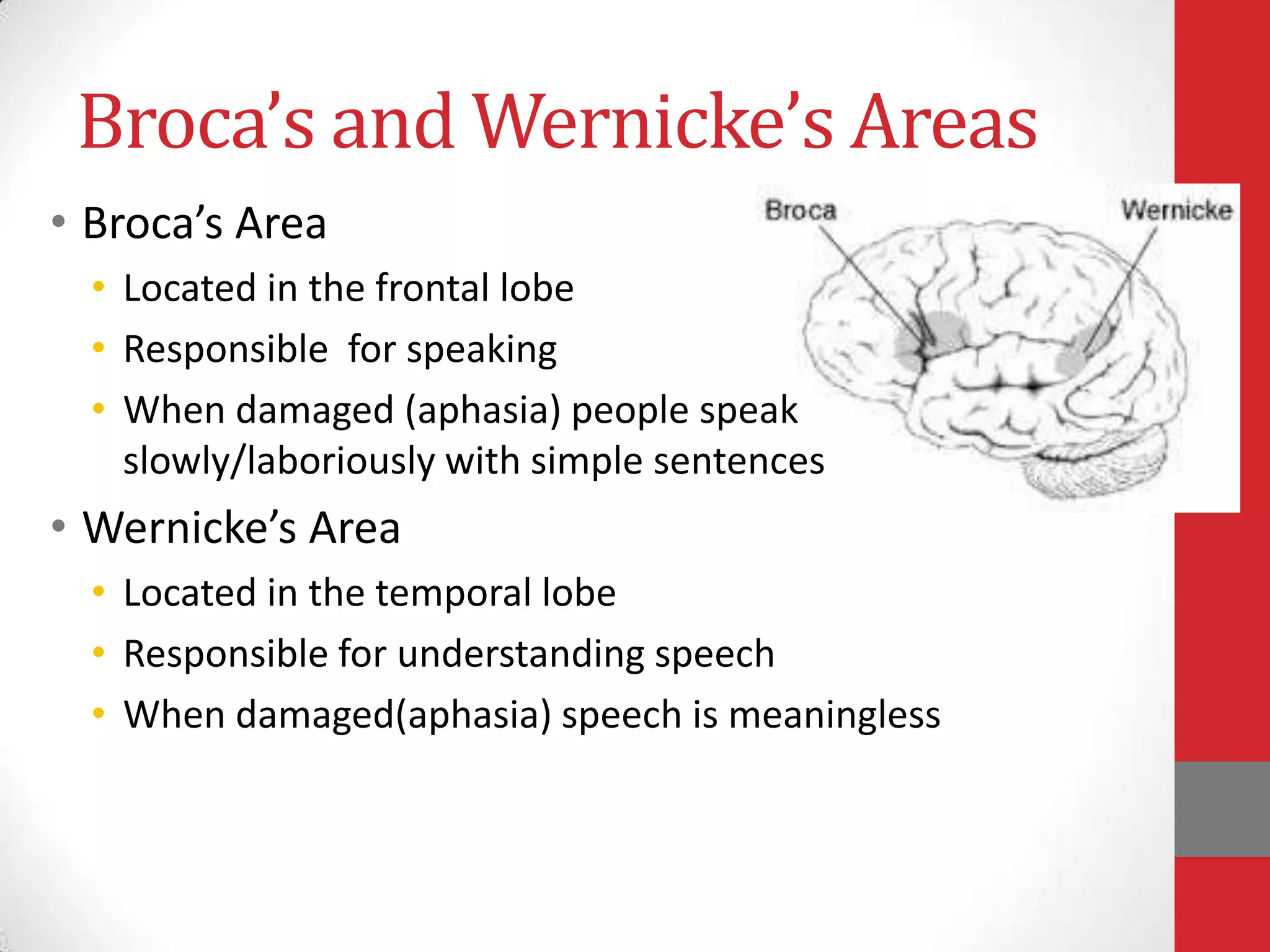
Broca’s and Wernicke’s Areas
• Broca’s Area
• Located in the frontal lobe
• Responsible for speaking
• When damaged (aphasia) people speak
slowly/laboriously with simple sentences

• Wernicke’s Area
• Located in the temporal lobe
• Responsible for understanding speech
• When damaged(aphasia) speech is meaningless
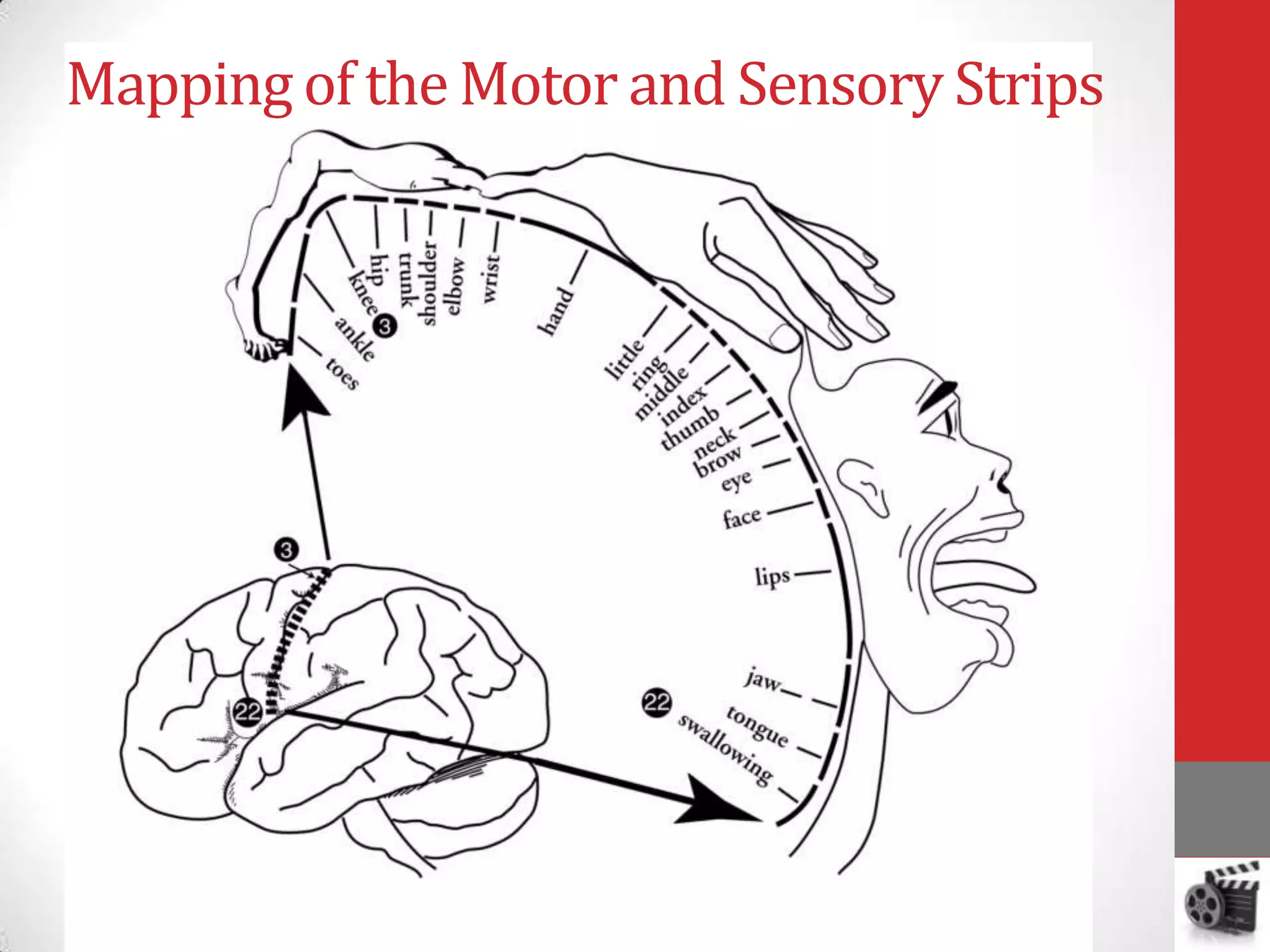
Mapping of the Motor and Sensory Strips
Lesson 3: Split Brain/Cerebral Lateralization
EQ: How do biological processes and systems
impact behavior?

Vocabulary
• Corpus Callosum
• Epilepsy
• Longitudinal Fissure
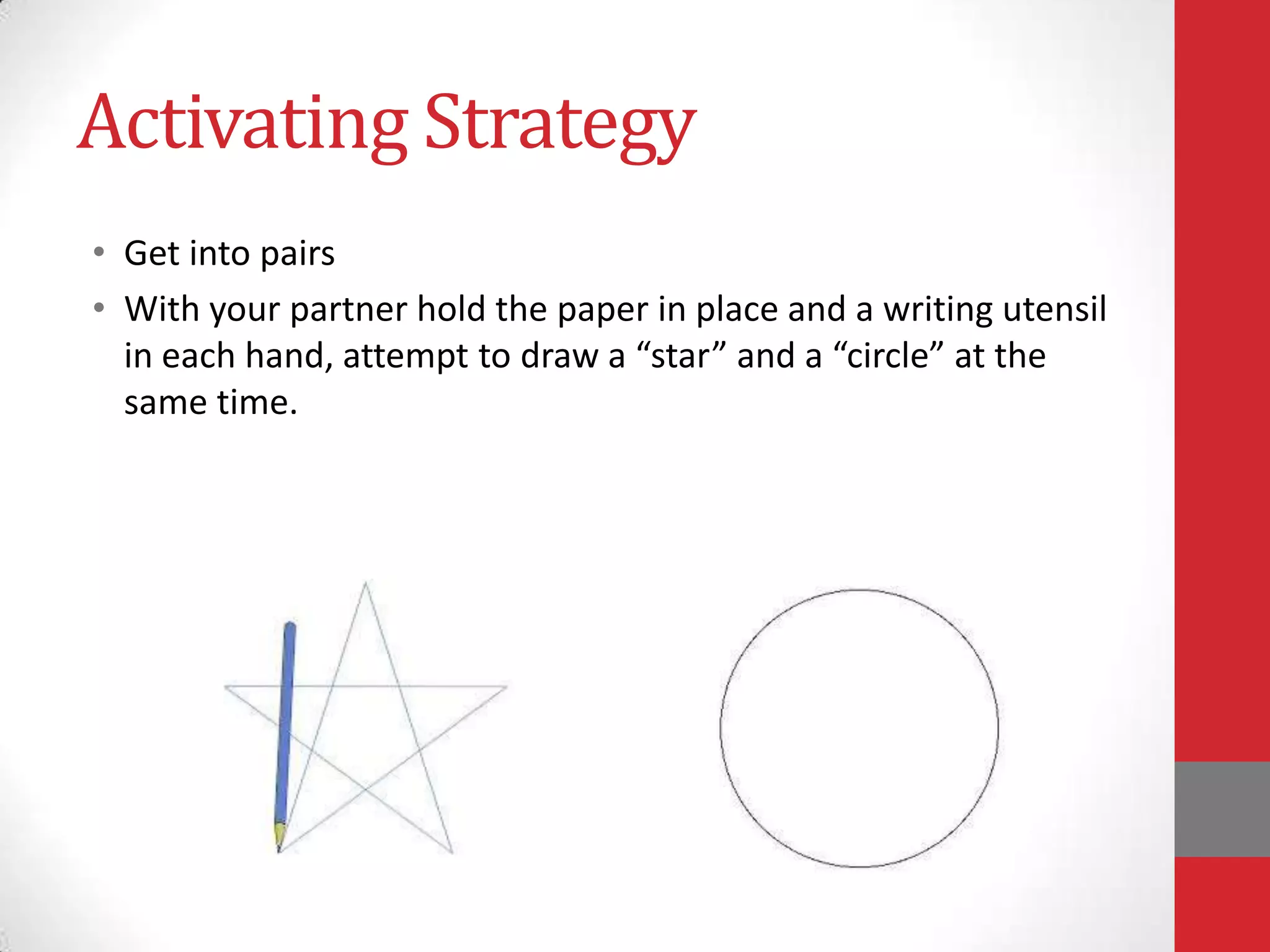
Activating Strategy
• Get into pairs
• With your partner hold the paper in place and a writing utensil
in each hand, attempt to draw a “star” and a “circle” at the
same time.
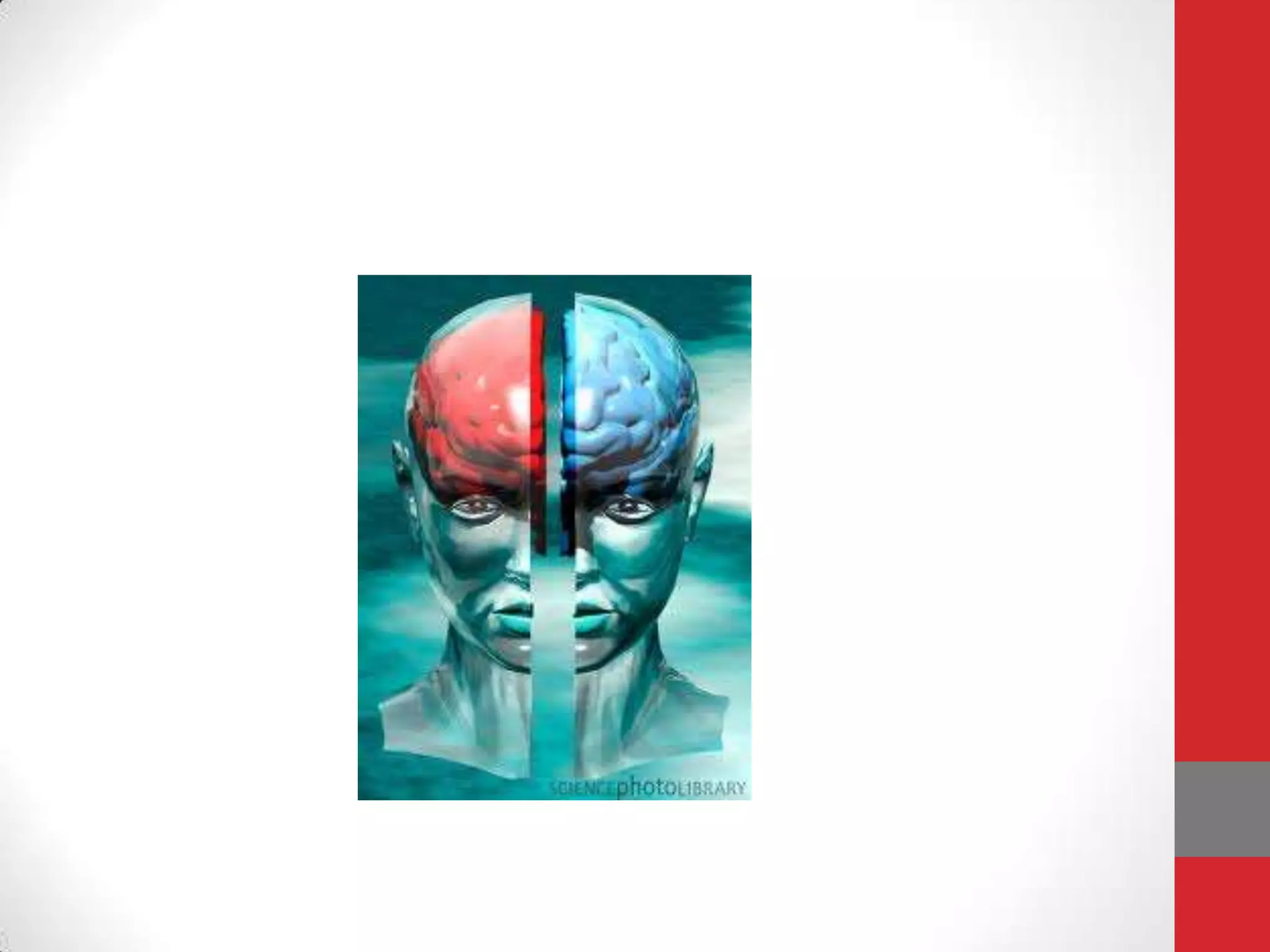
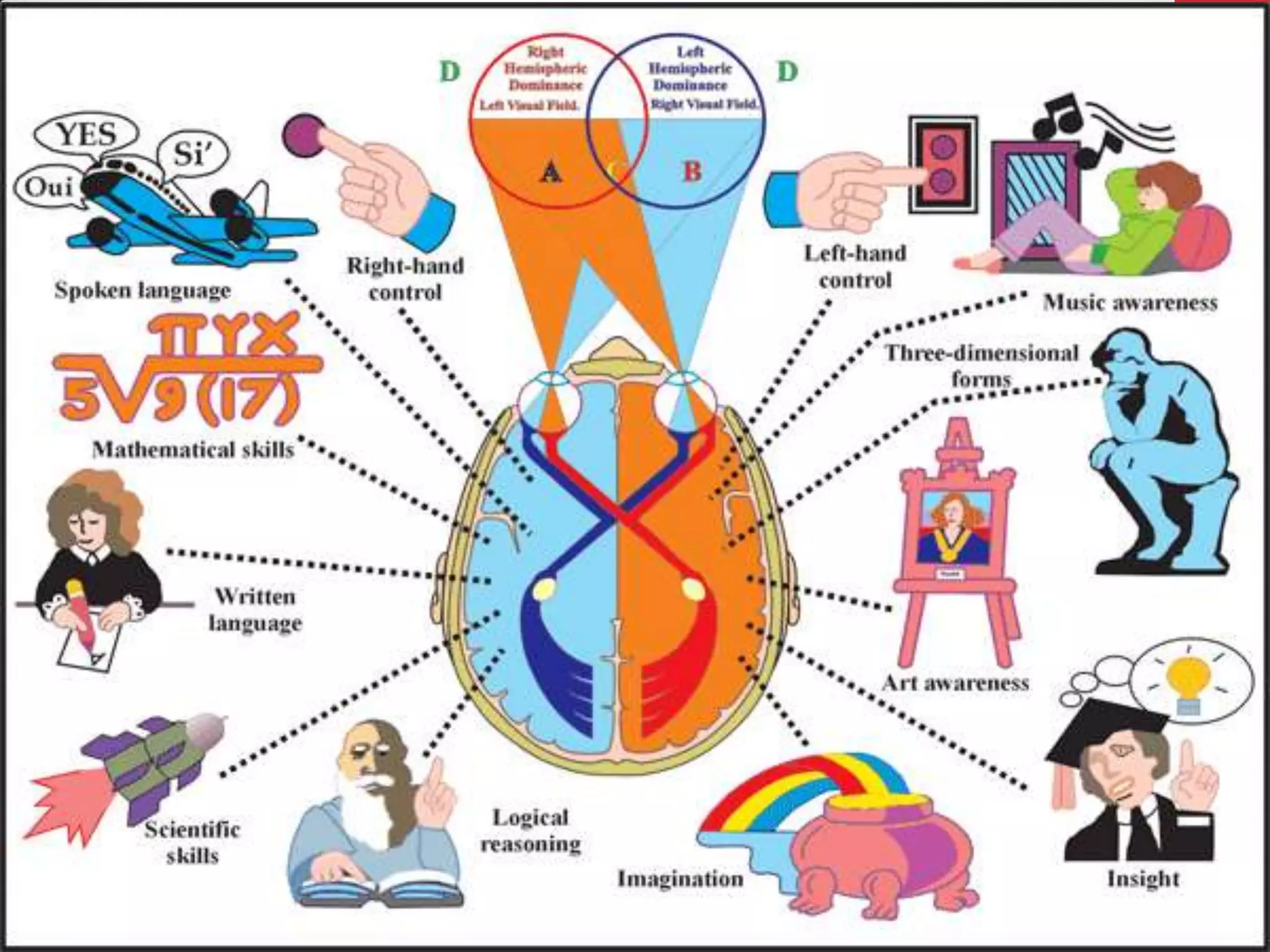
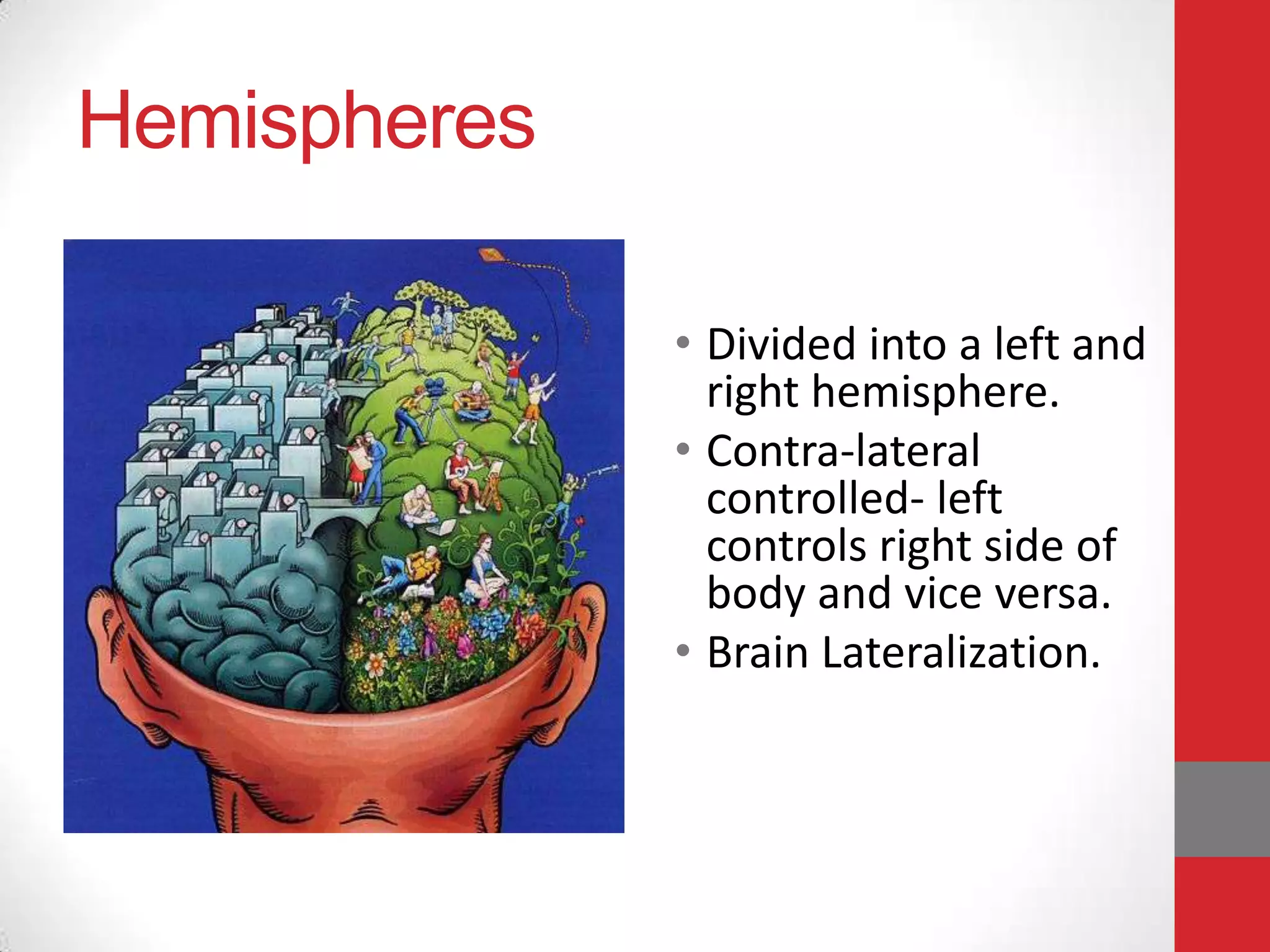
Hemispheres
• Divided into a left and
right hemisphere.
• Contra-lateral
controlled- left
controls right side of
body and vice versa.
• Brain Lateralization.
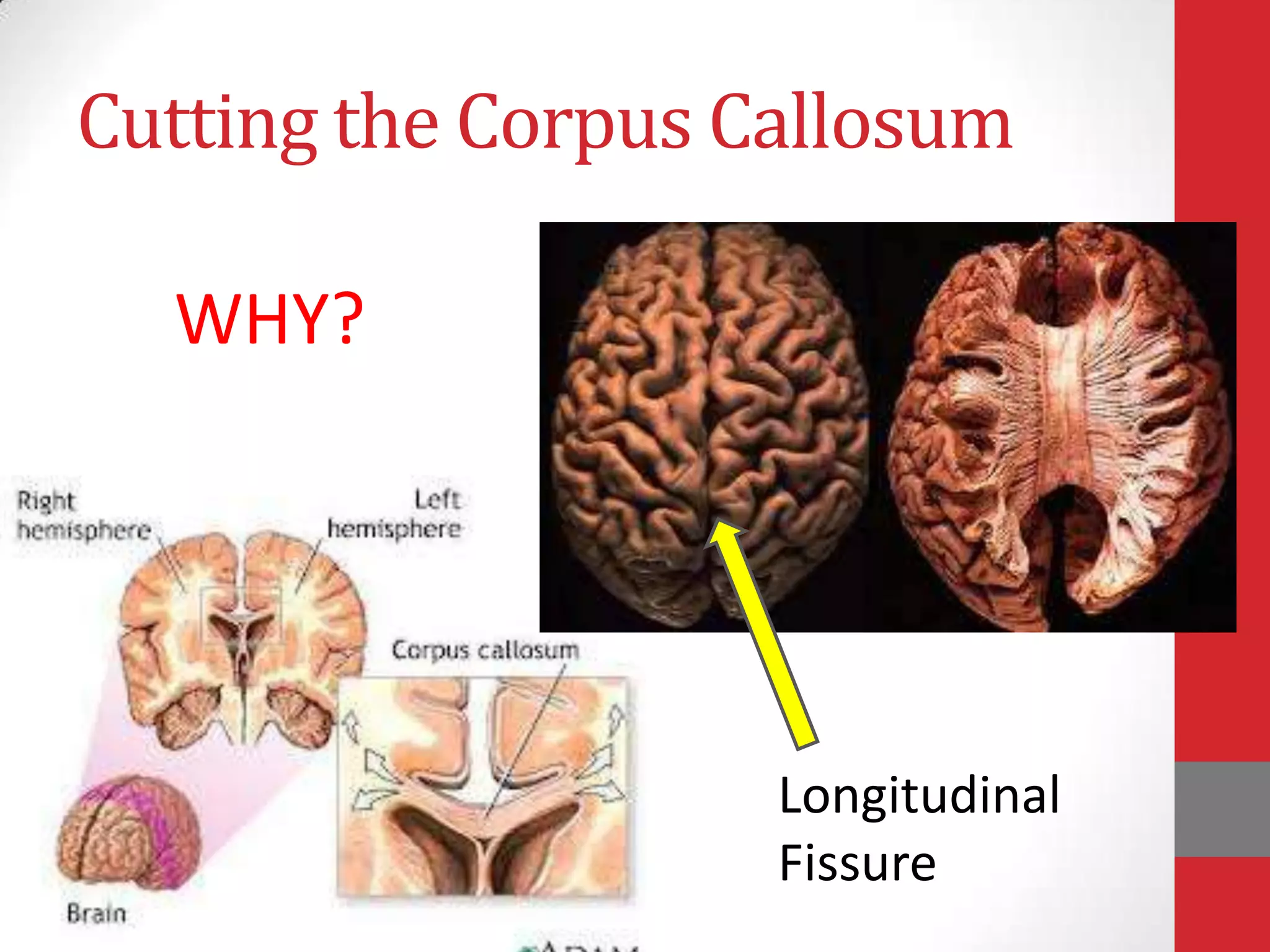
Cutting the Corpus Callosum
WHY?

Longitudinal
Fissure
Split Brain: Assignment 1
• Read with a Purpose: Read p. 65
in alternate textbook.
• Summarize the main points and
the experiment discussed.
• Focus on the outcomes.
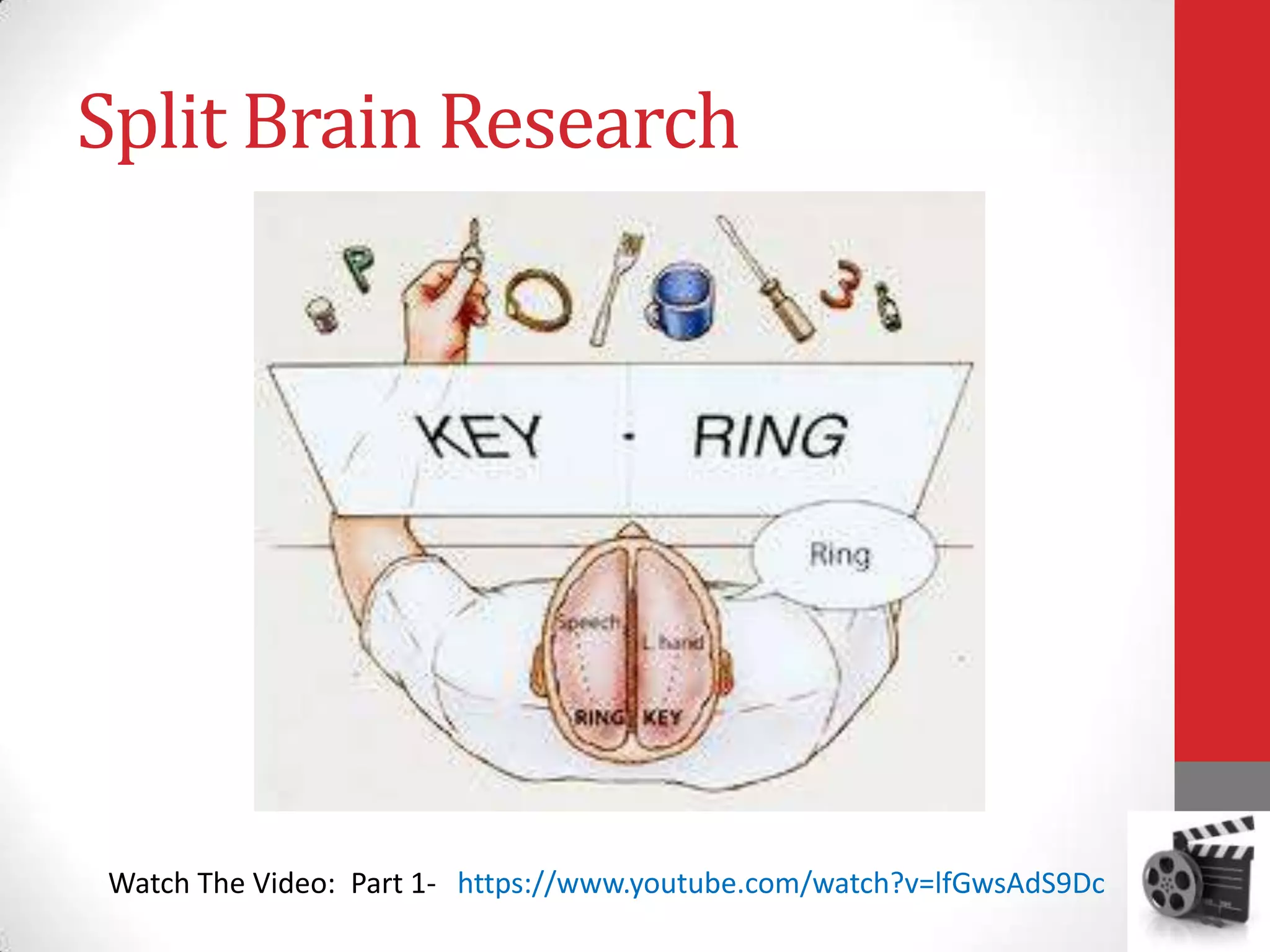
Split Brain Research

Watch The Video: Part 1- https://www.youtube.com/watch?v=lfGwsAdS9Dc
Split Brain: Assignment 2
• Group discussion:
• Now that you have watched the film, what are
some right and left brain abilities that were
revealed in the film the film?
• What are some questions that you have
remaining?
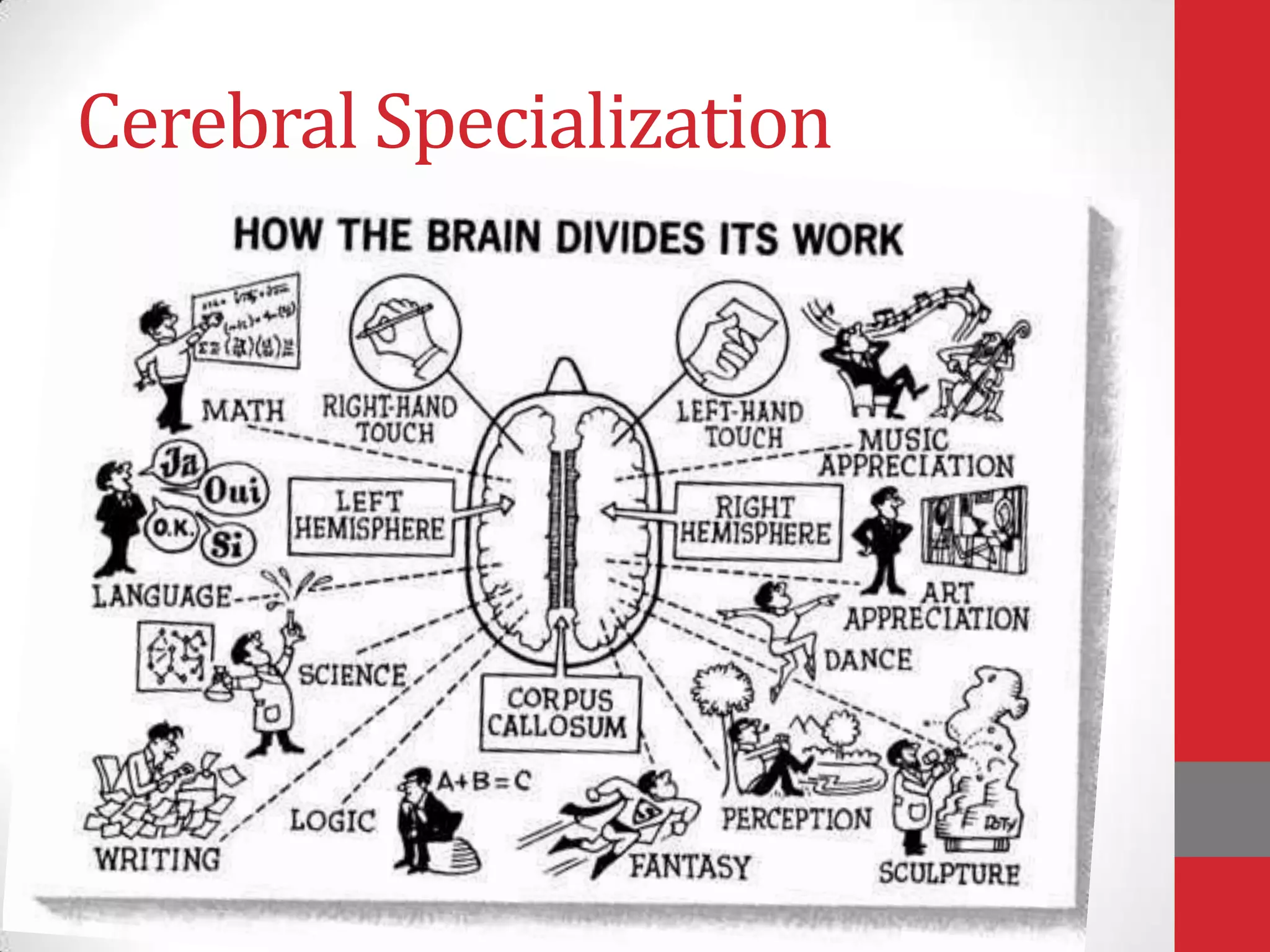
Cerebral Specialization
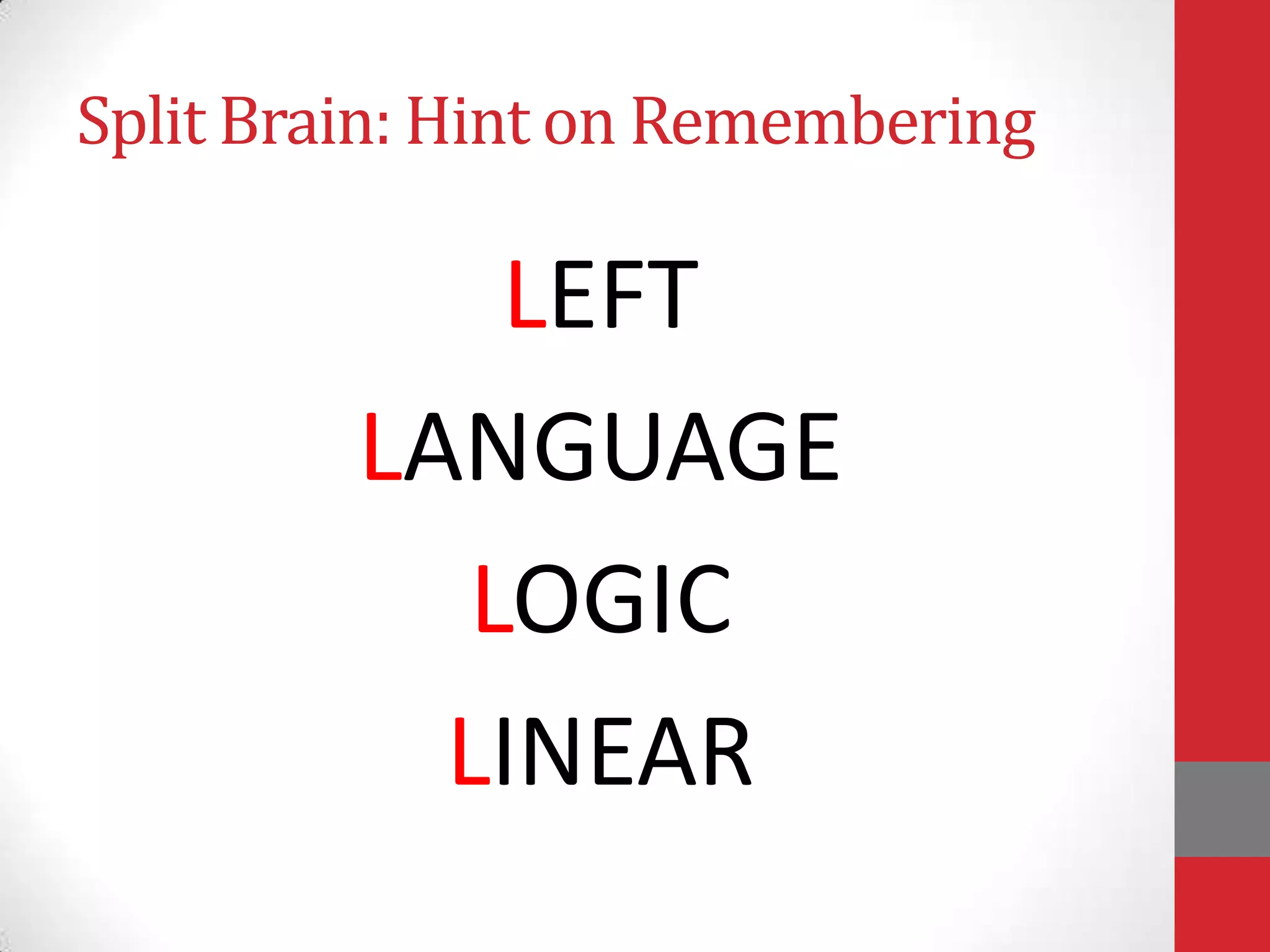
Split Brain: Hint on Remembering

LEFT
LANGUAGE
LOGIC
LINEAR
Lesson 4: The Neuron
EQ: How do biological processes and systems
impact behavior?

Vocabulary
• Dendrites
• Cell body (Soma)
• Axon
• Myelin Sheath

• Synapse
• Vesicles
• Nodes of Ranvier
• Neurotransmitters
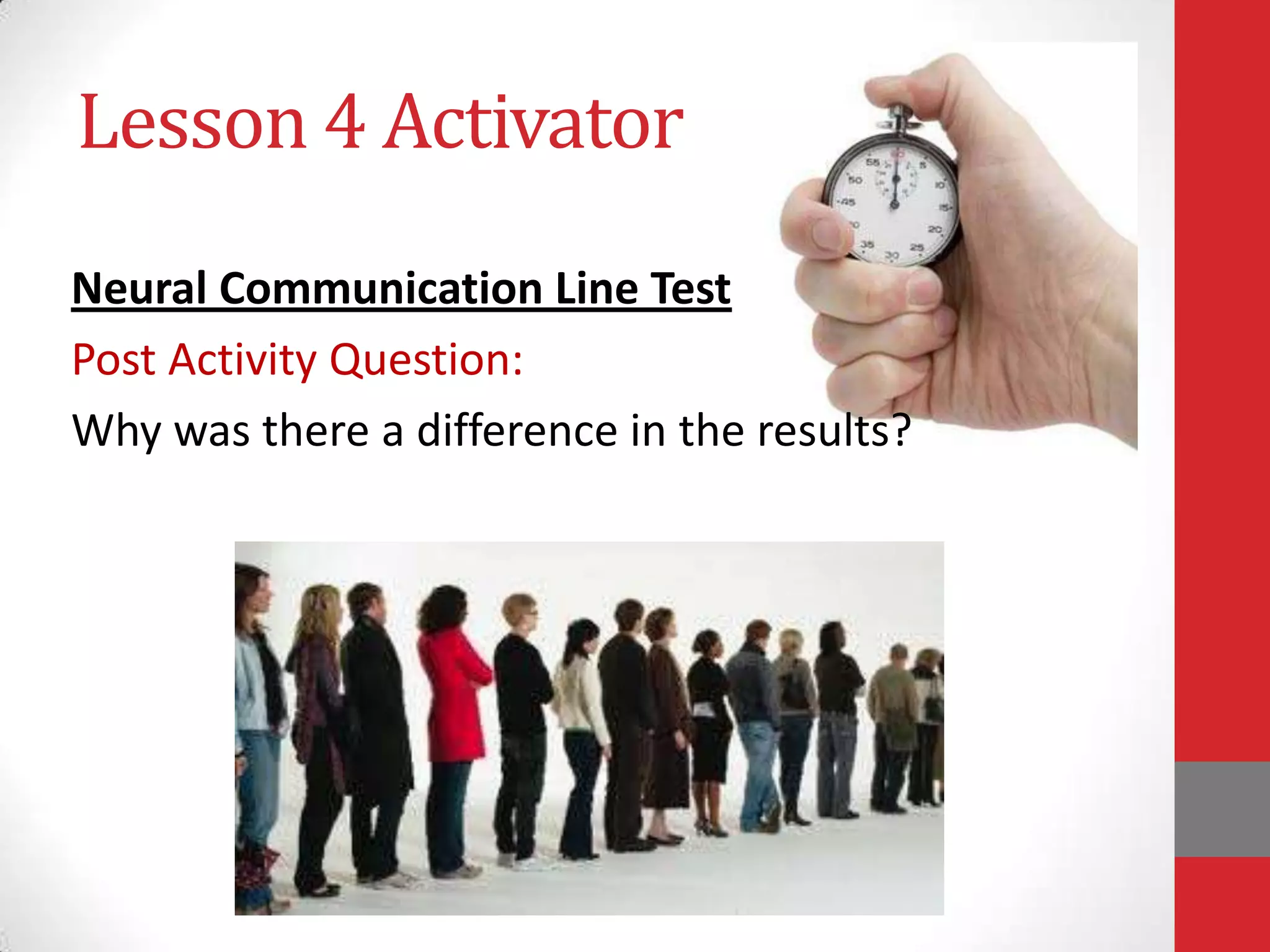
Lesson 4 Activator
Neural Communication Line Test
Post Activity Question:
Why was there a difference in the results?
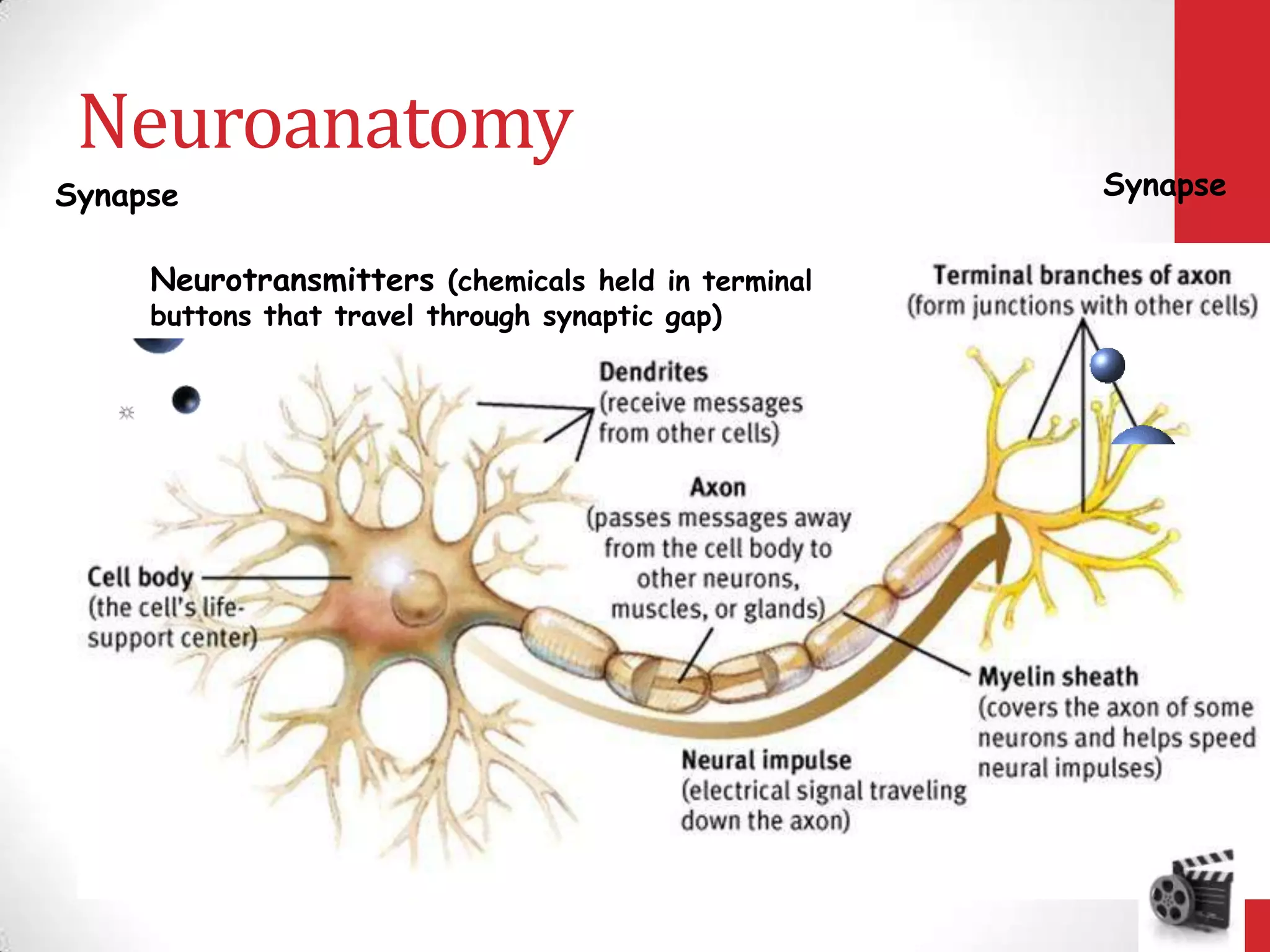
Neuroanatomy
Synapse
Neurotransmitters (chemicals held in terminal
buttons that travel through synaptic gap)

Synapse
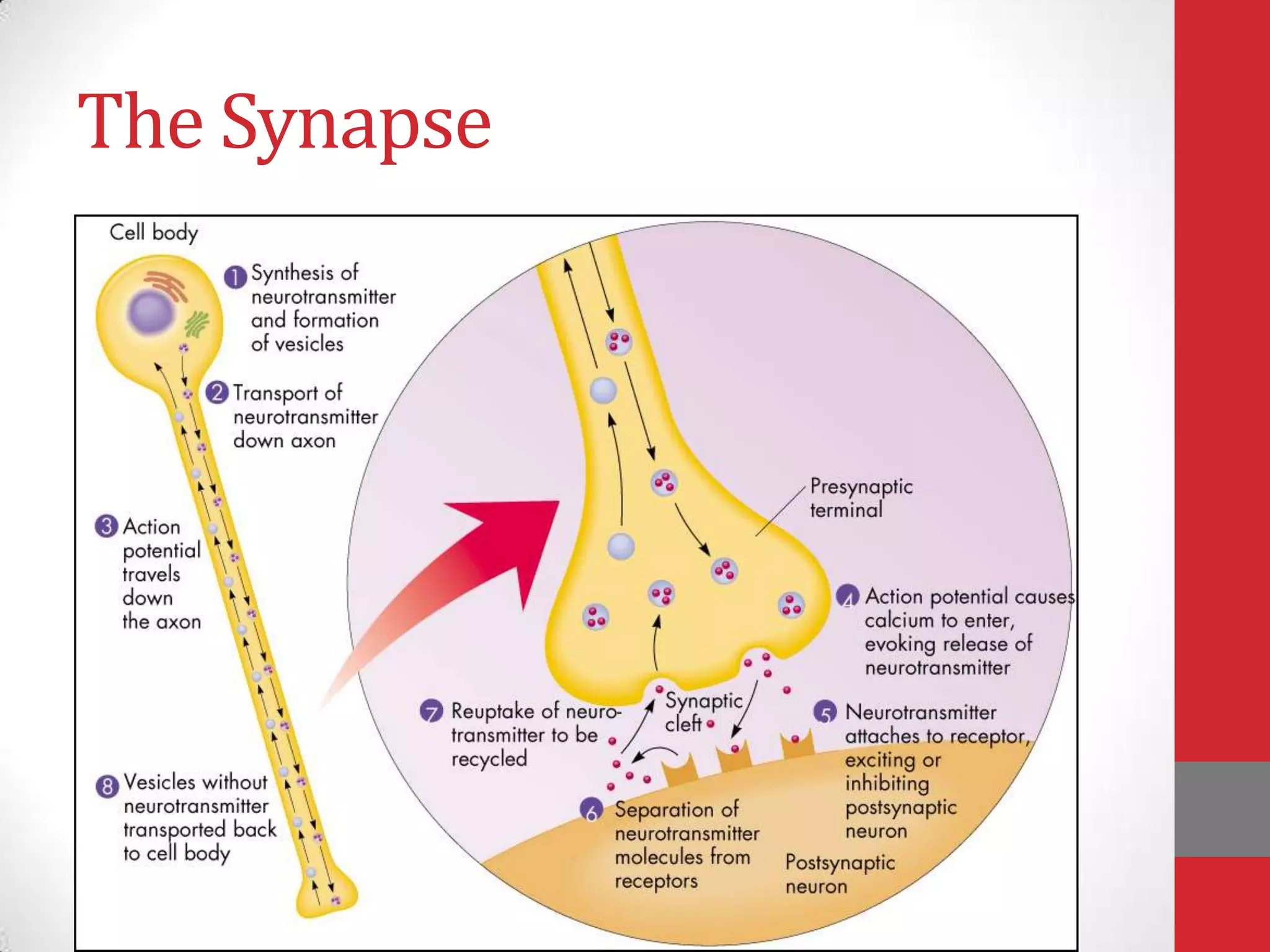
The Synapse
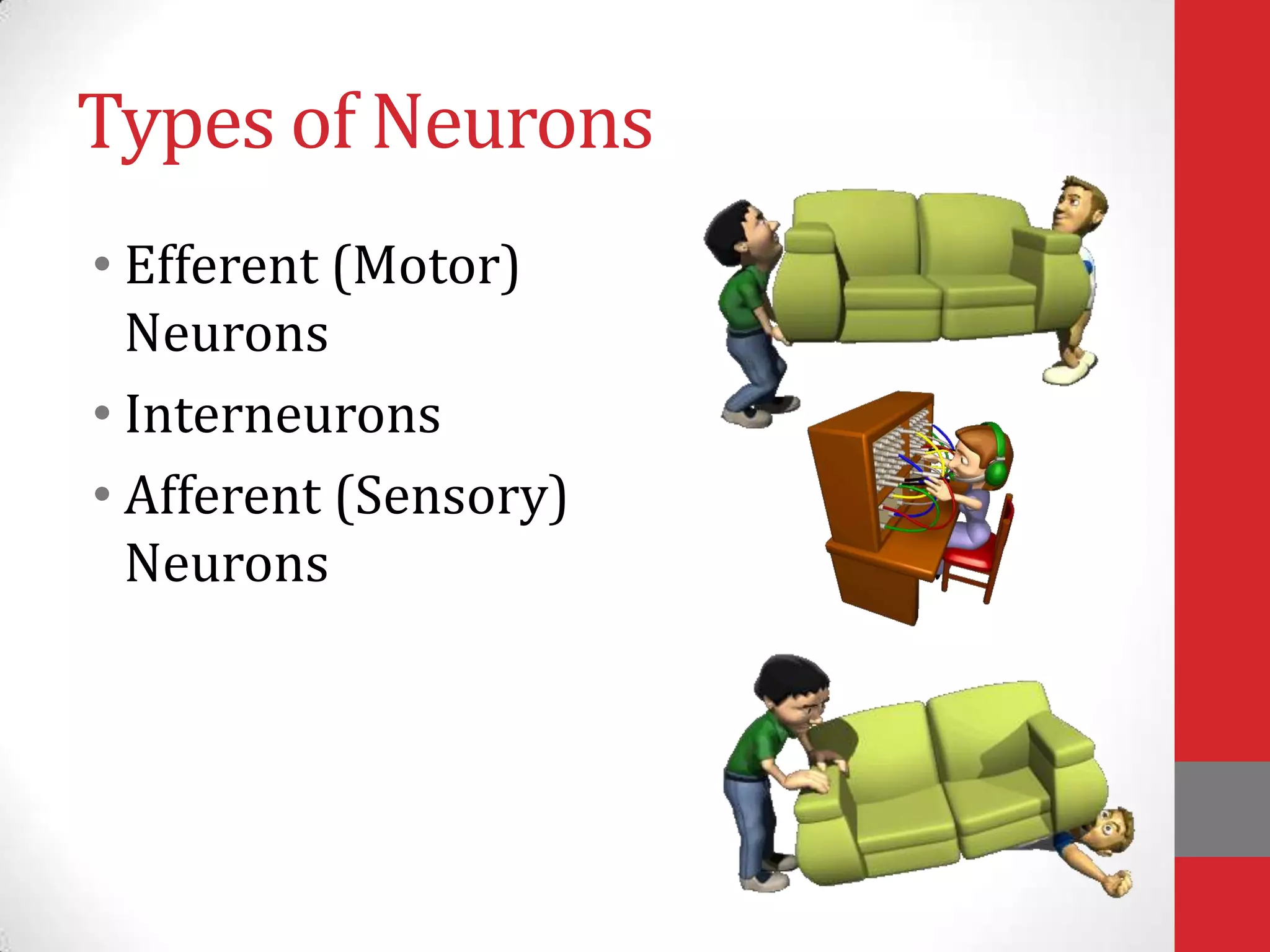
Types of Neurons
• Efferent (Motor)
Neurons
• Interneurons
• Afferent (Sensory)
Neurons
Neuroanatomy: Formal Assessment
Link Through Color: Using the three
sheets provided, color the
corresponding parts on each sheet.
Colors should be consistent
demonstrating your understanding of
the connection between diagrams. You
have 15 minutes to complete this
assignment.
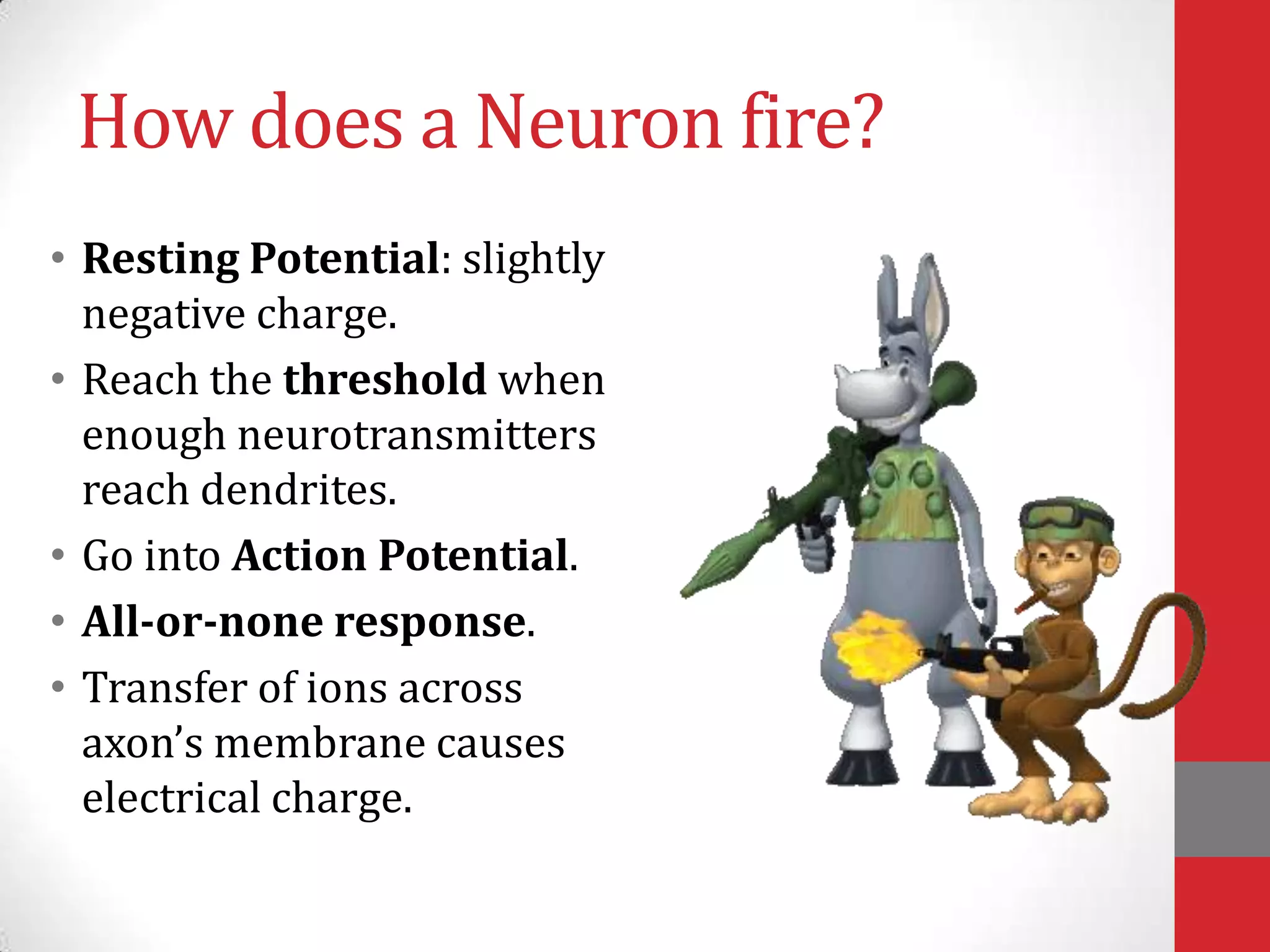
How does a Neuron fire?
• Resting Potential: slightly
negative charge.
• Reach the threshold when
enough neurotransmitters
reach dendrites.
• Go into Action Potential.
• All-or-none response.
• Transfer of ions across
axon’s membrane causes
electrical charge.
Lesson Activator
Any questions prior to the neuron quiz?
Lesson 5: Neurotransmitters
EQ: How do biological processes and systems
impact behavior?

Vocabulary
• Acetylcholine
• Dopamine
• Serotonin
• Endorphins

• Reuptake
• SSRI
• Neurotransmitter
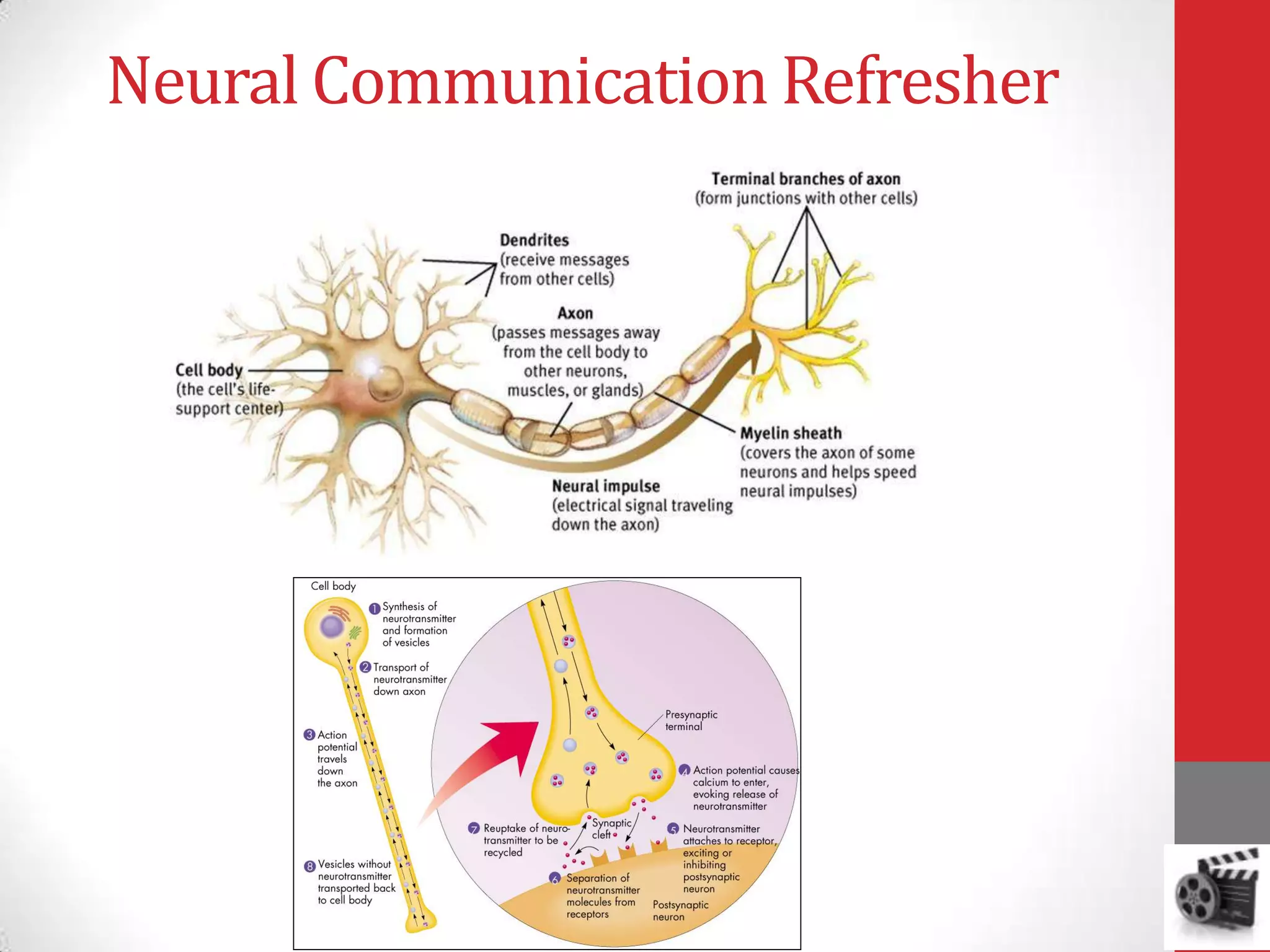
Neural Communication Refresher
Neurotransmitter Assignment
Using the article Plunge of Pleasure
and the Read with a Purpose technique
collect evidence on the psychological
importance of dopamine and
serotonin. This information includes
associated behaviors, disorders, and
relationship to other drugs.
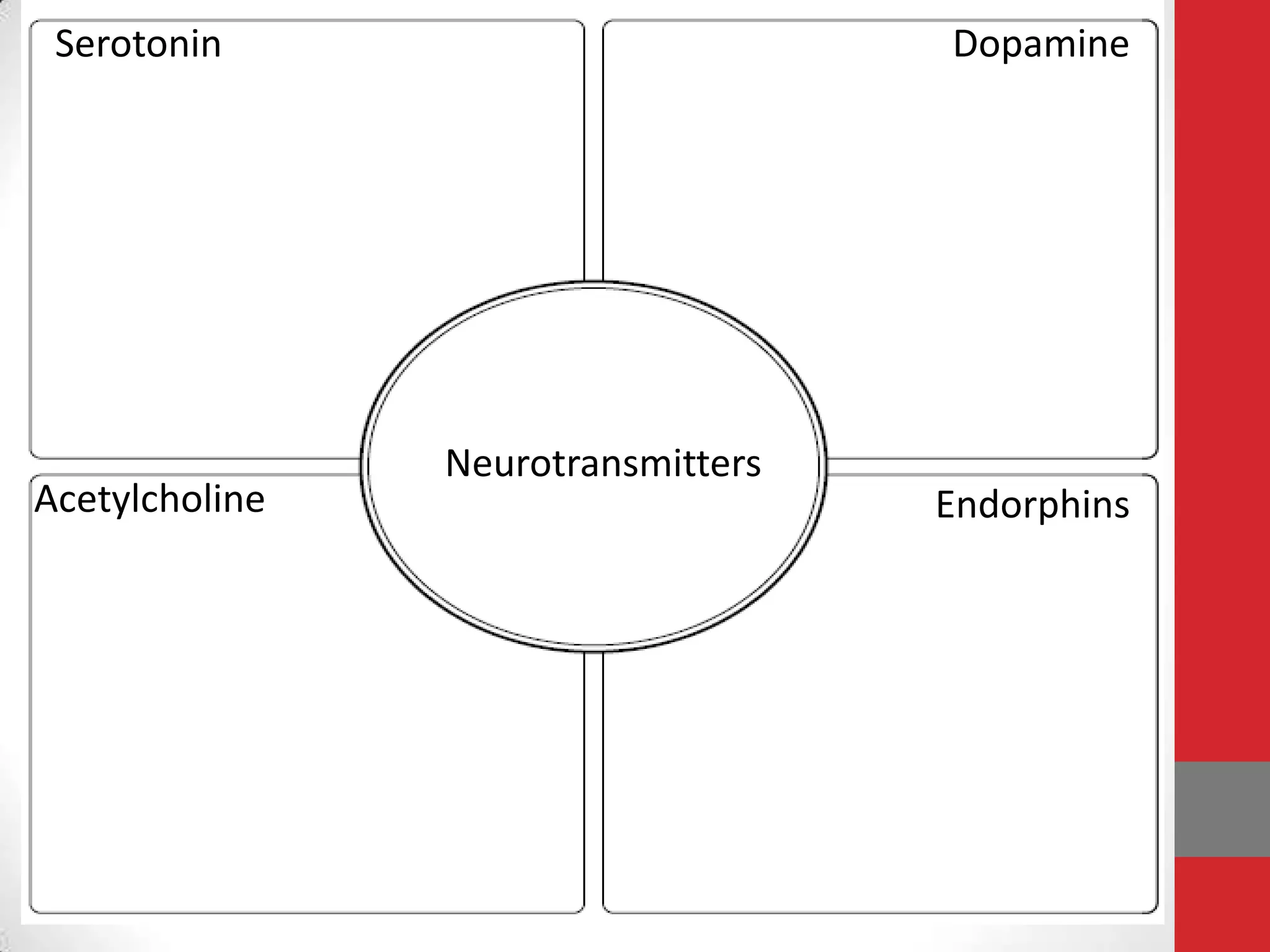
Serotonin

Acetylcholine

Dopamine

Neurotransmitters

Endorphins
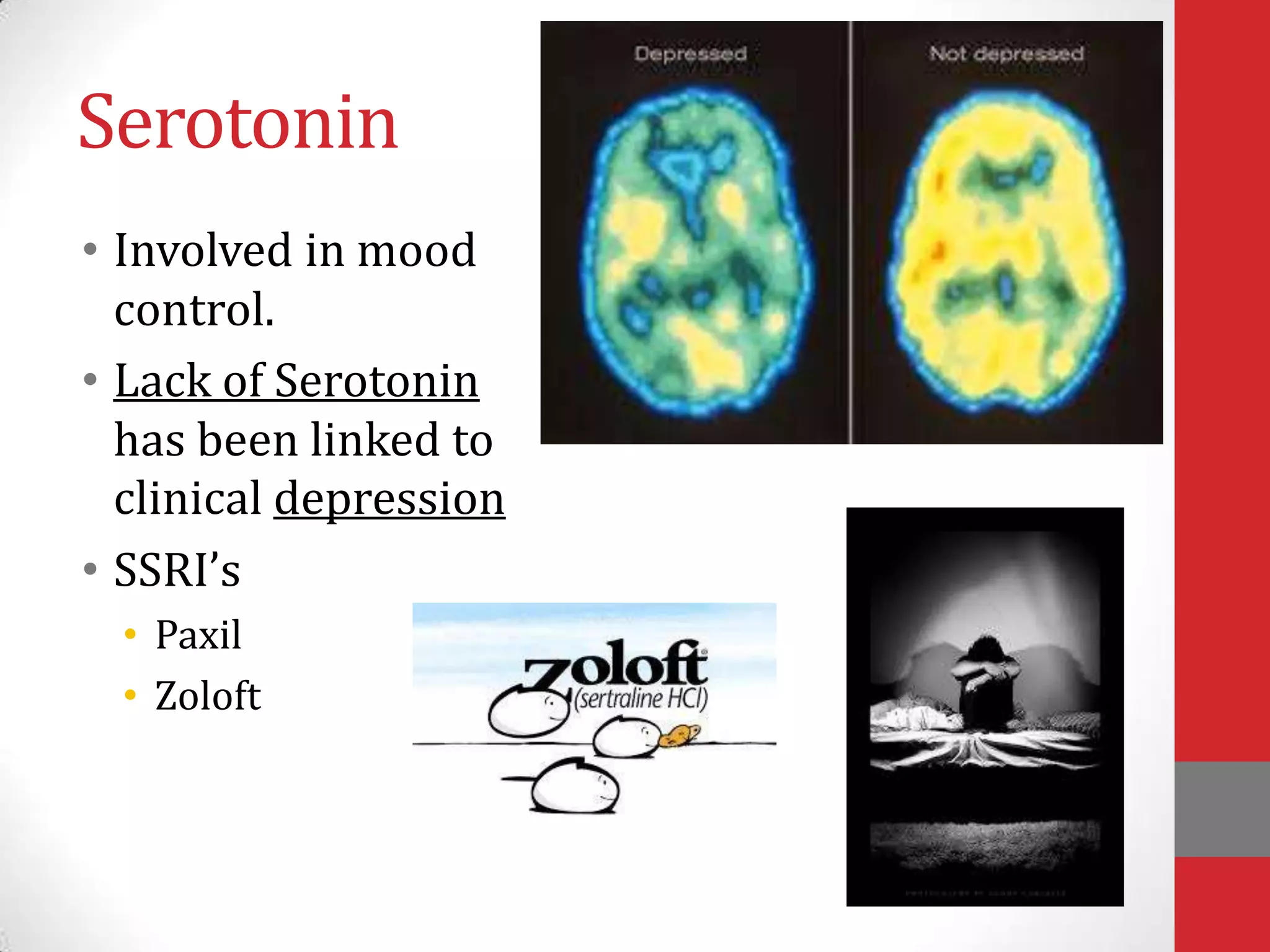
Serotonin
• Involved in mood
control.
• Lack of Serotonin
has been linked to
clinical depression
• SSRI’s
• Paxil
• Zoloft
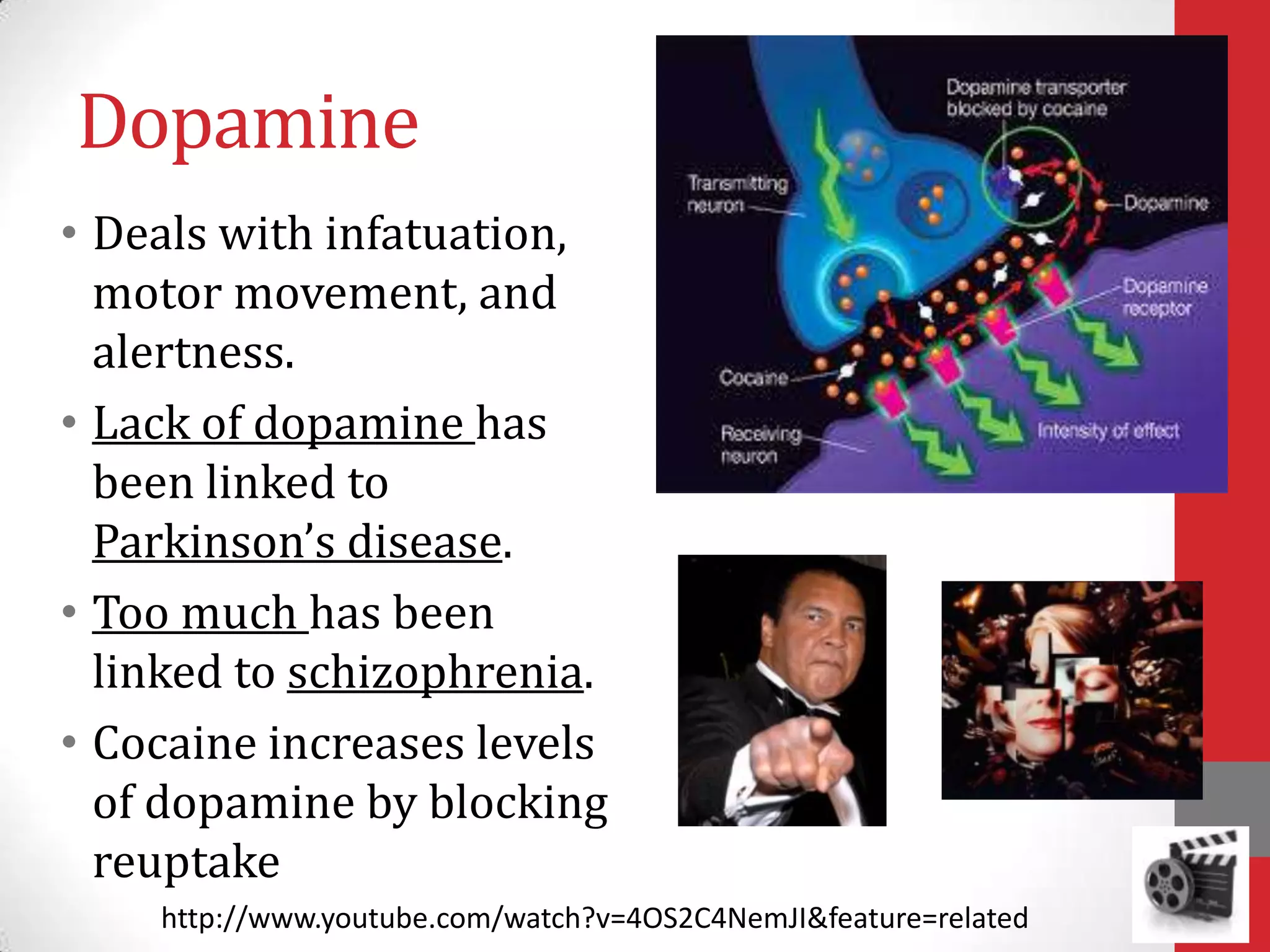
Dopamine
• Deals with infatuation,
motor movement, and
alertness.
• Lack of dopamine has
been linked to
Parkinson’s disease.
• Too much has been
linked to schizophrenia.
• Cocaine increases levels
of dopamine by blocking
reuptake
http://www.youtube.com/watch?v=4OS2C4NemJI&feature=related
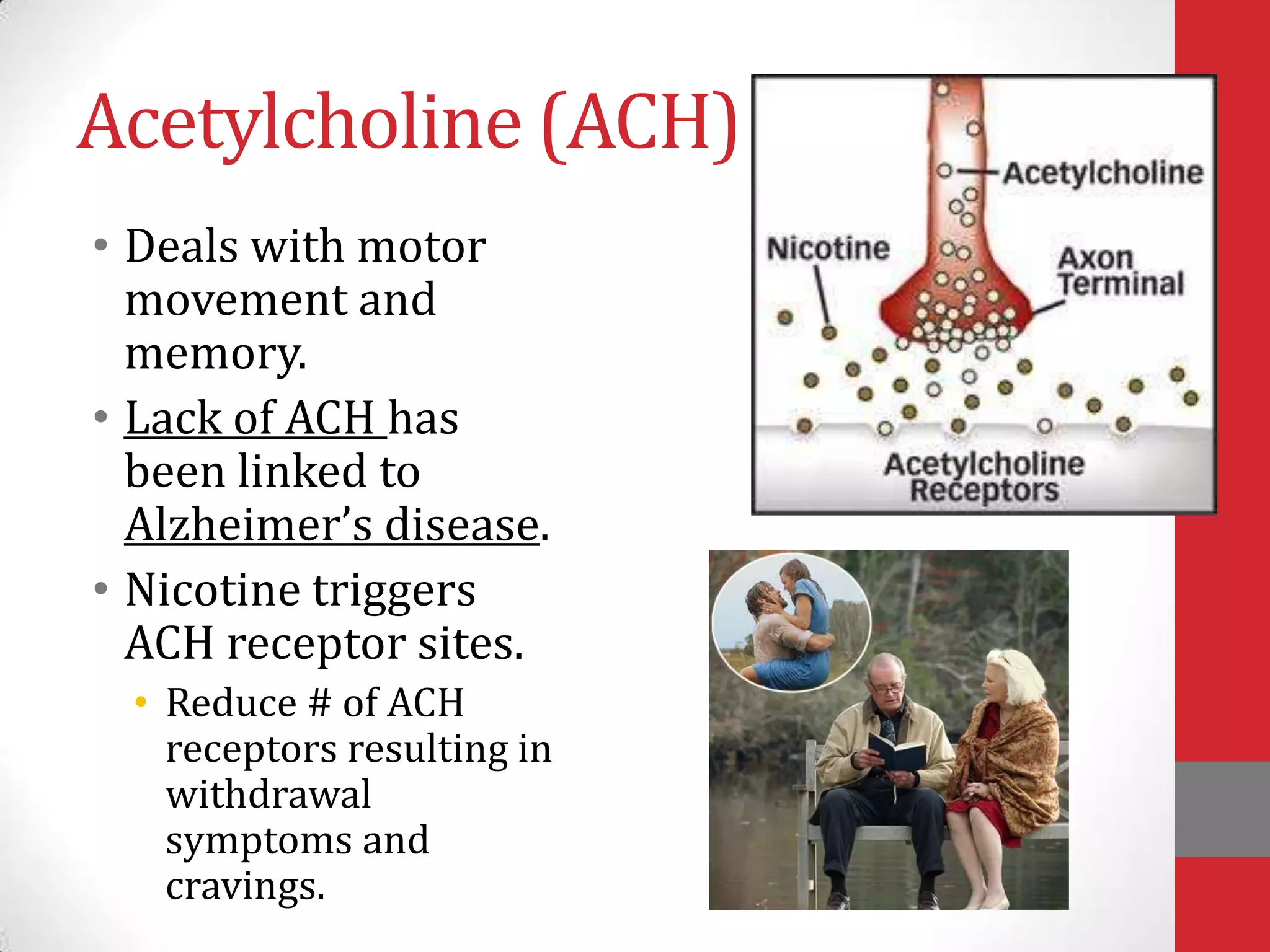
Acetylcholine (ACH)
• Deals with motor
movement and
memory.
• Lack of ACH has
been linked to
Alzheimer’s disease.
• Nicotine triggers
ACH receptor sites.
• Reduce # of ACH
receptors resulting in
withdrawal
symptoms and
cravings.
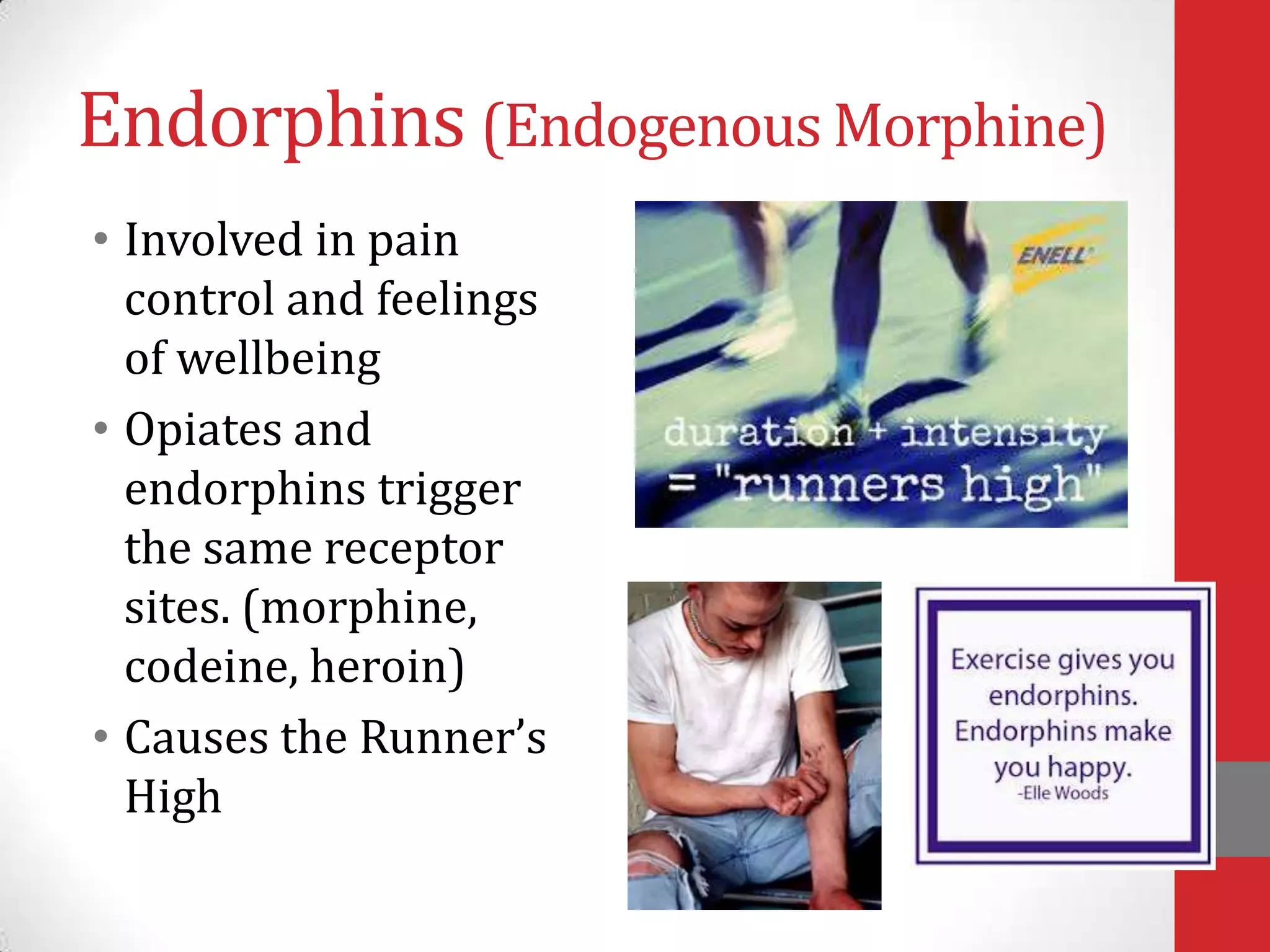
Endorphins (Endogenous Morphine)
• Involved in pain
control and feelings
of wellbeing
• Opiates and
endorphins trigger
the same receptor
sites. (morphine,
codeine, heroin)
• Causes the Runner’s
High
Drugs can be…..
• Agonists- make neuron fire
• Antagonists- stop neural firing
• Reuptake Inhibitors- block
reuptake
Lesson 6: The Nervous and Endocrine Systems
EQ: How do biological processes and systems
impact behavior?

Vocabulary
• Central Nervous System
• Endocrine System
• Peripheral Nervous System
• Thyroid
• Somatic Nervous System
• Androgen
• Autonomic Nervous System
• Estrogen
• Sympathetic Nervous System
• Parasympathetic Nervous System
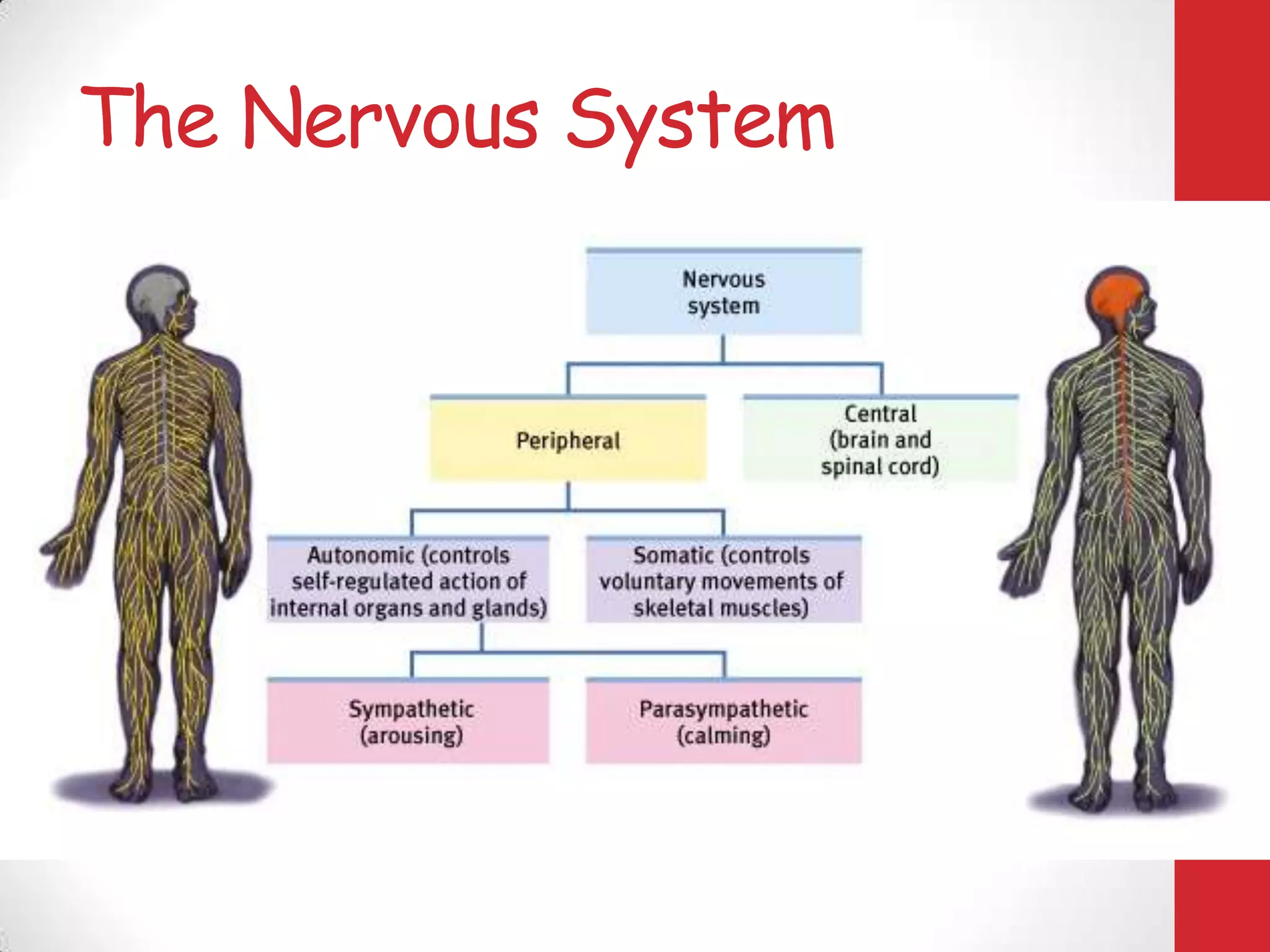
The Nervous System
Central Nervous System
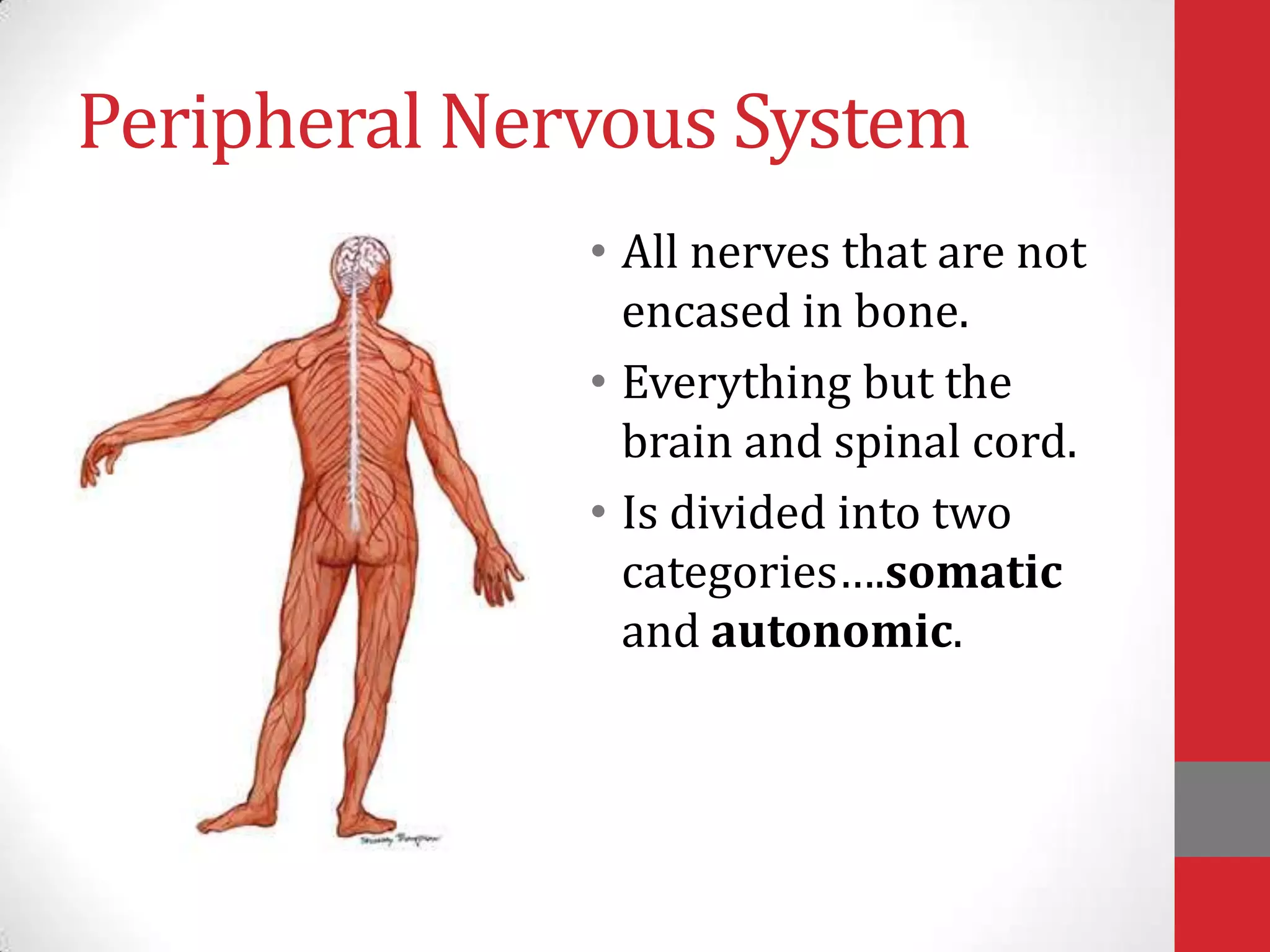
Peripheral Nervous System
• All nerves that are not
encased in bone.
• Everything but the
brain and spinal cord.
• Is divided into two
categories….somatic
and autonomic.
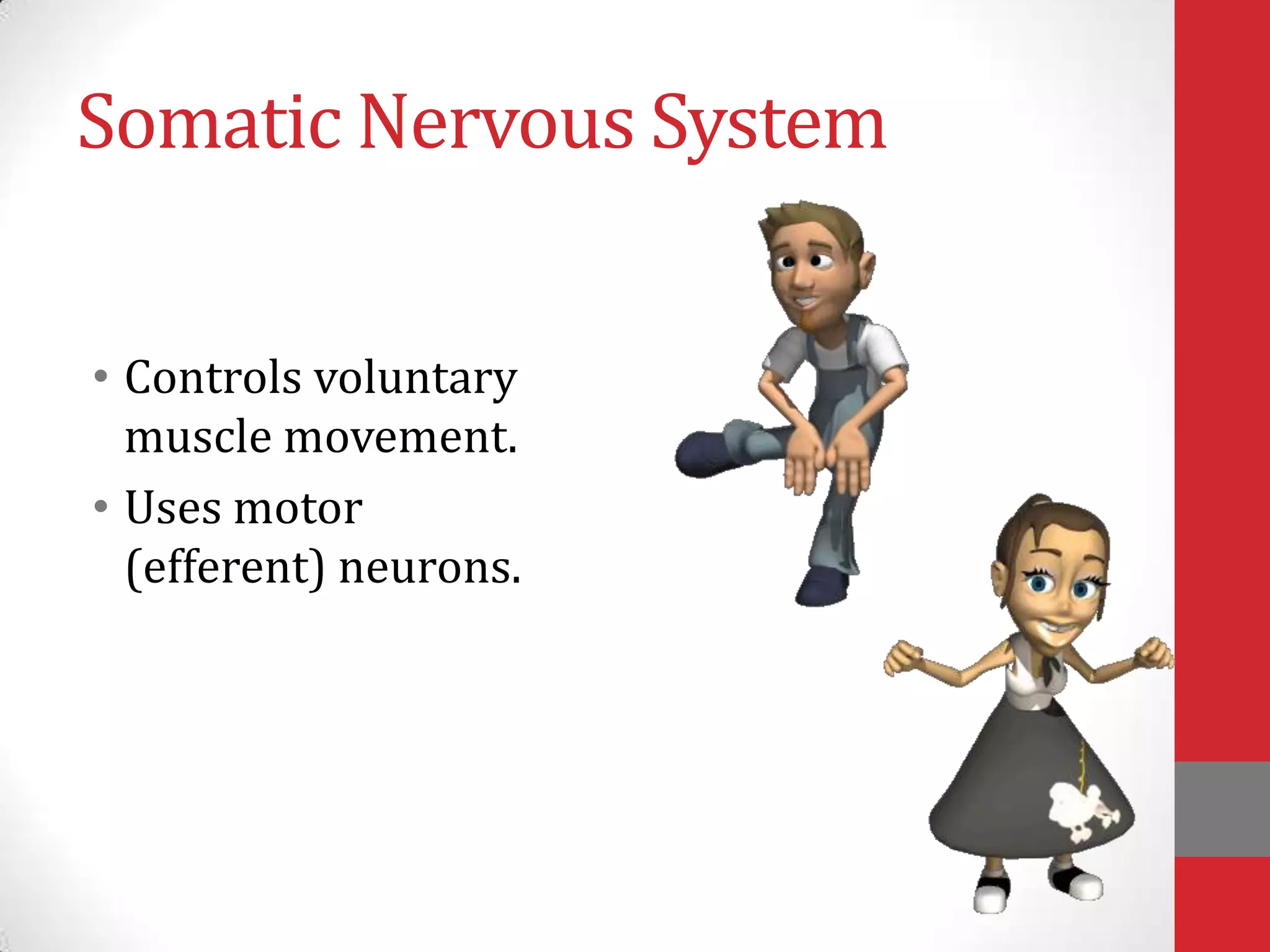
Somatic Nervous System
• Controls voluntary
muscle movement.
• Uses motor
(efferent) neurons.
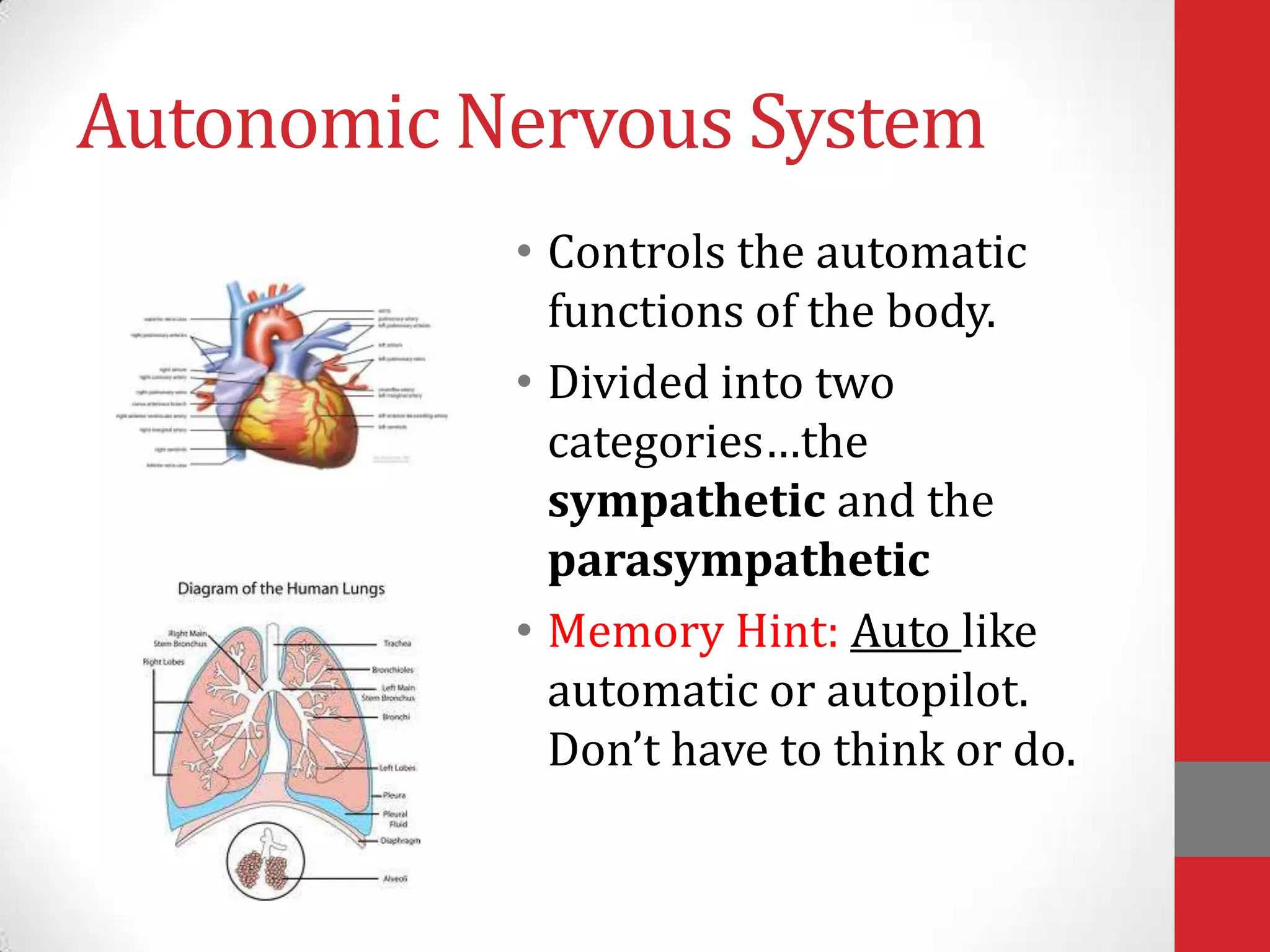
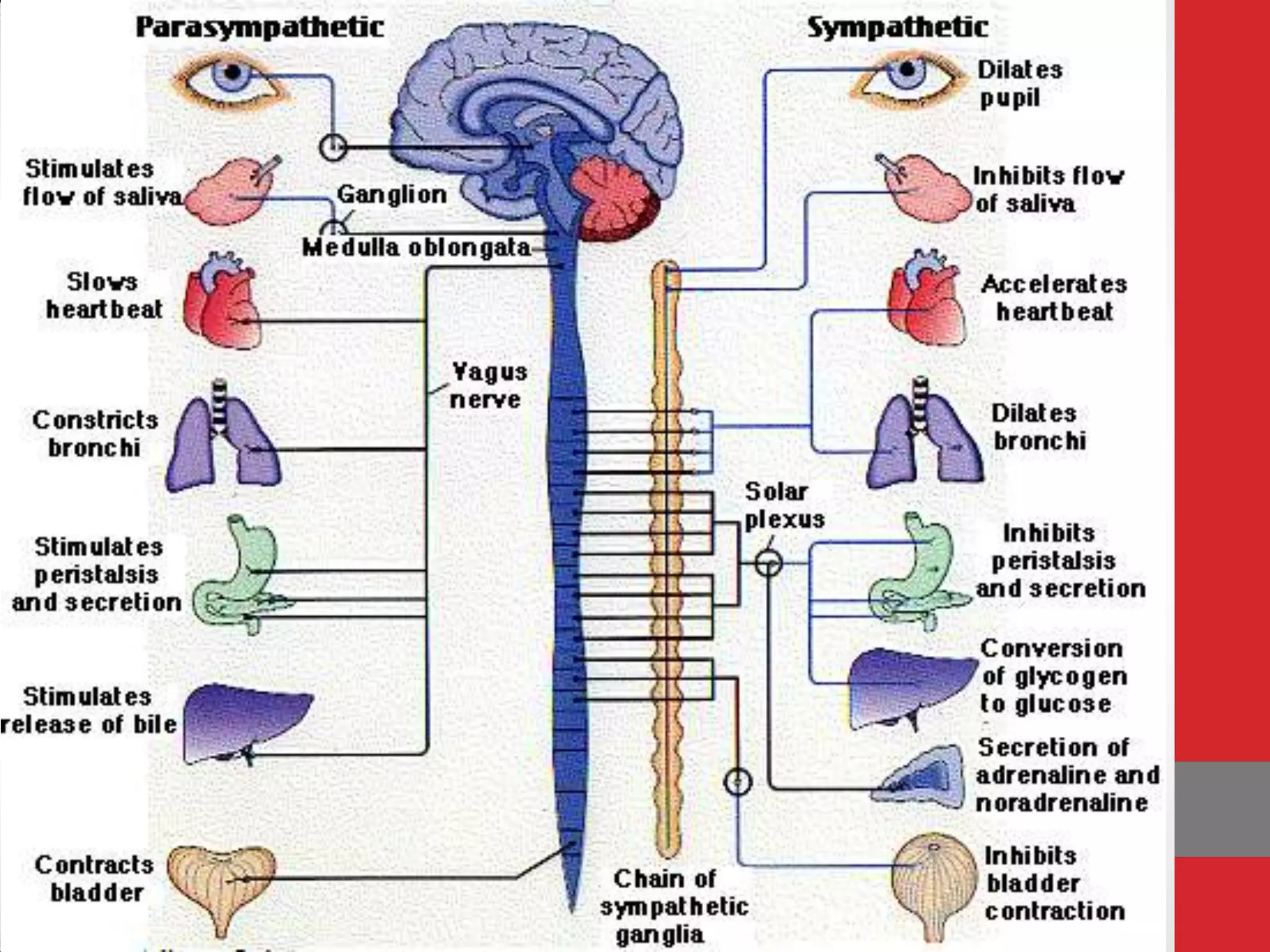
Autonomic Nervous System
• Controls the automatic
functions of the body.
• Divided into two
categories…the
sympathetic and the
parasympathetic
• Memory Hint: Auto like
automatic or autopilot.
Don’t have to think or do.
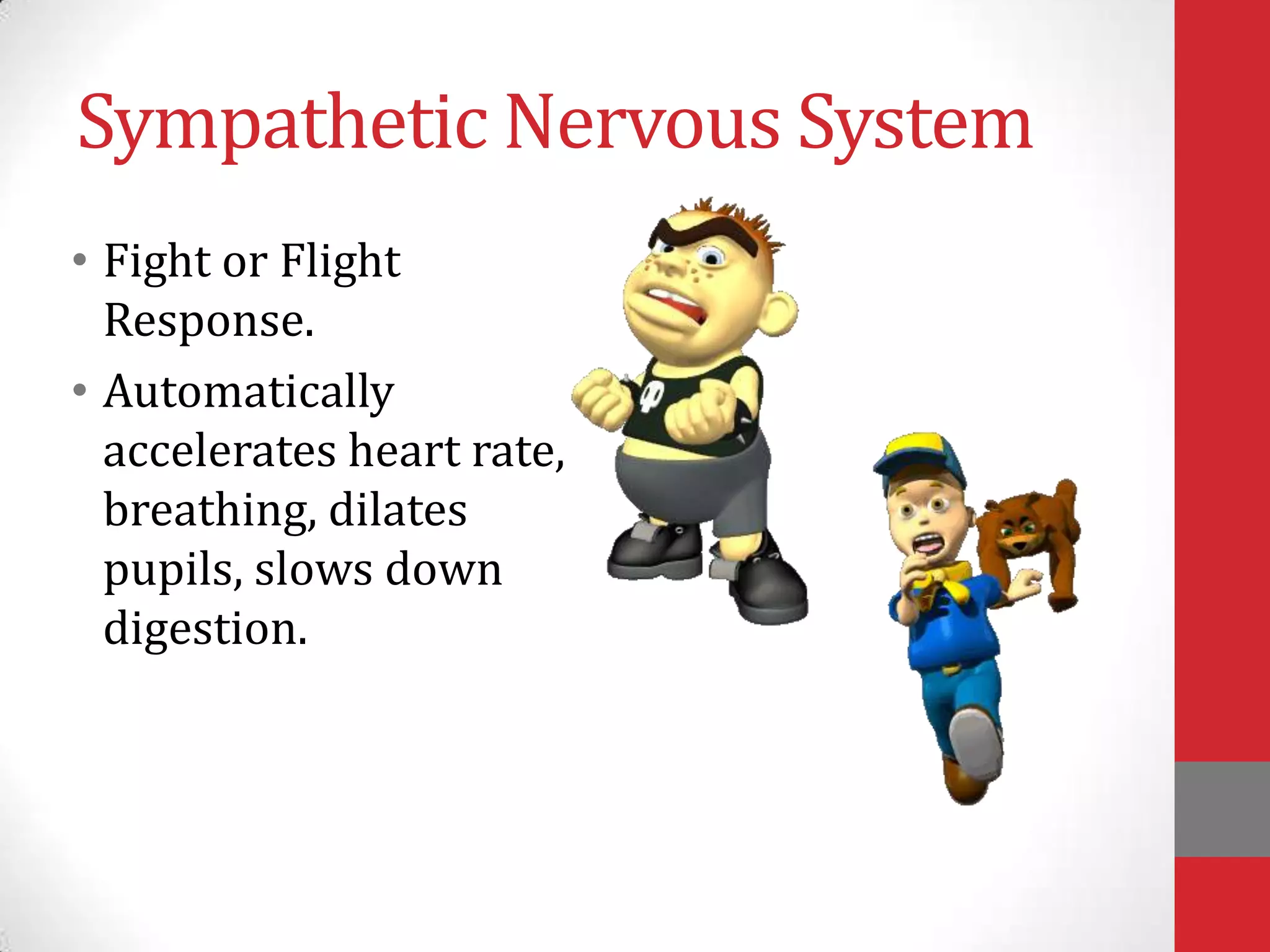
Sympathetic Nervous System
• Fight or Flight
Response.
• Automatically
accelerates heart rate,
breathing, dilates
pupils, slows down
digestion.
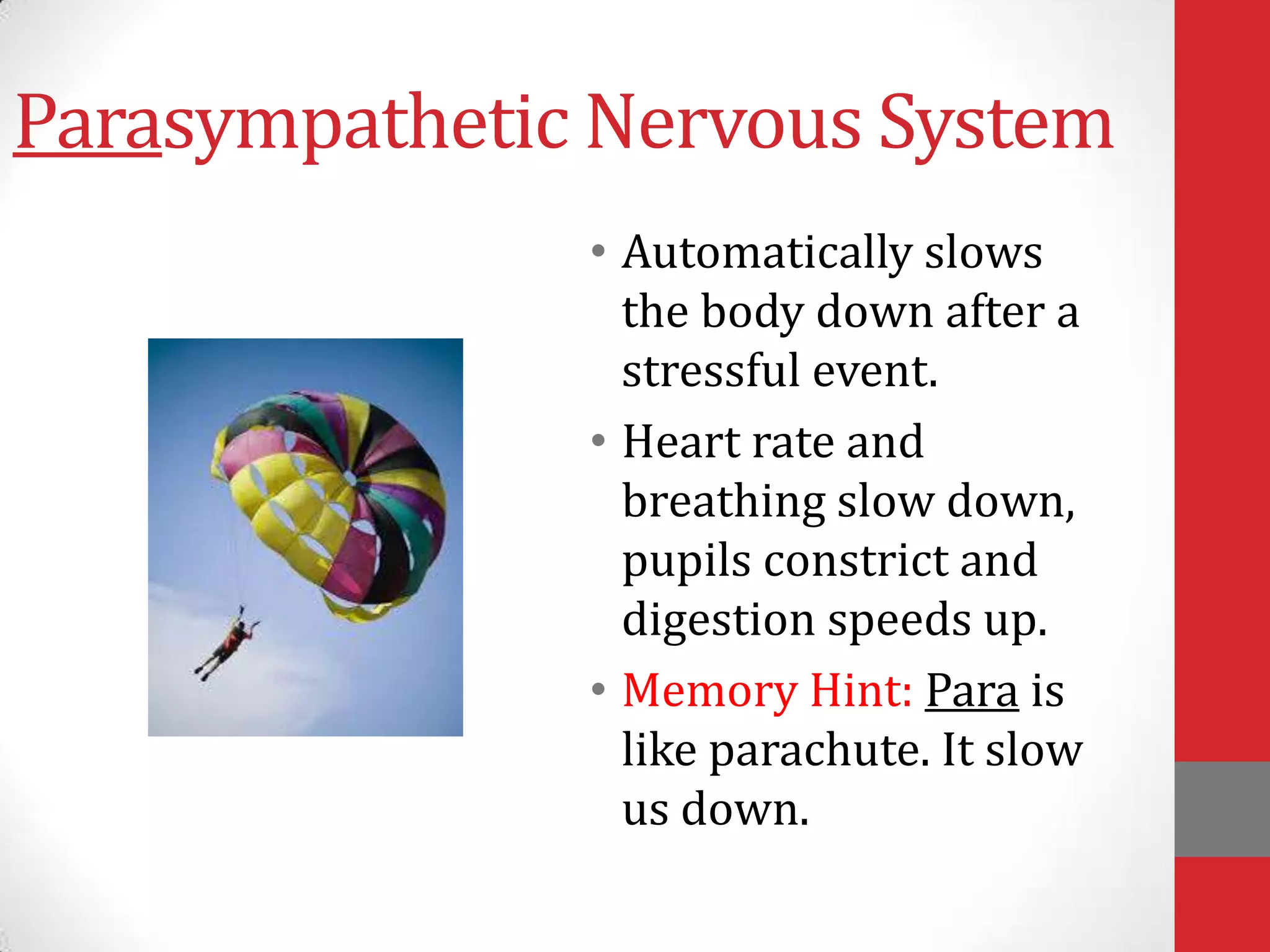
Parasympathetic Nervous System
• Automatically slows
the body down after a
stressful event.
• Heart rate and
breathing slow down,
pupils constrict and
digestion speeds up.
• Memory Hint: Para is
like parachute. It slow
us down.
Pituitary Gland
• “Master Gland”
• An important link
between the nervous
system and the endocrine
system
• Releases many hormones
which affect growth,
sexual development,
metabolism and the
system of reproduction.
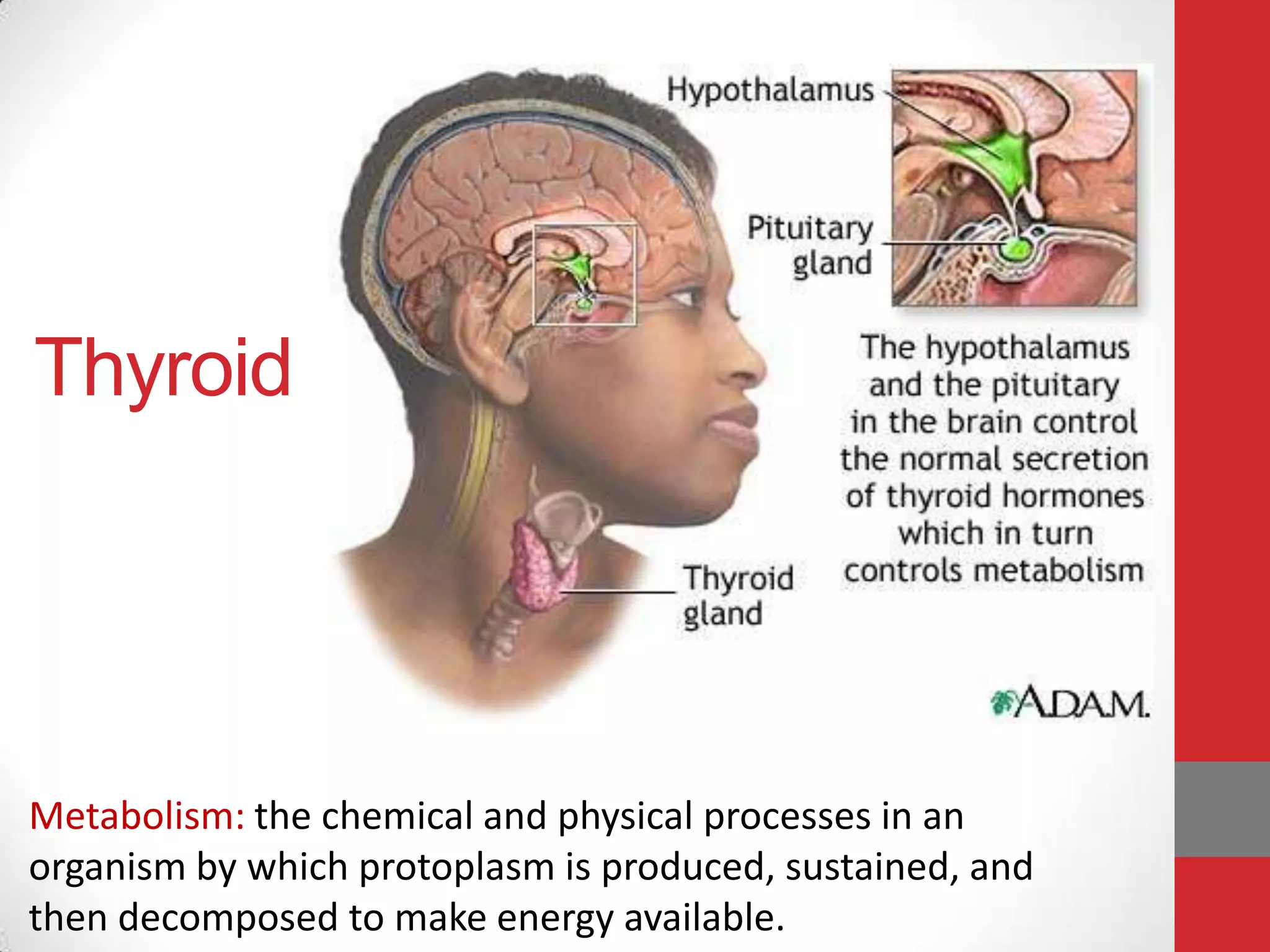
Thyroid

Metabolism: the chemical and physical processes in an
organism by which protoplasm is produced, sustained, and
then decomposed to make energy available.
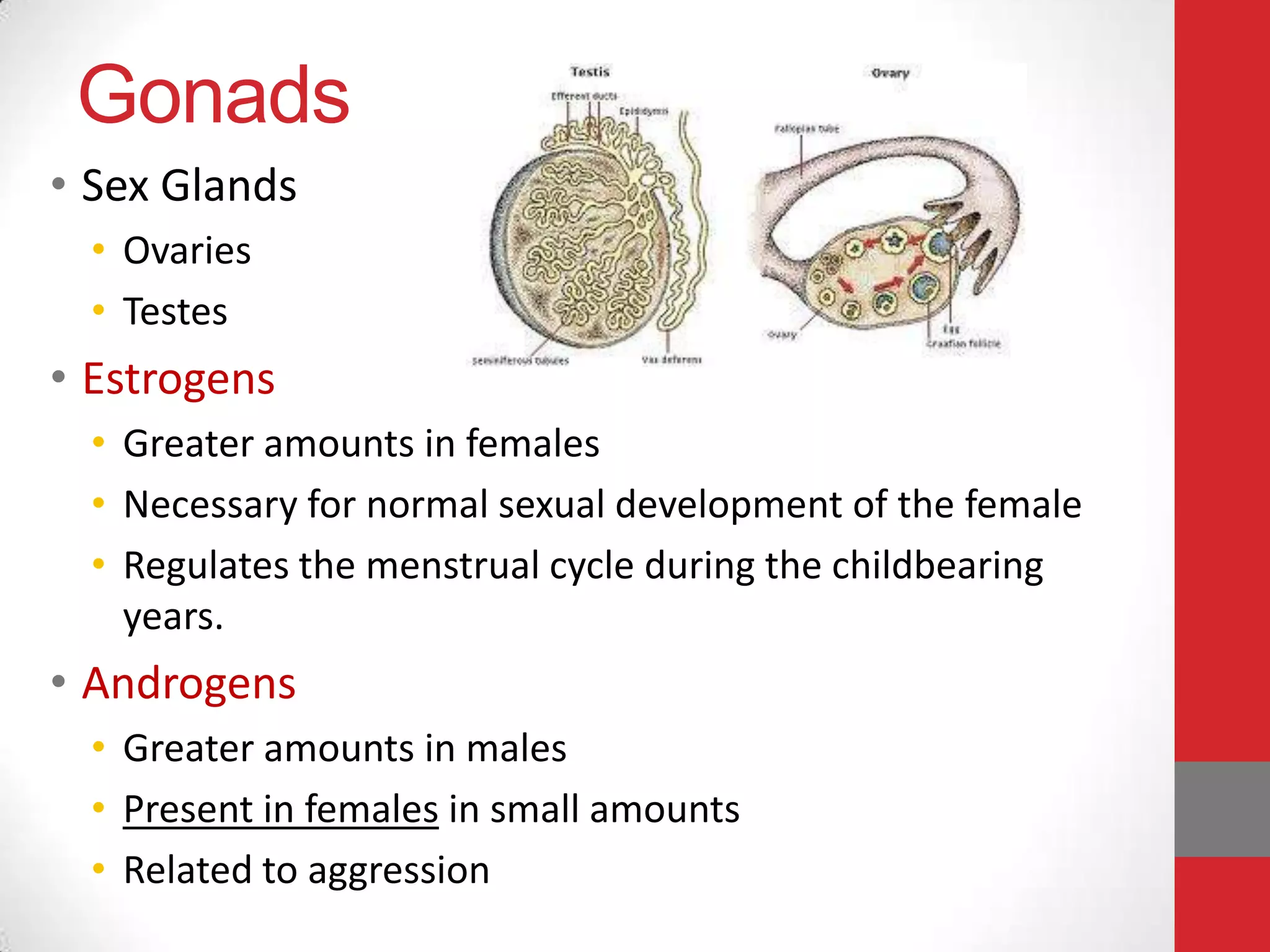
Gonads
• Sex Glands
• Ovaries
• Testes

• Estrogens
• Greater amounts in females
• Necessary for normal sexual development of the female
• Regulates the menstrual cycle during the childbearing
years.

• Androgens
• Greater amounts in males
• Present in females in small amounts
• Related to aggression
Unit 2: Biopsychology Summarizer
1. Using the Learning Goals Outline in your
biopsychology packet, attempt to answer
the questions without the use of your
notes. This will act as a pre-study test.
2. Identify your areas of weakness
3. Complete any unanswered or correct any
incorrect questions
4. Study your packet using the resources
provided. (Flashcards, graphic organizers,
diagrams, Learning Goals Outline)
Study
for the
Biopsychology Exam
Lesson Activator
Any questions prior to the Biopsychology
Exam?

Unit 2 Biopsychology PowerPoint

  • 1.
  • 2.
    Lesson 1: TheBrain ACTIVATOR: Parts of the Brain
  • 3.
    Lesson 1: TheBrain EQ: How do biological processes and systems impact behavior? Vocabulary • Cerebrum (Cerebral Cortex) • Cerebellum • Pons • Medulla • Reticular Activating System • Corpus Callosum • Thalamus • Hypothalamus • Hippocampus • Amygdala • Pituitary Gland • Spinal Cord
  • 4.
    Parts of theBrain Use Your Textbook Resources to Complete the Chart Below Part of the Brain Medulla Pons Reticular Activating System Cerebellum Thalamus Hypothalamus Hippocampus Amygdala Pituitary Gland Cerebral Cortex Corpus Callosum Primary Function(s)
  • 5.
  • 6.
    Spinal Cord • Transmitsneural signals between the brain and the rest of the body. • Contains neural circuits that can independently control numerous reflexes
  • 7.
  • 8.
    Brain Structures • Somescientists divide the brain up into three parts. • Hindbrain • Midbrain • Forebrain
  • 9.
    Medulla (Oblongata) • Heartrate • Breathing • Blood Pressure
  • 10.
    Pons • Connects hindbrain, midbrainand forebrain together. • Respiration • Movement • Sleep • Facial expressions
  • 11.
    Reticular Activating System (RAS) •Responsible for regulating arousal and sleep • Helps mediate transitions from relaxed wakefulness to periods of high attention.
  • 12.
    Cerebellum • Means “littlebrain” • Voluntary muscle movements. • Coordination • Balance
  • 13.
    Thalamus • In Forebrain •Receives sensory information and sends them to appropriate areas of the cerebral cortex. • Like a switchboard. • Everything but smell.
  • 14.
    Limbic System • EMOTIONAL CONTROLCENTER of the brain. • Includes: • Amygdala • Hippocampus • Hypothalamus
  • 15.
    Hippocampus and Amygdala •Hippocampus is involved in memory processing. • Amygdala is vital for our basic emotions. Involved with anger
  • 16.
    Hypothalamus • Pea sizedin brain, but plays a not so pea sized role. • Body temperature • Hunger • Thirst • Sexual Arousal (libido) • Endocrine System
  • 17.
    Pituitary Gland • “MasterGland” • An important link between the nervous system and the endocrine system • Releases many hormones which affect growth, sexual development, metabolism and the system of reproduction.
  • 18.
    Cerebrum (Cerebral Cortex) •Top layer of our brain. • Responsible for highlevel mental process and thought • Contains wrinkles called fissures. • The fissures increase surface area of our brain. • Divided into two hemispheres
  • 19.
  • 20.
    Corpus Callosum • CorpusCallosum attaches the two hemispheres of cerebral cortex. • Allows both hemispheres to communicate with one another
  • 21.
    Lesson 1: TheBrain Summarizer: Brain Parts and Functions
  • 23.
    Lesson 2: TheBrain ACTIVATOR: 3 Parts of the Brain 2 Facts learned 1 Question
  • 24.
    Lesson 2: TheBrain EQ: How do biological processes and systems impact behavior? Vocabulary • Frontal Lobe • Parietal Lobe • Occipital Lobe • Temporal Lobe • Motor Cortex (Strip) • (Soma)Sensory Cortex (Strip) • Broca’s Area • Wernicke’s Area
  • 25.
    Lobes and AreasAssignment 1. Read the article in your packet entitled Men and Women are Different and answer the questions on the accompanying question sheet. 2. Using colored pencils, locate, label, and shade the following: (Use pg. 74 in your text) • Frontal Lobe, Parietal Lobe, Temporal Lobe, Occipital Lobe, Motor Cortex, Somasensory Cortex, Broca’s Area, and Wernicke’s Area. • Note: The areas and cortexes are located in lobes. This means you must locate all areas prior to coloring. 3. Meet with a partner to check each other’s work
  • 26.
    Lobes and Areasof the Brain
  • 27.
    Areas of theCerebral Cortex • Divided into eight lobes, four in each hemisphere (frontal, parietal, occipital and temporal). • Any area not dealing with our senses or muscle movements are called association areas.
  • 28.
    Frontal Lobe • Executivecenter of the brain. • Deals with planning, maintaining emotional control, abstract thought, and the storage of memories. • Contains Broca’s Area. • Contains Motor Cortex (Strip)
  • 29.
    Parietal Lobes • Locatedat the top of our head. • Contains the Somasensory Cortex (Strip) • Rest are association areas.
  • 30.
    Temporal Lobes • Processsound sensed by ears. • Not lateralized. • Contains Wernicke’s area.
  • 31.
    Occipital Lobes • Inthe back of our head. • Contains the visual association area which handles visual information from the eyes. • Right half of each retina goes to left occipital lobe and vice versa.
  • 32.
    Broca’s and Wernicke’sAreas • Broca’s Area • Located in the frontal lobe • Responsible for speaking • When damaged (aphasia) people speak slowly/laboriously with simple sentences • Wernicke’s Area • Located in the temporal lobe • Responsible for understanding speech • When damaged(aphasia) speech is meaningless
  • 33.
    Mapping of theMotor and Sensory Strips
  • 36.
    Lesson 3: SplitBrain/Cerebral Lateralization EQ: How do biological processes and systems impact behavior? Vocabulary • Corpus Callosum • Epilepsy • Longitudinal Fissure
  • 37.
    Activating Strategy • Getinto pairs • With your partner hold the paper in place and a writing utensil in each hand, attempt to draw a “star” and a “circle” at the same time.
  • 38.
    Hemispheres • Divided intoa left and right hemisphere. • Contra-lateral controlled- left controls right side of body and vice versa. • Brain Lateralization.
  • 39.
    Cutting the CorpusCallosum WHY? Longitudinal Fissure
  • 40.
    Split Brain: Assignment1 • Read with a Purpose: Read p. 65 in alternate textbook. • Summarize the main points and the experiment discussed. • Focus on the outcomes.
  • 42.
    Split Brain Research WatchThe Video: Part 1- https://www.youtube.com/watch?v=lfGwsAdS9Dc
  • 43.
    Split Brain: Assignment2 • Group discussion: • Now that you have watched the film, what are some right and left brain abilities that were revealed in the film the film? • What are some questions that you have remaining?
  • 44.
  • 45.
    Split Brain: Hinton Remembering LEFT LANGUAGE LOGIC LINEAR
  • 46.
    Lesson 4: TheNeuron EQ: How do biological processes and systems impact behavior? Vocabulary • Dendrites • Cell body (Soma) • Axon • Myelin Sheath • Synapse • Vesicles • Nodes of Ranvier • Neurotransmitters
  • 47.
    Lesson 4 Activator NeuralCommunication Line Test Post Activity Question: Why was there a difference in the results?
  • 48.
    Neuroanatomy Synapse Neurotransmitters (chemicals heldin terminal buttons that travel through synaptic gap) Synapse
  • 49.
  • 50.
    Types of Neurons •Efferent (Motor) Neurons • Interneurons • Afferent (Sensory) Neurons
  • 51.
    Neuroanatomy: Formal Assessment LinkThrough Color: Using the three sheets provided, color the corresponding parts on each sheet. Colors should be consistent demonstrating your understanding of the connection between diagrams. You have 15 minutes to complete this assignment.
  • 52.
    How does aNeuron fire? • Resting Potential: slightly negative charge. • Reach the threshold when enough neurotransmitters reach dendrites. • Go into Action Potential. • All-or-none response. • Transfer of ions across axon’s membrane causes electrical charge.
  • 53.
    Lesson Activator Any questionsprior to the neuron quiz?
  • 54.
    Lesson 5: Neurotransmitters EQ:How do biological processes and systems impact behavior? Vocabulary • Acetylcholine • Dopamine • Serotonin • Endorphins • Reuptake • SSRI • Neurotransmitter
  • 55.
  • 56.
    Neurotransmitter Assignment Using thearticle Plunge of Pleasure and the Read with a Purpose technique collect evidence on the psychological importance of dopamine and serotonin. This information includes associated behaviors, disorders, and relationship to other drugs.
  • 57.
  • 58.
    Serotonin • Involved inmood control. • Lack of Serotonin has been linked to clinical depression • SSRI’s • Paxil • Zoloft
  • 59.
    Dopamine • Deals withinfatuation, motor movement, and alertness. • Lack of dopamine has been linked to Parkinson’s disease. • Too much has been linked to schizophrenia. • Cocaine increases levels of dopamine by blocking reuptake http://www.youtube.com/watch?v=4OS2C4NemJI&feature=related
  • 60.
    Acetylcholine (ACH) • Dealswith motor movement and memory. • Lack of ACH has been linked to Alzheimer’s disease. • Nicotine triggers ACH receptor sites. • Reduce # of ACH receptors resulting in withdrawal symptoms and cravings.
  • 61.
    Endorphins (Endogenous Morphine) •Involved in pain control and feelings of wellbeing • Opiates and endorphins trigger the same receptor sites. (morphine, codeine, heroin) • Causes the Runner’s High
  • 62.
    Drugs can be….. •Agonists- make neuron fire • Antagonists- stop neural firing • Reuptake Inhibitors- block reuptake
  • 63.
    Lesson 6: TheNervous and Endocrine Systems EQ: How do biological processes and systems impact behavior? Vocabulary • Central Nervous System • Endocrine System • Peripheral Nervous System • Thyroid • Somatic Nervous System • Androgen • Autonomic Nervous System • Estrogen • Sympathetic Nervous System • Parasympathetic Nervous System
  • 64.
  • 65.
  • 66.
    Peripheral Nervous System •All nerves that are not encased in bone. • Everything but the brain and spinal cord. • Is divided into two categories….somatic and autonomic.
  • 67.
    Somatic Nervous System •Controls voluntary muscle movement. • Uses motor (efferent) neurons.
  • 68.
    Autonomic Nervous System •Controls the automatic functions of the body. • Divided into two categories…the sympathetic and the parasympathetic • Memory Hint: Auto like automatic or autopilot. Don’t have to think or do.
  • 70.
    Sympathetic Nervous System •Fight or Flight Response. • Automatically accelerates heart rate, breathing, dilates pupils, slows down digestion.
  • 71.
    Parasympathetic Nervous System •Automatically slows the body down after a stressful event. • Heart rate and breathing slow down, pupils constrict and digestion speeds up. • Memory Hint: Para is like parachute. It slow us down.
  • 73.
    Pituitary Gland • “MasterGland” • An important link between the nervous system and the endocrine system • Releases many hormones which affect growth, sexual development, metabolism and the system of reproduction.
  • 74.
    Thyroid Metabolism: the chemicaland physical processes in an organism by which protoplasm is produced, sustained, and then decomposed to make energy available.
  • 75.
    Gonads • Sex Glands •Ovaries • Testes • Estrogens • Greater amounts in females • Necessary for normal sexual development of the female • Regulates the menstrual cycle during the childbearing years. • Androgens • Greater amounts in males • Present in females in small amounts • Related to aggression
  • 76.
    Unit 2: BiopsychologySummarizer 1. Using the Learning Goals Outline in your biopsychology packet, attempt to answer the questions without the use of your notes. This will act as a pre-study test. 2. Identify your areas of weakness 3. Complete any unanswered or correct any incorrect questions 4. Study your packet using the resources provided. (Flashcards, graphic organizers, diagrams, Learning Goals Outline)
  • 77.
  • 78.
    Lesson Activator Any questionsprior to the Biopsychology Exam?