Psychophysics
PSY103 Cognitive Psychology – 1
Presented to: Asst Prof Hemlata Joshi
HOD: Prof L. N. Bunker
Presented by:
A Siddhartha
MA (Psychology) 1st Sem
Jai Narayan Vyas University
Contents
1. What is Psychophysics?
2. Origins of Psychophysics
3. Thresholds
4. Detection
5. Discrimination
6. Psychological Scaling
7. Classical Methods of Psychophysics
8. Major Influencing Factors
9. Deficits
10.Adaptive Psychophysical Methods
What is Psychophysics?
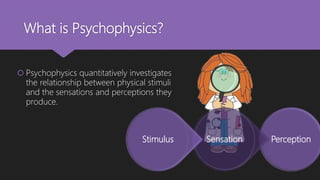
 Psychophysics quantitatively investigates
the relationship between physical stimuli
and the sensations and perceptions they
produce.
PerceptionSensationStimulus
Origins of Psychophysics
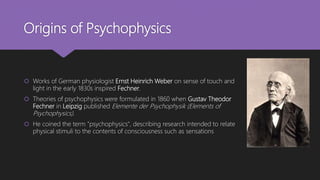
 Works of German physiologist Ernst Heinrich Weber on sense of touch and
light in the early 1830s inspired Fechner.
 Theories of psychophysics were formulated in 1860 when Gustav Theodor
Fechner in Leipzig published Elemente der Psychophysik (Elements of
Psychophysics).
 He coined the term "psychophysics", describing research intended to relate
physical stimuli to the contents of consciousness such as sensations
Three main areas of investigation
Absolute
Thresholds
Discrimination
Thresholds
Psychological
Scaling
Thresholds
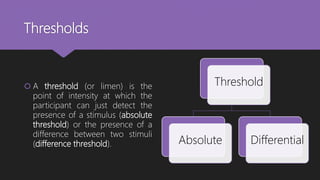
 A threshold (or limen) is the
point of intensity at which the
participant can just detect the
presence of a stimulus (absolute
threshold) or the presence of a
difference between two stimuli
(difference threshold).
Threshold
Absolute Differential
Detection
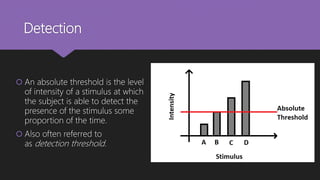
 An absolute threshold is the level
of intensity of a stimulus at which
the subject is able to detect the
presence of the stimulus some
proportion of the time.
 Also often referred to
as detection threshold.
Discrimination
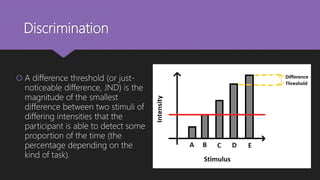
 A difference threshold (or just-
noticeable difference, JND) is the
magnitude of the smallest
difference between two stimuli of
differing intensities that the
participant is able to detect some
proportion of the time (the
percentage depending on the
kind of task).
Psychophysical scaling
 It refers to the process of quantifying psychological events, especially
sensations and perceptions.
 Scaling requires both a set of empirical operations and a theoretical
framework to derive the quantitative values or representations
Classical Methods of Psychophysics
 Psychophysical experiments have traditionally used three methods for
testing subjects' perception in stimulus detection and difference
detection experiments:
the method of limits,
the method of constant stimuli and
the method of adjustment.
Major Influencing Factors
Sensitivity
Response Bias
Attention
Memory
Motivation
Deficits
 In general, each of these three methods suffers from one or more of the
following deficits:
absence of control over the subject's decision criterion;
the estimates may be substantially biased;
no theoretical justification for important aspects of the
procedure;
a large amount of data is wasted since the stimulus is often
presented far from threshold where little information is
gained
Adaptive Psychophysical Methods
 Staircase procedures
 Bayesian and maximum-likelihood
procedures
 Magnitude estimation
Thank You

Psychophysics - Siddhartha

  • 1.
    Psychophysics PSY103 Cognitive Psychology– 1 Presented to: Asst Prof Hemlata Joshi HOD: Prof L. N. Bunker Presented by: A Siddhartha MA (Psychology) 1st Sem Jai Narayan Vyas University
  • 2.
    Contents 1. What isPsychophysics? 2. Origins of Psychophysics 3. Thresholds 4. Detection 5. Discrimination 6. Psychological Scaling 7. Classical Methods of Psychophysics 8. Major Influencing Factors 9. Deficits 10.Adaptive Psychophysical Methods
  • 3.
    What is Psychophysics? Psychophysics quantitatively investigates the relationship between physical stimuli and the sensations and perceptions they produce. PerceptionSensationStimulus
  • 4.
    Origins of Psychophysics Works of German physiologist Ernst Heinrich Weber on sense of touch and light in the early 1830s inspired Fechner.  Theories of psychophysics were formulated in 1860 when Gustav Theodor Fechner in Leipzig published Elemente der Psychophysik (Elements of Psychophysics).  He coined the term "psychophysics", describing research intended to relate physical stimuli to the contents of consciousness such as sensations
  • 5.
    Three main areasof investigation Absolute Thresholds Discrimination Thresholds Psychological Scaling
  • 6.
    Thresholds  A threshold(or limen) is the point of intensity at which the participant can just detect the presence of a stimulus (absolute threshold) or the presence of a difference between two stimuli (difference threshold). Threshold Absolute Differential
  • 7.
    Detection  An absolutethreshold is the level of intensity of a stimulus at which the subject is able to detect the presence of the stimulus some proportion of the time.  Also often referred to as detection threshold.
  • 8.
    Discrimination  A differencethreshold (or just- noticeable difference, JND) is the magnitude of the smallest difference between two stimuli of differing intensities that the participant is able to detect some proportion of the time (the percentage depending on the kind of task).
  • 9.
    Psychophysical scaling  Itrefers to the process of quantifying psychological events, especially sensations and perceptions.  Scaling requires both a set of empirical operations and a theoretical framework to derive the quantitative values or representations
  • 10.
    Classical Methods ofPsychophysics  Psychophysical experiments have traditionally used three methods for testing subjects' perception in stimulus detection and difference detection experiments: the method of limits, the method of constant stimuli and the method of adjustment.
  • 11.
    Major Influencing Factors Sensitivity ResponseBias Attention Memory Motivation
  • 12.
    Deficits  In general,each of these three methods suffers from one or more of the following deficits: absence of control over the subject's decision criterion; the estimates may be substantially biased; no theoretical justification for important aspects of the procedure; a large amount of data is wasted since the stimulus is often presented far from threshold where little information is gained
  • 13.
    Adaptive Psychophysical Methods Staircase procedures  Bayesian and maximum-likelihood procedures  Magnitude estimation
  • 14.