Chapter 1
By: Anju Gautam
 The term cognition (Latin: cognoscere, "to know") is used in several loosely-related ways to refer
to a facility for the human like processing of information, applying knowledge and changing
preferences ( see, for ex. IPK cognitive architecture). Cognition/(cognitive processes) can be
natural and artificial, conscious and not conscious, therefore they are analyzed from different
perspectives and in different contexts, in neurology, psychology, philosophy, systemics and
computer science. The concept cognition is closely related to such abstract concepts as, mind,
reasoning, perception, intelligence, learning, and many others which describe numerous
capabilities of human mind and expected properties of artificial or synthetic intelligence.
Cognition is an abstract property of advanced living organisms, therefore it is studied as a direct
property of a brain or of an abstract mind on subsymbolic and symbolic levels.
 In psychology and in artificial intelligence it is used to refer to the mental functions, mental
processes and states of intelligent entities (humans, human organizations, highly autonomous
robots), with a particular focus toward the study of such mental processes as, comprehension,
inferencing, decision-making, planning and learning (see also cognitive science and
cognitivism). Recently, advanced cognitive researchers are especially focused on the capacities
of abstraction, generalization, concretization/specialization and meta-reasoning which
descriptions involve such concepts as, beliefs, knowledge, desires, preferences and intentions of
intelligent individuals/objects/agents/systems.
 The term "cognition" is also used in a wider sense to mean the act of knowing or knowledge, and
may be interpreted in a social or cultural sense to describe the emergent development of
knowledge and concepts within a group that culminate in both thought and action.
 Cognitive Psychology: The scientific study of
mental processes.
 Using controlled research methods to investigate
questions of mind.
 We’ll discuss research methods in Chapter 2.
 “The science of how the mind is organized to produce
intelligent thought and how it is realized in the brain” –
Anderson, 2004
 Cognitive Science: Study of the relationships among and
integration of cognitive psychology, biology,
anthropology, computer science, linguistics, and
philosophy.
 Cognition: Mental activity associated with thinking,
knowing, and remembering.
 Cognitive Psychology: The study of these mental
activities.
 Concept formation
 Problem solving
 Decision making
 Judgment formation
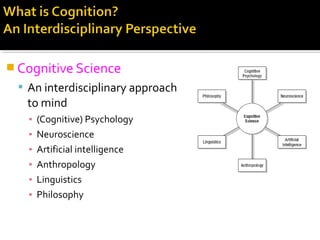
 Cognitive Science
 An interdisciplinary approach
to mind
▪ (Cognitive) Psychology
▪ Neuroscience
▪ Artificial intelligence
▪ Anthropology
▪ Linguistics
▪ Philosophy
 Perception
▪ How do we take in and organize information?
 Attention and Working Memory
▪ How do we focus on and manipulate
information?
 Recognizing and Identifying
▪ How do we realize what something is?
 Long-Term Memory
▪ How do store and retrieve information?
 Memory Distortion
▪ How does memory go awry?
 Autobiographical Memory
▪ What processes influence personal recollection?
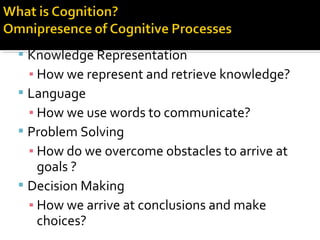
 Knowledge Representation
▪ How we represent and retrieve knowledge?
 Language
▪ How we use words to communicate?
 Problem Solving
▪ How do we overcome obstacles to arrive at
goals ?
 Decision Making
▪ How we arrive at conclusions and make
choices?
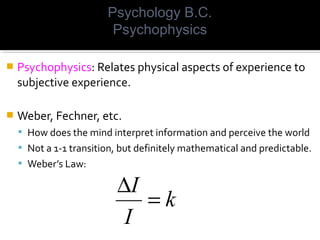
 Psychophysics: Relates physical aspects of experience to
subjective experience.
 Weber, Fechner, etc.
 How does the mind interpret information and perceive the world
 Not a 1-1 transition, but definitely mathematical and predictable.
 Weber’s Law:
k
I
I
=
∆
Psychology B.C.
Psychophysics
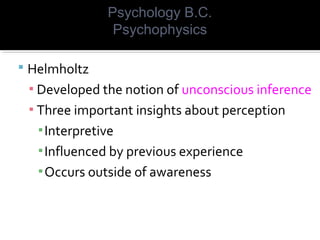
 Helmholtz
▪ Developed the notion of unconscious inference
▪ Three important insights about perception
▪Interpretive
▪Influenced by previous experience
▪Occurs outside of awareness
Psychology B.C.
Psychophysics
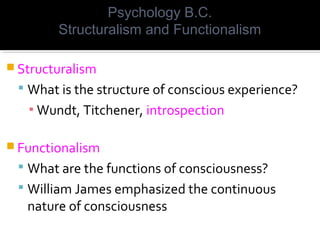
 Structuralism
 What is the structure of conscious experience?
▪ Wundt, Titchener, introspection
 Functionalism
 What are the functions of consciousness?
 William James emphasized the continuous
nature of consciousness
Psychology B.C.
Structuralism and Functionalism
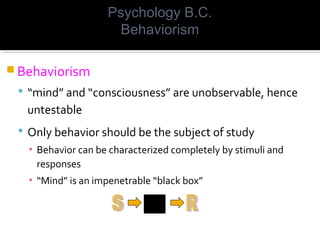
 Behaviorism
 “mind” and “consciousness” are unobservable, hence
untestable
 Only behavior should be the subject of study
▪ Behavior can be characterized completely by stimuli and
responses
▪ “Mind” is an impenetrable “black box”
Psychology B.C.
Behaviorism
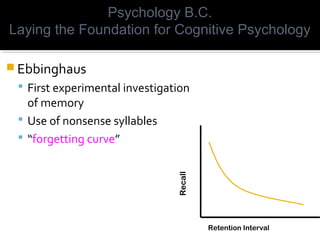
 Ebbinghaus
 First experimental investigation
of memory
 Use of nonsense syllables
 “forgetting curve”
Psychology B.C.
Laying the Foundation for Cognitive Psychology
Retention Interval
Recall
 Bartlett
 Investigated memory for stories (concern for ecological validity)
 Recall guided by “schemata”
 We’ll return to this in Memory and the Law material
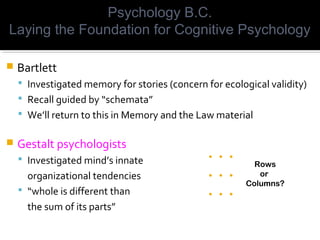
 Gestalt psychologists
 Investigated mind’s innate
organizational tendencies
 “whole is different than
the sum of its parts”
Psychology B.C.
Laying the Foundation for Cognitive Psychology
. . .
. . .
. . .
Rows
or
Columns?
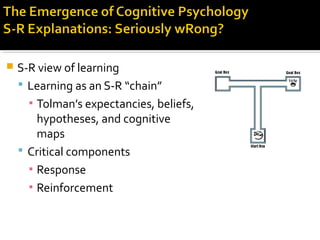
 S-R view of learning
 Learning as an S-R “chain”
▪ Tolman’s expectancies, beliefs,
hypotheses, and cognitive
maps
 Critical components
▪ Response
▪ Reinforcement
 Learning without responding
 Response is part of what is learned
▪ Learning cannot occur in the absence of a
response
 McNamara, Long,Wike (1956) found rats
prevented from running a maze still learned
▪ A “mental map” of the maze?
 Learning without reinforcement
 Reinforcement necessary for solidifying S-R
associations
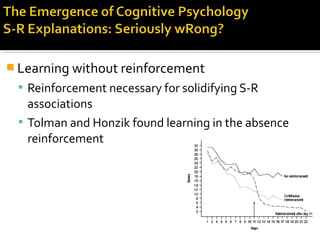
 Tolman and Honzik found learning in the absence
reinforcement
 Tolman proposed “cognitive maps” to account for
learning in the absence of response or
reinforcement
 cognitive maps = mental representation
 Necessity of investigating “mind”
 Other criticisms of behaviorism
 Lashley
▪ Skilled behavior is too complex for an S-R
account
 Chomsky
▪ Linguistic expression is too creative and
productive for an S-R account
 Technological influences on the development of
cognitive psychology
 Communication Systems
 Computers
 These sequential, information-processing systems
provided a possible metaphor for mind
 Behaviorism had considerable influence
 Rigor of research
 Observations of behavior still central
▪ Cannot measure a cognitive process, can only
infer it from behavior (and language is a
behavior when studying human cognition).
 Information processing approach
 Models thinking on the computer
 Assumptions:
▪ Humans as symbol manipulators
▪ Human thought as active, interpretive
▪ Processing is step-by-step; stages can be
isolated
 Connectionist Approach
 Models thinking on neural networks
 Assumptions:
▪ Cognitive processes occur in parallel
▪ Networks of neurons distributed throughout
brain
▪ “parallel distributed processing”
 Criticisms of current conceptions of mind:
 Materialist critique: Is “mind” separable from
“brain”?
 “Disembodied” approach to the study of mind
▪ Importance of studying cognition and action
▪ Importance of studying cognition in meaningful
contexts
▪ “ecological validity”
 Mental Representation: An unobservable internal
code for information.
 Similar to prototypes
 Some perfect version of an object
▪ Plato’s version of the heavenly or pure form.
 Mental representations form the basis of ALL
cognitive activity.
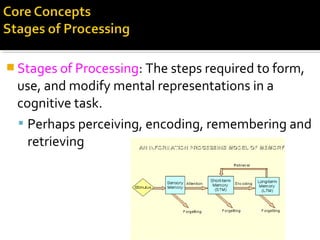
 Stages of Processing: The steps required to form,
use, and modify mental representations in a
cognitive task.
 Perhaps perceiving, encoding, remembering and
retrieving
 Serial Processing: Cognitive operations occur one
at a time in a series.
 The way computers run
 Parallel Processing: Cognitive operations occur
simultaneously in parallel.
 The way people run
 Hierarchical Systems: A system composed of component
parts.
 Nervous system composed of peripheral and central,
each of which has its own components.
 The mind can be divided into component functions
▪ Perception
▪ Memory
▪ Long term
▪ Short Term
▪ Motor output
 Cognitive Architecture: The design or organization
of the mind’s information processing components
and systems.
 Understanding (human) cognitive processing means
being able to implement them on a computational level.
 Artificial Intelligence (AI) simulations are generally
designed to be similar to human cognition.
 Believe that the mind is built from independent
processing modules, each module specialized for an
independent function.
 Artificial intelligence (AI): A branch of computer
science that investigates the extent to which
machines can simulate or duplicate the intelligent
behavior of living organisms.
 Founded by Turing in an article titled
“Computing Machinery and Intelligence”
▪ Can machines think? Depends on how you
define it I guess!
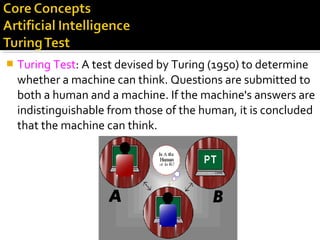
 Turing Test: A test devised by Turing (1950) to determine
whether a machine can think. Questions are submitted to
both a human and a machine. If the machine's answers are
indistinguishable from those of the human, it is concluded
that the machine can think.
 Weak Artificial Intelligence: The contention that
machines (such as computers) can simulate human
cognitive processes but not duplicate them.
 Even if the computer passes the Turing test, it is simply
imitating humans, not being human.
 Strong Artificial Intelligence: The contention that
machines (such as computers) can duplicate
human cognitive processes.
 An appropriately programmed computer is a mind and a
human mind is simply a program.
 Symbolic Models: Assume that the mind is built
like a digital computer (serial processing).
 Mental representations are symbols which are
serially processed using a set of rules.
 Connectionist Models: Use the structure of the
brain itself as a model of the mind’s structure
(parallel processing).
 A set of simple neurons, interconnected, allows
for complex thinking.
 Memory is divided into many distinctions
 Short term vs. Long Term
 Audio vs. Visual
 Etc.
 Consciousness: Our awareness of ourselves
and our environments.
 Awareness of external events and internal
sensations, including awareness of the self and
thoughts about one’s experiences.
 Allows us to focus our attention.
 Difficult (impossible?) to define
 Self-knowledge: Knowledge about the self.
 Informational Access: The capacity to become aware of
and able to report on mental representations and the
processes that operate on them.
 Ability to take advantage of mental representations to
allow us to function in the world.
 Includes awareness of emotions and self-concepts
 Sentience: The basic capacity for raw sensations, feelings,
or subjective experience of any kind.
 Relationship between sentience and brain creates mind-
body problem.

introduction to cognition

  • 1.
  • 2.
     The termcognition (Latin: cognoscere, "to know") is used in several loosely-related ways to refer to a facility for the human like processing of information, applying knowledge and changing preferences ( see, for ex. IPK cognitive architecture). Cognition/(cognitive processes) can be natural and artificial, conscious and not conscious, therefore they are analyzed from different perspectives and in different contexts, in neurology, psychology, philosophy, systemics and computer science. The concept cognition is closely related to such abstract concepts as, mind, reasoning, perception, intelligence, learning, and many others which describe numerous capabilities of human mind and expected properties of artificial or synthetic intelligence. Cognition is an abstract property of advanced living organisms, therefore it is studied as a direct property of a brain or of an abstract mind on subsymbolic and symbolic levels.  In psychology and in artificial intelligence it is used to refer to the mental functions, mental processes and states of intelligent entities (humans, human organizations, highly autonomous robots), with a particular focus toward the study of such mental processes as, comprehension, inferencing, decision-making, planning and learning (see also cognitive science and cognitivism). Recently, advanced cognitive researchers are especially focused on the capacities of abstraction, generalization, concretization/specialization and meta-reasoning which descriptions involve such concepts as, beliefs, knowledge, desires, preferences and intentions of intelligent individuals/objects/agents/systems.  The term "cognition" is also used in a wider sense to mean the act of knowing or knowledge, and may be interpreted in a social or cultural sense to describe the emergent development of knowledge and concepts within a group that culminate in both thought and action.
  • 3.
     Cognitive Psychology:The scientific study of mental processes.  Using controlled research methods to investigate questions of mind.  We’ll discuss research methods in Chapter 2.
  • 4.
     “The scienceof how the mind is organized to produce intelligent thought and how it is realized in the brain” – Anderson, 2004  Cognitive Science: Study of the relationships among and integration of cognitive psychology, biology, anthropology, computer science, linguistics, and philosophy.  Cognition: Mental activity associated with thinking, knowing, and remembering.  Cognitive Psychology: The study of these mental activities.  Concept formation  Problem solving  Decision making  Judgment formation
  • 5.
     Cognitive Science An interdisciplinary approach to mind ▪ (Cognitive) Psychology ▪ Neuroscience ▪ Artificial intelligence ▪ Anthropology ▪ Linguistics ▪ Philosophy
  • 6.
     Perception ▪ Howdo we take in and organize information?  Attention and Working Memory ▪ How do we focus on and manipulate information?  Recognizing and Identifying ▪ How do we realize what something is?
  • 7.
     Long-Term Memory ▪How do store and retrieve information?  Memory Distortion ▪ How does memory go awry?  Autobiographical Memory ▪ What processes influence personal recollection?
  • 8.
     Knowledge Representation ▪How we represent and retrieve knowledge?  Language ▪ How we use words to communicate?  Problem Solving ▪ How do we overcome obstacles to arrive at goals ?  Decision Making ▪ How we arrive at conclusions and make choices?
  • 9.
     Psychophysics: Relatesphysical aspects of experience to subjective experience.  Weber, Fechner, etc.  How does the mind interpret information and perceive the world  Not a 1-1 transition, but definitely mathematical and predictable.  Weber’s Law: k I I = ∆ Psychology B.C. Psychophysics
  • 10.
     Helmholtz ▪ Developedthe notion of unconscious inference ▪ Three important insights about perception ▪Interpretive ▪Influenced by previous experience ▪Occurs outside of awareness Psychology B.C. Psychophysics
  • 11.
     Structuralism  Whatis the structure of conscious experience? ▪ Wundt, Titchener, introspection  Functionalism  What are the functions of consciousness?  William James emphasized the continuous nature of consciousness Psychology B.C. Structuralism and Functionalism
  • 12.
     Behaviorism  “mind”and “consciousness” are unobservable, hence untestable  Only behavior should be the subject of study ▪ Behavior can be characterized completely by stimuli and responses ▪ “Mind” is an impenetrable “black box” Psychology B.C. Behaviorism
  • 13.
     Ebbinghaus  Firstexperimental investigation of memory  Use of nonsense syllables  “forgetting curve” Psychology B.C. Laying the Foundation for Cognitive Psychology Retention Interval Recall
  • 14.
     Bartlett  Investigatedmemory for stories (concern for ecological validity)  Recall guided by “schemata”  We’ll return to this in Memory and the Law material  Gestalt psychologists  Investigated mind’s innate organizational tendencies  “whole is different than the sum of its parts” Psychology B.C. Laying the Foundation for Cognitive Psychology . . . . . . . . . Rows or Columns?
  • 15.
     S-R viewof learning  Learning as an S-R “chain” ▪ Tolman’s expectancies, beliefs, hypotheses, and cognitive maps  Critical components ▪ Response ▪ Reinforcement
  • 16.
     Learning withoutresponding  Response is part of what is learned ▪ Learning cannot occur in the absence of a response  McNamara, Long,Wike (1956) found rats prevented from running a maze still learned ▪ A “mental map” of the maze?
  • 17.
     Learning withoutreinforcement  Reinforcement necessary for solidifying S-R associations  Tolman and Honzik found learning in the absence reinforcement
  • 18.
     Tolman proposed“cognitive maps” to account for learning in the absence of response or reinforcement  cognitive maps = mental representation  Necessity of investigating “mind”
  • 19.
     Other criticismsof behaviorism  Lashley ▪ Skilled behavior is too complex for an S-R account  Chomsky ▪ Linguistic expression is too creative and productive for an S-R account
  • 20.
     Technological influenceson the development of cognitive psychology  Communication Systems  Computers  These sequential, information-processing systems provided a possible metaphor for mind
  • 21.
     Behaviorism hadconsiderable influence  Rigor of research  Observations of behavior still central ▪ Cannot measure a cognitive process, can only infer it from behavior (and language is a behavior when studying human cognition).
  • 22.
     Information processingapproach  Models thinking on the computer  Assumptions: ▪ Humans as symbol manipulators ▪ Human thought as active, interpretive ▪ Processing is step-by-step; stages can be isolated
  • 23.
     Connectionist Approach Models thinking on neural networks  Assumptions: ▪ Cognitive processes occur in parallel ▪ Networks of neurons distributed throughout brain ▪ “parallel distributed processing”
  • 24.
     Criticisms ofcurrent conceptions of mind:  Materialist critique: Is “mind” separable from “brain”?  “Disembodied” approach to the study of mind ▪ Importance of studying cognition and action ▪ Importance of studying cognition in meaningful contexts ▪ “ecological validity”
  • 25.
     Mental Representation:An unobservable internal code for information.  Similar to prototypes  Some perfect version of an object ▪ Plato’s version of the heavenly or pure form.  Mental representations form the basis of ALL cognitive activity.
  • 26.
     Stages ofProcessing: The steps required to form, use, and modify mental representations in a cognitive task.  Perhaps perceiving, encoding, remembering and retrieving
  • 27.
     Serial Processing:Cognitive operations occur one at a time in a series.  The way computers run  Parallel Processing: Cognitive operations occur simultaneously in parallel.  The way people run
  • 28.
     Hierarchical Systems:A system composed of component parts.  Nervous system composed of peripheral and central, each of which has its own components.  The mind can be divided into component functions ▪ Perception ▪ Memory ▪ Long term ▪ Short Term ▪ Motor output
  • 29.
     Cognitive Architecture:The design or organization of the mind’s information processing components and systems.  Understanding (human) cognitive processing means being able to implement them on a computational level.  Artificial Intelligence (AI) simulations are generally designed to be similar to human cognition.  Believe that the mind is built from independent processing modules, each module specialized for an independent function.
  • 30.
     Artificial intelligence(AI): A branch of computer science that investigates the extent to which machines can simulate or duplicate the intelligent behavior of living organisms.  Founded by Turing in an article titled “Computing Machinery and Intelligence” ▪ Can machines think? Depends on how you define it I guess!
  • 31.
     Turing Test:A test devised by Turing (1950) to determine whether a machine can think. Questions are submitted to both a human and a machine. If the machine's answers are indistinguishable from those of the human, it is concluded that the machine can think.
  • 32.
     Weak ArtificialIntelligence: The contention that machines (such as computers) can simulate human cognitive processes but not duplicate them.  Even if the computer passes the Turing test, it is simply imitating humans, not being human.  Strong Artificial Intelligence: The contention that machines (such as computers) can duplicate human cognitive processes.  An appropriately programmed computer is a mind and a human mind is simply a program.
  • 33.
     Symbolic Models:Assume that the mind is built like a digital computer (serial processing).  Mental representations are symbols which are serially processed using a set of rules.  Connectionist Models: Use the structure of the brain itself as a model of the mind’s structure (parallel processing).  A set of simple neurons, interconnected, allows for complex thinking.
  • 34.
     Memory isdivided into many distinctions  Short term vs. Long Term  Audio vs. Visual  Etc.
  • 35.
     Consciousness: Ourawareness of ourselves and our environments.  Awareness of external events and internal sensations, including awareness of the self and thoughts about one’s experiences.  Allows us to focus our attention.
  • 36.
     Difficult (impossible?)to define  Self-knowledge: Knowledge about the self.  Informational Access: The capacity to become aware of and able to report on mental representations and the processes that operate on them.  Ability to take advantage of mental representations to allow us to function in the world.  Includes awareness of emotions and self-concepts  Sentience: The basic capacity for raw sensations, feelings, or subjective experience of any kind.  Relationship between sentience and brain creates mind- body problem.

Editor's Notes

  • #26 -Kant’s categories of thought. -
  • #28 -Parallel processing is the ability of the brain to simultaneously process incoming stimuli. This becomes most important in vision, as the brain divides and conquers what it sees. It breaks up a scene into four components: color, motion, form, and depth. These are individually analyzed and then compared to stored memories, which helps the brain identify what you are viewing. The brain then combines all of these into one image that you see and comprehend. This is a continual and seamless operation.
  • #33 -A behaviorist might advocate Weak AI -John Searle argues against Strong AI by describing a situation where someone is placed in a room with Chinese symbols and is given a book describing the manipulation of the symbols. You would not need to understand the symbols to follow the rules.