SENSATION
AND
PERCEPTION
Presenter: Dr. Subodh Kumar Sharma (Resident Ist year)
Moderator: Assoc. Prof. Sandesh Sawant, (Clinical Psychology)
Department of Psychiatry
National Medical College, Birgunj
Overview:
• Sensation and its psychophysics aspect
• Sense organs and their pathways
• Perception
• Various Perceptual Process
• Factors affecting Perception
Sensation
• The process of receiving information through the senses (organs), which
can later be interpreted by the brain.
• Is a general biological process.
• The source is stimuli received by the senses.
• Results in raw information.
Psychophysics:
Thresholds and Stimulus Change
• Threshold: minimum amount of any given sensation that has to be present
for us to notice.
• Absolute threshold: minimum amount of stimulus that is necessary for us to
notice it 50% of the time.
• Difference threshold: difference between two stimuli to be detected.
• Weber’s law: The law states that the change in a stimulus that will be just
noticeable is a constant ratio of the original stimulus.
• Sensory adaptation: reduction in sensitivity to a stimulus after constant
exposure to it.
• Helps free up our attention and resources to attend to other stimuli in the
environment around us.
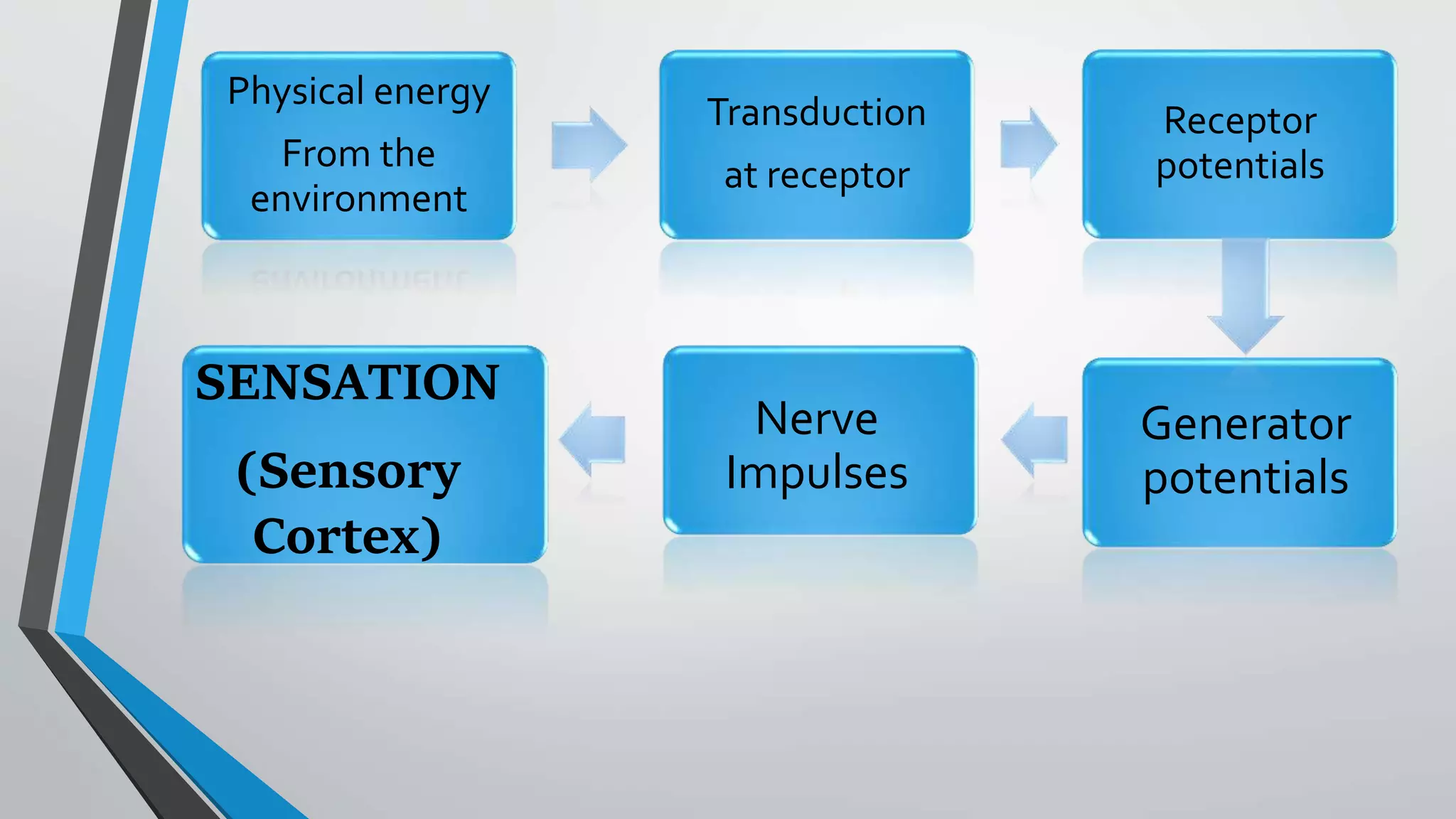
Physical energy
From the
environment
Transduction
at receptor
Receptor
potentials
Generator
potentials
Nerve
Impulses
SENSATION
(Sensory
Cortex)
Sensory Receptors:
• Detect stimuli and convert energy into neural impulses.
• Receptors are special cells designed to serve very specific functions.
• Rods and Cones cells
• Pacinian , Meissner's, Ruffini’s corpuscle, Merkle's disc, free nerve endings,
hair receptors
• Taste Buds
• Hair cells in Ear
• Olfactory Epithelium (Bulb)
VISION
Visual Pathway
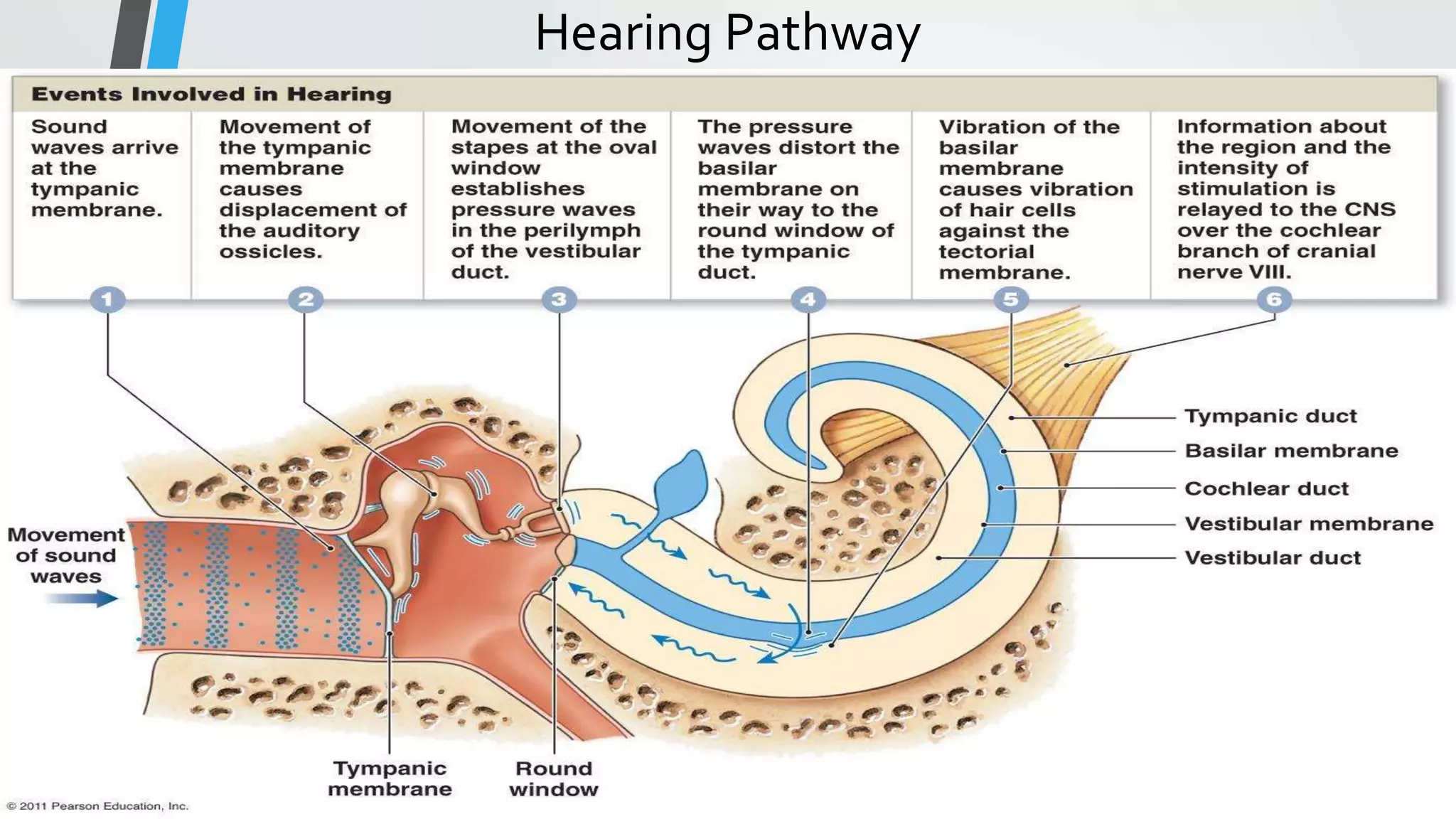
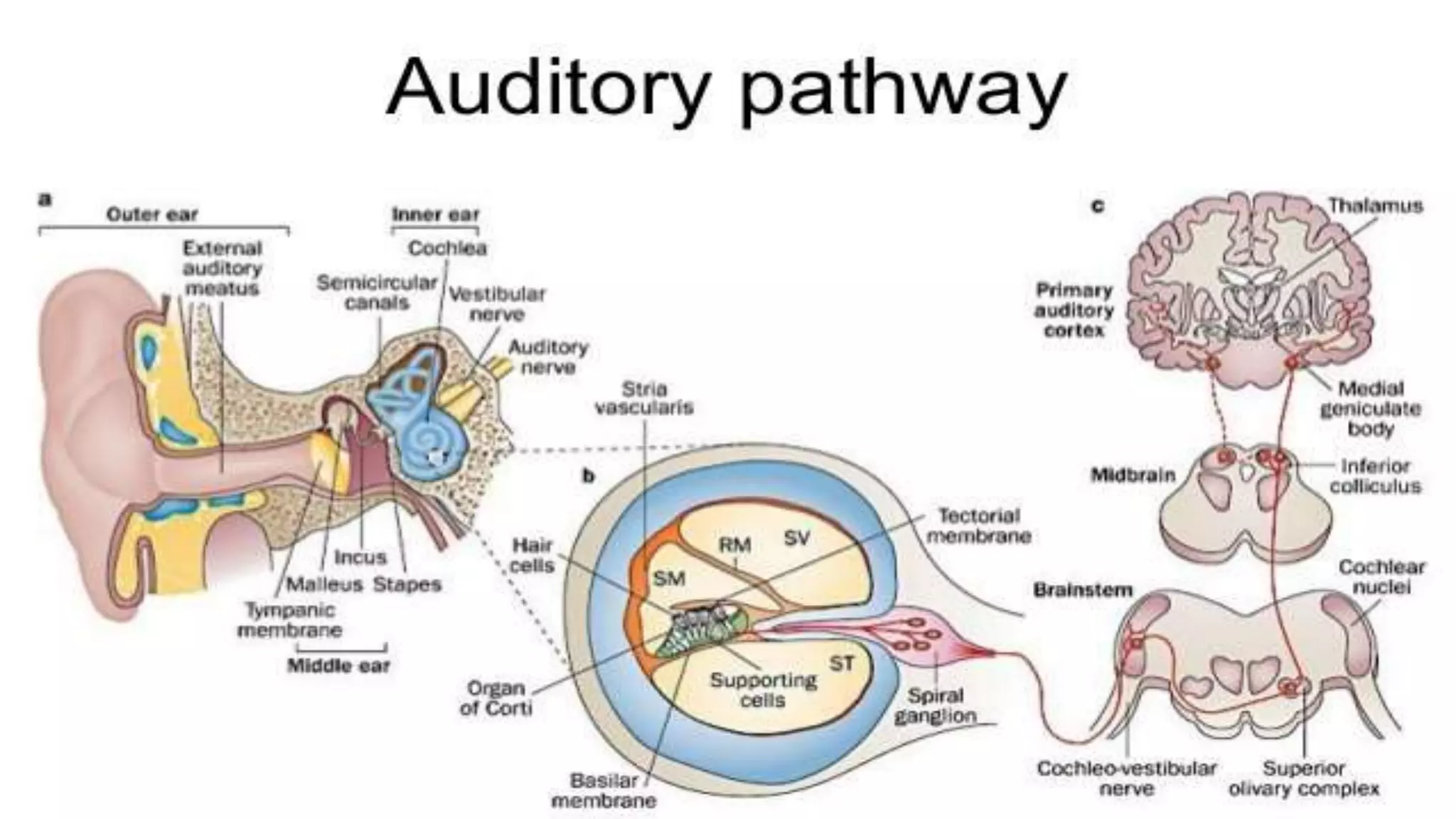
Hearing Pathway
OLFACTORY PATHWAY
Skin and Sensations
Cutaneous Sensory Pathway
Sensation to Perception
• Perception is the process of interpreting the information received by the
sensation process.
• Results in meaning of that information.
• More of a psychological process as it is affected by the prestored information
in the brain.
• Perception thus is whatever is experienced by the person. The way world
looks, sound, feels, tastes or smells.
Perception
• Arrived from Latin word “percepio”…..
• Meaning action of taking possession and apprehension from mind and
senses.
Perception
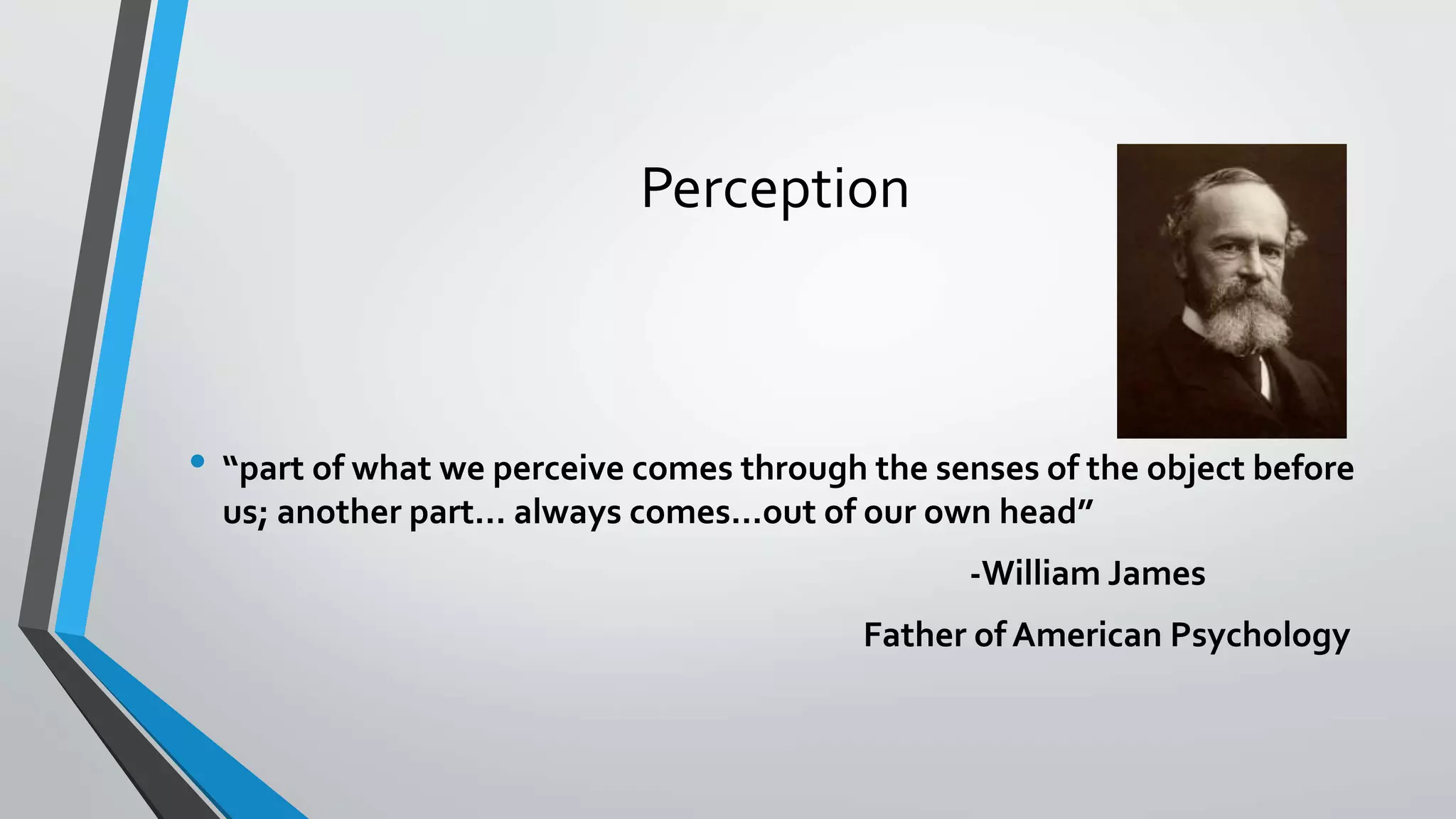
• “part of what we perceive comes through the senses of the object before
us; another part… always comes…out of our own head”
-William James
Father of American Psychology
Perceptual Process
• Attention
• Form perception
• Visual Depth Perception
• Constancy
• Movement Perception
• Plasticity
• Individual Differences
Perceptual Process: Attention
• Attention is the term given to the perceptual process that select
certain inputs for inclusion in our conscious experience, or
awareness, at any given time.
• Characteristics of attention:
• Selective
• Shiftable
BottleneckTheory: filtration
Early vs Late Bottleneck
• Specially two Theories regarding filtration:
• Broadbent ,1958: the filter or information bottleneck is at sensory organ or at
least at the very early stage of information processing.
• Shiffrin and Schneider, 1977 argue that filtering take place at later stages of
information flow (at the stages where input is interpreted as meaningful)
Filtration: Processing Capacity
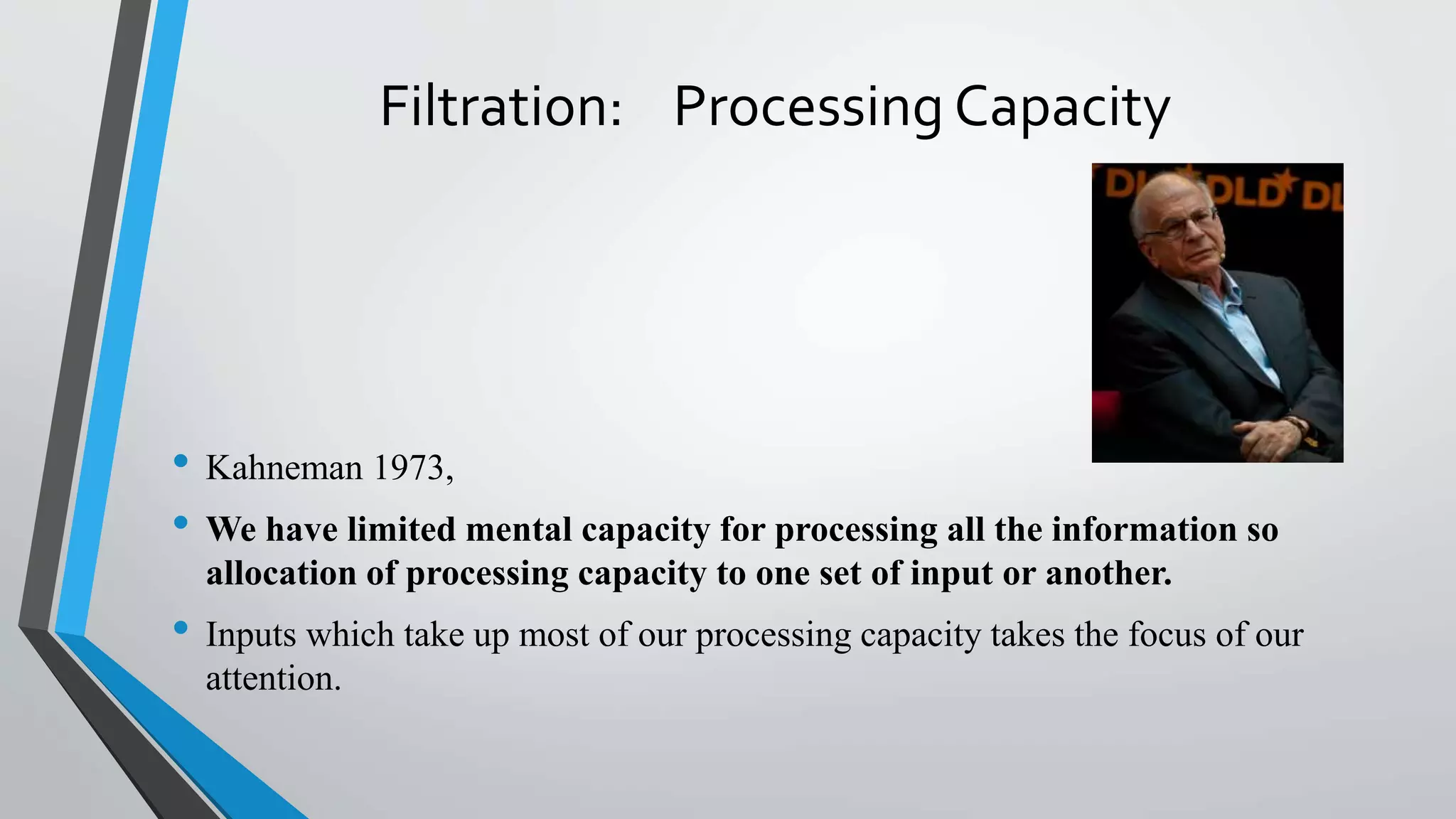
• Kahneman 1973,
• We have limited mental capacity for processing all the information so
allocation of processing capacity to one set of input or another.
• Inputs which take up most of our processing capacity takes the focus of our
attention.
Determinants of Attention
• Depends upon different character of stimuli:
• Nature
• Reality
• Familiarity
• Proximity
• Novelty
• Suspense
• Conflict
• Humor
• Vitality
• Activity
• Intensity
Perceptual Process: Form Perception
• Ability to distinguish an object from its general background
Form perception is the recognition of visual elements of objects, specifically
those to do with shapes, patterns and previously identified important
characteristics.
Components of form perceptions:
• Contour
• Organization
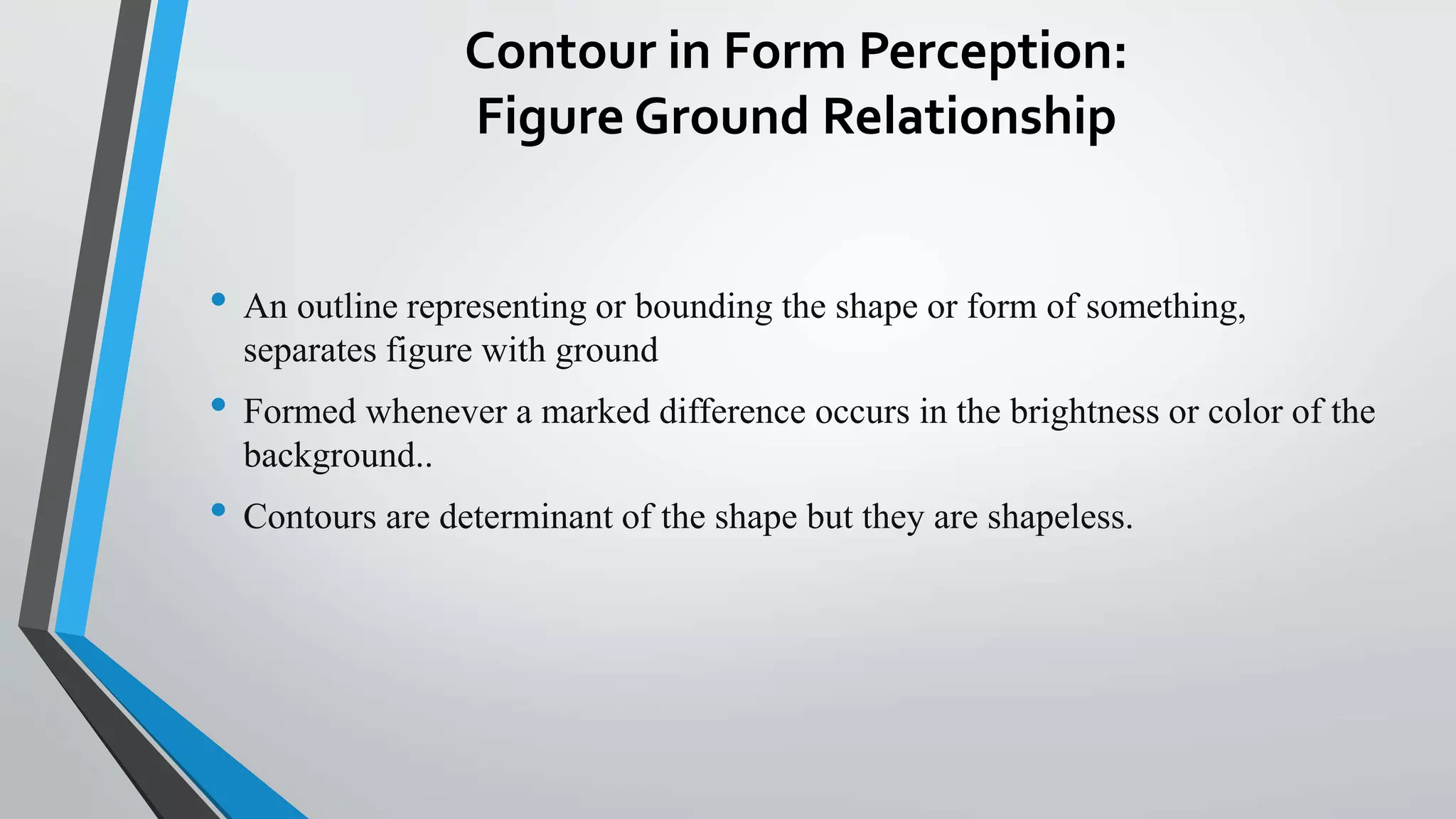
Contour in Form Perception:
Figure Ground Relationship
• An outline representing or bounding the shape or form of something,
separates figure with ground
• Formed whenever a marked difference occurs in the brightness or color of the
background..
• Contours are determinant of the shape but they are shapeless.
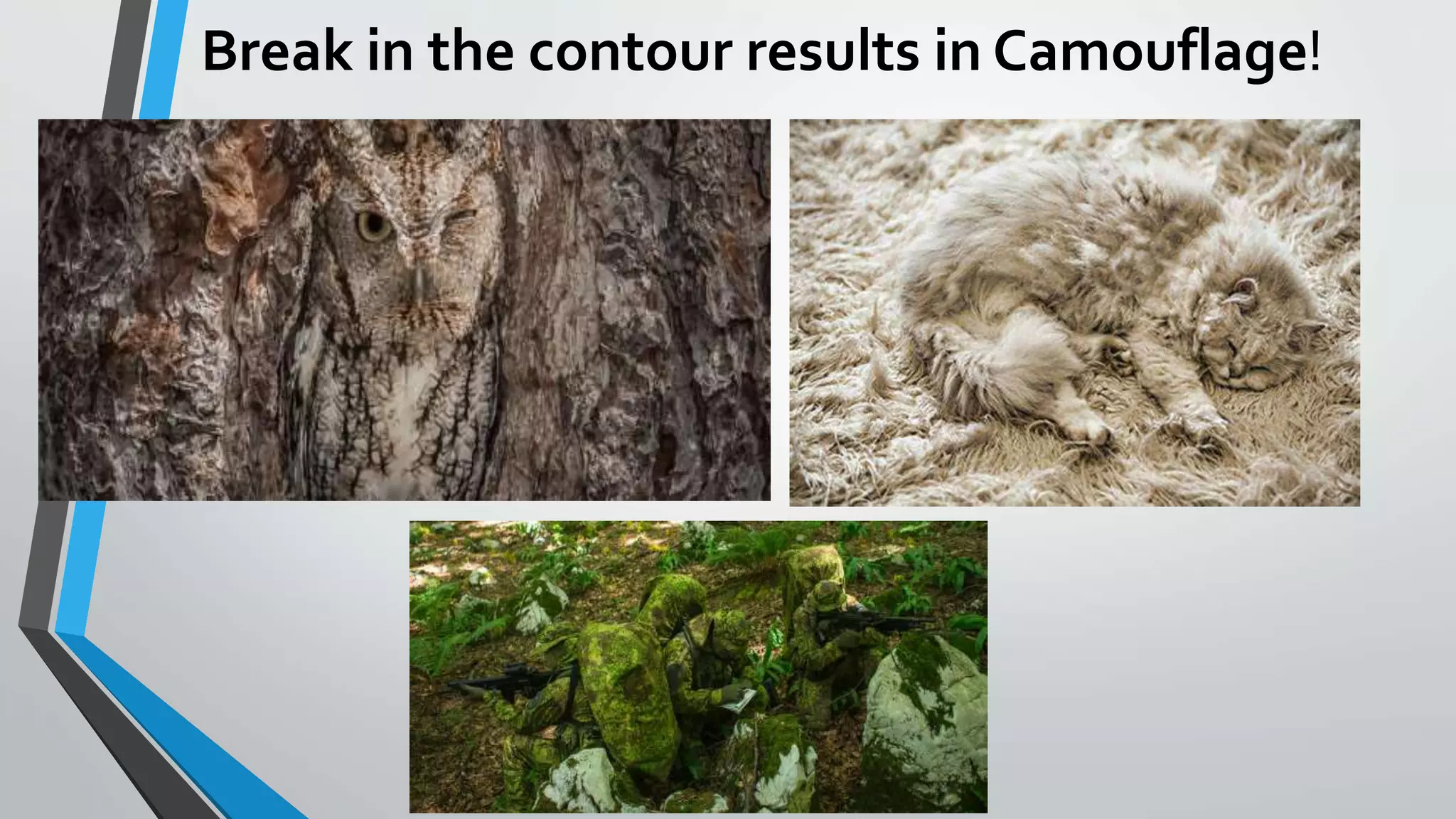
Break in the contour results in Camouflage!
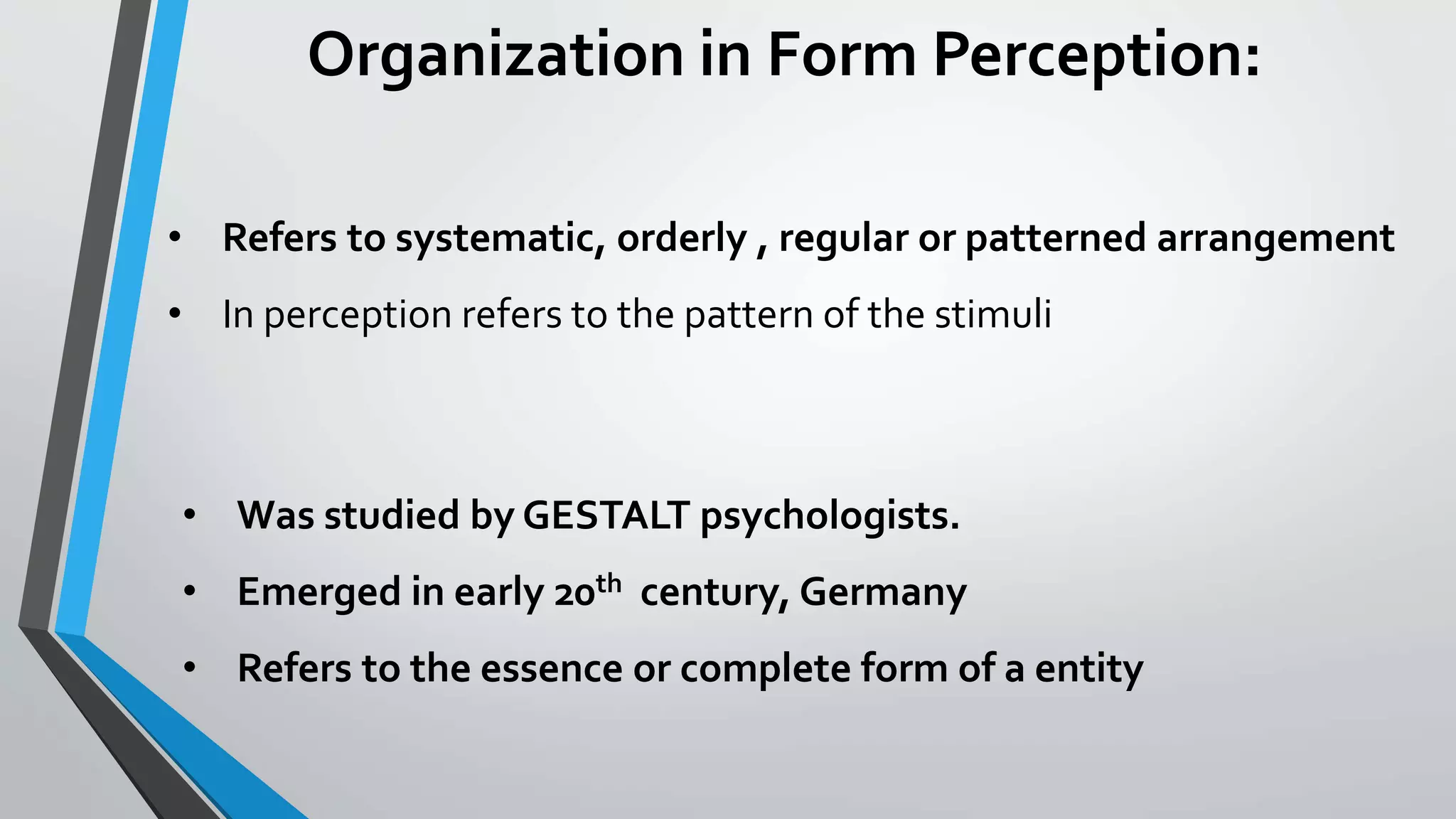
Organization in Form Perception:
• Refers to systematic, orderly , regular or patterned arrangement
• In perception refers to the pattern of the stimuli
• Was studied by GESTALT psychologists.
• Emerged in early 20th century, Germany
• Refers to the essence or complete form of a entity
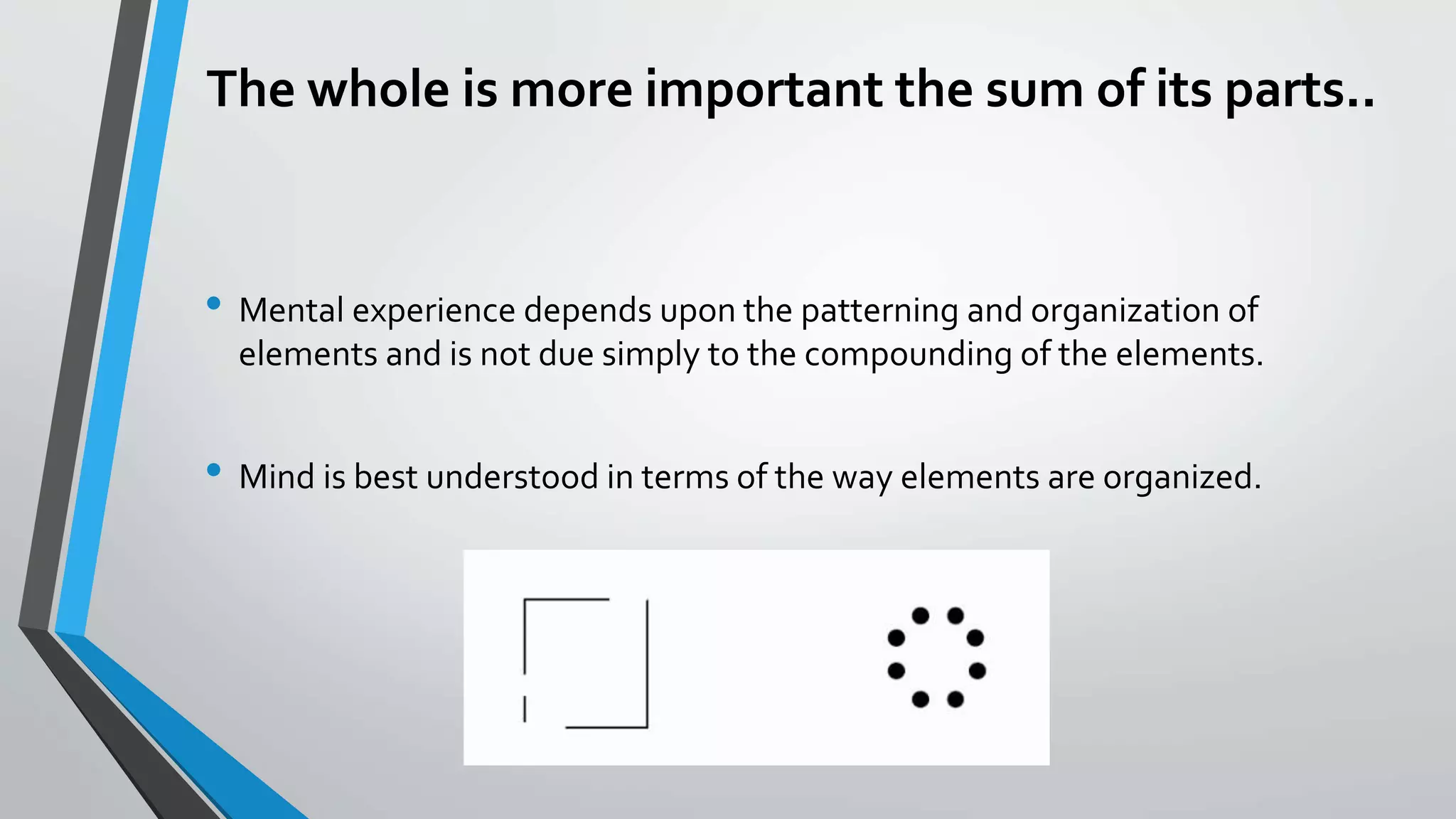
The whole is more important the sum of its parts..
• Mental experience depends upon the patterning and organization of
elements and is not due simply to the compounding of the elements.
• Mind is best understood in terms of the way elements are organized.
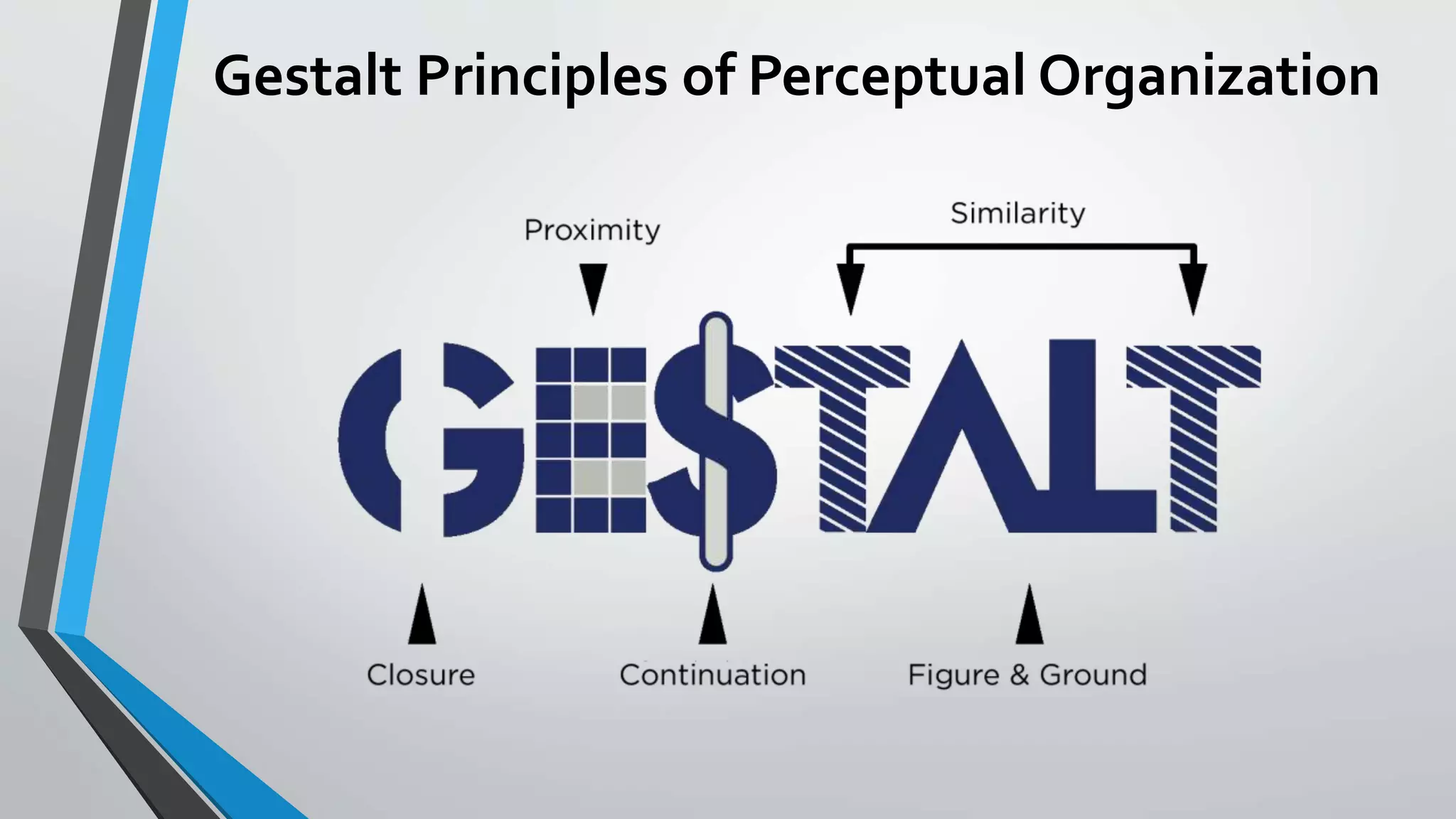
Gestalt Principles of Perceptual Organization
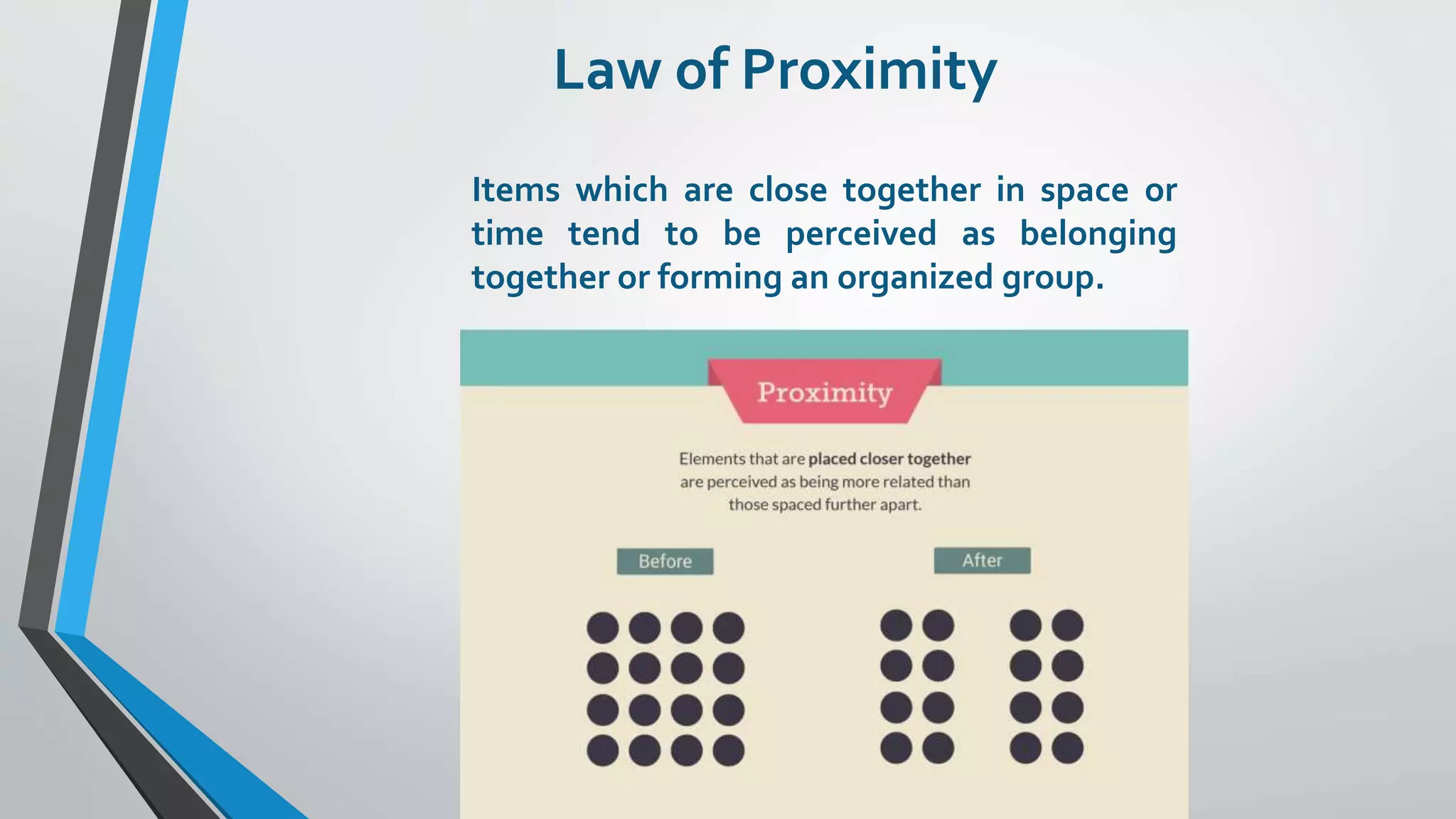
Law of Proximity
Items which are close together in space or
time tend to be perceived as belonging
together or forming an organized group.
Law of Similarity
Items that are similar in shape size or color
are perceived as being grouped or related.
Law of Good Figure (Symmetry)
There is tendency to organize things to make
a balanced or symmetrical figure that
includes all the parts.
Law of Continuation
There is tendency to perceive a line that
starts in one way as continuing in the same
way.
Law of Closure
Tendency to organize the perceived world by
filling the gaps in stimulation, and perceive a
whole form rather than disjointed parts.
Perceptual Process:Visual Depth Perception
Depth perception is the ability of the human eye to see in three dimensions.
It is often demonstrated with the measurements of length, width and height.
Perceiving the three dimensional world is attributed to:
• Monocular Cues
• Binocular Cues
Monocular Cues:
• Linear Perspective
• Clearness
• Interposition
• Shadows
• Gradients of texture
• Movement
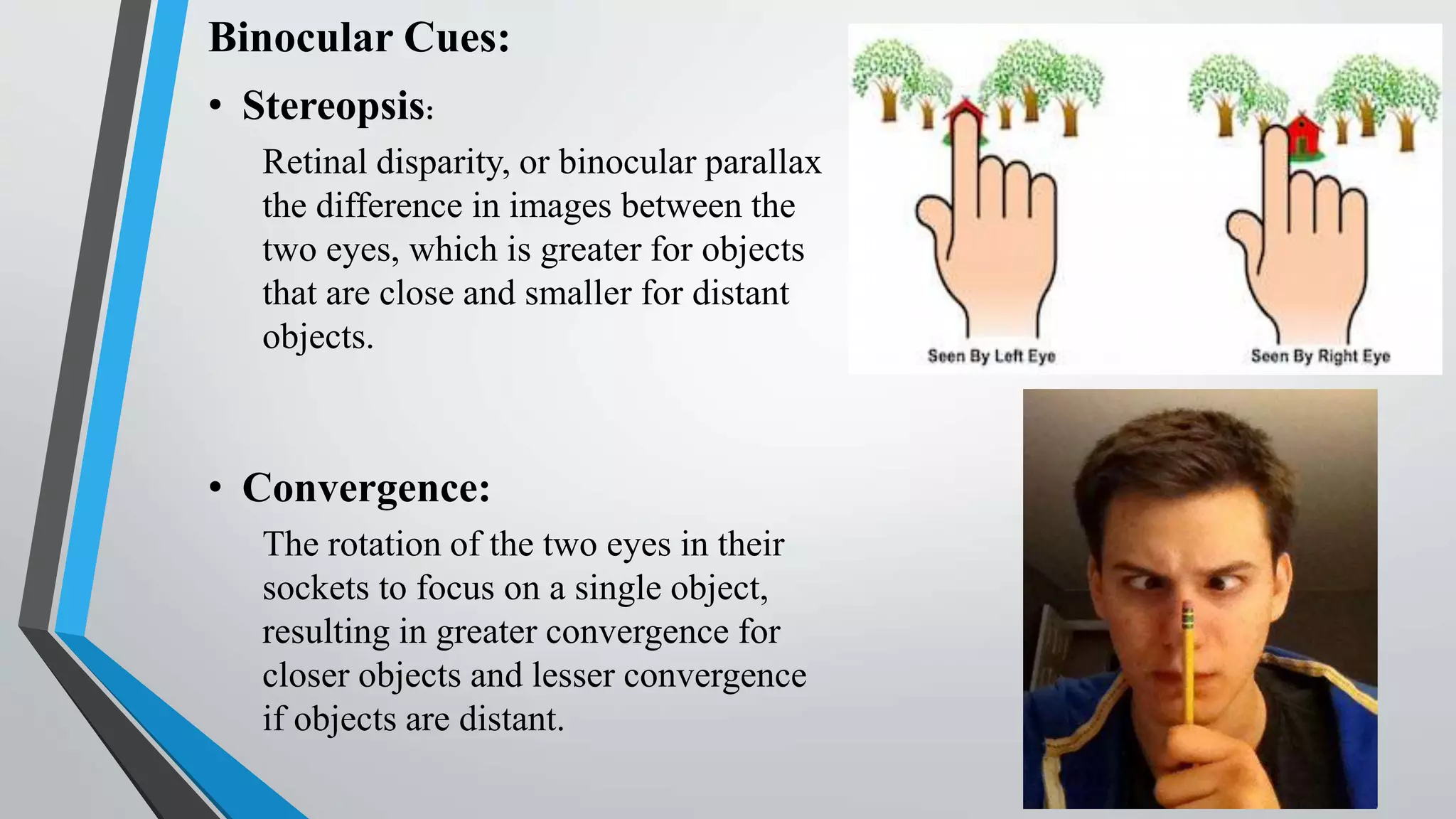
Binocular Cues:
• Stereopsis:
Retinal disparity, or binocular parallax
the difference in images between the
two eyes, which is greater for objects
that are close and smaller for distant
objects.
• Convergence:
The rotation of the two eyes in their
sockets to focus on a single object,
resulting in greater convergence for
closer objects and lesser convergence
if objects are distant.
Perceptual Process: Constancy
• Size Constancy:
• The tendency to interpret an object as always being the same actual size,
regardless of its distance.
Perceptual Process: Constancy
• Brightness Constancy:
• The tendency to perceive the apparent brightness of an object as the same
even when the light conditions change
Perceptual Process: Constancy
• Shape Constancy:
• the tendency to interpret the shape of an object as being constant, even
when its shape changes on the retina
Perceptual Process: Movement Perception
• Constancy of real motion perception:
• Independent of the real motion of the image across the retina, perception
depends upon the motion relative to the background of the image.
• Brain Comparator and Real motion Perception:
• The brain comparator is the system which compares information about the
muscle movements with the information about the movement of retinal
image.
• Apparent Motion: Movement perceived in the absence of physical
movement of an image across the retina.
• Stroboscopic Motion
• Induced movement
Perceptual Process: Plasticity
• Visual Deprivation: restriction of visual impulses during the sensitive period
results in impaired visual perception even after correction of restraints.
• Nature VS Nurture: inborn, innate vs learning and effect of environment
Refers to the moldability or modifiability of perception.
Prolonged changes in sensory input can modify the ways information is processed.
Perceptual Process: Individual Differences
• Perceptual Learning:
• Learning, experience and practice in past makes the difference in ability to
extract information from the stimuli, Practical and adaptive value
• Example: Bird expert (Ornithologists) can separate more sounds of birds.
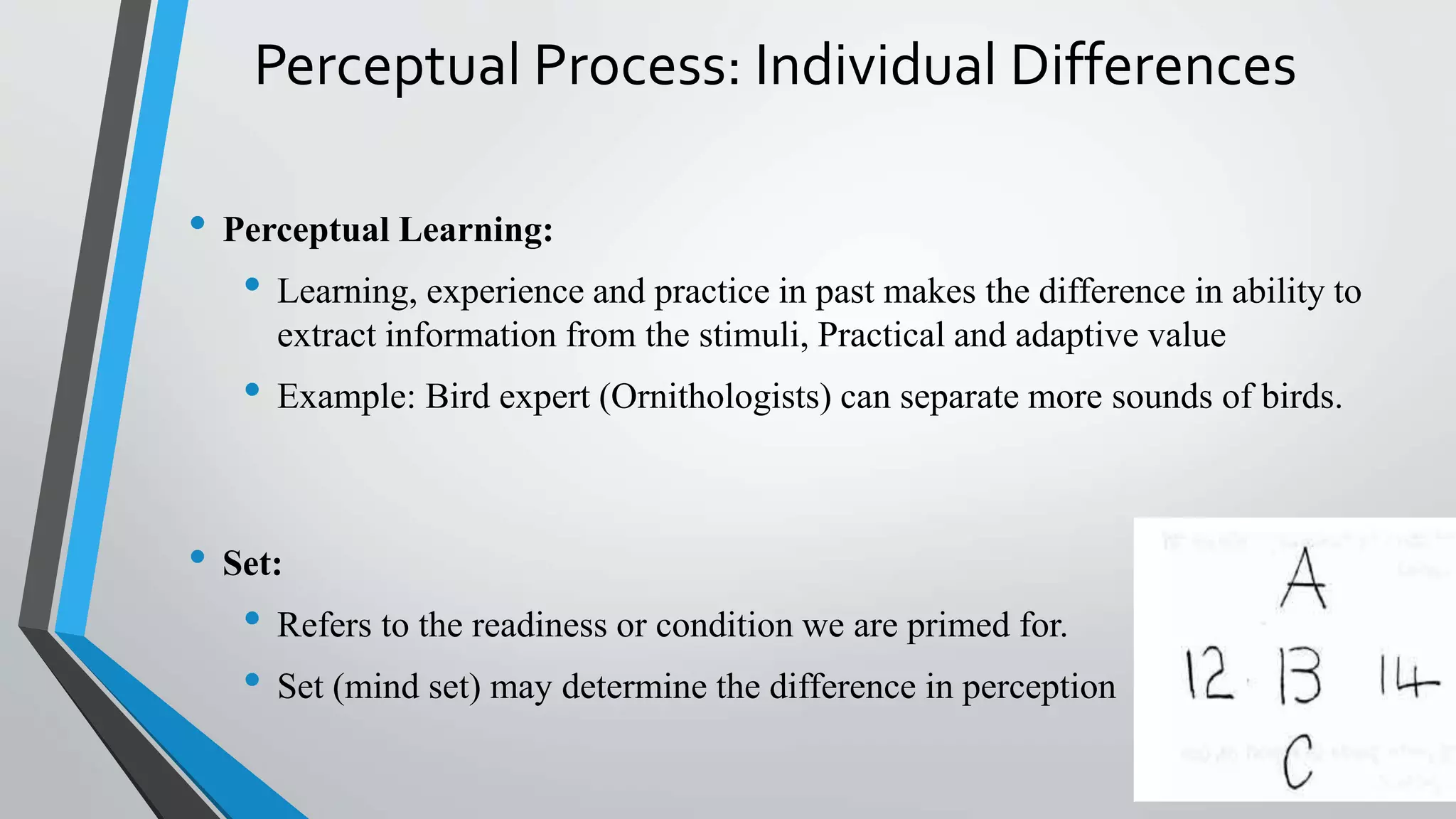
• Set:
• Refers to the readiness or condition we are primed for.
• Set (mind set) may determine the difference in perception
Perceptual Process: Individual Differences
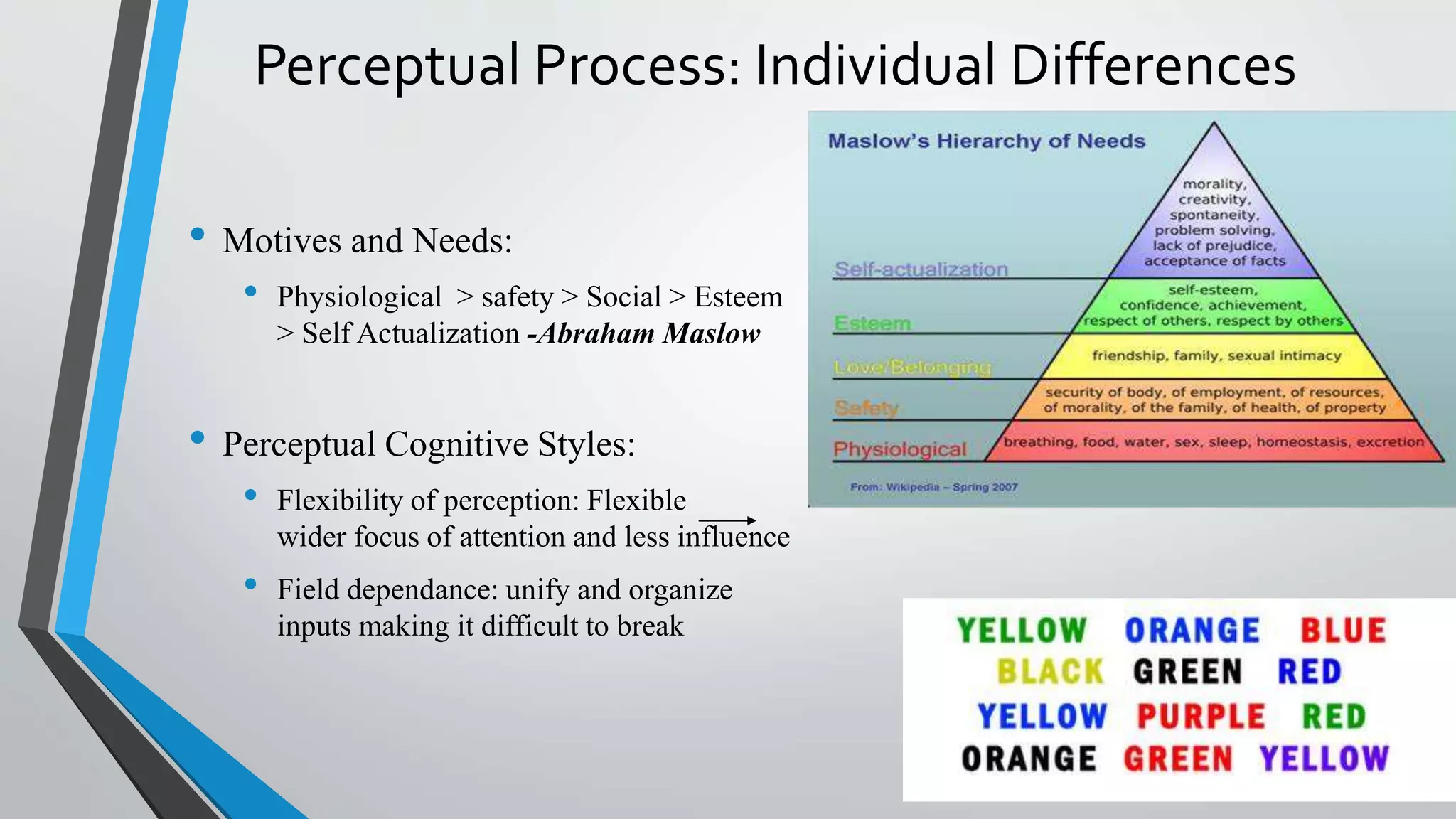
• Motives and Needs:
• Physiological > safety > Social > Esteem
> Self Actualization -Abraham Maslow
• Perceptual Cognitive Styles:
• Flexibility of perception: Flexible
wider focus of attention and less influence
• Field dependance: unify and organize
inputs making it difficult to break
Parrot
High heeled boot
Screw driver
Kangaroo
Horse shoe
Mitten
Squirrel
Cap
Shark
Eel
Sunglasses
moon
Factors Influencing Perception:
• Character of Stimulation
• Character Of Context
• Character of Individual
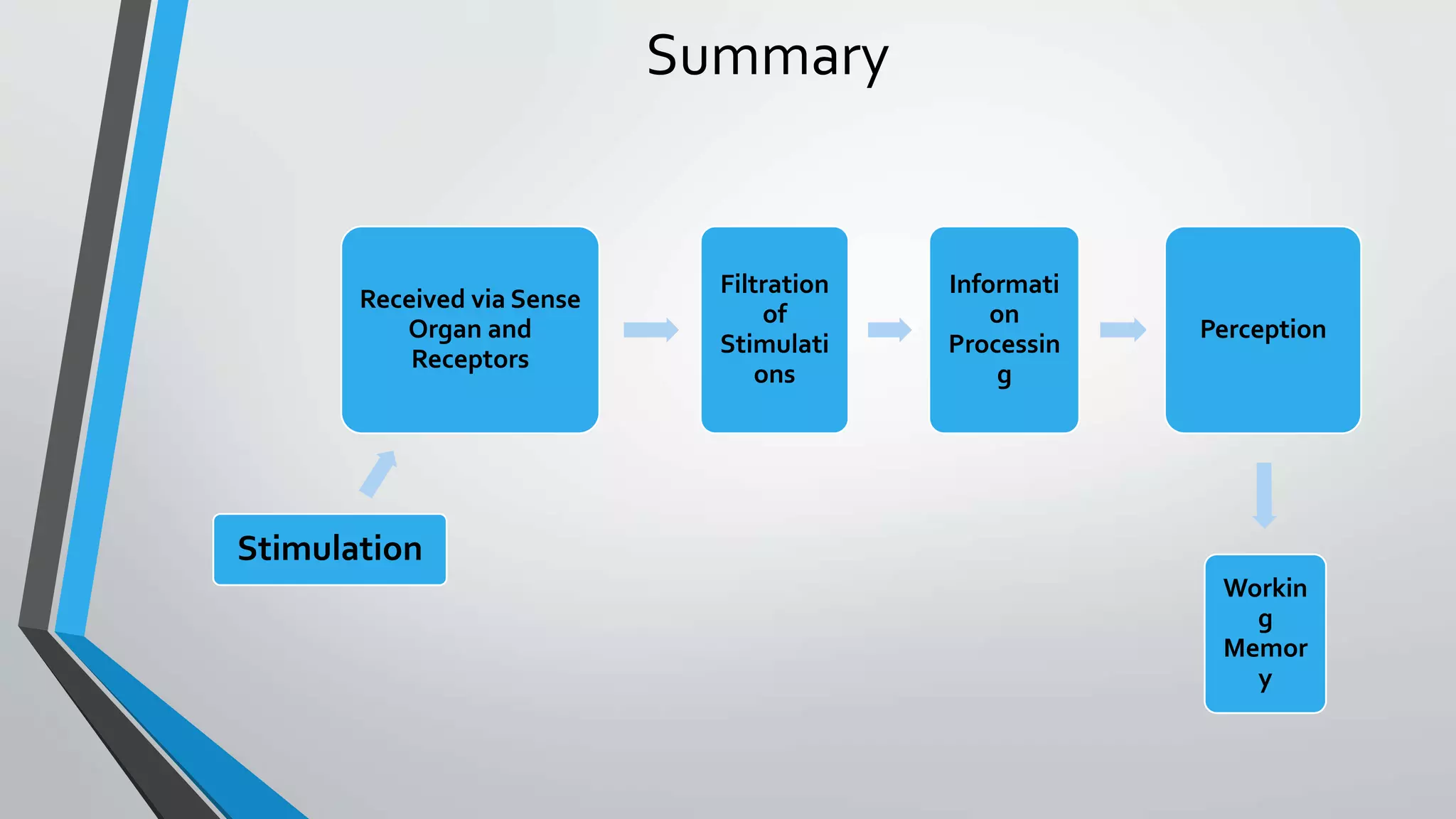
Summary
Stimulation
Received via Sense
Organ and
Receptors
Filtration
of
Stimulati
ons
Informati
on
Processin
g
Perception
Workin
g
Memor
y
References:
• Introduction to Psychology, Seventh Edition, CliffordT. Morgan Et. all
• A text book of General Psychology, First Edition, Grishbala Mohanty
• General Psychology
THANKYOU!!

Senstation and Perception

  • 1.
    SENSATION AND PERCEPTION Presenter: Dr. SubodhKumar Sharma (Resident Ist year) Moderator: Assoc. Prof. Sandesh Sawant, (Clinical Psychology) Department of Psychiatry National Medical College, Birgunj
  • 2.
    Overview: • Sensation andits psychophysics aspect • Sense organs and their pathways • Perception • Various Perceptual Process • Factors affecting Perception
  • 3.
    Sensation • The processof receiving information through the senses (organs), which can later be interpreted by the brain. • Is a general biological process. • The source is stimuli received by the senses. • Results in raw information.
  • 4.
    Psychophysics: Thresholds and StimulusChange • Threshold: minimum amount of any given sensation that has to be present for us to notice. • Absolute threshold: minimum amount of stimulus that is necessary for us to notice it 50% of the time. • Difference threshold: difference between two stimuli to be detected. • Weber’s law: The law states that the change in a stimulus that will be just noticeable is a constant ratio of the original stimulus. • Sensory adaptation: reduction in sensitivity to a stimulus after constant exposure to it. • Helps free up our attention and resources to attend to other stimuli in the environment around us.
  • 5.
    Physical energy From the environment Transduction atreceptor Receptor potentials Generator potentials Nerve Impulses SENSATION (Sensory Cortex)
  • 6.
    Sensory Receptors: • Detectstimuli and convert energy into neural impulses. • Receptors are special cells designed to serve very specific functions. • Rods and Cones cells • Pacinian , Meissner's, Ruffini’s corpuscle, Merkle's disc, free nerve endings, hair receptors • Taste Buds • Hair cells in Ear • Olfactory Epithelium (Bulb)
  • 9.
  • 10.
  • 11.
  • 13.
  • 15.
  • 17.
  • 18.
    Sensation to Perception •Perception is the process of interpreting the information received by the sensation process. • Results in meaning of that information. • More of a psychological process as it is affected by the prestored information in the brain. • Perception thus is whatever is experienced by the person. The way world looks, sound, feels, tastes or smells.
  • 19.
    Perception • Arrived fromLatin word “percepio”….. • Meaning action of taking possession and apprehension from mind and senses.
  • 20.
    Perception • “part ofwhat we perceive comes through the senses of the object before us; another part… always comes…out of our own head” -William James Father of American Psychology
  • 21.
    Perceptual Process • Attention •Form perception • Visual Depth Perception • Constancy • Movement Perception • Plasticity • Individual Differences
  • 22.
    Perceptual Process: Attention •Attention is the term given to the perceptual process that select certain inputs for inclusion in our conscious experience, or awareness, at any given time. • Characteristics of attention: • Selective • Shiftable
  • 23.
  • 24.
    Early vs LateBottleneck • Specially two Theories regarding filtration: • Broadbent ,1958: the filter or information bottleneck is at sensory organ or at least at the very early stage of information processing. • Shiffrin and Schneider, 1977 argue that filtering take place at later stages of information flow (at the stages where input is interpreted as meaningful)
  • 25.
    Filtration: Processing Capacity •Kahneman 1973, • We have limited mental capacity for processing all the information so allocation of processing capacity to one set of input or another. • Inputs which take up most of our processing capacity takes the focus of our attention.
  • 26.
    Determinants of Attention •Depends upon different character of stimuli: • Nature • Reality • Familiarity • Proximity • Novelty • Suspense • Conflict • Humor • Vitality • Activity • Intensity
  • 27.
    Perceptual Process: FormPerception • Ability to distinguish an object from its general background Form perception is the recognition of visual elements of objects, specifically those to do with shapes, patterns and previously identified important characteristics. Components of form perceptions: • Contour • Organization
  • 28.
    Contour in FormPerception: Figure Ground Relationship • An outline representing or bounding the shape or form of something, separates figure with ground • Formed whenever a marked difference occurs in the brightness or color of the background.. • Contours are determinant of the shape but they are shapeless.
  • 30.
    Break in thecontour results in Camouflage!
  • 31.
    Organization in FormPerception: • Refers to systematic, orderly , regular or patterned arrangement • In perception refers to the pattern of the stimuli • Was studied by GESTALT psychologists. • Emerged in early 20th century, Germany • Refers to the essence or complete form of a entity
  • 32.
    The whole ismore important the sum of its parts.. • Mental experience depends upon the patterning and organization of elements and is not due simply to the compounding of the elements. • Mind is best understood in terms of the way elements are organized.
  • 33.
    Gestalt Principles ofPerceptual Organization
  • 34.
    Law of Proximity Itemswhich are close together in space or time tend to be perceived as belonging together or forming an organized group.
  • 35.
    Law of Similarity Itemsthat are similar in shape size or color are perceived as being grouped or related.
  • 36.
    Law of GoodFigure (Symmetry) There is tendency to organize things to make a balanced or symmetrical figure that includes all the parts.
  • 37.
    Law of Continuation Thereis tendency to perceive a line that starts in one way as continuing in the same way.
  • 38.
    Law of Closure Tendencyto organize the perceived world by filling the gaps in stimulation, and perceive a whole form rather than disjointed parts.
  • 39.
    Perceptual Process:Visual DepthPerception Depth perception is the ability of the human eye to see in three dimensions. It is often demonstrated with the measurements of length, width and height. Perceiving the three dimensional world is attributed to: • Monocular Cues • Binocular Cues
  • 40.
    Monocular Cues: • LinearPerspective • Clearness • Interposition • Shadows • Gradients of texture • Movement
  • 41.
    Binocular Cues: • Stereopsis: Retinaldisparity, or binocular parallax the difference in images between the two eyes, which is greater for objects that are close and smaller for distant objects. • Convergence: The rotation of the two eyes in their sockets to focus on a single object, resulting in greater convergence for closer objects and lesser convergence if objects are distant.
  • 42.
    Perceptual Process: Constancy •Size Constancy: • The tendency to interpret an object as always being the same actual size, regardless of its distance.
  • 43.
    Perceptual Process: Constancy •Brightness Constancy: • The tendency to perceive the apparent brightness of an object as the same even when the light conditions change
  • 44.
    Perceptual Process: Constancy •Shape Constancy: • the tendency to interpret the shape of an object as being constant, even when its shape changes on the retina
  • 45.
    Perceptual Process: MovementPerception • Constancy of real motion perception: • Independent of the real motion of the image across the retina, perception depends upon the motion relative to the background of the image. • Brain Comparator and Real motion Perception: • The brain comparator is the system which compares information about the muscle movements with the information about the movement of retinal image. • Apparent Motion: Movement perceived in the absence of physical movement of an image across the retina. • Stroboscopic Motion • Induced movement
  • 46.
    Perceptual Process: Plasticity •Visual Deprivation: restriction of visual impulses during the sensitive period results in impaired visual perception even after correction of restraints. • Nature VS Nurture: inborn, innate vs learning and effect of environment Refers to the moldability or modifiability of perception. Prolonged changes in sensory input can modify the ways information is processed.
  • 47.
    Perceptual Process: IndividualDifferences • Perceptual Learning: • Learning, experience and practice in past makes the difference in ability to extract information from the stimuli, Practical and adaptive value • Example: Bird expert (Ornithologists) can separate more sounds of birds. • Set: • Refers to the readiness or condition we are primed for. • Set (mind set) may determine the difference in perception
  • 48.
    Perceptual Process: IndividualDifferences • Motives and Needs: • Physiological > safety > Social > Esteem > Self Actualization -Abraham Maslow • Perceptual Cognitive Styles: • Flexibility of perception: Flexible wider focus of attention and less influence • Field dependance: unify and organize inputs making it difficult to break
  • 49.
    Parrot High heeled boot Screwdriver Kangaroo Horse shoe Mitten Squirrel Cap Shark Eel Sunglasses moon
  • 50.
    Factors Influencing Perception: •Character of Stimulation • Character Of Context • Character of Individual
  • 51.
    Summary Stimulation Received via Sense Organand Receptors Filtration of Stimulati ons Informati on Processin g Perception Workin g Memor y
  • 52.
    References: • Introduction toPsychology, Seventh Edition, CliffordT. Morgan Et. all • A text book of General Psychology, First Edition, Grishbala Mohanty • General Psychology
  • 53.

Editor's Notes

  • #2 Good morning! faculty members senior and juniors
  • #4 There are lots of information, stimuli and energy in different forms around us and inside us.
  • #6 In order to know about the world around and within us physical energy from Environment that can be external or internal must be changes into activity within nervous system. The activity is called transduction. Physical energy into electrical voltage or potential receptor potential Receptor potential may not directly trigger the nerve impulse and may further process to produce generator potential
  • #7 To detect different stimuli and energy from the surroundings and send it as information to brain we require receptors There are other several receptors inside the body like muscles tendons joints
  • #8 The stimuli present in the environment are converted to nerve impulses by transduction by the receptors present in sense organs
  • #9 Sensory ares majority located Post Central Gyrus
  • #21 Meaning through the processing of the brain or neocortex
  • #23 Among different stimului around us we may only choose certain stimulus to be processed by the brain and form the perception
  • #24 Among numerous sensory inputs or stimulus only few stimulus reach to brain for further processing this is explained by bottlenecking of stimulus, or narrowing the channel of stimulus.
  • #29 So , it is the energy levels of light across the retina that is involved in forming the contour.
  • #32 Ususal scientific approach to study things is to break down into the simpler level but brain doesn’t work that simple rather as a whole unit perception should be understood as a whole rather than breaking into scattered stimuli
  • #33 Despite break in continuity and incomplete shape we take those shapes as square and ring rather than lines and dots
  • #34 There are 5 different laws regarding organization of information or stimulus given by gestalt psychologists
  • #40 with flat two dimensional Retina (stimuli from single eye) (stimuli from both eye working together)
  • #41 Linear perspective is an artistic or visual term that refers to the eye's sense of depth and distance perception. causes parallel lines to appear to meet at some point in the distance. The vanishing point is where the lines seem to merge. Interposition: the obstructing object appears to be nearer Shadows: single source of light and from top The farther the denser and the details are lost on farthest objects, nearer objects have more details The perception of moving objects also serve as a monocular cue for depth. As you're moving, objects that are closer seem to zoom by faster than do objects in the distance
  • #42  Retinal disparity occurs due to location of eyes and distance between them roughly 2.5 inches The retinal disparity and convergence both provide information for brain to know which of the object is nearer and which is farther
  • #46 Stroboscopic motion: this principle is used in television and films where different images without real motion but with little difference in image are projected in calculated time for which we perceive it as motion Induced movement is motion noticed that of stationary objects due to relative movement of frame or background like in moon can be seen moving rapidly into and out of clouds and slower in clear sky
  • #47 Congenital cataract: visual deprivation later recorrection is done but they find it difficult to be dependent on their visual perception Genes code for the mechanisms in brain so may be the perception also
  • #49 Flexibility : the extent to which a person can cope with changes in circumstances and think about problems and tasks in novel, creative ways. This trait is used when stressors or unexpected events occur, requiring a person to change their stance, outlook, or commitment Field dependance the person relies on external cues rather than internal cues. These people are susceptible to deceptive cues when identifying known elements in unknown settings. 
  • #51 Determinants of attention Context: emotions , internal state, hungry thirsty, aroused Character of individual: culture, education and preformed values and prestored informations