Human
MEMORY
Let’s define memory…
•is an organism's ability to store, retain,
and recall information and experiences.
•is our ability to encode, store, retain
and subsequently recall information
and past experiences in the human
brain.
*Sensory Memory
-is the shortest-term element of memory.
-The ability to look at an item for a second and
then remember what it looked like.
-It is processed approximately 200-500
milliseconds after an item is perceived.
*Short-term Memory (Working Memory)
-Is where memory is recalled without practicing,
something that happened recently.
-Short-Term Memory is dependent on the regions
of the Frontal & Parietal Lobes
-acts as a kind of “scratch-pad” for temporary
recall of the information which is being
processed at any point in time, and has been
referred to as "the brain's Post-it note".
*Long-Term Memory
-Is the ability to store more information for long
periods of time (life times) like phone numbers,
names and address’ from when we were kids.
-long-term memory can store much larger quantities
of information for potentially unlimited duration
(sometimes a whole life span). Its capacity is
immeasurably large.
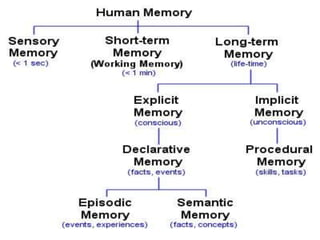
- Long-term memory is often divided into two further
main types: explicit (or declarative) memory and
implicit (or procedural) memory.
1. Declarative memory (“knowing what”)
>(“knowing what”) is memory of facts and events,
and refers to those memories that can be
consciously recalled.
>It is sometimes called explicit memory, since it
consists of information that is explicitly stored and
retrieved, although it is more properly a subset of
explicit memory.
>Declarative memory can be further sub-divided
into episodic memory and semantic memory.
1.1 Episodic Memory
> represents our memory of experiences and
specific events in time in a serial form, from which
we can reconstruct the actual events that took
place at any given point in our lives. It is the
memory of autobiographical events (times, places,
associated emotions and other contextual
knowledge) that can be explicitly stated. Individuals
tend to see themselves as actors in these events,
and the emotional charge and the entire context
surrounding an event is usually part of the
memory, not just the bare facts of the event itself.
1.2 Semantic Memory
>on the other hand, is a more structured record
of facts, meanings, concepts and knowledge about
the external world that we have acquired. It refers
to general factual knowledge, shared with others
and independent of personal experience and of the
spatial/temporal context in which it was acquired.
Semantic memories may once have had a personal
context, but now stand alone as simple knowledge.
It therefore includes such things as types of food,
capital cities, social customs, functions of objects,
vocabulary, understanding of mathematics, etc.
Much of semantic memory is abstract and relational
and is associated with the meaning of verbal
symbols.
2. Procedural memory (“knowing how”)
>is the unconscious memory of skills and how to do
things, particularly the use of objects or movements
of the body, such as playing a guitar or riding a bike.
It is composed of automatic sensory motor behaviors
that are so deeply embedded that we are no longer
aware of them, and, once learned, these "body
memories" allow us to carry out ordinary motor
actions automatically. Procedural memory is
sometimes referred to as implicit memory, because
previous experiences aid in the performance of a
task without explicit and conscious awareness of
these previous experiences, although it is more
properly a subset of implicit memory
Memory Processes
o Memory Encoding
*is the crucial first step to creating a new
memory. It allows the perceived item of interest
to be converted into a construct that can be
stored within the brain, and then recalled later
from short-term or long-term memory.
*is a biological event beginning with perception
through the senses
*Encoding or registration (receiving,
processing and combining of received
information)
Memory Storage
*is the more or less passive process of retaining
information in the brain, whether in the sensory
memory, the short-term memory or the more
permanent long-term memory.
*Each of these different stages of human
memory function as a sort of filter that helps to
protect us from the flood of information that
confront us on a daily basis, avoiding an
overload of information and helping to keep us
sane.
*The more the information is repeated or used, the
more likely it is to be retained in long-term memory
(which is why, for example, studying helps people
to perform better on tests).
*This process of consolidation, the stabilizing of a
memory trace after its initial acquisition, is treated
in more detail in a separate section.
Memory Recall/Retrieval
*Retrieval, recall or recollection (calling back the
stored information in response to some cue for use
in a process or activity)
*refers to the subsequent re-accessing of events or
information from the past, which have been
previously encoded and stored in the brain.
*During recall, the brain "replays" a pattern of
neural activity that was originally generated in
response to a particular event, echoing the brain's
perception of the real event.
*it is known as Remembering.
*Because of the way memories are encoded and
stored, memory recall is effectively an on-the-fly
reconstruction of elements scattered throughout
various areas of our brains.
*Memories are not stored in our brains like books
on library shelves, or even as a collection of self-
contained recordings or pictures or video clips, but
may be better thought of as a kind of collage or a
jigsaw puzzle, involving different elements stored
in disparate parts of the brain linked together by
associations and neural networks.
THE END 

Human Memory (Psychology)

  • 1.
  • 2.
    Let’s define memory… •isan organism's ability to store, retain, and recall information and experiences. •is our ability to encode, store, retain and subsequently recall information and past experiences in the human brain.
  • 4.
    *Sensory Memory -is theshortest-term element of memory. -The ability to look at an item for a second and then remember what it looked like. -It is processed approximately 200-500 milliseconds after an item is perceived.
  • 5.
    *Short-term Memory (WorkingMemory) -Is where memory is recalled without practicing, something that happened recently. -Short-Term Memory is dependent on the regions of the Frontal & Parietal Lobes -acts as a kind of “scratch-pad” for temporary recall of the information which is being processed at any point in time, and has been referred to as "the brain's Post-it note".
  • 6.
    *Long-Term Memory -Is theability to store more information for long periods of time (life times) like phone numbers, names and address’ from when we were kids. -long-term memory can store much larger quantities of information for potentially unlimited duration (sometimes a whole life span). Its capacity is immeasurably large. - Long-term memory is often divided into two further main types: explicit (or declarative) memory and implicit (or procedural) memory.
  • 7.
    1. Declarative memory(“knowing what”) >(“knowing what”) is memory of facts and events, and refers to those memories that can be consciously recalled. >It is sometimes called explicit memory, since it consists of information that is explicitly stored and retrieved, although it is more properly a subset of explicit memory. >Declarative memory can be further sub-divided into episodic memory and semantic memory.
  • 8.
    1.1 Episodic Memory >represents our memory of experiences and specific events in time in a serial form, from which we can reconstruct the actual events that took place at any given point in our lives. It is the memory of autobiographical events (times, places, associated emotions and other contextual knowledge) that can be explicitly stated. Individuals tend to see themselves as actors in these events, and the emotional charge and the entire context surrounding an event is usually part of the memory, not just the bare facts of the event itself.
  • 9.
    1.2 Semantic Memory >onthe other hand, is a more structured record of facts, meanings, concepts and knowledge about the external world that we have acquired. It refers to general factual knowledge, shared with others and independent of personal experience and of the spatial/temporal context in which it was acquired. Semantic memories may once have had a personal context, but now stand alone as simple knowledge. It therefore includes such things as types of food, capital cities, social customs, functions of objects, vocabulary, understanding of mathematics, etc. Much of semantic memory is abstract and relational and is associated with the meaning of verbal symbols.
  • 10.
    2. Procedural memory(“knowing how”) >is the unconscious memory of skills and how to do things, particularly the use of objects or movements of the body, such as playing a guitar or riding a bike. It is composed of automatic sensory motor behaviors that are so deeply embedded that we are no longer aware of them, and, once learned, these "body memories" allow us to carry out ordinary motor actions automatically. Procedural memory is sometimes referred to as implicit memory, because previous experiences aid in the performance of a task without explicit and conscious awareness of these previous experiences, although it is more properly a subset of implicit memory
  • 11.
    Memory Processes o MemoryEncoding *is the crucial first step to creating a new memory. It allows the perceived item of interest to be converted into a construct that can be stored within the brain, and then recalled later from short-term or long-term memory. *is a biological event beginning with perception through the senses *Encoding or registration (receiving, processing and combining of received information)
  • 12.
    Memory Storage *is themore or less passive process of retaining information in the brain, whether in the sensory memory, the short-term memory or the more permanent long-term memory. *Each of these different stages of human memory function as a sort of filter that helps to protect us from the flood of information that confront us on a daily basis, avoiding an overload of information and helping to keep us sane.
  • 13.
    *The more theinformation is repeated or used, the more likely it is to be retained in long-term memory (which is why, for example, studying helps people to perform better on tests). *This process of consolidation, the stabilizing of a memory trace after its initial acquisition, is treated in more detail in a separate section.
  • 14.
    Memory Recall/Retrieval *Retrieval, recallor recollection (calling back the stored information in response to some cue for use in a process or activity) *refers to the subsequent re-accessing of events or information from the past, which have been previously encoded and stored in the brain. *During recall, the brain "replays" a pattern of neural activity that was originally generated in response to a particular event, echoing the brain's perception of the real event.
  • 15.
    *it is knownas Remembering. *Because of the way memories are encoded and stored, memory recall is effectively an on-the-fly reconstruction of elements scattered throughout various areas of our brains. *Memories are not stored in our brains like books on library shelves, or even as a collection of self- contained recordings or pictures or video clips, but may be better thought of as a kind of collage or a jigsaw puzzle, involving different elements stored in disparate parts of the brain linked together by associations and neural networks.
  • 16.