Social cognition: Perceiving self
and others

Ari Sudan
Tiwari, Ph. D.
Social cognition: Perceiving the social world

The manner in which we
receive, interpret, analyze, remember and use
information about the social world.
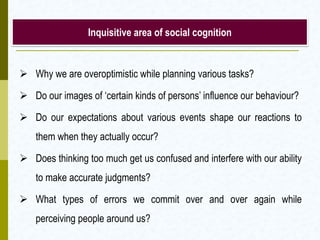
Inquisitive area of social cognition

 Why we are overoptimistic while planning various tasks?
 Do our images of ‘certain kinds of persons’ influence our behaviour?
 Do our expectations about various events shape our reactions to

them when they actually occur?
 Does thinking too much get us confused and interfere with our ability
to make accurate judgments?

 What types of errors we commit over and over again while
perceiving people around us?
Schemas

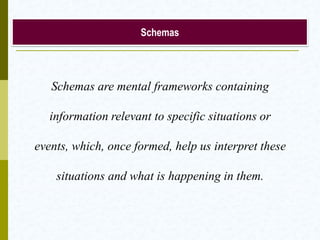
Schemas are mental frameworks containing
information relevant to specific situations or
events, which, once formed, help us interpret these
situations and what is happening in them.
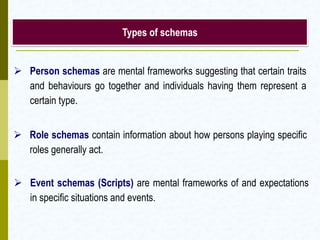
Types of schemas

 Person schemas are mental frameworks suggesting that certain traits
and behaviours go together and individuals having them represent a
certain type.
 Role schemas contain information about how persons playing specific
roles generally act.
 Event schemas (Scripts) are mental frameworks of and expectations
in specific situations and events.
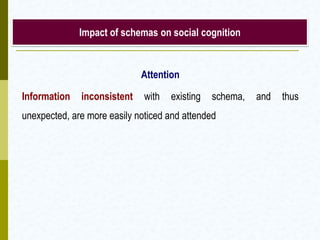
Impact of schemas on social cognition

Attention
Information

inconsistent

with

existing

schema,

unexpected, are more easily noticed and attended

and

thus
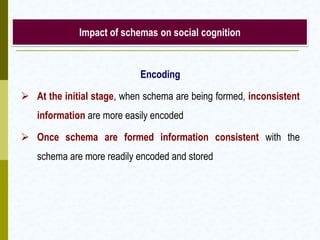
Impact of schemas on social cognition

Encoding
 At the initial stage, when schema are being formed, inconsistent
information are more easily encoded
 Once schema are formed information consistent with the
schema are more readily encoded and stored
Impact of schemas on social cognition

Recovery and Retrieval
Information consistent with existing schema or part of them, are more
often retrieved, recovered and used in our thought, decisions and
behaviours
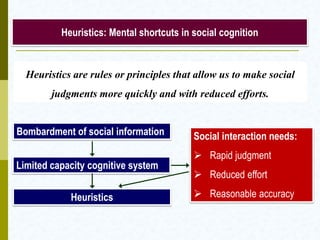
Heuristics: Mental shortcuts in social cognition

Heuristics are rules or principles that allow us to make social
judgments more quickly and with reduced efforts.
Bombardment of social information
Limited capacity cognitive system
Heuristics

Social interaction needs:
 Rapid judgment

 Reduced effort
 Reasonable accuracy
Types of heuristics

Representativeness: Judging by resemblance

Strategy to make social judgments based on the extent to which current
person’s or event’s characteristics resemble with the characteristics of
stored schema of similar event or person
Availability: What comes to mind first
Strategy to make social judgments based on specific kinds of information
that can easily be brought into mind
Types of heuristics

False consensus effect
Tendency to assume that others behave or think as we do to a greater
extent than is actually true
Priming: Medical student syndrome

Some events or stimuli increase the availability of specific types of
information in memory or consciousness
Errors in social cognition
Rational vs. intuitive processing
Red and White Jelly Beans Experiment
 Rational Thinking in situations involving analytical thought
(Solving mathematical problems)
 Intuitive Thinking in situation involving social judgments
Dealing with inconsistent information
Tendency to pay greater attention to information that is unexpected
or somehow inconsistent with our expectations
Errors in social cognition

Optimistic bias for task completion: Planning Fallacy
Tendency to make optimistic prediction concerning how long a task will
take
Automatic vigilance: Noticing the negative
We never notice a person’s twenty smiles but readily notice once
he frowns.
Strong tendency to pay attention to undesirable or negative information
Errors in social cognition

Counterfactual thinking: Experience of regret
Tendency to evaluate events by thinking about alternatives to them“what might have been or should have been”
Errors in social cognition

Magical thinking
Belief that things that resemble one another share fundamental
properties; Assumptions that does not hold up to rational inquiry
 Law of Contagion: When two objects touch, they pass properties
to one another,
 Law of Similarity: Things that resemble one another share
fundamental properties
Person perception: Attribution

Attribution is the process of identifying the causes of others’
behaviour and their stable traits and dispositions
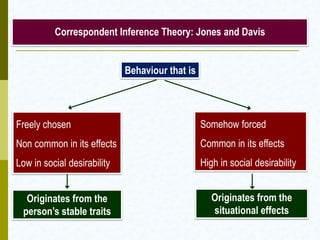
Correspondent Inference Theory: Jones and Davis

Behaviour that is

Freely chosen

Somehow forced

Non common in its effects

Common in its effects

Low in social desirability

High in social desirability

Originates from the
person’s stable traits

Originates from the
situational effects
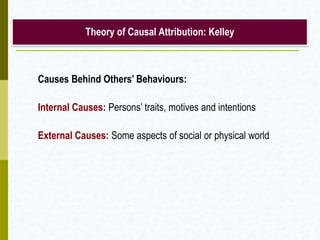
Theory of Causal Attribution: Kelley

Causes Behind Others’ Behaviours:

Internal Causes: Persons’ traits, motives and intentions
External Causes: Some aspects of social or physical world
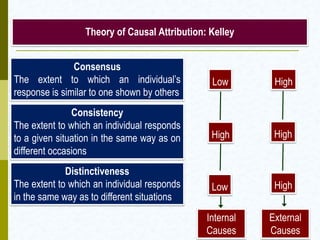
Theory of Causal Attribution: Kelley
Consensus
The extent to which an individual’s
response is similar to one shown by others

Low

High

Consistency
The extent to which an individual responds
to a given situation in the same way as on
different occasions

High

High

Distinctiveness
The extent to which an individual responds
in the same way as to different situations

Low

High

Internal
Causes

External
Causes
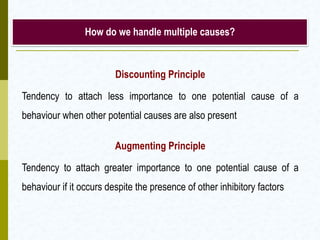
How do we handle multiple causes?

Discounting Principle
Tendency to attach less importance to one potential cause of a
behaviour when other potential causes are also present
Augmenting Principle
Tendency to attach greater importance to one potential cause of a
behaviour if it occurs despite the presence of other inhibitory factors
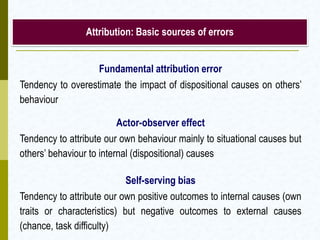
Attribution: Basic sources of errors
Fundamental attribution error
Tendency to overestimate the impact of dispositional causes on others’
behaviour
Actor-observer effect
Tendency to attribute our own behaviour mainly to situational causes but
others’ behaviour to internal (dispositional) causes
Self-serving bias
Tendency to attribute our own positive outcomes to internal causes (own
traits or characteristics) but negative outcomes to external causes
(chance, task difficulty)
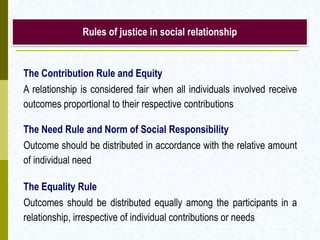
Rules of justice in social relationship

The Contribution Rule and Equity
A relationship is considered fair when all individuals involved receive
outcomes proportional to their respective contributions
The Need Rule and Norm of Social Responsibility
Outcome should be distributed in accordance with the relative amount
of individual need
The Equality Rule
Outcomes should be distributed equally among the participants in a
relationship, irrespective of individual contributions or needs
Thank You

Social cognition: Perceiving self and others

  • 1.
    Social cognition: Perceivingself and others Ari Sudan Tiwari, Ph. D.
  • 2.
    Social cognition: Perceivingthe social world The manner in which we receive, interpret, analyze, remember and use information about the social world.
  • 3.
    Inquisitive area ofsocial cognition  Why we are overoptimistic while planning various tasks?  Do our images of ‘certain kinds of persons’ influence our behaviour?  Do our expectations about various events shape our reactions to them when they actually occur?  Does thinking too much get us confused and interfere with our ability to make accurate judgments?  What types of errors we commit over and over again while perceiving people around us?
  • 4.
    Schemas Schemas are mentalframeworks containing information relevant to specific situations or events, which, once formed, help us interpret these situations and what is happening in them.
  • 5.
    Types of schemas Person schemas are mental frameworks suggesting that certain traits and behaviours go together and individuals having them represent a certain type.  Role schemas contain information about how persons playing specific roles generally act.  Event schemas (Scripts) are mental frameworks of and expectations in specific situations and events.
  • 6.
    Impact of schemason social cognition Attention Information inconsistent with existing schema, unexpected, are more easily noticed and attended and thus
  • 7.
    Impact of schemason social cognition Encoding  At the initial stage, when schema are being formed, inconsistent information are more easily encoded  Once schema are formed information consistent with the schema are more readily encoded and stored
  • 8.
    Impact of schemason social cognition Recovery and Retrieval Information consistent with existing schema or part of them, are more often retrieved, recovered and used in our thought, decisions and behaviours
  • 9.
    Heuristics: Mental shortcutsin social cognition Heuristics are rules or principles that allow us to make social judgments more quickly and with reduced efforts. Bombardment of social information Limited capacity cognitive system Heuristics Social interaction needs:  Rapid judgment  Reduced effort  Reasonable accuracy
  • 10.
    Types of heuristics Representativeness:Judging by resemblance Strategy to make social judgments based on the extent to which current person’s or event’s characteristics resemble with the characteristics of stored schema of similar event or person Availability: What comes to mind first Strategy to make social judgments based on specific kinds of information that can easily be brought into mind
  • 11.
    Types of heuristics Falseconsensus effect Tendency to assume that others behave or think as we do to a greater extent than is actually true Priming: Medical student syndrome Some events or stimuli increase the availability of specific types of information in memory or consciousness
  • 12.
    Errors in socialcognition Rational vs. intuitive processing Red and White Jelly Beans Experiment  Rational Thinking in situations involving analytical thought (Solving mathematical problems)  Intuitive Thinking in situation involving social judgments Dealing with inconsistent information Tendency to pay greater attention to information that is unexpected or somehow inconsistent with our expectations
  • 13.
    Errors in socialcognition Optimistic bias for task completion: Planning Fallacy Tendency to make optimistic prediction concerning how long a task will take Automatic vigilance: Noticing the negative We never notice a person’s twenty smiles but readily notice once he frowns. Strong tendency to pay attention to undesirable or negative information
  • 14.
    Errors in socialcognition Counterfactual thinking: Experience of regret Tendency to evaluate events by thinking about alternatives to them“what might have been or should have been”
  • 15.
    Errors in socialcognition Magical thinking Belief that things that resemble one another share fundamental properties; Assumptions that does not hold up to rational inquiry  Law of Contagion: When two objects touch, they pass properties to one another,  Law of Similarity: Things that resemble one another share fundamental properties
  • 16.
    Person perception: Attribution Attributionis the process of identifying the causes of others’ behaviour and their stable traits and dispositions
  • 17.
    Correspondent Inference Theory:Jones and Davis Behaviour that is Freely chosen Somehow forced Non common in its effects Common in its effects Low in social desirability High in social desirability Originates from the person’s stable traits Originates from the situational effects
  • 18.
    Theory of CausalAttribution: Kelley Causes Behind Others’ Behaviours: Internal Causes: Persons’ traits, motives and intentions External Causes: Some aspects of social or physical world
  • 19.
    Theory of CausalAttribution: Kelley Consensus The extent to which an individual’s response is similar to one shown by others Low High Consistency The extent to which an individual responds to a given situation in the same way as on different occasions High High Distinctiveness The extent to which an individual responds in the same way as to different situations Low High Internal Causes External Causes
  • 20.
    How do wehandle multiple causes? Discounting Principle Tendency to attach less importance to one potential cause of a behaviour when other potential causes are also present Augmenting Principle Tendency to attach greater importance to one potential cause of a behaviour if it occurs despite the presence of other inhibitory factors
  • 21.
    Attribution: Basic sourcesof errors Fundamental attribution error Tendency to overestimate the impact of dispositional causes on others’ behaviour Actor-observer effect Tendency to attribute our own behaviour mainly to situational causes but others’ behaviour to internal (dispositional) causes Self-serving bias Tendency to attribute our own positive outcomes to internal causes (own traits or characteristics) but negative outcomes to external causes (chance, task difficulty)
  • 22.
    Rules of justicein social relationship The Contribution Rule and Equity A relationship is considered fair when all individuals involved receive outcomes proportional to their respective contributions The Need Rule and Norm of Social Responsibility Outcome should be distributed in accordance with the relative amount of individual need The Equality Rule Outcomes should be distributed equally among the participants in a relationship, irrespective of individual contributions or needs
  • 23.