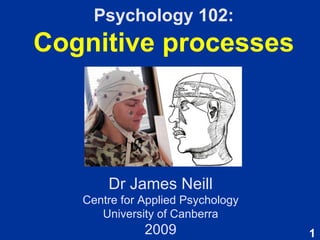
Psychology 102: Cognitive processes Dr James Neill Centre for Applied Psychology University of Canberra 2009
Reading Gerrig et al.  (Chapter 8): Cognitive processes
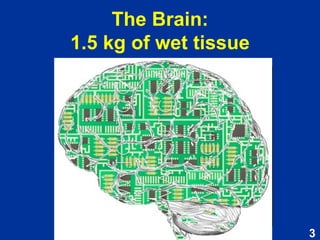
The Brain:  1.5 kg of wet tissue
Cognitive Scenarios:  A mysterious note At midnight, there's a knock on your door. When you answer, there is no one there, but you see an envelope on the floor. Inside the envelope is a handwritten message: “The cat is on the mat.” What do you make of this? Gerrig et al. (2008), p. 248
Cognitive Scenarios:  Attention, Problem Solving, Memory... Kris is sitting at a desk reading some interesting papers to help with an assignment. Without removing her eyes from the paper she is reading, she reaches for a bag of sweets, unties a wrapper and pops a sweet into her mouth. Suddenly she stops and wonders: “What is happening here?” Gerrig et al. (2008), p. 248
Studying cognition
Language use
Concepts & their organisation
Problem solving & reasoning Overview
Studying cognition Cognitive science
Cognitive psychology
Cognition
Processes of attention
Framing decisions
Consequences of decision making Decision aversion Decision making
Cognitive Science
Cognitive Psychology
Processes of  knowing Attending,
Remembering
Reasoning Content of the processes e.g., Concepts
Memories Cognition
Thinking
Knowing
Remembering
Communicating Cognition
Discovering the process of mind F.C. Donders: Reaction time The amount of time it takes experimental participants to perform particular tasks Studying cognition
Serial processes Carried out in order, one after the other Parallel processes Carried out simultaneously Mental processes & resources
Attentional processes Distribute the limited processing resources over different tasks Controlled processes Require attention Automatic processes Do not require attention Mental processes & resources
Language use Language production
Audience design
Speech execution & errors
Language understanding
Language & evolution
Linguistic relativity
Visual representations
What people say, sign, and write and the processes they go through to produce the message  Speakers versus listeners Language production
Shaping a message depending on the audience H. Paul Grice
Cooperative principle Speakers should produce utterances appropriate to the setting and meaning of the ongoing conversation Audience design
Herbert Clark Common Ground Community membership
Linguistic co presence
Physical co presence Audience design
Spoonerism “You have tasted the whole worm!”
“Tips of the slung” Processes
Representations Speech execution  & speech errors
Resolving ambiguity Lexical ambiguity
Structural ambiguity Products of understanding Representations
Propositions Language understanding
Fully human speech anatomy first appears in the fossil record ~50,000 years ago. Language & evolution May have evolved with walking, running, tool making, & complex group organisation.
Language structure Washoe & ASL
Sue Savage-Rumbaugh  Bonobos Audience design Dorothy Cheny  & Robert Seyfarth Veret monkeys Cross-species comparisons Language structure Washoe & ASL
Sue Savage-Rumbaugh  Bonobos Audience design Dorothy Cheny  & Robert Seyfarth Veret monkeys Language structure Washoe & ASL
Sue Savage-Rumbaugh  Bonobos Audience design Dorothy Cheny  & Robert Seyfarth Veret monkeys
Language development Babbling stage : 4 months, sounds like “ah-goo”
One-word stage : ~1 year old.
Telegraphic speech : Before 2nd birthday, “want juice”
Complete sentences : 2+ years
Language development We learn language before learning numbers
Between 1 and 18, we learn on ~10 words/day or 3,500 per year.
Vocab of ~60,000 by end of high school Time Life Pictures/ Getty Images
Language development Operant Learning (Skinner)  -  language development can be explained on the basis of learning principles such as association, imitation, and reinforcement.
Inborn Universal Grammar (Chomsky)  -  the rate of language acquisition is so fast that it cannot be explained through learning principles, so most of it is inborn.
Phonemes The smallest, distinctive sound unit
bat, has three phonemes b · a · t
chat, has three phonemes ch · a · t
Morpheme Smallest unit of language that conveys meaning Bat
Pre
Un
Undesirables –  4 morphemes Un-desir-able-s
Grammar - the rules Semantics  – how we get meaning from the sentence, e.g., add “ed” and it happened in the past Syntax  – rules for making a grammatically correct sentence http://en.wikipedia.org/wiki/Mr._Ed
Semantics & syntax They are hunting dogs.
They are  hunting  dogs.
They are hunting  dogs .

Psychology 102: Cognitive processes

Editor's Notes

  • #2 Image source; Remix of http://en.wikiversity.org/wiki/File:Brain,_G_Reisch.png (public domain) and http://commons.wikimedia.org/wiki/File:EEG_mit_32_Electroden.jpg (GFDL by http://commons.wikimedia.org/w/index.php?title=User:Aschoek ) by James Neill Acknowledgements: This lecture is based on 2008 lecture notes by Dr, Thea Vanags and the instructor slides and material provided by Pearson Education for Chapter 15 from Gerrig et al. (2008) Psychology and life (Australian edition).
  • #3 Image source: Cover of Gerrig et al. (2008)
  • #4 Image source: http://commons.wikimedia.org/wiki/File:CabbageBG.JPG License: Public domain
  • #5 Image source: http://commons.wikimedia.org/wiki/File:CabbageBG.JPG License: Public domain
  • #6 Image source: http://commons.wikimedia.org/wiki/File:CabbageBG.JPG License: Public domain
  • #7 Image source: http://commons.wikimedia.org/wiki/File:Information_icon4.svg License: Public domain Image source: http://commons.wikimedia.org/wiki/File:Autoroute_icone.svg License: CC-BY-A 2.5 Author: http://commons.wikimedia.org/wiki/User:Doodledoo
  • #8 Image source: http://commons.wikimedia.org/wiki/File:Information_icon4.svg License: Public domain
  • #13 Image source: Unkown
  • #14 Image source: Gerrig et al. (2008)
  • #17 Image source: http://commons.wikimedia.org/wiki/File:Information_icon4.svg License: Public domain
  • #20 Image source: http://commons.wikimedia.org/wiki/File:Jeffinhotattow.JPG License: Public domain
  • #22 Image source: Gerrig et al. (2008)
  • #23 Fully human speech anatomy first appears in the fossil record in the Upper Paleolithic (about 50,000 years ago) and is absent in both Neanderthals and earlier humans (Lieberman, 2007). Image description: Woman in museum, USA License: Unknown
  • #24 Image source: Gerrig et al. (2008)
  • #25 Image source: Unknown (Vanags, 2008) Unfamiliar language – all the syllables run together Infants can detect word breaks at 8 months old
  • #26 Image source: Unknown (Vanags, 2008)
  • #28 Image source: Unknown (Vanags, 2008)
  • #30 Image source: Unknown (Vanags, 2008)
  • #31 Image source: Unknown (Vanags, 2008)
  • #33 Image source: Gerrig et al. (2008)
  • #34 Image source: Unknown (Vanags, 2008)
  • #35 Image source: Unknown (Vanags, 2008)
  • #36 Image source: http://commons.wikimedia.org/wiki/File:Information_icon4.svg License: Public domain
  • #37 Image source: Unknown (Vanags, 2008)
  • #38 Image source: Unknown (Vanags, 2008)
  • #39 Image source: Unknown (Vanags, 2008)
  • #40 Iimage source (left): Public domain Image source (right): Unknown (Vanags, 2008)
  • #42 Image source: http://commons.wikimedia.org/wiki/File:Information_icon4.svg License: Public domain
  • #44 Image source: http://www.mazes.com/NineDotsFourLines.html License: Unknown
  • #46 Image source: Unknown (Vanags, 2008)
  • #47 Image source: Unknown (Vanags, 2008)
  • #48 Image source: http://commons.wikimedia.org/wiki/File:Alnatura_Muesli_Kundin.jpg License: CC-by-A 2.0 Germany Author: "Alnatura" Availability heuristic: A person begins with a first approximation (anchor) and then makes adjustments to that number based on additional information. The availability heuristic is a phenomenon (which can result in a cognitive bias) in which people predict the frequency of an event, or a proportion within a population, based on how easily an example can be brought to mind.
  • #50 Image source: Unknown (Vanags, 2008)
  • #57 Image source: Unknown (Vanags, 2008)
  • #61 Image source: Unknown (Vanags, 2008)
  • #62 Image source: Unknown (Vanags, 2008)
  • #63 Image source: Unknown (Vanags, 2008)
  • #65 Image source: http://commons.wikimedia.org/wiki/File:Information_icon4.svg Image source: Unknown (Vanags, 2008)