Chromosome structure
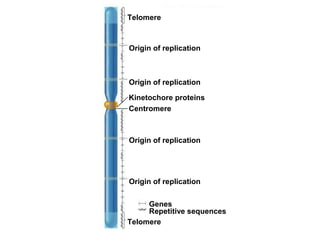
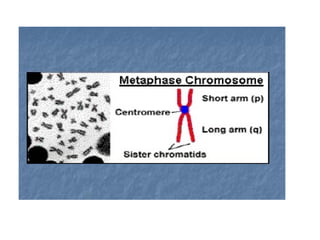
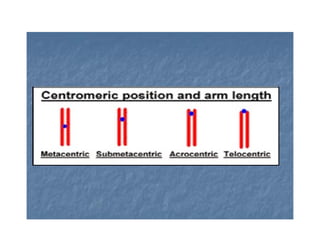
Centromere
Kinetochore proteins
Origin of replication
Telomere
Telomere
Genes
Repetitive sequences
Chromosome Organization
• Genes located between centromere & telomeres
– hundreds to thousands of genes
– lower eukaryotes (i.e. yeast)
• Genes are relatively small
• Very few introns
– higher eukaryotes (i.e. mammals)
• Genes are long
• Have many introns
• Non-gene sequences
– Repetitive DNA
• Telomere
• Centromere
• Satellite
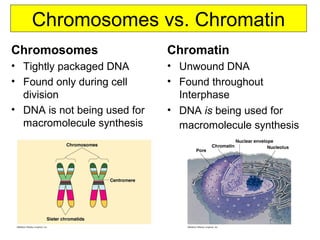
Chromosomes vs. Chromatin
Chromosomes
• Tightly packaged DNA
• Found only during cell
division
• DNA is not being used for
macromolecule synthesis
Chromatin
• Unwound DNA
• Found throughout
Interphase
• DNA is being used for
macromolecule synthesis
Homologous Chromosome Pairs
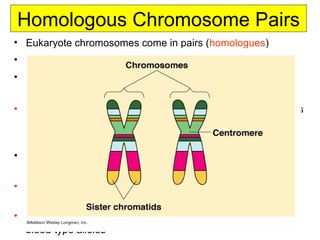
• Eukaryote chromosomes come in pairs (homologues)
• Normal humans have 46 chromosomes in 23 pairs
• One chromosome of each pair comes from an individual’s
mother, the other comes from their father
• Homologous Chromosomes (chromosome pairs) carry genes
that control the same Characters, e.g., eye color, blood type,
flower color, height, etc.
• Homologous chromosomes have nearly identical structure,
banding patterns, and nucleotide sequences
• Locus: Physical site on chromosomes where given gene is
located
• Allele: Different forms of the same gene, e.g., A, B, or O
blood-type alleles
Autosomes & Sex Chromosomes
Autosomes: Found in both males and females
• In humans there are 22 pairs of autosomes
• Autosomes that are the same size (& structure) are called
homologues
Sex Chromosomes: Determine an individual’s gender
• One pair of chromosomes (X and Y)
• The X and Y chromosomes are not homologous
• The X chromosome is much larger than the Y chromosome
and contains many genes
• The Y chromosome has only a small number of genes
• In humans and other mammals females are XX and males
are XY
• Lesson 2 - Chromosome structure
• The DNA compaction problem
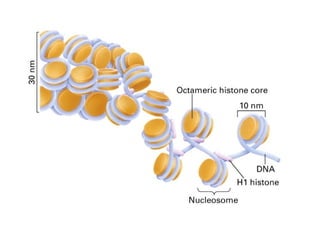
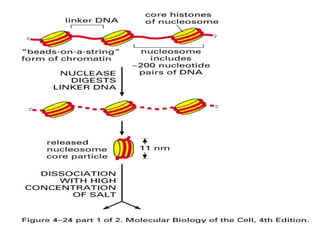
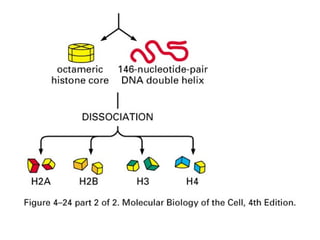
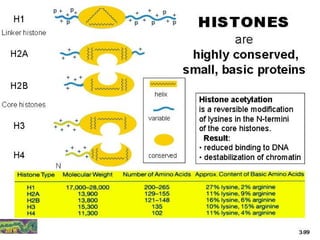
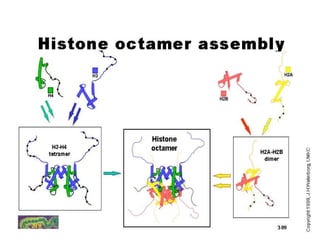
• The nucleosome histones (H2A, H2B, H3, H4)
• The histone octamere
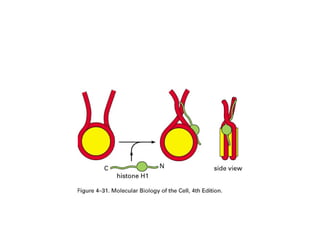
• Histone H1 the linker histone
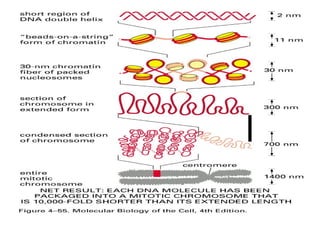
• Higher order compactions
• Chromatin loops and scaffolds (SAR)
• Non histone chromatin proteins
• Heterochromatin and euchromatin
• Chromosome G and R bands
• Centromere
• Take 4 meters of DNA (string) and compact them
into a ball of 10µM. Now 10µM are 1/100 of a
mm and a bit small to imagine – so now walk from
here to the main entrance let say 400 meters and
try to compact it all into 1 mm.
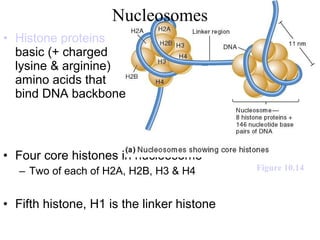
• Histone proteins
basic (+ charged
lysine & arginine)
amino acids that
bind DNA backbone
• Four core histones in nucleosome
– Two of each of H2A, H2B, H3 & H4
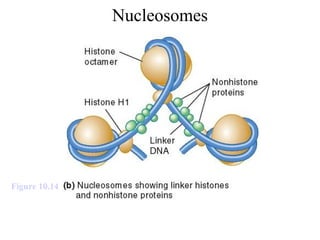
• Fifth histone, H1 is the linker histone
Figure 10.14
Nucleosomes
Figure 10.14
Nucleosomes
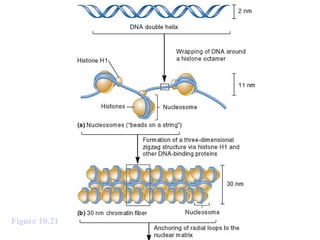
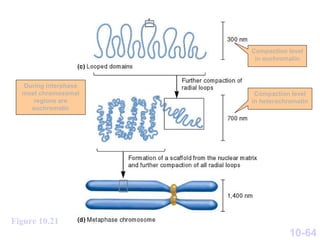
Figure 10.21
10-64
Figure 10.21
Compaction level
in euchromatin
Compaction level
in heterochromatin
During interphase
most chromosomal
regions are
euchromatic
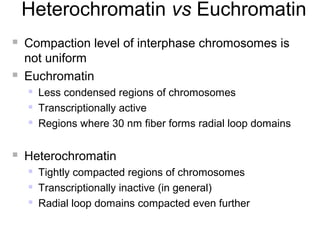
 Compaction level of interphase chromosomes is
not uniform
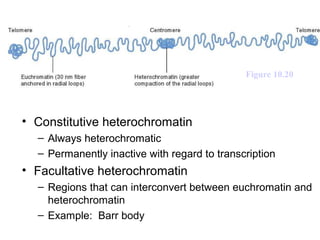
 Euchromatin
 Less condensed regions of chromosomes
 Transcriptionally active
 Regions where 30 nm fiber forms radial loop domains
 Heterochromatin
 Tightly compacted regions of chromosomes
 Transcriptionally inactive (in general)
 Radial loop domains compacted even further
Heterochromatin vs Euchromatin
Types of Heterochromatin
Figure 10.20
• Constitutive heterochromatin
– Always heterochromatic
– Permanently inactive with regard to transcription
• Facultative heterochromatin
– Regions that can interconvert between euchromatin and
heterochromatin
– Example: Barr body

Chromosome structure

  • 1.
  • 2.
    Centromere Kinetochore proteins Origin ofreplication Origin of replication Origin of replication Origin of replication Telomere Telomere Genes Repetitive sequences
  • 3.
    Chromosome Organization • Geneslocated between centromere & telomeres – hundreds to thousands of genes – lower eukaryotes (i.e. yeast) • Genes are relatively small • Very few introns – higher eukaryotes (i.e. mammals) • Genes are long • Have many introns • Non-gene sequences – Repetitive DNA • Telomere • Centromere • Satellite
  • 4.
    Chromosomes vs. Chromatin Chromosomes •Tightly packaged DNA • Found only during cell division • DNA is not being used for macromolecule synthesis Chromatin • Unwound DNA • Found throughout Interphase • DNA is being used for macromolecule synthesis
  • 5.
    Homologous Chromosome Pairs •Eukaryote chromosomes come in pairs (homologues) • Normal humans have 46 chromosomes in 23 pairs • One chromosome of each pair comes from an individual’s mother, the other comes from their father • Homologous Chromosomes (chromosome pairs) carry genes that control the same Characters, e.g., eye color, blood type, flower color, height, etc. • Homologous chromosomes have nearly identical structure, banding patterns, and nucleotide sequences • Locus: Physical site on chromosomes where given gene is located • Allele: Different forms of the same gene, e.g., A, B, or O blood-type alleles
  • 6.
    Autosomes & SexChromosomes Autosomes: Found in both males and females • In humans there are 22 pairs of autosomes • Autosomes that are the same size (& structure) are called homologues Sex Chromosomes: Determine an individual’s gender • One pair of chromosomes (X and Y) • The X and Y chromosomes are not homologous • The X chromosome is much larger than the Y chromosome and contains many genes • The Y chromosome has only a small number of genes • In humans and other mammals females are XX and males are XY
  • 11.
    • Lesson 2- Chromosome structure • The DNA compaction problem • The nucleosome histones (H2A, H2B, H3, H4) • The histone octamere • Histone H1 the linker histone • Higher order compactions • Chromatin loops and scaffolds (SAR) • Non histone chromatin proteins • Heterochromatin and euchromatin • Chromosome G and R bands • Centromere
  • 12.
    • Take 4meters of DNA (string) and compact them into a ball of 10µM. Now 10µM are 1/100 of a mm and a bit small to imagine – so now walk from here to the main entrance let say 400 meters and try to compact it all into 1 mm.
  • 18.
    • Histone proteins basic(+ charged lysine & arginine) amino acids that bind DNA backbone • Four core histones in nucleosome – Two of each of H2A, H2B, H3 & H4 • Fifth histone, H1 is the linker histone Figure 10.14 Nucleosomes
  • 19.
  • 20.
  • 21.
    10-64 Figure 10.21 Compaction level ineuchromatin Compaction level in heterochromatin During interphase most chromosomal regions are euchromatic
  • 24.
     Compaction levelof interphase chromosomes is not uniform  Euchromatin  Less condensed regions of chromosomes  Transcriptionally active  Regions where 30 nm fiber forms radial loop domains  Heterochromatin  Tightly compacted regions of chromosomes  Transcriptionally inactive (in general)  Radial loop domains compacted even further Heterochromatin vs Euchromatin
  • 25.
    Types of Heterochromatin Figure10.20 • Constitutive heterochromatin – Always heterochromatic – Permanently inactive with regard to transcription • Facultative heterochromatin – Regions that can interconvert between euchromatin and heterochromatin – Example: Barr body