DR. ASHISH PATEL
Assistant professor
Dept. AGB, Veterinary College, AAU,
Anand
 In somatic cell of diploid organism two copies of same
genome are present (2n), while their gametes contain a
single genome (n).
 The deviation from the diploid state of chromosome and
structure of chromosome is known as chromosomal
aberration.
 The deviations from the standard chromosomal numbers
and morphology (structure) of any species can be
detected by Karyotyping (chromosomal Banding).
 Broadly the chromosomal abnormalities categorized in to
two types:
 Numerical abnormality: Change in number of
chromosome
 Structural abnormality: Change in structure of
chromosome
 The numerical chromosomal aberration is also known as
heteroploidy and individuals who possess other than
normal chromosome pair are known as heteroploids.
 The heteroploidy is divided in to two categories:
Aneuploidy and Euploidy.
Aneuploidy
 A change in number of only single or few chromosome/s
within a set of chromosomes is known as aneuploidy.
 In aneuploidy, changed not in whole genome.
 Reason for Anueploidy is non disjunction of chromosome
during meiosis.
 The single chromosome is less from the somatic number
of chromosome number (2n - 1) is known as monosomy.
 The deficiency of pair of chromosome (2n - 2) is known
as nullysomy.
 If two missing chromosome are non-homologous (2n-1-1)
then it is known as double monosomy.
 If individual possess one extra chromosome (2n + 1) are
termed as trisomics.
 The individual possess an extra pair of chromosome (2n
+ 2) are referred to as tetrasomics.
 If two additional chromosome are non-homologous (2n
+1 +1), such individual are known as double trisomics.
Term Type of change Symbol
Heteroploidy change from the 2n state
Aneuploidy
Aneuploidy One or few chromosomes
extra or missing from 2n
2n ± one or few
Nullisomy One pair of chromosome
missing
2n – 2
Monosomy One chromosome missing 2n – 1
Double monosomy Two non-homologous
chromosome missing
2n -2
Trisomy one extra chromosome 2n + 1
Double trisomy Two extra non homologous
chromosome
2n + 1 + 1
Tetrasomy two extra chromosome 2n + 2
Term Type of change Symbol
Heteroploidy change from the 2n state
Euploidy
Euploidy Change in the chromosomes of entire set (other than
diploid 2n )
Monoploidy only one genome present n
Haploidy Gametic chromosome
complement
n
Autopolyploidy More than two copies of same
genome present
3n (AAA), 4n
(AAAA), 5n
(AAAAA)…….
Autotriploidy Three copies of same genome 3n (AAA)
Autotetraploidy, Autopentaploidy, Autohexaploidy etc (4n, 5n, 6n ….)
Allopolyploidy Two or more different genome AABB, AABBCC
Allotetraploidy Two different genome present AABB
Trisomy of Autosomes:
 Trisomy at 21st chromosomal pair (means in 21st pair one
extra chomosome): Down syndrome (mongolism idiocy):
(47, 21+)
 Trisomy at 13th chromosomal pair: Patau’s syndrome
(47, 13+)
 Trisomy at 18th chromosomal pair: Edward’s syndrome
(47, 18+) (individual who have such abnormality die within
one year)
Trisomy of sex chromosomes
 Klinefelter’s syndrome (47, XXY)
 Triple X syndrome: (47, XXX)
 Jacob’s syndrome: (47, XYY)
Monosomy of sex chromosome: Turner syndrome (45, X)
Common sex chromosome aneuploids in livestock animals
and their phenotypic effects are
 Monosomy (X0): pig, cat, dog: Ovarian hypoplasia:
Infertlity in female
 Trisomy (XXX): cattle: Ovarian hypoplasia: Infertlity in
female
 Trisomy (XXY): Cattle, Buffalo, Sheep, Goat: Testicular
hypoplasia: Infertlity in male
 Change in entire set of chromosome is called as Euploidy.
 It is also known as heteroploidy. heteroploidy means any
alteration in no. of whole set of chromosome from normal
2n number.
 Euploidy (Heteroploidy) includes: haploidy (n), triploidy
(3n), tetraploidy (4n), pentaploidy (5n) these all are
collectively known as polyploidy.
 An individual having only one set (n) of chromosome is
known as monoploidy or haploidy.
 An individual having three or more than three sets of
chromosomes is called as polyploidy.
 Most commonly triploidy and tetraploidy are observed out
of polyploidy (in plants but rarely in animals).
 Autopolyploidy: More than two copies of same genome
present. chromosome complements of same species/origin
 Allopolyploidy: Two or more different genome present. The
chromosome complements belong to different origin. e.g. cell
hybridization
Reasons for polyploidy
 Fertilization of egg with more than one speramatozoa
(polyspermy)
 Abnormal gamete formation/ meiosis (polar bodies not
removed )
 Two zygotes fused and produced single individual (tetraploidy)
 Any deviation from normal structure of chromosome is
called Structural abnormality or Structural mutation of
chromosome.
 Structural changes usually take place either during
interphase or early prophase.
 Structural changes occur due to breakage and reunion of
the chromosome.
 The chromosomal breaks are of two types -restituted and
non-restituted. Two non-restituted breaks in one
chromosome can lead to deficiency, duplication and
inversion.
 A non-restituted break in each of two non-homologous
chromosomes may lead to reciprocal translocations.
 Structural changes lead to alteration in phenotype,
fertility, viability and karyotype of an individual.
Types of Structural Changes
Two types:
(1) Alteration in gene number in the chromosome- deletion
&duplications
(2) Alteration in the sequence of genes in the chromosome -
translocations and inversions
Deletion
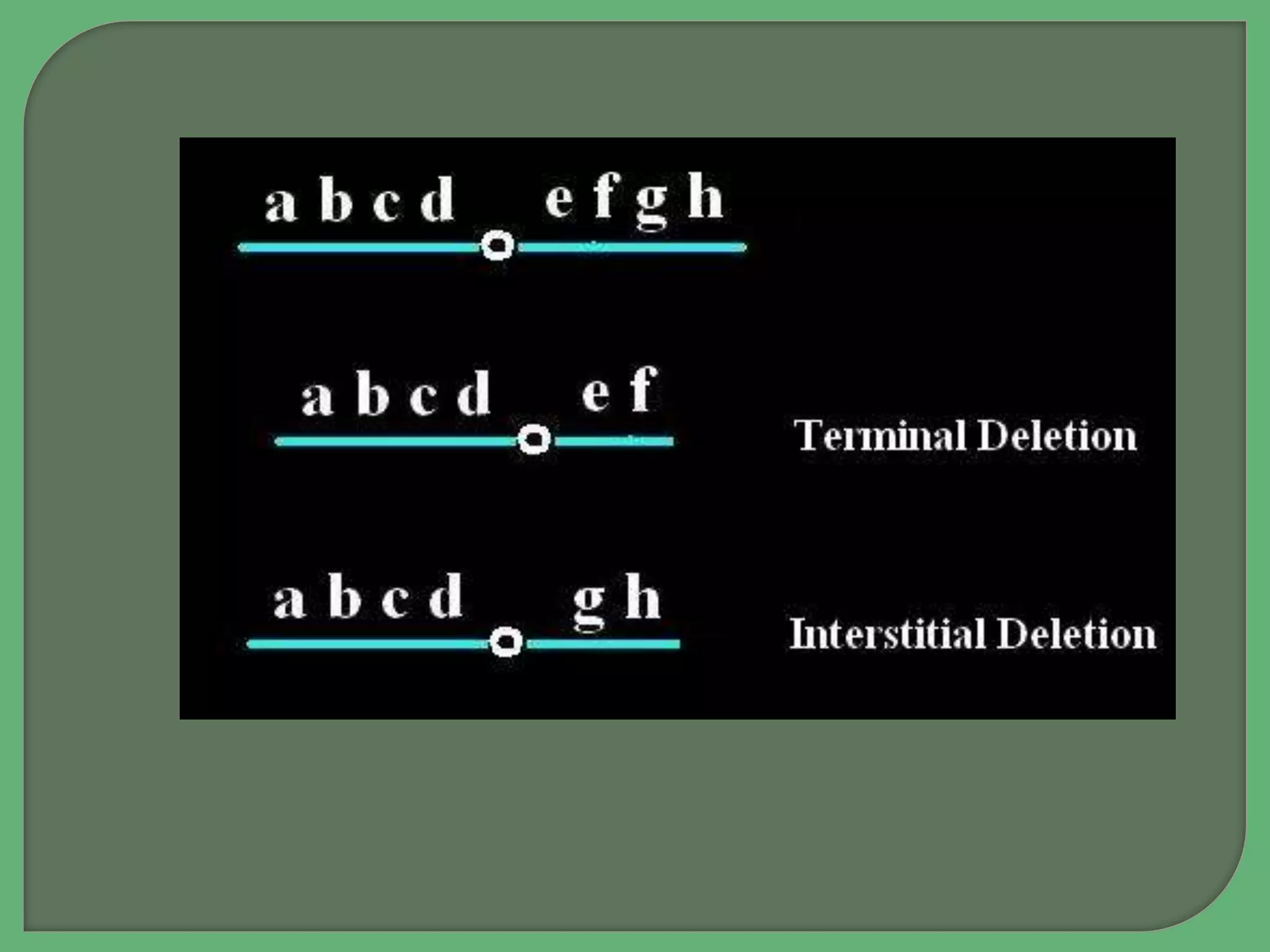
 Deletion refers to loss of a portion of segment from a
chromosome. It is also known as deficiency.
 Depending upon the location, deletions are of two types:
Terminal Deletion
 Loss of either terminal segment of a chromosome is known
as terminal deletion.
Interstitial Deletion
 Loss of a segment of chromosome from the intermediate
portion or between telomere and centromere is known as
interstitial or intercalary deletion.
Cri-du-chat syndrome in human
 In Cri-du-chat syndrome, deletion of terminal segment of
the short arm (q) of chromosome number 5.
 In this syndrome, infants crying like cat crying, which is
due to malformation of larynx
 Affected children show mental retardation and die at
early age or some may attain adulthood
 Di-george syndrome in human: deletion of small
segment of the short arm (q) of chromosome number 22.
 Angelman syndrome: deletion of small segment of the
short arm (q) of chromosome number 15.
 Pseudo-dominance: Due to loss of dominance loci in
deletion its alternative recessive allele act as dominance
and produce phenotype, which is called as pseudo-
dominance.
Duplication
 Occurrence of a segment twice in the same
chromosome. Duplication is also known as repeat. or
 Presence of segment of chromosome in excess of the
normal is called as duplication.
 It results in addition of one or more genes to a
chromosome.
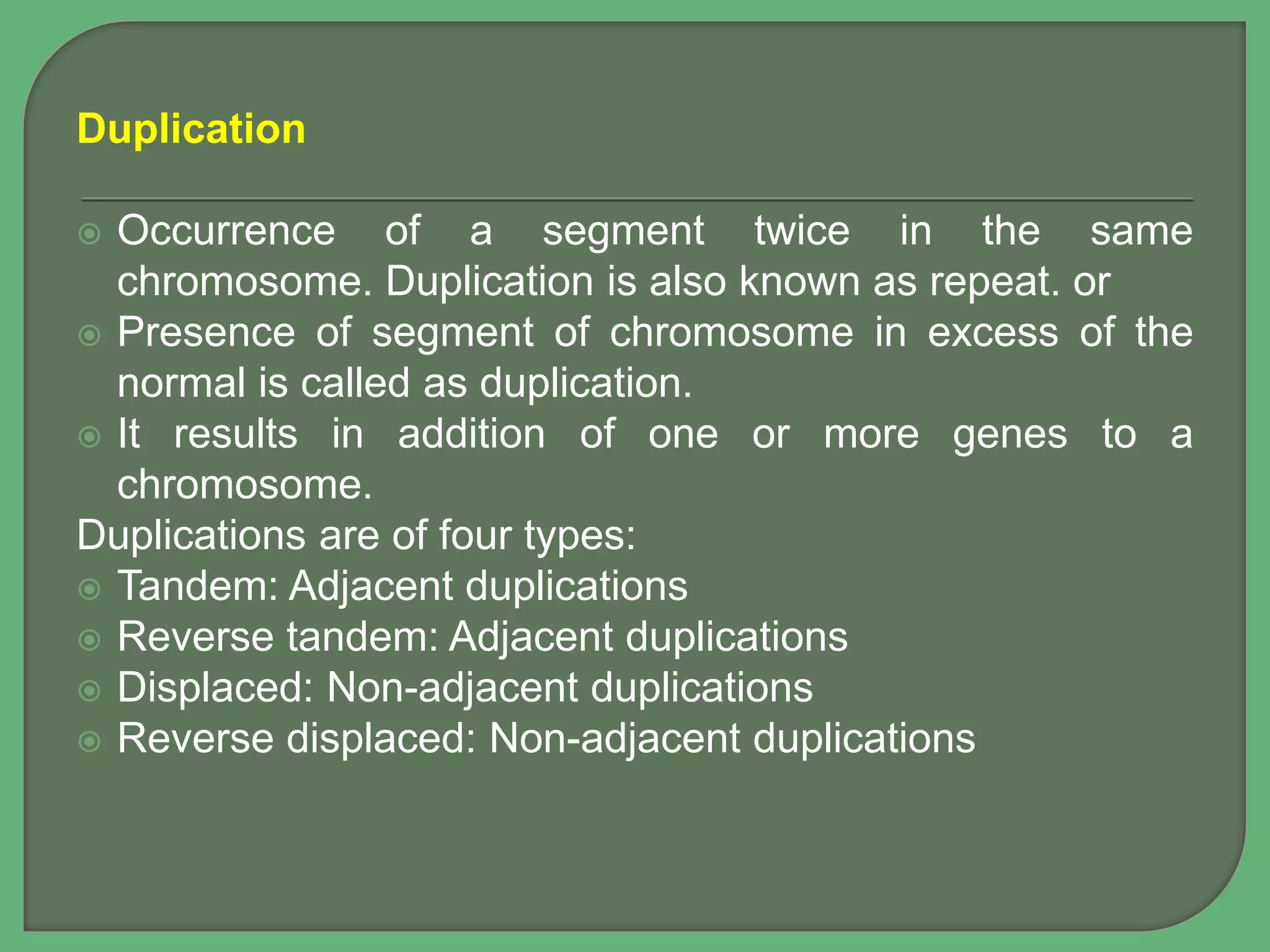
Duplications are of four types:
 Tandem: Adjacent duplications
 Reverse tandem: Adjacent duplications
 Displaced: Non-adjacent duplications
 Reverse displaced: Non-adjacent duplications
Tandem
 Sequence of genes in the duplicated segment is similar to
the sequence of genes in the original segment of a
chromosome.
Reverse Tandem
 The sequence of genes in the duplicated segment is
reverse to the sequence of genes in the original segment
of a chromosome.
 Tandem and reverse tandem duplications are known as
adacent duplications, because they are adacent to the
original segment.
Displaced
 When the duplication is found away from the original
segment but on the same arm of the chromosome, it is
known as displaced duplication.
Reverse Displaced
 Such duplication is also away from the original segment
but on the other arm of a chromosome.
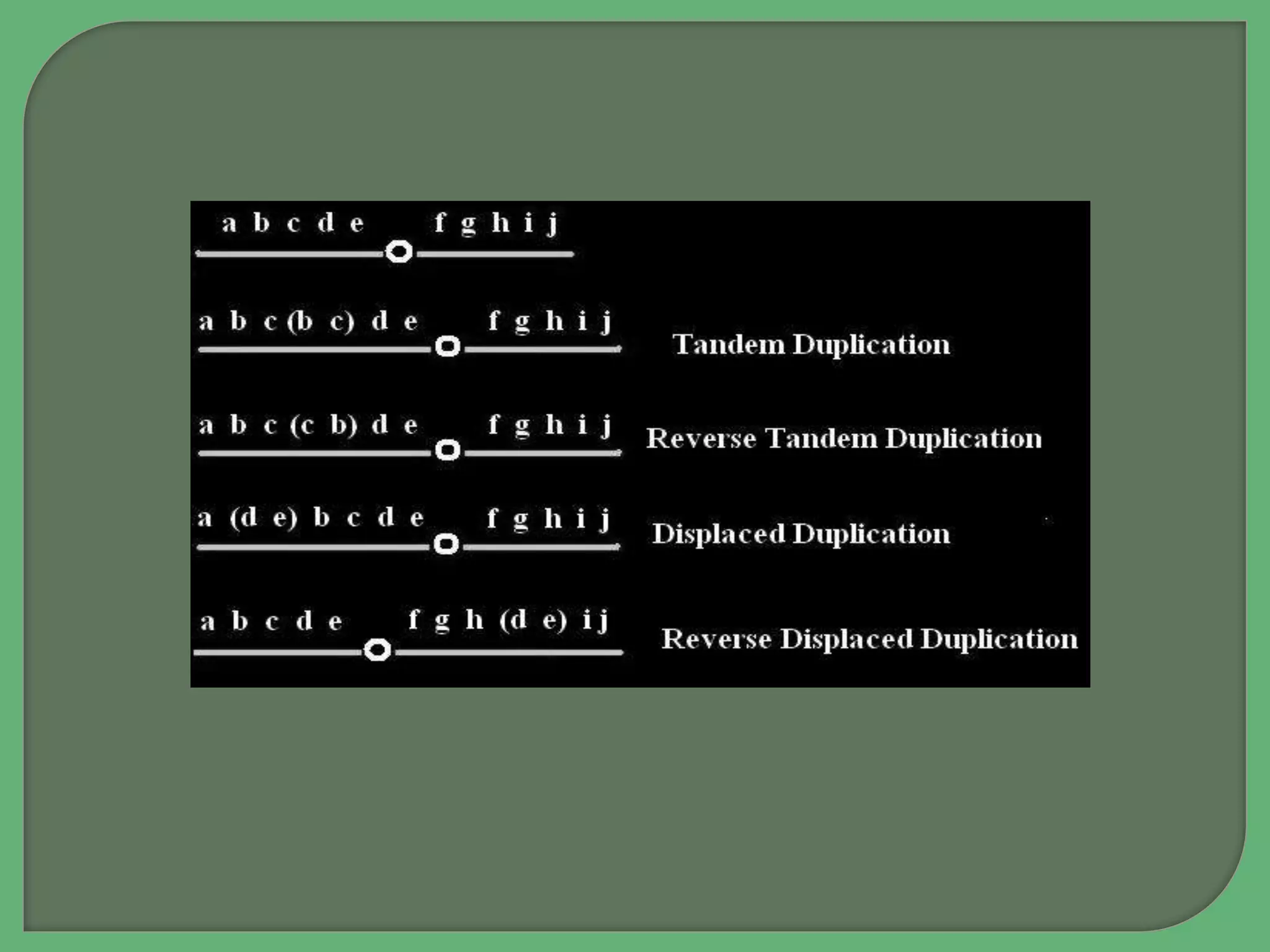
Inversion
 Inversion refers to structural change in a chromosome in
which a segment is oriented in a reverse order. Thus the
inverted segment is rotated to a full 180°.
 It leads to change in arrangement of gene loci.
 Depending upon whether centromere is involved or not
inversions are of two types - paracentric and pericentric.
Paracentric Inversion
 Centromere is not involved.
 Both breaks occur in one arm of the chromosome.
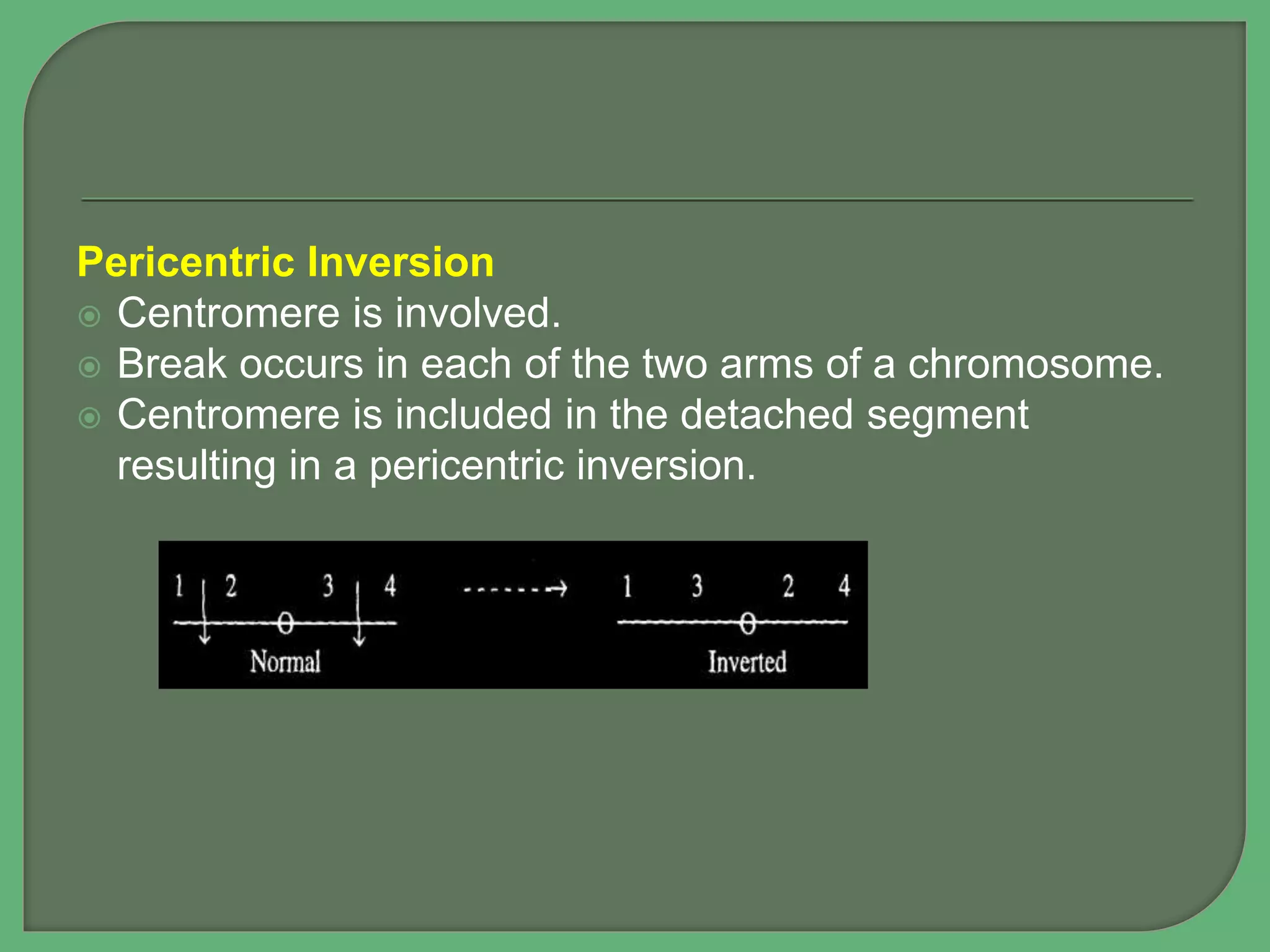
Pericentric Inversion
 Centromere is involved.
 Break occurs in each of the two arms of a chromosome.
 Centromere is included in the detached segment
resulting in a pericentric inversion.
Translocation
 One way or reciprocal transfer of segments between
non-homologous chromosomes is known as
translocation.
 Differences between translocation and crossing over:
 Translocations involve non-homologous chromosomes,
whereas crossing over involves non-sister chromatids of
homologous chromosomes.
 Translocation homozygotes change the linkage map,
whereas crossing over does not change the linkage map.
 Translocations involve breakage and reunion, whereas
crossing over involves chiasma formation.
 Three types of translocations:
(1) Simple Translocation
(2) Shifts
(3) Reciprocal Translocations
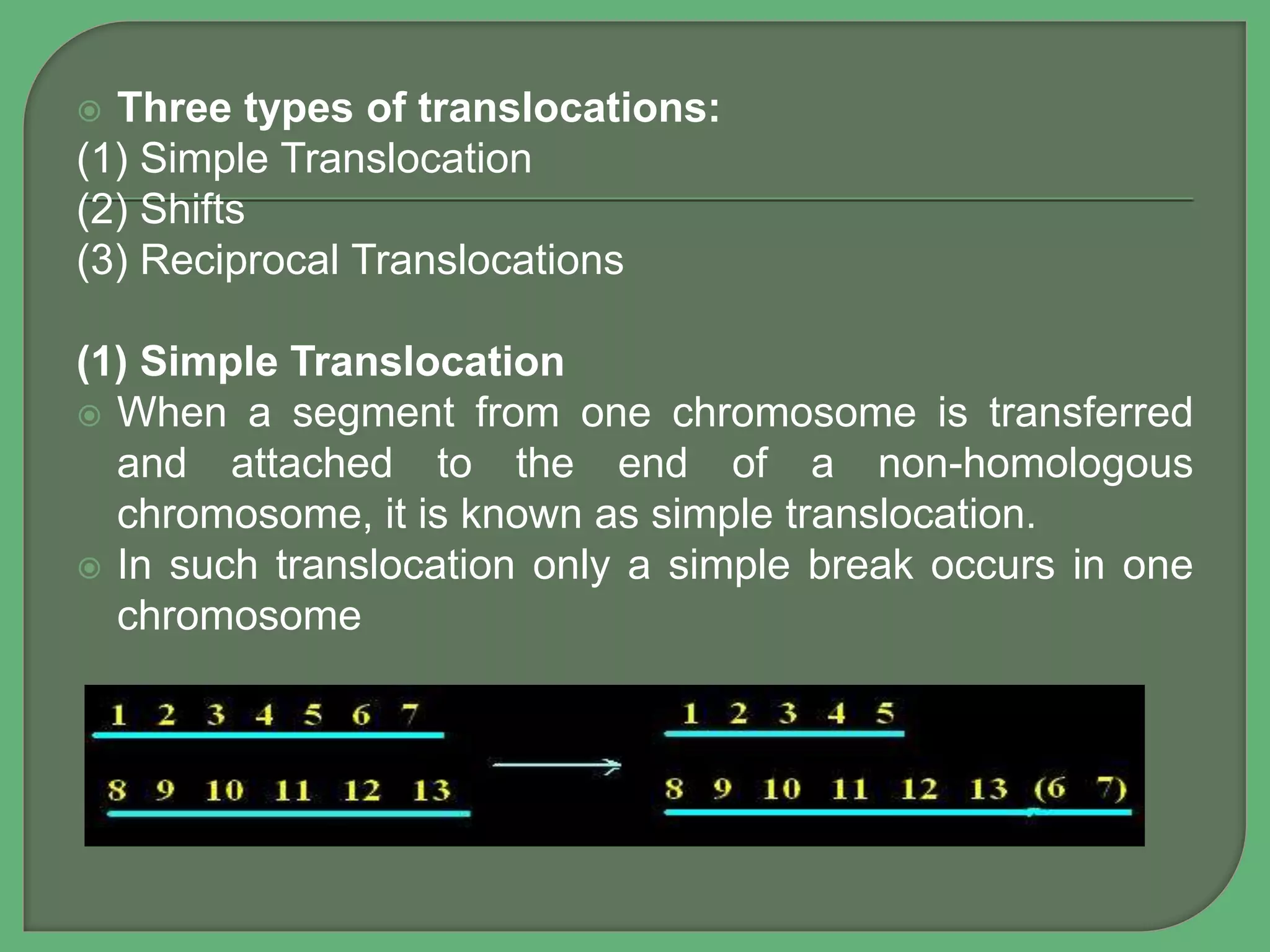
(1) Simple Translocation
 When a segment from one chromosome is transferred
and attached to the end of a non-homologous
chromosome, it is known as simple translocation.
 In such translocation only a simple break occurs in one
chromosome
(2) Shifts
 Transfer of an intercalary segment from one
chromosome to the intercalary position in a
non-homologous chromosome is referred to as shift.
 Thus two breaks occur in a loser chromosome and one
break in the gainer chromosome for transfer and
integration of such segment.
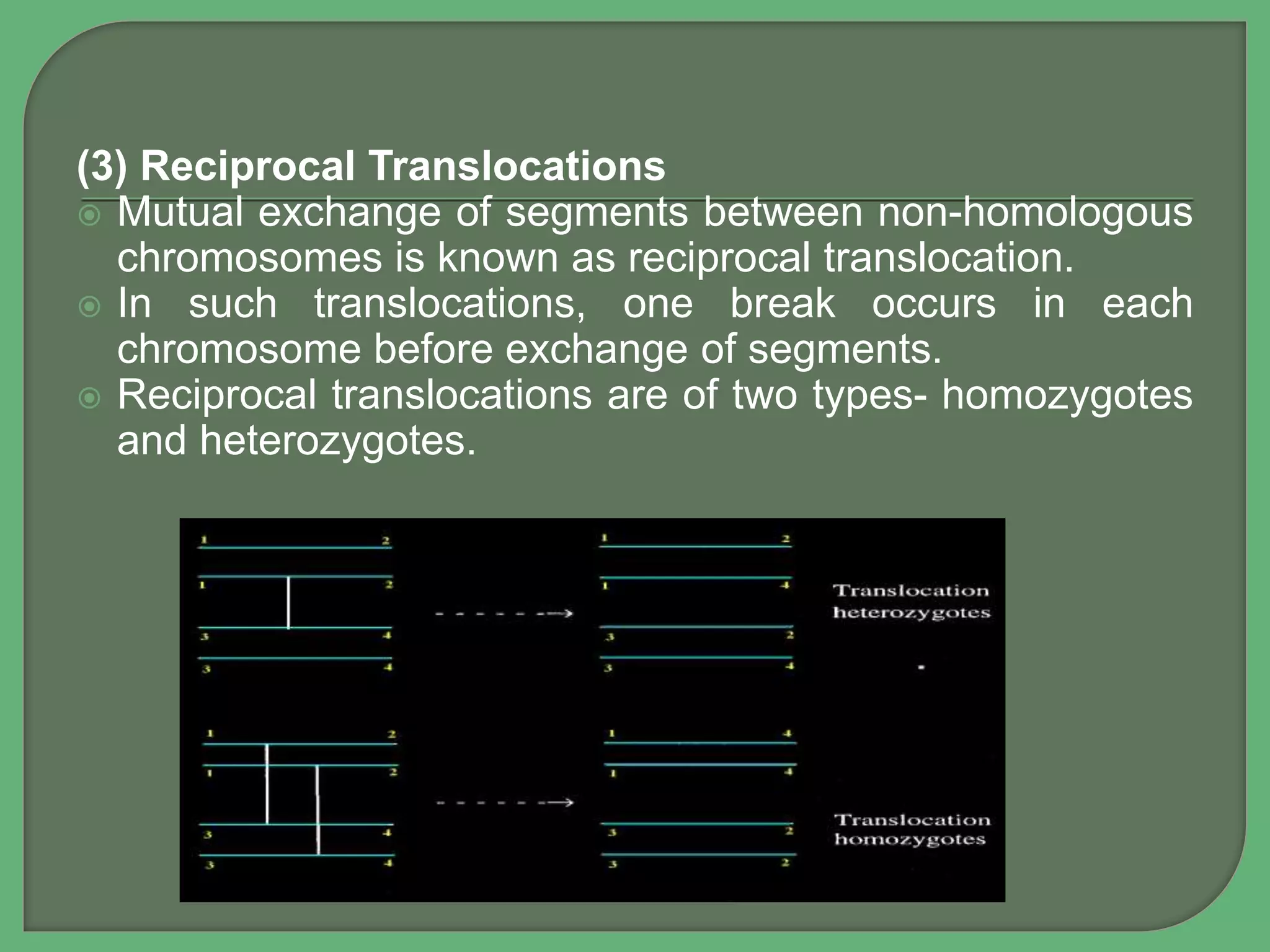
(3) Reciprocal Translocations
 Mutual exchange of segments between non-homologous
chromosomes is known as reciprocal translocation.
 In such translocations, one break occurs in each
chromosome before exchange of segments.
 Reciprocal translocations are of two types- homozygotes
and heterozygotes.
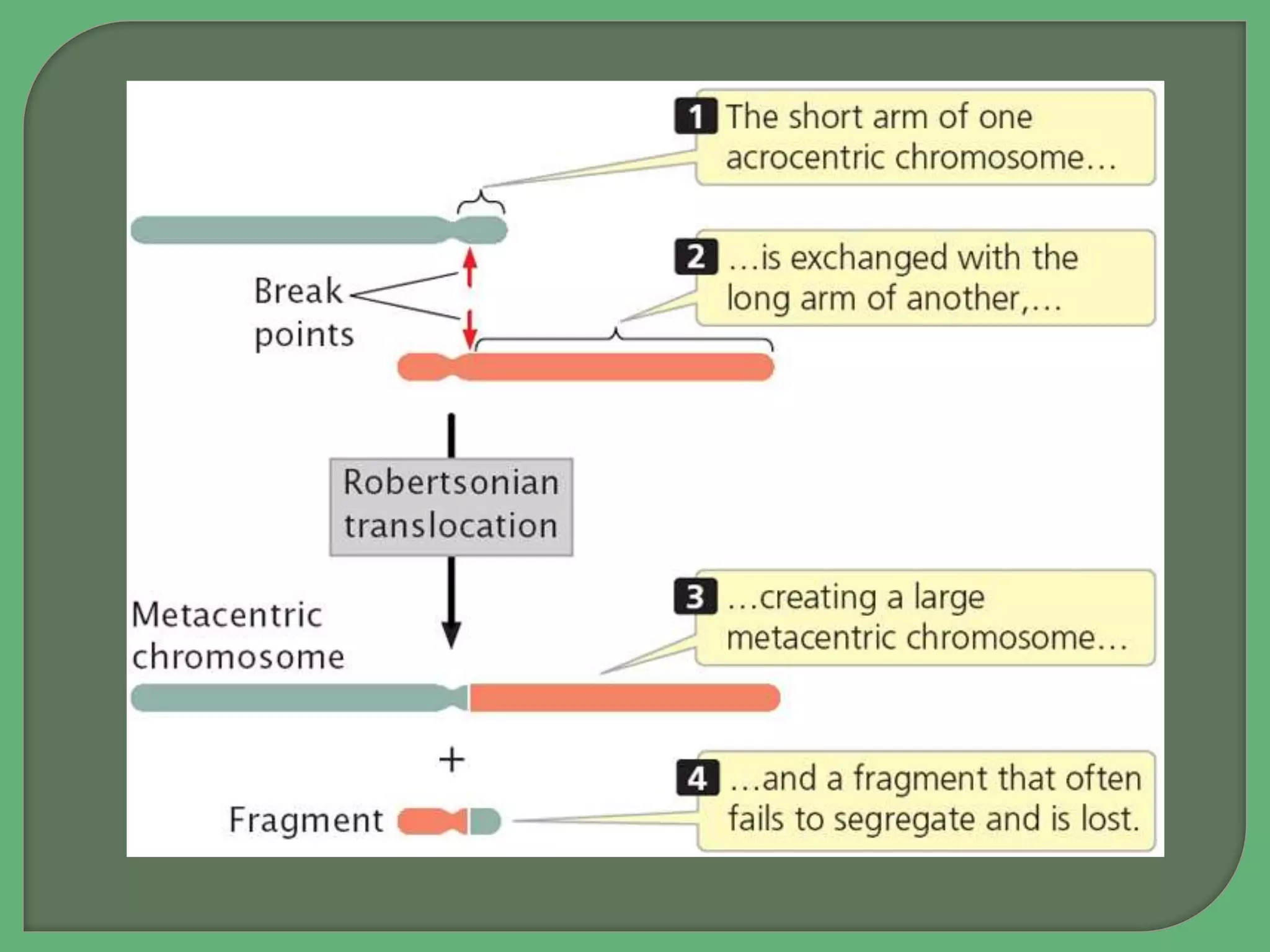
 A reciprocal translocation between two acrocentric
chromosomes may produce a dot or microchromosome
and metacentric chromosome this phenomenon is known
as Centric fusion or Robertsonian translocation.
 If unequal translocation between a dot and a metacentric
chromosome, would produce two acrocentric
chromosomes. This process is known as Dissociation.
 1/29 translocation reported first time in Swedish red and
white cattle by Gustavassam and it is most common
types of translocation livestock species.
 1/29 translocation result into reduction in fertility, early
embryonic death, interfere in embryonic development in
female, poor libido, inferior quality semen in bull

Chromosomal abeeration

  • 1.
    DR. ASHISH PATEL Assistantprofessor Dept. AGB, Veterinary College, AAU, Anand
  • 2.
     In somaticcell of diploid organism two copies of same genome are present (2n), while their gametes contain a single genome (n).  The deviation from the diploid state of chromosome and structure of chromosome is known as chromosomal aberration.  The deviations from the standard chromosomal numbers and morphology (structure) of any species can be detected by Karyotyping (chromosomal Banding).
  • 3.
     Broadly thechromosomal abnormalities categorized in to two types:  Numerical abnormality: Change in number of chromosome  Structural abnormality: Change in structure of chromosome  The numerical chromosomal aberration is also known as heteroploidy and individuals who possess other than normal chromosome pair are known as heteroploids.  The heteroploidy is divided in to two categories: Aneuploidy and Euploidy.
  • 4.
    Aneuploidy  A changein number of only single or few chromosome/s within a set of chromosomes is known as aneuploidy.  In aneuploidy, changed not in whole genome.  Reason for Anueploidy is non disjunction of chromosome during meiosis.  The single chromosome is less from the somatic number of chromosome number (2n - 1) is known as monosomy.  The deficiency of pair of chromosome (2n - 2) is known as nullysomy.
  • 5.
     If twomissing chromosome are non-homologous (2n-1-1) then it is known as double monosomy.  If individual possess one extra chromosome (2n + 1) are termed as trisomics.  The individual possess an extra pair of chromosome (2n + 2) are referred to as tetrasomics.  If two additional chromosome are non-homologous (2n +1 +1), such individual are known as double trisomics.
  • 6.
    Term Type ofchange Symbol Heteroploidy change from the 2n state Aneuploidy Aneuploidy One or few chromosomes extra or missing from 2n 2n ± one or few Nullisomy One pair of chromosome missing 2n – 2 Monosomy One chromosome missing 2n – 1 Double monosomy Two non-homologous chromosome missing 2n -2 Trisomy one extra chromosome 2n + 1 Double trisomy Two extra non homologous chromosome 2n + 1 + 1 Tetrasomy two extra chromosome 2n + 2
  • 7.
    Term Type ofchange Symbol Heteroploidy change from the 2n state Euploidy Euploidy Change in the chromosomes of entire set (other than diploid 2n ) Monoploidy only one genome present n Haploidy Gametic chromosome complement n Autopolyploidy More than two copies of same genome present 3n (AAA), 4n (AAAA), 5n (AAAAA)……. Autotriploidy Three copies of same genome 3n (AAA) Autotetraploidy, Autopentaploidy, Autohexaploidy etc (4n, 5n, 6n ….) Allopolyploidy Two or more different genome AABB, AABBCC Allotetraploidy Two different genome present AABB
  • 8.
    Trisomy of Autosomes: Trisomy at 21st chromosomal pair (means in 21st pair one extra chomosome): Down syndrome (mongolism idiocy): (47, 21+)  Trisomy at 13th chromosomal pair: Patau’s syndrome (47, 13+)  Trisomy at 18th chromosomal pair: Edward’s syndrome (47, 18+) (individual who have such abnormality die within one year) Trisomy of sex chromosomes  Klinefelter’s syndrome (47, XXY)  Triple X syndrome: (47, XXX)  Jacob’s syndrome: (47, XYY) Monosomy of sex chromosome: Turner syndrome (45, X)
  • 9.
    Common sex chromosomeaneuploids in livestock animals and their phenotypic effects are  Monosomy (X0): pig, cat, dog: Ovarian hypoplasia: Infertlity in female  Trisomy (XXX): cattle: Ovarian hypoplasia: Infertlity in female  Trisomy (XXY): Cattle, Buffalo, Sheep, Goat: Testicular hypoplasia: Infertlity in male
  • 10.
     Change inentire set of chromosome is called as Euploidy.  It is also known as heteroploidy. heteroploidy means any alteration in no. of whole set of chromosome from normal 2n number.  Euploidy (Heteroploidy) includes: haploidy (n), triploidy (3n), tetraploidy (4n), pentaploidy (5n) these all are collectively known as polyploidy.  An individual having only one set (n) of chromosome is known as monoploidy or haploidy.  An individual having three or more than three sets of chromosomes is called as polyploidy.  Most commonly triploidy and tetraploidy are observed out of polyploidy (in plants but rarely in animals).
  • 11.
     Autopolyploidy: Morethan two copies of same genome present. chromosome complements of same species/origin  Allopolyploidy: Two or more different genome present. The chromosome complements belong to different origin. e.g. cell hybridization Reasons for polyploidy  Fertilization of egg with more than one speramatozoa (polyspermy)  Abnormal gamete formation/ meiosis (polar bodies not removed )  Two zygotes fused and produced single individual (tetraploidy)
  • 12.
     Any deviationfrom normal structure of chromosome is called Structural abnormality or Structural mutation of chromosome.  Structural changes usually take place either during interphase or early prophase.  Structural changes occur due to breakage and reunion of the chromosome.  The chromosomal breaks are of two types -restituted and non-restituted. Two non-restituted breaks in one chromosome can lead to deficiency, duplication and inversion.  A non-restituted break in each of two non-homologous chromosomes may lead to reciprocal translocations.  Structural changes lead to alteration in phenotype, fertility, viability and karyotype of an individual.
  • 13.
    Types of StructuralChanges Two types: (1) Alteration in gene number in the chromosome- deletion &duplications (2) Alteration in the sequence of genes in the chromosome - translocations and inversions Deletion  Deletion refers to loss of a portion of segment from a chromosome. It is also known as deficiency.  Depending upon the location, deletions are of two types: Terminal Deletion  Loss of either terminal segment of a chromosome is known as terminal deletion. Interstitial Deletion  Loss of a segment of chromosome from the intermediate portion or between telomere and centromere is known as interstitial or intercalary deletion.
  • 15.
    Cri-du-chat syndrome inhuman  In Cri-du-chat syndrome, deletion of terminal segment of the short arm (q) of chromosome number 5.  In this syndrome, infants crying like cat crying, which is due to malformation of larynx  Affected children show mental retardation and die at early age or some may attain adulthood  Di-george syndrome in human: deletion of small segment of the short arm (q) of chromosome number 22.  Angelman syndrome: deletion of small segment of the short arm (q) of chromosome number 15.  Pseudo-dominance: Due to loss of dominance loci in deletion its alternative recessive allele act as dominance and produce phenotype, which is called as pseudo- dominance.
  • 16.
    Duplication  Occurrence ofa segment twice in the same chromosome. Duplication is also known as repeat. or  Presence of segment of chromosome in excess of the normal is called as duplication.  It results in addition of one or more genes to a chromosome. Duplications are of four types:  Tandem: Adjacent duplications  Reverse tandem: Adjacent duplications  Displaced: Non-adjacent duplications  Reverse displaced: Non-adjacent duplications
  • 17.
    Tandem  Sequence ofgenes in the duplicated segment is similar to the sequence of genes in the original segment of a chromosome. Reverse Tandem  The sequence of genes in the duplicated segment is reverse to the sequence of genes in the original segment of a chromosome.  Tandem and reverse tandem duplications are known as adacent duplications, because they are adacent to the original segment. Displaced  When the duplication is found away from the original segment but on the same arm of the chromosome, it is known as displaced duplication. Reverse Displaced  Such duplication is also away from the original segment but on the other arm of a chromosome.
  • 19.
    Inversion  Inversion refersto structural change in a chromosome in which a segment is oriented in a reverse order. Thus the inverted segment is rotated to a full 180°.  It leads to change in arrangement of gene loci.  Depending upon whether centromere is involved or not inversions are of two types - paracentric and pericentric. Paracentric Inversion  Centromere is not involved.  Both breaks occur in one arm of the chromosome.
  • 20.
    Pericentric Inversion  Centromereis involved.  Break occurs in each of the two arms of a chromosome.  Centromere is included in the detached segment resulting in a pericentric inversion.
  • 21.
    Translocation  One wayor reciprocal transfer of segments between non-homologous chromosomes is known as translocation.  Differences between translocation and crossing over:  Translocations involve non-homologous chromosomes, whereas crossing over involves non-sister chromatids of homologous chromosomes.  Translocation homozygotes change the linkage map, whereas crossing over does not change the linkage map.  Translocations involve breakage and reunion, whereas crossing over involves chiasma formation.
  • 22.
     Three typesof translocations: (1) Simple Translocation (2) Shifts (3) Reciprocal Translocations (1) Simple Translocation  When a segment from one chromosome is transferred and attached to the end of a non-homologous chromosome, it is known as simple translocation.  In such translocation only a simple break occurs in one chromosome
  • 23.
    (2) Shifts  Transferof an intercalary segment from one chromosome to the intercalary position in a non-homologous chromosome is referred to as shift.  Thus two breaks occur in a loser chromosome and one break in the gainer chromosome for transfer and integration of such segment.
  • 24.
    (3) Reciprocal Translocations Mutual exchange of segments between non-homologous chromosomes is known as reciprocal translocation.  In such translocations, one break occurs in each chromosome before exchange of segments.  Reciprocal translocations are of two types- homozygotes and heterozygotes.
  • 25.
     A reciprocaltranslocation between two acrocentric chromosomes may produce a dot or microchromosome and metacentric chromosome this phenomenon is known as Centric fusion or Robertsonian translocation.  If unequal translocation between a dot and a metacentric chromosome, would produce two acrocentric chromosomes. This process is known as Dissociation.
  • 27.
     1/29 translocationreported first time in Swedish red and white cattle by Gustavassam and it is most common types of translocation livestock species.  1/29 translocation result into reduction in fertility, early embryonic death, interfere in embryonic development in female, poor libido, inferior quality semen in bull