GENOME ORGANIZATION
AND
CHROMOSOME
GENOME ORGANIZATION
• DNA is genetic material that is found inside each cell.
• Gene is a functional unit of the genome. They are hereditary unit consisting
of DNA sequence that occupy specific location on a chromosome.
• Nucleosome is a fundamental subunit of chromatin. Is a basic unit of DNA
packaging in eukaryotes, consisting of a segment of DNA wound around
histone protein cores.
• Chromatin is a complex of DNA and protein that forms chromosomes.
• Chromosomes is a tightly packaged and organized structure of DNA and
proteins including histones and non histones.
• Genome is the entire collection of genes and all other functional and non
functional DNA sequences in an organism in a haploid set of chromosomes.
It include gene , regulatory genes and nonfunctional nucleotide sequences.
• The genome of all living beings represent their hereditary material and is
formed by DNA
• Genome consists of a long sequence of nucleic acid that provide the
information needed to construct an organism.
• A genome consists of the entire set of chromosomes for any particular
organism. It, therefore, comprises a series of DNA molecule each of which
contain many genes.
• The genome itself does not perform any function rather a sequence of nucleic
acid determine the hereditary features.
 PROKARYOTIC GENE ORGANIZATION
• In bacteria and blue-green algae, the hereditary material is organized into a
single large circular chromosome composed of a circular molecule of double
stranded DNA. It is known as bacterial chromosome or nucleoid.
• It lies free in cytoplasm in the nuclear zone and has no protein around the DNA
molecule as it is found in eukaryotic chromosomes.
• However, some RNA is found associated with DNA and forms its backbone or
core.
 GENE ORGANISATION IN EUKARYOTIC
• DNA is associated with basic protein( histones). They form long
chromatin fibers. The chromatin fibers form a network and are enclosed in
the double-layered nuclear envelope. This structure is called nucleus. Its
chromatin condenses into chromosomes during cell division.
CHROMOSOME
• Chromosome is a long dense thread containing a coiled and twisted chain
of DNA.
• It made up of proteins and a molecule of deoxyribonucleic acid (DNA).
• The term chromosome is derived from a Greek word 'chroma' which
means 'color' and 'soma' which means 'body'.
• The chromosomes are named so because they are cellular structures or
cellular bodies and they are strongly stained by some dyes used in research.
• Chromosomes play an important role that ensures DNA is copied and
distributed accurately in the process of cell division.
• It is located inside the nucleus.
• They are the vehicle of heredity means they are passed on from parents to
offspring.
• Chromosome were first observed by Hofmeister in 1848. However, they
were named chromosomes in 1888 by Waldeyer
MORPHOLOGY
• The number of chromosomes varies from species to species, But the number
remains constant among the members of the species.
• The lower number of chromosomes is 2 and it occurs in Ascaris megalocephala
and the maximum number of chromosomes is 1700 and it occur in a
radiolarian(Protozoa).
• Generally the chromosomes are arranged in pairs. A pair of similar chromosomes is
called homologous chromosomes.
• The size of chromosomes ranges from 0.1 micron to 30 microns.
• The diameter varies from 0.2 micron to 2 microns. In general, plants have larger
chromosomes than animals.
• The length of the human chromosomes varies from 4 microns to 6 microns
SHAPE OF CHROMOSOME
• The shape of the chromosomes is changeable from phase to phase in the
continuous process of the cell growth and cell division
• Chromosome contain a clear zone, known as centromere or kinetocore, along their
length.
• Centromere divides the Chromosomes into two parts, each part is called
chromosome arm.
• The position of centromere varies from chromosome to chromosome and it provides
different shapes to the chromosomes
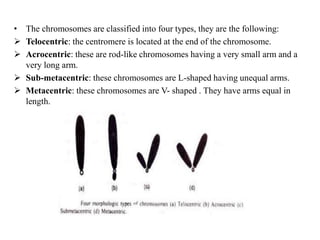
• The chromosomes are classified into four types, they are the following:
 Telocentric: the centromere is located at the end of the chromosome.
 Acrocentric: these are rod-like chromosomes having a very small arm and a
very long arm.
 Sub-metacentric: these chromosomes are L-shaped having unequal arms.
 Metacentric: these chromosomes are V- shaped . They have arms equal in
length.
Human Chromosomes
• Humans chromosomes are of two types autosomes and allosome (sex
chromosomes). Genetic traits that are linked to the sex of the person are passed on
through the sex chromosomes. The rest of the genetic information is present in the
autosomes. Humans have 23 pairs of chromosomes in their cells, of which 22 pairs
are autosomes and one pair of sex chromosomes, making a total of 46
chromosomes in each cell. Many copies of mitochondrial genome are present in
human cells.
• ALLOSOME
Sex chromosomes differ in form of size, behavior from the ordinary chromosome.
The sex chromosomes determine the sex of an individual during reproduction.
These sex chromosomes differ between the male and the females. Females have
two copies of X chromosome, males have one X chromosome and one Y
chromosome
 AUTOSOME
The homologous chromosomes are pairs of chromosomes that are approximately of
the same length, position of centromere, and pattern of staining, genes for the same
characteristic are at a corresponding loci. In an organism one of the homologous
chromosome is inherited from the mother and the other from the father. These
chromosomes are usually not identical, but they carry the same type of genes.
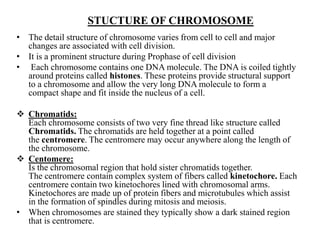
STUCTURE OF CHROMOSOME
• The detail structure of chromosome varies from cell to cell and major
changes are associated with cell division.
• It is a prominent structure during Prophase of cell division
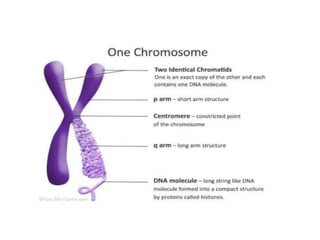
• Each chromosome contains one DNA molecule. The DNA is coiled tightly
around proteins called histones. These proteins provide structural support
to a chromosome and allow the very long DNA molecule to form a
compact shape and fit inside the nucleus of a cell.
 Chromatids:
Each chromosome consists of two very fine thread like structure called
Chromatids. The chromatids are held together at a point called
the centromere. The centromere may occur anywhere along the length of
the chromosome.
 Centomere:
Is the chromosomal region that hold sister chromatids together.
The centromere contain complex system of fibers called kinetochore. Each
centromere contain two kinetochores lined with chromosomal arms.
Kinetochores are made up of protein fibers and microtubules which assist
in the formation of spindles during mitosis and meiosis.
• When chromosomes are stained they typically show a dark stained region
that is centromere.
According to the number of the centromere the eukaryotic chromosomes may be :
Acentric: without the centromere
Monocentric: with one centromere
Dicentric: with two centromere
Polycentric: with more then two centromere.
• In humans, the centromere contains 1-10 million base pairs of DNA.
• It helps in chromosomal movement during cell division and it also helps in the
formation of spindle fibers during metaphase division..
 Arms:
Each chromosome has two arms labeled p( the shorter of the two) and q (the
longer arm).
 The p arm is named for “Petit ”meaning “short”.
The q arm is named refers to French word “queue” meaning “tail”.
Two arms divided at centromere. They can be connected in either metacentric,
sub-metacentric, acrocentric, telocentric manner.
 Constriction:
A typical chromosomes has narrow zones called constriction..
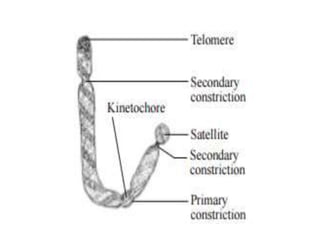
 They are two types of constriction namely: -Primary constriction and
Secondary constriction
 The primary constriction is made of centromere and kinetochore. the shape of
the chromosomes is determined by the primary constriction, situated at the
meeting point of the arms of the chromosomes
 Secondary constriction is a darkly stained constricted area. It is associated
with the formation of nucleolus. So they are refer as nucleolar organizer
 Satellite bodies:
The part of the chromosome which is present beyond the secondary
constriction is called satellite body or trabant. It varies in size according to
the position of the secondary constriction.
If secondary constriction is very close to an end of the chromosome, the
satellite may be a baiely perceptible dot.
 Telomeres:
The ends of a chromosome are called telomeres.
The telomeres behave differently from the interstitial portions of
chromosome. Each telomere has polarity and it prevents the ends of the
chromosomes from attaching to each other.
It offers stability to the chromosome.
FUNCTION OF CHROMOSOMES
 The structure of chromosomes helps ensure the DNA remains tightly wrapped
around the proteins; otherwise, DNA molecules would be too large for the
inside of the cells.
 The chromosome control the heredity.
 Genetic Code Storage: Chromosome contains the genetic material that is
required by the organism to develop and grow. DNA molecules are made of
chain of units called genes. Genes are those sections of the DNA which code
for specific proteins required by the cell for its proper functioning.
 Sex Determination: Humans have 23 pairs of chromosomes out of which one
pair is the sex chromosome. Females have two X chromosomes and males have
one X and one Y chromosome. The sex of the child is determined by the
chromosome passed down by the male. If X chromosome is passed out of XY
chromosome, the child will be a female and if a Y chromosome is passed, a
male child develops.
 Control of Cell Division: Chromosomes check successful division of cells
during the process of mitosis. The chromosomes of the parent cells insure that
the correct information is passed on to the daughter cells required by the cell to
grow and develop correctly.
 Chromosomes are important to this process to ensure the DNA is accurately
replicated.
 Formation of Proteins and Storage: Proteins are essential for the activity
of a cell. The chromosomes direct the sequences of proteins formed in our
body and also maintain the order of DNA. The proteins are also stored in
the coiled structure of the chromosomes. These proteins bound to the DNA
help in proper packaging of the DNA.
 Chromosomes the differentiation of different characteristics of an
organism.

Chromosome structure

  • 1.
  • 2.
    GENOME ORGANIZATION • DNAis genetic material that is found inside each cell. • Gene is a functional unit of the genome. They are hereditary unit consisting of DNA sequence that occupy specific location on a chromosome. • Nucleosome is a fundamental subunit of chromatin. Is a basic unit of DNA packaging in eukaryotes, consisting of a segment of DNA wound around histone protein cores. • Chromatin is a complex of DNA and protein that forms chromosomes. • Chromosomes is a tightly packaged and organized structure of DNA and proteins including histones and non histones. • Genome is the entire collection of genes and all other functional and non functional DNA sequences in an organism in a haploid set of chromosomes. It include gene , regulatory genes and nonfunctional nucleotide sequences. • The genome of all living beings represent their hereditary material and is formed by DNA
  • 3.
    • Genome consistsof a long sequence of nucleic acid that provide the information needed to construct an organism. • A genome consists of the entire set of chromosomes for any particular organism. It, therefore, comprises a series of DNA molecule each of which contain many genes. • The genome itself does not perform any function rather a sequence of nucleic acid determine the hereditary features.  PROKARYOTIC GENE ORGANIZATION • In bacteria and blue-green algae, the hereditary material is organized into a single large circular chromosome composed of a circular molecule of double stranded DNA. It is known as bacterial chromosome or nucleoid. • It lies free in cytoplasm in the nuclear zone and has no protein around the DNA molecule as it is found in eukaryotic chromosomes. • However, some RNA is found associated with DNA and forms its backbone or core.
  • 5.
     GENE ORGANISATIONIN EUKARYOTIC • DNA is associated with basic protein( histones). They form long chromatin fibers. The chromatin fibers form a network and are enclosed in the double-layered nuclear envelope. This structure is called nucleus. Its chromatin condenses into chromosomes during cell division.
  • 6.
    CHROMOSOME • Chromosome isa long dense thread containing a coiled and twisted chain of DNA. • It made up of proteins and a molecule of deoxyribonucleic acid (DNA). • The term chromosome is derived from a Greek word 'chroma' which means 'color' and 'soma' which means 'body'. • The chromosomes are named so because they are cellular structures or cellular bodies and they are strongly stained by some dyes used in research. • Chromosomes play an important role that ensures DNA is copied and distributed accurately in the process of cell division. • It is located inside the nucleus. • They are the vehicle of heredity means they are passed on from parents to offspring. • Chromosome were first observed by Hofmeister in 1848. However, they were named chromosomes in 1888 by Waldeyer
  • 7.
    MORPHOLOGY • The numberof chromosomes varies from species to species, But the number remains constant among the members of the species. • The lower number of chromosomes is 2 and it occurs in Ascaris megalocephala and the maximum number of chromosomes is 1700 and it occur in a radiolarian(Protozoa). • Generally the chromosomes are arranged in pairs. A pair of similar chromosomes is called homologous chromosomes. • The size of chromosomes ranges from 0.1 micron to 30 microns. • The diameter varies from 0.2 micron to 2 microns. In general, plants have larger chromosomes than animals. • The length of the human chromosomes varies from 4 microns to 6 microns SHAPE OF CHROMOSOME • The shape of the chromosomes is changeable from phase to phase in the continuous process of the cell growth and cell division • Chromosome contain a clear zone, known as centromere or kinetocore, along their length. • Centromere divides the Chromosomes into two parts, each part is called chromosome arm. • The position of centromere varies from chromosome to chromosome and it provides different shapes to the chromosomes
  • 8.
    • The chromosomesare classified into four types, they are the following:  Telocentric: the centromere is located at the end of the chromosome.  Acrocentric: these are rod-like chromosomes having a very small arm and a very long arm.  Sub-metacentric: these chromosomes are L-shaped having unequal arms.  Metacentric: these chromosomes are V- shaped . They have arms equal in length.
  • 9.
    Human Chromosomes • Humanschromosomes are of two types autosomes and allosome (sex chromosomes). Genetic traits that are linked to the sex of the person are passed on through the sex chromosomes. The rest of the genetic information is present in the autosomes. Humans have 23 pairs of chromosomes in their cells, of which 22 pairs are autosomes and one pair of sex chromosomes, making a total of 46 chromosomes in each cell. Many copies of mitochondrial genome are present in human cells. • ALLOSOME Sex chromosomes differ in form of size, behavior from the ordinary chromosome. The sex chromosomes determine the sex of an individual during reproduction. These sex chromosomes differ between the male and the females. Females have two copies of X chromosome, males have one X chromosome and one Y chromosome  AUTOSOME The homologous chromosomes are pairs of chromosomes that are approximately of the same length, position of centromere, and pattern of staining, genes for the same characteristic are at a corresponding loci. In an organism one of the homologous chromosome is inherited from the mother and the other from the father. These chromosomes are usually not identical, but they carry the same type of genes.
  • 11.
    STUCTURE OF CHROMOSOME •The detail structure of chromosome varies from cell to cell and major changes are associated with cell division. • It is a prominent structure during Prophase of cell division • Each chromosome contains one DNA molecule. The DNA is coiled tightly around proteins called histones. These proteins provide structural support to a chromosome and allow the very long DNA molecule to form a compact shape and fit inside the nucleus of a cell.  Chromatids: Each chromosome consists of two very fine thread like structure called Chromatids. The chromatids are held together at a point called the centromere. The centromere may occur anywhere along the length of the chromosome.  Centomere: Is the chromosomal region that hold sister chromatids together. The centromere contain complex system of fibers called kinetochore. Each centromere contain two kinetochores lined with chromosomal arms. Kinetochores are made up of protein fibers and microtubules which assist in the formation of spindles during mitosis and meiosis. • When chromosomes are stained they typically show a dark stained region that is centromere.
  • 13.
    According to thenumber of the centromere the eukaryotic chromosomes may be : Acentric: without the centromere Monocentric: with one centromere Dicentric: with two centromere Polycentric: with more then two centromere. • In humans, the centromere contains 1-10 million base pairs of DNA. • It helps in chromosomal movement during cell division and it also helps in the formation of spindle fibers during metaphase division..  Arms: Each chromosome has two arms labeled p( the shorter of the two) and q (the longer arm).  The p arm is named for “Petit ”meaning “short”. The q arm is named refers to French word “queue” meaning “tail”. Two arms divided at centromere. They can be connected in either metacentric, sub-metacentric, acrocentric, telocentric manner.  Constriction: A typical chromosomes has narrow zones called constriction..
  • 14.
     They aretwo types of constriction namely: -Primary constriction and Secondary constriction  The primary constriction is made of centromere and kinetochore. the shape of the chromosomes is determined by the primary constriction, situated at the meeting point of the arms of the chromosomes  Secondary constriction is a darkly stained constricted area. It is associated with the formation of nucleolus. So they are refer as nucleolar organizer  Satellite bodies: The part of the chromosome which is present beyond the secondary constriction is called satellite body or trabant. It varies in size according to the position of the secondary constriction. If secondary constriction is very close to an end of the chromosome, the satellite may be a baiely perceptible dot.  Telomeres: The ends of a chromosome are called telomeres. The telomeres behave differently from the interstitial portions of chromosome. Each telomere has polarity and it prevents the ends of the chromosomes from attaching to each other. It offers stability to the chromosome.
  • 16.
    FUNCTION OF CHROMOSOMES The structure of chromosomes helps ensure the DNA remains tightly wrapped around the proteins; otherwise, DNA molecules would be too large for the inside of the cells.  The chromosome control the heredity.  Genetic Code Storage: Chromosome contains the genetic material that is required by the organism to develop and grow. DNA molecules are made of chain of units called genes. Genes are those sections of the DNA which code for specific proteins required by the cell for its proper functioning.  Sex Determination: Humans have 23 pairs of chromosomes out of which one pair is the sex chromosome. Females have two X chromosomes and males have one X and one Y chromosome. The sex of the child is determined by the chromosome passed down by the male. If X chromosome is passed out of XY chromosome, the child will be a female and if a Y chromosome is passed, a male child develops.  Control of Cell Division: Chromosomes check successful division of cells during the process of mitosis. The chromosomes of the parent cells insure that the correct information is passed on to the daughter cells required by the cell to grow and develop correctly.
  • 17.
     Chromosomes areimportant to this process to ensure the DNA is accurately replicated.  Formation of Proteins and Storage: Proteins are essential for the activity of a cell. The chromosomes direct the sequences of proteins formed in our body and also maintain the order of DNA. The proteins are also stored in the coiled structure of the chromosomes. These proteins bound to the DNA help in proper packaging of the DNA.  Chromosomes the differentiation of different characteristics of an organism.