Genetic Code
The relationship between codons and amino acids
was determined by
Nirenberg and Khorana (1968)
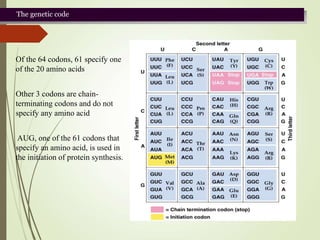
The genetic code
Of the 64 codons, 61 specify one
of the 20 amino acids
Other 3 codons are chain-
terminating codons and do not
specify any amino acid
AUG, one of the 61 codons that
specify an amino acid, is used in
the initiation of protein synthesis.
Characteristics of the genetic code:
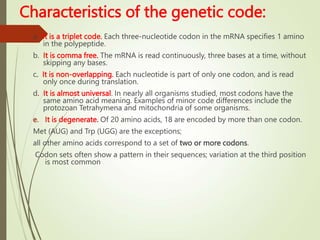
a. It is a triplet code. Each three-nucleotide codon in the mRNA specifies 1 amino
in the polypeptide.
b. It is comma free. The mRNA is read continuously, three bases at a time, without
skipping any bases.
c. It is non-overlapping. Each nucleotide is part of only one codon, and is read
only once during translation.
d. It is almost universal. In nearly all organisms studied, most codons have the
same amino acid meaning. Examples of minor code differences include the
protozoan Tetrahymena and mitochondria of some organisms.
e. It is degenerate. Of 20 amino acids, 18 are encoded by more than one codon.
Met (AUG) and Trp (UGG) are the exceptions;
all other amino acids correspond to a set of two or more codons.
Codon sets often show a pattern in their sequences; variation at the third position
is most common
f. The code has start and stop signals.
AUG is the usual start signal for protein synthesis.
Stop signals are codons with no corresponding tRNA, the nonsense or chain-
terminating codons.
There are generally three stop codons: UAG (amber), UAA (ochre) and UGA
(opal).
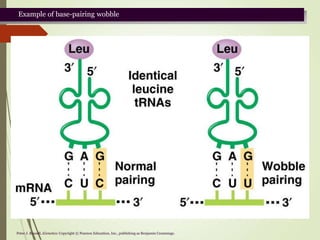
g. Wobble occurs in the anticodon. The 3rd base in the codon is able to
pair less specifically, because it is less constrained three-dimensionally.
It wobbles, allowing a tRNA with base modification of its anticodon (e.g., the
purine inosine) to recognize up to three different codons (U, C, A)
Peter J. Russell, iGenetics: Copyright © Pearson Education, Inc., publishing as Benjamin Cummings.
Example of base-pairing wobble

GENETIC CODONS.ppt

  • 1.
    Genetic Code The relationshipbetween codons and amino acids was determined by Nirenberg and Khorana (1968)
  • 2.
    The genetic code Ofthe 64 codons, 61 specify one of the 20 amino acids Other 3 codons are chain- terminating codons and do not specify any amino acid AUG, one of the 61 codons that specify an amino acid, is used in the initiation of protein synthesis.
  • 3.
    Characteristics of thegenetic code: a. It is a triplet code. Each three-nucleotide codon in the mRNA specifies 1 amino in the polypeptide. b. It is comma free. The mRNA is read continuously, three bases at a time, without skipping any bases. c. It is non-overlapping. Each nucleotide is part of only one codon, and is read only once during translation. d. It is almost universal. In nearly all organisms studied, most codons have the same amino acid meaning. Examples of minor code differences include the protozoan Tetrahymena and mitochondria of some organisms. e. It is degenerate. Of 20 amino acids, 18 are encoded by more than one codon. Met (AUG) and Trp (UGG) are the exceptions; all other amino acids correspond to a set of two or more codons. Codon sets often show a pattern in their sequences; variation at the third position is most common
  • 4.
    f. The codehas start and stop signals. AUG is the usual start signal for protein synthesis. Stop signals are codons with no corresponding tRNA, the nonsense or chain- terminating codons. There are generally three stop codons: UAG (amber), UAA (ochre) and UGA (opal). g. Wobble occurs in the anticodon. The 3rd base in the codon is able to pair less specifically, because it is less constrained three-dimensionally. It wobbles, allowing a tRNA with base modification of its anticodon (e.g., the purine inosine) to recognize up to three different codons (U, C, A)
  • 5.
    Peter J. Russell,iGenetics: Copyright © Pearson Education, Inc., publishing as Benjamin Cummings. Example of base-pairing wobble